English spelling can be surprisingly sticky, especially when two words look almost identical. If you have ever hesitated over glueing vs gluing, you are not alone. That extra letter can turn a simple sentence into a surprisingly tricky spelling puzzle. Fortunately, the confusion becomes much easier to handle once you understand the spelling rule and regional differences. In this guide, we will explore the correct spelling, explain why the final e disappears, and compare British and American usage. You will also learn about common mistakes and practical examples, helping your writing remain clear, confident, and firmly attached to the rules.
Glueing vs Gluing The Main Difference
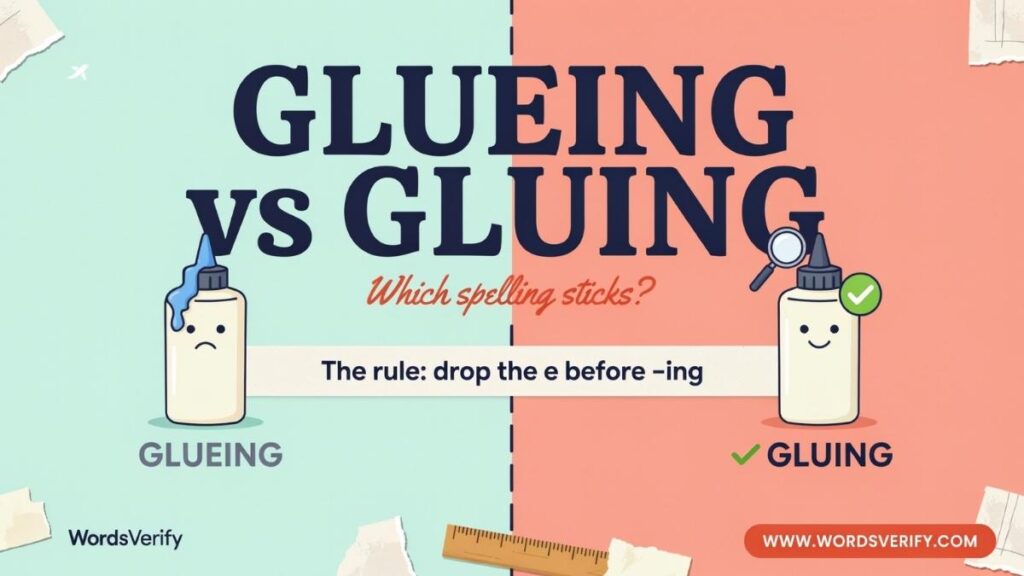
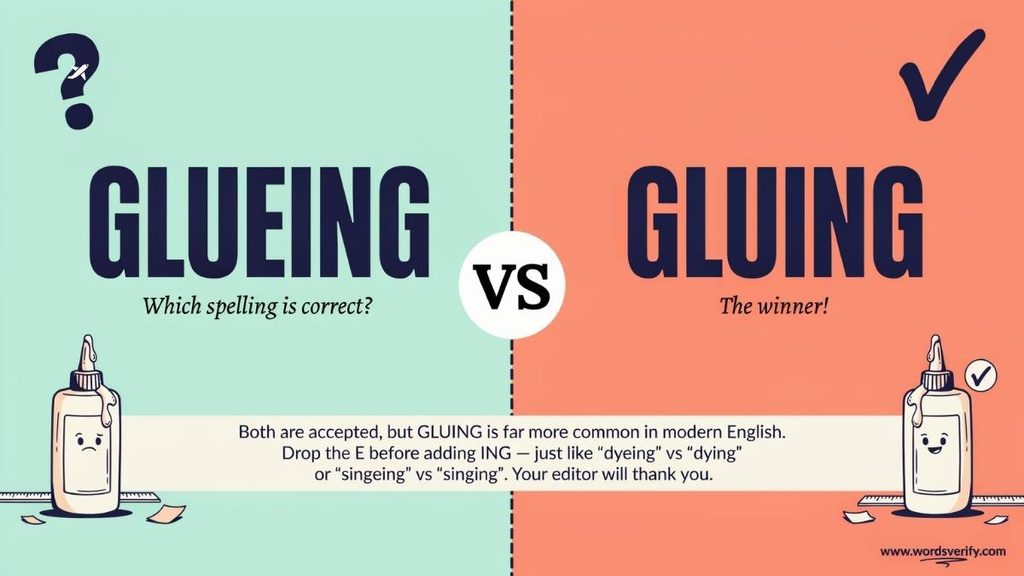
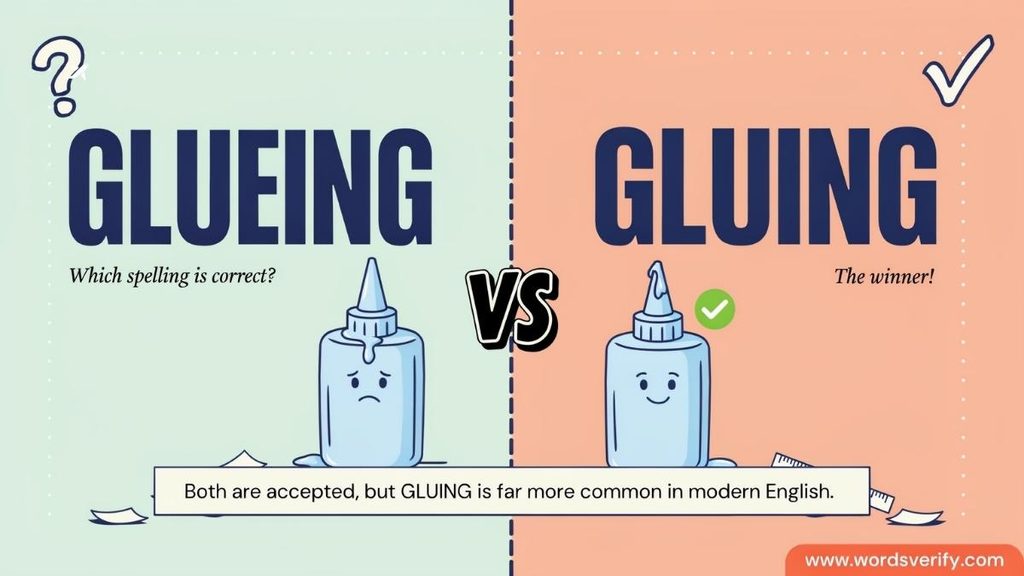
The words gluing and glueing have the same meaning. Both refer to joining or attaching something with glue.
| Word | Common Usage | Meaning |
|---|---|---|
| Gluing | Standard in American English and widely used in British English | Joining something with glue |
| Glueing | Accepted in some British English usage | Joining something with glue |
If you are writing for an American audience, gluing is the safest choice. If you are using British English, glueing may also be acceptable, depending on the dictionary or style guide you follow.
Examples
- I am gluing the pieces of cardboard together.
- She spent the afternoon gluing pictures into her scrapbook.
- He is glueing the broken pieces of the model together.
The meaning remains the same in all three sentences.
What Does Gluing Mean?
Gluing is the present participle and gerund form of the verb glue. It means joining two or more things with glue.
For example:
- The children are gluing paper shapes onto the poster.
- She is gluing the handle back onto the cup.
- Gluing the pieces carefully will make the model stronger.
The word can describe an action that is happening now or an activity in general.
Gluing as an Action
When gluing describes something happening at the moment, it works as part of the present continuous tense.
- He is gluing the pages together.
- They are gluing decorations onto the box.
- I am gluing the final piece into place.
Gluing as an Activity
Gluing can also act as a noun.
- Gluing requires patience.
- She enjoys gluing paper crafts.
- Proper gluing helps the pieces stay attached.
In these examples, gluing names the activity rather than simply describing what someone is doing.
Why Does the Final E Disappear?
The spelling difference glueing vs gluing comes from a common English spelling rule.
For example:
- Make becomes making.
- Write becomes writing.
- Take becomes taking.
- Use becomes using.
- Move becomes moving.
- Love becomes loving.
- Hope becomes hoping.
- Dance becomes dancing.
- Create becomes creating.
The same pattern applies to glue:
Glue + ing = gluing
This is why gluing is the standard spelling in American English.
Why Is Glueing Also Used?

English spelling is not always perfectly consistent. Different varieties of English sometimes follow different spelling traditions.
In some British English dictionaries and publications, glueing is accepted. Writers may keep the final e to make the base word easier to recognize. The spelling also follows a pattern seen in some other words ending in -e.
For example, British English sometimes uses forms such as:
- Ageing
- Singeing
- Dyeing
- Shoeing
However, not every word follows the same pattern. English has developed over centuries, so spelling rules often include exceptions and regional preferences.
Glueing is therefore not meaningless or completely incorrect. It is simply less common in American English.
Is Gluing the Correct American Spelling?
Yes. Gluing is the standard spelling in American English.
If you are writing an essay, email, instruction manual, school assignment, or article for an American audience, use gluing.
Examples:
- The students are gluing the photographs onto the display board.
- Make sure the surface is clean before gluing the pieces together.
- The technician is gluing the broken plastic part.
The spelling gluing is clear, familiar, and widely accepted.
Is Glueing Correct in British English?
Glueing is accepted in some British English dictionaries and writing styles. However, gluing is also common and widely understood in British English.
This means that neither spelling should automatically be treated as a serious mistake. The best choice depends on the audience and the spelling standard you are following.
If you are writing in British English, check the preferred style of your school, workplace, publisher, or dictionary. Consistency is more important than switching between both forms.
The Other Forms of Glue
Understanding the other forms of glue can help prevent additional spelling mistakes.
| Form | Example |
|---|---|
| Base form | Glue |
| Third-person singular | Glues |
| Past tense | Glued |
| Past participle | Glued |
| Present participle | Gluing or glueing |
Examples
- I use glue to repair the frame.
- She glues the pieces together carefully.
- He glued the broken handle yesterday.
- They have glued the parts into place.
- We are gluing the decorations onto the card.
One common mistake is writing glueed. That form is incorrect. The past tense is glued, not glueed.
Glued vs Gluing
The words glued and gluing describe different times or functions.
Glued is the past tense or past participle of glue. It describes something that has already been attached.
- She glued the pieces together yesterday.
- The label was glued to the package.
- He has glued the broken parts back into place.
Gluing describes the action of attaching something with glue.
- She is gluing the pieces together now.
- He enjoys gluing paper models.
- They are gluing the final section of the project.
A simple way to remember the difference is this:
- Glued describes a completed action.
- Gluing describes an action in progress or an activity.
Gluing vs Sticking
Gluing and sticking are similar, but they are not always interchangeable.
The Gluing specifically involves using glue or adhesive. Sticking has a broader meaning and may describe attaching something with tape, pressure, a natural adhesive surface, or glue.
For example:
- She is gluing the pieces of wood together.
- He is sticking a note onto the refrigerator.
- The tape is sticking to the wall.
- The children are gluing colored paper onto the poster.
You can use sticking in many situations, but gluing is more precise when glue is involved.
Gluing vs Bonding
Bonding is another related word. It often sounds more technical and is commonly used in construction, manufacturing, dentistry, and engineering.
For example:
- The worker is gluing the wooden parts together.
- The manufacturer is bonding the materials with a strong adhesive.
- The dentist used a bonding material during the procedure.
Gluing is suitable for everyday activities. Bonding is often better when discussing a strong or technical connection between materials.
Common Spelling Mistakes

Many spelling mistakes involving glue happen because writers apply a rule too mechanically.
Writing Glueing in American English
Glueing may be accepted in some forms of British English, but gluing is the usual American spelling.
Incorrect for standard American usage:
The children are glueing paper onto the poster.
Preferred American spelling:
The children are gluing paper onto the poster.
Writing Glueed
The past tense of glue is glued.
Incorrect:
She glueed the pieces together.
Correct:
She glued the pieces together.
Confusing Glued and Gluing
Incorrect:
He is glued the model together.
Correct:
He is gluing the model together.
Incorrect:
She is gluing the pieces yesterday.
Correct:
She glued the pieces together yesterday.
Assuming Every Dictionary Uses the Same Spelling
Dictionaries may differ because they reflect different varieties of English. A word listed as an accepted British spelling may not be the preferred form in American English.
Always consider the audience before deciding which spelling to use.
Learn how to use confusing more words correctly
Speach vs Speech Which one Is Correct?
Examples of Gluing in Everyday Life
Gluing is used in many ordinary activities.
Arts and Crafts
- The students are gluing leaves onto a sheet of paper.
- She is gluing beads onto the handmade card.
- We spent the afternoon gluing decorations onto the gift box.
Home Repairs
- He is gluing the loose edge of the wallpaper.
- She glued the broken handle back onto the drawer.
- The repair requires gluing the two wooden pieces together.
School Projects
- The class is gluing pictures onto a science poster.
- He is gluing cardboard pieces to build a model bridge.
- The students glued the labels onto the project board.
Manufacturing
- The machine applies adhesive before gluing the parts together.
- Workers are gluing the layers of material into place.
- The company uses a special adhesive for gluing plastic components.
How Is Gluing Pronounced?
glueing vs gluing are generally pronounced the same way .
The word has two syllables:
Glu-ing
The pronunciation does not change simply because one spelling contains an extra e. The difference is mainly written rather than spoken.
Similar Words That Follow the Same Rule glueing vs gluing
Many English verbs lose their final silent e before the ending -ing is added.
- Bake becomes baking.
- Ride becomes riding.
- Smile becomes smiling.
- Close becomes closing.
- Save becomes saving.
- Drive becomes driving.
- Share becomes sharing.
- Believe becomes believing.
- Prepare becomes preparing.
- Admire becomes admiring.
These examples can help you remember why glue becomes gluing.
However, English has exceptions.
Words That Keep the E
Some verbs keep the final e to avoid confusion or preserve pronunciation.
- See becomes seeing.
- Agree becomes agreeing.
- Free becomes freeing.
- Flee becomes fleeing.
Words That Change the Spelling in Another Way
Some verbs ending in -ie change that ending to y before adding -ing.
- Die becomes dying.
- Lie becomes lying.
- Tie becomes tying.
Spelling rules are useful, but they are not perfect. When a word looks unusual, checking a reliable dictionary is often the quickest solution.
A Simple Memory Trick glueing vs gluing
Remember this pattern:
Glue → Gluing
Think of the final e as a letter that quietly steps aside before -ing arrives.
You can compare it with:
- Make → Making
- Write → Writing
- Take → Taking
- Glue → Gluing
If you are writing in American English, choose gluing. If you are following a British English style that accepts glueing, that spelling may also be suitable.
- Here’s a trusted source for clear more words Comparison:
- Grammar Update
Practice Session Glueing vs Gluing
Test your understanding of the spelling, meaning, and usage of glue, glued, gluing, and glueing. Complete each sentence with the most suitable word glueing vs gluing.
Fill in the Blanks
- She is __________ the photographs onto the scrapbook page.
- He __________ the broken handle back onto the cup yesterday.
- The children enjoy __________ colorful paper onto their school projects.
- Please use some __________ to attach the two pieces of cardboard.
- The teacher __________ the final picture onto the display board.
- They are __________ the wooden pieces together.
- The correct past tense of glue is __________.
- The incorrect form “glueed” should be replaced with __________.
- In standard American English, the preferred spelling is __________.
- In some British English writing, __________ is also accepted.
- The worker is __________ the label onto the package.
- She has __________ the loose corner back into place.
- The students are __________ decorations onto the poster.
- The verb “glue” means to __________ or attach something with glue.
- The word “gluing” can describe an action that is happening __________.
- The past participle of glue is __________.
- The final silent __________ is usually removed before adding -ing to glue.
- The word “gluing” is pronounced the same as __________.
- The children __________ the pieces together during yesterday’s craft lesson.
- Proper __________ helps the parts remain firmly attached.
- She is __________ a paper model for her science project.
- The shop sells different types of __________ for wood, paper, and plastic.
- When writing for an American audience, choose __________ rather than glueing.
Answers
- Gluing
- Glued
- Gluing
- Glue
- Glued
- Gluing
- Glued
- Glued
- Gluing
- Glueing
- Gluing
- Glued
- Gluing
- Join
- Now
- Glued
- E
- Glueing
- Glued
- Gluing
- Gluing
- Glues
- Gluing
FAQs
Is gluing vs glueing correct?
Both gluing and glueing are used, but gluing is the standard spelling in American English. Glueing is accepted in some British English dictionaries and writing styles.
What does glueing mean?
Glueing means joining or attaching something with glue. It is an alternative spelling of gluing and has the same meaning.
Why is it spelled gluing instead of glueing?
The final silent e is usually removed when a verb takes the ending -ing. Therefore, glue becomes gluing, just as make becomes making and write becomes writing.
Is gluing or glueing preferred in American English?
Gluing is the preferred spelling in American English. Use it in American schoolwork, professional writing, instructions, and general communication.
Is glueing accepted in British English?
Yes. Glueing is accepted in some British English usage, although gluing is also common. The preferred form may depend on the dictionary or style guide being followed.
What is the past tense of glue?
The past tense of glue is glued.
Example: She glued the broken pieces together.
Is glued or glueed correct?
Glued is correct. Glueed is an incorrect spelling.
Example: He glued the label onto the box.
What is the present participle of glue?
The present participle is gluing in standard American English. Glueing is also used in some British English contexts.
Example: They are gluing the pictures onto the poster.
What is another word for gluing?
Depending on the context, alternatives to gluing include attaching, sticking, bonding, adhering, joining, and securing.
Gluing is the most precise choice when glue is used as the adhesive.
What is the verb form of glue?
Glue is both a noun and a verb.
As a verb, it means to join or attach something with glue.
Example: Please glue the pieces together.
Is glue countable or uncountable?
Glue is usually an uncountable noun when referring to the substance.
Example: I need some glue.
It can be countable when referring to different types or containers of glue.
Example: The store sells several glues for different materials.
What is the plural form of glue?
The usual plural form is glues when referring to different types or varieties of glue.
Example: These glues are suitable for wood, paper, and plastic.
When referring to the substance generally, glue is normally uncountable.
What is the scientific term for glue?
The scientific or technical term for glue is adhesive. An adhesive is a substance used to join two surfaces.
Glue is a common type of adhesive, while adhesive is the broader term.
What is the gluing process?
The gluing process involves applying an adhesive to one or more surfaces, bringing the surfaces together, and allowing the adhesive to set or dry.
A basic gluing process usually includes these steps:
- Clean and prepare the surfaces.
- Apply the appropriate amount of glue.
- Join the surfaces carefully.
- Hold or clamp them in place.
- Allow the glue to dry or cure.
What is the difference between gluing and sticking?
Gluing means attaching something specifically with glue. Sticking has a broader meaning and may involve glue, tape, pressure, or another adhesive surface.
Example: She is gluing the wooden pieces together.
Example: He is sticking a note onto the wall.
What does it mean when someone is called the glue?
Calling someone “the glue” means that person holds a group, family, or team together. They may provide support, encouragement, communication, or stability.
Example: Maria is the glue that keeps the team working together.
What is a formal word for putting things together?
Depending on the context, formal alternatives include assembling, joining, connecting, combining, integrating, and consolidating.
Assembling is commonly used when separate parts are put together to create something complete.
What is the opposite of glue?
There is no single opposite of glue in every context. Depending on the meaning, possible opposites include separate, detach, loosen, disconnect, or unstick.
Example: Glue the pieces together.
Example: Detach the pieces carefully.
What is the difference between glue and adhesive?
Glue is a common word for a substance used to attach things. Adhesive is a broader and more technical term that includes glue, tape adhesives, bonding agents, and other substances used to join surfaces.
How do you use gluing in a sentence?
Here are a few examples:
- The children are gluing paper shapes onto the card.
- She enjoys gluing photographs into her scrapbook.
- The worker is gluing the wooden parts together.
- Gluing the pieces carefully will produce a stronger result.
What are common mistakes involving glue?
Common mistakes include writing glueed instead of glued, using gluing and glued incorrectly, and assuming that glueing is always wrong.
The correct forms are:
- Glue
- Glues
- Glued
- Gluing
- Glueing, as an accepted variant in some British English usage
How can you remember the spelling of gluing?
Remember the pattern glue → gluing. The final silent e is removed before -ing is added.
You can compare it with these examples:
- Make → making
- Write → writing
- Take → taking
- Glue → gluing
conclusion
The glueing vs gluing mystery is finally ready to stick around no longer. Both spellings refer to joining something with glue, but gluing is the standard choice in American English, while glueing is accepted in some British English usage. The difference comes from regional spelling preferences and the familiar rule that usually removes a silent e before adding -ing.
Remember the essentials: glue becomes gluing, and its past tense is glued, never glueed. Once these simple rules become familiar, you can write with confidence and avoid letting one tiny letter create a big spelling mess.

Lisa AJS is an experienced blogger and language enthusiast at Words Verify, dedicated to making grammar simple, practical, and enjoyable. She writes engaging content on commonly confused words, grammar mistakes, word meanings, and everyday language challenges.