
Have you ever told someone you hid your keys, then paused to wonder whether you should have said you hidden them? English irregular verbs can turn an ordinary sentence into a surprising grammar puzzle. The difference between hide, hid, and hidden is easy to overlook, but choosing the wrong form can make your writing sound awkward. In this guide to Hide vs Hid you’ll discover what each word means, how the three forms work, and when to use them correctly. With clear explanations, practical examples, and helpful tips, you’ll master these tricky verb forms without hiding from the rules!
Hide vs Hid The Quick Answer
Let’s clear up the confusion first. Hid is the simple past tense of hide, while hidden is its past participle. All three are correct English words, but they aren’t interchangeable.
Here’s a quick comparison:
| Word | Verb form | Main use | Example |
|---|---|---|---|
| Hide | Base form | Present, infinitive, and after modal verbs | I hide my diary. |
| Hid | Simple past | Completed past actions | I hid my diary yesterday. |
| Hidden | Past participle | Perfect tenses and passive constructions | I have hidden my diary. |
The easiest way to remember the difference is to connect each word with its purpose:
- Hide: Something you do regularly, do now, or plan to do.
- Hid: Something you did in the past.
- Hidden: A form used with helping verbs such as have, has, and had.
Consider these three sentences:
- She likes to hide her birthday presents.
- She hid the presents in the closet last night.
- She has hidden the presents so nobody can find them.
The basic meaning stays the same, but the verb changes to fit the sentence.
If someone asks, “What is the past tense of hide?” the answer is hid. If they ask for the past participle, the answer is hidden.
Understand confusing English more words simply
Envisage vs Envision what’s the difference
What Does Hide Mean?
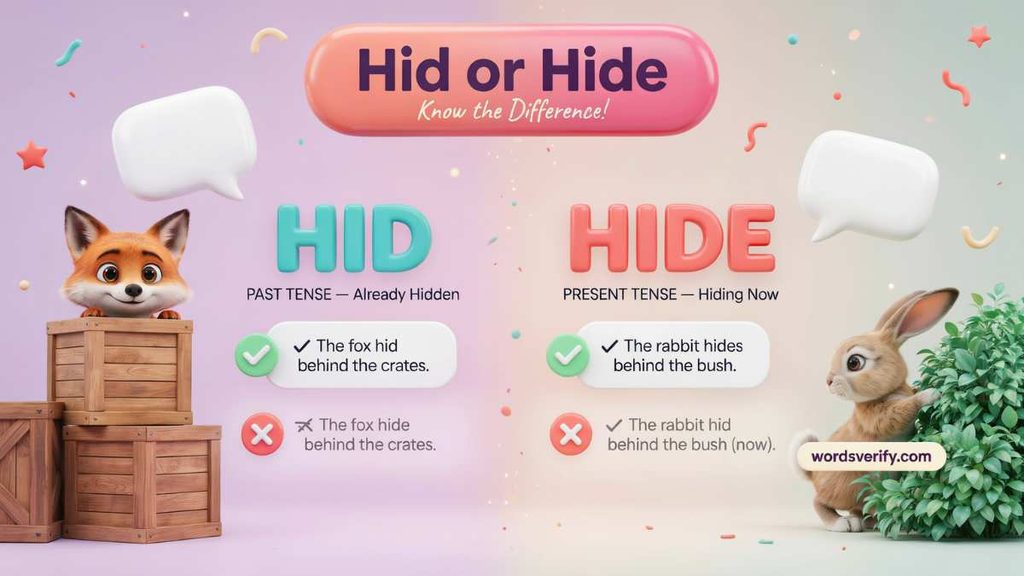
Hide is a verb that means to put something out of sight, prevent someone from seeing it, or keep information secret. It can describe a physical action, such as placing a wallet inside a drawer, or something less tangible, such as concealing your feelings.
For example:
- The children hide behind the curtains during hide-and-seek.
- I hide important documents in a locked cabinet.
- She tries to hide her disappointment.
- Thick clouds hide the mountains.
- He wanted to hide the truth from his family.
Notice that hiding doesn’t always involve a physical object. You can hide your identity, intentions, emotions, or mistakes just as easily as you can hide your phone.
Common Meanings of Hide
Depending on the situation, hide can express several related ideas.
To conceal something physically
This is the most familiar meaning. You put an object somewhere so other people can’t easily see or find it.
Example: “He decided to hide the spare key beneath the garden stone.”
To keep information secret
You can hide facts, plans, or details when you don’t want others to discover them.
Example: “The company tried to hide important information from its customers.”
To stay out of sight
The verb can describe someone moving to a place where others can’t see them.
Example: “The rabbit ran into the bushes to hide from the dog.”
To conceal emotions
People sometimes hide their feelings to avoid embarrassment, conflict, or unwanted attention.
Example: “She smiled to hide her nervousness before the interview.”
To cover or obscure something
An object can hide another object by blocking someone’s view.
Example: “A large tree hides the entrance to the old house.”
In everyday English, hide also appears in expressions such as hide away, hide behind something, and hide something from someone.
Understand confusing English more words simply
Saucy vs Saucey Which one Is Correct?
What Does Hid Mean?
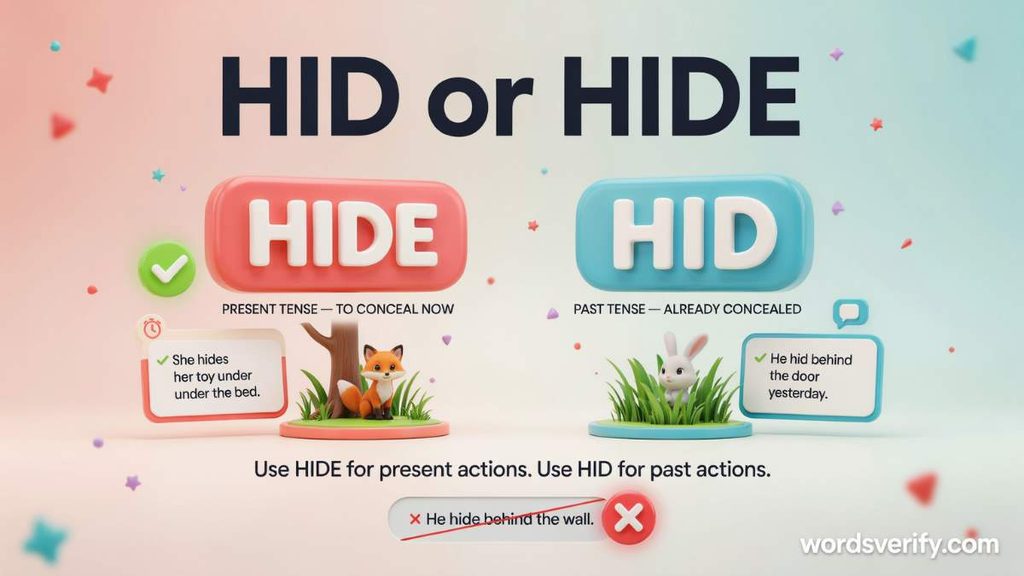
Hid is the simple past tense of hide. It describes an action that started and finished in the past.
Its meaning is closely related to hide. The difference isn’t in what the word describes but in when the action happened.
For example:
- I hid my wallet in the bedroom.
- She hid behind the door when her friends arrived.
- The dog hid under the table during the storm.
- They hid the surprise party decorations before the guests came.
- He hid his disappointment behind a cheerful smile.
Each sentence describes something that happened earlier.
The word often appears with past-time expressions such as:
- Yesterday
- Last night
- Last week
- A few hours ago
- Earlier that morning
- When I was younger
- Before the meeting
However, you don’t always need a specific time expression. The surrounding sentence can make the past meaning clear.
For instance:
“Everyone searched the house, but nobody knew that Sarah hid the letter in the attic.”
The sentence describes an earlier action even though it doesn’t mention an exact date or time.
Is Hid a Correct English Word?
Absolutely. Hid is a standard English word and the correct simple past form of hide.
It isn’t a spelling mistake or an informal variation. The confusion usually happens because English learners expect every verb to follow the regular pattern of adding -ed.
For example:
- Walk → Walked
- Clean → Cleaned
- Jump → Jumped
However, hide belongs to a group called irregular verbs. Its past form changes instead of simply adding -ed.
That’s why hid is correct, while hided is generally incorrect when you’re using the ordinary verb meaning to conceal something.
Understand confusing English more words simply
Annual vs Anual Which one Is Correct?
Hide vs Hid Understanding the Verb Forms
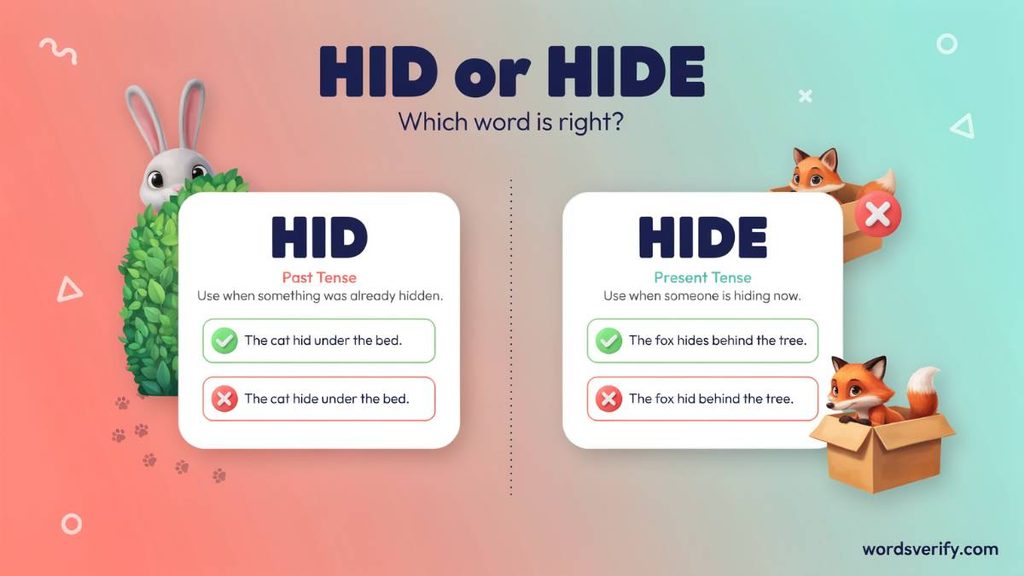
To understand the difference between these three words, it helps to recognize their principal verb forms.
English verbs change their forms to express different times and grammatical relationships. This process is called conjugation.
The verb hide follows an irregular pattern:
| Form | Word | Grammatical role |
|---|---|---|
| V1 | Hide | Base form |
| V2 | Hid | Simple past |
| V3 | Hidden | Past participle |
Let’s look at each form more closely.
Hide: The Base Form and Present Tense
Hide is the base form of the verb. You use it in the present tense, infinitive constructions, commands, and sentences containing modal verbs.
For example:
- I hide my important files in a separate folder.
- They hide whenever someone knocks on the door.
- You should hide the gift before the birthday party.
- She wants to hide her new shoes from her sister.
- Please hide the documents somewhere safe.
In the simple present tense, the verb usually takes an -s ending with third-person singular subjects.
For example:
- I hide my keys.
- You hide your keys.
- He hides his keys.
- She hides her keys.
- They hide their keys.
This distinction matters because he hide and she hide are incorrect in ordinary present-tense statements. The correct forms are he hides and she hides.
You also use the base form after modal and auxiliary verbs.
| Helping verb or construction | Correct example |
|---|---|
| Can | She can hide the package. |
| Will | He will hide the surprise. |
| Should | You should hide the password. |
| Might | They might hide the evidence. |
| To | I want to hide the letter. |
| Do | Where do you hide your keys? |
One important rule: after do, does, did, and modal verbs, use the base form hide rather than hid or hidden.
Hid: The Simple Past Tense
Hid is the second principal form of the verb. Use it when describing an action that happened and finished in the past.
For example:
- She hid her phone under the pillow.
- I hid the birthday present in my closet.
- The children hid behind the sofa.
- He hid the truth from his parents.
- They hid the treasure beneath an old tree.
The past-tense form doesn’t change according to the subject.
Compare:
- I hid the letter.
- You hid the letter.
- He hid the letter.
- She hid the letter.
- They hid the letter.
Unlike the present tense, you don’t add -s to hid when using third-person singular subjects.
Another important rule concerns negative and question sentences. When you use did, the main verb returns to its base form.
Correct:
- I didn’t hide the money.
- Did she hide the documents?
- Why did they hide the truth?
Incorrect:
- I didn’t hid the money.
- Did she hid the documents?
- Why did they hid the truth?
Why? Because did already carries the past-tense meaning. The main verb doesn’t need to show the past again.
Hidden: The Past Participle
Hidden is the third principal form of the verb. It’s called the past participle.
Unlike hid, hidden generally needs a helping verb when it forms part of a verb phrase.
Common helping verbs used with hidden include:
- Have
- Has
- Had
- Was
- Were
- Be
- Been
Consider these examples:
- I have hidden the spare key.
- She has hidden her diary.
- They had hidden the documents before the inspection.
- The money was hidden inside a wooden box.
- Several important details were hidden from the public.
Here, hidden helps form perfect tenses or passive constructions.
One useful distinction: the past participle doesn’t automatically mean an action happened a long time ago. Its tense depends on the helping verb and the overall sentence.
For example, “I have hidden the letter” uses the present perfect, while “I had hidden the letter” uses the past perfect.
Complete Hide Verb Forms Table
The following table brings the main forms together with their grammatical uses.
| Form | Example |
|---|---|
| Base form | I hide my passport. |
| Third-person singular | She hides her passport. |
| Present participle | They are hiding their passports. |
| Simple past | I hid my passport. |
| Past participle | I have hidden my passport. |
| Present perfect | She has hidden the letter. |
| Past perfect | They had hidden the documents. |
| Future | I will hide the package. |
| Present continuous | He is hiding behind the wall. |
| Past continuous | We were hiding in the basement. |
Learning all these forms makes it easier to use hide correctly in different situations.
Understand confusing English more words simply
Recurrence vs Reoccurrence What’s the Difference?
When Should You Use Hide vs Hid?
Choosing between hide vs hid becomes much easier when you consider the time of the action and the structure of the sentence.
The basic rule is straightforward: use hide for the base form and present-tense constructions, hid for completed past actions, and hidden when the sentence requires a past participle.
Use Hide for Present and General Actions
Use hide when describing something that happens regularly, represents a general fact, or hasn’t happened yet.
Examples:
- I hide my wallet in the same drawer every evening.
- Some animals hide when they sense danger.
- Children often hide their toys under the bed.
- We hide our personal information from strangers.
- Birds hide their nests among thick branches.
You can also use hide in commands and instructions:
- Hide the gift before she arrives.
- Don’t hide your mistakes.
- Hide behind the wall until the coast is clear.
Commands usually take the base form because they tell someone what to do.
Use Hid for Completed Past Actions
Use hid when an action happened and finished in the past.
For example:
- I hid my phone before the meeting started.
- She hid behind the curtains during the game.
- The children hid their toys after playing.
- He hid the truth from his closest friends.
- They hid the old photographs in a wooden box.
Here’s another useful comparison:
| Present or base form | Simple past |
|---|---|
| I hide my keys here. | I hid my keys here yesterday. |
| She hides her feelings. | She hid her feelings last night. |
| They hide behind the wall. | They hid behind the wall earlier. |
| He hides the documents. | He hid the documents before leaving. |
The difference becomes obvious when you add a clear reference to the past.
Use Hidden with Perfect Tenses
Use hidden when the sentence requires a past participle.
The three most common constructions are:
Present perfect: Have or has + hidden
The present perfect connects a past action with the present.
- I have hidden the spare key.
- She has hidden her identity.
- They have hidden the important files.
Past perfect: Had + hidden
The past perfect describes an action completed before another past event.
- I had hidden the documents before the inspector arrived.
- She had hidden the gift before her brother entered the room.
- They had hidden the evidence before the investigation began.
Passive voice: Was or were + hidden
The passive construction focuses on the person or thing affected by the action rather than the person who performed it.
- The money was hidden beneath the floor.
- The documents were hidden inside a locked cabinet.
- The entrance was hidden behind thick bushes.
Hidden can also work as an adjective, as in “a hidden door” or “hidden information.” In these examples, it describes something rather than forming a perfect-tense verb phrase.
Understand confusing English more words simply
Copyright vs Copywrite Which one Is Correct?
Hide vs Hid in Sentences
Grammar rules make more sense when you see them in everyday situations. These examples show how each form works in natural English.
Examples of Hide in Sentences
Here are some sentences using the base form:
- I hide my car keys in the kitchen drawer.
- She likes to hide small gifts around the house.
- The cat often hides beneath the sofa.
- We should hide the surprise decorations before the guests arrive.
- He tries to hide his nervousness during interviews.
- Some insects hide under leaves to avoid predators.
- You must never hide important information from your doctor.
- The children play hide-and-seek after school.
- They want to hide the old furniture in the storage room.
- Where do you hide your spare batteries?
These examples include simple present, infinitive, modal verb, and question constructions.
Examples of Hid in Sentences
The following sentences demonstrate how hid works in the simple past tense.
- She hid behind the door when the guests arrived.
- I hid my birthday present in the closet.
- The dog hid under the bed during the thunderstorm.
- He hid his disappointment behind a smile.
- They hid the treasure near the river.
- My brother hid my shoes as a practical joke.
- The children hid their toys before their parents returned.
- Sarah hid the letter inside an old book.
- We hid from the rain beneath a large tree.
- The suspect hid in an abandoned building.
Each example describes a completed past action.
Examples of Hidden in Sentences
Here are some examples showing how hidden works with helping verbs and as an adjective.
- I have hidden the spare key in the garden.
- She has hidden her feelings for years.
- They had hidden the documents before the meeting.
- The treasure was hidden beneath an ancient tree.
- Several important details were hidden from the public.
- He has hidden the truth from his family.
- The missing necklace had been hidden inside a drawer.
- A hidden passage connected the two rooms.
- The children have hidden all the birthday decorations.
- The hidden object was difficult to find.
Notice the different structures. Some sentences use have, has, or had, while others use was or were. Hidden can also describe a noun directly.
A Real-Life Example Hide, Hid and Hidden Together
Imagine you’re organizing a surprise birthday party for a friend.
You might say:
- Present: “I hide the decorations whenever my friend enters the room.”
- Past: “Yesterday, I hid the birthday cake in the refrigerator.”
- Present perfect: “I have hidden all the presents in the spare bedroom.”
- Past perfect: “I had hidden the invitations before the guests arrived.”
The situation stays the same, but each verb form communicates a different grammatical relationship.
That’s the easiest way to understand these three words: look at the sentence structure rather than choosing a word based only on its meaning.
Understand confusing English more words simply
Appraised vs Apprised What’s the Difference?
Common Grammar Mistakes with Hide, Hid or Hidden
Even experienced English speakers sometimes mix up irregular verb forms. The problem often comes from applying regular verb rules to words that follow a different pattern.
Here are some common mistakes and their corrections.
Using Hid After Did
This is one of the most frequent errors.
Incorrect: “I didn’t hid the money.”
Correct: “I didn’t hide the money.”
The auxiliary verb did already marks the sentence as past tense. Therefore, the main verb must remain in its base form.
The same rule applies to questions.
Incorrect: “Did she hid the letter?”
Correct: “Did she hide the letter?”
Confusing Hid with Hidden
Another common mistake involves using hid instead of hidden after have, has, or had.
Incorrect: “She has hid the documents.”
Correct: “She has hidden the documents.”
Perfect tenses require the past participle rather than the simple past form.
Using Hide for a Completed Past Action
Incorrect: “Yesterday, I hide my wallet in the drawer.”
Correct: “Yesterday, I hid my wallet in the drawer.”
The word yesterday establishes a completed past event, so hid is the appropriate choice.
Adding -Ed to Hide
Because many English verbs form their past tense with -ed, learners sometimes write hided.
Incorrect: “He hided the gift.”
Correct: “He hid the gift.”
The correct past-tense form doesn’t need an additional ending.
Using Hid After Modal Verbs
Modal verbs such as can, could, should, would, and might take the base form of the main verb.
Incorrect: “You should hid the documents.”
Correct: “You should hide the documents.”
The same principle applies to will.
Incorrect: “They will hid the treasure.”
Correct: “They will hide the treasure.”
Incorrect vs Correct Usage
| Incorrect sentence | Correct sentence |
|---|---|
| I didn’t hid it. | I didn’t hide it. |
| She has hid the money. | She has hidden the money. |
| They had hid the evidence. | They had hidden the evidence. |
| He hided the letter. | He hid the letter. |
| You should hid it. | You should hide it. |
| Did they hid the box? | Did they hide the box? |
| I have hide the keys. | I have hidden the keys. |
| Yesterday, she hide the gift. | Yesterday, she hid the gift. |
One simple check can prevent most of these errors: identify the helping verb before choosing the main verb form.
Understand confusing English more words simply
Simular vs Similar Which one Is Correct?
Hide vs Hid Pronunciation How Are They Different?
Although hide vs hid look similar, they sound different. The main distinction comes from their vowel sounds.
In American English, their standard pronunciations are:
| Word | IPA | Vowel sound |
|---|---|---|
| Hide | /haɪd/ | /aɪ/ |
| Hid | /hɪd/ | /ɪ/ |
| Hidden | /ˈhɪdən/ | /ɪ/ |
Hide rhymes with words such as side, wide, and ride. Its vowel is a diphthong, meaning the sound moves from one vowel position to another.
Hid has a short vowel sound, similar to the vowel in sit, bit, and did.
Hidden begins with the same short vowel sound as hid. It has two syllables, with the stress on the first.
Try saying these sentences aloud:
- “I hide my keys.”
- “I hid my keys.”
- “I have hidden my keys.”
Pay attention to the vowel in the first two sentences. Changing that sound changes the word and its grammatical meaning.
How Do Americans Pronounce Hid?
Americans generally pronounce hid as /hɪd/. The vowel is short, and the final /d/ sound is clearly part of the word.
To practice, compare it with these familiar words:
- Hid
- Did
- Kid
- Lid
- Bid
They all contain the same short /ɪ/ vowel sound.
A useful practice technique is to alternate between hide vs hid in short sentences. This helps you hear and produce the difference without overthinking the pronunciation.
Understand confusing English more words simply
Cataloguing vs Cataloging? Which one Is Correct?
Synonyms or Related Words for Hide , Hid and Hidden
Hide vs hid share the same basic meaning because they’re different forms of the same verb. Their synonyms, however, depend on the context.
For example, conceal works well when someone deliberately keeps something secret. Camouflage is more suitable when an object blends into its surroundings.
Here are some useful alternatives.
| Synonym | Meaning | Example |
|---|---|---|
| Conceal | Keep something out of sight | She concealed the letter. |
| Cover | Place something over an object | He covered the box with a cloth. |
| Camouflage | Make something blend into its surroundings | The soldiers camouflaged their equipment. |
| Disguise | Change appearance to avoid recognition | He disguised his identity. |
| Obscure | Make something difficult to see or understand | Thick fog obscured the road. |
| Secrete | Hide something in a secret place | The animal secreted food in its nest. |
| Shelter | Protect someone or something | The cave sheltered the hikers. |
| Mask | Hide or disguise something | She masked her disappointment. |
What Is Another Word for Hidden?
When hidden functions as an adjective, you can use several alternatives depending on what you’re describing.
Some common options include:
- Concealed
- Unseen
- Secret
- Covered
- Obscured
- Undisclosed
- Camouflaged
- Unnoticed
For example:
- A hidden entrance → A concealed entrance.
- Hidden information → Undisclosed information.
- A hidden object → An unseen object.
- A hidden message → A secret message.
These words aren’t perfect substitutes in every situation. Their meanings overlap, but each carries a slightly different meaning.
Antonyms of Hide
An antonym is a word with an opposite meaning.
Depending on the context, possible opposites of hide include:
- Reveal
- Expose
- Disclose
- Uncover
- Show
- Display
- Unmask
For example, “She hid the letter” expresses concealment, while “She revealed the letter” communicates the opposite action.
Understand confusing English more words simply
Ingenuine vs Ungenuine Which one Is Correct?
The Origin and History of Hide vs Hid
The history of hide goes back to Old English, where the verb appeared as hȳdan. It carried the meaning of concealing something or keeping it out of sight.
Over time, the word developed into the modern English form hide. Its basic meaning remained remarkably stable even as English grammar and pronunciation changed.
The past-tense form hid developed through the historical irregular conjugation of the verb. Rather than following the regular pattern of adding -ed, it changed its vowel.
This type of vowel change appears in many older Germanic verbs. Linguists call the historical pattern ablaut, a systematic vowel change used to distinguish grammatical forms.
The past participle hidden also has historical roots in Old English forms of the verb. Its ending reflects an older pattern used in certain past participles.
Today, the three forms remain:
- Old English: hȳdan
- Modern base form: hide
- Modern simple past: hid
- Modern past participle: hidden
An interesting detail: the noun hide, meaning the skin of an animal, is another use of the same modern spelling. For example, “The leather was made from cowhide.” This meaning doesn’t affect the verb forms discussed in this article.
Other Irregular Verbs Similar to Hide
English contains many irregular verbs that change their spelling or vowel sounds to form the past tense and past participle. Unlike regular verbs, they don’t simply add -ed to the base form.
The verb hide follows the pattern hide, hid, hidden. Several other verbs use similar vowel-changing patterns.
| Base form (V1) | Simple past (V2) | Past participle (V3) |
|---|---|---|
| Hide | Hid | Hidden |
| Ride | Rode | Ridden |
| Write | Wrote | Written |
| Drive | Drove | Driven |
| Rise | Rose | Risen |
| Bite | Bit | Bitten |
| Give | Gave | Given |
| Speak | Spoke | Spoken |
| Break | Broke | Broken |
| Choose | Chose | Chosen |
| Freeze | Froze | Frozen |
| Take | Took | Taken |
Look closely at these examples. Many change their vowel sounds in the simple past and use an -en ending in the past participle.
However, English irregular verbs don’t all follow the same pattern.
For instance:
- Go → Went → Gone
- Eat → Ate → Eaten
- See → Saw → Seen
- Come → Came → Come
- Cut → Cut → Cut
Learning irregular verbs in groups can make English grammar easier to remember. Instead of memorizing isolated words, practice all three forms together.
For example, remember hide, hid, hidden as one unit. Then use each form in a different sentence.
A Simple Trick to Remember Hide vs Hid or Hidden
Sometimes the easiest way to remember a grammar rule is to connect it with a familiar situation.
Imagine hiding a birthday present. You might do it regularly, have already done it, or have completed the action before another event. Each situation calls for a different verb form.
Here’s a simple memory trick:
| Word | Remember it as | Example |
|---|---|---|
| Hide | Base form | I hide the birthday present every year. |
| Hid | Simple past | I hid the birthday present yesterday. |
| Hidden | Past participle | I have hidden the birthday present. |
Keep these three reminders in mind:
- If you’re using the base form, choose hide.
- If you’re describing a completed past action, choose hid.
- If you’re using a perfect tense or passive construction that requires a past participle, choose hidden.
There’s one additional trick worth remembering: did always takes hide, not hid.
For example, “Did you hide the present?” is correct. The auxiliary verb did already expresses the past.
With a little practice, these forms become much easier to recognize.
Understand confusing English more words simply
Manner vs Manor which one is correct?
Practice session Hide vs Hid
Ready to put your grammar skills to the test? Complete the following 25 sentences with the correct form of the verb: hide vs hid, or hidden. Pay attention to the tense and helping verbs in each sentence. No need to hide from a tricky question!
Fill in the blanks
- I usually ______ my spare keys in the kitchen drawer.
- Sarah ______ the birthday present before her brother came home.
- They have ______ the old photographs in a wooden box.
- Where did you ______ my favorite book?
- The cat has ______ under the sofa.
- He ______ his disappointment during the meeting yesterday.
- Please ______ these documents somewhere safe.
- We had ______ the gifts before the children arrived.
- She often ______ her feelings behind a smile.
- The little boy ______ behind the curtains during the game.
- Have you ever ______ something from your parents?
- The treasure was ______ beneath the old tree.
- I didn’t ______ your phone. You must have misplaced it.
- The dog ______ its bone in the backyard last week.
- They are trying to ______ the truth from everyone.
- By the time we arrived, the guests had ______ the decorations.
- Why did he ______ the letter in his desk?
- The moon was ______ behind thick clouds.
- She has ______ her identity from the public.
- I ______ my wallet in my bag every morning.
- The children ______ behind the door when their father entered.
- Nothing can remain ______ forever.
- He should ______ the surprise until the right moment.
- We discovered a ______ room behind the bookshelf.
- The suspect ______ from the police last night.
Answers
- hide
- hid
- hidden
- hide
- hidden
- hid
- hide
- hidden
- hides
- hid
- hidden
- hidden
- hide
- hid
- hide
- hidden
- hide
- hidden
- hidden
- hide
- hid
- hidden
- hide
- hidden
- hid
Here’s a trusted source for clear word meanings:
FAQs
What is the difference between hide, hid and hidden?
Hide is the base form, hid is the simple past tense, and hidden is the past participle. For example: “I hide my diary,” “I hid it yesterday,” and “I have hidden it.”
Is “hid” the past tense of “hide”?
Yes. Hid is the simple past tense of hide. Use it when describing an action that happened and finished in the past. For example: “She hid the letter in her desk.”
Which is correct: “I hid” or “I hide”?
Both are correct, but they refer to different times. “I hide” describes a present or habitual action, while “I hid” describes something that happened in the past.
Can you say “had hid” or should you say “had hidden”?
“Had hidden” is the standard form in modern English. The past perfect tense uses had followed by the past participle. For example: “They had hidden the presents before the guests arrived.”
Which is correct: “I have hidden” or “I have hid”?
“I have hidden” is correct in standard English. Have must be followed by the past participle, and hidden is the past participle of hide. “I have hid” is generally considered nonstandard in edited English.
What does “hid” mean?
Hid means placed something out of sight or kept something secret in the past. For example: “The child hid behind the curtains during the game.”
How do you pronounce hide, hid, and hidden?
The three forms have different pronunciations. Hide rhymes with “wide,” hid rhymes with “did,” and hidden has two syllables, with the stress on the first.
Is “hid” a verb or an adjective?
Hid is a verb. It is the simple past tense of hide and describes an action someone completed. For example: “He hid the package under his bed.”
What are the two meanings of “hide”?
Hide can have two common meanings. As a verb, it means to put something out of sight or keep it secret. As a noun, it refers to the skin of an animal, especially when used as material for leather.
What is another word for “hid”?
Depending on the context, synonyms for hid include concealed, covered, disguised, stashed, tucked away, and kept secret. For example, “She concealed the evidence” can replace “She hid the evidence.”
What is the opposite of “hid”?
Possible opposites include revealed, exposed, uncovered, displayed, and disclosed. The best choice depends on the sentence. For example, “He revealed the secret” is the opposite of “He hid the secret.”
Is “hid it” or “hide it” correct?
Both are grammatically correct, but the tense changes. Use “hid it” for a completed past action, as in “I hid it yesterday.” Use “hide it” for the present, an instruction, or after a modal verb, as in “Please hide it.”
What is the noun form of “hide”?
The noun form can be hide, meaning an animal’s skin. The word hiding is also a noun in certain contexts, as in “The children played a game of hiding.” However, the most suitable form depends on the meaning you want.
Is “hide” an irregular verb?
Yes. Hide is an irregular verb because its past tense and past participle do not follow the usual -ed pattern. Its principal forms are hide, hid, and hidden.
Why is “hidden” used instead of “hided”?
Hidden is the established past participle of hide. Unlike regular verbs that form the past participle by adding -ed, hide changes its form. Therefore, use “have hidden,” not “have hided,” in standard English.
Is “hid” a preposition or an action word?
Hid is an action word, also called a verb. It describes the act of concealing something in the past. It is not a preposition.
How can I remember when to use “hid” and “hidden”?
Remember this simple pattern: hide today, hid yesterday, and have hidden before now. Also, use hidden after helping verbs such as have, has, and had when forming perfect tenses. A few practice sentences will make the difference easier to remember.
Can “hidden” be used as an adjective?
Yes. Hidden can describe something that cannot be seen, is difficult to find, or is kept secret. For example: “We discovered a hidden passage behind the bookshelf.” In this sentence, hidden describes the passage.
What are five examples of irregular verbs like “hide”?
Here are five common irregular verbs and their principal forms:
| Base form | Simple past | Past participle |
|---|---|---|
| Hide | Hid | Hidden |
| Write | Wrote | Written |
| Drive | Drove | Driven |
| Speak | Spoke | Spoken |
| Break | Broke | Broken |
Is “hid” the same as “hidden”?
No. Hid is the simple past tense, while hidden is the past participle. For example, “I hid the key” is correct for a completed past action, whereas “I have hidden the key” uses the present perfect tense.
Conclusion
Although hide vs hid look similar, each word has a different job in a sentence .In Hide vs Hid, Hide is the base form, hid describes a completed past action, and hidden is the past participle used with helping verbs such as have, has, and had. Once you understand these differences, choosing the right form becomes much easier.
Think of it this way: you hide something today, hid it yesterday, and have hidden it before now. No more guessing, no more awkward sentences, and certainly no need to hide from irregular verbs! A little practice will help you use all three forms confidently and keep these common grammar mistakes out of sight.

Lisa AJS is an experienced blogger and language enthusiast at Words Verify, dedicated to making grammar simple, practical, and enjoyable. She writes engaging content on commonly confused words, grammar mistakes, word meanings, and everyday language challenges.