Ever paused over a word because one tiny spelling difference made you second-guess yourself? The confusion between simular vs similar can do exactly that. Although the two spellings look nearly identical, only similar is correct in modern everyday English. It describes people, objects, or ideas that share certain qualities. Simular, by contrast, is an obsolete historical form that rarely appears in contemporary writing. Using the wrong spelling can distract readers and weaken an otherwise clear sentence. Let’s explore their meanings, grammatical roles, pronunciation, and usage so you can avoid this common mistake and choose the right word with confidence.
The Quick Answer
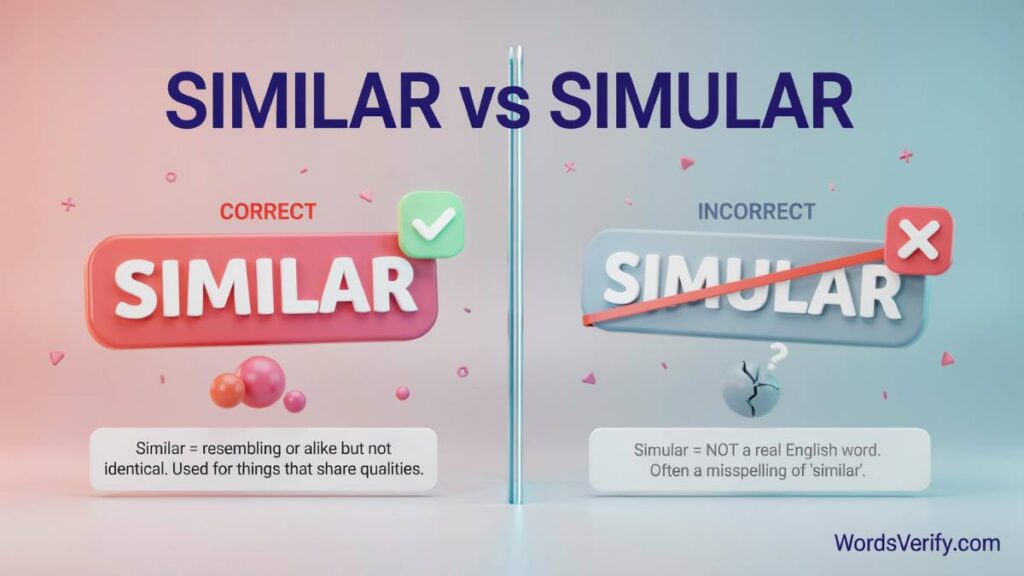
Similar is the correct spelling in modern English when you mean alike, comparable, or resembling something else. Simular is an archaic English word, but it isn’t a standard alternative spelling of similar.
For example:
- Correct: The two houses have a similar architectural design.
- Incorrect: The two houses have a simular architectural design.
The first sentence tells us that the houses share certain features. They might have similar windows, roof shapes, or exterior colors, but they don’t have to be identical.
The second sentence uses an outdated word where the modern adjective similar belongs.
Here’s a quick comparison:
| Feature | Similar | Simular |
|---|---|---|
| Standard modern spelling | Yes | No, not as a substitute for similar |
| Historical dictionary recognition | Yes | Yes |
| Part of speech | Adjective | Historically a noun and adjective |
| Meaning | Alike or resembling | Historically associated with imitation or pretense |
| Everyday usage | Very common | Extremely rare |
| Suitable for modern writing | Yes | Generally no |
| Example | The designs look similar. | Historical or archaic usage only |
The easiest way to remember the distinction is to connect similar with similarity. Both words describe likeness or resemblance.
Whether you’re writing an email, school assignment, business report, or everyday message, choose similar. There’s no need to introduce an archaic word when a familiar modern alternative already exists.
Avoid everyday grammar mistakes with simple tips
Cataloguing vs Cataloging? Which one Is Correct?
Similar vs Simular What’s the Difference?
The main difference between similar vs simular involves their meanings and modern usage.
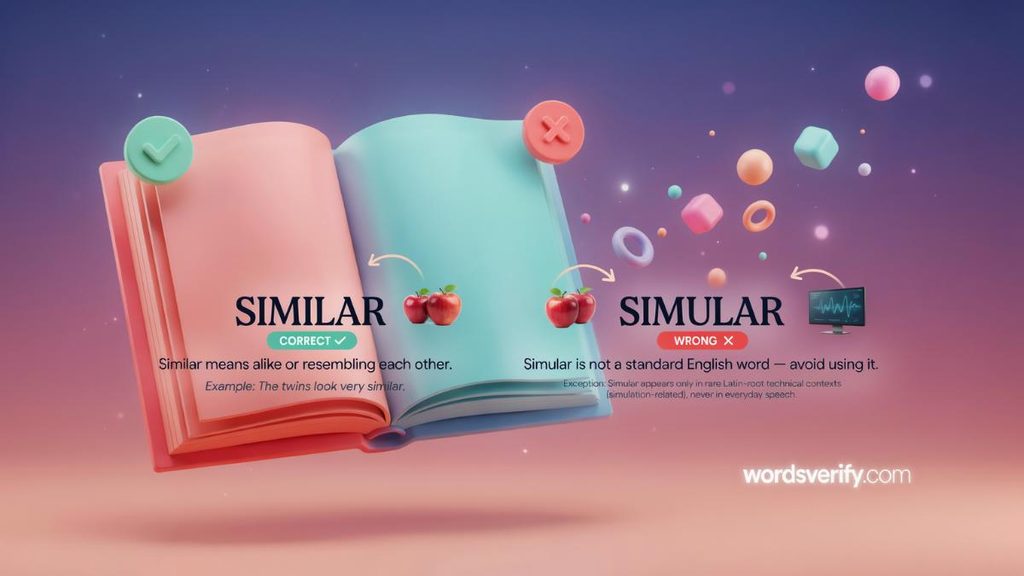
Similar describes a relationship between things that share certain characteristics. Historical simular referred to someone or something associated with imitation, pretense, or a false appearance.
Consider these two examples:
- Two paintings have similar colors. This means their colors resemble one another.
- A person described as a simular in an older text may be someone who pretends to be something they aren’t.
These meanings aren’t interchangeable. Resemblance doesn’t necessarily involve deception. Two products can look similar without either being a fake or imitation of the other.
Likewise, something simulated may imitate an original, but that doesn’t automatically make it similar in every respect.
The distinction becomes clearer when you consider how English uses these words today. Similar remains a useful everyday adjective, while simular mainly belongs in historical discussions of older English vocabulary.
Avoid everyday grammar mistakes with simple tips
Ingenuine vs Ungenuine Which one Is Correct?
What Does Similar Mean?
The word similar describes two or more things that share qualities, features, or characteristics. They may look alike, behave alike, or express comparable ideas. However, they don’t have to match in every detail.
For example, imagine buying two blue shirts from different clothing stores. Both have the same shade of blue, a round neckline, and short sleeves. However, one has a pocket and the other doesn’t. You could describe them as similar, but not identical.
Here are a few more examples:
- My sister and I have similar interests.
- These two smartphones have similar features.
- The new restaurant has a design similar to the one downtown.
- Both students received similar grades.
- Their experiences were remarkably similar.
In each sentence, similar highlights shared characteristics rather than complete equality.
Similar as an Adjective
Grammatically, similar is an adjective. It describes or gives more information about a noun or pronoun.
For instance, in the sentence “The children have similar personalities,” the adjective similar describes the relationship between the children’s personalities.
It can describe several types of resemblance:
| Context | Example |
|---|---|
| Physical appearance | The twins have similar facial features. |
| Personality | Both friends have similar personalities. |
| Behavior | The employees follow similar work habits. |
| Opinions | We have similar views on education. |
| Products | These laptops offer similar performance. |
| Experiences | They went through similar challenges. |
| Design | The buildings have similar architectural styles. |
| Results | Both experiments produced similar results. |
Notice that similar doesn’t require two things to be exactly alike. It simply establishes a connection between their characteristics.
Similar To: The Most Common Sentence Structure
One of the most common grammatical patterns is similar to. Use this construction when comparing one person, object, idea, or situation with another.
Examples:
- Your new hairstyle is similar to mine.
- This recipe is similar to the one my grandmother used.
- The weather today is similar to yesterday’s.
- Her writing style is similar to that of her favorite author.
- The company’s new product is similar to its previous model.
A useful rule is to use similar to when identifying what something resembles.
Similar In: Describing Shared Characteristics
The construction similar in identifies the particular quality or feature two or more things share.
Examples:
- The two apartments are similar in size.
- The brothers are similar in appearance.
- Both machines are similar in design.
- The students are similar in age.
- These products are similar in quality.
The distinction is straightforward:
- Similar to identifies the comparison.
- Similar in identifies the shared characteristic.
You can also combine both constructions:
“The two houses are similar to each other in size and design.”
Similarly: The Adverb Form of Similar
Similarly is the adverb form of similar. It describes actions or situations that happen in a comparable way.
Examples:
- The first company reduced its prices. The second company acted similarly.
- Both students performed similarly during the examination.
- The two researchers approached the problem similarly.
- The northern region experienced heavy rainfall. Southern areas were similarly affected.
Don’t confuse similar with similarly. The first is an adjective, while the second is an adverb.
| Word | Part of speech | Example |
|---|---|---|
| Similar | Adjective | We have similar interests. |
| Similarly | Adverb | We responded similarly. |
| Similarity | Noun | There is a clear similarity between the designs. |
The noun similarity describes the quality or state of being alike. It’s also a helpful spelling reminder because it reinforces the correct spelling pattern.
Avoid everyday grammar mistakes with simple tips
Manner vs Manor which one is correct?
What Does Simular Mean?
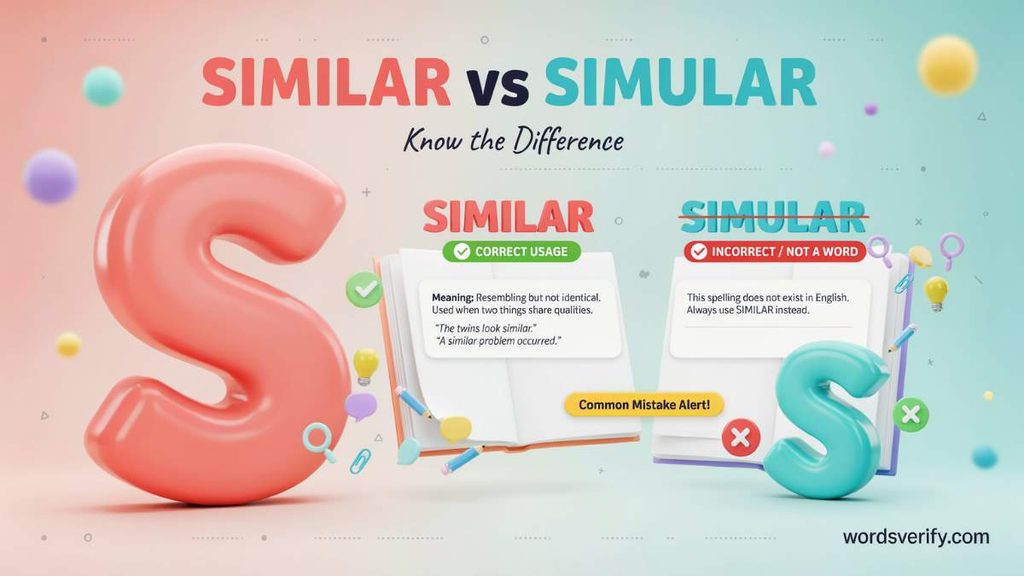
Here’s where the comparison gets interesting. Although simular isn’t the correct modern spelling for the meaning of resemblance, historical dictionaries recognize it as an English word.
Historically, the noun referred to a person or thing that simulates or imitates something. As an adjective, it described something false, assumed, or simulated.
In simpler terms, a simular could be a pretender or an imitation.
For example, an individual who pretended to possess qualities they didn’t actually have could be described using this historical noun.
The word also appeared in older literary writing. One notable example comes from William Shakespeare’s King Lear, where he used the expression “simular of virtue” to describe someone whose apparent virtue was false.
That historical usage is quite different from the modern meaning of similar.
Is Simular a Word?
Yes. If you’re wondering whether simular is a real word, the answer is yes, but there’s an important qualification.
Simular is a genuine historical English word, not an invented spelling. However, it has an archaic status and doesn’t function as an ordinary modern replacement for similar.
Historical dictionaries record two principal uses:
As a noun: A person or thing that imitates, pretends, or counterfeits something.
As an adjective: Something false, counterfeit, assumed, or simulated.
Consider these historical-style examples:
- The dishonest man was called a simular because he pretended to possess virtues he lacked.
- The supposed evidence was described as simular because it gave a false appearance of authenticity.
These examples illustrate the historical meanings rather than recommend the word for everyday writing.
If you encounter simular in an older book, poem, or historical document, don’t automatically assume the writer made a spelling mistake. The word may be perfectly appropriate within that historical context.
However, if you’re writing a modern sentence such as “Our opinions are simular,” you’re almost certainly looking for similar.
The Historical Meaning of Simular
The historical record provides useful clues about the word’s development.
Simular appeared in English during the 1520s. Its original noun sense referred to someone who simulated something. Its adjective use, meaning simulated or assumed, appeared during the 1610s.
The word also appears in Shakespeare’s King Lear, written around the beginning of the 17th century and published in the First Folio in 1623.
One famous passage includes the phrase:
“Thou perjured, and thou simular of virtue”
The expression refers to someone who falsely presents themselves as virtuous.
This example demonstrates why the historical meaning of simular differs from the modern meaning of similar. The former concerns imitation or false appearance, while the latter describes shared characteristics.
Avoid everyday grammar mistakes with simple tips
Updated vs Update which one is correct?
Similar vs Simular Key Differences Explained
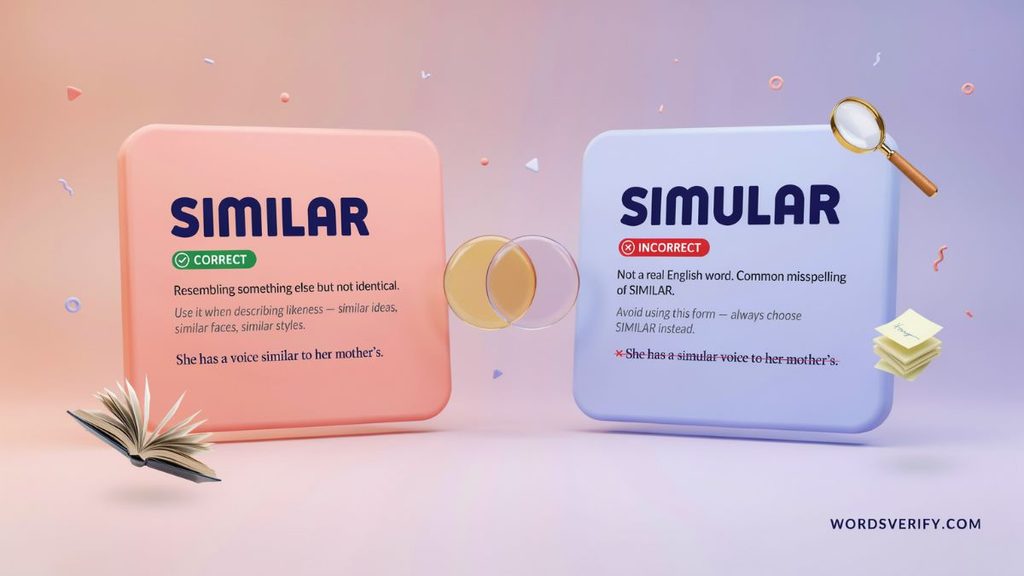
At first glance, the two words simular vs similar look almost identical. They share several letters and have related linguistic backgrounds. Nevertheless, their meanings and modern applications differ.
The most important distinction is that similar describes resemblance, while historical simular describes imitation, pretense, or something counterfeit.
Here’s a more detailed comparison:
| Comparison | Similar | Simular |
|---|---|---|
| Modern status | Standard English | Archaic |
| Main meaning | Alike or resembling | Imitative, false, or pretended |
| Part of speech | Adjective | Historical noun and adjective |
| Common usage | Everyday communication | Historical and literary contexts |
| Etymological connection | Latin similis through French or Medieval Latin | Latin simulare |
| Refers to resemblance | Yes | Not as its standard modern meaning |
| Refers to deception | No inherent connection | Yes, in historical usage |
| Common in modern writing | Yes | No |
| Suitable for ordinary comparisons | Yes | No |
Similar vs Simular Are Related but Not Interchangeable
The words simular vs similar have a shared linguistic background, which helps explain their resemblance.
Both connect to Latin words associated with likeness and imitation. However, their development produced different English meanings.
Think about the distinction this way:
- Two paintings with matching colors are similar.
- A painting presented as an original when it’s actually a fake may be described as simular in an archaic context.
One describes resemblance. The other historically describes imitation or pretense.
This is why the difference between similar and simular isn’t simply a matter of changing one letter. The words carry different meanings and belong to different stages of English usage.
Avoid everyday grammar mistakes with simple tips
Light vs Lite which one is correct?
The Origin and History of Similar vs Simular
A look at their origins reveals why these words appear so closely related. Their histories connect to Latin, French, and the development of English vocabulary.
Although both words ultimately trace back to related Latin roots, they entered English through different formations.
The Etymology of Similar
The English word similar comes through French similaire and Medieval Latin similaris, ultimately deriving from Latin similis.
The Latin word similis meant like, resembling, or of the same kind.
An earlier English form, similary, appeared in the 16th century. The modern adjective similar is recorded from the early 17th century.
Over time, the word developed into the familiar adjective used to describe resemblance and shared characteristics.
Its linguistic family includes several related words:
- Similarity: The quality or condition of being alike.
- Similarly: In a comparable or related manner.
- Dissimilar: Not alike or not sharing the same characteristics.
- Dissimilarity: A difference or lack of resemblance.
- Simile: A figure of speech that compares two different things using words such as like or as.
For example, consider this sentence:
“Her smile was like sunshine.”
This is a simile because it compares a smile with sunshine. The comparison depends on an imagined resemblance rather than literal identity.
These related words show how the idea of likeness has influenced English vocabulary.
The Historical Origin of Simular
The word simular has a closely related but slightly different history.
It entered English during the 1520s and connects to Latin simulare, meaning to make like, imitate, copy, represent, or pretend.
The Latin verb comes from the same broader family as similis.
However, the English noun simular developed around the idea of someone who imitates or pretends. Its adjective use later described something assumed or simulated.
This explains its historical association with:
- Imitation.
- Pretense.
- False appearances.
- Counterfeit objects.
- People pretending to possess qualities they don’t have.
The word eventually became rare and archaic in ordinary English.
Today, related words such as simulate, simulation, and simulated remain much more useful.
For example:
- The software can simulate real-world driving conditions.
- The training program uses a flight simulation.
- The company created a simulated environment for testing.
These modern words retain the idea of imitation or representation without requiring the archaic term simular.
Are Similar vs Simular Related?
Yes. Their linguistic roots are related, although their modern meanings differ.
Both connect to Latin similis and simulare. The first concerns being alike, while the second concerns making something appear alike or imitating it.
A useful way to understand their relationship is to compare the following words:
| Word | Meaning |
|---|---|
| Similar | Having characteristics in common |
| Simulate | To imitate or reproduce conditions |
| Simulation | An imitation or representation of a real process |
| Simulated | Artificially reproduced or imitated |
| Similarity | The quality of being alike |
| Simular | An archaic word associated with imitation or pretense |
The relationship becomes easier to understand when you consider how language develops. Words that share an origin can acquire different meanings over centuries.
Their common ancestry doesn’t mean modern writers can substitute one for another.
Avoid everyday grammar mistakes with simple tips
Loss vs Lose which one is correct?
American English vs British English Is Similar Spelled Differently?
Some English words change spelling depending on whether you’re writing for an American or British audience. For example, Americans generally write color, while British writers use colour. Similarly, center becomes centre in British English.
Fortunately, similar doesn’t follow this pattern.
The spelling remains similar in both American and British English. Neither variety recognizes simular as a standard alternative spelling.
| American English | British English |
|---|---|
| Similar | Similar |
| Similarity | Similarity |
| Similarly | Similarly |
| Dissimilar | Dissimilar |
| Dissimilarity | Dissimilarity |
The main differences involve pronunciation rather than spelling.
For example, American speakers commonly pronounce the middle vowel in similar with a reduced sound. British pronunciation often retains a more noticeable second syllable.
However, these accent differences don’t change the written form.
Whether you’re preparing an American school assignment, a British business report, or an international email, the correct spelling remains similar.
Avoid everyday grammar mistakes with simple tips
Nitch vs Niche Which one Is Correct?
How to Pronounce Similar vs Simular
Pronunciation can contribute to English word confusion. Sometimes, a word sounds different from the way people expect it to look on paper. That’s one reason writers may accidentally produce a spelling such as simular.
Let’s look at both words.
Similar Pronunciation in American and British English
The standard American pronunciation of similar is:
- IPA: /ˈsɪm.ə.lɚ/
- Syllables: Three
- Primary stress: First syllable
The British pronunciation is commonly represented as:
- IPA: /ˈsɪm.ɪ.lə/
- Syllables: Three
- Primary stress: First syllable
The exact vowel sounds vary by accent. American English commonly uses a reduced vowel in the middle syllable and a pronounced final R sound. In many British accents, the final R isn’t pronounced unless a following vowel connects to it.
To say similar naturally, begin with the first syllable and keep the remaining sounds relatively light.
Simular Pronunciation
Historical simular has also been recorded with pronunciation forms such as /ˈsɪm.jʊ.lə(r)/.
Its pronunciation may resemble similar in certain accents, which can make the two spellings look even more confusing.
However, pronunciation doesn’t determine whether a word is an acceptable modern spelling.
Even if someone pronounces similar in a way that sounds close to simular, the standard written form remains unchanged.
Similar vs Simular Pronunciation Differences
| Feature | Similar | Simular |
|---|---|---|
| First syllable | Stressed | Historically stressed |
| Syllable count | Three | Three |
| Standard modern pronunciation | Established | Archaic or dictionary-specific |
| Modern everyday use | Common | Rare |
| Standard spelling for resemblance | Yes | No |
The safest approach is to learn the pronunciation of similar rather than inventing a spelling based on how it sounds.
Avoid everyday grammar mistakes with simple tips
Feed vs Fead and which one is correct?
How to Use Similar Correctly in a Sentence
Knowing the meaning of similar is only half the job. You also need to understand how it fits into a sentence.
Because similar is an adjective, it usually appears before a noun or after a linking verb.
For example:
- They purchased similar cars.
- The two cars are similar.
- Both candidates have similar qualifications.
The adjective can also appear with modifiers that show the degree of resemblance.
Using Modifiers With Similar
Words such as very, quite, fairly, remarkably, and strikingly help explain how closely two things resemble each other.
Examples:
- The two paintings are very similar.
- Their opinions are quite similar.
- The buildings have remarkably similar designs.
- Both companies offer fairly similar services.
- The twins look strikingly similar.
These modifiers add useful detail. Saying two products are slightly similar communicates something different from saying they’re almost identical.
Similar in Everyday Situations
Here are some practical examples showing how the word works in different contexts.
At work:
“The two departments have similar responsibilities.”
This means both departments handle comparable tasks, although their exact duties may differ.
At school:
“The students submitted similar answers.”
Their answers shared important ideas or information, but they weren’t necessarily word-for-word copies.
While shopping:
“These jackets look similar, but one costs twice as much.”
The jackets share visual features, yet their prices differ.
In relationships:
“My best friend and I have similar interests.”
Both people enjoy some of the same activities, hobbies, or experiences.
In science:
“The two samples showed similar chemical properties.”
The samples shared certain measurable characteristics, although they weren’t necessarily identical in composition.
These examples demonstrate how flexible similar is in modern English.
Avoid everyday grammar mistakes with simple tips
Discard vs Disgard Which one Is Correct?
Common Mistakes When Writing Similar vs Simular
Even experienced writers occasionally make spelling mistakes. Some errors happen because two words look alike, while others develop through pronunciation habits or confusion about word origins.
The most common mistake involves replacing the final letters of similar with -ular.
Here are the problems to watch for.
Using Simular Instead of Similar
This is the central mistake.
Incorrect: The two dresses have a simular design.
Correct: The two dresses have a similar design.
The sentence describes resemblance, so similar is the appropriate adjective.
Confusing Similar With Identical
These words are related in meaning, but they don’t communicate exactly the same thing.
Incorrect: The two phones are similar, so they must be identical.
Correct: The two phones are similar, but their cameras and battery capacities differ.
Similar means sharing characteristics. Identical means exactly the same in the relevant respects.
Using Similar When You Mean Simulated
Another source of confusion involves similar and simulated.
Incorrect: The pilot practiced in a similar flight environment, when the intended meaning is an artificial training environment.
Correct: The pilot practiced in a simulated flight environment.
A simulated environment reproduces aspects of a real environment. A similar environment simply resembles another one.
Confusing Similar and Similarly
Remember their grammatical roles.
Incorrect: The two companies similarly products.
Correct: The two companies offer similar products.
Alternatively:
“The two companies operate similarly.”
The adjective similar describes nouns, while the adverb similarly describes actions or circumstances.
Assuming Simular Is a Regional Spelling
Some writers assume that simular might be accepted in another English-speaking country.
That’s not the case for the modern adjective meaning alike. American and British English both use similar.
The historical word simular doesn’t become a regional spelling variation simply because older dictionaries record it.
Avoid everyday grammar mistakes with simple tips
Inversely vs Conversely which one is correct?
Similar vs Simular Examples in Everyday Sentences
Examples are often the quickest way to understand a spelling distinction. Instead of memorizing a complicated definition, look at how the words function in context.
Correct Examples Using Similar
Here are 15 examples of similar in everyday English.
| Example sentence | Context |
|---|---|
| My brother and I have similar interests. | Personality and hobbies |
| These two cars have similar engines. | Products |
| The houses have similar architectural styles. | Design |
| Both students received similar grades. | Education |
| Their experiences were remarkably similar. | Life experiences |
| The two dresses have similar patterns. | Clothing |
| Our opinions on the subject are similar. | Ideas |
| These recipes use similar ingredients. | Cooking |
| The twins have similar facial features. | Appearance |
| Both companies offer similar services. | Business |
| The results were similar to those of the previous experiment. | Research |
| Their working methods are quite similar. | Professional life |
| The two neighborhoods have similar housing costs. | Living expenses |
| This problem is similar to the one we solved yesterday. | Problem-solving |
| The paintings look similar from a distance. | Art |
Each example describes resemblance without claiming that the compared things are exactly alike.
Incorrect Examples Using Simular
Now look at sentences where simular incorrectly replaces similar.
| Incorrect sentence | Correct sentence |
|---|---|
| We have simular opinions. | We have similar opinions. |
| The two bags look simular. | The two bags look similar. |
| Their experiences were simular. | Their experiences were similar. |
| These products have simular features. | These products have similar features. |
| My handwriting is simular to yours. | My handwriting is similar to yours. |
| Both buildings have simular designs. | Both buildings have similar designs. |
In every example, the sentence describes resemblance. Therefore, similar is the correct modern spelling.
Historical Examples of Simular
Although simular doesn’t belong in ordinary modern comparisons, it can appear in historical writing.
One notable example is Shakespeare’s King Lear, which uses the phrase “simular of virtue.”
In that context, the word describes someone who only pretends to possess virtue.
Historical usage also includes references to people who imitate or counterfeit something.
The important lesson is simple: a word can be legitimate in an older text without being appropriate for modern everyday writing.
Similar vs. Other Commonly Confused Words
The English language contains many words that describe likeness, resemblance, and comparison. However, their meanings aren’t always interchangeable.
Understanding these differences can improve your vocabulary and help you choose more precise words.
Similar vs. Same
Similar means sharing certain characteristics, while same indicates that two or more things are identical in identity or relevant characteristics.
Examples:
- Similar: The two students have similar backpacks.
- Same: The two students bought the same backpack model.
In the first example, the backpacks resemble each other. In the second, they belong to the same model or type.
Similar vs. Alike
Both words describe resemblance, but they work differently in sentences.
Similar is an adjective that commonly appears before a noun or after a linking verb. Alike generally appears after a linking verb.
Examples:
- The sisters have similar personalities.
- The sisters are very much alike.
- Their opinions are similar.
- Their opinions are alike.
You wouldn’t normally say “alike personalities.” Instead, use similar personalities.
Similar vs. Identical
These words describe different degrees of resemblance.
Similar means having some qualities in common. Identical means exactly the same in the relevant respects.
For example:
“The two watches look similar, but they have different mechanisms.”
This sentence tells readers that the watches share visual characteristics but differ internally.
By contrast:
“The two documents are identical.”
This means their contents match exactly.
Similar vs. Simulated
These words are especially interesting because they share a linguistic connection.
Similar describes resemblance. Simulated describes something artificially reproduced or imitated.
Examples:
- The two training programs have similar structures.
- The students practiced in a simulated classroom.
The first sentence compares two programs. The second describes an artificial environment designed to reproduce a real classroom experience.
Similar vs. Comparable
Comparable describes things that can reasonably be compared, often because they share qualities, standards, or measurable features.
For example:
“The two smartphones have comparable battery performance.”
This means their battery performance can be considered similar, although the actual figures may differ.
Comparable is especially useful in business, academic, and technical writing.
Synonyms and Antonyms of Similar
Sometimes, repeating the same adjective makes writing feel dull. Fortunately, English offers several alternatives.
However, choosing the right synonym matters because each word carries a slightly different meaning.
Common Synonyms for Similar
| Synonym | Meaning | Example |
|---|---|---|
| Alike | Having similar qualities | The brothers look alike. |
| Comparable | Suitable for comparison | Both products offer comparable performance. |
| Resembling | Looking or being like something | She bought a dress resembling mine. |
| Analogous | Similar in certain ways, often by comparison | The two systems have analogous structures. |
| Equivalent | Equal in value, function, or effect | Both methods produce equivalent results. |
| Corresponding | Matching or relating to something else | The figures show corresponding changes. |
| Related | Connected in some way | The two subjects are closely related. |
| Nearly identical | Almost exactly the same | The two copies are nearly identical. |
| Matching | Having features that go together | They wore matching jackets. |
Don’t assume these words are interchangeable in every situation. For example, equivalent often suggests equal value or function, while analogous highlights a meaningful comparison between different things.
Antonyms of Similar
The opposite of similar is generally different or dissimilar.
Other useful antonyms include:
- Distinct.
- Unlike.
- Unrelated.
- Contrasting.
- Dissimilar.
- Opposite.
- Divergent.
- Incompatible.
Examples:
- Their opinions are completely different.
- The two designs have distinct features.
- These products are unrelated.
- The results were markedly dissimilar.
Choosing an appropriate antonym can make comparisons clearer and more precise.
How to Remember the Correct Spelling of Similar
Spelling becomes easier when you connect a word with other familiar words simular vs similar in its family.
If you frequently confuse simular vs similar, try these simple techniques.
Remember Similarity
The easiest memory trick involves the noun similarity.
Both similar and similarity contain the same central spelling pattern.
For example:
- Similar appearance.
- Similar interests.
- Similar characteristics.
- Strong similarity.
- Noticeable similarity.
When you remember similarity, the correct adjective becomes easier to recognize.
Focus on the Meaning
Ask yourself what you’re trying to describe.
Are two people alike? Do two products share features? Are two situations comparable?
If the answer involves resemblance, choose similar.
For example:
“These two paintings have a ______ style.”
The correct answer is similar because the sentence describes shared artistic characteristics.
Connect Similar With Its Related Words
Remembering related vocabulary can reinforce correct spelling of simular vs similar.
| Word | Meaning |
|---|---|
| Similar | Alike or resembling |
| Similarity | Shared qualities or resemblance |
| Similarly | In a comparable way |
| Dissimilar | Not alike |
| Dissimilarity | A difference or lack of resemblance |
The more familiar you become with this word family, the less likely you are to make the same spelling mistake.
Practice session Simular vs Similar
Test your understanding of simular vs similar and related words with these fill-in-the-blank sentences. Choose the correct word or form for each sentence.
1. The two sisters have remarkably __________ personalities.
2. Your new phone looks __________ to the model I bought last year.
3. The students completed the assignment in a __________ way.
4. These paintings share several __________ features.
5. My opinion is quite __________ to yours.
6. The two houses look __________, but their interiors are completely different.
7. She responded __________ to both questions.
8. The designs are more __________ than I initially expected.
9. There is a strong __________ between these two photographs.
10. His writing style is __________ to that of his favorite author.
11. The two companies offer __________ services to their customers.
12. Both teams performed __________ well during the competition.
13. The twins have __________ interests and hobbies.
14. This situation is __________ to what we experienced last year.
15. The second example is the most __________ to the original.
16. Although the bags look __________, they come from different manufacturers.
17. The two researchers reached __________ conclusions.
18. Their approaches were __________, despite their different backgrounds.
19. The old document contains the historical word __________, which is no longer used in everyday English.
20. The correct modern spelling is __________, not simular.
21. The two recipes are __________ in ingredients but differ in preparation.
22. My experience was __________ to yours, although the results were different.
23. The new design closely __________ the original version.
24. Both speakers expressed their ideas __________, using nearly identical arguments.
25. The words similar and similarly are related, but they have different grammatical __________.
Answers
- Similar
- Similar
- Similar
- Similar
- Similar
- Similar
- Similarly
- Similar
- Similarity
- Similar
- Similar
- Similarly
- Similar
- Similar
- Similar
- Similar
- Similar
- Similar
- Simular
- Similar
- Similar
- Similar
- Resembles
- Similarly
- Functions
Here’s a trusted source for clear word meanings:
FAQs
Is similar an adjective or an adverb?
Similar is an adjective because it describes a noun or pronoun. Similarly is an adverb because it describes how an action happens or how two situations compare.
Can similar be used with people?
Yes. Similar can describe people who share interests, personalities, habits, appearances, or experiences. For example, “My brother and I have similar tastes in music.”
Is it correct to say “I feel similar”?
It depends on what you mean. “I feel similar” is possible when you’re comparing your emotional state or experience with someone else’s, but “I feel the same way” sounds more natural in everyday conversation.
What does “similar in appearance” mean?
Similar in appearance means that two or more people or things look alike in certain ways. They might share facial features, colors, shapes, or designs without being identical.
What is the difference between similar and identical?
Similar describes things that share some characteristics but aren’t necessarily exactly alike. Identical means two things are exactly the same in the relevant details. For example, two similar bags may have different colors, while identical bags have matching features.
Can I use “very similar” in formal writing?
Yes. Very similar is grammatically correct and works in both formal and informal writing. In academic or professional contexts, you can also use closely comparable or highly alike when those expressions fit the meaning.
What does “closely similar” mean?
Closely similar means having many shared characteristics or a strong resemblance. However, the phrase can sound redundant because similar already expresses resemblance. In most cases, closely resemble or very similar sounds more natural.
Is “similar with” grammatically correct?
Usually, use similar to when comparing two things. For example, “Her writing style is similar to her teacher’s.” Similar with may occur in certain constructions, but it isn’t the standard choice for a direct comparison.
What does “similar-looking” mean?
Similar-looking describes two or more people or objects that have much the same appearance. For example, “The twins wore similar-looking jackets.”
What is the difference between “resemble” and “similar”?
Resemble is a verb meaning to look like or share characteristics with someone or something. Similar is an adjective that describes the relationship between things. For example, “The sisters resemble each other” and “The sisters look similar.”
Can “similar” describe ideas and opinions?
Yes. Similar can describe abstract things such as ideas, opinions, beliefs, experiences, and methods. For example, “The researchers reached similar conclusions.”
What does “similarly situated” mean?
Similarly situated describes people, groups, or organizations that share comparable circumstances or conditions. The expression often appears in legal, academic, and professional writing.
Is “similar to each other” correct?
Yes. Similar to each other is a grammatically correct phrase used when two or more things share characteristics. For example, “The two designs are similar to each other.”
What is the difference between “similarity” and “similar”?
Similar is an adjective that describes resemblance. Similarity is a noun that refers to the quality or degree of being alike. For example, “The paintings are similar” and “There is a clear similarity between the paintings.”
Can “similar” be used in the comparative and superlative forms?
Yes. You can use more similar and most similar to compare degrees of resemblance. For example, “These two models are more similar than the older versions.” Most similar identifies the closest match among several options.
What does “similarly to” mean?
Similarly to introduces a comparison between actions, situations, or examples. However, it can sound awkward in some sentences. Depending on the context, like, in the same way as, or comparable to may read more naturally.
Is “similarity” the same as “sameness”?
No. simular vs similar, Similarity means that things share certain features, while sameness suggests that they are alike in identity or essential characteristics. Two songs may have similarities without being the same song.
What is a common mistake when using similar?
One common mistake is writing simular instead of similar. Other errors include using similarily instead of similarly and writing similar too instead of similar to. Remember that similar is the standard spelling, and the preposition to introduces the comparison.
How can I remember the spelling of similar?
Remember that similar contains the letter i before the final lar. You can also connect it with similarity, which shares the same spelling pattern. Practicing both words in sentences can help make the correct form stick.
Conclusion
Choosing between simular vs similar doesn’t have to be a spelling guessing game. Similar is the correct modern spelling when you describe things that share qualities, features, or characteristics. Simular may look like a reasonable alternative, but it’s an outdated form that has little place in everyday English. Remember, one small letter can make a big difference, especially when you’re trying to communicate clearly. The next time you write about two things that resemble each other, stick with similar. Your readers will understand exactly what you mean, and your spelling won’t need a second opinion!

Lisa AJS is an experienced blogger and language enthusiast at Words Verify, dedicated to making grammar simple, practical, and enjoyable. She writes engaging content on commonly confused words, grammar mistakes, word meanings, and everyday language challenges.