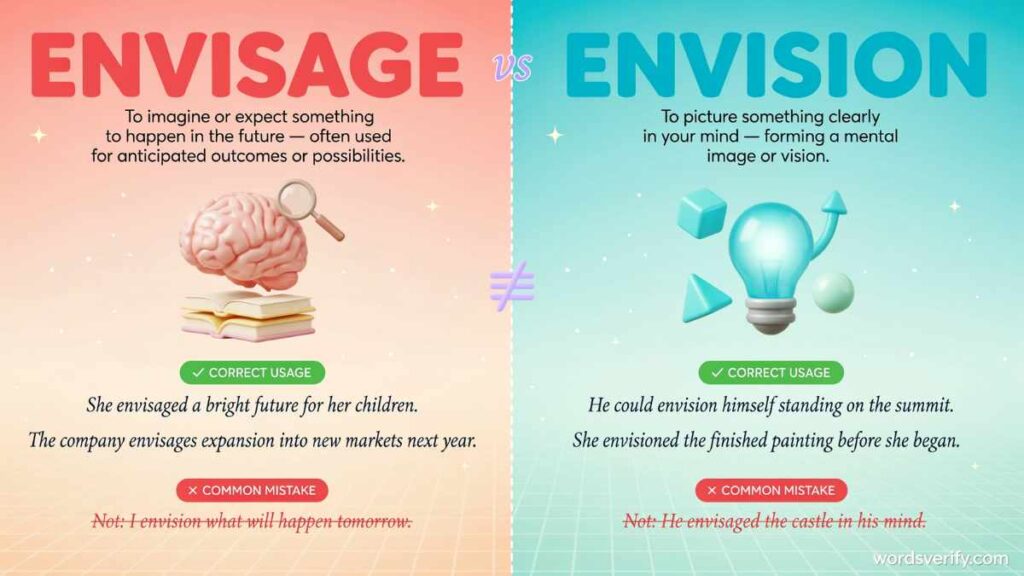
Have you ever pictured your future and wondered whether to envisage it or envision it? These two verbs look so much alike that even confident writers sometimes mix them up. The good news is that understanding envisage vs envision doesn’t require a crystal ball or a grammar degree. Both words describe imagining something that may happen or exist, but they differ slightly in usage and regional preference. Pick the wrong one, and your sentence probably won’t fall apart. Still, choosing the right word makes your writing clearer and more natural. Let’s explore their meanings, differences, and correct usage through simple explanations and practical examples.
Envisage vs Envision Quick Answer
Envisage and envision both mean to imagine, picture, or mentally consider something that may happen or exist in the future. They are verbs used to describe thoughts about possible situations, plans, goals, and outcomes.
The biggest difference is how frequently people use them in different varieties of English.
- Envisage is more common in British English.
- Envision is more common in American English.
- Both words describe forming a mental picture or considering a future possibility.
- Both work in everyday conversations, academic writing, and professional communication.
- They are often interchangeable without changing the meaning of a sentence.
Consider these examples:
- British English: The government envisages a significant improvement in public transportation.
- American English: The government envisions a significant improvement in public transportation.
Both sentences express the same idea. The difference reflects regional preference rather than a grammatical rule.
| Feature | Envisage | Envision |
|---|---|---|
| Part of speech | Verb | Verb |
| Basic meaning | To imagine or consider something possible | To imagine or mentally picture something |
| Regional preference | British English | American English |
| Common contexts | Future situations, plans, and possible outcomes | Future goals, ambitions, and possibilities |
| Past tense | Envisaged | Envisioned |
| Present participle | Envisaging | Envisioning |
| Interchangeable | Often | Often |
A simple way to remember the distinction is to associate envisage with British English and envision with American English. Neither word is restricted to a particular country, though.
Learn the difference between commonly misused words
Saucy vs Saucey Which one Is Correct?
What Does Envisage Definition and Meaning?
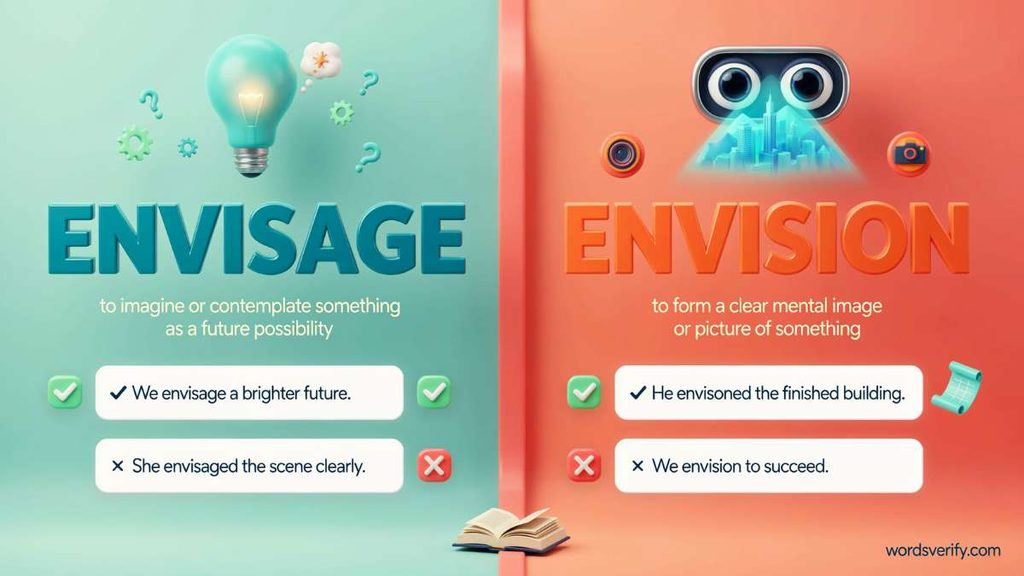
Envisage is a verb that means to imagine something, form a mental picture of a possible situation, or consider what might happen in the future.
It often describes thinking about an event, outcome, plan, or circumstance before it becomes reality. For instance, someone might envisage moving abroad, starting a business, or enjoying a more comfortable retirement.
The word doesn’t always describe wishful thinking. It can also involve practical decisions and realistic expectations.
A business manager might envisage the challenges of launching a new product. An architect might envisage how a building will look once construction finishes. Similarly, a student might envisage a future career before choosing a university course.
Here are some examples:
- The architect envisages a modern building with energy-efficient features.
- We envisage several challenges during the first year of the project.
- She envisages becoming a successful entrepreneur.
- The researchers envisage a future in which renewable energy supplies most of the world’s electricity.
- I cannot envisage living somewhere without access to the internet.
In each example, someone mentally considers a situation that hasn’t happened yet.
How to Use Envisage in a Sentence
Knowing what envisage means is important, but using it correctly in a sentence matters just as much.
Envisage is a transitive verb, which means it can take a direct object. It also works with gerunds and clauses that describe possible situations.
Envisage + noun
Use this structure when imagining a particular thing, outcome, or situation.
- The company envisages a major expansion next year.
- Scientists envisage new possibilities for medical research.
- She envisages a peaceful retirement in the countryside.
Envisage + someone or something + doing something
This pattern describes an imagined action or situation.
- I envisage my brother running his own company someday.
- They envisage the new system reducing operating costs.
- We don’t envisage making any major changes this year.
Envisage + that-clause
Use a that-clause to explain what someone thinks might happen.
- The management envisages that sales will increase next quarter.
- Experts envisage that technology will transform several industries.
- I envisage that the negotiations will take several months.
Envisage + how, what, or where
These structures help describe the details of an imagined situation.
- Can you envisage how the new arrangement will work?
- Nobody could envisage what would happen next.
- It’s difficult to envisage where the industry will be in ten years.
These patterns make envisage useful in everyday conversations, business reports, academic discussions, and planning.
Envisage Pronunciation
In American English, envisage is commonly pronounced /ɛnˈvɪzɪdʒ/. British speakers often pronounce it /ɪnˈvɪzɪdʒ/.
The word has three syllables, with the stress falling on the second. Its final sound is similar to the ending of judge.
One common mistake is pronouncing the ending like the word age. The final syllable actually has a /ɪdʒ/ sound.
Learn the difference between commonly misused words
Annual vs Anual Which one Is Correct?
What Does Envision Definition and Meaning?
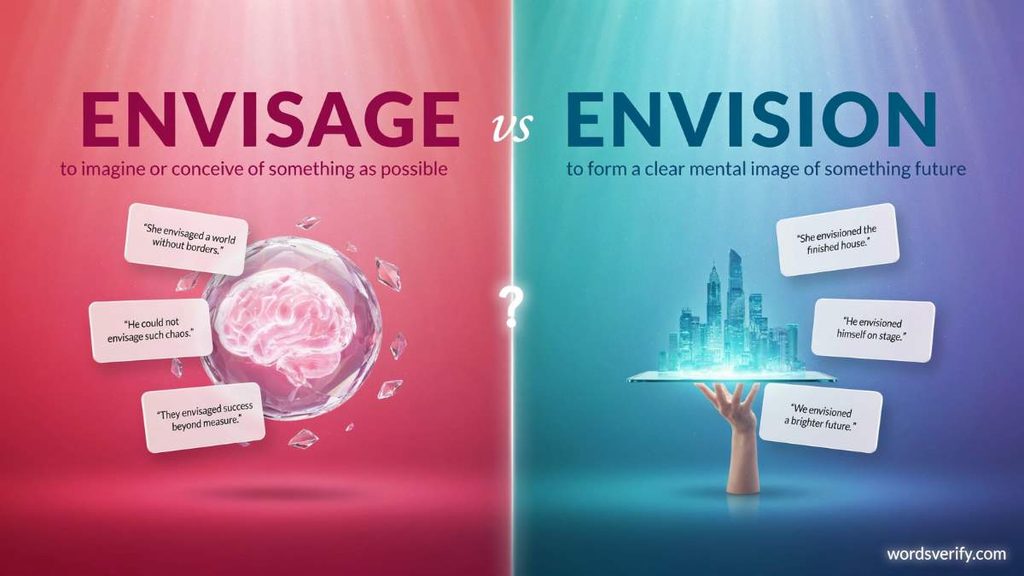
Envision is a verb that means to imagine, picture, or mentally visualize something, particularly a future event, situation, or possibility.
When you envision something, you create a mental picture of what it could look like. That picture might represent a personal ambition, a professional goal, a creative idea, or a completely different future.
For example, a student might envision graduating from college and becoming a doctor. A business owner might envision opening several branches across the country. An engineer might envision a machine that solves an existing problem more efficiently.
The word often appears in conversations about ambition, innovation, leadership, and long-term goals.
However, envisioning something doesn’t mean it will automatically happen. It simply means you can imagine that possibility.
Consider these examples:
- She envisions a future where every child has access to quality education.
- The designer envisions a spacious home with large windows and natural lighting.
- He envisions becoming an international business consultant.
- The organization envisions a world with fewer environmental problems.
- We envision a more efficient transportation system.
Each sentence describes a mental picture of something that might become reality.
How to Use Envision in a Sentence
Like envisage, envision is a transitive verb. It commonly takes a direct object and works with several sentence structures.
Envision + noun
Use this pattern when describing a particular goal, idea, or future possibility.
- The company envisions a new approach to customer service.
- She envisions a successful career in medicine.
- They envision a better future for their children.
Envision + someone or something + doing something
This structure describes an imagined action or situation.
- I envision my daughter studying at a leading university.
- The developers envision the software helping thousands of businesses.
- We envision our team working more efficiently.
Envision + that-clause
Use this construction when describing what you imagine might happen.
- The director envisions that the project will attract international attention.
- They envision that the new policy will improve working conditions.
- She envisions that her business will expand over the next few years.
Envision + someone or something + as
This pattern describes how you imagine or regard someone or something.
- He envisions himself as a future company director.
- The architect envisions the building as a community center.
- They envision the organization as a leader in sustainable development.
These structures make envision particularly useful when discussing ambitions, professional objectives, creative projects, and future plans.
Envision Pronunciation
The common American pronunciation of envision is /ɪnˈvɪʒən/.
It has three syllables, with the stress on the second. The middle consonant is the voiced /ʒ/ sound, which also appears in words such as vision and measure.
Pay attention to the ending when comparing the two verbs. Envisage ends with a /dʒ/ sound, while envision ends with /ʒən/.
Learn the difference between commonly misused words
Recurrence vs Reoccurrence What’s the Difference?
Envisage vs Envision What Is the Difference?
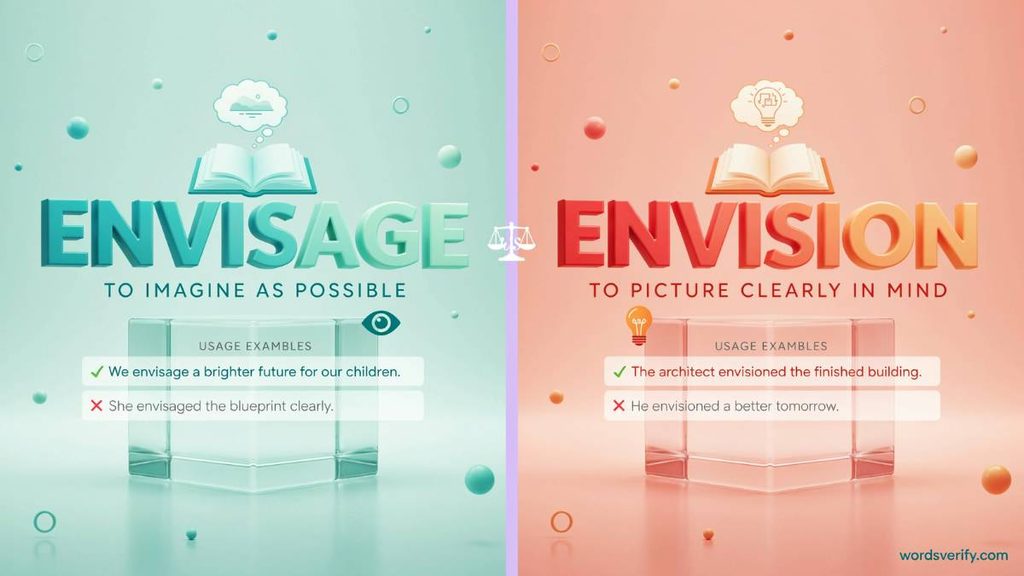
Both words describe mental activity. They allow you to talk about situations that haven’t happened yet, possible outcomes, and ideas that exist only in someone’s imagination.
However, their typical contexts and regional preferences can help you decide which one sounds more natural.
Differences in Meaning and Context
Envisage often appears when someone considers a possible situation, future event, or practical outcome. It can suggest careful thought about what might happen.
For example:
The project manager envisages several difficulties during the construction phase.
Here, the manager considers potential problems before construction begins.
Envision often appears when someone imagines a particular future, especially one they hope to create or work toward.
For example:
The project manager envisions a modern office that encourages creativity and teamwork.
This sentence focuses on a desired future arrangement.
The distinction isn’t absolute. You could replace envisages with envisions in the first sentence and envisions with envisages in the second. Both alternatives would be grammatically correct.
The difference lies mainly in emphasis and common usage rather than a strict difference in definition.
Envisage vs Envision Comparison
| Comparison | Envisage | Envision |
|---|---|---|
| Core meaning | Imagine or consider a possibility | Imagine or mentally picture something |
| Common association | Future circumstances and possible outcomes | Future goals and desired situations |
| British usage | Especially common | Less common overall |
| American usage | Less common overall | Especially common |
| Business writing | Plans and possible outcomes | Strategic goals and future development |
| Personal goals | Correct | Correct |
| Academic writing | Correct | Correct |
| Formal writing | Appropriate | Appropriate |
Are Envisage vs Envision Interchangeable?
Yes. In many situations, envisage and envision are interchangeable because they share almost identical meanings.
For example:
- She envisages a future without financial difficulties.
- She envisions a future without financial difficulties.
Both sentences describe someone mentally picturing a possible future.
Here are a few more examples:
| With Envisage | With Envision |
|---|---|
| They envisage a new business opportunity. | They envision a new business opportunity. |
| I envisage working abroad someday. | I envision working abroad someday. |
| The team envisages a successful project. | The team envisions a successful project. |
| We envisage a world with cleaner energy. | We envision a world with cleaner energy. |
The meaning stays largely the same.
However, regional expectations still matter. An American reader will generally find envision more familiar, while a British reader may naturally expect envisage.
The best approach is to consider your audience and use the same variety of English throughout your writing.
Learn the difference between commonly misused words
Copyright vs Copywrite Which one Is Correct?
Envisage vs Envision in British and American English
English speakers across different countries often prefer different words, even when those words have almost identical meanings.
For example, Americans generally use apartment, while British speakers commonly say flat. Similarly, envisage and envision have developed different levels of popularity across English-speaking regions.
Envisage in British English
Envisage is particularly common in British English. British writers frequently use it when discussing future circumstances, expectations, proposed changes, and possible outcomes.
Consider these examples:
- The government envisages introducing new environmental regulations.
- We envisage a gradual improvement in the economy.
- The company envisages expanding its operations across Europe.
- She cannot envisage living in a large city.
These sentences sound natural in British English, especially in professional and formal settings.
The word also appears in Australian and other Commonwealth varieties of English, although individual preferences vary.
Envision in American English
Envision is generally the preferred option in American English.
American speakers commonly use it when discussing personal ambitions, professional goals, creative ideas, and long-term plans.
Examples include:
- We envision a stronger economy with more employment opportunities.
- She envisions becoming a successful architect.
- The company envisions opening 20 new locations.
- He envisions a future powered by renewable energy.
The word is especially familiar in American business and political discussions.
Which Word Should You Choose?
Your audience is usually the best guide.
| Writing situation | Natural choice |
|---|---|
| American business report | Envision |
| British business report | Envisage |
| American academic paper | Envision is generally more familiar |
| British academic paper | Envisage is generally more familiar |
| American everyday conversation | Envision |
| British everyday conversation | Envisage |
| International audience | Either, used consistently |
These are general preferences rather than strict rules. Americans can use envisage, and British speakers can use envision.
Both words are recognized English vocabulary. You won’t make a grammatical mistake simply by choosing the less common regional option.
Learn the difference between commonly misused words
Appraised vs Apprised What’s the Difference?
The Origin and History of Envisage and Envision
Although envisage vs envision share similar meanings, they developed through different word-formation processes.
Their histories also reveal an interesting connection with sight, imagination, and mental pictures.
Envisage Word Origin and Etymology
Envisage comes from the French verb envisager, which originally meant to look in the face or face something directly.
The French word combines two elements:
- En-: A prefix associated with putting something into or bringing it into a particular state.
- Visage: A French word meaning face or facial appearance.
Envisage entered English in 1778, initially carrying the sense of looking someone or something in the face. By 1837, it had also developed the meaning of mentally considering or contemplating something.
Over time, its modern meaning became associated with forming a mental picture of a possible event or future situation.
This development connects the original idea of looking directly at something with the figurative act of looking at a possibility in your mind.
Envision Word Origin and Etymology
Envision developed much later than envisage. Its formation combines the English prefix en- with the noun vision.
The word vision relates to seeing, mental images, and the ability to imagine something.
According to historical etymological records, envision first appeared in English in 1914.
Its construction is relatively easy to understand:
- En-: A prefix associated with putting something into a particular state.
- Vision: The ability to see or form a mental picture.
Together, these elements create a verb associated with forming a mental picture of something.
The word became particularly established in American English, where speakers commonly use it to describe future ambitions, creative ideas, and long-term goals.
How Their Origins Explain Their Meanings
The histories of both words connect them with the idea of seeing.
Envisage originally referred to looking at something directly, while envision developed from the word vision. Both eventually acquired meanings related to mental images and imagination.
Their different origins explain why they look and sound different. Their shared connection with seeing helps explain why their modern definitions overlap so closely.
| Word | Historical origin | Earliest recorded date in the cited etymological record | Original connection |
|---|---|---|---|
| Envisage | French envisager | 1778 | Looking in the face |
| Envision | English en- + vision | 1914 | Mental or visual perception |
Learn the difference between commonly misused words
Simular vs Similar Which one Is Correct?
Envisage vs Envision Synonyms and Similar Words
Both verbs have several synonyms. However, choosing an alternative requires some care because words that share a general meaning don’t always work in exactly the same context.
For example, imagine, visualize, and foresee all relate to mental activity or future possibilities. Nevertheless, each word emphasizes something slightly different.
Envisage Synonyms
Here are some useful alternatives to envisage:
| Synonym | Meaning | Example |
|---|---|---|
| Imagine | Form an idea or picture in your mind | I imagine a better future. |
| Visualize | Create a mental picture | She visualizes her new home. |
| Contemplate | Think carefully about something | They contemplate moving abroad. |
| Conceive | Form an idea or concept | He conceived a different solution. |
| Foresee | Recognize or anticipate something before it happens | We foresee possible difficulties. |
| Anticipate | Expect or prepare for something | They anticipate further changes. |
| Picture | Imagine something mentally | I can picture the entire project. |
These alternatives can help you avoid repetition or express a more specific idea.
For instance, foresee emphasizes anticipating a future event, while visualize places greater emphasis on creating a mental image.
Envision Synonyms
The following words can also replace envision in suitable contexts:
| Synonym | Meaning | Example |
|---|---|---|
| Imagine | Think of something mentally | She imagines a successful career. |
| Visualize | Form a mental picture | He visualizes the finished design. |
| Picture | Imagine how something might look | I picture a house near the beach. |
| Conceive | Develop or form an idea | They conceived an innovative product. |
| Dream of | Imagine something desirable | She dreams of becoming a pilot. |
| Foresee | Anticipate a possible event | Experts foresee major changes. |
| Contemplate | Consider something carefully | We contemplate a new business strategy. |
Envisage vs Envision vs Imagine
Imagine has a broader meaning than either envisage or envision.
You can imagine almost anything. This includes fictional characters, unlikely situations, past events, future possibilities, and things that have never existed.
For example:
- Imagine a world without electricity.
- Imagine what would happen if animals could talk.
- I imagine he is already home.
By comparison, envisage and envision often focus more specifically on considering a possible future situation or forming an idea of what something might become.
Compare these examples:
Imagine: Imagine a dragon living in that cave.
Envisage: The researchers envisage a future with cleaner energy.
Envision: The company envisions becoming a global technology leader.
The first sentence involves creative imagination. The other two focus on possible or intended future situations.
Envisage vs Foresee
Although envisage and foresee sometimes overlap, they don’t mean exactly the same thing.
To envisage something is to imagine or consider a possible situation. To foresee something is to anticipate or recognize that it may happen.
For example:
- We envisage a major improvement in customer service.
- We foresee a possible shortage of raw materials.
The first sentence describes a possible future outcome. The second suggests an expectation about an event that may occur.
Envision vs Visualize
These words are also closely related.
Visualize specifically emphasizes forming a mental picture. Envision can describe that process but also commonly refers to imagining a broader future goal or situation.
For example:
- Visualize the layout of your new kitchen.
- Envision a future in which your business serves customers worldwide.
The distinction is subtle, but it helps you choose a more precise word.
Learn the difference between commonly misused words
Cataloguing vs Cataloging? Which one Is Correct?
Envisage vs Envision Grammar and Word Forms
Both words are regular verbs. They follow predictable spelling patterns when used in different tenses.
Knowing these forms will help you avoid common mistakes in everyday writing.
Envisage Word Forms
| Grammatical form | Correct spelling |
|---|---|
| Base form | Envisage |
| Third-person singular | Envisages |
| Simple past | Envisaged |
| Past participle | Envisaged |
| Present participle | Envisaging |
Examples:
- She envisages a successful future.
- He envisaged a different outcome.
- They are envisaging several changes.
- The project was originally envisaged as a small experiment.
Envision Word Forms
| Grammatical form | Correct spelling |
|---|---|
| Base form | Envision |
| Third-person singular | Envisions |
| Simple past | Envisioned |
| Past participle | Envisioned |
| Present participle | Envisioning |
Examples:
- He envisions a new business opportunity.
- She envisioned a peaceful retirement.
- They are envisioning a different approach.
- The organization has envisioned several improvements.
Common Grammatical Mistakes
Because both words are regular verbs, their past and participle forms are straightforward.
However, writers sometimes create incorrect forms by adding unnecessary endings.
| Incorrect form | Correct form |
|---|---|
| Envisageed | Envisaged |
| Envisageing | Envisaging |
| Envisionned | Envisioned |
| Envisioninged | Envisioning |
| Envisiones | Envisages |
Remember that envisage already ends in an E. When forming its present participle, remove that final E before adding -ing.
Thus, the correct spelling is envisaging, not envisageing.
For envision, simply add the appropriate verb ending: envisions, envisioned, and envisioning.
Learn the difference between commonly misused words
Ingenuine vs Ungenuine Which one Is Correct?
Envisage vs Envision in Everyday Examples
Definitions explain what words mean, but practical examples show how people use them.
Both verbs can appear in personal conversations, business reports, educational discussions, and creative writing. The following examples demonstrate their flexibility.
Examples About Future Plans
Future planning is one of the most common contexts for both verbs.
- She envisages living in a quiet coastal town after retirement.
- He envisions building a successful career in international finance.
- They envisage moving to another country within five years.
- We envision a future where everyone has access to affordable housing.
- I cannot envisage spending the rest of my life in the same city.
Examples in Business and Professional Writing
In professional settings, these words help describe possible outcomes, organizational goals, and long-term plans.
- The company envisages expanding its operations into three additional markets.
- The CEO envisions a workplace built around innovation and collaboration.
- The management team envisages a gradual increase in annual revenue.
- The organization envisions becoming a leading provider of renewable energy.
- Analysts envisage several challenges during the initial stages of implementation.
Examples in Education and Personal Development
Students, teachers, and professionals often use these verbs when discussing ambitions and future opportunities.
- She envisions becoming a university professor.
- The students envisage a future with more employment opportunities.
- He envisions studying engineering at a respected university.
- Teachers envisage a classroom where technology supports individual learning.
- I envisage gaining enough experience to manage my own team.
Examples in Creative and Everyday Contexts
Creative thinking often involves imagining situations that don’t yet exist.
- The artist envisions a colorful city filled with futuristic buildings.
- I envisage a garden with flowering plants and a small fountain.
- The novelist envisioned an imaginary world with its own history.
- The architect envisages a house that blends traditional and modern design.
- They envision a community where people share resources and support one another.
A Practical Example Choosing the Right Word
Imagine a technology company preparing a presentation about its next five years.
The management team wants to explain two things: the challenges it expects to face and the future it hopes to create.
It could write:
“The company envisages increased competition as new businesses enter the market. However, it envisions becoming one of the industry’s leading providers through innovation and customer-focused services.”
Why does this wording work?
The first sentence uses envisages to discuss a possible business circumstance. The second uses envisions to describe an ambitious future goal.
This distinction is useful, but it isn’t a fixed grammatical rule. A British writer might use envisages in both sentences, while an American writer would probably prefer envisions in both.
The important lesson is to choose words that communicate your intended meaning clearly and suit your audience.
Learn the difference between commonly misused words
Manner vs Manor which one is correct?
Common Mistakes When Using Envisage and Envision
Even though these verbs are relatively straightforward, a few misunderstandings can lead to awkward or inaccurate sentences.
Here are the mistakes worth avoiding.
Treating Envisage as an Incorrect American Word
Some writers assume that envisage is exclusively British and should never appear in American writing.
That’s incorrect.
Envisage is a recognized English verb in the United States. Americans simply tend to favor envision in most contexts.
Assuming Envision Is Incorrect in British English
The opposite assumption is also mistaken.
British speakers understand and use envision. Although envisage is generally more familiar, envision isn’t grammatically incorrect.
Confusing Envisage With Predict
These words are related, but they don’t mean exactly the same thing.
- Envisage: To imagine or consider a possible situation.
- Predict: To state what you think will happen.
- Foresee: To anticipate something before it occurs.
For example:
The researchers envisage a future with advanced medical technology.
This sentence describes a possible future.
The researchers predict that the new treatment will become widely available.
This sentence makes a prediction.
Assuming Envision Always Describes Positive Goals
Envision often appears in positive discussions about ambitions and progress. However, it can also describe neutral or negative possibilities.
For example:
The investigators envisioned several possible explanations for the incident.
The sentence doesn’t describe an aspiration. It describes possible interpretations.
Using Incorrect Verb Forms
Remember the correct forms:
- Envisaged, not envisageed.
- Envisaging, not envisageing.
- Envisioned, not envisionned.
- Envisioning, not envisioninged.
A quick review of regular verb endings can prevent these spelling mistakes.
Learn the difference between commonly misused words
Updated vs Update which one is correct?
Envisage vs Envision Is One More Formal?
Both words work in formal and informal English, although their tone can vary according to the sentence.
Envisage frequently appears in British professional writing, government documents, reports, and discussions about possible future circumstances.
Envision is common in American business writing, academic discussions, strategic planning, and presentations about future goals.
Neither word is automatically more formal than the other.
Consider these examples:
Formal: The committee envisages a substantial improvement in public services over the next decade.
Formal: The committee envisions a substantial improvement in public services over the next decade.
Conversational: Can you envisage living in another country?
Conversational: Can you envision living in another country?
All four sentences are grammatically correct.
If you’re writing an academic paper, business proposal, or professional report, choose the form that best suits your audience. Consistency matters more than trying to make one word sound unnecessarily sophisticated.
How to Remember the Difference Between Envisage and Envision
If you occasionally confuse these words, a simple memory trick can make the choice easier.
Think of the word vision when you see envision. Both relate directly to seeing or forming a mental picture.
For envisage, remember its connection with the French word visage, meaning face.
You can also use regional preference as a practical reminder:
- Envisage: Think British English.
- Envision: Think American English.
This isn’t an absolute rule, but it provides a useful starting point when deciding which word to use.
Most importantly, remember that both verbs describe imagining or considering something mentally. Their regional preferences shouldn’t make you think one is right and the other is wrong.
Practice session Envisage vs Envision
Test your understanding of “envisage” vs “envision” with these 25 fill-in-the-blank sentences. Choose the word that best completes each sentence. Pay attention to the context and verb form.
Fill in the blanks
- I can easily ________ a future where everyone has access to quality education.
- The architect ________ a modern home with large windows and an open kitchen.
- Can you ________ living in a city without traffic?
- The company hopes to ________ a major expansion over the next five years.
- She had never ________ herself working in the medical field.
- They ________ several possible solutions to the problem.
- I cannot ________ a world without the internet.
- The government ________ introducing new policies to support small businesses.
- He ________ a peaceful retirement near the ocean.
- We had ________ a different outcome before the negotiations began.
- Do you ________ yourself becoming a successful entrepreneur?
- The project manager ________ a smoother process for the entire team.
- She couldn’t ________ how the plan would work in practice.
- The designers are ________ a building that uses renewable energy.
- He never ________ that his small business would become so successful.
- The researchers ________ new possibilities for treating the disease.
- I can ________ several ways to improve this presentation.
- They are ________ working together on a new project.
- The author ________ a fictional world filled with unusual creatures.
- Before starting the project, we had ________ its possible challenges.
- She ________ a career that would allow her to travel and teach.
- Can you ________ what this neighborhood might look like in twenty years?
- The team is ________ a more efficient way to complete the task.
- Nobody had ________ such a sudden change in the company’s fortunes.
- The students were asked to ________ their ideal future and explain their goals.
Answers
- Envision
- Envisaged
- Envisage
- Envision
- Envisioned
- Envisaged
- Envision
- Envisages
- Envisioned
- Envisaged
- Envision
- Envisaged
- Envisage
- Envisioning
- Envisioned
- Envisaged
- Envision
- Envisaging
- Envisioned
- Envisaged
- Envisioned
- Envision
- Envisaging
- Envisaged
- Envision
Here’s a trusted source for clear word meanings:
FAQs
Can envisage and envision be used interchangeably in formal writing?
Yes. Both verbs can describe imagining a future situation, possibility, or outcome. You can generally use either in formal writing, although regional preferences may influence your choice. Envisage is more common in British English, while envision is more widely used in American English.
Should I use envisage or envision in academic writing?
Both are suitable for academic writing. Choose the word that fits your meaning and maintains consistency with your preferred variety of English. Envisage often appears when discussing possible scenarios, while envision is common when describing future goals, ideas, or developments.
What words commonly follow envisage and envision?
Both verbs can take a direct object or an -ing form. For example, you can say, “We envision a better future” or “We envisage working together.” The choice depends on the sentence structure and the idea you want to express.
Can envisage and envision describe something negative?
Yes. Neither word is limited to positive ideas or hopeful plans. You can use them to describe an undesirable possibility, such as “I can’t envision a situation where this decision would work” or “She couldn’t envisage living without her family.”
What is the past tense of envisage?
The past tense of envisage is envisaged. For example: “They envisaged a successful launch before the project began.” In American English, envisioned is the past tense of envision.
Are envisage and envision transitive or intransitive verbs?
Both are generally transitive verbs, meaning they usually take an object. For example, “She envisioned a peaceful future” and “They envisaged several possible outcomes.” The imagined future, situation, or outcome acts as the object.
Can you use envisage and envision when discussing business plans?
Absolutely. Both words work well when discussing strategies, goals, projects, and future developments. For example, “The company envisions expanding into new markets” or “The managers envisage introducing a new product next year.”
Is envisage more formal than envision?
Neither word is automatically more formal than the other. Both appear in professional, academic, and everyday writing. However, envisage may sound more familiar to British English readers, while envision is often more natural to American English readers.
Can envisage and envision be used with “not”?
Yes. Both verbs can appear in negative sentences to express that someone cannot imagine a particular situation. For example, “I cannot envision working in that environment” and “They could not envisage such a dramatic change.”
What is the difference between envisioning a goal and planning for it?
Envisioning a goal means forming a mental picture of what you want to achieve. Planning involves deciding on the steps, resources, and actions needed to reach it. You can envision success without having a plan, but turning that vision into reality usually requires one.
Conclusion
Now that you’ve explored envisage vs envision, choosing between these two words should feel much easier. Both describe imagining something that may happen or exist, so they often work in similar contexts. The main difference comes down to regional preference: envisage is more common in British English, while envision is widely preferred in American English.
Remember, neither word needs a crystal ball to make sense. Simply consider your audience, pay attention to the context, and choose the word that sounds most natural. With a little practice, you’ll stop second-guessing yourself and use both verbs with confidence. After all, good writing isn’t about making things complicated; it’s about making every word count.

Lisa AJS is an experienced blogger and language enthusiast at Words Verify, dedicated to making grammar simple, practical, and enjoyable. She writes engaging content on commonly confused words, grammar mistakes, word meanings, and everyday language challenges.