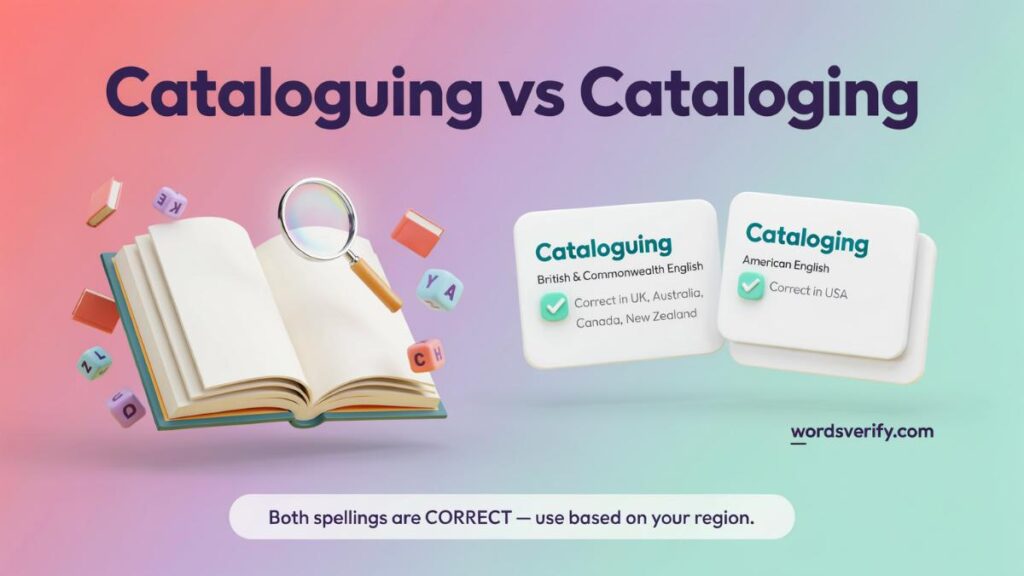
Is it cataloguing vs cataloging? That tiny letter “u” can turn an ordinary spelling choice into a surprisingly tricky question. You may wonder whether one version is wrong, whether the words have different meanings, or whether British and American English are simply playing by different rules. The good news? Both spellings are correct! The difference comes down to regional spelling preferences, not meaning. In this article, we’ll explore cataloguing or cataloging, explain how each form is used, look at its history, and share practical examples to help you choose the right spelling without second-guessing yourself.
The Quick Answer
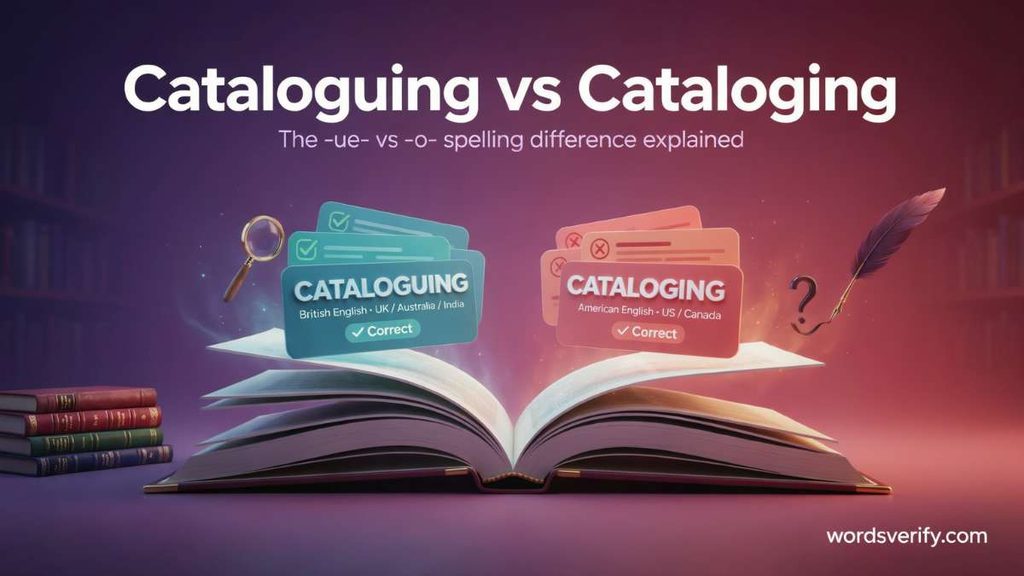
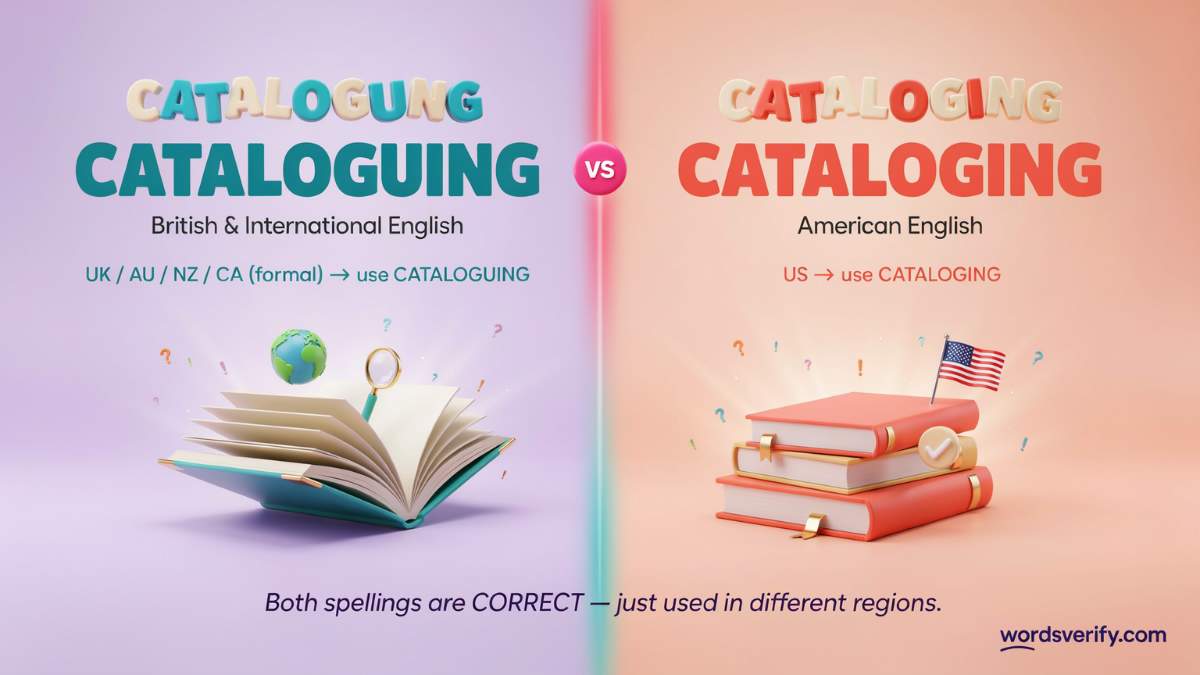
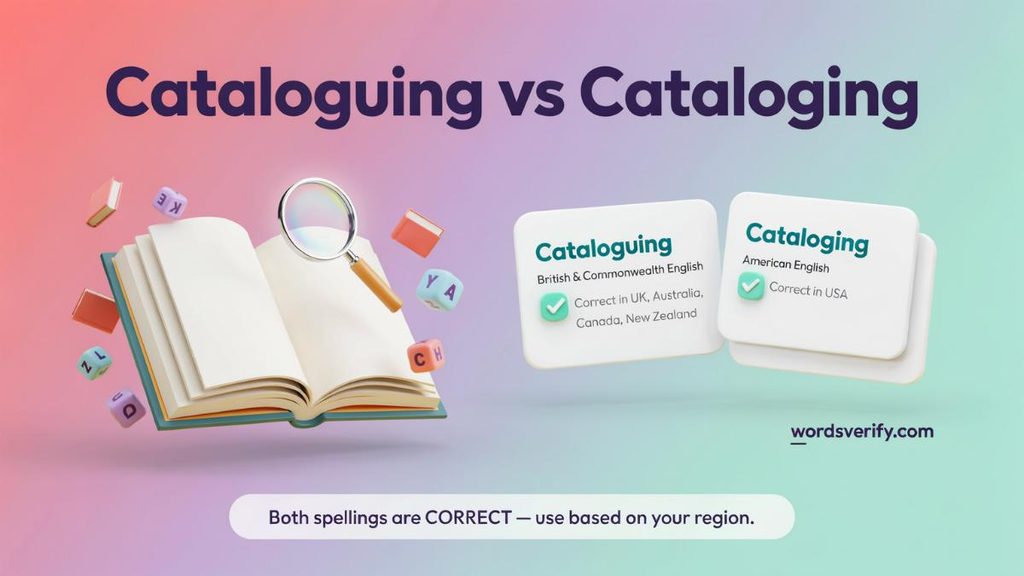
Both cataloguing vs cataloging are correct English spellings. The difference comes from regional spelling preferences rather than meaning or grammar.
- Cataloging: The standard American English spelling.
- Cataloguing: The standard British English spelling.
- Meaning: Both refer to creating and organizing a catalog of items or information.
- Pronunciation: Both generally sound the same within the same regional accent.
- Usage: Choose the spelling that matches your audience and use it consistently.
Here are a few examples:
| American English | British English |
|---|---|
| The librarian is cataloging new books. | The librarian is cataloguing new books. |
| She spent the afternoon cataloging historical documents. | She spent the afternoon cataloguing historical documents. |
| The museum is cataloging its collection. | The museum is cataloguing its collection. |
| Cataloging digital resources requires careful record keeping. | Cataloguing digital resources requires careful record keeping. |
As you can see, the sentences communicate exactly the same information. Only the spelling changes.
If you’re writing for an American audience, choose cataloging. For British readers, cataloguing is generally the better option. The same distinction applies to related forms such as cataloged and catalogued.
Learn the difference between tricky grammar more words
Ingenuine vs Ungenuine Which one Is Correct?
What Does Cataloguing vs Cataloging Mean?
Cataloguing vs cataloging means creating an organized record of items so people can identify, locate, and retrieve them.
A catalog is more than a simple list. It contains useful information about individual items and arranges that information in a way that makes searching easier.
Imagine a library receiving 200 new books. The librarian doesn’t simply place them on shelves and hope readers find what they’re looking for. Instead, the librarian records details about each book, including its title, author, publisher, publication date, subject, and location.
These details become part of the library’s catalog.
The same process happens in other settings. A museum might catalog paintings and historical objects. A business might catalog its products, while researchers might catalog plant specimens, photographs, and archival documents.
Cataloging vs Cataloguing Definitions
The cataloging definition describes the process of making a catalog or systematically listing and describing items.
The cataloguing definition means exactly the same thing. The spelling changes according to regional conventions, but the underlying activity remains unchanged.
Both words can serve different grammatical purposes:
- As a present participle: The librarian is cataloging new books.
- As a gerund: Cataloguing requires attention to detail.
- As a modifier: The cataloging process takes several days.
The base verbs are catalog and catalogue. Their corresponding forms, cataloging and cataloguing, describe the activity or process.
How Is Cataloging Different From Making a List?
Although cataloging involves listing items, the two activities aren’t quite the same.
A basic list might contain only the names of books, products, or documents. A catalog provides additional details that help people identify and locate individual items.
Consider this example:
| Basic list | Catalog record |
|---|---|
| The Great Gatsby | Title: The Great Gatsby |
| F. Scott Fitzgerald | Author: F. Scott Fitzgerald |
| 1925 | Publication year: 1925 |
| Novel | Genre: American fiction |
| — | Publisher, edition, ISBN, and location |
The second version provides much more useful information. It also helps distinguish one edition from another.
In simple terms, listing tells you what exists, while cataloging helps you identify and find it.
Learn the difference between tricky grammar more words
Manner vs Manor which one is correct?
Cataloguing vs Cataloging British and American English
The difference between cataloguing and cataloging comes from a familiar pattern in British and American spelling: retaining or removing the final -ue in certain words.
British English generally retains the final letters in catalogue. American English usually shortens the word to catalog.
This difference continues in related word forms.
Cataloging in American English
American English generally uses catalog as both a noun and a verb. When writers add the suffix -ing, the result is cataloging.
The main forms are:
- Catalog
- Cataloging
- Cataloged
- Cataloger
For example:
The company is cataloging its entire product collection before launching the new website.
American dictionaries recognize catalog and cataloging as standard spellings. Although catalogue also appears in American writing, catalog is the more common choice.
Cataloguing in British English
British English generally retains the final -ue in catalogue. Its related forms follow the same pattern.
The main forms are:
- Catalogue
- Cataloguing
- Catalogued
- Cataloguer
For example:
The university is cataloguing its historical manuscripts for public access.
This spelling is common in British publications, educational materials, and institutional documents.
American vs British Spelling Comparison
The following table shows how the main forms differ:
| Word form | American English | British English |
|---|---|---|
| Noun | Catalog | Catalogue |
| Verb | Catalog | Catalogue |
| Present participle | Cataloging | Cataloguing |
| Past tense | Cataloged | Catalogued |
| Past participle | Cataloged | Catalogued |
| Person who catalogs | Cataloger | Cataloguer |
These differences follow a recognizable spelling pattern. However, English doesn’t apply every regional spelling rule to every word. It’s always worth checking an individual word rather than assuming that all words ending in -ue behave alike.
What About Canadian, Australian and New Zealand English?
British spelling conventions have influenced several other English-speaking countries. However, their spelling practices aren’t identical in every situation.
- Canadian English commonly uses catalogue and cataloguing, although preferences can vary.
- Australian English generally favors catalogue and cataloguing.
- New Zealand English also tends to follow British-style spelling.
- Indian English commonly uses catalogue and cataloguing because of its British spelling influence.
Professional organizations, publishers, and academic institutions may have their own preferences. When writing for a particular publication, follow its style guide.
Learn the difference between tricky grammar more words
Updated vs Update which one is correct?
The Origin and History of Cataloguing vs Cataloging
The word catalogue has a much longer history than modern libraries, online stores, and digital databases. Its roots go back to ancient Greek, where related words described lists, registers, and organized accounts.
The English word ultimately comes from the Greek katalogos, meaning a list or register. It entered English through Latin and French before developing into the spelling familiar today.
How Did the Word Catalogue Enter English?
The noun catalogue appeared in English during the early 15th century. It originally referred to an organized list or enumeration of separate items.
Later, the word developed into a verb. English speakers began using catalogue to describe the activity of making a list or entering information into an organized record.
As libraries, universities, businesses, and other institutions expanded their collections, the term became increasingly useful.
People needed practical ways to record books, manuscripts, commercial products, and other resources. Catalogues provided a way to organize that information.
Why Does American English Use Catalog Instead of Catalogue?
The shorter spelling catalog has existed as an English variant for centuries. However, it gradually became more established in American English.
American spelling preferences often favor shorter forms of certain words, particularly those ending in -our and -re or containing French-influenced endings.
Compare these examples:
| British English | American English |
|---|---|
| Catalogue | Catalog |
| Colour | Color |
| Honour | Honor |
| Centre | Center |
| Theatre | Theater |
Not every word follows the same pattern, but these examples show how American English has developed several distinct spelling preferences.
The shorter form catalog eventually became the standard American choice.
Why Does Cataloguing Have Two Gs?
This question is easier to answer when you look at the word’s structure.
The British base word is catalogue. When you add the suffix -ing, you remove the final silent e.
Catalogue + ing = cataloguing.
The two Gs in the resulting word aren’t caused by doubling the final consonant. One G belongs to the original word, while the other comes from the suffix? No. The suffix begins with I, not G. Therefore, the correct spelling contains only one G.
The same spelling pattern appears in other words:
- Make → Making
- Write → Writing
- Use → Using
- Catalogue → Cataloguing
Why Is Cataloging Spelled Without a U?
The American base word is catalog, which doesn’t contain the final e or u found in the British form catalogue.
Adding -ing produces cataloging.
The related forms follow the same pattern:
- Catalog + ing = Cataloging
- Catalog + ed = Cataloged
- Catalog + er = Cataloger
This explains the spelling difference without suggesting that either form has a different meaning.
Learn the difference between tricky grammar more words
Light vs Lite which one is correct?
How to Use Cataloguing vs Cataloging in a Sentence
Knowing the correct spelling is only half the job. You also need to understand how these words work in sentences.
Both forms can function as gerunds, present participles, and modifiers. Their grammatical roles remain the same regardless of which spelling convention you follow.
Cataloging vs Cataloguing as Present Participles
A present participle describes an ongoing action or helps form a continuous verb tense.
Examples:
- The librarian is cataloging the newly purchased books.
- The museum is cataloguing several historical paintings.
- Researchers are cataloging plant specimens collected during the expedition.
- The university is cataloguing its rare manuscripts.
In these sentences, the words describe activities that are currently taking place.
Cataloging vs Cataloguing as Gerunds
A gerund is a verb form ending in -ing that functions as a noun.
Examples:
- Cataloging requires patience and attention to detail.
- Cataloguing historical documents takes considerable research.
- The library introduced a new system for cataloging its digital resources.
- Accurate cataloguing improves access to archival collections.
Here, the words refer to activities rather than simply describing ongoing actions.
Cataloging vs Cataloguing as Modifiers
Both forms can also describe a noun or activity.
Examples:
- The cataloging department handles new acquisitions.
- The cataloguing project covers thousands of historical records.
- The cataloging software stores bibliographic information.
- The cataloguing team checks every entry for accuracy.
The spelling difference doesn’t affect sentence structure or meaning.
Learn the difference between tricky grammar more words
Loss vs Lose which one is correct?
Cataloguing vs Cataloging in Libraries
Libraries offer one of the clearest examples of why cataloguing and cataloging matter.
Without an organized catalog, finding a particular book in a collection of thousands would feel like searching for a needle in a haystack.
Library cataloging is the process of identifying, describing, organizing, and providing access to library materials.
It plays an important role in library science because it connects readers with the resources they need.
Whether a library manages printed books, electronic journals, maps, photographs, manuscripts, or audio recordings, cataloging creates searchable records that make its collection easier to use.
What Is Cataloging in Library Science?
In library science, cataloging involves creating bibliographic records that describe individual resources and provide ways to find them.
A bibliographic record contains information that identifies a particular publication or resource. Depending on the material, it may include:
- Title and subtitle.
- Author, editor, or other creator.
- Publisher and publication date.
- Edition or version.
- Physical description.
- ISBN or another identifying number.
- Subject headings.
- Classification number.
- Language and format.
- Location or access information.
These details help librarians distinguish similar materials and help readers find the right resource.
For example, a library might hold three editions of the same novel. Their titles and authors may be identical, but their publication dates, publishers, ISBNs, and physical descriptions can differ.
A well-prepared catalog record helps readers identify the edition they want.
The Main Types of Library Cataloguing and Cataloging
Library cataloging involves several related activities. Two particularly important areas are descriptive cataloging and subject cataloging.
Descriptive cataloging
Descriptive cataloging records the identifying and physical details of a resource.
A librarian examines the item and records information such as its title, creator, edition, publication details, and physical characteristics.
For example, a descriptive record for a printed book might identify its author, publisher, publication year, number of pages, and ISBN.
Subject cataloging
Subject cataloging focuses on what a resource discusses.
A librarian examines its content and assigns appropriate subject headings or other access points. These terms help users locate materials even when they don’t know the exact title or author.
For instance, a book about climate change might receive subject headings relating to global warming, environmental policy, and atmospheric science.
The Library of Congress Subject Headings system provides a widely used controlled vocabulary for this purpose. It helps libraries organize materials under consistent topics rather than relying entirely on different authors’ wording.
Library Cataloguing and Classification What’s the Difference?
Cataloging and classification work together, but they aren’t the same thing.
Cataloging creates descriptive records and access points. Classification assigns a resource to an organized subject system, often providing a call number that helps determine where a physical item belongs.
Consider the difference:
| Cataloging | Classification |
|---|---|
| Describes a library resource. | Assigns it to a subject category or class. |
| Records title, author, publisher, and other details. | Determines its position within a classification system. |
| Creates searchable bibliographic records. | Helps organize and arrange library materials. |
| Supports identification and discovery. | Supports browsing and physical arrangement. |
Two important library classification systems are:
- Dewey Decimal Classification (DDC): Organizes knowledge into ten main classes, represented by numbers from 000 through 900.
- Library of Congress Classification (LCC): Uses letters and numbers to divide knowledge into subject classes and more specific topics.
The Dewey Decimal system is common in public and school libraries. Many academic and research libraries use the Library of Congress system.
What Is the Purpose of Cataloguing in a Library?
A library catalog does more than tell readers which books exist. It provides several important services.
- Finding resources: Readers can search by title, author, subject, or keyword.
- Identifying materials: Bibliographic details distinguish different editions and publications.
- Organizing collections: Classification numbers help arrange physical materials.
- Discovering related resources: Subject headings connect books and documents covering similar topics.
- Managing collections: Librarians use catalog records to track holdings and maintain accurate information.
- Supporting digital access: Online catalogs connect users with electronic books, journals, databases, and other resources.
Without cataloging, even a large and valuable library could become difficult to navigate.
A Practical Example of Cataloging a Book in a Library
Imagine a public library receives a new copy of The Great Gatsby by F. Scott Fitzgerald.
The librarian examines the book and creates a bibliographic record.
Illustrative library catalog record
| Field | Example information |
|---|---|
| Title | The Great Gatsby |
| Author | F. Scott Fitzgerald |
| Original publication year | 1925 |
| Genre | Literary fiction |
| Language | English |
| Format | Printed book |
| Subject | American fiction |
| Identifier | ISBN, where applicable |
| Classification | Assigned according to the library’s system |
| Location | Fiction section |
The librarian then assigns appropriate subject access points and a classification number. The record enters the library’s information system, allowing readers to search for the book.
A reader can now find it by entering the title, author’s name, or relevant subject into the library’s online catalog.
That’s library cataloging in action.
Learn the difference between tricky grammar more words
Nitch vs Niche Which one Is Correct?
What Is the Process of Cataloging vs Cataloguing?
The cataloguing process varies according to the collection, institution, and type of material. However, most professional workflows follow several broad stages.
From identifying an item to making its record searchable, each step contributes to accurate information organization.
The Main Steps in the Cataloging Process
Examine and identify the item
The cataloger first examines the resource to understand what it contains.
For a printed book, this might involve checking the title page, copyright page, cover, and contents. For a digital resource, the cataloger may examine its metadata, file information, and accompanying documentation.
Record bibliographic details
Next, the cataloger records identifying information such as the title, author, publisher, publication date, edition, and format.
Accuracy matters here. A small mistake in an author’s name or publication date can make a resource harder to find.
Perform subject analysis
The cataloger examines the resource’s content and determines its main subjects.
Appropriate subject headings or keywords help users discover the item through topic-based searches.
Assign classification information
The resource receives a classification number or another organizational identifier when the collection’s system requires one.
This step helps libraries organize materials by subject and arrange physical resources.
Create the bibliographic record
The cataloger enters the collected information into a cataloging system.
The record may follow established standards and formats such as Resource Description and Access (RDA) and MARC 21, depending on the institution’s workflow.
Add holdings and location details
For physical materials, the library records information about copies, branches, shelf locations, and availability.
For electronic resources, the record may include access links and relevant access information.
Review and maintain the record
Finally, the cataloger checks the information for accuracy and consistency.
Records may require updates when an item moves, a digital link changes, or a new edition becomes available.
What Are Cataloging Standards?
Professional cataloging depends on shared rules and standards. These help different libraries create records that other institutions can understand, exchange, and reuse.
Some important examples include:
- RDA (Resource Description and Access): Provides guidelines for describing resources and supporting access to them.
- MARC 21: Provides standardized formats for exchanging bibliographic and related data in machine-readable form.
- LCC (Library of Congress Classification): Organizes library materials into subject-based classes.
- LCSH (Library of Congress Subject Headings): Provides controlled subject vocabulary for consistent subject access.
These standards help libraries maintain accurate records and share information more effectively.
Manual vs Automated Cataloging
Traditional cataloging required librarians to examine resources and prepare records manually. Modern systems can automate or assist with several parts of the process.
| Manual cataloging | Automated cataloging |
|---|---|
| Librarians enter information directly. | Software imports or generates record information. |
| Requires substantial individual data entry. | Can reduce repetitive work. |
| Depends heavily on human examination. | Uses imported metadata and automated matching. |
| Offers direct control over each record. | Still requires quality checks and corrections. |
Automation doesn’t eliminate the need for professional catalogers. Software can retrieve existing records and suggest metadata, but people still need to assess accuracy, identify errors, and make decisions about complex resources.
Learn the difference between tricky grammar more words
Feed vs Fead and which one is correct?
Cataloguing vs Cataloging Synonyms
Several words have meanings related to cataloging. However, they aren’t always interchangeable.
The best alternative depends on the activity you’re describing.
| Synonym | Meaning | Example |
|---|---|---|
| Listing | Writing down items in a sequence. | Listing the books in a collection. |
| Indexing | Creating access points for finding information. | Indexing articles in a database. |
| Classifying | Arranging items into categories. | Classifying books by subject. |
| Organizing | Arranging resources systematically. | Organizing digital documents. |
| Documenting | Recording information about something. | Documenting historical objects. |
| Registering | Officially recording an item or event. | Registering newly acquired equipment. |
| Inventorying | Counting and recording available items. | Inventorying warehouse stock. |
| Itemizing | Listing individual items separately. | Itemizing office supplies. |
| Archiving | Preserving and managing records over time. | Archiving historical correspondence. |
| Compiling | Gathering information into one collection. | Compiling a list of research publications. |
Is Indexing the Same as Cataloging?
No. Indexing and cataloging are related information-management activities, but they serve different purposes.
Cataloging creates structured descriptions of resources. Indexing creates access points that help people locate specific information within or across those resources.
For example, a library might catalog an entire book while an index helps readers find particular subjects or names mentioned inside it.
Similarly, inventorying focuses on recording and tracking what an organization owns. It doesn’t necessarily involve the detailed bibliographic descriptions associated with library cataloging.
Choose a synonym that describes the actual task rather than simply replacing one word with another.
Learn the difference between tricky grammar more words
Discard vs Disgard Which one Is Correct?
Cataloguing vs Cataloging Pronunciation
Despite the difference in spelling, cataloguing and cataloging generally share the same pronunciation within a particular English accent.
The extra u in the British spelling doesn’t create another syllable or a separate sound.
The pronunciation can vary slightly between British and American accents, but those differences come from regional speech patterns rather than the spelling itself.
How Do You Pronounce Cataloging?
In General American English, cataloging is commonly represented as:
- IPA: /ˈkæt̬əlɔːɡɪŋ/
- Syllables: Four.
- Primary stress: First syllable.
How Do You Pronounce Cataloguing?
In British English, cataloguing is commonly represented as:
- IPA: /ˈkætəlɒɡɪŋ/
- Syllables: Four.
- Primary stress: First syllable.
The exact vowel sounds vary between accents. The important point is that the regional spelling difference doesn’t create a fundamentally different word or pronunciation.
Learn the difference between tricky grammar more words
Inversely vs Conversely which one is correct?
Cataloguing or Cataloging in Everyday Examples
Cataloging isn’t limited to libraries. It appears in businesses, museums, research institutions, archives, and digital information systems.
Understanding these different applications makes the meaning easier to recognize.
Cataloging Examples in Business
Businesses use cataloging to organize products, supplies, equipment, and other resources.
Examples:
- The company is cataloging its products before updating the online store.
- The warehouse manager spent the morning cataloging new equipment.
- Our team is cataloguing the company’s office supplies.
- The retailer maintains a digital catalog of available products.
Cataloguing Examples in Museums and Archives
Museums and archives use cataloging to identify, describe, and manage valuable objects and historical records.
Examples:
- The museum is cataloging its collection of ancient pottery.
- Archivists are cataloguing letters from the early 20th century.
- The historical society completed the cataloging of its photographic collection.
- Researchers are cataloguing documents from the regional archives.
Cataloging Examples in Research
Researchers often catalog specimens, observations, publications, and other materials.
Examples:
- Scientists are cataloging plant species found in the rainforest.
- The research team is cataloguing samples collected during the expedition.
- The university maintains a catalog of scientific publications.
- Each specimen receives a unique identification number during cataloging.
Cataloguing Examples in Digital Information Management
Digital cataloging helps organizations manage electronic resources, including images, videos, documents, and databases.
Examples:
- The company is cataloging its digital photographs.
- The library is cataloguing electronic journals.
- The research center uses metadata to organize digital resources.
- The website team is cataloging its downloadable publications.
American and British Sentence Comparison
Here are some direct comparisons that demonstrate how the spelling changes without affecting meaning.
| American English | British English |
|---|---|
| The librarian is cataloging books. | The librarian is cataloguing books. |
| She cataloged the documents yesterday. | She catalogued the documents yesterday. |
| The cataloging process is complete. | The cataloguing process is complete. |
| The cataloger checked the records. | The cataloguer checked the records. |
These examples also show how to use cataloguing in a sentence. Simply follow the same grammatical rules you would use for cataloging. Only the regional spelling changes.
Learn the difference between tricky grammar more words
Ironic vs Unironic which one is correct?
Common Mistakes When Using Cataloguing or Cataloging
Even though both spellings are straightforward, writers sometimes confuse their related forms or mix regional conventions.
Here are a few mistakes worth avoiding.
Mixing American and British Spellings
Using cataloging in one paragraph and cataloguing in another can make an article look inconsistent.
Choose one spelling convention and follow it throughout the document.
Confusing Cataloged and Catalogued
Both past-tense forms are correct, but they belong to different spelling conventions.
- American: The librarian cataloged the new books.
- British: The librarian catalogued the new books.
Don’t assume that one is a spelling error simply because you’re more familiar with the other.
Adding Unnecessary Letters
The standard forms are:
- Cataloging, not catalogging.
- Cataloguing, not catalogguing.
- Cataloged, not catalogged.
- Catalogued, not cataloggued.
The correct forms follow the base word and its appropriate suffix.
Assuming Cataloging and Cataloguing Have Different Meanings
They don’t. Both describe the same activity.
The spelling distinction reflects regional English conventions, not a difference in the process.
Confusing Cataloging With Classification
Cataloging describes a resource and provides access to it. Classification places it within an organizational system.
These activities often work together in libraries, but they aren’t identical.
Which Spelling Should You Use Cataloguing or Cataloging?
The easiest way to choose is to consider your audience, location, and writing guidelines.
If you’re writing for readers in the United States, cataloging is the natural choice. If your audience primarily uses British English, cataloguing is generally preferable.
Here’s a quick reference:
| Writing situation | Recommended spelling |
|---|---|
| US school assignment | Cataloging |
| American business report | Cataloging |
| US academic paper | Cataloging |
| UK publication | Cataloguing |
| British university assignment | Cataloguing |
| Australian publication | Cataloguing |
| New Zealand publication | Cataloguing |
| Canadian publication | Usually cataloguing |
Which Spelling Should You Use in Academic Writing?
Academic writing requires particular attention to consistency.
Universities, journals, publishers, and professional organizations may follow specific style guides. These guides establish preferred spellings for terminology used throughout a publication.
For example, an American research journal may expect cataloging, while a British academic publication may prefer cataloguing.
If you’re preparing a dissertation, research paper, or professional report, check the required style guide before choosing a spelling.
The same principle applies to library science terminology. A publication may use a particular spelling convention even when its contributors come from different countries.
Consistency matters more than personal preference when a publication has an established style.
Related Words and Their Spellings
Understanding the related forms makes the spelling pattern easier to remember.
| British English | American English |
|---|---|
| Catalogue | Catalog |
| Cataloguing | Cataloging |
| Catalogued | Cataloged |
| Cataloguer | Cataloger |
These forms belong to the same word family. If you choose British English, retain the British forms throughout your writing. If you choose American English, use the American equivalents.
One useful reminder: the base word determines the spelling of its related forms.
- Catalogue becomes cataloguing and catalogued.
- Catalog becomes cataloging and cataloged.
This pattern explains the difference without requiring you to memorize each form separately.
practice session Cataloguing vs Cataloging
Complete each sentence with the correct spelling. Use the context to decide which form fits best.
- The librarian is ______ the newly donated books.
- The university library is ______ its digital collection.
- She spent the afternoon ______ historical documents.
- The museum is ______ its collection of ancient artifacts.
- The librarian has finished ______ all the reference books.
- Our local library is ______ its new arrivals.
- The process of ______ books makes them easier to find.
- He works in the department responsible for ______ rare manuscripts.
- The archivist is carefully ______ old photographs.
- The library began ______ its collection last month.
- The staff completed the ______ of the historical records.
- The librarian is responsible for ______ books and journals.
- We learned about library ______ during our information science course.
- The museum uses a digital system for ______ its exhibits.
- The new assistant is training in ______ library materials.
- The school is ______ its textbooks before the new term begins.
- Accurate ______ helps readers locate books quickly.
- The university is ______ its research publications.
- She has experience in ______ rare and valuable books.
- The library is ______ its entire collection into a searchable database.
- The librarian ______ the new books yesterday.
- The assistant has already ______ the latest journal issues.
- The museum hired an experienced ______ to organize its collection.
- The university needs a professional ______ to manage its records.
- Both ______ and cataloging are accepted spellings, depending on the English variety.
Answers
- Cataloguing
- Cataloging
- Cataloguing
- Cataloging
- Cataloguing
- Cataloging
- Cataloguing
- Cataloging
- Cataloguing
- Cataloging
- Cataloguing
- Cataloging
- Cataloguing
- Cataloging
- Cataloguing
- Cataloging
- Cataloguing
- Cataloging
- Cataloguing
- Cataloging
- Catalogued
- Cataloged
- Cataloguer
- Cataloger
- Cataloguing
Here’s a trusted source for clear word meanings:
FAQs
Is cataloguing British English or American English?
Cataloguing is the preferred British English spelling. It is commonly used in the UK and other regions that follow British spelling conventions, including Australia and New Zealand.
Is cataloging used outside the United States?
Yes. Although cataloging is standard in American English, it also appears in other English-speaking countries. Some organizations and style guides prefer the American spelling regardless of location.
Does cataloguing have a different pronunciation from cataloging?
No. Both forms are generally pronounced the same way. The only difference is their spelling, not their meaning or pronunciation.
What is the past tense of cataloguing?
The past tense is catalogued in British English. In American English, it is cataloged. For example, “The librarian catalogued the new books” and “The librarian cataloged the new books” are both correct.
Is it cataloguer or cataloger?
Both spellings are correct. Cataloguer is the preferred British English form, while cataloger is commonly used in American English. Both refer to someone who creates or maintains catalog records.
Can cataloguing be used as a verb?
Yes. Cataloguing is the -ing form of the British English verb catalogue. For example, “She is cataloguing the museum’s collection.” The American equivalent is cataloging.
Why does British English keep the U in cataloguing?
British English retains the U in the base word catalogue. When the suffix -ing is added, the final silent E is dropped, producing cataloguing. American English starts with catalog and forms cataloging instead.
Should I use cataloguing or cataloging in academic writing?
Choose the spelling required by your university, publisher, or style guide. If no specific preference exists, follow the spelling convention of your chosen variety of English and use it consistently.
Is cataloguing a formal word?
Yes. Cataloguing is a standard, formal English word used in libraries, museums, archives, publishing, and information management. It is not an outdated or informal spelling.
Can cataloguing and cataloging be used interchangeably?
Yes. Both spellings have the same meaning and can be used in the same grammatical contexts. However, it’s best not to switch between them in the same document unless you’re reproducing a title or quotation that uses a different spelling.
Conclusion
So, should you write cataloguing vs cataloging? Fortunately, there’s no spelling battle to settle because both forms are correct. The difference lies in regional preferences: British English favors cataloguing, while American English uses cataloging. Both words have the same meaning, so that little “u” doesn’t change what you’re saying.
The easiest way to avoid confusion is to consider your audience and stick to one spelling throughout your writing. If you’re following American English, choose cataloging. For British English, go with cataloguing. It’s a small spelling difference, not a grammar disaster! Once you know the rule, you can use either form confidently without letting one extra letter turn your writing into a guessing game.

Lisa AJS is an experienced blogger and language enthusiast at Words Verify, dedicated to making grammar simple, practical, and enjoyable. She writes engaging content on commonly confused words, grammar mistakes, word meanings, and everyday language challenges.