
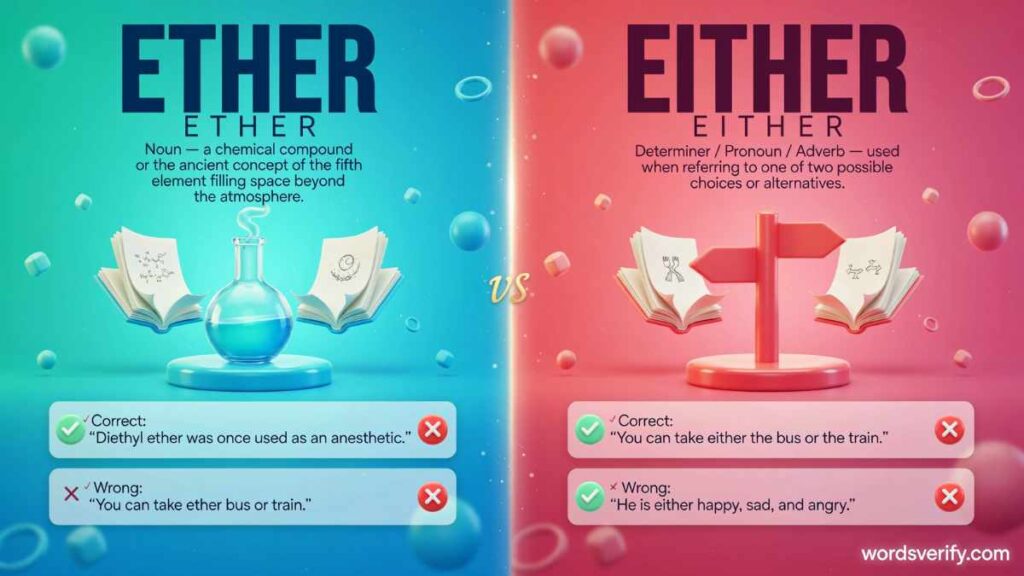
Have you ever stopped mid-sentence, unsure whether to write ether vs either? You’re not alone! These two words can easily cause confusion because they look and sound alike, yet their meanings couldn’t be more different. One belongs to the worlds of chemistry and medicine, while the other helps us express choices and alternatives. Mixing them up can leave readers scratching their heads. In this guide, we’ll untangle the confusion surrounding ether vs. either, explore their meanings and pronunciation, and show you how to use each word correctly. With clear explanations and everyday examples, you’ll soon know which word fits without a second guess.
quick answer?
The main difference between ether vs either comes down to meaning and usage. “Either” is commonly used when discussing two choices or alternatives. “Ether,” on the other hand, is a noun associated with chemical compounds, a historical anesthetic, and an old scientific theory about a substance believed to fill space.
Both are correctly spelled English words. However, they serve entirely different purposes.
Consider these examples:
- Either: You can choose either the red shirt or the blue one.
- Ether: Diethyl ether was once widely used as a surgical anesthetic.
In the first sentence, “either” introduces two possible choices. In the second, “ether” identifies a chemical substance.
Here’s a simple comparison:
| Word | Meaning | Example |
|---|---|---|
| Either | One or the other of two choices | You can take either road. |
| Ether | A class of chemical compounds | Ether is used as a laboratory solvent. |
| Either | Also, when used in negative statements | I don’t like coffee either. |
| Ether | A historical term for a supposed substance filling space | Scientists once proposed the existence of luminiferous ether. |
Either vs Ether Which Spelling Is Correct?
Both spellings are correct, but the right choice depends on what you want to say.
Use “either” when discussing alternatives, choices, or agreement with a negative statement. Use “ether” when referring to a chemical compound, a historical anesthetic, or the older scientific concept of a medium filling space.
For example:
- Correct: Either answer will work.
- Incorrect: Ether answer will work.
- Correct: Ether evaporates quickly because it is highly volatile.
- Incorrect: Either evaporates quickly because it is highly volatile.
Notice that a spellchecker might not catch these mistakes. Both words appear in standard English dictionaries, so your writing software may accept either one even when you’ve chosen the wrong word.
That’s why understanding their meanings matters more than relying on automatic corrections.
Understand confusing English more words simply
Patronise vs Patronize What’s the Difference?
What Does Either Mean?
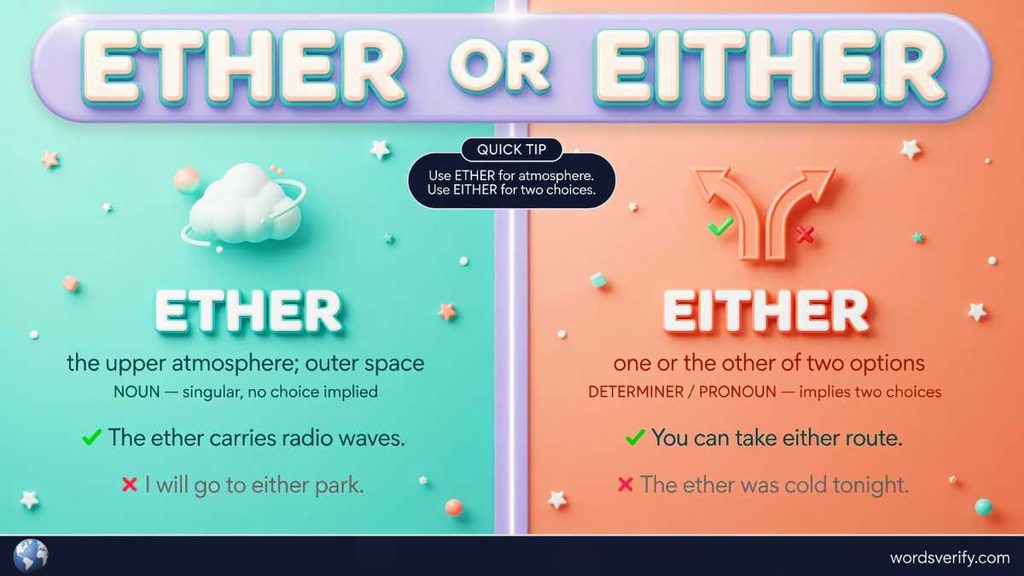
The word “either” refers to one of two people, things, choices, or possibilities. It helps you express alternatives without repeating the same information.
Imagine you’re ordering a drink and the server offers tea or coffee. You might respond, “Either is fine.” This means you’re happy with one option or the other.
However, “either” doesn’t always work in the same way. Depending on the sentence, it can function as a determiner, pronoun, adverb, or part of the construction “either … or.”
Let’s look at each use.
Either as a Determiner
As a determiner, “either” comes before a singular noun and refers to one of two possible people or things.
It tells the reader that both options are acceptable individually, although only one is being considered or selected at a time.
Examples:
- You can sit in either chair.
- Either candidate could win the election.
- We can take either route to reach the station.
- Either answer is acceptable for this question.
- You may choose either color.
In each sentence, “either” identifies two available alternatives.
Remember that the noun following “either” is generally singular when the word functions as a determiner. For instance, “either option” is correct, while “either options” isn’t standard in this construction.
Either as a Pronoun
“Either” can also replace a noun when the reader already knows which two people or things you’re discussing.
Rather than repeating both options, you can use “either” to refer to one of them.
Examples:
- Both restaurants look good. Either would be fine.
- I haven’t chosen between the two books. Either seems interesting.
- You can contact either of them.
- Either of the solutions should work.
The expression “either of” commonly appears before a plural noun or pronoun. However, traditional formal grammar generally treats the subject as singular because “either” refers to one member of the pair.
For example:
- Correct: Either of the students is eligible.
- Incorrect in traditional formal usage: Either of the students are eligible.
In everyday conversation, plural agreement sometimes occurs because the nearby plural noun influences the verb. Still, singular agreement is the safer choice in formal writing.
Either as an Adverb
One particularly useful feature of “either” is its role in negative sentences. Here, it means “also not” or “not as well.”
This usage allows you to agree with another person’s negative statement.
Consider this conversation:
Person A: I don’t enjoy horror movies.
Person B: I don’t enjoy them either.
The second speaker agrees with the first person’s negative opinion.
More examples include:
- She doesn’t eat meat either.
- I can’t find my keys either.
- They haven’t finished their homework either.
- He wasn’t invited to the meeting either.
- We don’t have enough time either.
In these examples, “either” usually appears at the end of the sentence.
A common mistake is using “too” instead of “either” in a negative statement.
Compare:
- Positive: I enjoy reading too.
- Negative: I don’t enjoy reading either.
Both sentences express agreement, but their grammatical structures are different.
Either … Or: Presenting Two Alternatives
The construction “either … or” connects two alternatives. It tells the reader that one possibility or the other applies.
Examples:
- You can either walk or take a taxi.
- Either Sarah or Emily will organize the event.
- We can meet either today or tomorrow.
- You must either finish the assignment or request an extension.
This construction is useful in everyday conversations, academic writing, and professional communication.
However, pay attention to parallel structure. The words or phrases connected by “either … or” should follow the same grammatical pattern.
For example:
- Correct: She wants either to study medicine or to study engineering.
- Less effective: She wants either to study medicine or engineering as a career.
The second sentence mixes structures awkwardly. A smoother version would be: “She wants either to study medicine or to pursue an engineering career.”
Subject-Verb Agreement With Either … Or
English grammar has an important rule for subjects connected by “either … or.” When the subjects differ in number, the verb generally agrees with the subject closest to it. This is known as the proximity rule.
Examples:
- Either the teacher or the students are responsible.
- Either the students or the teacher is responsible.
- Either my brother or my sister is coming.
- Either the manager or the employees are attending.
The position of each subject determines which verb form you use.
For clearer formal writing, you can sometimes rewrite a sentence to avoid an awkward combination of singular and plural subjects.
For instance, instead of “Either the manager or the employees are responsible,” you could write, “The employees or the manager must take responsibility.”
Understand confusing English more words simply
Hide vs Hid which one is correct?
What Does Ether Mean?
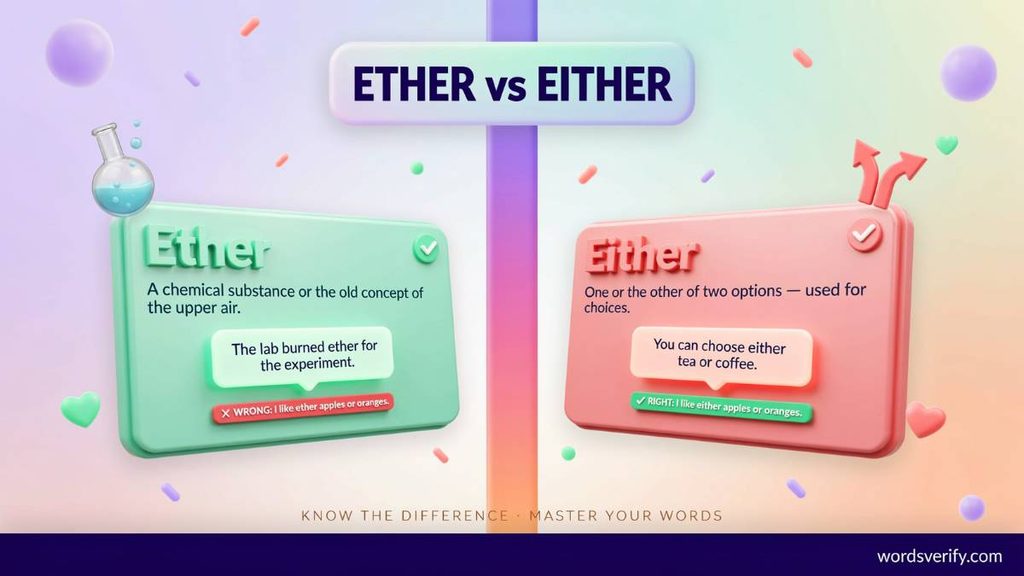
Unlike “either,” which usually deals with choices, “ether” is primarily a noun with scientific and historical meanings.
The word has several uses, particularly in chemistry and the history of physics. You’ll also encounter it in discussions about anesthesia, laboratory solvents, and older scientific theories.
Ether in Chemistry
In organic chemistry, an ether is a compound containing an oxygen atom connected to two carbon-containing groups.
Its general structural formula is:
R–O–R′
Here, R and R′ represent carbon-containing groups, which may be identical or different.
For example, dimethyl ether and diethyl ether belong to this chemical family.
Ethers are important in organic chemistry because their molecular structures give them useful physical and chemical properties. Many have relatively low boiling points and can dissolve various organic substances.
Some common examples include:
- Dimethyl ether: A simple ether used as a propellant and in other industrial applications.
- Diethyl ether: A volatile organic liquid historically used as an anesthetic and still useful as a laboratory solvent.
- Methyl tert-butyl ether (MTBE): A compound used as a gasoline oxygenate to help improve fuel combustion.
The term “ether” doesn’t identify just one chemical. It describes an entire family of compounds.
Diethyl Ether Meaning and Uses
Diethyl ether is one of the best-known examples of an ether compound. Its chemical formula is C₄H₁₀O, and its structure contains an oxygen atom connecting two ethyl groups.
At room temperature, diethyl ether is a clear, colorless, highly volatile liquid with a distinctive sweet smell.
Its boiling point is approximately 34.6°C (94.3°F), so it evaporates readily under ordinary conditions.
Diethyl ether has several important properties:
- High volatility: It changes into vapor easily because of its relatively low boiling point.
- Low water solubility: It doesn’t mix with water as readily as many polar liquids.
- Solvent properties: It dissolves many organic compounds and works well in laboratory extraction.
- Flammability: Its vapor can ignite easily, so laboratories must follow strict safety precautions.
These properties explain why diethyl ether became important in chemical laboratories and medical history.
Ether as an Anesthetic
Before modern anesthesia became widely available, surgery was often an extremely painful experience. Patients had limited options for controlling pain, and surgeons frequently had to work quickly.
Diethyl ether helped change that situation.
In 1846, American dentist William T. G. Morton publicly demonstrated the use of ether anesthesia during surgery at Massachusetts General Hospital in Boston. The demonstration, commonly associated with the first widely publicized successful public demonstration of ether anesthesia, helped establish the role of general anesthesia in modern surgery.
This development marked a major turning point in medicine.
Surgeons could perform longer and more complicated procedures without relying solely on physical restraint or speed.
However, ether had disadvantages. It was highly flammable, took longer to induce and recover from anesthesia than many modern agents, and could cause unpleasant side effects.
Today, diethyl ether is no longer a routine general anesthetic in modern operating rooms. Nevertheless, its historical importance remains significant.
Ether as a Solvent
Another important use of ether involves laboratory chemistry.
Diethyl ether works as an organic solvent because it can dissolve many nonpolar and moderately polar substances. Chemists have traditionally used it in extraction procedures to separate compounds from mixtures.
For example, a researcher might use an organic solvent to transfer a particular substance from an aqueous solution into an organic layer.
Because diethyl ether is less dense than water, it usually forms the upper layer when the two liquids separate.
Its volatility also makes it relatively easy to remove after an extraction.
However, ether requires careful handling. It is extremely flammable and can form explosive peroxides during storage, particularly when exposed to air and light over time.
Ether in Historical Physics Luminiferous Ether
The word “ether” also has an unusual place in the history of science.
During the 19th century, many physicists believed that light needed a medium through which to travel. Since sound travels through air and water waves move through water, scientists wondered what carried light through empty space.
They proposed a hypothetical substance called “luminiferous ether.”
The name came from the Latin word lumen, meaning light. Scientists imagined this substance filling the universe and allowing light waves to travel through otherwise empty space.
However, experiments eventually challenged this idea.
In 1887, physicists Albert A. Michelson and Edward W. Morley conducted a famous experiment designed to detect Earth’s motion relative to the proposed ether. Their results failed to reveal the expected ether wind.
The experiment became an important part of physics history. Later developments, particularly Albert Einstein’s special theory of relativity in 1905, removed the need for luminiferous ether to explain how light travels.
Today, physicists don’t consider the historical luminiferous ether a necessary part of modern physics.
You’ll mainly encounter this meaning in scientific history, older literature, and discussions about the development of physical theories.
Ether in Literature and Figurative Language
Beyond chemistry and science, “ether” sometimes appears in literary and historical writing.
Its older meaning relates to the upper regions of the sky or the heavens. Ancient Greek thought associated the word with the bright, pure air above the clouds.
Writers have used it to suggest something distant, mysterious, or seemingly beyond the physical world.
Examples:
- The music seemed to disappear into the ether.
- Ancient philosophers imagined a pure substance filling the heavens.
- His message vanished into the ether without receiving a reply.
In modern informal language, “into the ether” can suggest that something has disappeared into an unknown or unreachable place.
For example, when someone says an email disappeared into the ether, they usually mean that it seems to have gone missing.
Understand confusing English more words simply
Envisage vs Envision what’s the difference
Ether vs Either Pronunciation Differences
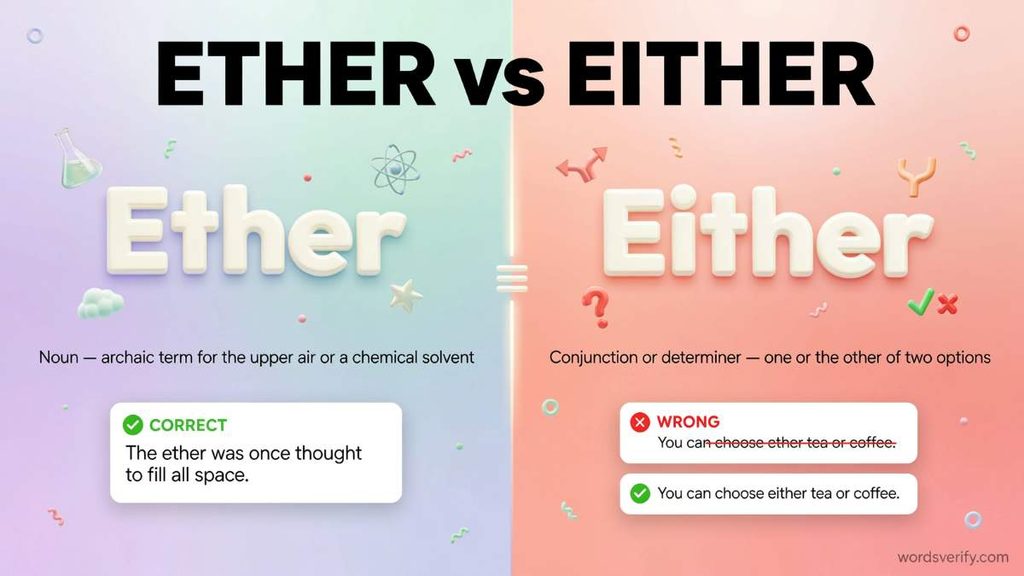
Pronunciation creates another reason people confuse these words. Although their spellings look similar, they contain an important difference in their consonant sounds.
The pronunciation of “ether” uses a voiceless TH sound, while “either” uses a voiced TH sound.
Ether Pronunciation
In standard American English, “ether” is commonly pronounced:
EE-ther
IPA: /ˈiːθər/
The first syllable contains a long E sound. The second syllable includes the voiceless TH sound, as heard in words such as “think” and “thin.”
In many British English accents, the final R isn’t pronounced, giving a form such as /ˈiːθə/.
Either Pronunciation
“Either” has two widely accepted pronunciations in English:
- EE-ther: /ˈiːðər/ in American English.
- EYE-ther: /ˈaɪðər/ in American English.
The British forms commonly include /ˈiːðə/ and /ˈaɪðə/.
Both pronunciations are correct. Neither is an English spelling mistake or an incorrect regional form.
The most important difference is the TH sound. In “either,” it is voiced, like the sound in “this” and “that.” In “ether,” it is voiceless, like the sound in “think” and “thought.”
| Word | Common pronunciation | IPA | TH sound |
|---|---|---|---|
| Ether | EE-ther | /ˈiːθər/ | Voiceless |
| Either | EE-ther | /ˈiːðər/ | Voiced |
| Either | EYE-ther | /ˈaɪðər/ | Voiced |
Can Either Have Two Pronunciations?
Yes. Both the long E and long I pronunciations of “either” are standard.
For example, one American English speaker might say, “You can choose either option,” using the EE sound. Another might use the EYE sound.
The meaning remains exactly the same.
Regional preferences vary, but neither pronunciation changes the spelling. You should always write “either” when referring to alternatives, regardless of how you pronounce it.
Understand confusing English more words simply
Saucy vs Saucey Which one Is Correct?
How to Use Either in a Sentence Practical Examples
Understanding definitions is useful, but seeing “either” in everyday sentences makes its usage much clearer.
Here are examples covering its main grammatical functions.
| Example | Meaning |
|---|---|
| You can choose either dress. | One of two dresses is available. |
| Either answer is correct. | Both possible answers are acceptable individually. |
| Either of them can help you. | One person from the pair can help. |
| I don’t want dessert either. | The speaker also doesn’t want dessert. |
| We can either stay home or go out. | Two alternatives are presented. |
| Either way, we’ll arrive on time. | Both possible outcomes lead to the same result. |
| You may take either road. | Both roads are possible choices. |
| Neither option appeals to me. | Neither of the two choices is attractive. |
More Examples of Either in Everyday English
1.In conversations:
- “Would you prefer tea or coffee?” “Either is fine.”
- “Can we meet on Monday or Tuesday?” “Either day works for me.”
- “Do you want to watch a movie or read a book?” “I can do either.”
In professional writing:
- Either department can provide the required information.
- Please contact either manager if you need assistance.
- You may submit your application through either method.
3.In academic writing:
- Either explanation could account for the observed result.
- The researcher can use either approach to analyze the data.
- Either hypothesis requires further investigation.
These examples show how naturally “either” fits into everyday English.
Understand confusing English more words simply
Annual vs Anual Which one Is Correct?
How to Use Ether in a Sentence Practical Examples
Although “ether” appears less often in everyday conversation, it remains useful in scientific, medical, and historical contexts.
The following examples demonstrate its different meanings.
| Example | Meaning |
|---|---|
| Diethyl ether is a volatile organic liquid. | A chemical compound. |
| Ether was historically used as an anesthetic. | A medical application. |
| The laboratory uses ether as a solvent. | A chemical application. |
| The experiment challenged the theory of luminiferous ether. | A historical physics concept. |
| The message disappeared into the ether. | A figurative expression meaning something vanished. |
More Examples of Ether in Scientific Writing
- Diethyl ether has a relatively low boiling point.
- Some organic compounds dissolve readily in ether.
- Ether is commonly used in certain laboratory extraction procedures.
- The chemical belongs to the ether family of organic compounds.
- Researchers discussed the historical ether theory in their physics lecture.
More Examples of Ether in Everyday and Literary Writing
- His words seemed to disappear into the ether.
- The old scientific theory described ether as a medium filling space.
- The poet used ether to describe the upper regions of the sky.
- The radio signal seemed to vanish into the ether.
The context determines the intended meaning. In scientific writing, “ether” generally refers to a chemical substance or a historical scientific concept. In figurative writing, it can describe something that disappears or seems to drift away.
Understand confusing English more words simply
Recurrence vs Reoccurrence What’s the Difference?
Ether vs Either Common Mistakes to Avoid
Even experienced English speakers occasionally confuse similar-looking words. These mistakes often happen because writers focus on spelling rather than meaning.
Here are some common problems and ways to correct them.
Using Ether Instead of Either
This is probably the most common spelling mistake in ordinary writing.
It happens when someone accidentally removes the letter “i” from “either.”
Incorrect: You can choose ether option.
Correct: You can choose either option.
The incorrect sentence uses the name of a chemical compound where a word expressing choice should appear.
Another example:
Incorrect: I don’t like ether of those restaurants.
Correct: I don’t like either of those restaurants.
A simple way to avoid this error is to ask whether the sentence involves two alternatives. If it does, “either” is probably the word you need.
Using Either Instead of Ether
The reverse mistake occurs when someone adds an unnecessary “i” to “ether.”
Incorrect: The laboratory used either as a solvent.
Correct: The laboratory used ether as a solvent.
Another example:
Incorrect: The scientist studied either in the laboratory.
Correct: The scientist studied ether in the laboratory.
The easiest way to distinguish the words is to remember that chemistry, anesthesia, and historical physics generally call for “ether.”
Confusing Either With Neither
Another common source of confusion involves “either” and “neither.”
Both words refer to two alternatives, but they express different ideas.
“Either” means one or the other. “Neither” means not one and not the other.
Compare:
- Either answer is acceptable.
- Neither answer is acceptable.
The first sentence accepts both possibilities individually. The second rejects both.
Here are more examples:
| Either | Neither |
|---|---|
| Either restaurant is suitable. | Neither restaurant is suitable. |
| You can choose either option. | You can choose neither option. |
| Either of them is available. | Neither of them is available. |
| Either solution could work. | Neither solution works. |
The distinction matters because changing one word reverses the meaning of the sentence.
Using Incorrect Subject-Verb Agreement
Writers sometimes use the wrong verb form after “either.”
When “either” functions as the subject of a sentence, it generally takes a singular verb.
Incorrect: Either of the students are responsible.
Correct: Either of the students is responsible.
However, remember the proximity rule with “either … or.”
- Either the teacher or the students are attending.
- Either the students or the teacher is attending.
The verb agrees with the subject closest to it.
Assuming Either and Both Mean the Same Thing
“Either” and “both” are related, but they don’t mean exactly the same thing.
“Either” refers to one of two alternatives considered individually. “Both” refers to the two together.
Compare:
- Either student can answer the question.
- Both students can answer the question.
The first sentence says each student is individually capable of answering. The second says the two students are capable of answering.
This small distinction can make a significant difference in meaning.
Understand confusing English more words simply
Copyright vs Copywrite Which one Is Correct?
Either vs Neither What’s the Difference?
Since “either” and “neither” often appear in the same grammatical situations, understanding their relationship helps prevent additional English grammar mistakes.
“Either” presents two alternatives, while “neither” rejects both alternatives.
Their corresponding conjunctions are “either … or” and “neither … nor.”
Either … Or Grammar
Use “either … or” to present two alternatives.
Examples:
- Either John or Peter will drive.
- You can either call me or send an email.
- Either the manager or the assistant will attend.
This structure can express choices, possibilities, and alternative outcomes.
Neither … Nor Grammar
Use “neither … nor” when both alternatives are negative.
Examples:
- Neither John nor Peter will drive.
- She likes neither coffee nor tea.
- Neither the manager nor the assistant attended.
Like “either … or,” the construction should maintain parallel grammatical structure.
Either vs Neither Comparison
| Feature | Either | Neither |
|---|---|---|
| Main meaning | One or the other | Not one and not the other |
| General sense | Positive or neutral | Negative |
| Common construction | Either … or | Neither … nor |
| Example | Either answer is correct. | Neither answer is correct. |
| Purpose | Presents alternatives | Rejects both alternatives |
One important rule: “Neither” already carries a negative meaning. Avoid adding another negative word unnecessarily in standard English.
For example:
- Standard: Neither of them knows the answer.
- Nonstandard in formal English: Neither of them doesn’t know the answer.
Understand confusing English more words simply
Appraised vs Apprised What’s the Difference?
British English vs American English Ether vs Either
Some English words have different spellings depending on whether you follow American or British conventions. Examples include “color” and “colour,” “center” and “centre,” and “organize” and “organise.”
However, ether vs either don’t follow this pattern.
Both words have the same standard spelling in American and British English.
| Word | American English | British English |
|---|---|---|
| Ether | Ether | Ether |
| Either | Either | Either |
| Neither | Neither | Neither |
The primary regional difference involves pronunciation rather than spelling.
For example, British speakers commonly pronounce the final R in these words differently from speakers of rhotic American English.
“Either” also has two accepted vowel pronunciations in both major varieties of English.
Therefore, you don’t need to worry about choosing a British or American spelling when writing ether vs either. The correct choice depends entirely on the intended meaning.
Easy Ways to Remember Ether vs Either
A few simple memory tricks can help you avoid confusing these words.
Remember the extra I in either.
The word “either” contains an additional letter compared with “ether.” Associate that letter with the idea of choosing between possibilities.
Connect ether with chemistry.
Think of diethyl ether, laboratory solvents, and the history of anesthesia. These associations make it easier to remember that “ether” names a substance or concept.
Ask yourself one question before writing.
Are you discussing a choice or a substance?
- If you’re discussing a choice, use “either.”
- If you’re discussing a chemical compound or historical scientific concept, use “ether.”
Memorize these two examples:
- Either answer is acceptable.
- Ether is a chemical compound.
These short sentences demonstrate the difference more effectively than memorizing lengthy definitions.
Understand confusing English more words simply
Simular vs Similar Which one Is Correct?
practice session Either vs Ether
Test your understanding of either vs ether with these fill-in-the-blank sentences. Choose the correct word, either or ether, based on the meaning and context of each sentence.
fill in the blanks
- You can choose ______ the red dress or the blue one.
- Diethyl ______ is commonly used as a solvent in laboratories.
- I don’t want to attend the meeting, and my brother doesn’t want to go ______.
- The scientist explained the chemical properties of ______.
- You can sit on ______ side of the table.
- Ancient philosophers believed that ______ filled the space beyond Earth.
- I haven’t finished my homework, and Sarah hasn’t finished hers ______.
- The doctor discussed the possible risks of using ______ as an anesthetic.
- We can travel by train or bus; ______ option will get us there.
- The laboratory stored the ______ in a properly sealed container.
- You can invite ______ John or Michael to the party.
- The concept of luminiferous ______ was once used to explain how light traveled through space.
- I don’t think this solution will work, and my colleague doesn’t think so ______.
- The teacher allowed students to select ______ topic for their presentations.
- Researchers studied the chemical structure of the ______ compound.
- You can use ______ of these two methods to solve the problem.
- The word ______ has a different meaning from either, despite their similar spelling.
- She didn’t enjoy the movie, and I didn’t enjoy it ______.
- In ancient Greek philosophy, ______ was considered a heavenly substance.
- We can meet on Monday or Tuesday; ______ day is convenient for me.
- The chemist explained how an ______ group forms in organic compounds.
- I don’t have enough money to buy ______ of those expensive phones.
- Scientists once believed that ______ carried light waves through space.
- You can take ______ the morning shift or the evening shift.
- The chemistry textbook includes a detailed explanation of ______ compounds.
Answers
- Either
- Ether
- Either
- Ether
- Either
- Ether
- Either
- Ether
- Either
- Ether
- Either
- Ether
- Either
- Either
- Ether
- Either
- Ether
- Either
- Ether
- Either
- Ether
- Either
- Ether
- Either
- Ether
Here’s a trusted source for clear word meanings:
FAQs
Is either vs ether the correct spelling?
Both are correct words, but they have different meanings. Either refers to one of two choices or alternatives, while ether is a chemical substance or a term for a substance once believed to fill space.
What is the main difference between either vs ether?
Either is used in everyday English to discuss choices, alternatives, and agreement. Ether is mainly used in chemistry and historical or scientific discussions. The two words sound similar but aren’t interchangeable.
Can either vs ether be pronounced the same way?
No. Either has two accepted pronunciations, beginning with either a long E sound or a long I sound. Ether usually begins with a long E sound and has a soft TH sound in the middle.
Does either have two correct pronunciations?
Yes. Either can be pronounced with an EE sound or an EYE sound at the beginning. Both pronunciations are standard in American and British English, although preferences vary by region and speaker.
Is ether ever used in everyday conversation?
Ether is uncommon in everyday conversation. You’ll mostly encounter it in chemistry, science, literature, and discussions about old theories of space. Either, on the other hand, appears frequently in ordinary speech and writing.
What does either mean in the expression “either way”?
Either way means that the outcome or decision remains the same regardless of which of two possibilities happens. For example, “We can drive or take the train; either way, we’ll arrive before noon.”
How do you use either in a sentence without making a grammatical mistake?
Use either when referring to two alternatives or when adding a negative statement. For example, “You can choose either option” and “I don’t like that movie either.” The correct construction depends on the sentence.
Should you say “me either” or “me neither”?
Both expressions appear in informal conversation, but me neither is the more traditional response to a negative statement. Me either is also common in American English, particularly in casual speech. For example, “I don’t enjoy horror movies.” “Me neither!”
Is “either do I” grammatically correct?
Yes, either do I can be correct in a negative context, but neither do I is the more natural and widely accepted response. For example, “I don’t eat seafood.” “Neither do I.”
Can you use either without the word or?
Yes. Either can appear without or when it means also in a negative sentence or refers to one of two things. For example, “I don’t want either of these shirts.”
What does “either…or” mean in English grammar?
Either…or is a correlative conjunction used to present two alternatives. For example, “You can either call me or send me an email.” It connects two choices within the same sentence.
Does ether have anything to do with the word aether?
Yes. Aether is an older spelling of ether, particularly associated with ancient Greek philosophy and historical scientific theories. Both spellings have appeared in discussions of the mysterious substance once believed to fill the heavens.
What was ether believed to be in ancient science?
In ancient philosophy, aether was considered a special substance that filled the heavens and surrounded celestial bodies. Later scientists used the concept of luminiferous ether to explain how light might travel through space, but experiments eventually disproved that theory.
Is ether still used in modern chemistry?
Yes. Ether remains an important chemical term. It describes a class of organic compounds containing an oxygen atom bonded to two carbon-containing groups. Diethyl ether is one familiar example.
Why do people confuse either vs ether?
The confusion comes from their similar spelling and pronunciation. However, their meanings, grammatical functions, and typical contexts are quite different. Remember that either deals with choices, while ether generally relates to chemistry or historical scientific ideas.
Understand confusing English more words simply
Cataloguing vs Cataloging? Which one Is Correct?
Conclusion
Choosing between ether vs either doesn’t have to feel like a chemistry experiment or a grammar test. Although these words look and sound similar, their meanings are quite different. Either helps you talk about choices and alternatives, while ether belongs mainly to chemistry, medicine, and scientific history. Remembering this simple distinction can save you from awkward spelling mistakes and confusing sentences. So, the next time you pause over ether vs either, think about what you’re trying to say. Are you discussing two options or a chemical compound? Make the right choice, and you’ll have one less grammar mistake to worry about!

Lisa AJS is an experienced blogger and language enthusiast at Words Verify, dedicated to making grammar simple, practical, and enjoyable. She writes engaging content on commonly confused words, grammar mistakes, word meanings, and everyday language challenges.