

Have you ever written a word that looked perfectly right, only to discover it had been playing a sneaky spelling trick? The confusion between speach vs speech is a perfect example. At first glance, “speach” seems believable, especially when words like teach and reach follow a similar pattern. However, English spelling has a few surprises, and speech is the correct choice. In this article, you’ll discover what speech means, learn why speach is incorrect, and explore simple ways to remember the right spelling. By the end, this little grammar mystery will be solved, leaving your writing clearer, sharper, and more confident.
Speach vs Speech The Quick Answer
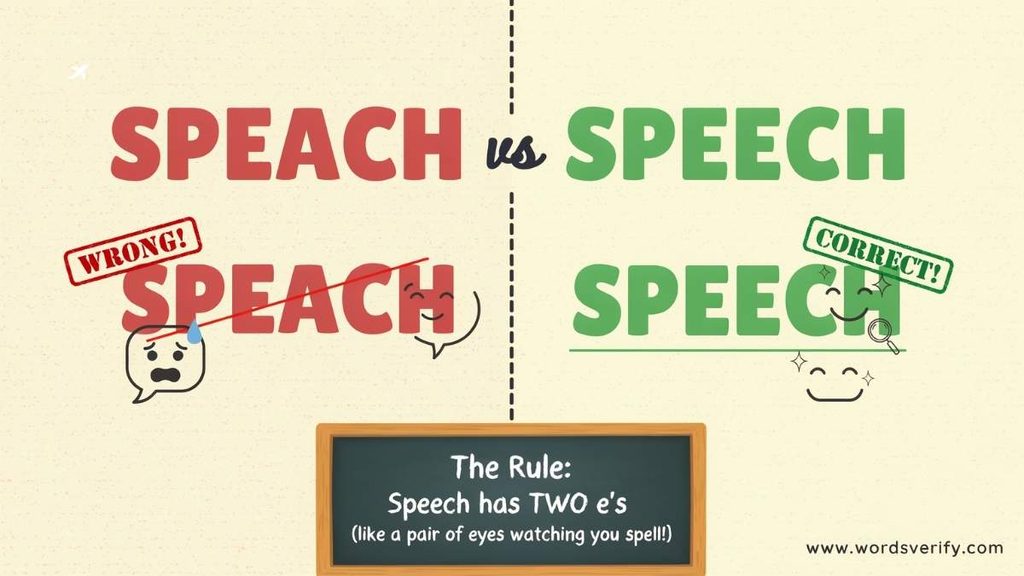
The correct spelling is speech.
The word has two e’s:
S-P-E-E-C-H
The spelling speach is incorrect when you mean spoken communication or a formal talk.
| Spelling | Correct? | Example |
|---|---|---|
| Speech | Yes | She gave a speech at graduation. |
| Speach | No | She gave a speach at graduation. |
If you’re writing a school assignment, an email, or a presentation, choose speech.
Is “Speach” a Word?
In standard modern English, speach isn’t the accepted spelling of the word speech.
You may see it in online posts, messages, or other writing, but that doesn’t make it a correct alternative. People often make spelling mistakes, and this is one of them.
For example:
She prepared a speech for the ceremony.
The same sentence with speach contains a spelling error:
She prepared a speach for the ceremony.
The meaning is still easy to understand, but the spelling needs correction.
What Does Speech Mean?
Speech has several related meanings. It doesn’t always refer to standing in front of a crowd with a microphone.
Speech as the Act of Talking
Speech can mean the ability or activity of communicating through spoken words.
For example:
- The illness affected his speech.
- The child is developing speech.
- Clear speech helps people understand one another.
In these sentences, speech refers to spoken communication rather than a prepared presentation.
Speech as a Formal Talk
Speech can also mean a talk given to an audience.
For example:
- She gave a speech at her graduation.
- The president delivered a speech.
- He prepared a short speech for the wedding.
This is probably the meaning you have in mind when you say, “I need to write a speech.”
Speech as a Person’s Way of Speaking
The word can also describe how someone speaks.
Consider this sentence:
His speech was slow and difficult to understand.
Here, speech doesn’t mean a formal address. It describes the person’s manner of speaking.
That small difference matters. The same word can describe both the act of talking and a particular talk speach vs speech.
Speech as Spoken Language
Speech can also refer to language used in spoken communication.
For example:
Some expressions are more common in speech than in writing.
This meaning often appears in discussions about communication, language, and grammar.
Why Do People Spell Speech as Speach?
The mistake usually comes from a familiar spelling pattern.
Look at these words:
- teach
- reach
- beach
- peach
- each
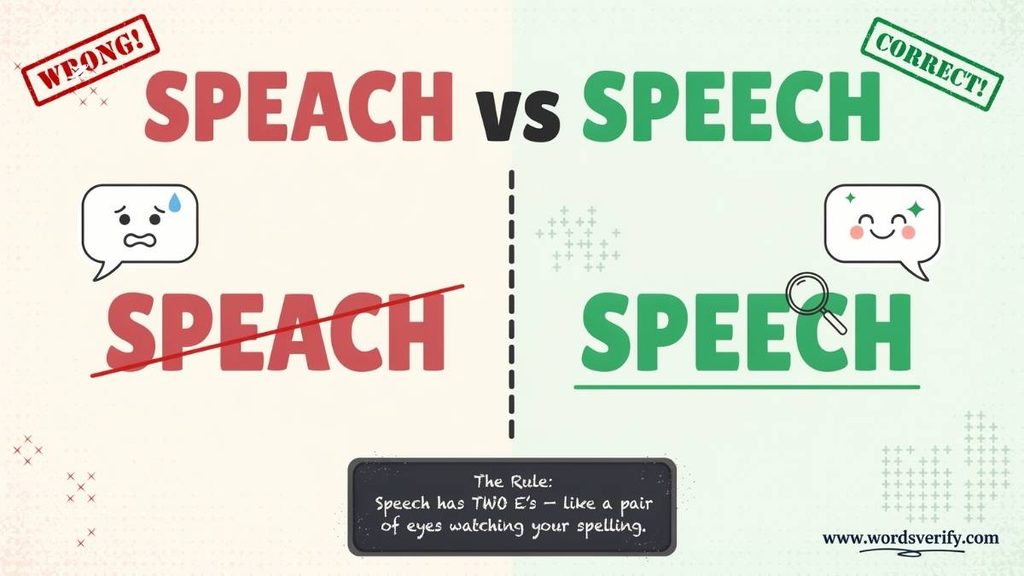
They all contain the letters ea. Because speech has a similar sound, it’s easy to assume it should follow the same pattern.
But English spelling doesn’t always work that neatly.
The correct word is speech, not speach.
Pronunciation Doesn’t Always Reveal Spelling
Speech is pronounced /spiːtʃ/.
The middle sound is the long “ee” sound, as in see or team. English uses several different letter combinations to represent that sound, including ee, ea, and ie.
For example:
- see
- team
- field
- piece
- speech
So hearing the word doesn’t always tell you which letters to write. That’s why pronunciation can sometimes lead to a spelling mistake.
Familiar Words Can Mislead You
When you learn English, you naturally look for patterns. That’s a good habit, but it doesn’t always work.
You might think:
Teach has ea, so speech should probably have ea too.
That sounds reasonable. Unfortunately, English has plenty of words that refuse to cooperate.
Speech is one of them.
Typing Quickly Can Cause Mistakes
Sometimes the problem isn’t that you don’t know the word. You simply type the wrong letters.
This can happen when:
- you’re writing quickly;
- you’re spelling from memory;
- you’re thinking about what to say next;
- you’re unfamiliar with the word;
- you rely too much on autocorrect.
A quick proofreading check can catch the mistake before anyone else does.
Learn how to use confusing more words correctly
Glueing vs Gluing Which one Is Correct?
How to Remember the Correct Spelling

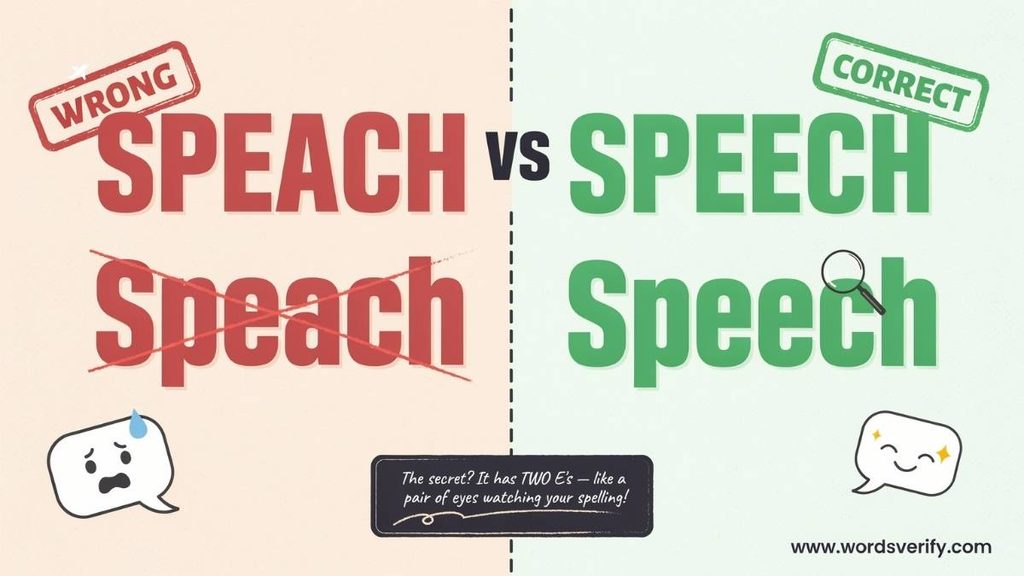
The easiest way to remember speech is to focus on the two e’s.
Think of the word like this:
S + P + EE + CH
That’s the spelling to keep in mind.
A simple memory trick is:
Speech has two e’s.
It isn’t a grammar rule. It’s just a useful reminder.
Connect Speech With Speak
Speech and speak are related words.
- Speak is a verb.
- Speech is a noun.
For example:
They speak clearly.
Their speech is clear.
Remembering the two words together can help you recognize the correct spelling.
Remember the Plural
The plural of speech is speeches.
Not speaches.
For example:
The students prepared several speeches.
The spelling changes from speech to speeches, but the double e remains.
Common Forms of Speech
Learning a few related words can make the spelling easier to remember.
| Word | Meaning | Example |
|---|---|---|
| Speech | Spoken communication or a formal talk | Her speech was memorable. |
| Speeches | More than one speech | The candidates gave speeches. |
| Speechless | Unable to speak because of strong emotion or surprise | The news left him speechless. |
| Speechwriter | Someone who writes speeches | The politician hired a speechwriter. |
| Speechmaker | Someone who gives speeches | He became a respected speechmaker. |
These words all keep the same spelling pattern.
Common Mistakes to Avoid
The spelling problem doesn’t stop with the singular form. People sometimes carry the mistake into other words.
Give a Speech
Correct:
She gave a speech at the ceremony.
Incorrect:
She gave a speach at the ceremony.
You can also say make a speech. Both expressions are natural.
Write a Speech
Correct:
I need to write a speech for class.
Incorrect:
I need to write a speach for class.
This is a common mistake in school assignments and presentations.
Speeches, Not Speaches
The plural of speech is speeches.
Correct:
The students prepared speeches.
Incorrect:
The students prepared speaches.
The word keeps its double e and adds es.
Speechless
The word speechless also uses the correct spelling.
For example:
The surprise left her speechless.
Writing speachless would carry the same spelling mistake into another word.
Speech in Everyday English
The Speech appears in many ordinary situations. It isn’t limited to politics or public speaking.
At School
Students often write or give speeches for:
- graduation;
- class presentations;
- debates;
- competitions;
- student elections;
- historical projects.
For example:
The student gave a short speech about protecting the environment.
A speech can be formal, but it doesn’t have to sound stiff. A good school speech should be clear, organized, and easy to follow speach vs speech.
At Work
People give speeches at meetings, conferences, award ceremonies, and company events.
For example:
The manager gave a speech at the annual meeting.
The word can also describe the way someone communicates:
His speech was calm and easy to understand.
At a Wedding
Wedding speeches are another familiar example.
Someone might say:
She gave a speech at her brother’s wedding.
Here, speech means a prepared talk for a special occasion.
In Everyday Conversation
Speech can also describe ordinary communication.
For example:
Her speech became clearer after months of practice.
Some expressions sound more natural in speech than in writing.
These examples show that speech has a much broader meaning than “a talk in front of an audience.”
Speech vs Related Words
The Speech is closely connected to several other English words, but they aren’t always interchangeable speach vs speech.
Speech vs Talk
Speech often sounds more formal than talk.
Compare:
The president gave a speech.
The professor gave a talk about climate science.
Both sentences describe a presentation, but speech often suggests a more formal occasion.
Talk can also refer to an ordinary conversation:
We had a talk after dinner.
You wouldn’t normally replace that with speech.
Speech vs Speaking
Speech is a noun. Speaking can work as a noun or as the present participle of speak.
Compare:
Her speech was excellent.
Speaking clearly takes practice.
The words are related, but they serve different roles in a sentence.
Speech vs Language
Language is the broader system people use to communicate. Speech usually refers to spoken communication or someone’s way of speaking.
For example:
English is a language.
English speech can vary depending on the situation.
This distinction is useful when studying grammar or communication.
Speech in Grammar
The word speech also appears in several grammar terms.
Parts of Speech
Parts of speech are categories of words, such as nouns, verbs, adjectives, and adverbs.
For example:
The word “happy” is an adjective.
This use has nothing to do with giving a formal talk. It refers to the role a word plays in a sentence.
Direct Speech
Direct speech reports someone’s exact words.
For example:
Maria said, “I am tired.”
The quoted words are the speaker’s own words.
Reported Speech
Reported speech tells us what someone said without necessarily repeating the exact words.
For example:
Maria said that she was tired.
Both terms are common in English grammar.
Figures of Speech
A figure of speech is an expression that uses words in a nonliteral way.
For example:
The classroom was a zoo.
The classroom isn’t literally a zoo. The expression compares it to one to suggest that it was noisy or chaotic.
Speech in American and British English
Fortunately, this spelling doesn’t change between American and British English.
The correct spelling is speech in both varieties.
| Variety | Correct spelling |
|---|---|
| American English | Speech |
| British English | Speech |
You don’t need to learn a second spelling for this word.
Whether you’re writing for an American audience, a British audience, or an international audience, speech is the standard form.
How to Use Speech Correctly
The meaning of speech depends on the sentence.
As a Noun
Speech is a noun.
For example:
- Her speech was memorable.
- His speech was difficult to understand.
- The child is developing speech.
- Freedom of speech is an important principle.
Common Expressions
The word appears in many familiar phrases:
- freedom of speech
- speech therapy
- speech recognition
- speech sounds
- speech writing
- direct speech
- reported speech
- figure of speech
- parts of speech
Each phrase has its own meaning, but the spelling remains the same.
Speech Therapy
Speech therapy is a common phrase related to communication and speaking.
For example:
The child receives speech therapy to help improve communication.
Here, speech refers to spoken communication, not a formal presentation.
A Few More Examples
Here are some sentences that show how speech works in everyday English:
She gave a speech at the ceremony.
He wrote a speech for his class.
Her speech was easy to understand.
The students prepared several speeches.
The surprise left him speechless.
Freedom of speech is an important principle.
The article compares speech and writing.
His speech became clearer with practice.
Notice how the meaning changes with the context, but the spelling never does.
Here’s a clear and engaging practice session with 25 fill-in-the-blank questions, followed by an answer key.
- Here’s a trusted source for clear more words Comparison:
- Grammar Update
Practice Session speach vs speech
Fill in each blank with the correct word speach vs speech
- The student prepared a short ______ for the school assembly.
- The word “speach” is a common spelling ______.
- The principal gave an inspiring ______ to the students.
- The correct spelling is s-p-e-e-c-h, or ______.
- The audience listened carefully to the guest speaker’s ______.
- The students practiced their ______ before the competition.
- Freedom of ______ is an important right.
- Her emotional ______ touched everyone in the room.
- The teacher asked us to write a ______ about our favorite hobby.
- Several ______ were delivered during the ceremony.
- He became ______ after hearing the surprising news.
- Clear ______ helps people understand your message.
- The politician delivered a powerful ______.
- The students gave three short ______ during the event.
- The word “speech” begins with the same sound as the word ______.
- She was nervous before giving her first public ______.
- The coach gave a motivational ______ before the match.
- The correct plural form of “speech” is ______.
- His ______ was easy to understand because he spoke clearly.
- The wedding guest prepared a humorous ______ for the couple.
- The class discussed the different parts of ______.
- The speaker delivered two ______ at the conference.
- Writing “speach” instead of “speech” can make your work look less ______.
- The audience applauded after the inspiring ______.
Answers
- speech
- mistake
- speech
- speech
- speech
- speeches
- speech
- speech
- speech
- speeches
- speechless
- speech
- speech
- speeches
- speak
- speech
- speech
- speeches
- speech
- speech
- speech
- speeches
- professional
- speech
FAQs
Here are fresh, AEO-friendly FAQs that focus specifically on the confusion between “speach” and “speech” without repeating your existing questions.
Why do people write “speach” instead of “speech”?
People often write “speach” because it follows the spelling pattern of words such as “teach,” “reach,” and “beach.” However, the correct spelling is “speech,” which contains two e’s.
Is “speach” accepted in standard English?
No. “Speach” is not the standard modern spelling of the word. In normal writing, education, and professional communication, use “speech.”
How can I remember the spelling of speech?
Remember that speech contains two e’s before the final “ch.” You can also connect it with “speak,” which begins with the same sound and helps you remember the correct spelling.
Does speech have the same spelling in American and British English?
Yes. The word “speech” is spelled the same way in both American and British English. The spelling does not change between the two varieties.
What is the plural of speech?
The plural of “speech” is “speeches.” For example, “The students prepared several speeches for the competition.”
Is “speech” a noun or a verb?
“Speech” is a noun. It refers to spoken communication, a person’s way of speaking, or a formal talk given to an audience.
Can speech refer to everyday conversation?
Yes. Speech can describe ordinary spoken communication, not just a formal presentation. For example, “Clear speech helps people understand one another.”
What is the difference between speech and speaking?
“Speech” is usually a noun that refers to spoken words or a formal talk. “Speaking” is the activity of using spoken language. For example, “Her speech was inspiring” and “He enjoys speaking in public.”
Why is the spelling “speech” unusual?
The spelling can seem unusual because the long “ee” sound is not always written with two e’s in English. Words such as “speak” and “speech” help show that spelling patterns can change from one word to another.
Is “speech” used in common expressions?
Yes. Common expressions include “freedom of speech,” “parts of speech,” “speechless,” “give a speech,” and “speech therapy.” These phrases all use the spelling “speech.”
What does “speechless” mean?
“Speechless” means unable to speak because of strong emotion, surprise, shock, or amazement. For example, “The unexpected announcement left everyone speechless.”
Can “speech” describe a person’s accent or voice?
Yes. Speech can describe how someone speaks, including their clarity, rhythm, pronunciation, or manner of expression. For example, “Her speech was clear and easy to understand.”
What is a speechwriter?
A speechwriter is someone who writes speeches for another person, such as a politician, business leader, student, or public speaker.
What is the easiest way to correct the mistake in writing?
Whenever you type “speach,” check the spelling and replace it with “speech.” A useful reminder is that the correct word has two e’s: S-P-E-E-C-H.
Can a spelling mistake change the impression of a speech?
Yes. A spelling mistake may distract readers from the message and make writing appear less polished. Using “speech” correctly helps keep your communication clear and professional.
conclusion
So, is it speach vs speech? The correct spelling is speech. Although “speach” may look right at first glance, it’s simply a common spelling mistake that can easily sneak into your writing.
The good news is that remembering the correct spelling is easy: speech contains two e’s. Whether you’re giving a speech, writing one, or discussing the way people communicate, this small spelling detail helps keep your writing clear and professional.
One extra letter can cause quite a bit of confusion, but now you know better. Keep speech in your vocabulary, leave speach behind, and let your words speak for themselves without any spelling drama speach vs speech.

Lisa AJS is an experienced blogger and language enthusiast at Words Verify, dedicated to making grammar simple, practical, and enjoyable. She writes engaging content on commonly confused words, grammar mistakes, word meanings, and everyday language challenges.