
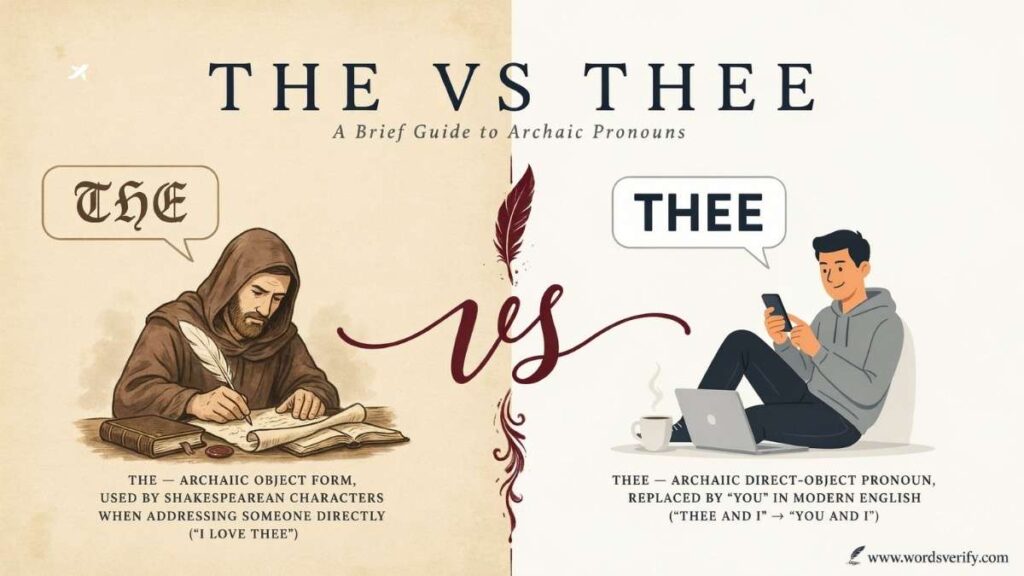
Have you ever looked at “the vs thee” and wondered whether English was playing a little trick on you? These words may look alike and sometimes sound the same, but their meanings and uses are quite different. In this guide to the vs. thee, you’ll learn why “the” introduces a noun while “thee” means “you” in older English. You’ll also discover when “the” sounds like “thuh” or “thee,” along with simple examples that make common grammar mistakes easier to understand. By the end, the vs thee this confusing pair will feel less like a language puzzle and more like a piece of cake.
The vs Thee The Main Difference
The simplest way to understand the difference is to look at their role in a sentence.
| Word | Function | Example |
|---|---|---|
| The | A definite article used before a noun | The child is sleeping. |
| Thee | An old-fashioned pronoun meaning “you” | I thank thee. |
“The” helps identify a particular person, place, thing, or idea.
For example:
- The car is outside.
- The teacher entered the room.
- The flowers need water.
In each sentence, “the” comes before a noun and points to something specific.
“Thee” does something completely different. It refers to the person receiving an action.
For example:
- I called thee.
- I thank thee.
- I give thee this gift.
In modern English, we would normally use “you” instead of “thee.”
- I called you.
- I thank you.
- I give you this gift.
The words may sound alike in some sentences, but their meanings and uses are not the same.
What Does “The” Mean?
“The” is known as the definite article. We use it when we are talking about a particular person or thing that the listener can identify.
Compare these sentences:
- I saw a dog.
- The dog was wearing a red collar.
In the first sentence, “a dog” could mean any dog. In the second sentence, “the dog” refers to the specific dog already mentioned.
We also use “the” when the situation makes the meaning clear.
- Please open the window.
- I left my phone on the table.
- The teacher gave us homework.
- We visited the museum yesterday.
The listener can usually understand which window, table, teacher, or museum the speaker means.
“The” can be used before singular nouns, plural nouns, and uncountable nouns.
- The student is ready.
- The students are ready.
- The water is cold.
- The information was helpful.
It can also appear before things that are unique or widely understood.
- The sun is shining.
- The moon looks beautiful tonight.
- The Earth moves around the sun.
- The internet has changed communication.
In short, “the” helps the reader or listener identify the noun being discussed.
Learn the difference between tricky grammar more word
Pleaded vs Pled Which One Is Correct?
What Does “Thee” Mean?
“Thee” is an old-fashioned English pronoun that means “you.” It was used when speaking directly to one person.
In older English, pronouns changed depending on their role in a sentence. Modern English mostly uses “you” for both the subject and the object.
For example, modern English uses:
- You helped me.
- I helped you.
Older English used different forms:
- Thou helped me.
- I helped thee.
“Thou” was the subject form. “Thee” was the object form.
Examples of “thee” include:
- I thank thee.
- I remember thee.
- I give thee my word.
- May peace be with thee.
- I shall follow thee.
These sentences sound old-fashioned today. Most modern speakers would say:
- I thank you.
- I remember you.
- I give you my word.
- May peace be with you.
- I shall follow you.
“Thee” still appears in older religious texts, traditional prayers, poetry, historical writing, and dramatic language. Someone might also use it jokingly to make an ordinary sentence sound grand or theatrical.
For example, saying “I thank thee for this sandwich” makes a simple thank-you sound like a speech from a historical drama.
Learn the difference between tricky grammar more word
Speach vs Speech Which one Is Correct?
The and Thee Pronunciation
The pronunciation of “the” changes depending on the sound that follows it the vs thee.
There are two common pronunciations:
- “Thuh” — /ðə/
- “Thee” — /ðiː/
We usually use “thuh” before a consonant sound and “thee” before a vowel sound.
“Thee,” the pronoun, is normally pronounced /ðiː/. It has the same vowel sound as the words “see,” “tree,” and “free.”
How to Pronounce “The” as “Thuh”
Use “thuh” before a consonant sound.
Examples include:
- the book — thuh book
- the car — thuh car
- the house — thuh house
- the dog — thuh dog
- the teacher — thuh teacher
- the garden — thuh garden
The sound that follows “the” matters more than the first letter of the next word.
For example, “university” begins with the letter “u,” but its first sound is /j/, like the beginning of “you.” That sound acts like a consonant.
Therefore, we usually say:
- the university — thuh university
- the union — thuh union
- the user — thuh user
- the European country — thuh European country
How to Pronounce “The” as “Thee”
Use “thee” before a vowel sound.
Examples include:
- the apple — thee apple
- the orange — thee orange
- the egg — thee egg
- the answer — thee answer
- the evening — thee evening
- the old house — thee old house
The word “hour” is another useful example. Although it begins with the letter “h,” the “h” is silent. The word starts with a vowel sound.
That is why we say:
- the hour — thee hour
- the honest man — thee honest man
- the heir — thee heir
The same pattern applies to “unusual,” “important,” and “interesting.”
- the unusual event
- the important decision
- the interesting story
The Pronunciation Before Consonant Sounds
The usual pronunciation is /ðə/ before a consonant sound.
Examples:
- the pen
- the school
- the red dress
- the small room
- the young boy
- the one I wanted
Although “one” begins with the letter “o,” it starts with a /w/ sound. That is why we normally say “thuh one.”
The Pronunciation Before Vowel Sounds
The usual pronunciation is /ðiː/ before a vowel sound.
Examples:
- the apple
- the elephant
- the ocean
- the answer
- the exam
- the idea
- the empty room
The important rule is simple: listen to the first sound of the next word rather than looking only at its first letter.
Learn the difference between tricky grammar more word
Glueing vs Gluing Which one Is Correct?
The vs Thee vs Thuh
“The,” “thee,” and “thuh” are closely connected, but they are not interchangeable.
“The” is the written word. “Thuh” and “thee” are its common spoken forms. “Thee” can also be a separate pronoun meaning “you.”
| Form | Meaning or use | Example |
|---|---|---|
| The | Written definite article | The book is new. |
| Thuh | Common pronunciation of “the” | Thuh book |
| Thee | Pronunciation of “the” before a vowel sound | Thee apple |
| Thee | Old-fashioned pronoun meaning “you” | I thank thee. |
Consider these sentences:
- The book is interesting.
- The apple is fresh.
- I thank thee.
In the first sentence, “the” is usually pronounced “thuh.” or In the second sentence, “the” is usually pronounced “thee and In the third sentence, “thee” is a pronoun.
The sound may be similar, but the grammatical function tells you which word is being used.
Is “The” Pronounced “Thuh” or “Thee”?
Both pronunciations are correct.
Use “thuh” before most consonant sounds:
- thuh house
- thuh chair
- thuh movie
- thuh garden
Use “thee” before most vowel sounds:
- thee apple
- thee answer
- thee evening
- thee ocean
There is one important exception to remember. Speakers may use “thee” for emphasis, even before a consonant sound.
For example:
- This is the best choice.
- This is thee best choice.
The second sentence places extra stress on “the.” It suggests that the speaker means the one truly outstanding choice.
Pronunciation can also vary slightly depending on a speaker’s accent, rhythm, and speaking style. The vowel-sound rule is a useful guide, but it is not an absolute rule that every speaker follows in exactly the same way.
When Do You Pronounce “The” as “Thee”?
You usually pronounce “the” as “thee” when the next word begins with a vowel sound.
Examples include:
- the artist
- the actor
- the airport
- the answer
- the event
- the orange
- the umbrella
- the old building
You may also use “thee” when you want to emphasize the article.
For example:
- She is the person I mentioned.
- She is thee person I mentioned.
The second version gives the word extra importance. It may sound dramatic or deliberate, but it is still understandable and grammatically acceptable.
When Do You Pronounce “The” as “Thuh”?
You usually pronounce “the” as “thuh” when the next word begins with a consonant sound.
Examples include:
- the boy
- the girl
- the house
- the river
- the blue car
- the university
- the European Union
- the one I wanted
The words “university,” “European,” and “one” show why sound matters more than spelling.
Although these words begin with vowel letters, they begin with consonant sounds. That is why “thuh” is the natural choice.
Does “Thee” Always Sound Like “The”?

Not always.
“Thee” always has the long “ee” sound in standard pronunciation. “The” can be pronounced in two common ways: “thuh” or “thee.”
This means the two words can sound identical in some sentences.
Compare:
- The apple is red.
- I thank thee.
In the first sentence, “the” is pronounced “thee” because it comes before a vowel sound. In the second sentence, “thee” is the pronoun meaning “you.”
Even though they sound alike, the context makes their meanings different.
This is similar to other English words that share a pronunciation but have different meanings. The surrounding words help us understand which word the speaker intends.
Is “Thee” Still Used?
“Thee” is uncommon in everyday modern English. Most people use “you” instead.
However, you may still see or hear “thee” in certain situations:
- Older Bible translations
- Traditional prayers
- Religious ceremonies
- Shakespearean plays
- Classic poetry
- Historical novels
- Songs written in an old-fashioned style
- Some traditional regional dialects
Writers sometimes use “thee” to create a poetic or historical atmosphere. Speakers may also use it humorously.
For example, someone might say, “I thank thee for your assistance” while joking with a friend. The sentence sounds unusual because “thee” belongs to an older style of English.
Using “thee” does not automatically make a sentence more polite. It usually makes the sentence sound old-fashioned, formal, poetic, or dramatic.
Is “Thee” an Old English Word?

“Thee” is an old-fashioned English word, but the phrase “Old English” needs some care .
In language studies, Old English refers to the language used in England many centuries ago. It was very different from the English we speak today.
“Thee” belongs mainly to later stages of English, especially Middle English and Early Modern English. It was widely used during the periods associated with Shakespeare and older English Bible translations.
For everyday discussion, it is fine to call “thee” an old-fashioned or historical English word. However, it is more precise to describe it as an archaic pronoun rather than technically calling it an Old English word.
Thee vs Thou
“Thee” and “thou” are related, but they have different grammatical roles.
| Word | Function | Modern equivalent |
|---|---|---|
| Thou | Subject pronoun | You |
| Thee | Object pronoun | You |
| Thy | Possessive word before a noun | Your |
| Thine | Possessive pronoun | Yours |
Examples make the difference clearer.
- Thou art kind.
Modern English: You are kind. - I see thee.
Modern English: I see you. - Thy voice is beautiful.
Modern English: Your voice is beautiful. - The choice is thine.
Modern English: The choice is yours.
A simple way to remember the difference is to ask who is performing the action and who is receiving it.
Use “thou” for the person doing the action. Use “thee” for the person receiving the action.
Compare:
- Thou called me.
- I called thee.
In the first sentence, “thou” is the subject. In the second sentence, “thee” is the object.
Thee in the Bible
“Thee” appears in many older English Bible translations. At the time, English used different pronouns for addressing one person.
Older religious language may include expressions such as:
- I praise thee.
- I beseech thee.
- Lead me to thee.
- Thy will be done.
Modern translations often use “you” instead.
The use of “thee” in religious language does not necessarily mean that it was more respectful. In earlier English, “thou” and “thee” were ordinary singular pronouns.
Over time, “you” became the usual form for both singular and plural address. Some religious traditions continued using “thee” because of tradition and familiarity.
That is why the word may still sound natural in prayers or religious ceremonies, even though it is unusual in everyday conversation.
Thee in Shakespeare
Shakespeare used “thou” and “thee” according to their grammatical roles. He also used them to help show relationships between characters.
“Thee” may appear in expressions of affection, anger, friendship, intimacy, or hostility. The word itself does not always reveal the speaker’s attitude. The surrounding language and situation provide that meaning.
Examples include:
- I love thee.
- I know thee well.
- I shall follow thee.
In modern English, these sentences would usually become:
- I love you.
- I know you well.
- I shall follow you.
Using “thee” in modern writing can make a sentence sound poetic, dramatic, or historical. It would usually feel out of place in a business email or an ordinary conversation.
Why Did People Stop Using “Thee”?
English changed gradually over many centuries. The separate forms “thou” and “thee” became less common, while “you” expanded into both singular and plural use.
Several changes helped bring about this shift.
- “You” became associated with politeness and respect.
- Speakers began using “you” more often in formal situations.
- Social habits influenced the way people addressed one another.
- Regional differences affected pronoun use.
- English gradually simplified some parts of its grammar.
Eventually, “you” became the normal pronoun for almost everyone.
Today, “thee” survives mainly in historical writing, religious language, poetry, traditional dialects, and humorous expressions.
Common Mistakes with “The” vs “Thee”
These words are easy to confuse when you focus only on their sound.
Using “thee” before a noun
Incorrect:
- Thee book is on the desk.
- I saw thee teacher.
Correct:
- The book is on the desk.
- I saw the teacher.
“Thee” cannot replace “the” before a noun.
Using “the” as an old-fashioned pronoun
Incorrect:
- I thank the.
- I give the this gift.
Correct:
- I thank thee.
- I give thee this gift.
In these sentences, “thee” means “you,” so it must function as a pronoun.
Assuming “thee” is always more polite
“Thee” is not automatically more respectful than “you.” It is an old-fashioned form that may sound poetic, religious, dramatic, or humorous.
Modern English uses “you” in both formal and informal situations.
Choosing the pronunciation from spelling alone
Do not choose between “thuh” and “thee” only by looking at the first letter of the next word.
Compare:
- the apple — thee apple
- the university — thuh university
- the hour — thee hour
- the one — thuh one
The first sound matters more than the first letter.
A Simple Comparison
| Feature | The | Thee |
|---|---|---|
| Part of speech | Definite article | Pronoun |
| Meaning | Identifies a specific noun | Means “you” |
| Modern use | Very common | Mostly historical or poetic |
| Pronunciation | Usually “thuh” or “thee” | Usually “thee” |
| Position | Before a noun | After a verb or preposition |
| Example | The girl smiled. | I called thee. |
The easiest way to remember the difference is this:
- “The” introduces a noun.
- “Thee” refers to a person.
- “The” may sound like “thuh” or “thee.”
- “Thee” normally sounds like “thee.”
Practice Session The vs Thee
Fill in each blank with the vs thee.
- Please close ______ door before you leave.
- I love ______, my dear friend.
- She visited ______ museum yesterday.
- May peace be with ______.
- He placed the book on ______ table.
- “I give ______ my word,” said the knight.
- We watched ______ movie together.
- The speaker said, “I shall remember ______.”
- She is ______ best student in the class.
- “I thank ______ for your kindness.”
- They walked through ______ park.
- The poet wrote, “I dedicate this song to ______.”
- Please pass me ______ salt.
- “I shall never forget ______.”
- He opened ______ window.
- The old prayer included the words, “Guide ______.”
- We waited outside ______ hospital.
- “I ask ______ to listen carefully.”
- She found ______ answer to the question.
- “May I speak with ______?”
- The children cleaned ______ classroom.
- “I shall always stand beside ______.”
- He bought ______ umbrella.
- “I offer ______ my sincere thanks.”
- We visited ______ ancient castle.
Answers
- The
- Thee
- The
- Thee
- The
- Thee
- The
- Thee
- The
- Thee
- The
- Thee
- The
- Thee
- The
- Thee
- The
- Thee
- The
- Thee
- The
- Thee
- The
- Thee
- The
Here’s a trusted source for clear more words Comparison:
More Related Articles You May Find Helpful
FAQs
Can “the” vs “thee” sound the same?
Yes. “The” is often pronounced “thee” before a vowel sound. The pronoun “thee” is also pronounced “thee.” Their meanings remain different even when they sound identical.
Does “thee” come before or after a noun?
“Thee” usually comes after a verb or preposition because it acts as an object pronoun.
Examples:
- I saw thee.
- She spoke to thee.
- He gave thee a gift.
Can “thee” be used for more than one person?
Traditionally, “thee” referred to one person. Older English used different pronouns for singular and plural forms. Modern English uses “you” for both.
Is “thee” appropriate in everyday conversation?
It is grammatically understandable, but it sounds old-fashioned in most modern conversations. It is more suitable for poetry, religious language, historical writing, or playful speech.
Can “thee” be used in formal writing?
It can be used when the writing has a historical, religious, or poetic purpose. It would usually sound unnatural in a modern business letter, school assignment, or professional report.
Why does “the” sometimes sound longer than usual?
The longer pronunciation, “thee,” often appears before a vowel sound. Speakers may also use it for emphasis when they want to draw attention to the following noun.
Does the pronunciation of “the” change in fast speech?
Yes. In connected speech, “the” is often reduced to a quick, unstressed sound. This is why “thuh” is common in natural conversation before consonant sounds.
Should I pronounce “the” differently when reading aloud?
Follow the usual sound pattern, but focus on speaking naturally. Use “thuh” before a consonant sound and “thee” before a vowel sound. Use “thee” for emphasis when the meaning requires extra stress.
Can “the” be pronounced “thee” before a consonant sound?
Yes. Although “thuh” is more common in that position, speakers may use “thee” to add emphasis.
For example:
- She is the winner.
- She is thee winner.
The second sentence gives extra importance to the word “the.”
Why does “the” sound different before “hour” and “house”?
“Hour” begins with a vowel sound because its “h” is silent. “House” begins with a consonant sound because its “h” is pronounced.
Therefore:
- the hour — “thee”
- the house — “thuh”
Why do “the university” and “the umbrella” sound different?
“University” begins with a consonant-like /y/ sound, while “umbrella” begins with a vowel sound.
That is why we usually say:
- the university — “thuh”
- the umbrella — “thee”
Can “thee” be the subject of a sentence?
No. In traditional English grammar, “thee” is an object pronoun. The subject form is “thou.”
For example:
- Thou art wise.
- I admire thee.
What comes after “thee” in a sentence?
“Thee” may be followed by a noun, adjective, or other phrase that completes the sentence.
Examples:
- I give thee my word.
- I consider thee a friend.
- May the Lord bless thee.
Is “thee” related to the word “thine”?
Yes. “Thee,” “thou,” “thy,” and “thine” belong to the same older pronoun system.
- Thou means “you” as the subject.
- Thee means “you” as the object.
- Thy means “your” before a noun.
- Thine means “yours” when used independently.
Does “thee” have a plural form?
No. “Thee” was used for one person. The older plural form was “you” or “ye,” depending on the grammatical role and period of English.
Can “thee” be used after a preposition?
Yes. Traditional English uses “thee” after prepositions.
Examples:
- I speak to thee.
- This gift is for thee.
- I walk beside thee.
- There is no one like thee.
Is “thee” used in modern poetry?
Yes. Poets sometimes use “thee” to create a romantic, dramatic, spiritual, or historical mood. Its use depends on the style of the poem.
Why does “thee” sound familiar in songs and prayers?
Many songs and prayers preserve older forms of English. Repeated expressions such as “I thank thee” or “with thee” have remained familiar even though people rarely use them in everyday speech.
Can using “thee” change the meaning of a sentence?
Yes. It can change the sentence from modern language into an older style. However, the basic meaning usually remains the same.
For example:
- I remember you.
- I remember thee.
Both sentences express the same idea, but the second sounds historical or poetic.
How can I quickly identify whether “the” is an article or “thee” is a pronoun?
Look at what comes after the word and what role it plays.
- If it introduces a noun, it is probably “the.”
- If it refers to a person receiving an action, it may be “thee.”
- If it means “you” in an older sentence, it is “thee.”
What is the easiest way to remember the difference?
Remember this simple rule the vs thee :
- “The” identifies a thing.
- “Thee” refers to a person.
- “Thuh” and “thee” are common pronunciations of “the.”
- “Thee” as a pronoun normally keeps its long “ee” sound.
conclusion
The difference between “the” vs “thee” may be small, but English has a way of turning tiny words into surprisingly big puzzles. “The” is the everyday article used before a noun, while “thee” is an old-fashioned pronoun meaning “you.” Although they can sound alike in some sentences, they have completely different meanings and grammatical roles.
Remember the pronunciation rule: “the” usually sounds like “thuh” before a consonant sound and “thee” before a vowel sound. “Thee,” the pronoun, keeps its long “ee” sound. Once you understand these simple differences, this confusing pair becomes much easier to use. English may still have a few tricks up its sleeve, but “the” vs “thee” no longer need to be one of them.

Lisa AJS is an experienced blogger and language enthusiast at Words Verify, dedicated to making grammar simple, practical, and enjoyable. She writes engaging content on commonly confused words, grammar mistakes, word meanings, and everyday language challenges.