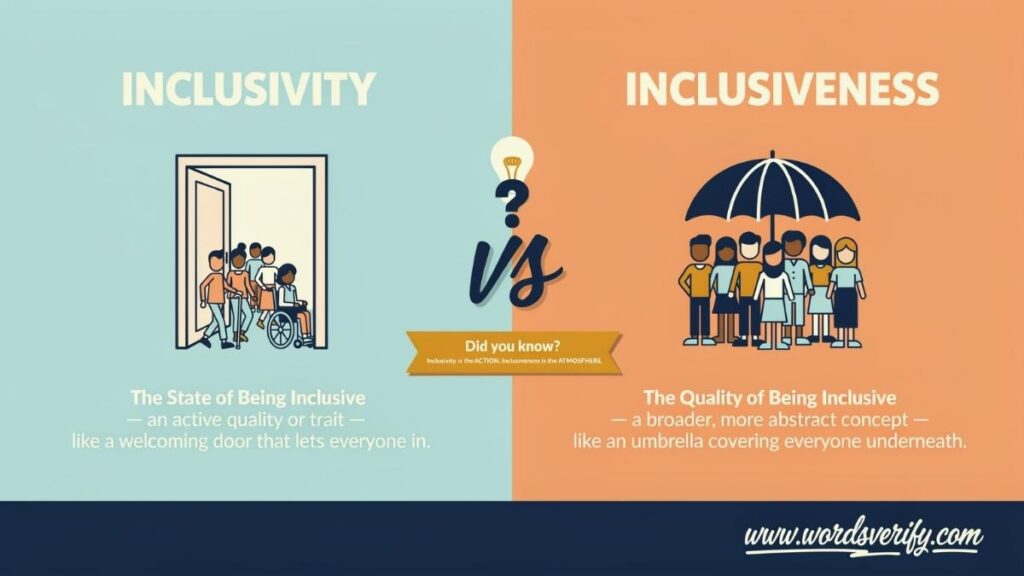
Ever paused over the words “inclusivity” vs “inclusiveness” and wondered if English is making a simple idea unnecessarily complicated? You’re certainly not the only one. These words look remarkably similar and both relate to creating spaces where people feel welcomed, valued, and included. However, they aren’t always used in exactly the same way. The inclusivity vs inclusiveness confusion often appears in workplace discussions, education, formal writing, and everyday conversations. Fortunately, the difference is easier to understand than it first appears. This guide explains their meanings, usage, and key distinctions with clear examples so you can use each word naturally and confidently.
Quick Answer
Inclusivity vs inclusiveness are both correct English nouns with closely related meanings.
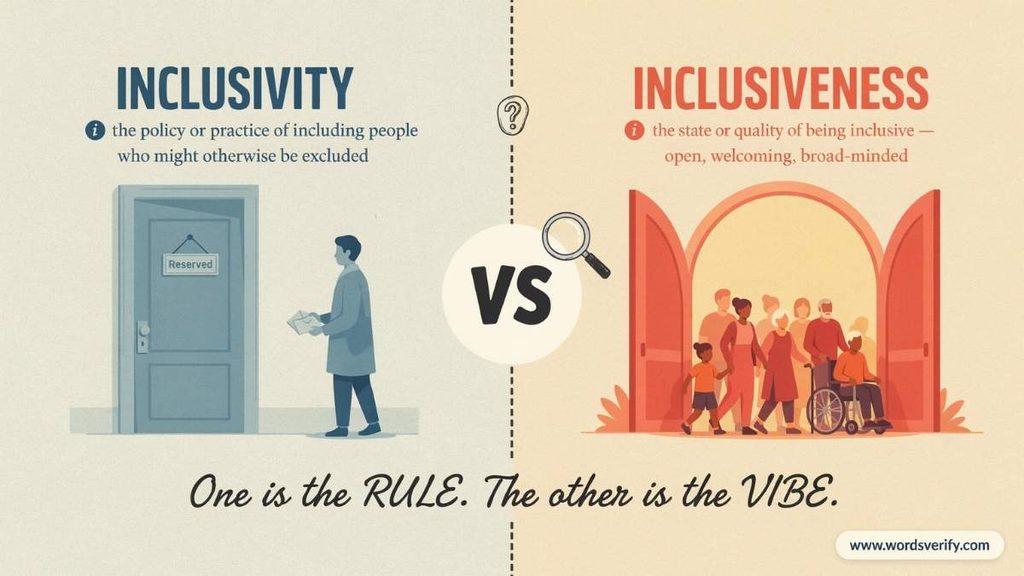
Inclusivity commonly refers to an approach, principle, practice, or effort to include people who might otherwise be excluded. Inclusiveness often describes the quality or extent to which a person, group, environment, policy, or organization is inclusive.
For example:
The company is committed to inclusivity in its hiring practices.
The inclusiveness of the company’s workplace helps employees feel valued.
The difference is subtle. The first sentence focuses on a deliberate commitment. The second focuses on the quality of the workplace.
Neither word is automatically better or more correct.
What Does Inclusivity Mean?
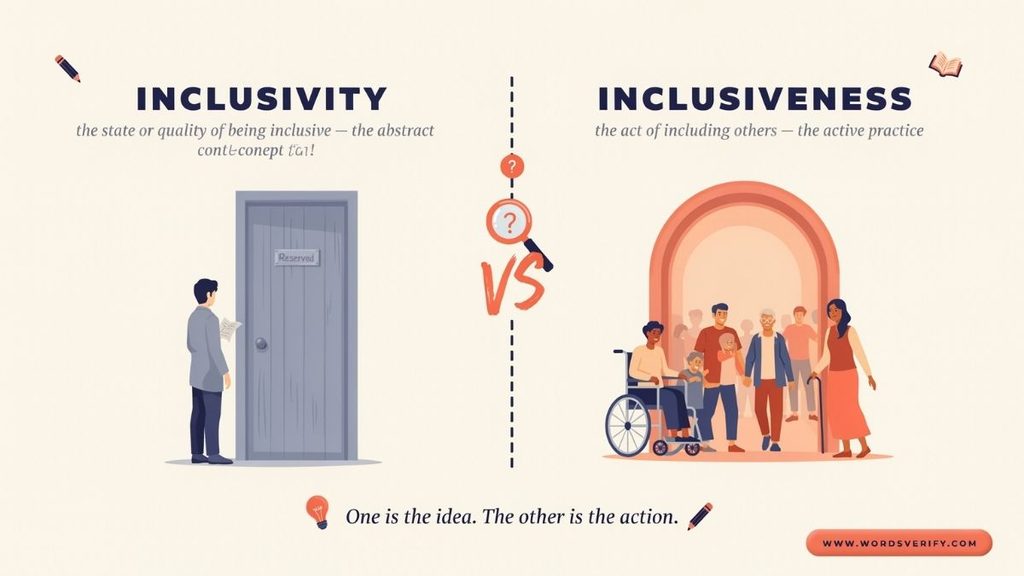
Inclusivity refers to the practice, principle, or quality of including people and allowing them to participate meaningfully.
It can involve much more than simply inviting someone into a room. True inclusion considers whether people can actually take part, access resources, contribute ideas, and feel respected.
Inclusivity can involve several things:
- Equal opportunity
- Accessibility
- Fair participation
- Representation
- Respect
- Acceptance
- Equal access to information and services
- Removal of unnecessary barriers
- A sense of belonging
Consider a workplace with an accessible office entrance. That change may seem small to someone who doesn’t need it. For an employee with limited mobility, however, it can determine whether the workplace is genuinely accessible.
That’s why inclusivity focuses on participation rather than appearances.
Inclusivity in Everyday Life
Inclusivity appears in ordinary situations more often than you might realize.
A community center might provide ramps and accessible restrooms. A school might offer learning materials in different formats. A business might provide multiple ways for customers to communicate with support staff.
These aren’t merely symbolic gestures. They address practical barriers.
Other examples include:
- A company offering reasonable accommodations to employees.
- A conference providing captions for presentations.
- A school making classroom activities accessible to students with different learning needs.
- A website using accessible design.
- A community event considering mobility, dietary, and communication needs.
- A manager giving every team member an opportunity to contribute during meetings.
- A public service providing important information in languages commonly used by the local community.
The common thread is simple: people aren’t merely allowed to participate. The environment is designed to make participation possible.
Learn the difference between tricky more English words
Emaculate vs Immaculate which one is correct?
What Does Inclusiveness Mean?
Inclusiveness describes the quality or condition of being inclusive.
If inclusivity often draws attention to the practice of including people, inclusiveness can draw attention to what that practice looks like in reality.
For example:
The inclusiveness of the classroom encouraged students to share their ideas.
Here, inclusiveness describes a quality of the classroom.
Another example:
The organization is known for its inclusiveness.
The sentence describes the organization’s character and how it treats people.
Inclusiveness can describe a workplace, classroom, community, organization, policy, event, communication style, or social environment.
Understanding Inclusiveness Through an Example
Imagine a neighborhood association that welcomes residents from different backgrounds.
The association holds meetings at accessible locations. It shares information clearly and It gives residents different ways to submit feedback. It doesn’t allow a small group of regular attendees to control every decision.
The association’s approach demonstrates inclusivity.
The resulting quality of the association can be described as inclusiveness.
The two ideas overlap heavily. The difference is mainly where the sentence places its emphasis.
Learn the difference between tricky more English words
Vinal vs Vinyl Which one Is Correct?
Inclusivity vs Inclusiveness The Main Difference
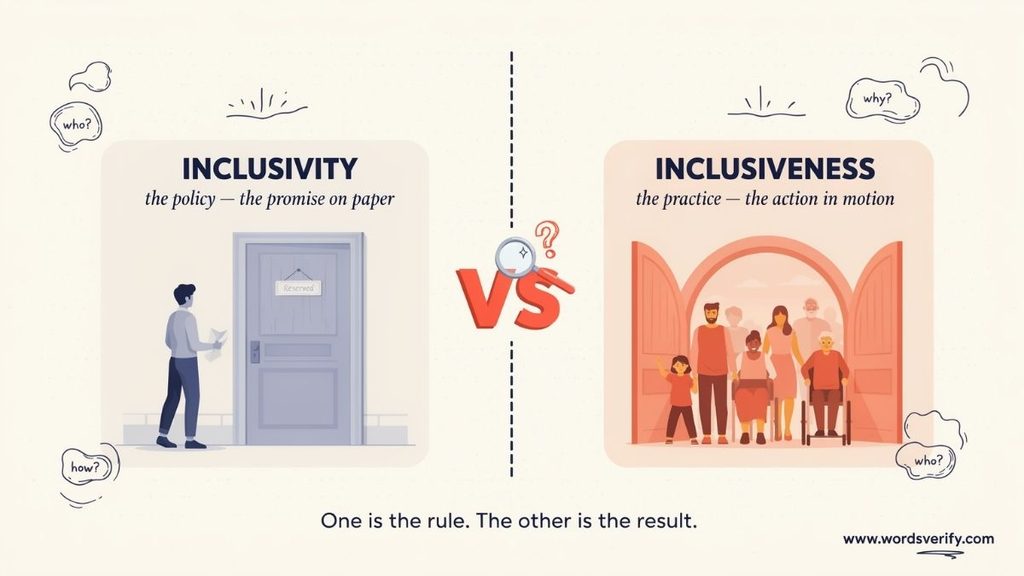
The difference between inclusivity vs inclusiveness is subtle.
Both words describe the idea of including people and reducing exclusion. However, they often appear in slightly different contexts.
| Feature | Inclusivity | Inclusiveness |
|---|---|---|
| Basic meaning | The practice, principle, or quality of including people | The quality or degree of being inclusive |
| Common emphasis | Goals, practices, policies, and efforts | Characteristics of groups, environments, and organizations |
| Workplace example | Promoting inclusivity in hiring | Evaluating workplace inclusiveness |
| Education example | Improving inclusivity in schools | The inclusiveness of a classroom |
| Can they overlap? | Yes | Yes |
| Is one always correct? | No | No |
A useful way to remember the distinction is this:
Inclusivity often describes what people or organizations aim to practice. Inclusiveness often describes what an environment or group is like.
That isn’t an absolute rule. You shouldn’t force the distinction when it makes a sentence awkward.
Inclusivity vs Inclusiveness Examples
Seeing the two words side by side makes the difference much easier to understand.
| Sentence | Main emphasis |
|---|---|
| The company promotes inclusivity in recruitment. | A deliberate effort |
| The inclusiveness of the recruitment process was praised. | A quality of the process |
| The school created new inclusivity policies. | A planned approach |
| The inclusiveness of the classroom encouraged participation. | A characteristic of the classroom |
| The organization has a strong commitment to inclusivity. | A principle or goal |
| The organization’s inclusiveness is reflected in its policies. | An observable quality |
Notice something important: none of these sentences depends on a completely different definition.
The words live in the same semantic neighborhood. They’re simply standing on different sides of the street.
How to Use Inclusivity in a Sentence
Inclusivity works naturally when you’re discussing a principle, goal, practice, policy, or deliberate effort.
Here are several examples:
- The organization promotes inclusivity through accessible community programs.
- Inclusivity plays an important role in the company’s recruitment strategy.
- The school made inclusivity a central part of its student support program.
- The designers considered inclusivity when developing the new product.
- The event organizers emphasized inclusivity when planning the venue.
In each case, inclusivity refers to something people are intentionally pursuing or building into a system.
How to Use Inclusiveness in a Sentence
Inclusiveness often works naturally when you’re describing a quality or characteristic.
Examples include:
- The inclusiveness of the workplace helped new employees settle in quickly.
- The team’s inclusiveness encouraged everyone to share ideas.
- The program was praised for its cultural inclusiveness.
- The inclusiveness of the community made newcomers feel welcome.
- The company evaluated the inclusiveness of its employee policies.
Again, these aren’t rigid rules. You can find plenty of situations where either word sounds perfectly natural.
Learn the difference between tricky more English words
Encorporate vs Incorporate Which one Is Correct?
When Should You Use Inclusivity?
Use inclusivity when you’re talking about the active idea of creating opportunities for participation.
It works especially well with words such as:
- Promoting inclusivity
- Improving inclusivity
- Supporting inclusivity
- Commitment to inclusivity
- Inclusivity strategies
- Inclusivity initiatives
- Inclusivity policies
- Inclusivity efforts
- Inclusivity in education
- Inclusivity in the workplace
For example:
The company introduced new policies to improve inclusivity across its hiring process.
The sentence focuses on an intentional effort.
Inclusivity as a Mindset
Inclusivity can also describe a way of thinking.
An inclusive mindset encourages you to consider people who might be overlooked by a standard process.
Instead of asking only, “Does this work for most people?” an inclusive approach asks:
- Who might struggle with this process?
- What barriers could prevent participation?
- Whose perspective hasn’t been considered?
- Can people access the same information?
- Do people have a meaningful opportunity to contribute?
Those questions can change how organizations design products, workplaces, classrooms, events, and public services.
Learn the difference between tricky more English words
Performed vs Preformed which one is correct?
When Should You Use Inclusiveness?
Inclusiveness is particularly useful when describing the quality or degree of an environment, group, organization, or system.
Natural expressions include:
- Workplace inclusiveness
- Organizational inclusiveness
- Cultural inclusiveness
- Social inclusiveness
- Greater inclusiveness
- Degree of inclusiveness
- Measuring inclusiveness
- Inclusiveness in organizations
- Inclusiveness of a community
- Inclusiveness of a program
For example:
The organization measured the inclusiveness of its employee development program.
The sentence evaluates how inclusive the program actually is.
Learn the difference between tricky more English words
Offered vs Offerred Which one Is Correct?
Inclusivity vs Inclusiveness in the Workplace
A workplace can be diverse without being genuinely inclusive.
That’s an important distinction.
Diversity concerns who is represented. Inclusivity concerns whether those people can participate and contribute. Belonging goes one step further by considering whether people feel accepted and valued.
Imagine a company with employees from many different backgrounds. On paper, its workforce looks diverse. However, managers regularly ignore certain employees during meetings. Promotion opportunities aren’t transparent. Employees who need workplace accommodations struggle to get them.
The company may have diversity without strong inclusion.
A genuinely inclusive workplace looks beyond numbers.
Examples in the Workplace
Practical examples include:
- Providing accessible physical and digital workspaces.
- Using fair and transparent recruitment procedures.
- Making professional development available to employees fairly.
- Giving employees different ways to provide feedback.
- Creating clear anti-discrimination policies.
- Making meetings accessible to remote employees.
- Encouraging different perspectives during decision-making.
- Reviewing promotion and advancement practices for unnecessary barriers.
- Using respectful and inclusive language.
- Training managers to recognize exclusionary practices.
These actions turn an abstract principle into everyday behavior.
Inclusivity and Leadership
Leadership plays a major role in creating an inclusive workplace culture.
An inclusive leader doesn’t simply announce that everyone is welcome. They pay attention to who gets heard, who receives opportunities, and who gets left out of important conversations.
For example, a manager might notice that the same three employees dominate every meeting. Rather than blaming quieter employees for not speaking up, the manager can change the structure of the meeting.
Agendas can be shared ahead of time. Everyone can be given time to respond. Written feedback can supplement verbal discussion.
Small structural changes can make participation much more equitable.
Learn the difference between tricky more English words
Tapping vs Taping which one is correct?
Inclusiveness in the Workplace
Inclusiveness in the workplace describes the quality of the working environment.
Consider these two sentences:
The company introduced new inclusivity initiatives.
The company has a high level of workplace inclusiveness.
The first sentence emphasizes action.
The second evaluates the resulting environment.
Workplace Diversity and Inclusion
Workplace diversity and inclusion are closely related but they aren’t identical.
A company might recruit a diverse workforce yet fail to create conditions where employees feel comfortable sharing ideas.
That’s why organizations often need to consider several connected areas:
- Representation
- Accessibility
- Fair opportunity
- Participation
- Leadership
- Communication
- Employee development
- Belonging
Looking at all of them provides a more realistic picture than focusing on representation alone.
in Education
Education provides another useful comparison.
Inclusive education aims to ensure that students can participate meaningfully in learning environments. That can involve accessibility, teaching methods, classroom design, communication, and support systems.
For example:
The school introduced new policies to improve inclusivity.
This sentence emphasizes the school’s effort.
Now compare:
The inclusiveness of the classroom encouraged students to participate.
This sentence describes the classroom’s quality.
Inclusion and Inclusive Education
Inclusion is a broad concept. Inclusive education applies that concept specifically to schools and educational systems.
The difference between inclusion and inclusive education is therefore mainly one of scope.
Inclusion can occur in workplaces, communities, public services, social groups, and many other settings.
Inclusive education focuses on removing barriers within education.
Learn the difference between tricky more English words
Emersion vs Immersion which one is correct?
Inclusivity, Inclusiveness, and Inclusion
These three terms are closely related but serve different grammatical roles.
| Word | Part of speech | Basic function |
|---|---|---|
| Include | Verb | To bring someone or something into a group or activity |
| Inclusion | Noun | The act or state of including |
| Inclusive | Adjective | Describing something that includes people |
| Inclusivity | Noun | The practice, principle, or quality of being inclusive |
| Inclusiveness | Noun | The quality or degree of being inclusive |
Consider how the words work together:
The company includes remote workers in important meetings.
Their inclusion gives them access to key discussions.
The company uses an inclusive meeting format.
Its approach demonstrates inclusivity.
The inclusiveness of the meetings encourages wider participation.
The words belong to the same family. Their grammatical jobs differ.
Inclusivity and Diversity
Diversity and inclusivity are often mentioned together. They still describe different ideas.
Diversity is about difference and representation. Inclusivity is about participation and access.
A diverse organization may include people with different backgrounds and experiences. An inclusive organization makes meaningful participation possible for those people.
For example, imagine a company where employees come from ten different cultural backgrounds. If only one viewpoint receives attention during major decisions then diversity exists without full inclusion.
A strong organization needs more than a diverse headcount.
It needs systems that allow diverse perspectives to matter.
Inclusive Language and Communication
Language can either open a door or quietly close one.
Inclusive language aims to communicate with respect while avoiding unnecessary assumptions, stereotypes, or exclusion.
Inclusive communication may involve:
- Choosing respectful terminology.
- Avoiding stereotypes.
- Providing information in accessible formats.
- Considering different audiences.
- Avoiding assumptions about people’s experiences.
- Allowing different communication preferences.
- Making important information clear and understandable.
This doesn’t mean communication needs to become complicated.
In fact, inclusive communication is often clearer because it encourages writers and speakers to think carefully about who will receive the message.
Accessibility and Inclusiveness
Accessibility is a major part of practical inclusiveness.
Consider a website that technically contains all the information a user needs. If the site’s navigation doesn’t work well with assistive technology then access remains limited.
The same principle applies outside the digital world.
A building may technically be open to everyone. If someone using a wheelchair can’t enter independently then the building isn’t equally accessible.
Accessibility can involve:
- Physical entrances and facilities
- Digital interfaces
- Captions and transcripts
- Accessible documents
- Clear signage
- Communication options
- Assistive technology
- Flexible service arrangements
Accessibility and inclusiveness often intersect because both focus on removing barriers to participation.
How to Promote Inclusivity
Good intentions are a starting point. They aren’t the finish line.
If an organization wants to promote inclusivity, it should examine how its systems actually work.
Useful steps include:
- Identify barriers to participation.
- Ask people about their experiences.
- Review policies and procedures.
- Improve physical and digital accessibility.
- Make communication more accessible.
- Examine recruitment and promotion practices.
- Give employees and community members meaningful ways to provide feedback.
- Train leaders to recognize exclusionary patterns.
- Measure outcomes rather than relying solely on intentions.
- Change practices when evidence shows that they aren’t working.
The strongest inclusion efforts are practical.
A statement saying “everyone is welcome” means little if the actual process makes participation difficult.
Learn the difference between tricky more English words
Conex vs Connex which one is correct?
How to Improve Inclusiveness
Improving inclusiveness requires attention to people’s real experiences.
Ask questions such as:
- Who participates?
- Who rarely participates?
- Who makes decisions?
- Who receives important opportunities?
- What barriers do people encounter?
- Can everyone access important information?
- Do people feel comfortable sharing concerns?
- Are different communication needs considered?
- Do policies work in practice?
- What does feedback reveal?
These questions help organizations move beyond slogans.
Creating an Inclusive Environment
A genuinely inclusive environment usually combines several qualities:
- Fairness
- Respect
- Accessibility
- Equal opportunity
- Participation
- Representation
- Clear communication
- Responsive leadership
- Non-discrimination
- A sense of belonging
No single policy can create all of these things.
An accessible building doesn’t automatically create an inclusive culture. A diversity program doesn’t automatically create belonging. A welcoming slogan doesn’t remove structural barriers.
Inclusion works best when the pieces reinforce one another.
Measuring Inclusiveness
Measuring inclusiveness isn’t as simple as counting how many people belong to a particular group.
Numbers can reveal patterns. They don’t always explain why those patterns exist.
Organizations can examine:
- Employee survey results
- Participation in decision-making
- Promotion rates
- Retention rates
- Accessibility data
- Training participation
- Representation rates
- Employee feedback
- Use of workplace accommodations
- Access to professional development
For example, an organization might have strong representation but low employee satisfaction among certain groups.
That finding deserves attention.
Likewise, high participation rates don’t automatically prove that people feel respected or valued.
The most useful approach combines quantitative data with direct feedback.
Learn the difference between tricky more English words
Spoiled vs Spoilt Which One Is Correct?
Common Mistakes to Avoid
Assuming One Word Is Always Correct
There is no universal rule that makes inclusivity correct and inclusiveness incorrect.
Both are legitimate words.
Treating Them as Completely Different Concepts
The distinction is useful but shouldn’t be exaggerated.
In many sentences, either word can work.
Trying to create a completely rigid difference can make your writing sound forced.
Confusing Inclusive With Inclusivity
Inclusive is an adjective.
The organization has an inclusive culture.
Inclusivity is a noun.
The organization prioritizes inclusivity.
The two forms are related but they don’t perform the same grammatical job.
Confusing Diversity With Inclusion
Diversity refers to differences and representation.
Inclusion concerns meaningful participation and access.
A group can be diverse without everyone having an equal voice.
Assuming Inclusion Automatically Creates Belonging
Someone can be physically present and technically included while still feeling ignored or isolated.
That is why belonging matters.
True inclusion considers not only whether someone has access but also whether the environment allows them to participate meaningfully.
Learn the difference between tricky more English words
Perfer vs Prefer which one is correct?
Inclusivity Synonyms
Several words can overlap with inclusivity depending on context.
Possible alternatives include:
- Inclusion
- Openness
- Acceptance
- Accessibility
- Participation
- Integration
- Representation
- Equal access
These aren’t perfect replacements.
For example, accessibility focuses specifically on removing barriers to access. Inclusivity has a broader meaning.
Inclusiveness Synonyms
Potential synonyms for inclusiveness include:
- Openness
- Acceptance
- Accessibility
- Integration
- Participation
- Welcoming nature
- Broad-mindedness
Again, context determines which word fits best.
A thesaurus can give you related words. It can’t always tell you which one sounds natural in a particular sentence.
Inclusivity and Inclusiveness in Formal Writing
Both words work in formal writing.
The choice depends on what you’re trying to say.
For example:
The department developed an inclusivity strategy to improve access to public services.
Here, the word describes an intentional approach.
Compare:
The review examined the inclusiveness of the department’s public services.
Here, the focus is on evaluation.
Both sentences are formal. Neither sounds incorrect.
The best choice is the one that expresses the intended idea clearly.
both in Everyday Communication
In casual conversation, people often use these words without making a careful distinction.
You might say:
The organization is committed to inclusivity.
Or:
The organization is known for its inclusiveness.
Both sentences communicate a similar idea.
Sometimes the adjective inclusive sounds even more natural:
The event is inclusive.
That sentence is short, direct, and easy to understand.
Good writing doesn’t require an abstract noun when a simple adjective will do.
Inclusivity and Inclusiveness Spelling
The correct spelling is:
Inclusivity
It is spelled:
I-N-C-L-U-S-I-V-I-T-Y
The other correct form is:
Inclusiveness
It is spelled:
I-N-C-L-U-S-I-V-E-N-E-S-S
Both are standard English words.
They shouldn’t be confused with the adjective:
Inclusive
Or the related noun:
Inclusion
Keeping these forms straight makes sentence construction much easier.
Which Is More Common in both
Usage varies depending on the subject and context.
Inclusivity frequently appears in discussions about policies, initiatives, strategies, design, organizational commitments, and social programs.
Inclusiveness often appears when writers describe the quality or character of a workplace, community, organization, or environment.
Neither word is universally superior.
More common doesn’t automatically mean more correct.
If you’re deciding between the two, focus first on what your sentence means. Then choose the form that sounds natural.
A Simple Rule for Choosing the Right Word
When you’re unsure whether to use inclusivity vs inclusiveness, ask what you’re emphasizing.
Use inclusivity when you’re talking about:
- A principle
- A goal
- A strategy
- A practice
- An initiative
- A deliberate effort
Use inclusiveness when you’re describing:
- A quality
- A characteristic
- An environment
- A group’s behavior
- An organization’s culture
- The degree to which something is inclusive
Remember that this is a practical guide rather than an absolute grammatical law.
If both options work, you can choose whichever sounds clearer in context.
Practice Session Inclusivity vs Inclusiveness
Test your understanding by choosing either inclusivity vs inclusiveness to complete each sentence.
Fill in the Blanks
- The company introduced new policies to promote __________ throughout the workplace.
- The school is committed to improving __________ in its classrooms.
- The manager praised the team for its __________ toward employees from different backgrounds.
- The organization made __________ a central part of its hiring strategy.
- The __________ of the workplace became clear when employees felt comfortable sharing different opinions.
- The new program was designed to encourage greater __________ among community members.
- The company measures the __________ of its workplace through employee surveys.
- Our goal is to create a culture of __________ where everyone feels respected.
- The committee discussed ways to increase __________ in its decision-making process.
- The __________ of the organization can be seen in how it welcomes different perspectives.
- The school promotes __________ by ensuring that students have opportunities to participate.
- Greater __________ can help create a workplace where employees feel valued.
- The nonprofit made __________ a key principle of its community programs.
- The survey examined employees’ perceptions of workplace __________.
- The organization’s commitment to __________ influenced several of its new policies.
- The team wants to improve the __________ of its meetings so that every employee can contribute.
- The company believes that __________ should be reflected in both its policies and everyday practices.
- The __________ of the environment encouraged people to share their ideas openly.
- The new accessibility measures demonstrate the organization’s commitment to __________.
- Leaders discussed how to strengthen __________ across different departments.
- The school evaluated the __________ of its learning environment.
- The organization’s approach to __________ focuses on removing unnecessary barriers to participation.
- Employee feedback revealed that the company needed to improve its __________.
- Promoting __________ can help organizations create more welcoming environments.
- The high level of __________ within the team allowed people with different perspectives to work together comfortably.
Answers
- inclusivity
- inclusivity
- inclusiveness
- inclusivity
- inclusiveness
- inclusivity
- inclusiveness
- inclusivity
- inclusivity
- inclusiveness
- inclusivity
- inclusiveness
- inclusivity
- inclusiveness
- inclusivity
- inclusiveness
- inclusivity
- inclusiveness
- inclusivity
- inclusiveness
- inclusiveness
- inclusivity
- inclusiveness
- inclusivity
- inclusiveness
Here’s a trusted source for clear more words Comparison:
FAQs
Is “inclusivity” a formal word?
Yes. “Inclusivity” is a standard English noun commonly used in professional, academic, educational, and organizational contexts. It refers to the practice or principle of including people who might otherwise be excluded.
Is “inclusiveness” a formal word?
Yes. “Inclusiveness” is also a standard noun. It describes the quality or degree of being open, welcoming, and inclusive toward different people or groups.
Which sounds more natural: “inclusivity” vs “inclusiveness”?
Both sound natural, but the better choice depends on what you want to emphasize. “Inclusivity” often works well when discussing an approach, policy, or effort. “Inclusiveness” often fits when describing the character or quality of a group, environment, or system.
Can “inclusivity” describe a person?
Yes, although it’s usually more natural to describe a person as “inclusive.” You can discuss someone’s “commitment to inclusivity” or “approach to inclusivity” rather than simply calling the person “inclusivity.”
Can “inclusiveness” describe an organization?
Yes. “Inclusiveness” can describe how welcoming and accessible an organization is to people with different backgrounds, experiences, abilities, or perspectives.
Which word works better with “culture”?
“Inclusiveness” often sounds more natural with “culture” when you’re describing the character of an environment. For example, “The company is known for its culture of inclusiveness.” However, “culture of inclusivity” is also grammatically correct.
Can “inclusivity” and “inclusiveness” be plural?
Generally, no. Both words are usually treated as uncountable abstract nouns. You would normally say “a commitment to inclusivity” or “a high level of inclusiveness” rather than “inclusivities” or “inclusivenesses.”
What adjectives are related to “inclusivity” and “inclusiveness”?
The main related adjective is “inclusive.” For example, you can say “inclusive policies,” “inclusive language,” “inclusive education,” or “an inclusive workplace.”
What is the adjective form of “inclusiveness”?
The adjective form is “inclusive.” “Inclusiveness” is the noun, while “inclusive” describes someone or something that welcomes and includes people.
Is “inclusively” the adverb form?
Yes. “Inclusively” is an adverb derived from “inclusive.” It describes an action carried out in a way that includes different people or perspectives.
Can you use “inclusivity” after “promote”?
Yes. “Promote inclusivity” is a natural and widely understandable phrase. For example, “The school introduced new programs to promote inclusivity among students.”
Can you use “inclusiveness” after “promote”?
Yes. “Promote inclusiveness” is also grammatically correct. The phrase emphasizes encouraging a more welcoming or inclusive quality within a group or environment.
Which prepositions commonly follow “inclusivity”?
Common combinations include “inclusivity in,” “inclusivity of,” and “commitment to inclusivity.” The correct preposition depends on the sentence and the relationship you want to express.
Which prepositions commonly follow “inclusiveness”?
Common patterns include “inclusiveness in,” “degree of inclusiveness,” “level of inclusiveness,” and “commitment to inclusiveness.” These combinations are especially common in discussions about organizations and social environments.
Is “inclusive” an adjective or a noun?
“Inclusive” is primarily an adjective. It describes something that includes people or different perspectives rather than excluding them. For example, “The organization has an inclusive hiring policy.”
Can you start a sentence with “Inclusivity”?
Yes. There is no grammatical problem with beginning a sentence with “inclusivity.” For example, “Inclusivity matters when organizations want everyone to have a meaningful opportunity to participate.”
Can you start a sentence with “Inclusiveness”?
Yes. “Inclusiveness” can also begin a sentence naturally. For example, “Inclusiveness can influence how comfortable employees feel sharing their ideas.”
Is “inclusivity” countable or uncountable?
“Inclusivity” is normally an uncountable noun because it refers to an abstract concept or quality. You generally wouldn’t say “an inclusivity” when using the word in ordinary English.
Is “inclusiveness” countable or uncountable?
“Inclusiveness” is also normally uncountable. Expressions such as “a high level of inclusiveness” or “greater inclusiveness” are more natural than treating it as an individual countable thing.
How can you tell which word fits a sentence?
Look at what the sentence is emphasizing. If you’re talking about the practice, effort, or principle of including people, “inclusivity” may fit better. If you’re describing how welcoming or inclusive something is, “inclusiveness” may be the more natural choice.
Does “inclusivity” always mean the same thing as “inclusion”?
Not exactly. The words overlap considerably, but “inclusion” often refers to the state or process of being included. “Inclusivity” more often highlights the principle, practice, or commitment to including people.
Does “inclusiveness” refer to a measurable quality?
It can. For example, an organization might discuss the “level of inclusiveness” of its workplace. Surveys, participation rates, employee feedback, accessibility measures, and other indicators can help evaluate how inclusive an environment feels and functions.
Is “inclusivity” suitable for academic writing?
Yes. “Inclusivity” can be appropriate in academic writing when the subject concerns participation, representation, access, social practices, education, organizations, or related issues. As always, choose the term that best matches the precise meaning of the sentence.
Is “inclusiveness” suitable for business writing?
Yes. “Inclusiveness” works well in business writing when discussing workplace culture, organizational behavior, policies, leadership, communication, or the overall character of an organization.
What is the easiest way to remember inclusivity vs inclusiveness?
Use a simple mental shortcut: inclusivity often points toward the practice or effort, while inclusiveness often points toward the quality or degree. The distinction isn’t absolute, but this rule works well in many everyday sentences.
conclusion
The inclusivity vs inclusiveness confusion may seem like one of those grammar puzzles English enjoys creating for no good reason. Thankfully, the difference is much simpler than the words themselves suggest. Both terms describe the idea of making people feel welcomed, respected, and able to participate. The main distinction lies in what you’re emphasizing. Inclusivity often refers to the effort, approach, or practice of including people. Inclusiveness usually describes the quality or extent to which a person, group, or environment is genuinely inclusive.
Once this distinction clicks, choosing between the two becomes far easier. Think of inclusivity as the action or intention and inclusiveness as the resulting quality. In other words, one helps create the welcoming door while the other describes how welcoming that door actually is. No grammar gymnastics required.

Lisa AJS is an experienced blogger and language enthusiast at Words Verify, dedicated to making grammar simple, practical, and enjoyable. She writes engaging content on commonly confused words, grammar mistakes, word meanings, and everyday language challenges.