English can be wonderfully simple until two spellings show up for the same word and start causing trouble. That’s exactly what happens with spoiled vs spoilt. Both forms are correct, but your choice often depends on the variety of English you’re using. American English generally favors “spoiled,” while British English commonly uses “spoilt” alongside “spoiled.” The good news? You don’t need to memorize a complicated grammar rule or flip a coin before writing your sentence. This guide explains the difference between spoiled and spoilt, their meanings, uses, and common mistakes, so you can choose the right form with confidence and keep your writing clear.
The Quick Answer
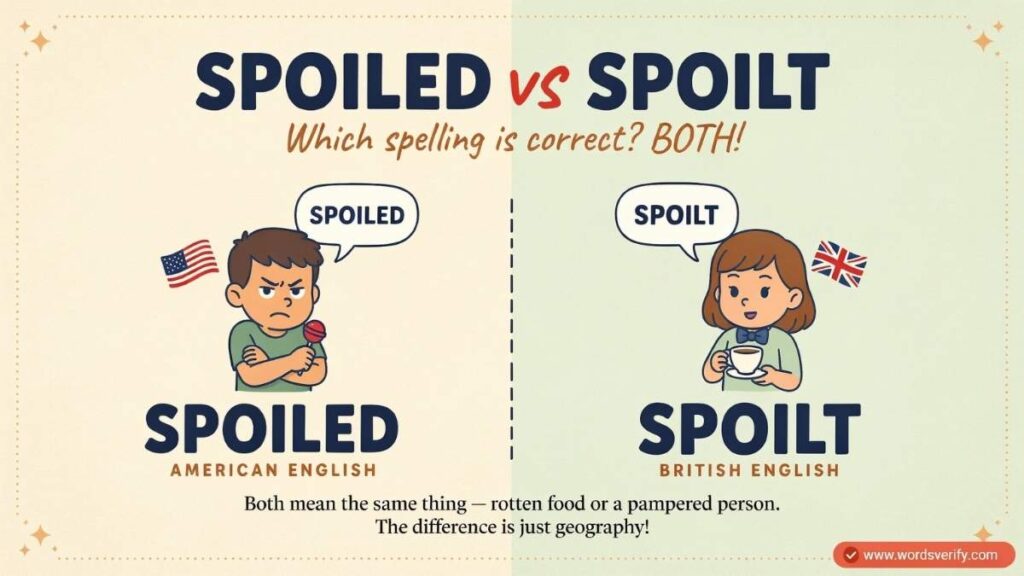
Spoiled and spoilt are both accepted forms of the verb spoil. They can work as the past tense, past participle, or adjective.
In American English, spoiled is usually the natural choice:
The milk spoiled overnight.
In British English, you may just as naturally see:
The milk spoilt overnight.
The meaning stays the same.
| Form | Common preference | Example |
|---|---|---|
| Spoiled | American English | The food has spoiled. |
| Spoilt | British English | The food has spoilt. |
| Spoiled | Also used in British English | The surprise was spoiled. |
| Spoilt | Also understood outside Britain | The surprise was spoilt. |
The easiest rule is simple: use spoiled for American English and spoilt when British English fits your writing style. However, don’t treat that as an absolute rule. British writers use spoiled too.
Spoiled vs Spoilt What’s the Difference?
The spoiled vs. spoilt difference is mainly regional. Neither word has a completely separate meaning.
Consider these two sentences:
The rain spoiled our picnic.
The rain spoilt our picnic.
Both sentences tell you the same thing. The rain ruined the picnic. The only noticeable difference is the form of the verb.
Spoiled is the form you’ll most often encounter in the United States. Spoilt has a long history in British English and remains common there.
Both forms can describe several situations:
- Food that has gone bad.
- Something that has been ruined.
- A person who has received too much attention or special treatment.
- Something that has lost its quality or enjoyment.
- A person who has become accustomed to excessive comfort or luxury.
That’s why context matters more than the spelling itself.
Learn how to use confusing more words correctly
Perfer vs Prefer which one is correct?
What Does “Spoiled” Mean?

The word spoiled has several related meanings. Once you understand those meanings, the spelling difference becomes much easier to handle.
Spoiled Food Has Gone Bad
When food becomes unpleasant or unsafe because it has deteriorated, you can describe it as spoiled.
For example:
- The milk has spoiled.
- We threw away the spoiled meat.
- I think the leftovers have spoiled.
- The fruit was already spoiled when we bought it.
This is one of the most familiar uses of spoiled in American English.
Spoiled milk doesn’t mean that someone deliberately damaged the milk. It means the milk has gone bad.
Spoiled Can Mean Ruined
Something can also be spoiled when an event, plan, surprise, or experience doesn’t turn out as intended.
For example:
- The storm spoiled our vacation.
- Someone spoiled the surprise.
- The loud noise spoiled the movie.
- His argument spoiled the mood.
- The mistake spoiled the presentation.
Here, spoiled means ruined or damaged.
Nothing has necessarily physically deteriorated. Instead, something has lost its enjoyment, effectiveness, or intended result.
Spoiled Can Describe an Overindulged Person
Spoiled can also describe someone who receives so much attention, money, freedom, or special treatment that they begin to expect it.
For example:
The child was spoiled by his grandparents.
This doesn’t simply mean the grandparents loved the child. It suggests that their generosity may have encouraged the child to expect special treatment.
That’s where expressions such as spoiled child and spoiled brat come from.
Learn how to use confusing more words correctly
Quiet vs Quite and which one is correct?
What Does “Spoilt” Mean?

The spoilt meaning is essentially the same as the meaning of spoiled. The main difference is regional usage.
British English often uses spoilt in sentences such as:
- The milk has spoilt.
- The rain spoilt our picnic.
- He was spoilt as a child.
- Someone spoilt the surprise.
These sentences express the same ideas as their versions with spoiled.
Spoilt Food
In British English, food that has gone bad can be described as spoilt.
For example:
- The cream had spoilt, so we threw it away.
- Don’t eat that. It looks spoilt.
- The hot weather caused the food to become spoilt.
American English would normally use spoiled in the same situations.
Spoilt Means Ruined
Spoilt can also describe something that has been ruined.
For example:
- The rain spoilt the photographs.
- Someone spoilt the ending.
- His behavior spoilt the evening.
- The delay spoilt our plans.
Again, American English would normally use spoiled.
Spoilt Means Overindulged
A person can also be spoilt when excessive attention or generosity has affected their behavior.
For example:
She was a spoilt child who expected everything to go her way.
The meaning is essentially identical to spoiled child.
Learn how to use confusing more words correctly
Weiner vs Wiener which one is correct?
Spoiled vs Spoilt in American and British English
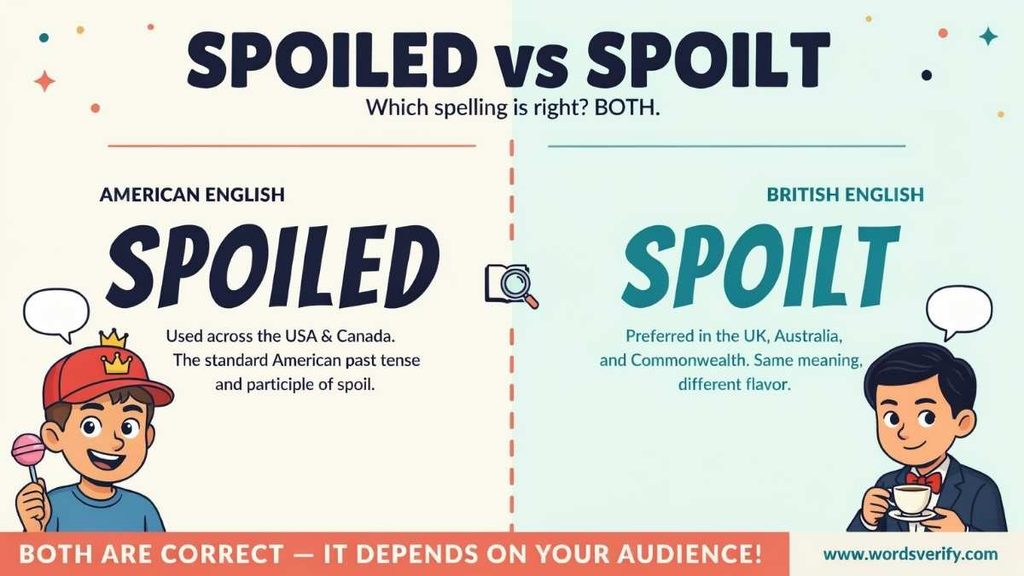
Regional preference explains most of the confusion surrounding these two forms.
American English
American English strongly favors spoiled.
You’ll commonly see:
- spoiled food
- spoiled milk
- spoiled child
- spoiled brat
- spoiled surprise
- spoiled plans
- spoiled vacation
- spoiled for choice
For an American audience, spoiled will almost always feel more natural.
British English
British English commonly uses spoilt.
You’ll often encounter:
- spoilt food
- spoilt milk
- spoilt child
- spoilt brat
- spoilt surprise
- spoilt plans
- spoilt holiday
- spoilt for choice
However, British English also uses spoiled. That’s important because English doesn’t divide neatly into two separate systems.
A British writer can use spoiled without making a grammatical mistake.
Australian and New Zealand English
Australian English and New Zealand English have strong British influences, so spoilt is common in both varieties.
You’ll often encounter phrases such as spoilt child and spoilt for choice.
Still, spoiled also appears. Real-world English doesn’t always follow one perfectly fixed rule.
Learn how to use confusing more words correctly
Flaky vs Flakey Which one Is Correct?
Spoiled vs Spoilt Comparison
| Feature | Spoiled | Spoilt |
|---|---|---|
| Base verb | spoil | spoil |
| Past tense | Yes | Yes |
| Past participle | Yes | Yes |
| Adjective | Yes | Yes |
| Common in US English | Very common | Less common |
| Common in UK English | Common | Very common |
| Used for bad food | Yes | Yes |
| Used for something ruined | Yes | Yes |
| Used for an overindulged person | Yes | Yes |
| Meaning generally changes? | No | No |
The main takeaway is simple: the spelling usually tells you more about regional preference than meaning.
Spoiled vs Spoilt as Verb Forms
The easiest way to understand these words is to start with their base verb: spoil.
The main forms are:
| Verb form | Form |
|---|---|
| Base form | spoil |
| Third-person singular | spoils |
| Past tense | spoiled / spoilt |
| Past participle | spoiled / spoilt |
| -ing form | spoiling |
So what is the past tense of spoil?
It can be spoiled or spoilt.
For example:
- The heat spoiled the food.
- The heat spoilt the food.
Both sentences describe an action that happened in the past.
What is the past participle of spoil?
Again, it can be spoiled or spoilt.
For example:
- The food has spoiled.
- The food has spoilt.
American English generally favors spoiled in both cases. British English commonly accepts both.
Learn how to use confusing more words correctly
Web Site vs Website which one is correct?
When Should You Use Spoiled vs Spoilt?
Your audience should guide your choice.
Use Spoiled for American English
If you’re writing for readers in the United States, spoiled is usually the most natural option.
For example:
- The milk has spoiled.
- His parents spoiled him.
- The storm spoiled our vacation.
- Don’t spoil the surprise.
This is the standard choice most American readers expect.
Use Spoilt for British English
If you’re deliberately writing in British English, spoilt is a natural choice.
For example:
- The milk has spoilt.
- His parents spoilt him.
- The rain spoilt our holiday.
- The bad weather spoilt the event.
Notice that the base verb remains spoil. Regional differences don’t affect every form of the verb.
Keep Your Writing Consistent
Consistency matters more than trying to prove that one form is better.
If your article follows American English throughout, spoiled fits naturally.
If your article follows British English, spoilt may fit better.
Think about spelling choices such as color and colour. Neither is universally wrong. They simply belong to different English traditions.
The same basic idea applies here.
Learn how to use confusing more words correctly
Ingrained vs Engrained which one is correct?
Spoiled vs Spoilt Examples
Seeing the two forms side by side makes the distinction much easier.
Examples With Spoiled
- The milk has spoiled.
- The heat spoiled the food.
- The storm spoiled our picnic.
- Someone spoiled the surprise.
- His parents spoiled him.
- She was a spoiled child.
- The ending was spoiled for me.
- We were spoiled for choice at the restaurant.
- The bad weather spoiled our plans.
- The expensive gifts spoiled the children.
Examples With Spoilt
- The milk has spoilt.
- The heat spoilt the food.
- The storm spoilt our picnic.
- Someone spoilt the surprise.
- His parents spoilt him.
- She was a spoilt child.
- The ending was spoilt for me.
- We were spoilt for choice at the restaurant.
- The bad weather spoilt our plans.
- The expensive gifts spoilt the children.
These examples show the central point: changing the form usually doesn’t change the meaning.
Learn how to use confusing more words correctly
Weeped vs Wept and which one is correct?
Spoiled vs Spoilt in a Sentence
Consider these pairs:
| American-style sentence | British-style sentence |
|---|---|
| The rain spoiled our picnic. | The rain spoilt our picnic. |
| The food has spoiled. | The food has spoilt. |
| He was spoiled as a child. | He was spoilt as a child. |
| Someone spoiled the surprise. | Someone spoilt the surprise. |
| The vacation was spoiled by the storm. | The holiday was spoilt by the storm. |
| She was spoiled with gifts. | She was spoilt with gifts. |
These examples show why learners often become confused. Both versions sound perfectly natural to native speakers of different English varieties.
Spoiled Food vs Spoilt Food
Food provides one of the clearest examples of regional variation.
In American English:
The refrigerator stopped working, so the food spoiled.
We threw away the spoiled milk.
In British English:
The refrigerator stopped working, so the food spoilt.
We threw away the spoilt milk.
The meaning is the same.
When you see spoiled food or spoilt food, think of food that has gone bad.
Spoiled or Spoilt for Your Birthday?
Birthday sentences can create another small spelling dilemma.
If you’re using American English:
I was spoiled with gifts on my birthday.
In British English:
I was spoilt with gifts on my birthday.
Both mean that the person received plenty of gifts or special attention.
The same applies when the birthday itself gets ruined.
- The storm spoiled my birthday.
- The storm spoilt my birthday.
So whether you write spoiled or spoilt for your birthday depends on the variety of English you’re following.
Spoiled or Spoilt Brat?
Both spoiled brat and spoilt brat are correct.
A spoiled brat is usually a child who behaves badly because they’ve received too much indulgence or expect special treatment.
For example:
Nobody wanted to deal with the spoiled brat.
In British English:
Nobody wanted to deal with the spoilt brat.
The meaning doesn’t change.
The same applies to spoiled child and spoilt child.
A spoiled child typically expects special treatment and may become upset when they don’t get what they want.
Being loved, supported, or given occasional gifts doesn’t automatically make a child spoiled. The word usually suggests excessive indulgence combined with an attitude of entitlement.
Spoiled for Choice and Spoilt for Choice
The expression spoiled for choice means having so many good options that choosing becomes difficult.
For example:
With so many restaurants nearby, we’re spoiled for choice.
British English often uses:
With so many restaurants nearby, we’re spoilt for choice.
This expression can seem strange at first. Why would having lots of choices mean you’re spoiled?
The idea is that you’re receiving such an abundance of good options that you have become accustomed to having plenty to choose from.
In other words, it’s a pleasant problem to have.
Learn how to use confusing more words correctly
Zeroes vs Zeros Which one is correct?
Common Mistakes With Spoiled and Spoilt
Thinking Spoilt Is Wrong
It’s not.
Spoilt is an established English form. It has been used for a long time and remains common in British English.
Thinking Spoiled Is Only American
That’s also incorrect.
Spoiled is strongly associated with American English, but British English uses it too.
Assuming They Have Different Meanings
In most ordinary situations, they don’t.
The sentences below communicate the same idea:
The food spoiled.
The food spoilt.
The regional preference changes, but the meaning doesn’t.
Assuming Spoilt Is More Formal
Spoilt isn’t automatically more formal than spoiled.
The difference mainly reflects regional usage.
Confusing Spoiled With Spoiling
Spoiled and spoilt are past forms.
Spoiling is the -ing form.
Compare these sentences:
The heat is spoiling the food.
The heat spoiled the food.
The first describes an ongoing action. The second describes a completed action.
Learn how to use confusing more words correctly
Hanukkah vs Chanukah Which one Is Correct?
Spoiled and Spoilt as Adjectives
Both forms can work as adjectives.
Consider:
A spoiled child.
Here, spoiled describes the child.
Likewise:
A spoilt child.
Spoilt describes the child in exactly the same basic way.
The same pattern works with food:
- spoiled milk
- spoilt milk
- spoiled fruit
- spoilt fruit
It also works with experiences:
- a spoiled surprise
- a spoilt surprise
- a spoiled vacation
- a spoilt holiday
The surrounding noun helps you understand what the adjective describes.
Spoil Complete Verb Pattern
Here’s the basic spoil conjugation in one place:
| Form | Example |
|---|---|
| Base form | Don’t spoil the surprise. |
| Present | He spoils his children. |
| Past | The rain spoiled the event. |
| Past alternative | The rain spoilt the event. |
| Past participle | The food has spoiled. |
| Past participle alternative | The food has spoilt. |
| -ing form | The heat is spoiling the food. |
This pattern answers several common grammar questions at once.
The past form of spoil can be spoiled or spoilt.
The past participle of spoil can be spoiled or spoilt.
The present participle is spoiling.
Spoiled vs Spoilt Synonyms
The best synonym depends on what spoil means in the sentence.
When spoil means “ruin,” useful alternatives include:
- Ruin
- Damage
- Wreck
- Harm
- Undermine
if spoil describes excessive indulgence, alternatives include:
- Pamper
- Indulge
- Overindulge
- Baby
- Treat excessively
When spoil refers to food, alternatives may include:
- Rot
- Decay
- Go bad
- Become rancid
- Become stale
However, these aren’t perfect substitutes in every sentence.
For example, you can say:
The rain ruined our picnic.
But you wouldn’t normally replace spoiled with rotten in that sentence.
Meaning comes first. Synonyms come second.
Learn how to use confusing more words correctly
Creeped vs Crept Which One Is Correct?
Which One Should You Use?
If you’re still asking, “Should I use spoiled or spoilt?” the answer depends on your readers.
| Writing situation | Recommended choice |
|---|---|
| US audience | Spoiled |
| American school assignment | Spoiled |
| American business writing | Spoiled |
| British audience | Spoilt is very natural |
| British publication | Follow its style guide |
| Australian audience | Spoilt is common |
| New Zealand audience | Spoilt is common |
| International audience | Choose one form and stay consistent |
There isn’t a single spelling that everyone must use.
Instead, think about audience, regional English, and consistency.
A Simple Way to Remember Spoiled vs Spoilt
Here’s a useful shortcut:
US English → spoiled
British English → spoilt
That’s enough to remember the main distinction.
Just don’t turn the shortcut into an absolute rule. British writers can use spoiled, and readers across English-speaking countries understand both forms.
English has plenty of regional variations. Color and colour, favorite and favourite, and organize and organise create similar choices.
The important thing is knowing which variety you’re using.
Practice Session Spoiled vs Spoilt
Fill in each blank with the correct form: spoiled vs spoilt
- The hot weather ______ the milk.
- She was completely ______ by her grandparents.
- The surprise was ______ when someone revealed the secret.
- He has always been ______ with expensive gifts.
- The children were ______ rotten during the holidays.
- I hope you get ______ on your birthday.
- She felt ______ after receiving so many thoughtful presents.
- The food had ______ before we could eat it.
- The British newspaper described him as a ______ child.
- The party was ______ by the sudden rain.
- We were ______ for choice at the restaurant.
- She said her parents had ______ her with attention.
- The fruit had ______ in the heat.
- He was a ______ brat who expected everything to go his way.
- I hope you’ve been ______ on your special day.
- The vacation was ______ by bad weather.
- They had ______ the child with too many toys.
- The milk smelled terrible because it had ______.
- She felt completely ______ after her friends organized a surprise party.
- The ending of the movie was ______ when someone told me what happened.
- We were ______ for choice when selecting a hotel.
- He admitted that he had been ______ by his family.
- The cake was ______ before the guests arrived.
- She was ______ with compliments throughout the evening.
- The child had been ______ rotten for years.
Answers
- spoiled
- spoiled
- spoiled
- spoiled
- spoiled
- spoiled
- spoiled
- spoiled
- spoilt
- spoiled
- spoilt
- spoiled
- spoiled
- spoilt
- spoilt
- spoiled
- spoiled
- spoiled
- spoiled
- spoiled
- spoilt
- spoiled
- spoiled
- spoiled
- spoilt
Here’s a trusted source for clear more words Comparison:
FAQs
Is a person spoiled or spoilt?
Both “spoiled” and “spoilt” are correct. “Spoiled” is more common in American English, while “spoilt” is widely used in British English. The choice usually depends on regional preference.
Is “spoilt” a real word?
Yes. “Spoilt” is a standard English word and an accepted past tense and past participle of “spoil.” It’s particularly common in British English.
What does “spoilt” mean?
“Spoilt” means that something has been ruined, has gone bad, or that someone has been given too much attention, freedom, or luxury. Its meaning depends on the context.
What does “spoiled” mean?
“Spoiled” has the same basic meanings as “spoilt.” It can describe food that has gone bad, something that has been ruined, or a person who has become entitled through excessive indulgence.
Is it “spoilt for choice” or “spoiled for choice”?
Both forms are correct. “Spoilt for choice” is especially common in British English, while “spoiled for choice” is more common in American English. Both mean having so many good options that choosing becomes difficult.
Is it “spoiled rotten” or “spoilt rotten”?
Both expressions are correct. “Spoiled rotten” is more common in American English, while “spoilt rotten” is frequently used in British English. The expression usually describes someone who has been excessively indulged.
Should I say “spoiled child” or “spoilt child”?
Both are correct. “Spoiled child” is more common in American English, while “spoilt child” is common in British English. Both describe a child who has received excessive indulgence and may behave entitled or demanding.
Is it “spoiled with gifts” or “spoilt with gifts”?
Both forms work. For example, you can say, “She was spoiled with gifts” or “She was spoilt with gifts.” The spelling choice mainly reflects regional English.
Is “spoilt” a negative word?
Not necessarily. “Spoilt” can be neutral when describing something that has gone bad or been damaged. When it describes a person, it can have a negative meaning because it may suggest excessive indulgence or entitlement.
What is a nicer word for “spoiled”?
The best alternative depends on the meaning. If you mean someone received generous treatment, words such as “pampered,” “cherished,” “well-treated,” or “indulged” may work. If you mean someone behaves badly because of excessive indulgence, “entitled” may be more accurate.
How can you say “spoiled” in a positive way?
If you want a positive meaning, you can use “pampered,” “well-treated,” “cherished,” or “lavished with attention.” For example, “I felt so pampered on my birthday” sounds more positive than “I felt spoiled.”
Is it correct to say “I feel spoiled”?
Yes. “I feel spoiled” is completely correct and often has a positive meaning. It can mean that someone has treated you especially well, given you thoughtful gifts, or made you feel cared for.
Is “I hope you get spoiled” correct?
Yes, but the meaning depends on context. “I hope you get spoiled” can mean “I hope people treat you very well.” In British English, “I hope you get spoilt” is also natural.
Is “I hope you’ve been spoiled” correct?
Yes. “I hope you’ve been spoiled” is grammatically correct and commonly means that you hope someone has been treated especially well. British English may use “I hope you’ve been spoilt.”
Is it correct to say “spoiled me” or “spoilt me”?
Both are correct. “You spoiled me” is more common in American English, while “You spoilt me” is common in British English. Both can mean that someone treated you especially generously.
Is “spoiled” an adjective?
Yes. “Spoiled” can function as an adjective. For example, “He is a spoiled child” describes his character or behavior rather than simply stating what happened to him.
Can “spoilt” be used as an adjective?
Yes. “Spoilt” can also function as an adjective. For example, “She is a spoilt child” describes someone who has been excessively indulged.
What is the difference between “spoiled” and “spoilt” in pronunciation?
In most varieties of English, “spoiled” and “spoilt” are pronounced very similarly. The main difference is spelling and regional preference rather than meaning or pronunciation.
Is “spoiled” used in British English?
Yes. Although “spoilt” is common in British English, “spoiled” is also used and is not incorrect. British English accepts both forms in many contexts.
Is “spoilt” used in American English?
It can be understood in American English, but “spoiled” is much more common in the United States. Writers targeting an American audience will generally find “spoiled” the more natural choice.
Is “spoiled” or “spoilt” more common in formal writing?
Neither form is automatically more formal. The better choice depends on the variety of English and the audience. “Spoiled” is the usual choice in American English, while British English can use either form.
What are the past tense and past participle of “spoil”?
Both “spoiled” and “spoilt” can serve as the past tense and past participle of “spoil.” For example, “The heat spoiled the food” uses the past tense, while “The food has spoiled” uses the past participle.
Is “spoiled” or “spoilt” the better choice for American English?
“Spoiled” is the better choice for American English because it is the standard and more widely preferred form in the United States.
Is “spoilt” or “spoiled” the better choice for British English?
Both are correct in British English. “Spoilt” is especially common, but “spoiled” is also widely understood and accepted.
Can “spoiled” and “spoilt” be used interchangeably?
Generally, yes. They usually have the same meaning and grammatical function. The main difference is regional preference, so consistency matters more than choosing one as universally correct.
conclusion
The confusion between spoiled vs spoilt is easier to solve than it first appears. Both are correct forms of the verb spoil, and both can describe food that has gone bad, plans that have been ruined, or someone who has received a little too much pampering. The main difference is regional preference. American English strongly favors “spoiled,” while British English commonly uses both “spoiled” and “spoilt.”
When choosing between them, consider your audience and stay consistent with the variety of English you’re using. If you’re writing in American English, spoiled is the natural choice. In British English, spoilt is perfectly acceptable. Once you know that, there’s no reason to let these two spellings spoil your writing!

Lisa AJS is an experienced blogger and language enthusiast at Words Verify, dedicated to making grammar simple, practical, and enjoyable. She writes engaging content on commonly confused words, grammar mistakes, word meanings, and everyday language challenges.