
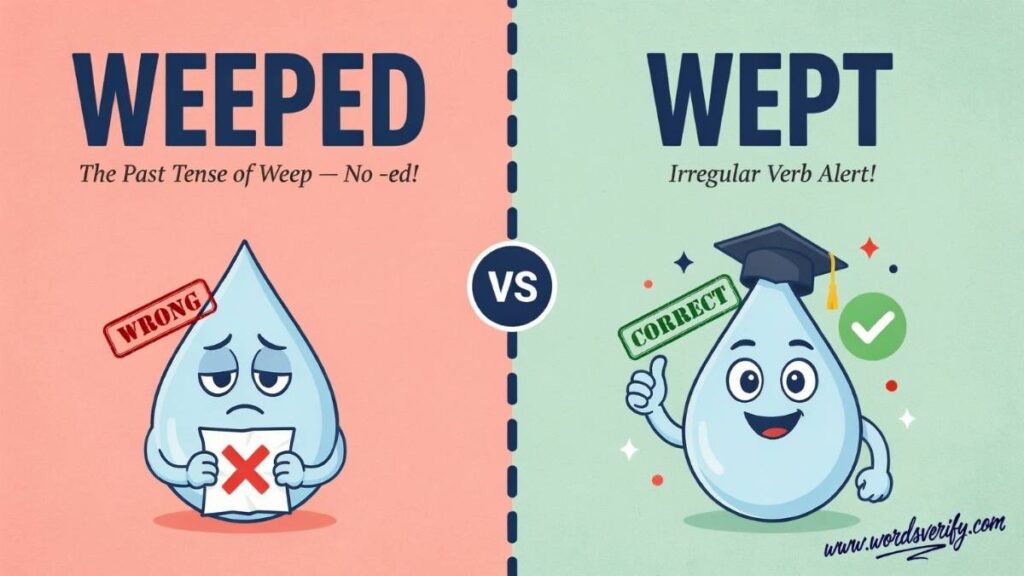
English has a talent for turning simple verbs into little grammar puzzles, and weeped or wept is a classic example. At first glance, weeped seems perfectly reasonable. After all, many English verbs form their past tense by adding -ed. Yet weep breaks that rule. Its correct past form is wept, not weeped. If this tiny difference has ever caused confusion, there’s no need to lose sleep over it. This guide explains the difference between weeped vs wept, shows how the verb works in different tenses, highlights common mistakes, and provides clear examples so you can remember the correct form without shedding a single grammatical tear.
Quick Answer
The correct standard form is wept.
Here’s the basic pattern:
| Verb form | Correct word | Example |
|---|---|---|
| Base form | weep | I sometimes weep. |
| Third-person singular | weeps | She weeps quietly. |
| Past tense | wept | He wept after hearing the news. |
| Past participle | wept | She has wept before. |
| Present participle | weeping | They are weeping. |
| Incorrect standard form | weeped | Avoid this form. |
So, if you’re wondering, “What is the past tense of weep?” the answer is wept.
If you’re asking for the past participle of weep, the answer is also wept.
The easiest form to remember is:
Weep → Wept → Wept
That’s the standard form to use in modern English.
What Does Weep Mean?
The verb weep means to cry or shed tears. It often describes crying because of grief, sadness, pain, disappointment, or another strong emotion.
For example:
- She began to weep after hearing the sad news.
- He wept after saying goodbye.
- The child wept quietly in the corner.
- They wept over the loss of their friend.
- She wept with joy when her family surprised her.
Although weep and cry have similar meanings, they don’t always sound the same.
Cry is the more common word in everyday conversation. You might say, “The baby cried,” “I cried during the movie,” or “She cried when she heard the news.”
Weep tends to sound more serious, formal, or literary. It often appears in stories, poems, historical writing, and emotional descriptions.
Compare these two sentences:
She cried when she heard the news.
She wept when she heard the news.
Both are correct. The first sounds more conversational, while the second has a more solemn or literary feel.
Weep Can Describe More Than Crying
There’s another meaning of weep that has nothing to do with human tears.
Weep can also describe something that produces or releases liquid. For example, a wound may be described as weeping when it produces fluid.
You might see expressions such as:
- A weeping wound
- A wound that is weeping
- A sore that continues to weep
- Liquid weeping from a surface
In this sense, weep means something like exude liquid or release fluid.
This meaning is less common in everyday conversation, but it can appear in descriptive or technical writing. It’s useful to know because weeping doesn’t always involve crying.
Weep Verb Forms Weep, Wept, Wept, Weeping
The complete set of weep verb forms is easy to understand once you see them together.
| Form | Word | Example |
|---|---|---|
| Base form | weep | Some people weep when they feel overwhelmed. |
| Third-person singular | weeps | She weeps when she remembers him. |
| Past tense | wept | He wept yesterday. |
| Past participle | wept | She has wept before. |
| Present participle | weeping | They are weeping together. |
Notice that wept appears twice.
That’s because the past tense and past participle have the same form.
This isn’t unusual in English. Several irregular verbs follow a similar pattern:
- Sleep → slept → slept
- Keep → kept → kept
- Sweep → swept → swept
- Weep → wept → wept
Learning the three main forms together is much easier than trying to create the past form from scratch every time you use the verb.
Learn the difference between tricky more English words
Zeroes vs Zeros Which one is correct?
Why Is the Past Tense of Weep Wept?
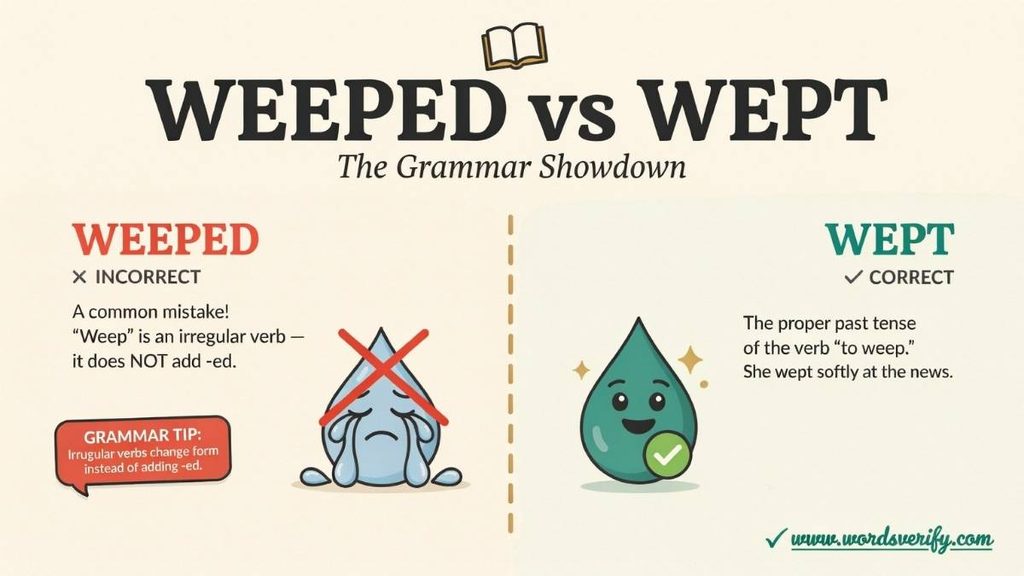
The answer is simple: weep is an irregular verb.
Regular verbs usually form their past tense with -ed:
- Walk → walked
- Clean → cleaned
- Open → opened
- Laugh → laughed
Irregular verbs don’t always follow that pattern.
For example:
- Go → went
- See → saw
- Take → took
- Keep → kept
- Sleep → slept
- Leave → left
- Weep → wept
You can’t always predict an irregular past form just by looking at the base verb.
That’s why weeped feels logical but isn’t the standard form. Your brain sees weep and naturally reaches for the familiar -ed pattern. English simply doesn’t follow that pattern here.
The practical solution is to learn the verb as a complete unit:
Weep – wept – wept
What Is the Past Tense of Weep?
The past tense of weep is wept.
Use wept when you’re describing an action that happened in the past.
Examples:
- I wept after hearing the news.
- She wept during the funeral.
- He wept when he said goodbye.
- They wept over the loss.
- We wept with relief when everyone arrived safely.
These sentences describe completed actions that happened in the past.
So, if you’re looking for the weep past tense form, use wept.
What Is the Past Participle of Weep?
The past participle of weep is also wept.
The past participle commonly appears with have, has, and had.
Examples:
- I have wept over that memory before.
- She has wept many times.
- He had wept before anyone noticed.
- They have wept together.
- We had wept enough by the end of the night.
The basic pattern is:
have + wept
has + wept
had + wept
For example:
She has wept over the loss.
Here, wept is the past participle.
Now compare it with:
She wept over the loss yesterday.
Here, wept is the simple past.
The spelling stays the same, but the grammatical role changes depending on the sentence.
Weeped vs Wept What Is the Difference?
The difference between weeped vs wept isn’t really a difference between two accepted past-tense forms.
Instead, wept is the standard form, while weeped isn’t the standard past tense or past participle of weep.
The confusion usually comes from applying the regular -ed rule.
Someone sees:
weep + ed
and naturally gets:
weeped
That works with many English verbs, but not with this one.
The standard pattern is:
weep → wept
not:
weep → weeped
So when you’re comparing weeped vs wept, remember that wept is the established form used in standard modern English.
Learn the difference between tricky more English words
Hanukkah vs Chanukah Which one Is Correct?
Weep vs Wept When Do You Use Each One?
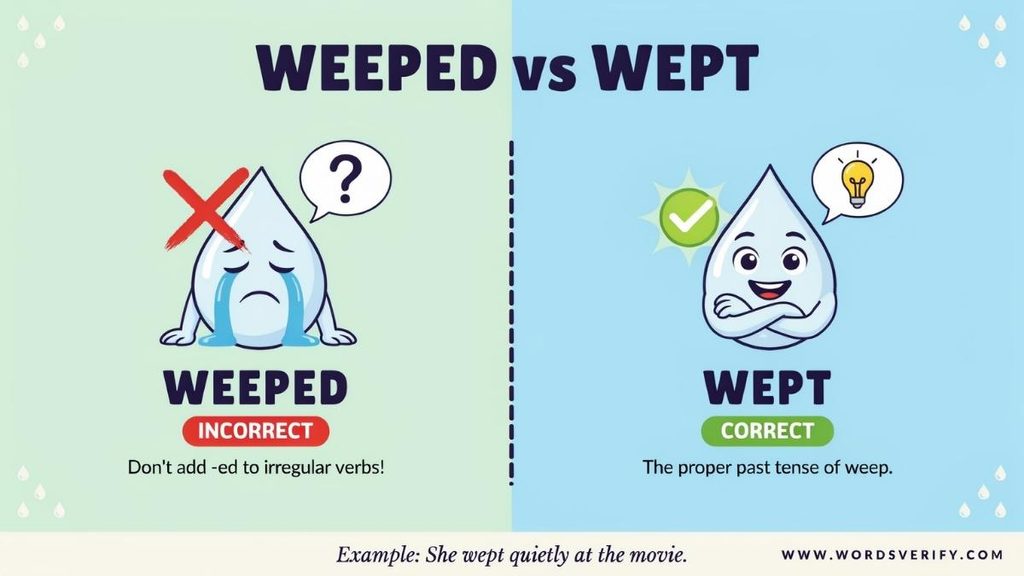
The difference between weep and wept mainly comes down to grammar and time.
Use Weep for the Base Form
Use weep when the verb needs its base form.
Examples:
- I sometimes weep when I watch emotional movies.
- Some people weep when they are overwhelmed.
- They may weep after hearing the news.
- Don’t weep over something you can’t change.
Use Wept for the Simple Past
Use wept for a completed action in the past.
Examples:
- She wept after the funeral.
- He wept when he read the letter.
- I wept when I heard the story.
Use Wept as the Past Participle
Use wept after have, has, or had.
Examples:
- She has wept many times.
- I have wept over that memory.
- He had wept before his family arrived.
Use Weeping for an Ongoing Action
Use weeping when the action is happening over a period of time.
For example:
She was weeping when I entered the room.
This focuses on the crying as an action that was already happening.
Compare that with:
She wept when I entered the room.
The second sentence presents the crying as a past event.
Weeped vs Wept Grammar A Common Trap
One of the easiest ways to make a mistake is to forget what happens after did.
When you use did or didn’t, the main verb returns to its base form.
Correct:
Did she weep?
Incorrect:
Did she wept?
Correct:
She didn’t weep.
Incorrect:
She didn’t wept.
Why? Because did already carries the past tense.
The same rule applies to many other verbs:
- Did he go?
- Did she see it?
- Did they leave?
- Did you sleep?
- Did she weep?
You wouldn’t normally say “Did he went?” or “Did she saw it?” The same principle applies to weep.
Once you understand this rule, several common grammar mistakes become much easier to avoid.
Learn the difference between tricky more English words
Creeped vs Crept Which One Is Correct?
Weeped vs Wept in a Sentence
If you’re looking for weeped or wept in a sentence, use wept when you’re describing something that happened in the past.
Here are some natural examples.
Simple Past Examples
- She wept after hearing the sad news.
- He wept quietly beside the window.
- I wept when I read the final letter.
- They wept during the ceremony.
- The child wept after losing his favorite toy.
- She wept with relief when she heard the good news.
- He wept bitterly after the loss.
Past Participle Examples
- She has wept over the same memory many times.
- I have wept before, but I eventually recovered.
- He had wept before his friends arrived.
- They have wept together through difficult times.
Ongoing Action Examples
- She was weeping when I arrived.
- The child was weeping quietly.
- They were weeping after the announcement.
These examples show why the form matters. Wept describes a past action or works as a past participle. Weeping describes an action in progress.
Learn the difference between tricky more English words
Worshiped vs Worshipped Which one Is Correct?
Common Mistakes With Weeped vs Wept
A few errors appear again and again.
Adding -ed Automatically
Incorrect:
She weeped after hearing the news.
Correct:
She wept after hearing the news.
The verb is irregular, so don’t add -ed.
Using Wept After Did
Incorrect:
Did she wept?
Correct:
Did she weep?
After did, use the base form.
Using Weeped After Has
Incorrect:
She has weeped many times.
Correct:
She has wept many times.
The past participle is wept.
Confusing Wept and Weeping
Incorrect:
She was wept when I arrived.
Correct:
She was weeping when I arrived.
The continuous structure requires the -ing form.
Assuming Weep Always Means Sadness
Weep can describe sadness, but it can also describe other strong emotions.
For example:
She wept with joy when her family surprised her.
The tears come from happiness rather than grief.
Learn the difference between tricky more English words
Judgement vs Judgment Which one Is Correct?
Is Weeped a Word?
If you’re wondering, “is weeped a word?” the most useful answer is that it isn’t the standard past tense or past participle of weep.
For standard English writing, use wept.
You may occasionally encounter unusual forms in informal writing, historical texts, creative writing, dialect, or other nonstandard contexts. However, that doesn’t change the standard conjugation.
For schoolwork, professional writing, formal English, and careful everyday writing, stick with:
weep → wept → wept
That’s the form readers will expect.
Is Weeped Grammatically Correct?
If you’re asking whether weeped is grammatically correct as the ordinary past tense of weep, the answer is no in standard English.
Use:
- Weep for the base form.
- Wept for the past tense.
- Wept for the past participle.
- Weeping for the -ing form.
So:
She wept yesterday.
is correct.
She weeped yesterday.
is not the standard form.
The same applies to the past participle:
She has wept before.
not:
She has weeped before.
Wept vs Cried Are They the Same?
Wept and cried overlap in meaning, but they don’t always create the same tone.
Cry is the more common word in everyday English.
Weep often sounds more formal, serious, or literary.
| Word or phrase | Typical feel |
|---|---|
| Cried | Everyday and neutral |
| Wept | More literary or serious |
| Sobbed | Stronger and more uncontrolled |
| Wailed | Loud and intense |
| Shed tears | Restrained or descriptive |
The choice depends on what you want the reader to picture.
If you’re chatting with a friend, cried will usually sound more natural.
If you’re writing a dramatic story, wept may fit better.
Neither word is automatically better. They simply carry different shades of meaning.
Learn the difference between tricky more English words
Wich vs Which what’s the difference?
Weeped vs Wept Synonyms
If you need another word for wept, choose one based on the kind of crying you want to describe.
Cried
This is the broadest and most natural everyday alternative.
She cried when she heard the news.
Sobbed
Sobbed suggests deeper or more uncontrolled crying.
He sobbed after losing his father.
Wailed
Wailed suggests loud, prolonged crying or lamenting.
The mourners wailed after the announcement.
Shed Tears
This expression focuses on the tears themselves.
She shed tears during the ceremony.
These aren’t perfect substitutes in every sentence. Weep can describe quiet or literary crying, while sobbed and wailed suggest specific ways of crying.
Learn the difference between tricky more English words
Curtesy vs Courtesy Which one Is Correct?
Why “Weeped” Feels So Natural
There’s a good reason people make this mistake.
English teaches a very strong pattern:
verb + -ed = past tense
Once you’ve learned hundreds of examples such as walked, talked, opened, watched, and played, your brain starts applying the rule automatically.
Then you meet weep.
Your brain says:
Weep + ed = weeped
It looks logical. It even sounds as if it should work.
But English has many older irregular verb patterns that don’t follow the regular rule. Weep belongs to that group.
The same thing happens with:
- Sleep → slept
- Keep → kept
- Sweep → swept
- Weep → wept
Nobody normally says “I sleeped” in standard English. The established form is slept.
Likewise, the standard past form of weep is wept.
The larger lesson is useful: English has patterns, but those patterns have exceptions.
A Simple Way to Remember Weep, Wept, Wept
Instead of memorizing one word, memorize the entire set:
Weep – Wept – Wept
Then place each form into a sentence.
- I sometimes weep.
- Yesterday, I wept.
- I have wept before.
- I was weeping earlier.
This approach helps you remember both the form and how it works.
Another useful memory trick is to connect weep with similar verbs:
sleep → slept
keep → kept
sweep → swept
weep → wept
The forms aren’t identical, but the pattern makes wept easier to recall.
Learn the difference between tricky more English words
Indexes vs Indices which one is correct?
Weep in Formal and Everyday English
Grammar and style are two different things.
Wept is grammatically correct in both casual and formal writing. However, the verb weep can sound more literary than cry.
For example, in casual conversation, someone might say:
I cried during the movie.
In a novel, you might read:
She wept as the final scene unfolded.
In a serious report, you might see:
Relatives wept as they remembered the victims.
The context determines whether weep feels natural.
That’s worth remembering because correct grammar doesn’t automatically make a word the best stylistic choice. Good writing depends on grammar, meaning, tone, and context.
Quick Comparison
| Question | Answer |
|---|---|
| What is the base form? | weep |
| What is the past tense? | wept |
| What is the past participle? | wept |
| What is the -ing form? | weeping |
| Is weep a regular verb? | No. It is irregular. |
| Is weeped the standard past form? | No. |
| Can you say “I wept”? | Yes. |
| Can you say “I have wept”? | Yes. |
| Can you say “Did you weep?” | Yes. |
| Can you say “Did you wept?” | No. |
| Does weep mean cry? | Yes, in its main emotional sense. |
| Can weep describe liquid coming from something? | Yes. |
| Is weep more formal than cry? | It can sound more formal or literary. |
Learn the difference between tricky more English words
Learnt vs Learned What’s the Difference?
Practice Session Weeped vs Wept
Fill in each blank with the correct form of weeped vs wept
Fill in the Blanks
- She ______ quietly after hearing the heartbreaking news. (weep)
- He has ______ many times since his friend passed away. (weep)
- They ______ with joy when their team won the championship. (weep)
- I ______ silently during the emotional scene in the movie. (weep)
- She was ______ when her family arrived. (weep)
- Have you ever ______ because of overwhelming happiness? (weep)
- The child began to ______ after losing his favorite toy. (weep)
- He had ______ before anyone noticed that something was wrong. (weep)
- Did she ______ after hearing the announcement? (weep)
- The mourners ______ throughout the funeral service. (weep)
- The wound began to ______ liquid after the bandage was removed. (weep)
- She has ______ over the loss for several days. (weep)
- The old man ______ when he remembered his childhood friend. (weep)
- We were ______ with relief after learning that everyone was safe. (weep)
- He did not ______ during the ceremony. (weep)
- She ______ bitterly after receiving the sad letter. (weep)
- The woman had ______ for hours before finally falling asleep. (weep)
- I have never ______ over a movie before. (weep)
- The injured area was ______ fluid. (weep)
- They ______ silently as they listened to the touching speech. (weep)
- Why did he ______ when he heard the news? (weep)
- She ______ after saying goodbye to her family. (weep)
- The character has ______ throughout the final chapter of the novel. (weep)
- He was ______ uncontrollably after the emotional reunion. (weep)
- Remember: ______ → ______ → ______. (weep)
Answer Session
- wept
- wept
- wept
- wept
- weeping
- wept
- weep
- wept
- weep
- wept
- weep
- wept
- wept
- weeping
- weep
- wept
- wept
- wept
- weeping
- wept
- weep
- wept
- wept
- weeping
- weep → wept → wept
Here’s a trusted source for clear more words Comparison:
FAQs
What is the correct past participle of “weep”?
The correct past participle of “weep” is wept. For example: “She has wept over the loss.”
Can “weep” be used in the present tense?
Yes. “Weep” is the present-tense form. For example: “Some people weep when they feel overwhelmed.”
Why does “weep” become “wept” instead of “weeped”?
“Weep” is an irregular verb. Instead of adding -ed, it changes its form to wept in both the simple past and past participle.
Can you use “wept” with “did”?
No. After “did,” use the base form “weep.” For example, say, “Did she weep?” rather than “Did she wept?”
Can “wept” be used with “has” or “had”?
Yes. “Wept” is the past participle, so it can follow has, have, or had. For example, “He had wept before anyone arrived.”
What is the difference between “weep” and “wept”?
“Weep” is the base or present form, while “wept” is the past tense and past participle. For example, “They weep during sad moments” changes to “They wept during the funeral.”
Is “wept” an irregular verb form?
Yes. “Wept” is an irregular form of the verb “weep.” It doesn’t follow the usual pattern of adding -ed to create the past tense.
Can “wept” describe crying from happiness?
Yes. “Wept” can describe crying caused by sadness, happiness, relief, grief, or another strong emotion. The surrounding context explains why the person cried.
Is “weep” only used for people?
No. “Weep” can also describe something that releases or produces liquid. For example, “The wound began to weep.”
What does “weeping” mean when talking about a wound?
When “weeping” describes a wound, it means the wound is producing or releasing liquid. This meaning is different from weeping as an emotional response.
What is the difference between “weeping” and “wept”?
“Weeping” usually describes an ongoing action or something happening around a particular time, while “wept” refers to a completed action in the past. For example, “She was weeping quietly” describes an ongoing action, while “She wept quietly” describes a past event.
Can “wept” be used in formal writing?
Yes. “Wept” is a standard English verb form and can appear in formal writing, literature, journalism, and everyday sentences. It can sound more literary or emotional than the more common word “cried.”
What are common mistakes with the verb “weep”?
A common mistake is using “weeped” as the past form. Other mistakes include using “wept” after “did” or confusing “wept” with “weeping.” Remember: weep → wept → wept → weeping.
Is “wept” more common than “weeped” in standard English?
Yes. “Wept” is the established standard past form of “weep.” “Weeped” is generally treated as a nonstandard form in modern English.
What sentence uses “wept” correctly?
“She wept after hearing the sad news” is a correct example. Here, “wept” functions as the simple past tense of “weep.”
Learn the difference between tricky more English words
Canceled vs Cancelled Which one Is Correct?
Conclusion
The confusion between weeped vs wept is understandable. “Weeped” looks like it should be correct because so many English verbs form their past tense by adding -ed. However, weep is an irregular verb, so it takes a different path. Its correct forms are weep → wept → wept.
Use wept for the past tense, as in “She wept after hearing the heartbreaking news.” Use it as the past participle, too, as in “She has wept many times over the years.” The form “weeped” is not the standard choice in modern English.
Once you remember this simple pattern, there’s little left to puzzle over. English may throw a few grammatical curveballs, but this one is easy to catch: weep, wept, wept. No tears needed—just the right verb form.

Lisa AJS is an experienced blogger and language enthusiast at Words Verify, dedicated to making grammar simple, practical, and enjoyable. She writes engaging content on commonly confused words, grammar mistakes, word meanings, and everyday language challenges.