
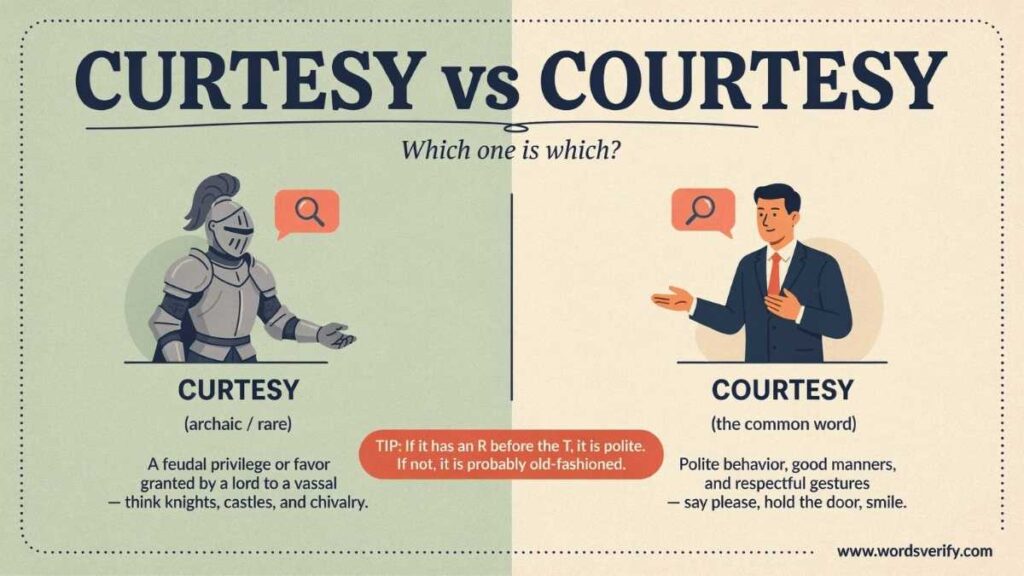
Have you ever typed curtesy vs courtesy and then stopped to wonder which one actually belongs in your sentence? It’s an easy mistake to make. The words look nearly identical, sound similar, and can leave even confident writers second-guessing their spelling. Here’s the twist: they don’t mean the same thing. Courtesy means politeness, respect, or a considerate act, while curtesy is a rare historical legal term connected to property rights. And don’t forget curtsy, which means a formal bow. One small spelling change can create a completely different meaning. Let’s untangle these confusing words and make the correct choice simple.
The Quick Answer
If you’re asking which spelling to use in ordinary writing, courtesy is correct.
Use courtesy when you mean:
- Polite behavior
- Good manners
- Respectful treatment
- Consideration for others
- A polite act or gesture
- A favor or service offered as a convenience
- A courtesy call
- A courtesy car
- The phrase “courtesy of”
For example:
Thank you for your courtesy.
Here, courtesy means polite and considerate behavior.
However, curtesy isn’t simply a misspelling. It is a genuine word with a historical legal meaning. Under traditional common law, it referred to a husband’s interest in certain property belonging to his deceased wife when specific legal conditions were met.
That distinction matters. Calling curtesy completely wrong would be inaccurate. Using it as a replacement for courtesy in everyday writing would also be wrong.
Courtesy vs Curtesy at a Glance
| Word | Meaning | Modern use |
|---|---|---|
| Courtesy | Politeness, consideration, a polite act, favor, or service | Very common |
| Curtesy | Historical common-law property interest | Rare and specialized |
| Curtsy | Formal gesture involving bending the knees | Occasional |
A quick way to remember them is:
Manners = courtesy. Property law = curtesy. Formal bow = curtsy.
Fix common more word mistakes in English
Indexes vs Indices which one is correct?
What Does Courtesy Mean?
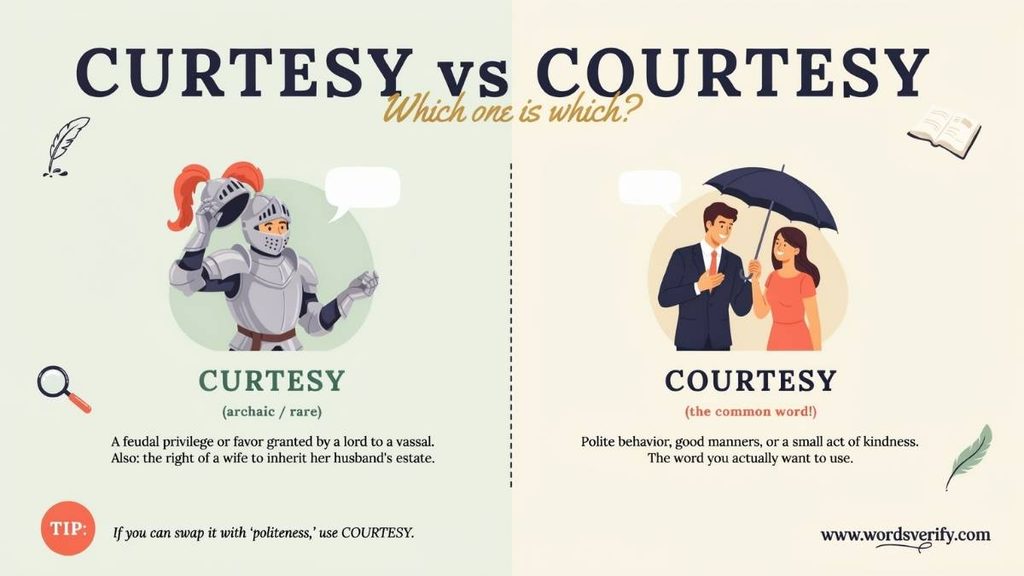
The word courtesy generally means polite, respectful, or considerate behavior toward another person.
It can describe someone’s general manner:
Her courtesy made everyone feel welcome.
It can also describe one specific action:
Holding the door open was a small courtesy.
In other situations, courtesy refers to a favor or service provided for someone’s convenience.
For example:
The hotel provided a courtesy shuttle to the airport.
Here, the word doesn’t directly describe someone’s manners. Instead, it describes a service offered as a convenience.
That’s why courtesy appears in so many different settings. You can encounter it in everyday conversations, workplaces, hotels, customer service, formal correspondence, and social situations.
Courtesy Definition in Simple English
A straightforward courtesy definition is:
Courtesy is polite and considerate behavior toward other people.
The word can cover several related ideas, including politeness, respect, consideration, kindness, and helpfulness.
For example:
- Saying “thank you” is a courtesy.
- Letting someone finish speaking is a courtesy.
- Calling before arriving can be a courtesy.
- Giving someone advance notice about a delay can show courtesy.
- Offering a customer temporary transportation can be a courtesy service.
Courtesy doesn’t have to involve a major favor. Quite often, it appears in small everyday actions.
Courtesy as a Polite Act
Sometimes courtesy describes a single action rather than someone’s overall behavior.
You might hold a door open for someone, allow another driver to merge, or tell a colleague that a meeting has been delayed.
Each action can show consideration.
For example:
She called ahead as a courtesy.
The call itself is the courtesy. It shows that she considered the other person’s time and plans.
That’s an important part of the courtesy meaning. Courtesy isn’t limited to formal manners. It can be any small action that shows consideration for another person.
Fix common more word mistakes in English
Learnt vs Learned What’s the Difference?
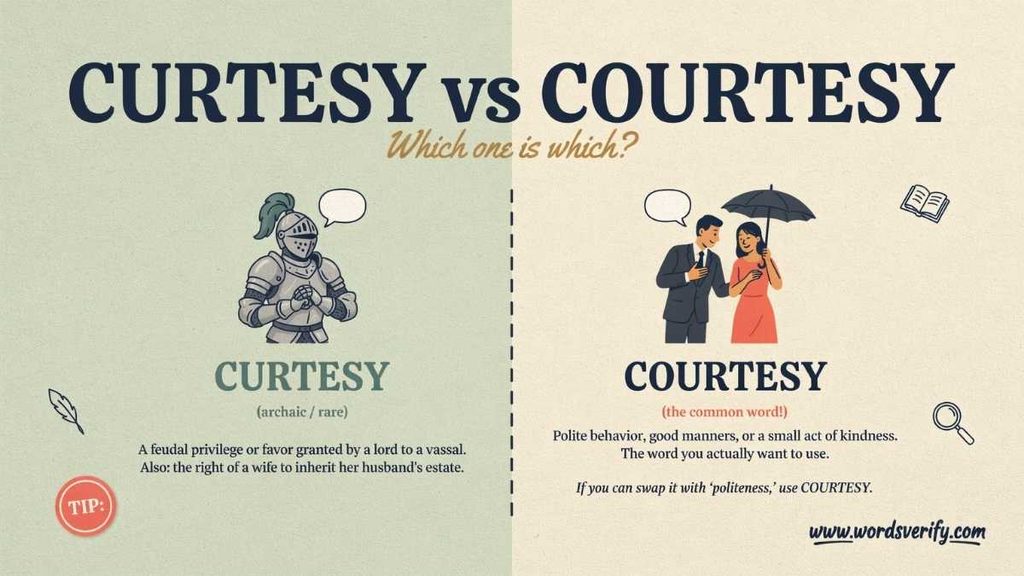
What Does Curtesy Mean?
This is where the confusion gets interesting.
Curtesy is a real English word, but it doesn’t normally mean politeness.
Its traditional meaning comes from common-law property rules. Historically, curtesy referred to a husband’s interest in certain real property belonging to his deceased wife when particular legal conditions had been satisfied.
The word may appear in historical legal phrases such as:
- Estate by the curtesy
- Tenant by the curtesy
- Curtesy estate
- Curtesy property rights
- Curtesy life interest
These expressions belong to legal history rather than everyday conversation.
If you’re writing an email to a customer or talking about someone’s good manners, curtesy isn’t the word you need.
Curtesy Definition in Legal History
A practical curtesy definition is:
Curtesy was a historical common-law property interest that could give a husband a life interest in qualifying property belonging to his deceased wife.
Traditional common-law rules were specific. Among the requirements historically associated with curtesy was the existence of a child who could inherit the property.
The exact rules varied across legal systems and periods. Modern property and inheritance laws have largely replaced these older concepts.
That historical background explains why you may find curtesy in old legal books even though you almost never see it in everyday writing.
Curtesy in Common Law
The history of curtesy common law is tied to the way older legal systems handled property belonging to married couples.
Traditional common law treated the property rights of partners differently. Curtesy generally concerned a widower’s interest in certain property of his deceased wife. Dower, by contrast, traditionally concerned a widow’s interest in her deceased husband’s property.
The two concepts are often discussed together.
| Historical term | Traditionally concerned | General subject |
|---|---|---|
| Curtesy | Husband | Property interest after wife’s death |
| Dower | Wife | Property interest after husband’s death |
This is the basis of the historical curtesy vs. dower distinction.
These terms are now mainly useful when reading historical legal materials or studying the development of property law. Modern laws vary by jurisdiction and generally use different rules for inheritance and marital property.
Fix common more word mistakes in English
Canceled vs Cancelled Which one Is Correct?
Curtesy vs Courtesy What’s the Difference?
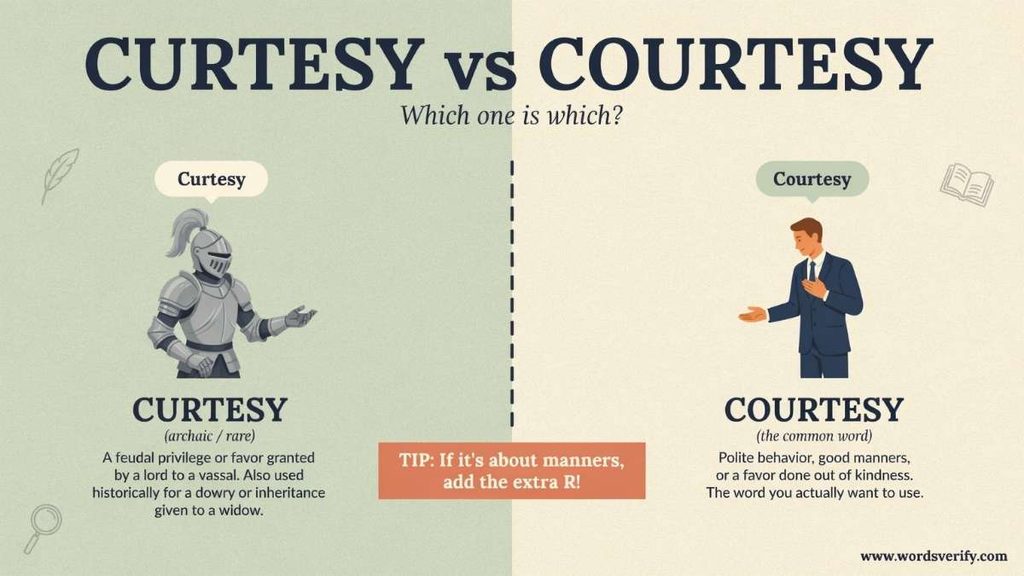
The central difference is simple.
Courtesy concerns manners and consideration.
Curtesy concerns a historical legal property interest.
Compare these two sentences:
She thanked the receptionist for her courtesy.
The historian discussed the husband’s estate by the curtesy.
Both words are legitimate. Their meanings have nothing to do with each other in these examples.
| Feature | Courtesy | Curtesy |
|---|---|---|
| Means politeness | Yes | No |
| Means good manners | Yes | No |
| Can describe a considerate act | Yes | No |
| Used in “courtesy call” | Yes | No |
| Used in “courtesy car” | Yes | No |
| Related to historical property law | No | Yes |
| Common in everyday English | Yes | No |
| Mainly historical or legal | No | Yes |
This is the main curtesy vs. courtesy difference to remember.
If you’re talking about how someone behaves, courtesy is almost certainly the word you want.
If you’re discussing an old common-law property right, curtesy may be appropriate.
Is Curtesy a Word?
Yes.
The answer to “is curtesy a word?” is definitely yes.
The confusion comes from assuming that a real word can automatically replace another word with a similar spelling. English doesn’t work that way.
For example, curtesy has a documented historical legal meaning. That doesn’t make it an alternative spelling of courtesy in everyday English.
So this sentence is incorrect if the intended meaning is politeness:
Thank you for your curtesy.
The correct version is:
Thank you for your courtesy.
A useful rule is to think about the meaning before deciding whether the spelling is right.
Is Courtesy Correct?
Yes. Courtesy is the standard spelling when you mean politeness, consideration, or good manners.
Here are some natural examples:
Thank you for your courtesy.
She treated every guest with courtesy.
The company handled the complaint with courtesy.
As a courtesy, the hotel extended the guest’s checkout time.
In all four examples, courtesy is the correct choice.
Is Curtesy Correct?
It depends on the context.
If you’re using curtesy as a spelling of courtesy, then no.
For example:
She showed curtesy to the guests.
The correct sentence is:
She showed courtesy to the guests.
However, curtesy can be correct when you’re discussing the historical legal term.
For example:
The historian examined the old rules concerning curtesy.
So the answer to “is curtesy correct?” isn’t simply yes or no. Context determines whether the word belongs in the sentence.
Fix common more word mistakes in English
Finaly vs Finally Which one Is Correct?
Why Do People Spell Courtesy as Curtesy?
Pronunciation explains much of the confusion.
When people speak quickly, the middle sound in courtesy can become less noticeable. Someone may hear the word and naturally write down the spelling that seems to match what they heard.
That can turn:
courtesy
into:
curtesy
The confusion becomes even more understandable because curtesy is an actual word. It doesn’t look like an obviously impossible spelling.
This makes curtesy vs courtesy a particularly tricky pair of commonly confused words.
The best solution isn’t to rely only on pronunciation. Instead, think about what you mean.
If the sentence is about politeness, manners, or consideration, choose courtesy.
Why Is Courtesy Spelled With “Our”?
The spelling of courtesy comes from the word’s history.
The English word developed through Middle English forms related to French words associated with courtly behavior and manners. Its history is also connected with words such as court and courteous.
The spelling may seem unusual when compared with the way many people pronounce the word. English has plenty of words like this. Their modern spellings often preserve traces of their earlier forms.
That is why pronunciation isn’t always a reliable spelling guide.
When you mean polite behavior, remember:
courtesy
not:
curtesy
Courtesy and Courteous
Another useful distinction is the difference between courtesy and courteous.
Courtesy is primarily a noun.
Courteous is an adjective.
Compare:
Thank you for your courtesy.
and:
Thank you for being courteous.
The first sentence names the quality or action. The second describes someone’s behavior.
There’s also the adverb courteously:
She responded courteously to the complaint.
The word family looks like this:
| Word | Part of speech | Meaning |
|---|---|---|
| Courtesy | Noun | Politeness or a considerate act |
| Courteous | Adjective | Polite and considerate |
| Courteously | Adverb | In a polite manner |
| Discourtesy | Noun | Rude or impolite behavior |
Knowing these forms can make your writing more precise.
Fix common more word mistakes in English
Aide vs Aid which one is correct?
Courtesy in Everyday English
You probably use or hear courtesy more often than you realize.
The word appears in customer service, workplaces, hotels, transportation, formal correspondence, and ordinary social situations.
What Is Common Courtesy?
Common courtesy means basic consideration for other people.
It can include simple actions such as:
- Saying “please” when making a request.
- Saying “thank you” when someone helps.
- Letting someone know when you’re running late.
- Avoiding unnecessary interruptions.
- Respecting shared spaces.
- Returning something you’ve borrowed.
- Giving reasonable notice when plans change.
None of these actions requires much effort. That’s what makes them examples of basic courtesy.
Often, courtesy is found in the small details of everyday life.
Courtesy and Respect
Courtesy and respect overlap, but they aren’t exactly the same.
Respect can describe how you regard someone’s rights, dignity, experience, or position. Courtesy usually describes the behavior through which that consideration is expressed.
For example, allowing someone to finish speaking shows courtesy. Listening carefully to what they have to say can show both courtesy and respect.
In that sense, courtesy is often respect expressed through behavior.
Courtesy and Good Manners
Good manners are another way to understand the idea.
You can show courtesy through:
- A polite remark
- A considerate response
- A helpful favor
- A respectful gesture
- A thoughtful warning
- A small act of kindness
The action doesn’t have to be expensive or complicated.
Sometimes a simple “Are you okay?” can show more consideration than a grand gesture.
Courtesy of Someone What Does It Mean?
The phrase “courtesy of” has a slightly different use.
When something is courtesy of someone, it generally means that person or organization provided it, supplied it, or allowed it to be used.
For example:
The photographs are courtesy of the museum.
This tells readers where the photographs came from.
Another example is:
The information was provided courtesy of the research team.
Here, the phrase identifies the source.
The expression can also be used humorously:
The traffic jam was courtesy of an accident on the highway.
The accident obviously wasn’t being polite. The phrase simply means that the accident caused the traffic problem.
Courtesy Call What Does It Mean?
A courtesy call is a phone call or visit made as a matter of politeness, professional consideration, or diplomacy.
For example:
The manager made a courtesy call before the meeting.
Another example:
The hotel made a courtesy call to confirm the reservation.
The standard expression is courtesy call, not curtesy call.
The meaning gives you a useful clue. The call is being made as a polite or considerate gesture.
Courtesy Car What Does It Mean?
A courtesy car is a vehicle provided as a convenience.
For example, a repair shop may provide one while a customer’s vehicle is being repaired.
The dealership provided a courtesy car while the repairs were underway.
You may also encounter related expressions such as:
- Courtesy vehicle
- Courtesy shuttle
- Courtesy service
So if you’re wondering whether it’s curtesy vs courtesy car, the standard expression is courtesy car.
Courtesy Visit and Professional Courtesy
A courtesy visit is generally made as a matter of politeness, respect, diplomacy, or professional convention.
For example:
The new director paid a courtesy visit to the regional office.
Professional courtesy refers to considerate or respectful treatment within a professional setting.
Its exact meaning depends on the situation. It might involve a small accommodation, a respectful introduction, or a service offered as a gesture of goodwill.
Fix common more word mistakes in English
Crier vs Cryer Which one Is Correct?
As a Courtesy, Out of Courtesy, and With Courtesy
The word appears in several useful expressions.
As a Courtesy
This means something is done as a polite gesture or consideration.
As a courtesy, the hotel offered guests free transportation to the airport.
Out of Courtesy
This means someone does something because politeness or consideration suggests that it is appropriate.
She called out of courtesy before stopping by.
With Courtesy
This means something is done politely or respectfully.
The complaint was handled with courtesy.
By Courtesy
This expression can describe something obtained through permission, convention, or someone’s generosity.
Learning these expressions as complete phrases can make everyday English easier to understand.
Curtesy vs Courtsy What’s the Difference?
A curtsy is a formal physical gesture.
Traditionally, a person performs a curtsy by bending the knees and lowering the body as a sign of respect.
For example:
The performer gave a graceful curtsy after the applause.
As a verb:
She curtsied after the performance.
So the difference between courtesy vs. curtsy is straightforward:
Courtesy means politeness or consideration.
Curtsy means a formal bow.
Fix common more word mistakes in English
Labelling vs Labeling Which one Is Correct?
Curtsy vs Courtesy Which One Should You Use?
Ask yourself what you’re describing.
If you’re describing polite behavior, use courtesy.
He showed courtesy toward the guests.
If you’re describing a formal physical gesture, use curtsy.
The dancer gave a curtsy at the end of the performance.
This makes curtsy or courtesy much easier to remember.
Curtsy vs Curtesy
The pair curtsy vs. curtesy can be especially confusing because both words look like variations of courtesy.
Their modern meanings are different.
| Word | Meaning | Example |
|---|---|---|
| Courtesy | Politeness or consideration | “She showed courtesy to everyone.” |
| Curtesy | Historical property interest | “The text discusses estate by the curtesy.” |
| Curtsy | Formal bow | “She gave a curtsy.” |
All three spellings exist. The important thing is matching the spelling to the meaning.
Curtsy or Curtsey?
There’s one more spelling detail worth knowing.
Curtsy is the common spelling in American English. Curtsey is also an accepted variant.
For example:
She gave a curtsy after the performance.
You may also see:
She gave a curtsey after the performance.
Both refer to the same type of formal gesture.
Don’t confuse either one with curtesy, which has a separate historical legal meaning.
Are Curtesy vs Courtesy Homophones?
For many speakers, courtesy and curtesy sound the same or nearly the same.
That can make them function as homophones.
However, similar pronunciation doesn’t make the words interchangeable.
Their meanings and spellings are different:
Courtesy → politeness
Curtesy → historical property law
This is a good example of why English spelling can be tricky. Sometimes the sound of a word doesn’t give you enough information to choose the correct spelling.
Fix common more word mistakes in English
Potatoes vs Potatos Which one Is Correct?
Common Mistakes With Curtesy vs Courtesy
Writing Curtesy When You Mean Courtesy
This is the most common mistake.
Incorrect:
Thank you for your curtesy.
Correct:
Thank you for your courtesy.
If you’re talking about manners, consideration, or politeness, use courtesy.
Saying Curtesy Is Never a Real Word
This is the opposite mistake.
Curtesy is a legitimate historical legal term. It simply isn’t the ordinary word for politeness.
A more accurate explanation is:
Curtesy is a real word, but it doesn’t normally mean courtesy.
Confusing Courtesy With Curtsy
Incorrect:
She gave a courtesy after the performance.
If you mean a formal bow, write:
She gave a curtsy after the performance.
Fix common more word mistakes in English
Moulding vs Molding which one is correct?
Assuming Curtesy Is the British Spelling
Curtesy isn’t simply a British spelling of courtesy.
Courtesy is the standard everyday word for politeness in both American and British English.
Curtesy has a separate historical meaning.
Courtesy Examples in Sentences
The following examples show how courtesy works in different situations.
- Politeness: “Her courtesy made the new employee feel welcome.”
- Respect: “The staff treated every customer with courtesy.”
- Consideration: “As a courtesy, he called before arriving.”
- Common courtesy: “It’s common courtesy to let people know when you’re running late.”
- Professional setting: “The complaint was handled with courtesy.”
- Courtesy service: “Guests can use the hotel’s courtesy shuttle.”
- Courtesy of someone: “The photographs were provided courtesy of the museum.”
- Courtesy call: “The company made a courtesy call before the delivery.”
- Courtesy car: “The repair shop provided a courtesy car.”
- Polite behavior: “Simple courtesy can make difficult conversations easier.”
Curtesy Examples in Sentences
Because curtesy has a specialized historical meaning, examples usually appear in legal or historical writing.
- “The historian examined the husband’s estate by the curtesy.”
- “The document discusses the tenant by the curtesy.”
- “The old property rules included provisions concerning curtesy.”
- “The legal scholar explained the historical difference between dower and curtesy.”
Notice the common thread: these sentences deal with property law or legal history.
You wouldn’t use curtesy to describe someone’s manners.
A Simple Way to Remember the Difference
Three words. Three meanings.
| If you mean… | Use… |
|---|---|
| Politeness or good manners | Courtesy |
| Historical property law | Curtesy |
| Formal bow | Curtsy |
There’s another useful memory trick.
Think of courtesy, courteous, and court as part of the same historical family of words connected with courtly manners.
Then remember:
Curtsy → bend your knees.
Curtesy → old legal property term.
Once you connect each spelling with its meaning, the confusion becomes much easier to avoid.
Fix common more word mistakes in English
Manuel vs Manual which one is correct?
Practice Session Curtesy vs Courtesy
Choose courtesy, curtesy, or curtsy based on the meaning of each sentence.
Fill in the Blanks
- The receptionist treated every visitor with ______.
- The hotel offered a ______ shuttle to the airport.
- The dancer gave a graceful ______ after the performance.
- The historian studied the old common-law rules concerning ______.
- Please show some ______ to the other guests.
- The company made a ______ call before the scheduled appointment.
- The photographs were provided ______ of the local museum.
- She gave a small ______ after meeting the royal guests.
- The legal document referred to an estate by the ______.
- Holding the door open for someone is a simple act of ______.
- The repair shop provided a ______ car while the customer’s vehicle was being serviced.
- He called ahead as a ______ to let his host know he would be late.
- The performer ______ at the end of the ceremony.
- The book explains the historical concept of ______ in common-law property rules.
- Treating customers with ______ can make a difficult situation easier.
- The company offered a ______ vehicle while the repairs were completed.
- She thanked her colleague for the ______ he showed during the meeting.
- The old legal text discusses the husband’s life interest under ______.
- The actress performed a formal ______ before leaving the stage.
- As a ______, the restaurant offered the guests free dessert after the long wait.
- The manager handled the complaint with patience and ______.
- The historian compared ______ with the traditional legal concept of dower.
- The young performer learned how to ______ properly for the ceremony.
- It’s common ______ to let someone know when you’re going to be late.
- The announcement included photographs published ______ of the organization.
Answers
- courtesy
- courtesy
- curtsy
- curtesy
- courtesy
- courtesy
- courtesy
- curtsy
- curtesy
- courtesy
- courtesy
- courtesy
- curtsied
- curtesy
- courtesy
- courtesy
- courtesy
- curtesy
- curtsy
- courtesy
- courtesy
- curtesy
- curtsy
- courtesy
- courtesy
Here’s a trusted source for clear more words Comparison:
FAQs
Is curtesy an outdated term?
Curtesy is an old legal term that still appears in historical and legal discussions. It refers to a husband’s traditional property interest under common law. It isn’t the everyday spelling of courtesy.
What does “curtesy” mean?
Curtesy refers to a historical common-law property right associated with a husband and certain property interests of his deceased wife. The term is now uncommon outside legal history.
What does curtsy mean?
A curtsy is a formal gesture of respect in which a person bends the knees and lowers the body slightly. It has traditionally appeared in formal settings involving royalty, ceremonies, or performances.
Is it courtesy of or courtesy from?
“Courtesy of” is the standard expression when you mean that something was provided, supplied, or made available by someone.
Example:
The photographs were provided courtesy of the museum.
“Courtesy from” isn’t normally used in this expression.
Is it curtesy vs courtesy?
For ordinary writing, courtesy is correct when you mean politeness, consideration, or good manners. Curtesy has a separate historical legal meaning.
What’s another way to say “courtesy of”?
Depending on the context, you can use:
- Provided by
- Supplied by
- With permission from
- Thanks to
- From
For example, “Photos courtesy of the museum” could become “Photos provided by the museum.”
What is another word for courtesy?
Common synonyms include politeness, consideration, civility, kindness, respect, and good manners. The best choice depends on the sentence.
What does courtesy mean in simple terms?
In simple terms, courtesy means treating other people politely and considerately. Saying “thank you,” listening without interrupting, or holding a door open can all be acts of courtesy.
What are the five courtesy words?
The commonly taught polite words are please, thank you, you’re welcome, excuse me, and sorry. Their exact list can vary depending on the etiquette guide or teaching context.
What are expressions of courtesy?
Expressions of courtesy are polite words or phrases used to show consideration. Examples include please, thank you, excuse me, you’re welcome, pardon me, and I appreciate it.
What are some common examples of courtesy?
Common examples include:
- Saying “please” and “thank you.”
- Letting someone finish speaking.
- Giving advance notice when you’re late.
- Holding a door open for someone.
- Respecting another person’s personal space.
What is an example of a courtesy?
Offering someone a courtesy call before an appointment is one example. Providing a courtesy car while a customer’s vehicle is being repaired is another.
What is the Golden Rule of courtesy?
The basic idea is to treat other people as you would like to be treated. In everyday situations, that means showing consideration, respect, patience, and good manners.
When should you use courtesy?
Use courtesy when you mean politeness, respectful behavior, consideration, or a polite act. It also appears in phrases such as common courtesy, courtesy call, courtesy car, and courtesy of.
What is another word for “common courtesy”?
Depending on the context, alternatives include basic manners, politeness, civility, consideration, and social etiquette.
What is the opposite of courtesy?
The opposite of courtesy is generally discourtesy, rudeness, disrespect, or incivility. The most suitable word depends on the situation.
What is a word for polite but not friendly?
Civil can describe behavior that is polite and respectful without suggesting warmth or friendliness. For example, two people may remain civil even when they aren’t particularly friendly toward each other.
Is courtesy the same as respect?
Not exactly. Courtesy usually describes polite or considerate behavior, while respect can involve recognizing someone’s rights, dignity, abilities, or position. The two often appear together, but they aren’t interchangeable in every sentence.
What do you call a woman’s bow?
A traditional woman’s formal bow is called a curtsy. It involves bending the knees and lowering the body slightly.
What is a synonym for curtsy?
Depending on the context, related terms include bow, dip, or formal bow. However, curtsy specifically describes the traditional gesture involving a bending of the knees.
What’s the male version of a curtsy?
There isn’t a direct male equivalent of a curtsy. Traditionally, a man may perform a bow as a formal gesture of respect.
Can curtesy mean politeness?
No. In standard modern English, courtesy means politeness or consideration. Curtesy has a separate historical legal meaning related to property rights.
Are curtesy vs courtesy pronounced the same?
They may sound the same or very similar for many English speakers. Despite the similar pronunciation, they have different spellings and meanings.
Is curtsy the same as courtesy?
No. Curtsy refers to a formal physical gesture, while courtesy means politeness, consideration, or a respectful act.
What is the difference between curtesy and curtsy?
Curtesy is a historical legal term involving property rights. Curtsy is a formal gesture made by bending the knees as a sign of respect.
How can you remember the difference between courtesy, curtesy, and curtsy?
Think of three meanings:
Courtesy = manners
Curtesy = old property law
Curtsy = formal bow
That simple connection makes these three commonly confused words much easier to distinguish.
Conclusion
The curtesy vs courtesy confusion is easy to understand. The words look almost identical, yet that small spelling difference changes everything. Courtesy is the word to use when you mean politeness, respect, good manners, or a considerate act. Curtesy is a genuine but rarely used historical legal term connected to property rights. Then there’s curtsy, which means a formal bow or respectful gesture.
The easiest way to remember the difference is simple: courtesy means politeness, curtesy belongs to historical property law, and curtsy means a formal bow. Once you connect each word with its meaning, choosing the right spelling becomes much easier. One little “o” can save your sentence from an awkward spelling mistake.

Lisa AJS is an experienced blogger and language enthusiast at Words Verify, dedicated to making grammar simple, practical, and enjoyable. She writes engaging content on commonly confused words, grammar mistakes, word meanings, and everyday language challenges.