
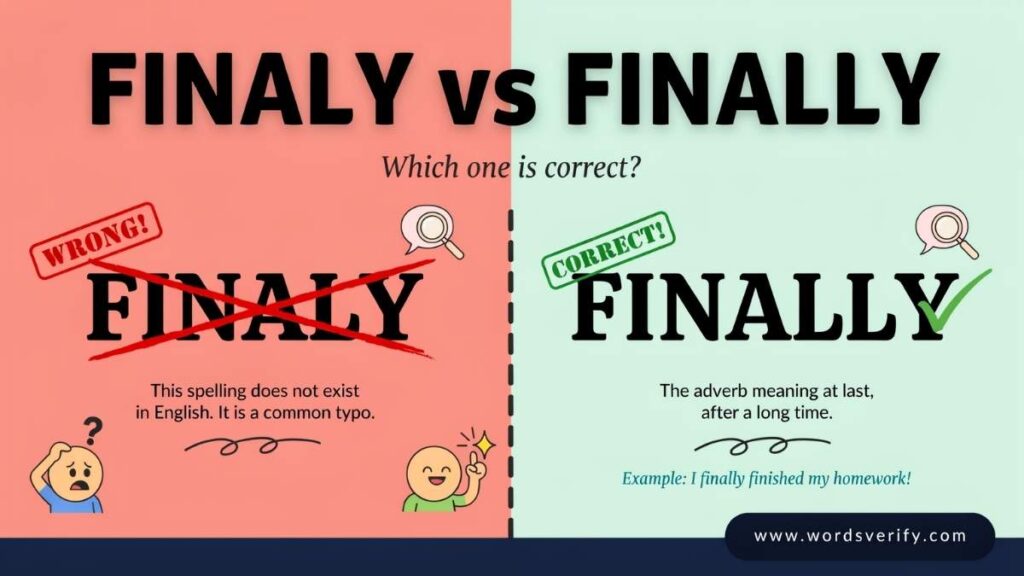
Have you ever written a word, looked at it twice, and suddenly wondered whether every letter is in the right place? Finaly vs finally can create exactly that kind of spelling confusion. The difference is only one letter, yet that missing L turns the correct word into a common spelling mistake. Finally is the standard spelling, while finaly is incorrect in standard English. Fortunately, there’s an easy way to remember it. This guide explains the correct spelling, meaning, grammar, usage, common mistakes, and practical examples. By the end, you’ll know exactly why finally needs two L’s and how to use it with confidence.
quick answer
The answer is simple regarding Finaly vs Finally
Finally is correct.
Finaly is incorrect in standard English.
| Spelling | Correct? | Meaning | Example |
|---|---|---|---|
| finally | Yes | After a delay, at the end, or as the last point | “The bus finally arrived.” |
| finaly | No | Misspelling of finally | “The bus finaly arrived.” |
If you’re wondering is it finaly vs finally, always choose finally.
The word has two l’s before the final y:
f-i-n-a-l-l-y
The incorrect form has only one:
f-i-n-a-l-y
That missing l is the entire spelling problem.
What Does “Finally” Mean?
The meaning of finally depends on the sentence. Most often, it describes something that happens after a period of waiting, difficulty, or delay. It can also introduce the last point in a series.
There are two main meanings to remember.
Finally Means After a Long Time
When something happens after you’ve waited for it or worked toward it for some time, finally can mean “at last.”
For example:
“The bus finally arrived.”
The sentence doesn’t simply tell you that the bus arrived. It suggests that people had been waiting for it.
Consider the difference:
“Sarah finished her assignment.”
“Sarah finally finished her assignment.”
The first sentence gives a simple fact. The second suggests that finishing the assignment took time, effort, or patience.
Here are a few natural examples:
- “I finally found my missing keys.”
- “She finally called me back.”
- “We finally reached the hotel.”
- “He finally solved the problem.”
- “The rain finally stopped.”
- “They finally completed the project.”
In each case, something happened after a delay or some difficulty.
Finally Means at the End
Finally can also introduce the last point in a list, discussion, explanation, or speech.
For example:
“Finally, we must consider the cost.”
Imagine that someone has already discussed quality, location, and availability. Cost is the last issue. The word finally tells the reader that the discussion has reached its final point.
You might also write:
- “Finally, let’s review the results.”
- “Finally, check the document for errors.”
- “Finally, we need to decide how much the project will cost.”
- “Finally, the speaker discussed the long-term effects.”
In these sentences, finally doesn’t necessarily mean that people waited a long time. Instead, it signals the last point in a sequence.
Learn the difference between tricky more English words
Aide vs Aid which one is correct?
Finaly vs Finally Grammar What Part of Speech Is It?
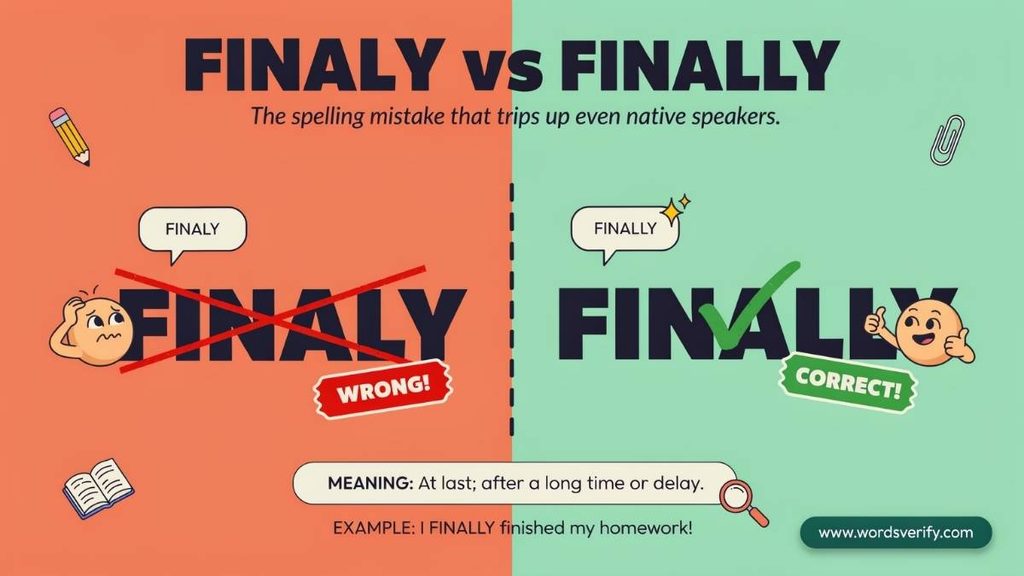
Finally is an adverb.
It can provide information about when something happens or help organize ideas in a sentence.
Consider:
“The train finally arrived.”
Here, finally tells us that the train arrived after some waiting.
Now consider:
“Finally, we reviewed the budget.”
Here, finally introduces the last point in the discussion.
This makes finally especially useful because it can do two related jobs. It can describe a delayed event, or it can guide the reader through the final part of an explanation.
Why Does Finally Have Two L’s?
The easiest way to understand the spelling is to look at the words that form it.
final + ly = finally
The base word is final.
The suffix is -ly.
When you put them together, you get:
final + ly → finally
That’s why writing finaly with one l creates a spelling error.
Think of the word in two parts:
final | ly
The first part already ends with l. The suffix -ly begins with another l.
Together, they give you:
finally
This is much easier to remember than trying to memorize the spelling letter by letter every time.
Finaly With One L vs Finally With Two L’s
Here’s the difference at a glance:
| Form | Status |
|---|---|
| finaly | Incorrect |
| finally | Correct |
The only difference is one letter, but that letter matters.
For example:
Incorrect: “I finaly finished the report.”
Correct: “I finally finished the report.”
Incorrect: “She finaly understood the lesson.”
Correct: “She finally understood the lesson.”
Incorrect: “Finaly, we reached the station.”
Correct: “Finally, we reached the station.”
The mistake is easy to spot once you know what to look for.
How to Spell Finally
If you often stop and wonder how to spell finally, use a simple memory trick:
final + ly = finally
Don’t think of finally as one long word. Break it into its parts.
FINAL
then
LY
Put them together:
FINALLY
The double l becomes obvious.
Another useful reminder is that the word final keeps its spelling when you add -ly:
final → finally
So don’t remove the second l just because the word is pronounced smoothly.
Learn the difference between tricky more English words
Crier vs Cryer Which one Is Correct?
Finaly vs Finally Meaning in Everyday English
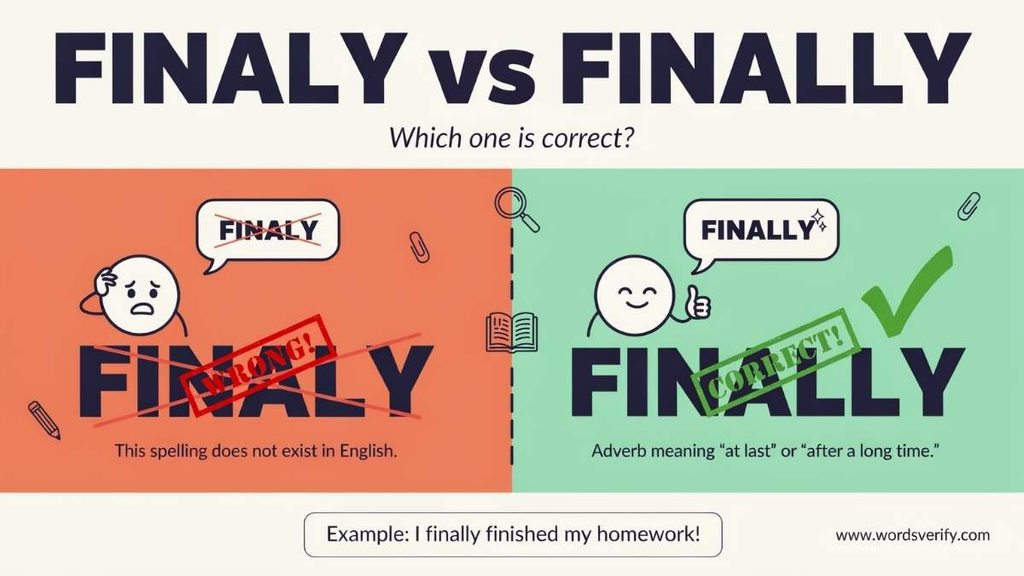
The word finally appears frequently in everyday conversation and writing.
Imagine waiting for a friend who is late. When the friend arrives, you might say:
“You finally made it!”
That sentence can express relief, amusement, or mild frustration depending on your tone.
Now imagine working on a difficult assignment all afternoon. When you finish, you might say:
“I finally finished it.”
Again, the word highlights the fact that something took time.
You can also use it when discussing the last part of something:
“Finally, let’s talk about the budget.”
The meaning changes slightly based on the context, but the basic idea remains connected to an ending, delay, or final point.
“The Bus Finally Arrived”
The sentence “The bus finally arrived” is a great example because it shows the most common use of finally.
Imagine that the bus was supposed to arrive at 8:00.
It’s 8:15.
Then 8:20.
You keep checking the road.
At 8:25, the bus appears.
You can say:
“The bus finally arrived.”
Without finally, you simply have:
“The bus arrived.”
Both sentences are grammatically correct. However, the second sentence doesn’t tell us anything about the waiting period.
Adding finally gives the sentence more context. It tells us that the arrival came after some delay or anticipation.
“Finally, We Must Consider the Cost”
Now look at another common use:
“Finally, we must consider the cost.”
Here, finally introduces the final point.
Suppose you’re explaining how to choose a new laptop. You discuss:
- Performance
- Battery life
- Storage
- Price
When you reach price, you might say:
“Finally, we must consider the cost.”
The word helps the reader follow the structure of the discussion. It signals that one more important point remains.
This use is common in essays, reports, presentations, instructions, and speeches.
Learn the difference between tricky more English words
Labelling vs Labeling Which one Is Correct?
How to Use Finally in a Sentence

The position of finally can vary depending on what you want to emphasize.
Finally in the Middle of a Sentence
This is one of the most common placements when the word means “after a delay.”
“She finally answered the phone.”
“We finally reached our destination.”
“He finally understood the instructions.”
These sentences sound natural because finally sits close to the verb or action it describes.
Finally at the Beginning of a Sentence
When finally introduces the last point, it often appears at the beginning.
“Finally, we need to review the results.”
“Finally, let’s discuss the cost.”
“Finally, check your work before submitting it.”
A comma commonly follows finally when it functions as an introductory word.
Finally at the End of a Sentence
You can sometimes place finally at the end:
“The package arrived finally.”
However, this sounds less natural in ordinary American English than:
“The package finally arrived.”
The second version is the more natural choice in most everyday situations.
Good grammar isn’t only about whether a sentence can be understood. Natural word order matters too.
Learn the difference between tricky more English words
Potatoes vs Potatos Which one Is Correct?
Finaly vs Finally Examples
Here are examples showing how finaly vs finally works in different situations.
Everyday Examples
- “I finally found my wallet.”
- “The rain finally stopped.”
- “She finally called me back.”
- “We finally got home.”
- “He finally opened the door.”
School Examples
- “I finally finished my homework.”
- “The students finally completed the experiment.”
- “She finally understood the difficult lesson.”
- “After several attempts, he finally solved the problem.”
Work Examples
- “The team finally completed the project.”
- “We finally received the report.”
- “The manager finally approved the proposal.”
- “After weeks of discussion, they finally reached an agreement.”
Writing and Presentations
- “Finally, we must consider the cost.”
- “Finally, the report examines the results.”
- “Finally, let’s review the main points.”
- “Finally, the speaker addressed the possible risks.”
These examples show that finally works naturally in both everyday English and more formal writing.
Learn the difference between tricky more English words
Moulding vs Molding which one is correct?
Common Spelling Mistakes
The most common mistake is dropping one of the two l’s.
Dropping One L
A writer may remember final and then add -y, producing:
finaly
However, the correct spelling is:
finally
Remember:
final + ly = finally
Typing Too Quickly
Fast typing can cause small spelling errors. Since finaly looks very similar to finally, the missing l can easily go unnoticed.
This is especially common in:
- Text messages
- Emails
- Social media posts
- Notes
- Quick online searches
A quick proofreading check can catch it.
Relying Only on Pronunciation
English pronunciation doesn’t always reveal every letter in a word.
When you say finally, you hear the word as a smooth group of sounds. You don’t consciously hear two separate l’s.
That’s why remembering the word formation is more useful than relying only on pronunciation.
Thinking Finaly Might Be an Alternative Spelling
It isn’t a standard alternative spelling.
This isn’t like color and colour, where both forms are accepted in different varieties of English.
For standard American English, the correct form is:
finally
The same spelling is also standard in British English.
Learn the difference between tricky more English words
Manuel vs Manual which one is correct?
Finaly vs Finally Comparison
| Feature | Finaly | Finally |
|---|---|---|
| Standard spelling | No | Yes |
| Number of l’s | One | Two |
| Standard English word | No | Yes |
| Part of speech | — | Adverb |
| Can mean “at last” | No | Yes |
| Can introduce a final point | No | Yes |
| Used in formal writing | No | Yes |
| Used in everyday English | No | Yes |
If you’re unsure which form to use, there’s no need to overthink it.
Choose finally.
Finally vs Eventually
Eventually and finally can sometimes have similar meanings, especially when something happens after a period of time.
Compare:
“We eventually found the house.”
“We finally found the house.”
Both sentences suggest that finding the house took time.
However, finally has an additional use that eventually doesn’t normally have.
You can say:
“Finally, let’s discuss the budget.”
You wouldn’t normally say:
“Eventually, let’s discuss the budget.”
In this context, finally introduces the last point in a discussion, while eventually focuses on something happening after time has passed.
Finally vs At Last
At last can often replace finally when something happens after a long wait.
For example:
“The train finally arrived.”
and:
“The train arrived at last.”
Both suggest that people had been waiting.
However, at last often sounds more emotional.
Compare:
“Finally, you’re here.”
“At last, you’re here!”
The second sentence may sound more dramatic or relieved.
The choice depends on the tone you want.
Finally vs Lastly
Lastly usually introduces the final item in a list or discussion.
For example:
“Lastly, we need to review the budget.”
You could also say:
“Finally, we need to review the budget.”
Both work in this context.
However, lastly doesn’t normally replace finally when you’re talking about something happening after a delay.
You can say:
“We finally reached the station.”
But “We lastly reached the station” doesn’t sound natural.
So finally has a wider range of uses.
Finally vs Ultimately
Ultimately often focuses on the final result or outcome.
For example:
“Ultimately, they decided to cancel the project.”
This focuses on the decision that came after other events or considerations.
Compare:
“They finally agreed.”
This can suggest that they had been discussing or disagreeing for some time.
“Ultimately, they agreed.”
This focuses more on the final outcome.
The words overlap, but the emphasis can differ.
Learn the difference between tricky more English words
Sneek vs Sneak Which one is Correct?
Finally in Formal Writing
Finally is useful in formal writing when you need to introduce a final point or describe an outcome that occurred after a process.
For example:
“Finally, the report examines the financial results.”
Or:
“After several rounds of testing, the product was finally approved.”
It works well in:
- Essays
- Reports
- Business documents
- Presentations
- Instructions
- Academic writing
However, don’t add finally simply because you’re writing a conclusion. Use it when the word actually communicates a final point, delayed event, or ending.
That keeps your writing natural.
Finally in Everyday Conversation
In everyday speech, finally can carry emotion as well as meaning.
Someone might say:
“Finally!”
Depending on the speaker’s tone, this could express relief, excitement, impatience, or satisfaction.
For example:
“Finally! The weekend is here.”
Or:
“Finally! I thought you’d never arrive.”
The same word can sound cheerful or frustrated depending on the situation.
That’s one reason finally is so useful in everyday English. It’s short, but it can carry a surprising amount of context.
Is Finaly a Word?
If you’re asking is finaly a word, the answer is no in standard English usage.
Finaly is normally a misspelling of finally.
The same applies to the question is finaly an English word. It isn’t the standard form of the adverb.
You might occasionally see Finaly used as a name, username, title, or other special label. Such uses don’t change the standard spelling of the English word.
For normal writing, use:
finally
Learn the difference between tricky more English words
Laid Down vs Lied Down which one is correct?
Does American English Spell Finally Differently?
No.
American English uses:
finally
British English also uses:
finally
So the spelling isn’t affected by whether you’re writing for an American or British audience.
The important point is simply to remember the two l’s.
A Simple Trick to Remember Finally
When you’re unsure, don’t try to guess the spelling.
Use this:
FINAL + LY
Then write:
FINALLY
You can also remember this short sentence:
The final L stays before -ly.
That gives you a quick mental check.
If you write finaly, look at the word again. Something is missing.
If you write finally, you have the standard spelling.
Correct and Incorrect Sentences
Seeing the mistake side by side makes the difference easier to remember.
| Incorrect | Correct |
|---|---|
| “I finaly finished.” | “I finally finished.” |
| “She finaly arrived.” | “She finally arrived.” |
| “Finaly, we can begin.” | “Finally, we can begin.” |
| “He finaly understood.” | “He finally understood.” |
| “They finaly agreed.” | “They finally agreed.” |
The correction is the same every time: add the second l.
Learn the difference between tricky more English words
Lieing vs Lying Which one Is Correct?
Practice Session Finaly vs Finally
Fill in each blank with the correct form:Finaly vs Finally
- The bus ______ arrived after a long wait.
- I ______ finished my homework.
- ______, we need to review the total cost.
- She ______ found her missing phone.
- After several attempts, he ______ solved the puzzle.
- The team ______ completed the project.
- ______, let’s discuss the final results.
- We ______ reached the hotel after driving all night.
- The teacher ______ explained the difficult lesson.
- After weeks of discussion, they ______ reached an agreement.
- ______, check your answers before submitting the test.
- The rain ______ stopped after several hours.
- He ______ understood what the instructions meant.
- After waiting for an hour, the doctor ______ called my name.
- ______, we must consider whether the plan is affordable.
- The package ______ arrived at the office.
- She ______ completed the last part of the assignment.
- After many delays, the event ______ began.
- ______, save the document and close the program.
- The students ______ finished their experiment.
- I was relieved when the train ______ arrived.
- After several meetings, the managers ______ made a decision.
- ______, let’s look at the main conclusion.
- He ______ repaired the computer after trying several solutions.
- The long wait was over when the movie ______ started.
Answers
- finally
- finally
- Finally
- finally
- finally
- finally
- Finally
- finally
- finally
- finally
- Finally
- finally
- finally
- finally
- Finally
- finally
- finally
- finally
- Finally
- finally
- finally
- finally
- Finally
- finally
- finally
Here’s a trusted source for clear more words Comparison:
FAQs
What type of word is “finally”?
“Finally” is an adverb. It can describe an action that happens after a delay or introduce the last point in a series, discussion, or explanation.
Does “finally” always refer to the end of something?
No. “Finally” can also describe an event that happens after waiting or difficulty. For example, “She finally found her keys” focuses on the delay rather than simply the ending of an event.
Can “finally” express relief?
Yes. In everyday conversation, “finally” can express relief, satisfaction, impatience, or excitement. For example, “Finally! The weekend is here” can show relief that the workweek has ended.
Can “finally” be used without a comma?
Yes. A comma isn’t always required. For example, “She finally finished her homework” doesn’t need a comma. When finally introduces a sentence as a transition, a comma is commonly used: “Finally, we reached an agreement.”
Is “finally” suitable for academic writing?
Yes. “Finally” can work well in academic writing when it introduces the final point in an organized discussion. However, it should add a clear structural purpose rather than appear simply to make the writing sound formal.
Can “finally” be used in an instruction?
Yes. It can introduce the last step in a set of instructions.
Example: “Finally, save the document and close the program.”
Can “finally” describe something that happened unexpectedly?
Yes. The word can describe an event that occurs after a period of waiting even when the exact timing wasn’t expected.
Example: “The missing package finally turned up.”
Can “finally” describe a decision?
Yes. It can show that a decision came after discussion, hesitation, or consideration.
Example: “After several meetings, the committee finally made a decision.”
Can “finally” describe something positive?
Yes. There is no positive or negative meaning built into the word. The context determines the tone.
Example: “She finally received the good news.”
Can “finally” describe something negative?
Yes. It can also describe an unwanted or unpleasant outcome that happens after a period of time.
Example: “The old machine finally stopped working.”
Does “finally” mean “immediately”?
No. In many contexts, “finally” suggests that something happened after some time, not immediately.
Example: “He finally answered the question” suggests that some waiting occurred before he answered.
Can “finally” refer to a future event?
Yes. It can refer to something expected to happen later.
Example: “The new store will finally open next month.”
Can “finally” modify an adjective?
Generally, no. “Finally” is mainly used to modify verbs or clauses and to organize ideas. When you want to describe the quality of something, another adverb may be needed.
What is the difference between “final” and “finally”?
Final is an adjective that describes something as last or concluding, while finally is an adverb.
Example: “This is the final chapter.”
Example: “She finally finished the book.”
What is the difference between “final” and “finale”?
Final can describe the last part, event, or stage. Finale is a noun referring to the final part of a performance, event, or series.
Example: “The final match starts tonight.”
Example: “The concert ended with a spectacular finale.”
Can “finally” be used more than once in a paragraph?
It can, but repeated use may make your writing sound repetitive. If several points need sequencing, vary the structure instead of beginning every sentence with “finally.”
Is “finally” appropriate in an email?
Yes. It works in both casual and professional emails when the meaning is clear.
Example: “Finally, please review the attached document before Friday.”
Can “finally” introduce a question?
Yes.
Example: “Finally, what happens if the deadline is missed?”
Here, finally signals that the question is the last point being raised.
Can “finally” be used with “after”?
Yes, when the sentence structure supports it.
Example: “After several attempts, she finally succeeded.”
This combination clearly shows that success came after repeated effort.
Can “finally” describe arriving somewhere?
Yes. This is one of its most natural uses.
Example: “After a long journey, we finally arrived at the airport.”
Can “finally” describe finishing something?
Yes. It often emphasizes that completing something took time or effort.
Example: “He finally finished the book.”
Is “finally” common in everyday English?
Yes. People use it frequently in conversation, emails, messages, stories, and formal writing. It is a normal part of everyday English vocabulary.
Does “finally” have the same meaning as “at the end”?
Not always. “At the end” can refer to the physical or chronological endpoint of something, while “finally” can also express a delayed event or introduce the last point in a discussion.
Example: “Finally, she answered the question” can suggest that the answer came after waiting.
Can “finally” refer to the final step of a process?
Yes.
Example: “Finally, submit the completed form.”
Here, the word identifies the last step in the process.
Can “finally” be used with “after all”?
Yes, but the two expressions have different meanings. “Finally” can show that something happened after waiting, while “after all” often introduces a reason, reminder, or fact that supports a conclusion.
Example: “She finally agreed after all the discussion.”
Learn the difference between tricky more English words
Sergeant vs Sargeant which one is correct?
conclusion
The finaly vs finally confusion is a small spelling trap, but one missing L can make a perfectly good sentence stumble. The correct spelling is finally, with two L’s. Remember it as final + ly = finally. The word can describe something that happens after a delay or introduce the last point in a series, discussion, or explanation. So, when this tricky spelling pops up, don’t let an L go missing. Keep both L’s in finally, and you’ll have the correct spelling every time. One extra letter may seem tiny, but in English spelling, even a little L can save the day.

Lisa AJS is an experienced blogger and language enthusiast at Words Verify, dedicated to making grammar simple, practical, and enjoyable. She writes engaging content on commonly confused words, grammar mistakes, word meanings, and everyday language challenges.