
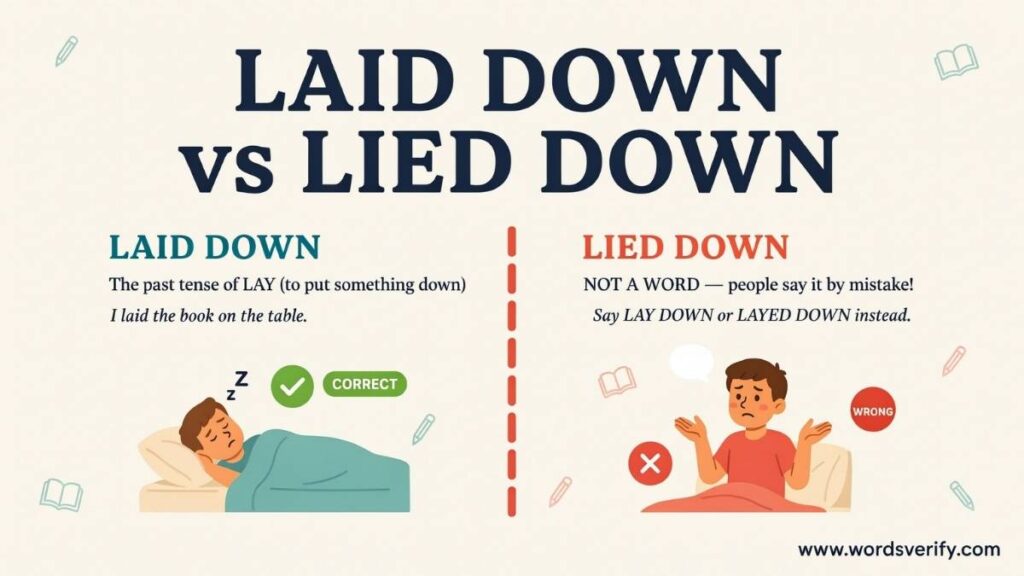
Have you ever typed “I laid down” and then paused, wondering if you just tripped over an English grammar rule? You’re not alone. The difference between laid down vs lied down confuses many writers because lie and lay have forms that look frustratingly alike. One refers to resting, another means putting something somewhere, while lied has a completely different meaning. The good news is that the rule isn’t as complicated as it first appears. In this guide, you’ll learn how lay, lie, laid, and lied work, which forms to use in different tenses, and how to avoid these common mistakes with simple, clear examples.
Quick Answer
If you’re talking about resting or reclining, neither “laid down” nor “lied down” is the correct simple past form.
The correct sentence is:
I lay down for a nap.
The verb forms for reclining are:
lie → lay → lain
For putting something somewhere:
lay → laid → laid
For telling a falsehood:
lie → lied → lied
Here’s the difference at a glance:
| Form | Meaning | Example |
|---|---|---|
| lie | Recline or rest | I lie down when I’m tired. |
| lay | Past tense of lie | I lay down after dinner. |
| lain | Past participle of lie | I have lain down for an hour. |
| lay | Put something somewhere | I lay the book down. |
| laid | Past tense of lay | I laid the book down. |
| lied | Past tense of lie meaning tell a falsehood | He lied about what happened. |
So, if you’re asking “is it laid down or lied down?” when someone is resting, the answer is neither. The correct past tense is “lay down.”
Learn the difference between confusing more English words
Lieing vs Lying Which one Is Correct?
What Does “Lie Down” Mean?
The verb lie in “lie down” means to recline or move your body into a resting position.
You can lie down on a bed, couch, floor, or another surface.
For example:
- I need to lie down for a few minutes.
- She wants to lie down after lunch.
- The dog likes to lie down beside the fireplace.
- Please lie down and get some rest.
Here, lie means “recline.” It has nothing to do with telling a falsehood.
Lie Meaning “Recline”
When lie means recline, its main forms are:
- Present: lie
- Past: lay
- Past participle: lain
- Present participle: lying
Examples:
- I lie down when I’m tired.
- Yesterday, I lay down after dinner.
- I have lain down for an hour.
- She is lying on the couch.
Lie Meaning “Tell a Falsehood”
English also has another verb spelled lie. This one means to say something that isn’t true.
Its forms are:
- Present: lie
- Past: lied
- Past participle: lied
- Present participle: lying
Examples:
- He lies about his age.
- He lied to his parents.
- She has lied about what happened.
This is why “lied down” isn’t the normal past tense of “lie down.” Lied belongs to the verb that means “tell a falsehood.”
Learn the difference between confusing more English words
Sergeant vs Sargeant which one is correct?
What Does “Lay Down” Mean?
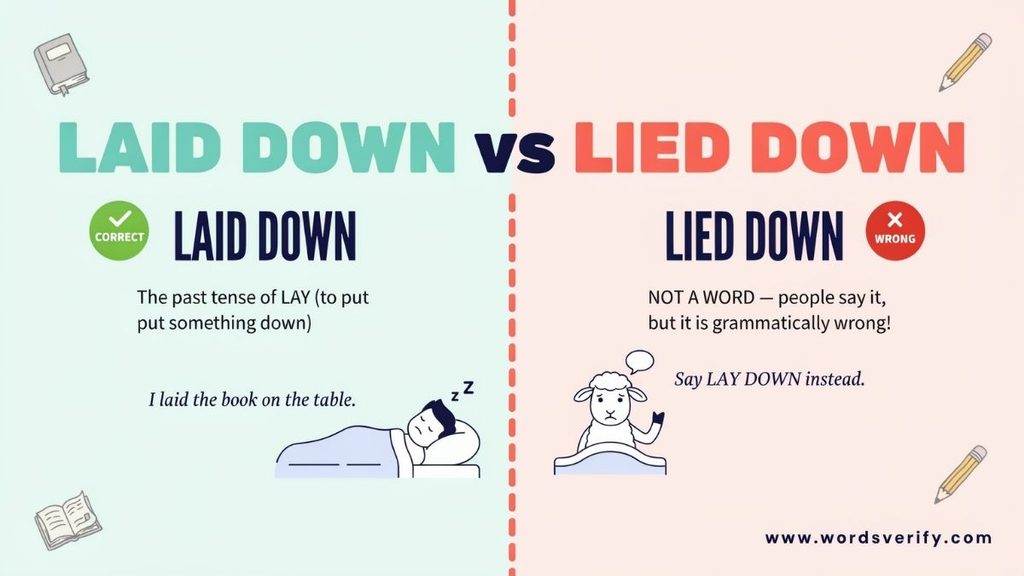
The verb lay means to put something or someone in a particular place or position.
For example:
- I lay the book down.
- She lays the keys down.
- He laid the blanket down.
- They laid the baby down carefully.
In these examples, something receives the action. The book, keys, blanket, and baby are all being placed somewhere.
That makes lay a transitive verb in these uses. A transitive verb normally takes a direct object.
The verb forms are:
lay → laid → laid
For example:
- Present: I lay the book down.
- Past: I laid the book down.
- Past participle: I have laid the book down.
So, the laid down meaning is usually “placed something or someone in a particular position.”
Lay Down vs Lie Down?
This is the main lay vs lie question.
Use lie down when the subject reclines.
Use lay something down when the subject puts something somewhere.
Compare these sentences:
| Sentence | Meaning |
|---|---|
| I lie down after work. | I recline. |
| I lay the phone down after work. | I put the phone somewhere. |
| She lay down yesterday. | She reclined yesterday. |
| She laid the phone down yesterday. | She put the phone somewhere yesterday. |
The easiest way to understand the difference is to look for the object.
If You Recline, Use Lie
I need to lie down.
The subject is simply moving into a resting position. There is no direct object.
If You Put Something Somewhere, Use Lay
I need to lay the book down.
The book is the direct object. You are putting it somewhere.
This object test is one of the most useful rules for lay down grammar and lie down grammar.
Learn the difference between confusing more English words
Affect vs Effect which one is correct?
Laid Down vs Lied Down What’s the Difference?
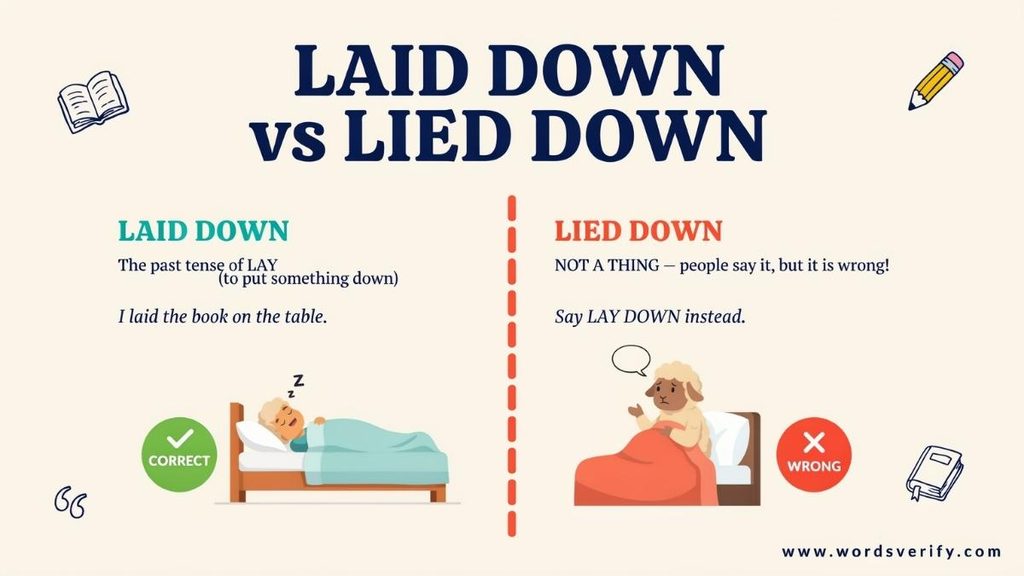
The phrases laid down vs lied down are confusing because they come from different verbs and different meanings.
Laid Down
Laid down usually means that someone put something somewhere.
Examples:
- I laid down the book.
- She laid down her phone.
- He laid the baby down.
- They laid the bags down near the door.
The phrase can also mean “established” or “stated,” especially when talking about rules or conditions.
For example:
The company laid down new safety rules.
Here, the company didn’t physically put the rules somewhere. It established them.
Lied Down
If you’re talking about resting, lied down is not the standard form.
Instead, say:
I lay down.
The word lied is the past tense of lie when lie means “tell a falsehood.”
For example:
He lied about what happened.
That has nothing to do with reclining.
Learn the difference between confusing more English words
Further vs Farther which one is correct?
Is “I Lay Down” Correct?
Yes.
I lay down is correct when you’re talking about the past tense of lie meaning “recline.”
For example:
I lay down for a nap after lunch.
This can feel strange because many people expect the past tense of lie to be lied. That works only when lie means “tell a falsehood.”
Compare the two meanings:
| Present | Past | Meaning |
|---|---|---|
| I lie down. | I lay down. | Recline |
| I lie about it. | I lied about it. | Tell a falsehood |
This is the key distinction in lie vs. lay.
Is “I Laid Down” Correct?
It can be correct, but it depends on what you mean.
If you’re putting something somewhere, laid down is correct.
For example:
I laid down the newspaper.
The newspaper is being placed somewhere.
But if you mean that you reclined, this isn’t the standard form:
I laid down for a nap.
In standard American English, the better sentence is:
I lay down for a nap.
This is one of the most common mistakes with these confusing verbs.
Learn the difference between confusing more English words
Treck vs Trek Which one Is Correct?
Is “I Lied Down” Correct?
Not when you mean that you rested or reclined.
This sentence is incorrect for that meaning:
I lied down for a nap.
Use:
I lay down for a nap.
Remember that lied belongs to the verb lie meaning “tell a falsehood.”
For example:
I lied about being sick.
But:
I lay down because I was tired.
The spelling is similar, but the verbs have different meanings and forms.
The Past Tense of Lie Down
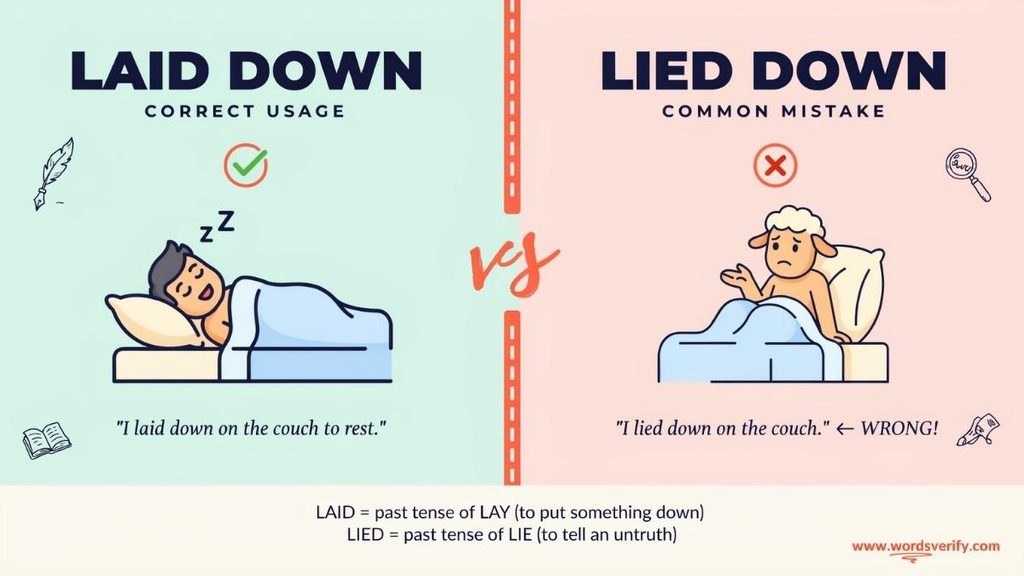
This is one of the most important points to remember.
The past tense of lie down is lay down.
Present
I lie down when I need to rest.
Past
I lay down when I needed to rest.
Past Participle
I have lain down to rest.
So, if you’re searching for the past tense of lie down, the answer is lay down.
The same rule applies to questions such as:
- What is the lie down past tense?
- What is the past tense of lie down?
- What is the past tense of lie when resting?
- Is lay the past tense of lie?
When lie means recline, yes. Lay is its simple past form.
Learn the difference between confusing more English words
Attornies vs Attorneys Which one Is Correct?
The Past Tense of Lay Down
Now the pattern changes.
When lay means “put something somewhere,” its past tense is laid.
For example:
Present: I lay the book down.
Past: I laid the book down.
Past participle: I have laid the book down.
Therefore, the past tense of lay down is laid down when lay means placing something somewhere.
Here’s the full picture:
| Meaning | Present | Past | Past Participle |
|---|---|---|---|
| Recline | lie | lay | lain |
| Put something down | lay | laid | laid |
| Tell a falsehood | lie | lied | lied |
This table is worth remembering because it covers the three forms that cause most of the confusion.
What About “I Have Just Laid Down”?
The sentence “I have just laid down” needs context.
If you’re saying that you have just placed something somewhere, laid can be correct.
For example:
I have just laid down the keys.
However, if you mean that you have just reclined, use:
I have just lain down.
Compare:
- I have just laid down the book. ✓
- I have just lain down. ✓
- I have just laid down for a nap. ✗ when you mean “reclined”
- I have just lied down. ✗ when you mean “reclined”
This is where the past participle becomes important.
After have, has, or had, you generally need the past participle form.
For the reclining verb, that form is lain.
What About “I Have Just Lied Down”?
If you’re asking about “I have just lied down” grammar, the answer is that lied isn’t the correct past participle when lie means recline.
Say:
I have just lain down.
The pattern is:
- I lie down.
- I lay down.
- I have lain down.
By contrast:
- I lie about it.
- I lied about it.
- I have lied about it.
The meaning determines the verb form.
Laid Down vs Lied Down in Bed
Questions about laid down vs lied down in bed are especially common because people often use these verbs when talking about sleep and rest.
Consider this sentence:
She ___ down in bed after dinner.
The correct answer is:
She lay down in bed after dinner.
Not “laid” and not “lied.”
Why? Because she is reclining. She isn’t putting another object somewhere.
You can also say:
- She lay down on the bed.
- She lay in bed until morning.
- He lay down to sleep.
- I lay down for a short nap.
But if you’re putting something on the bed, use lay or laid depending on the tense.
For example:
She laid the clothes on the bed.
The clothes are the object being placed.
Bed Examples
| Intended meaning | Correct sentence |
|---|---|
| Recline now | I lie in bed. |
| Reclined yesterday | I lay in bed. |
| Already reclined | I have lain in bed. |
| Put an object on the bed | I lay the book on the bed. |
| Put an object there yesterday | I laid the book on the bed. |
The same principle applies whether you’re talking about a bed, couch, chair, or another surface.
Learn the difference between confusing more English words
Lose vs Loose which one is correct?
“She Laid Down vs she Lied Down Which Is Correct?
Suppose you see this sentence:
She ___ down because she was tired.
The correct answer is:
She lay down because she was tired.
Now change the sentence:
She ___ the baby down because the baby was tired.
The correct answer becomes:
She laid the baby down because the baby was tired.
The difference is the object.
In the first sentence, she reclines.
In the second sentence, the baby receives the action.
A Simple Example
Imagine Maria comes home after a long day.
First:
Maria lay down on the couch.
She is resting.
Then:
Maria laid her bag down beside the couch.
She puts the bag somewhere.
Later:
Maria said she had lain down for only ten minutes.
Now we need the past participle of lie.
Finally:
Maria lied about how long she had slept.
Here, lied means she told a falsehood.
The same person appears in every sentence, but the verb changes because the meaning, tense, and grammatical role change.
Learn the difference between confusing more English words
Advise vs Advice which one is correct
Common Mistakes With Lay, Lie, Laid, and Lied
“I Laid Down for a Nap”
If you mean that you reclined, write:
I lay down for a nap.
Use laid when you’re putting something somewhere:
I laid the blanket down.
“She Lied Down”
For reclining, write:
She lay down.
The word lied means “told a falsehood.”
“I Lay the Book Down Yesterday”
If the action happened in the past, use:
I laid the book down yesterday.
The present-tense version is:
I lay the book down every morning.
The past-tense version is:
I laid the book down yesterday.
“I Have Lay Down”
After have, you need the past participle.
Correct:
I have lain down.
Not:
I have lay down.
“I Have Just Lied Down”
When you’re talking about reclining, use:
I have just lain down.
Again, lied belongs to the falsehood meaning of lie.
Learn the difference between confusing more English words
Peices vs Pieces difference and correct usage
Understanding Transitive and Intransitive Verbs
Understanding lay down grammar becomes much easier when you know the difference between transitive and intransitive verbs.
A transitive verb takes a direct object.
For example:
She laid the book down.
The book is the direct object.
An intransitive verb doesn’t take a direct object in that construction.
For example:
She lay down.
She isn’t putting another object somewhere. She’s changing her own position.
Transitive Pattern
The basic pattern is:
Subject + lay/laid + object
Examples:
- I laid the phone down.
- She laid the blanket down.
- He laid the baby down.
Intransitive Pattern
The basic pattern is:
Subject + lie/lay + down
Examples:
- I lie down.
- She lay down.
- The dog lay down.
This object test is a useful shortcut for everyday English grammar.
Laid Down Grammar in Other Contexts
The phrase laid down doesn’t always describe physical movement.
It can also mean established, stated, or set out.
For example:
The teacher laid down clear rules for the class.
or The teacher didn’t physically place the rules on a table and The teacher established them.
You may see laid down used with:
- Rules
- Conditions
- Principles
- Requirements
- Procedures
- Standards
For example:
The contract laid down several conditions for payment.
Here, laid down means something like “specified” or “established.”
Lay Down Has Several Meanings
The phrase lay down can be used in different ways.
Put Something Down
Lay the book down.
Put a Person or Animal Down
She laid the baby down carefully.
Establish Rules or Conditions
The committee laid down new guidelines.
Surrender Something
In certain expressions, lay down can mean to give something up or surrender it.
For example:
The soldiers were ordered to lay down their weapons.
The meaning comes from the context. However, the basic verb forms remain the same.
Learn the difference between confusing more English words
Seel vs Seal Difference and correct usage
A Simple Memory Trick for Laid Down vs Lied Down
If you often mix these words up, keep one sentence in mind:
You lie down, but you lay something down.
Then change the tense:
Yesterday, you lay down. Yesterday, you laid something down.
For the past participle:
You have lain down. You have laid something down.
Here’s a quick reference:
| Situation | Correct form |
|---|---|
| Recline now | lie down |
| Reclined in the past | lay down |
| Have reclined | have lain down |
| Put something down now | lay it down |
| Put something down in the past | laid it down |
| Have put something down | have laid it down |
| Told a falsehood in the past | lied |
This pattern is easier to remember than memorizing individual sentences.
Lay vs Lie Complete Verb Chart
Keep this chart nearby when you’re unsure about these forms.
| Meaning | Present | Past | Past Participle | Example |
|---|---|---|---|---|
| Recline | lie | lay | lain | I have lain down. |
| Put something down | lay | laid | laid | I laid the book down. |
| Tell a falsehood | lie | lied | lied | She lied about it. |
The problem becomes much clearer when you treat these as three separate verb patterns rather than one confusing group of words.
Practical Laid Down vs Lied Down Examples
Resting
- I lie down when my back hurts.
- I lay down after dinner yesterday.
- She lay down for a quick nap.
- The dog lay down beside the chair.
- He has lain down to rest.
Putting an Object Down
- I lay the remote down beside me.
- She laid the keys down on the counter.
- He laid the newspaper down.
- We laid the bags down near the door.
Putting Someone Down
- She laid the baby down carefully.
- He laid the injured bird down on a towel.
Telling a Falsehood
- He lied about where he had been.
- She lied to protect her friend.
- They lied about the missing money.
Notice that lied appears only in the falsehood examples. It isn’t the past tense of lie when you’re talking about resting.
Practice Session Laid Down vs Lied Down
Fill in each blank with the correct form of Laid Down vs Lied Down
- I was exhausted, so I decided to ______ down for a while.
- Yesterday, I ______ down on the couch after work.
- She has ______ down for a short nap.
- Please ______ the book down on the table.
- He ______ the keys down beside the phone.
- The dog ______ down near the fireplace last night.
- The children are ______ on the floor.
- She ______ about where she had been.
- I usually ______ down when I feel tired.
- He has ______ the documents on the desk.
- We ______ down after walking for several hours.
- She ______ the baby down gently.
- The cat was ______ on the bed.
- I had ______ down before the phone rang.
- He ______ to his parents about the missing money.
- Please ______ down and get some rest.
- Yesterday, she ______ the blanket on the bed.
- I have just ______ down to relax.
- The company ______ down several new rules.
- He ______ the newspaper down and picked up his phone.
- We were tired, so we ______ down under a tree.
- She has ______ the keys down somewhere, but she can’t remember where.
- I don’t usually ______ awake for very long at night.
- The puppy ______ down beside its owner.
- He ______ about finishing the project when he actually hadn’t started it.
Answers
- lie
- lay
- lain
- lay
- laid
- lay
- lying
- lied
- lie
- laid
- lay
- laid
- lying
- lain
- lied
- lie
- laid
- lain
- laid
- laid
- lay
- laid
- lie
- lay
- lied
Here’s a trusted source for clear more words Comparison:
FAQs
What is the difference between lay, lie, laid, and lied?
Lie means to recline, while lay means to put something somewhere. Laid is the past tense of lay, while lied is the past tense of lie when it means telling a falsehood.
What is the past tense of “lie” when it means rest?
The past tense of lie meaning “recline” is lay. For example, “I lay down after dinner.”
What is the past participle of “lie” meaning recline?
The past participle is lain. For example, “She has lain down for a while.”
Why is “lay” the past tense of “lie”?
English uses irregular verb forms, so lie does not become “lied” when it means recline. Its past form is lay, while lied belongs to the other verb lie, meaning “tell a falsehood.”
When should I use “lain” instead of “lay”?
Use lain after helping verbs such as have, has, or had when you mean reclining. For example, “I have lain down for an hour.”
Can “laid down” have a meaning besides putting something down?
Yes. Laid down can also mean established, stated, or set out. For example, “The organization laid down new safety rules.”
Why does “lied down” sound wrong?
Lied is the past tense of lie when lie means “tell a falsehood.” It is not the standard past tense of lie when you mean “recline.” For reclining, the correct past tense is lay.
What is the difference between “I lay down” and “I laid something down”?
“I lay down” means that I reclined. “I laid something down” means that I placed an object somewhere. The presence of an object helps distinguish the two uses.
How can I quickly tell whether to use “lay” or “lie”?
Ask yourself whether someone is reclining or putting something somewhere. If the person is reclining, use lie or its appropriate form. If something is being placed somewhere, use lay or its appropriate form.
Is “I have lain down” grammatically correct?
Yes. “I have lain down” is the correct present perfect form when lie means recline.
Is “I had lain down” correct?
Yes. “I had lain down” is correct when describing an earlier reclining action. For example, “I had lain down before the phone rang.”
What is the difference between “laid” and “lain”?
Laid comes from lay and is used when something is placed somewhere. Lain comes from lie and is used when someone or something has reclined or remained in a position.
Can “lay” be present tense?
Yes. Lay is the present tense of the verb meaning “put something somewhere.” For example, “I lay the keys on the table every morning.”
Can “lay down” refer to rules?
Yes. Lay down can mean to establish or state rules, requirements, conditions, or principles. For example, “The manager laid down clear rules for the team.”
What does “lie down” mean in grammar?
Lie down is an intransitive verb phrase meaning to recline or move into a resting position. It does not normally take a direct object in this use.
What does “lay something down” mean?
Lay something down means to put or place an object in a particular position. For example, “Please lay the documents down on the desk.”
Why is “I laid down the book” correct?
Because laid is the past tense of lay when lay means “put something somewhere.” The book is the object being placed down.
Is “I had laid the book down” correct?
Yes. Had laid is the past perfect form of lay when something was placed somewhere before another past event.
What does “lied” mean in English grammar?
Lied is the past tense and past participle of lie when it means “tell a falsehood.” For example, “He lied about what happened.”
What is an easy way to remember the reclining forms?
Remember this sequence: lie in the present, lay in the past, and lain after have or had. For example, “I lie down,” “I lay down,” and “I have lain down.”
conclusion
The confusion between laid down vs lied down can make a simple sentence feel like a grammar puzzle. Fortunately, the rule is easier than it looks. When you mean resting or reclining, use lie in the present, lay in the past, and lain after have or had. When you mean putting something somewhere, use lay, laid, and laid. And when you mean telling a falsehood, use lie, lied, and lied. So, if you’re heading to bed, you can confidently say, “I lay down.” No grammar guilt, no second-guessing, and definitely no need to “lied down.” Once the pattern clicks, these confusing verbs become much easier to handle.

Lisa AJS is an experienced blogger and language enthusiast at Words Verify, dedicated to making grammar simple, practical, and enjoyable. She writes engaging content on commonly confused words, grammar mistakes, word meanings, and everyday language challenges.