
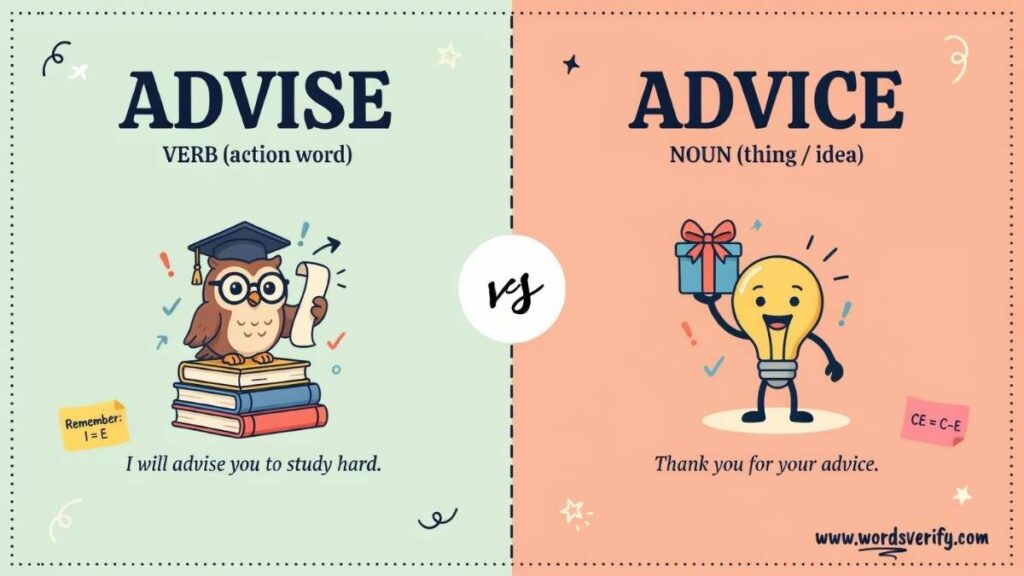
Have you ever written a sentence, paused, and wondered, “Is it advise or advice?” You’re not alone. These two words look almost identical, sound remarkably similar, and even share a connection in meaning. No wonder they cause so many grammar mistakes. The good news is that the advise vs advice difference is easier than it looks. One is a noun, the other is a verb, and that small grammatical detail makes all the difference. In this guide, you’ll learn what advise and advice mean, how to pronounce them, when to use each one, and how to avoid the common mistakes that can trip you up.
Quick Answer
The correct word depends on what you’re trying to say.
| Word | Part of Speech | Meaning | Example |
|---|---|---|---|
| Advice | Noun | A suggestion, recommendation, or guidance | She gave me good advice. |
| Advise | Verb | To give someone a suggestion or recommendation | She advised me to wait. |
A quick memory trick is:
Advice = the guidance
Advise = giving the guidance
For example:
- My teacher gave me some advice.
- My teacher advised me to study harder.
The meaning is connected, but the grammatical role is different.
What Does Advise Mean?
Advise is a verb. It means to give someone a suggestion, recommendation, or guidance about what they should do.
In simple terms, when you advise someone, you’re telling them what you think they should do.
For example:
- I advise you to save some money.
- The doctor advised him to rest.
- She advised me against buying the car.
- My teacher advised me to practice every day.
- We advise customers to read the instructions carefully.
In each sentence, advise describes an action.
A friend can advise you. A teacher can advise a student. A doctor can advise a patient. A lawyer can advise a client.
Advise Someone to Do Something
This is one of the most common ways to use advise.
The basic pattern is:
advise + person + to + verb
Examples:
- I advised him to wait.
- She advised me to apply early.
- The doctor advised her to drink more water.
- My parents advised me to think carefully.
- The manager advised the team to arrive early.
Notice how a person usually comes after advise in this structure.
You don’t simply say, “I advise to wait.”
Instead, say:
“I advise you to wait.”
Advise Against Something
Use advise against when you want to recommend that someone not do something.
Examples:
- I advise against driving in heavy rain.
- The doctor advised against strenuous exercise.
- She advised me against accepting the offer.
- We advise against using the equipment incorrectly.
It’s basically a polite way of saying, “I don’t think you should do that.”
Advise on Something
You can also use advise when someone provides guidance about a particular subject.
Examples:
- The lawyer advised us on the contract.
- She advises students on career choices.
- He advised me on how to prepare for the interview.
- The consultant advised the company on financial matters.
This structure is especially common in professional situations.
Advise That…
Advise can also be followed by a clause beginning with that.
Examples:
- The company advised that the meeting would start at noon.
- The doctor advised that I should get more rest.
- Officials advised that travelers should check their schedules.
In formal communication, advise can also mean giving someone official information.
For example:
- We advise you that your application has been received.
- Please be advised that the office will close early.
You’ll often see this kind of wording in emails, notices, letters, and other formal messages.
Learn how to use confusing more words correctly
Eying vs Eyeing difference and Correct usage
What Does Advice Mean?
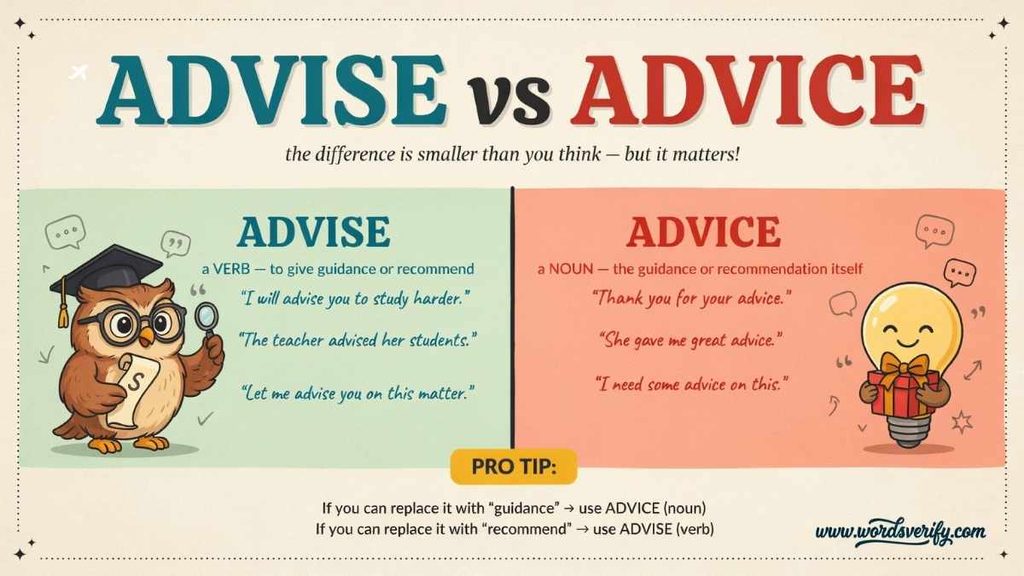
Advice is a noun. It means a suggestion, recommendation, opinion, or guidance about what someone should do.
For example:
- She gave me some advice.
- I need your advice.
- His advice helped me make a decision.
- The doctor gave her useful advice.
- Thank you for your advice.
Here, advice is the thing being given or received.
Think about it this way:
If someone tells you what they think you should do, that suggestion is advice.
If you tell someone what they should do, you advise them.
That simple distinction solves most advise-versus-advice problems.
Is Advice Countable or Uncountable?
There’s another little grammar rule worth knowing.
Advice is an uncountable noun.
That means you normally don’t put a number directly in front of it or use “an” with it.
So these forms are incorrect:
- An advice
- Two advices
- Three advices
Instead, use phrases such as:
- Some advice
- A piece of advice
- Two pieces of advice
- A bit of advice
- A word of advice
- A lot of advice
For example:
- She gave me some advice.
- He gave me a piece of advice.
- My father gave me two pieces of advice.
If you want to count individual suggestions, piece is your friend.
For example:
“I have two pieces of advice for you.”
That sounds natural and grammatically correct.
Learn how to use confusing more words correctly
Humour vs Humor Difference and Correct usage
Advise vs Advice What’s the Difference?
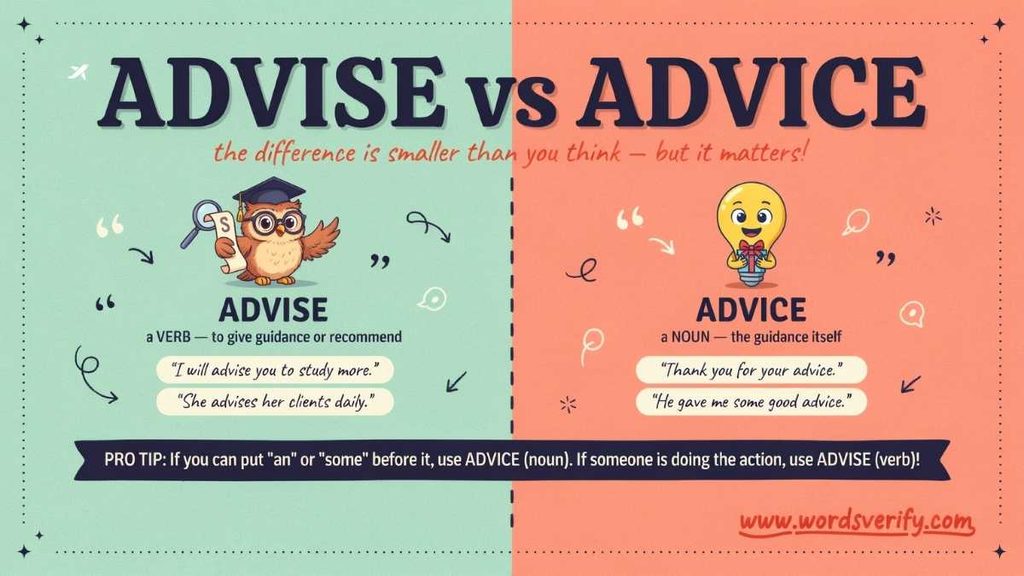
The biggest difference is their part of speech.
Advice is a noun.
Advise is a verb.
Compare these sentences:
- I need your advice.
- Please advise me.
In the first sentence, advice is the guidance you need.
In the second sentence, advise is the action you’re asking someone to take.
Here’s another pair:
- She gave me some advice.
- She advised me to wait.
The two words are related. They simply have different jobs.
Advice vs Advise Pronunciation
The pronunciation is slightly different too.
In US English:
- Advice sounds roughly like “ad-VICE.”
- Advise sounds roughly like “ad-VIZE.”
The final sound is the important part.
Advice ends with an “s” sound.
Advise ends with a “z” sound.
The spelling gives you a helpful clue as well:
- advice → noun
- advise → verb
So if you’re speaking, listen to the final sound. If you’re writing, look at the ending.
Learn how to use confusing more words correctly
Insite vs Insight difference and Correct usage
A Simple Memory Trick for Advice vs Advise

Still mixing them up? Try this:
Advice has “ice.”
Think of advice as a thing you can “give.”
Advise has “ise.”
Think of advise as an action you perform.
But there’s an even easier trick:
You give advice. You advise someone.
For example:
- I gave her some advice.
- I advised her to wait.
That pattern is worth memorizing because you’ll use it again and again.
Learn how to use confusing more words correctly
Ballot vs Bullet difference and correct usage
Common Mistakes With Advice vs Advise
These two words tend to cause the same mistakes over and over.
Using Advice as a Verb
A common mistake is using advice when you need a verb.
Incorrect:
- I will advice you tomorrow.
- Please advice me what to do.
- She adviced him to wait.
Correct:
- I will advise you tomorrow.
- Please advise me what to do.
- She advised him to wait.
Why?
Because the sentence needs a verb. Advice is a noun. Advise is the verb.
Using Advise as a Noun
The reverse mistake is just as common.
Incorrect:
- Thank you for your advise.
- I need your advise.
- That was good advise.
Correct:
- Thank you for your advice.
- I need your advice.
- That was good advice.
A quick test can help.
If you mean “suggestion” or “guidance,” you probably need advice.
If you mean “give guidance” or “recommend,” you probably need advise.
Writing “Adviced”
Another common spelling mistake is adviced.
The correct past tense is advised.
Examples:
- The doctor advised me to rest.
- She advised him to wait.
- My teacher advised me to practice more.
The spelling follows advise → advised.
Please Advise or Please Advice?
This question comes up a lot, especially in emails.
The correct phrase is:
Please advise.
It means you’re asking someone to provide information, guidance, or an answer.
Examples:
- Please advise me on the next step.
- Please advise whether the meeting has been confirmed.
- Please advise if you need any additional information.
“Please advice” is incorrect when you mean “please give me information.”
Why?
Because you need a verb after “please.”
Since advise is the verb, “Please advise” is correct.
A simple way to remember it is:
Please + verb = Please advise.
I Will Advise or I Will Advice?
The correct phrase is:
I will advise.
After will, you use the base form of a verb.
Since advise is a verb, it fits.
Examples:
- I will advise you tomorrow.
- I will advise him of the changes.
- I will advise you once I receive the information.
“I will advice” doesn’t work because advice is a noun.
My Advice or My Advise?
The correct phrase is:
my advice
Examples:
- My advice is to wait.
- You should consider my advice.
- I hope my advice helps.
- Let me give you some advice.
“My advise” is incorrect when you mean a suggestion or recommendation.
Remember:
My advice = my suggestion.
Doctor’s Advice or Doctor’s Advise?
The correct phrase is:
doctor’s advice
You’re talking about the guidance the doctor gave you.
Examples:
- Follow your doctor’s advice.
- I took my doctor’s advice.
- Her doctor’s advice helped her make the decision.
But if you’re describing what the doctor did, use advise:
- The doctor advised me to rest.
- The doctor advised him to change his diet.
- The doctor advised her against strenuous activity.
So the pattern is easy:
The doctor gives advice.
The doctor advises the patient.
Give Advice or Give Advise?
The correct phrase is:
give advice
Examples:
- She gave me some advice.
- Can you give me some advice?
- He gave his friend useful advice.
“Give advise” is incorrect because you need the noun after “give.”
You give advice.
You don’t give advise.
Take Advice or Take Advise?
The correct phrase is:
take advice
Examples:
- You should take her advice.
- He refused to take my advice.
- She decided to take her father’s advice.
Again, advice is the noun.
Ask for Advice or Advise?
The correct phrase is:
ask for advice
Examples:
- I asked my teacher for advice.
- She asked her manager for advice.
- He asked his parents for advice.
You can then use advise when describing the response:
“My manager advised me to wait.”
The two words can appear in the same situation. They simply play different grammatical roles.
Learn how to use confusing more words correctly
Honor vs Honour difference and Correct usage
Advice in a Sentence
Here are some natural examples of advice:
- I need some advice about my new job.
- She gave me helpful advice.
- His advice saved me a lot of time.
- We asked our teacher for advice.
- You should take your doctor’s advice.
- Thank you for your advice.
- I appreciate your honest advice.
- She offered me a piece of advice.
- He ignored everyone’s advice.
- Good advice can help you avoid unnecessary mistakes.
Advise in a Sentence
Here are some natural examples of advise:
- I advise you to check the details.
- She advised me to arrive early.
- The doctor advised him to rest.
- We advise customers to keep their receipts.
- My teacher advised me to practice more.
- I would advise against making a quick decision.
- The lawyer advised us on the agreement.
- She advised her brother to save money.
- The manager advised the team to remain calm.
- Please advise me of any changes.
Learn how to use confusing more words correctly
Steer vs Stear difference and Correct usage
Advice vs Advise in Everyday English
You’ll see these words in all kinds of situations. Knowing the difference helps you sound more confident in both casual and professional English.
Workplace situations
- I need your advice on this project.
- Please advise me when the report is ready.
- She gave me useful advice.
- The manager advised us to review the document.
academic settings
- My teacher gave me some advice.
- She advised me to study for the exam.
- I asked my professor for advice.
- He advised us to start early.
medical consultations
- The doctor gave me some advice.
- The doctor advised me to get more rest.
- I followed my doctor’s advice.
- She advised him against skipping his medication.
In Everyday Conversation
- Can I ask you for some advice?
- What would you advise me to do?
- My friend gave me good advice.
- I’d advise you to think about it first.
Advice vs Advise in an Email
Emails are one of the easiest places to make this mistake.
Imagine you’re waiting for an update from a coworker. You might write:
“Please advise when the report is ready.”
Here, advise is correct because you’re asking the person to give you information.
Now imagine someone has already helped you. You could write:
“Thank you for your advice regarding the report.”
Here, advice is correct because you’re talking about the guidance you received.
When you’re unsure, ask yourself:
Am I asking someone to give me information or guidance?
Use advise.
Am I talking about the guidance itself?
Use advice.
Learn how to use confusing more words correctly
Tying vs Tieing difference and Correct usage
Common Expressions With Advice
You’ll often see advice used in these expressions.
A Piece of Advice
Use “a piece of advice” when you want to talk about one specific suggestion.
Example:
- Let me give you a piece of advice.
A Word of Advice
This phrase usually introduces a helpful suggestion or warning.
Example:
- A word of advice: always check your work before submitting it.
Some Advice
Example:
- Can you give me some advice?
Good Advice
Example:
- That’s good advice.
Professional Advice
Example:
- You may want to seek professional advice.
Expert Advice
Example:
- The company sought expert advice before making the decision.
| Expression Pattern | Example Sentence |
|---|---|
| Advise someone | I advised him. |
| Advise someone to do something | I advised him to wait. |
| Advise against something | I advised against buying it. |
| Advise someone on something | She advised me on my career options. |
| Advise someone of something | We will advise you of any changes. |
| Advise someone of something (formal) | The company advised customers of the new policy. |
Advice, Adviser, Advisor, and Advisory
Once you understand advice and advise, you may notice several related words.
Advice is the noun.
Advise is the verb.
Adviser and advisor refer to someone who gives advice.
Examples:
- She is a financial adviser.
- He works as a legal advisor.
- The career adviser helped me choose a course.
Both adviser and advisor are used in standard English.
Advisory can refer to something related to advice or guidance.
Examples:
- The government issued an advisory.
- The company provides advisory services.
Advisable means sensible or recommended.
Example:
- It may be advisable to check the information first.
Learn how to use confusing more words correctly
Cudos vs Kudos difference and Correct usage
Advice vs Advise Quick Comparison
| Feature | Advice | Advise |
|---|---|---|
| Part of speech | Noun | Verb |
| Meaning | A suggestion or recommendation | To give a suggestion or recommendation |
| Final sound | “s” sound | “z” sound |
| Countable? | Usually uncountable | Not applicable |
| Common phrase | Give advice | Advise someone |
| Example | She gave me advice. | She advised me to wait. |
How Do You Know Which Word to Use?
When you’re stuck between advice and advise, don’t focus only on how the words look. Look at what the sentence needs.
Are You Talking About a Suggestion?
Use advice.
- I need your advice.
- That’s useful advice.
- She gave me some advice.
Are You Talking About the Action of Giving Guidance?
Use advise.
- I advise you to wait.
- She advised him to leave.
- Please advise me.
Could You Replace the Word With “Suggest”?
If the meaning works with “suggest,” you probably need advise.
For example:
“I advise you to wait.”
This has almost the same meaning as:
“I suggest that you wait.”
Could You Replace It With “Suggestion” or “Guidance”?
If that works, you probably need advice.
For example:
“Thank you for your advice.”
You could also say:
“Thank you for your guidance.”
Learn how to use confusing more words correctly
Seel vs Seal Difference and correct usage
A Quick Rule to Remember
If you forget everything else, remember this:
You give advice, but you advise someone.
You can also remember:
- Give advice.
- Ask for advice.
- Take advice.
- Receive advice.
- Advise someone.
- Advise someone to do something.
- Advise against something.
- Advise someone on something.
Once these patterns become familiar, you won’t need to stop and think about the difference every time you write.
Practice Session Advise vs Advice
Fill in each blank with advise vs advice.
- My teacher gave me useful ______ about improving my writing.
- I would ______ you to check the instructions before submitting the form.
- She asked her manager for ______ about the new project.
- The doctor ______ him to get plenty of rest.
- Can you give me some ______ about choosing a career?
- We strongly ______ against making a decision too quickly.
- His ______ helped me solve the problem.
- I ______ you to keep a copy of the document.
- She offered me some excellent ______ before the interview.
- The lawyer ______ her client to read the contract carefully.
- I need your ______ before I make a final decision.
- Would you ______ me on what to do next?
- My parents always give me practical ______.
- The guide ______ us to arrive early.
- She ignored my ______ and later regretted it.
- We ______ customers of any changes to the schedule.
- He asked for professional ______ before investing his money.
- I strongly ______ you against sharing your password.
- Her ______ was simple but extremely helpful.
- The counselor ______ him to explore other options.
- Could you ______ me on the best way to prepare?
- A good piece of ______ can sometimes save you from a costly mistake.
- The manager ______ the employees to review the safety rules.
- I appreciate your ______ and will carefully consider it.
- If I may offer some ______, don’t rush into the decision.
Answers
- advice
- advise
- advice
- advised
- advice
- advise
- advice
- advise
- advice
- advised
- advice
- advise
- advice
- advised
- advice
- advised
- advice
- advise
- advice
- advised
- advise
- advice
- advised
- advice
- advice
Here’s a trusted source for clear more words Comparison:
FAQs
Is it correct to say “Can you advise me”?
Yes. “Can you advise me?” is correct because advise is a verb meaning to give someone guidance or a recommendation.
Is it “ask for advice” or “ask for advise”?
The correct phrase is “ask for advice.” Advice is a noun, so it follows the verb “ask for.”
Is it “give advice” or “give advise”?
The correct expression is “give advice.” You give someone advice, while you advise someone.
Is “kindly advise” grammatically correct?
Yes. “Kindly advise” is grammatically correct when you are asking someone to provide information, guidance, or a recommendation. It is especially common in professional communication.
Is “please advice” ever correct?
No, not when you mean “please give me guidance or information.” The correct phrase is “please advise” because advise is the verb needed after “please.”
Is “I need your advice” or “I need your advise” correct?
“I need your advice” is correct. Advice is a noun and refers to the guidance or recommendation you need.
Is “doctor’s advice” or “doctor’s advise” correct?
“Doctor’s advice” is correct when referring to guidance given by a doctor. For example, “Follow your doctor’s advice.”
Can I say “a piece of advice”?
Yes. “A piece of advice” is the standard expression because advice is generally an uncountable noun. You can also say “some advice” or “two pieces of advice.”
Is “an advice” grammatically correct?
No. In standard English, advice is uncountable, so you generally don’t say “an advice.” Use “a piece of advice” instead.
Is “advices” a correct plural?
No, advices is not normally used as the plural of advice in standard everyday English. Say “pieces of advice” when you need to refer to multiple recommendations.
What does “I advise you” mean?
“I advise you” means “I recommend that you do something” or “I give you guidance about what you should do.” For example, “I advise you to check the document carefully.”
What is the easiest way to remember advice vs. advise?
Remember the grammatical roles: advice is a noun, and advise is a verb. You give advice, but you advise someone.
How are advice and advise pronounced differently?
Advice ends with an /s/ sound, while advise ends with a /z/ sound. They look similar but have a small difference in pronunciation.
Can “advise” be followed by “to”?
Yes. A common structure is advise someone to do something. For example, “The teacher advised the students to review their notes.”
How do you use “advise against” in a sentence?
“Advise against” means to recommend that someone not do something. For example, “The guide advised against traveling during the storm.”
Can you use “advise” with “on”?
Yes. Advise someone on something means to give guidance about a particular subject. For example, “She advised me on my career options.”
What is the difference between “advice” and “recommendation”?
Both words refer to guidance about what someone might do, but advice is usually broader guidance, while a recommendation often suggests a specific choice or action.
Is “professional advice” correct?
Yes. Professional advice is a standard phrase used when guidance comes from someone with relevant knowledge, training, or experience. For example, “You should seek professional advice before making a major decision.”
What are some common phrases with “advice”?
Common expressions include give advice, get advice, ask for advice, seek advice, take advice, follow advice, offer advice, and a piece of advice.
What are some common phrases with “advise”?
Common structures include advise someone, advise someone to do something, advise against something, advise someone on something, and advise someone of something.
Is “good advice” or “good advise” correct?
“Good advice” is correct because advice is the noun. For example, “She gave me some good advice.”
Is “I will advise” or “I will advice” correct?
“I will advise” is correct when you mean that you will give guidance or information. Advise is the verb.
Is “my advice” or “my advise” correct?
“My advice” is correct when referring to guidance or a recommendation. For example, “My advice is to read the instructions carefully.”
Is advice used differently in American and British English?
The basic distinction is the same in both varieties: advice is the noun and advise is the verb. The spelling difference does not change between American and British English.
What is the difference between “adviser” and “advisor”?
Both adviser and advisor are accepted spellings for a person who gives advice. The choice often depends on style, organization, or regional preference.
Learn how to use confusing more words correctly
Peices vs Pieces difference and correct usage
Conclusion
The advise or advice confusion may seem like a tiny grammar headache, but the solution is surprisingly simple. Advice is a noun, meaning a suggestion, recommendation, or guidance. Advise is a verb, meaning to give that guidance to someone.
Think of it this way: you give advice, but you advise someone. You can ask for advice, follow advice, or offer a piece of advice. On the other hand, you can advise someone to wait, advise them on a decision, or advise them against taking a particular action.
Once this noun-and-verb difference clicks, these two tricky words become much easier to handle. So, the next time you hesitate between advise and advice, take a breath, check the word’s job, and let grammar make the decision not guesswork.

Lisa AJS is an experienced blogger and language enthusiast at Words Verify, dedicated to making grammar simple, practical, and enjoyable. She writes engaging content on commonly confused words, grammar mistakes, word meanings, and everyday language challenges.