
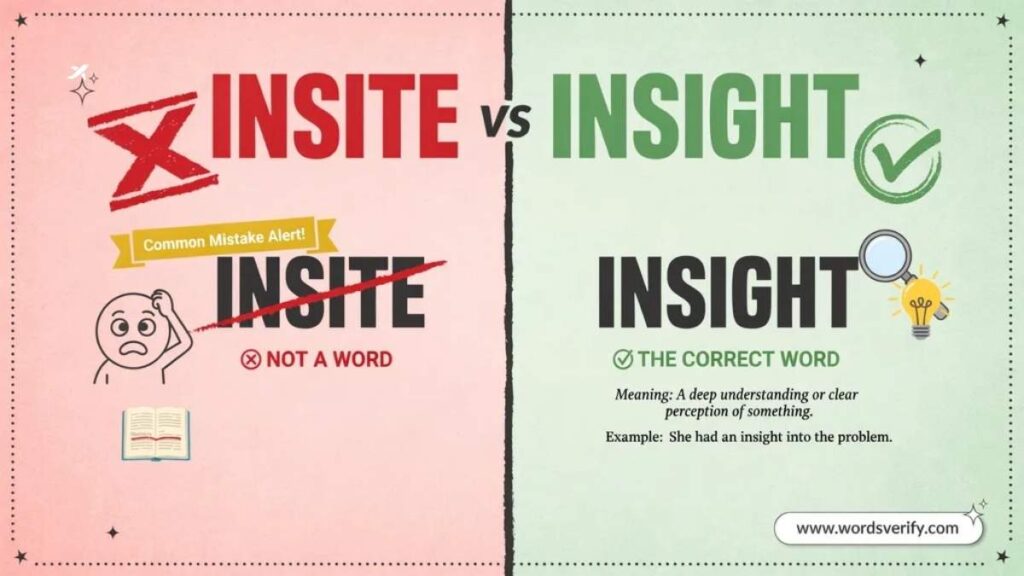
Have you ever written a word correctly in your head, only to discover that your keyboard had other plans? The confusion over insite vs insight is a perfect example. These two spellings look nearly identical, but there’s an important difference: insight is the standard English word for a deep or clear understanding of something. So, where does “insite” fit in? In this guide, you’ll discover the correct spelling, meaning, pronunciation, and usage of insite vs insight. You’ll also learn why this mistake happens, explore simple examples, and see how “insight” differs from “incite,” another word that can easily cause confusion.
The Quick Answer
If you mean a deep or clear understanding, use insight.
For example:
The conversation gave me valuable insight into the problem.
Here, insight means a better understanding of the problem.
Insite is not the standard English spelling for this meaning. You may see Insite used as part of a business name, product name, organization, or another proper name. In those cases, it is a name rather than an alternative spelling of insight.
The basic distinction is easy to remember:
| Word | Meaning | Part of speech |
|---|---|---|
| Insight | Deep or clear understanding | Noun |
| Insite | Not the standard spelling of insight | Usually a proper name or specialized term |
| Incite | Encourage or provoke someone to act | Verb |
So, if you’re asking, “Is it insite vs insight?” and you’re talking about understanding, the answer is insight.
What Does Insight Mean?
Insight means a clear or deep understanding of something. It can involve recognizing a reason, pattern, feeling, or idea that isn’t immediately obvious.
For example, imagine that a student keeps missing deadlines. You might know that the assignments are late. That’s information.
After talking with the student, you discover that the assignments seem overwhelming and the student doesn’t know where to begin. That deeper understanding gives you insight into the problem.
Insight often goes beyond simply knowing facts. It helps you understand what those facts mean.
You can have insight into:
- A person’s behavior
- A difficult situation
- A problem
- A relationship
- A work-related issue
- A research finding
- A character in a book
- A personal experience
- A social issue
- A business decision
The word can describe a sudden realization, but it doesn’t always have to be sudden. You can develop insight gradually through experience, observation, study, or conversation.
Insight as a Noun
Insight is a noun.
It can describe the understanding itself or a person’s ability to understand something clearly.
Consider these examples:
- Her experience gave her insight into the industry.
- His comment showed considerable insight.
- The report provides useful insight into customer behavior.
- The discussion gave me a new insight into the situation.
- Years of experience gave the doctor valuable insight into the problem.
Notice that insight doesn’t simply mean intelligence.
A person can be highly intelligent but still misunderstand a particular situation. Insight involves seeing relationships, causes, or meanings that may not be obvious at first.
Learn the difference between often confused words
Copys vs Copies Which one Is Correct?
Insight Definition and Meaning

A simple definition of insight is “a deep or clear understanding of something.”
That definition becomes more useful when you look at what insight actually involves.
Insight can include:
- Recognizing an important pattern
- Understanding why something happens
- Seeing a situation from another perspective
- Realizing something that was previously unclear
- Understanding another person’s behavior
- Connecting separate pieces of information
- Identifying what lies beneath an obvious problem
Think about putting together a puzzle. At first, you see dozens of separate pieces. Then you notice how several pieces fit together and suddenly understand part of the picture.
That moment of understanding is a good way to think about insight.
Insight vs Knowledge
Insight and knowledge are closely related, but they’re not the same.
Knowledge involves knowing information or facts. Insight involves understanding the meaning or significance behind that information.
For example, a manager may know that several employees have resigned during the past year.
That’s knowledge.
After speaking with employees, the manager discovers that most departures happened because workers felt they had no opportunity to grow.
That’s insight.
The difference can be summarized this way:
| Word | Main idea |
|---|---|
| Information | Facts and details |
| Knowledge | What you know and understand |
| Awareness | Knowing that something exists or is happening |
| Insight | Deeper understanding of what something means or why it happens |
| Wisdom | Good judgment developed through knowledge and experience |
Insight often turns information into something useful.
Learn the difference between often confused words
Descision vs Decision Meaning, and Usage
Is “Insite” a Word?
If you’re wondering, “Is insite a word?” the answer depends on what you mean by it.
In standard English, insite is not the correct spelling of the noun insight.
However, Insite may appear as a proper name. A company, organization, product, service, or other entity may choose to use that spelling.
That doesn’t make it an alternative spelling of the ordinary English word insight.
So if you’re asking, “Is insite correct?” because you want to describe understanding, the answer is no. Use insight.
Why Do People Spell Insight as Insite?
The mistake is easy to make because English spelling doesn’t always match pronunciation.
”When comparing insite vs insight, the confusion often happens because insight is pronounced roughly like ‘in-site.’ Someone who hears the word without seeing it written may naturally assume that it ends with site.
But the word is built around sight:
in + sight = insight
In the insite vs insight debate, the correct spelling for deep understanding is therefore insight, not insite.”
This is similar to other words that contain sight:
- eyesight
- foresight
- hindsight
- insight
Remembering the word sight makes the spelling much easier.
Learn the difference between often confused words
Grately vs Greatly Meaning, Difference and Usage
Insite vs Insight The Main Difference
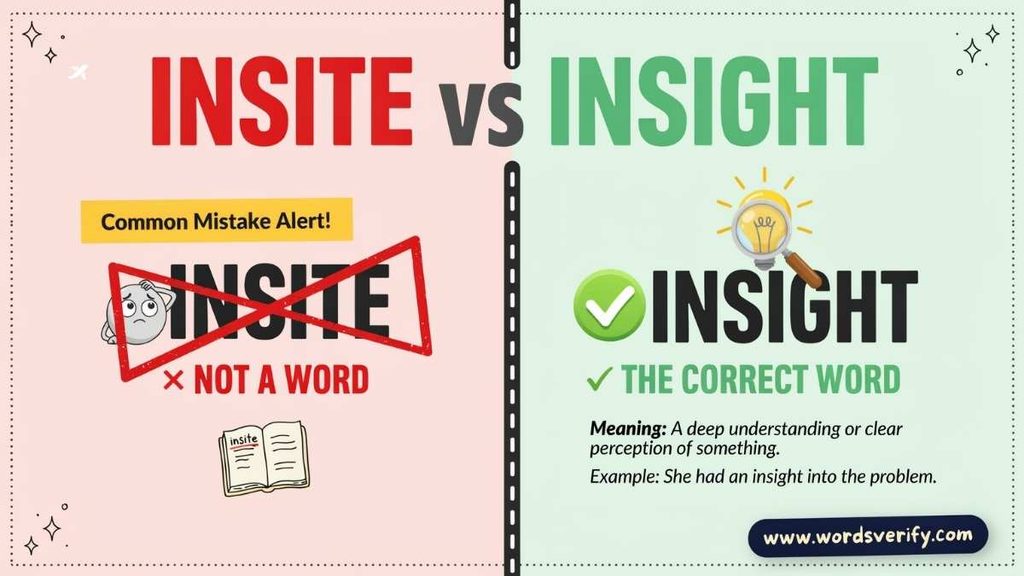
The difference between insite vs insight is mainly a matter of standard spelling and usage.
Insight is the ordinary English noun used for a deep or clear understanding.
Insite is not the standard spelling of that noun.
| Form | Correct for meaning “understanding”? | Example |
|---|---|---|
| Insight | Yes | The book offers insight into human behavior. |
| Insite | No | Don’t use it as a spelling of insight. |
| Incite | No | It has a completely different meaning. |
When deciding between Insite vs Insight in an email, school assignment, report, article, or other piece of standard English, use insight when you mean understanding.
Learn the difference between often confused words
Neice vs Niece Which one Is Correct?
Insight Pronunciation
Insight is pronounced roughly as “IN-site.”
The pronunciation can cause the spelling mistake because the ending sounds like site.
The safest way to remember the written form is to connect it with the word sight.
Think of insight as being able to “see into” something. You’re not literally looking through it. You’re understanding something beneath the surface.
How to Spell Insight
If you’re unsure how to spell insight, break it into two familiar parts:
in + sight
That gives you:
insight
The spelling contains the full word sight, including the letters gh.
A useful memory trick is:
If you mean seeing or understanding something more deeply, think sight.
That gives you insight.
Learn the difference between often confused words
Principal vs Principle Difference and Correct usage
Common Expressions With Insight

Some combinations with insight occur so often that they’re worth learning as complete phrases.
Gain Insight
To gain insight means to develop a deeper understanding.
Talking to experienced teachers helped me gain insight into classroom management.
Gain an Insight
You can also use the singular countable form when referring to a particular understanding or realization.
The discussion gave me an important insight into the problem.
Both constructions can be natural depending on the context.
Provide Insight
To provide insight means to give someone useful understanding.
The survey provides insight into customer preferences.
Offer Insight
To offer insight means to contribute a useful perspective or understanding.
Her experience offers valuable insight into the challenges faced by new employees.
Give Insight
You can also say give insight.
The interview gave us insight into the athlete’s training routine.
Insight Into
This is one of the most useful patterns to remember.
The documentary provides insight into the lives of emergency workers.
It means that something helps you understand a subject more deeply.
Insight From
You can also explain where an understanding came from.
The team gained valuable insight from customer interviews.
Here, from identifies the source of the insight.
Learn the difference between often confused words
Inquire vs Enquire Difference and Usage
Insight Examples in Real-Life Situations
The meaning of insight becomes clearer when you see how it works in practical situations.
A Workplace Situation
Imagine that a company notices a drop in employee productivity.
At first, managers only have numbers showing that productivity has fallen.
They investigate further and discover that employees are spending hours dealing with an outdated computer system.
The important discovery is an insight because it explains what may be causing the problem.
The information showed what happened. The insight helped explain why.
A Classroom Situation
A teacher notices that a student rarely participates in class.
It would be easy to assume the student isn’t interested.
After speaking with the student, the teacher learns that the student understands the material but feels uncomfortable speaking in front of classmates.
That conversation provides insight into the student’s behavior.
A Personal Situation
Suppose someone becomes upset whenever a particular subject comes up.
After thinking about past experiences, they realize that the subject reminds them of an unpleasant event.
That realization can be described as personal insight.
The person has moved from simply noticing a reaction to understanding its possible cause.
Insight in Business and Research
The word insight appears frequently in business, research, marketing, education, and data analysis because these fields deal with large amounts of information.
A company might collect:
- Customer reviews
- Sales figures
- Survey responses
- Website activity
- Product feedback
- Support requests
- Market research
The information itself doesn’t automatically become insight.
Insight comes from finding something meaningful in that information.
For example, a company may notice that many customers abandon an online shopping cart.
That’s a useful observation.
After examining the data, the company discovers that customers often leave after unexpected delivery charges appear.
That finding provides a clearer understanding of the problem.
The business can then make a better decision based on that insight.
This is why phrases such as customer insights and market insights are common in professional writing.
Common Mistakes With Insight
Using Insite Instead of Insight
This is the most common spelling mistake.
Incorrect:
The article gives useful insite into the issue.
Correct:
The article gives useful insight into the issue.
The difference is only two letters, but they matter.
Using Insight as a Verb
Another common mistake is treating insight as a verb.
Insight is normally a noun.
Incorrect:
She insighted the problem.
Better:
She understood the problem.
Or:
She gained insight into the problem.
You can also use verbs such as recognize, realize, analyze, identify, or perceive depending on what you want to say.
Assuming Insight Means Intelligence
Insight isn’t simply another word for intelligence.
Someone may be intelligent but lack insight into a particular situation.
Likewise, someone without advanced academic knowledge may offer an insightful observation because they’ve gained useful understanding through experience.
Learn the difference between often confused words
Carmel vs Caramel difference and Correct usage
Insight vs Incite What’s the Difference?
The difference between incite and insight is important because both are legitimate English words.
They simply mean different things.
Insight is a noun connected with understanding.
Incite is a verb meaning to encourage, stir up, or provoke someone to take action.
| Word | Meaning | Part of speech | Example |
|---|---|---|---|
| Insight | Deep understanding | Noun | She gained insight into the problem. |
| Incite | Encourage or provoke action | Verb | The speech could incite anger. |
The words may sound similar, but their meanings are miles apart.
Incite Meaning
To incite someone means to encourage or provoke them to do something.
The word often appears in discussions involving anger, conflict, violence, or unrest. However, its meaning isn’t limited to those situations.
For example:
The speech was criticized for attempting to incite violence.
You can also use incite in less serious contexts when something encourages a reaction or action.
Incite Definition and Usage
Incite is a verb.
Common words with similar meanings include:
- provoke
- urge
- encourage
- instigate
- stir up
The exact synonym depends on the situation.
For example, provoke can mean causing a reaction, while incite often emphasizes deliberately encouraging someone toward an action.
How to Tell Them Apart
When you’re deciding between incite or insight, look at the meaning and grammatical role.
If you’re talking about understanding, use insight.
The research gave us insight into the problem.
If you’re talking about encouraging or provoking an action, use incite.
The speech could incite anger among the crowd.
A simple memory trick works well:
Insight is about understanding. Incite is about action.
That distinction can prevent many mistakes.
Incite and Insight in One Sentence
Using both words in the same sentence makes the difference especially clear.
The investigation provided insight into the conflict but did not incite further violence.
In this sentence, insight means understanding.
Incite means encourage or provoke.
Another example is:
The report offered insight into the disagreement, while the inflammatory comments threatened to incite anger.
Once you connect insight with understanding and incite with action, the distinction becomes much easier.
Learn the difference between often confused words
Naive vs Nieve difference and Correct usage
Insight Synonyms
There isn’t always one perfect synonym for insight. The best choice depends on what kind of understanding you’re describing.
Common alternatives include:
- Understanding
- Awareness
- Perception
- Comprehension
- Realization
- Perspective
- Discernment
- Wisdom
- Knowledge
- Intuition
These words overlap, but each has its own shade of meaning.
| Word | What it emphasizes |
|---|---|
| Understanding | Knowing what something means |
| Awareness | Recognizing that something exists or is happening |
| Perception | How something is noticed or interpreted |
| Realization | Becoming aware of something, often suddenly |
| Perspective | A particular way of viewing something |
| Wisdom | Good judgment based on knowledge and experience |
| Discernment | Ability to recognize important differences |
| Intuition | Understanding without deliberate reasoning |
For example, a sudden realization can be an insight, but not every realization has the depth that the word insight can suggest.
What Does Deep Insight Mean?
Deep insight means a particularly strong or meaningful understanding of something.
For example:
The novel offers deep insight into the character’s fears.
The phrase suggests that the book doesn’t merely describe the character’s behavior. It helps readers understand the reasons behind it.
Deep insight can develop through:
- Experience
- Careful observation
- Research
- Reflection
- Conversation
- Analysis
It often helps reveal something that isn’t immediately visible.
What Does Valuable Insight Mean?
Valuable insight is an understanding that is particularly useful.
For example:
The interview provided valuable insight into the needs of new customers.
The word valuable tells the reader that the understanding has practical importance.
A valuable insight might help someone:
- Make a decision
- Solve a problem
- Understand behavior
- Avoid a mistake
- Recognize a pattern
- Improve a process
- See an issue from another perspective
Learn the difference between often confused words
Eying vs Eyeing difference and Correct usage
Can Insight Be Countable?
Yes.
Insight can be used as an uncountable noun when you’re talking about understanding in a general sense.
The research provides insight into the problem.
It can also be countable when you’re referring to particular observations or conclusions.
The researchers discovered several important insights.
The plural form is insights.
This distinction is especially common in professional and academic writing.
Compare:
The study provides insight into consumer behavior.
with:
The study produced several insights about consumer behavior.
Both sentences work, but the second refers to multiple specific findings.
Learn the difference between often confused words
Humour vs Humor Difference and Correct usage
What Is an Insightful Person?
An insightful person tends to understand situations beyond their obvious surface.
They may notice patterns, recognize motives, ask thoughtful questions, or see connections that other people miss.
For example:
Maria is an insightful teacher who quickly notices when a student is struggling.
This doesn’t mean Maria knows everything. It means she has a strong ability to notice and understand meaningful details.
The adjective insightful can also describe:
- An insightful comment
- An insightful question
- An insightful observation
- An insightful analysis
- An insightful book
- An insightful discussion
For example:
His insightful observation changed the way the team viewed the problem.
When Should You Use Insight?
Use insight when you want to describe a deeper understanding rather than a simple fact.
It works particularly well when someone:
- Understands a complicated situation
- Recognizes a hidden reason
- Notices an important pattern
- Gains a new perspective
- Makes a meaningful realization
- Understands another person’s behavior
- Uses experience to understand a problem
However, don’t use insight simply because it sounds sophisticated.
Sometimes a simpler word is better.
For example, if you mean that someone knows a basic fact, knowledge may be more accurate.
If you mean that someone knows something is happening, awareness may be better.
Good writing isn’t about choosing the fanciest word. It’s about choosing the word that says exactly what you mean.
Practice Session Insite vs Insight
Choose the correct word to complete each sentence: insight, insights, insite, or incite.
Fill in the Blanks
- The teacher gave us valuable ________ into the topic.
- Her experience provided useful ________ into the problem.
- The report offers several important ________ about customer behavior.
- Reading biographies can give you ________ into how successful people think.
- The counselor helped me gain greater ________ into my feelings.
- The researcher shared an interesting ________ into the causes of the problem.
- The manager asked the team to share their ________ on the new project.
- His thoughtful comment showed remarkable ________.
- The survey gave the company valuable ________ into what customers wanted.
- The documentary offered a deeper ________ into life in the region.
- The speech was designed to ________ the crowd to protest.
- The article helped readers develop a better ________ of the issue.
- She has a talent for explaining complex ideas with great ________.
- The psychologist’s findings provided fresh ________ into human behavior.
- The discussion gave me a new ________ into the situation.
- The organization was accused of trying to ________ anger among the workers.
- The student’s answer demonstrated a clear ________ into the character’s motives.
- The interview provided valuable ________ from someone with years of experience.
- The spelling “________” is often used incorrectly when the writer means “insight.”
- The coach’s advice gave the players useful ________ into improving their performance.
- The article offers several practical ________ into the subject.
- The politician’s remarks were criticized for attempting to ________ violence.
- A good book can give you unexpected ________ into another person’s perspective.
- The expert’s explanation gave us a clearer ________ of the situation.
- If you mean “deep understanding,” the correct word is ________, not “insite.”
Answers
- insight
- insight
- insights
- insight
- insight
- insight
- insights
- insight
- insights
- insight
- incite
- insight
- insight
- insights
- insight
- incite
- insight
- insight
- insite
- insight
- insights
- incite
- insight
- insight
- insight
Here’s a trusted source for clear more words Comparison:
FAQs
Is “insite” the correct spelling of “insight”?
No. When you mean deep or clear understanding, the correct spelling is “insight.” “Insite” is a common spelling mistake in this context.
How do you spell “insight” correctly?
“Insight” is spelled I-N-S-I-G-H-T. A useful way to remember it is to think of the word as “in” + “sight.”
Is “insite” an English word?
“Insite” is not the standard English spelling of the word meaning deep understanding. You may see “Insite” used in names, brands, or other proper names, but it should not replace “insight” in ordinary writing.
What does “insight” mean in simple terms?
Insight means a clear and deeper understanding of a person, situation, problem, or idea. It often involves seeing something that isn’t immediately obvious.
Is “insight” a noun or a verb?
“Insight” is a noun. You can say “She gained insight into the problem,” but you wouldn’t normally use “insight” as a verb.
What does “gain insight” mean?
“Gain insight” means to develop a clearer or deeper understanding of something. For example, studying history can help you gain insight into how societies change.
What does “insight into” mean?
“Insight into” means an understanding of the deeper details or nature of something. For example, “The interview gave us insight into her career.”
Can you say “insight from”?
Yes. “Insight from” is correct when you identify the source of the understanding. For example, “We gained valuable insight from the expert.”
What is the plural of “insight”?
The plural form is “insights.” Use “insight” for one understanding or idea and “insights” for multiple observations or discoveries.
What is an insightful person?
An insightful person understands situations deeply and often notices details or connections that others may overlook. Their comments tend to show thoughtful understanding.
What is the adjective form of “insight”?
The adjective is “insightful.” You can use it to describe a person, comment, observation, analysis, or idea that shows deep understanding.
Is “insightful” related to “insight”?
Yes. “Insightful” comes from “insight” and describes something that demonstrates or provides deep understanding. For example, “She made an insightful observation.”
What is the easiest way to remember “insight” versus “insite”?
Remember the word “sight” at the end of “insight.” The spelling is “in” + “sight,” giving you “insight,” not “insite.”
Why is “insite” commonly confused with “insight”?
The confusion usually comes from pronunciation. “Insight” is pronounced like “in-site,” so it can sound as if it ends in “site.” However, its correct spelling contains “sight.”
Is “insight” the same as “knowledge”?
Not exactly. Knowledge is information or facts you have learned, while insight involves understanding the deeper meaning, relationships, or reasons behind something.
Can “insight” refer to personal understanding?
Yes. Insight can describe a person’s understanding of their own thoughts, feelings, behavior, or experiences. For example, “The experience gave him new insight into his own choices.”
What is the difference between “insight” and “information”?
Information gives you facts or details. Insight helps you understand what those facts mean and why they matter. You can have plenty of information without having much insight.
Is “insight” countable or uncountable?
“Insight” can be used both ways. It can refer generally to understanding, as in “The book provides insight into the issue,” or to individual observations, as in “The report contains several useful insights.”
What is the difference between “insight” and “intuition”?
Insight usually comes from understanding, observation, or careful thinking. Intuition is a feeling or sense about something that may occur without conscious reasoning.
Can “insight” describe a useful observation?
Yes. An observation that reveals something important or helps explain a situation can be called an insight. For example, a manager might gain an insight into why a team is struggling.
What does “deep insight” mean?
“Deep insight” means a particularly strong or detailed understanding of something. It suggests that the understanding goes beyond obvious facts or surface-level information.
What does “valuable insight” mean?
“Valuable insight” refers to an understanding or observation that is especially useful or meaningful. It can help someone make a decision, solve a problem, or see a situation differently.
How is “insight” pronounced?
“Insight” is pronounced “IN-site.” Although it sounds similar to “in site,” the spelling and meaning are different.
What is the difference between “insight” and “incite”?
“Insight” is a noun meaning deep understanding. “Incite” is a verb meaning to encourage or provoke someone to take action, especially strong or harmful action. The two words sound similar but have completely different meanings.
Can “insight” and “incite” be used in the same sentence?
Yes. For example: “Her insight into the situation helped prevent the speech from inciting anger.” Here, “insight” means understanding, while “inciting” means provoking a reaction.
Is “incite” always negative?
No. “Incite” is not automatically negative, but it often has a negative meaning because it commonly describes provoking anger, violence, conflict, or other strong reactions. The context determines how it is understood.
Conclusion
The difference between insite vs insight comes down to more than one little spelling detail. If you’re talking about a deeper understanding of a person, problem, or situation, insight is the word you need. “Insite” is not the standard spelling for this meaning, although it may appear in certain names or proper uses.
There’s an easy way to remember it: insight contains “sight.” Just think of it as being able to see beyond the surface. And while you’re at it, keep incite in a separate mental box. It means to provoke or encourage action, not to understand something deeply.
One small spelling check can save you from a surprisingly big grammar mistake. So, when in doubt, choose insight word between Insite vs Insight and let your writing shine!

Lisa AJS is an experienced blogger and language enthusiast at Words Verify, dedicated to making grammar simple, practical, and enjoyable. She writes engaging content on commonly confused words, grammar mistakes, word meanings, and everyday language challenges.