Have you ever stared at a sentence and wondered, “Is it principal vs principle?” You’re certainly not the only one. These two words sound alike, but their meanings are completely different. One can refer to a school leader, something most important, or the original amount of money borrowed. The other describes a rule, belief, or fundamental idea. Mix them up, and a simple sentence can suddenly take an unexpected turn. In this guide to principal vs principle, you’ll learn how to tell these commonly confused words apart, understand when to use each one, and master the difference through clear, practical examples that make the rules easy to remember.
Principal vs Principle The Basic Difference
Principal and principle are both correct English words. The important thing is knowing when to use each one.
Principal has several meanings. It can describe a person who holds a position of authority, such as the head of a school. It can also mean main or most important. In financial contexts, it refers to the original amount of money borrowed or invested.
Principle is a noun that refers to a rule, belief, standard, or fundamental idea.
Here is the simplest way to remember the difference:
- Principal = a person in charge.
- Principal = main or most important.
- Principal = the original amount of money.
- Principle = a rule or belief.
- Principle = a fundamental idea or standard.
For example:
- The principal spoke to the students.
- Safety was the principal concern.
- She paid part of the loan principal.
- Honesty is an important principle.
The meaning changes completely depending on which spelling you choose.
What Does Principal Mean?
Principal has several common meanings. It can work as both a noun and an adjective.
Principal as a Noun
As a noun, principal can refer to a person who has authority or responsibility.
The most familiar example is a school principal. In the United States, the principal is generally the person who oversees the daily operation of a school. This can include managing staff, supporting students, working with parents, handling school policies, and coordinating administrative matters.
For example:
“The principal spoke to the parents after the meeting.”
Here, principal refers to a person.
The word can also describe someone who has an important or leading role in another organization or situation.
For example:
“The company principal signed the agreement.”
The exact meaning can depend on the context, but the general idea is that the person holds an important position.
Principal as an Adjective
Principal can also work as an adjective. In this use, it means main, primary, chief, or most important.
For example:
- The principal reason for the delay was heavy traffic.
- Her principal concern was the safety of the children.
- The principal goal of the project is to improve access.
- Cost was the principal factor in the decision.
- Education became his principal focus.
In each sentence, principal describes something important.
A useful test is to replace principal with main or primary. If the sentence still makes sense, principal may be the correct word.
For example:
“The principal reason was cost.”
You could say:
“The main reason was cost.”
The meaning remains almost the same.
Principal in Finance
Principal has another important meaning in banking and investing.
In finance, principal refers to the original amount of money borrowed or invested. It does not refer to the interest earned or charged on that money.
Suppose you borrow $10,000 from a bank. The original $10,000 is the principal.
As you make payments, the amount of principal you still owe decreases.
For example:
“She made an extra payment toward the loan principal.”
The word principal is correct because the sentence refers to money.
Common financial expressions include:
- Principal amount
- Principal balance
- Principal payment
- Loan principal
- Investment principal
- Repayment of principal
Understanding this use can prevent a common spelling mistake. You would not write “loan principle” when referring to the amount borrowed.
Principal Amount of Money
The principal amount of money is the original sum involved in a loan or investment.
For example, if you borrow $25,000, the initial principal is $25,000. Interest may increase the total cost of the loan, but interest and principal are separate concepts.
The same idea applies to investments. If you invest $5,000, that $5,000 is your investment principal. Any earnings generated by the investment are separate from the original amount.
Learn the difference between confusing word pairs
Neice vs Niece Which one Is Correct?
What Does Principle Mean?
Principle has a different meaning and is always used as a noun.
It commonly refers to a rule, belief, standard, or fundamental idea.
Principle as a Rule or Belief
A principle can be a belief that guides the way someone behaves.
For example:
“Honesty is one of her strongest principles.”
The sentence means that honesty is an important belief or standard that guides her behavior.
Other examples include:
- Fairness is an important principle.
- He refused to compromise his principles.
- Respect should be a guiding principle in the workplace.
- The organization follows strong ethical principles.
- She made the decision according to her personal principles.
Principles can shape decisions and behavior. They aren’t necessarily written laws. A person may follow a principle because it reflects their values.
Principle as a Fundamental Idea
Principle doesn’t always relate to morality.
The word can also describe a basic idea or rule that explains how something works.
For example:
“The machine works according to a simple principle.”
Here, principle means a fundamental idea behind the machine’s operation.
You may encounter the word in science, mathematics, technology, economics, and other subjects.
For example:
- The experiment demonstrates an important scientific principle.
- The system operates on a basic principle.
- The theory is based on a fundamental principle.
- The engineer explained the principle behind the design.
In these cases, principle means a basic idea or rule rather than a personal belief.
Learn the difference between confusing word pairs
Grately vs Greatly Meaning, Difference and Usage
Principal vs Principle A Simple Comparison
The two words may sound identical, but their meanings are quite different.
| Principal | Principle |
|---|---|
| A person in charge | A rule or belief |
| Main or most important | A fundamental idea |
| Original amount of money | A standard for behavior |
| A noun or adjective | A noun |
| School principal | Moral principle |
| Principal reason | Guiding principle |
| Principal balance | Basic principle |
A quick way to think about them is:
- Person, main, or money → principal.
- Rule, belief, or fundamental idea → principle.
Learn the difference between confusing word pairs
Descision vs Decision Meaning, and Usage
Principal and Principle Sound Alike
One reason these words cause so much confusion is that they sound the same in standard American English.
They are homophones. Homophones are words that have the same pronunciation but different meanings or spellings.
For example, when someone says:
“The principal called.”
You cannot determine the spelling from the sound alone. You need to understand what the speaker means.
This is why pronunciation isn’t a reliable way to choose between principal and principle. Context matters.
Principal vs Principle in School
School is probably the most familiar setting where these words become confused.
When you mean the person who runs or manages a school, use principal.
For example:
“The principal announced the new school schedule.”
When you mean a rule or belief, use principle.
For example:
“The students learned the principle of fairness.”
The two sentences use different words because they describe different things.
A school principal is a person. Fairness is a principle.
Principal vs Principle in Business
Both words can appear in business writing, but they serve different purposes.
Principal can describe a person with a leading role.
For example:
“The company principal approved the contract.”
Principal can also mean the main or most important thing.
For example:
“Customer safety is the principal concern.”
Principle refers to a rule or standard that guides a company.
For example:
“Honesty is one of the company’s guiding principles.”
The distinction is straightforward when you focus on the meaning rather than the sound.
Principal vs Principle in Finance
When money is involved, principal is normally the correct word.
For example:
“The borrower reduced the principal balance.”
“The bank explained the principal payment.”
“The investment returned more than the original principal.”
In all three sentences, principal refers to money.
Principle would be incorrect if you were referring to the amount borrowed or invested.
However, principle can appear in financial discussions when the sentence refers to a general idea or rule.
For example:
“The investor followed the basic principle of diversification.”
Here, principle refers to an idea rather than money.
Learn the difference between confusing word pairs
Copys vs Copies Which one Is Correct?
Principal vs Principle in a Sentence
Looking at simple sentences is one of the easiest ways to understand the difference.
Examples With Principal
- The principal greeted the students.
- The principal called a staff meeting.
- Safety was the principal concern.
- Cost was the principal reason for the change.
- She paid down the loan principal.
- The principal balance has decreased.
- The principal character appears in every chapter.
- The company identified quality as its principal objective.
Examples With Principle
- Honesty is an important principle.
- She believes strongly in the principle of fairness.
- The organization follows ethical principles.
- He refused to act against his principles.
- The machine operates according to a basic principle.
- The theory is built around a fundamental principle.
- Respect is a guiding principle in the workplace.
- The policy reflects the principle of equality.
These examples show why context is more useful than pronunciation.
Learn the difference between confusing word pairs
The vs Thee Meaning, Difference and Pronunciation
Principal vs Principle Examples Side by Side
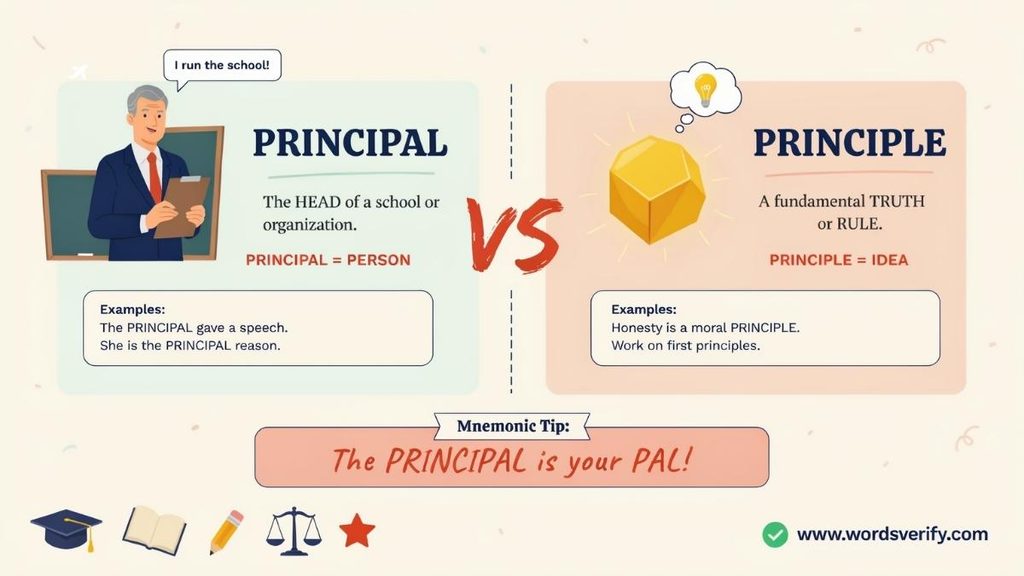
The spelling becomes easier once the meaning is clear.
Principal vs Principle Character
The phrase principal character can be correct when you mean the main or leading character in a story.
For example:
“The principal character changes significantly during the novel.”
Here, principal means the most important or central character.
However, if you’re discussing someone’s values or moral beliefs, principle is the correct word.
For example:
“His principles influenced the way he treated others.”
The first sentence concerns importance. The second concerns beliefs and values.
Principal vs Principle Photography
In filmmaking, principal photography refers to the main phase of production during which the primary footage is filmed.
For example:
“The film began principal photography in June.”
Principal is correct because the term refers to the main filming period.
Principle photography would be incorrect in this context.
Principal vs Principle Bedroom
Principal bedroom is a term used in home and real estate descriptions for the main bedroom.
For example:
“The house has a spacious principal bedroom with a private bathroom.”
Principal means main or primary.
Principle bedroom would not have the intended meaning.
Principal vs Principle Document
Principal document can refer to the main or most important document in a particular collection or process.
For example:
“The contract is the principal document governing the agreement.”
Here, principal means the primary document.
Principle would be appropriate only if the sentence referred to a rule, belief, or fundamental idea.
For example:
“The document explains the principles behind the new policy.”
Learn the difference between confusing word pairs
Pleaded vs Pled Which One Is Correct?
Common Mistakes With Principal and Principle
Because the words sound the same, writers often choose the wrong spelling without realizing it.
School Principal
Incorrect:
“The school principle addressed the students.”
Correct:
“The school principal addressed the students.”
The word refers to the person in charge of the school.
Moral Principle
Incorrect:
“Honesty is an important moral principal.”
Correct:
“Honesty is an important moral principle.”
The word refers to a moral belief or standard.
Principal Reason
Incorrect:
“The principle reason was the cost.”
Correct:
“The principal reason was the cost.”
The word means main reason.
Principal Balance
Incorrect:
“The borrower reduced the principle balance.”
Correct:
“The borrower reduced the principal balance.”
The word refers to the amount of money still owed.
Learn the difference between confusing word pairs
Speach vs Speech Which one Is Correct?
How to Spell Principal and Principle
If you’re trying to learn the correct spelling, it helps to connect each spelling with a meaning.
For principal, remember the phrase:
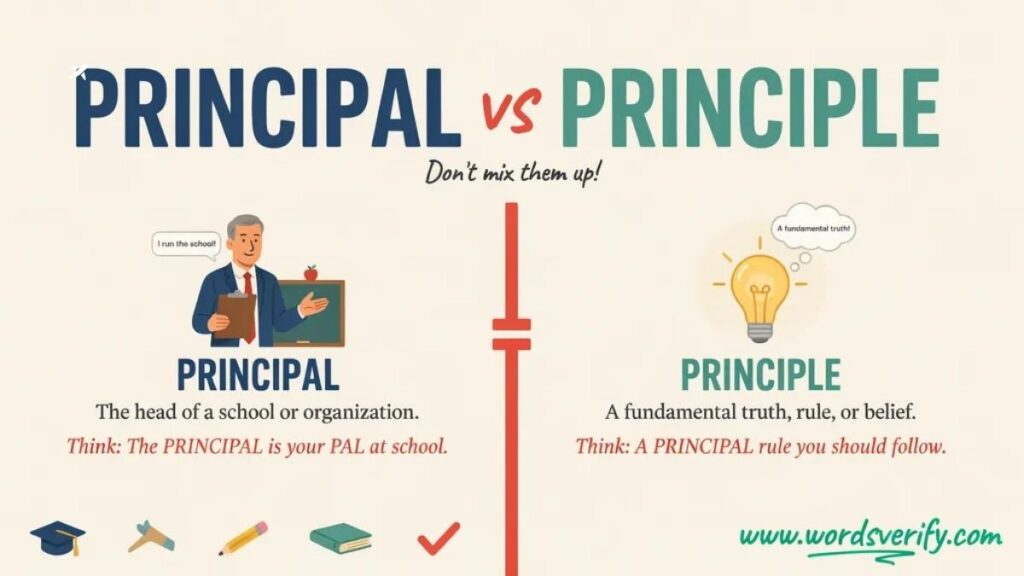
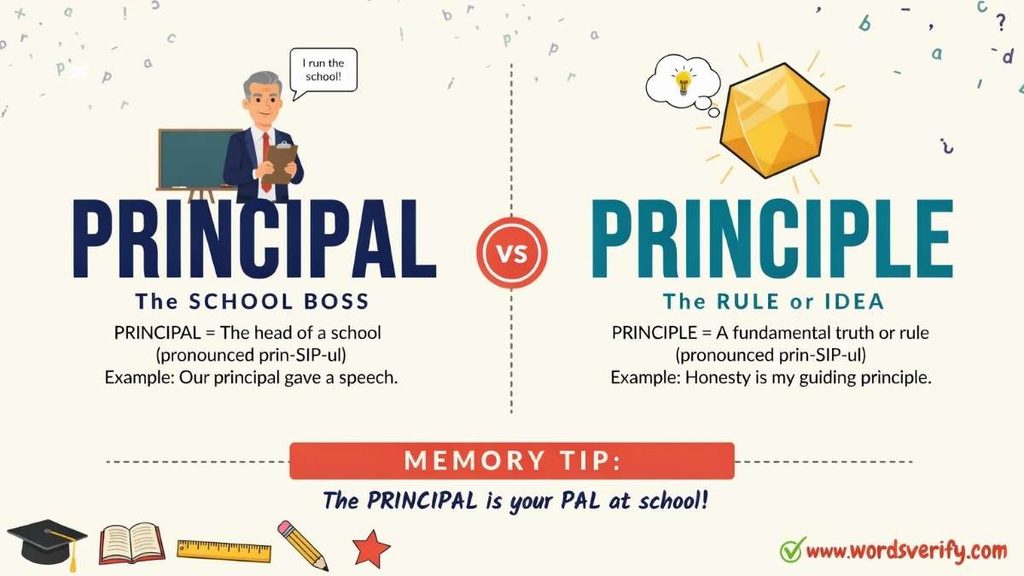
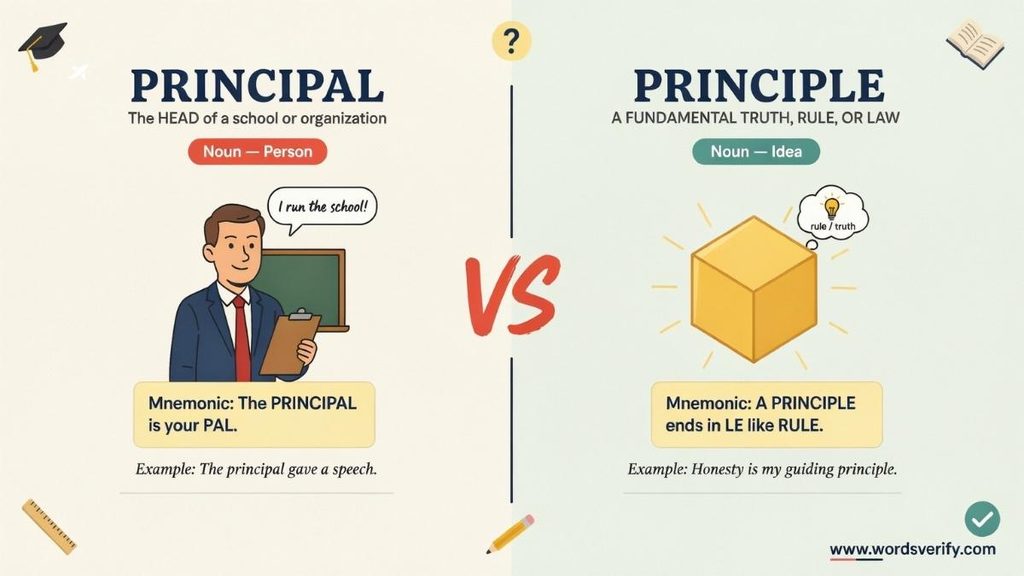
“Principal is your pal.”
This is a popular memory trick for remembering the spelling of a school principal. The word principal contains “pal.”
For principle, connect the word with rules and beliefs.
Think:
“Principle = rule.”
For example:
- Moral principle
- Guiding principle
- Basic principle
- Fundamental principle
These associations are more useful than trying to memorize the spellings in isolation.
Learn the difference between confusing word pairs
Glueing vs Gluing Which one Is Correct?
Principal vs Principle Mnemonics
A mnemonic is a memory device that helps you recall information.
Two simple mnemonics work particularly well here.
Principal Is Your Pal
Think of the school principal as your “pal.”
Principal contains the letters p-a-l in sequence.
This can help you remember the spelling when you’re talking about a school administrator.
Principle Means Rule
Connect principle with the idea of a rule or belief.
For example:
“A principle guides behavior.”
That association works for moral principles, ethical principles, and fundamental principles.
There is no need to rely on a complicated trick. Meaning-based memory is often easier to use because it connects the spelling to the actual context.
Practice Session Principal vs Principle
Fill in each blank with principal vs principle.
- The school ________ welcomed the new students.
- Honesty is an important ________ in her life.
- The ________ reason for the meeting was to discuss safety.
- He paid $500 toward the loan ________.
- The company follows a strict ________ of fairness.
- Our high school ________ gave a speech at the graduation ceremony.
- The machine works according to a basic scientific ________.
- The ________ amount of the loan was $20,000.
- Respect for others is one of his guiding ________.
- The ________ character in the story is a young detective.
- Safety was the ________ concern during the construction project.
- She refused to break her moral ________.
- The bank explained how much of the payment would reduce the ________ balance.
- The ________ objective of the project is to improve customer service.
- The teacher asked the ________ to address the problem.
- The experiment demonstrates an important scientific ________.
- He invested his original ________ in a new business.
- One of her strongest ________ is to treat everyone fairly.
- The ________ document contains all the important information.
- The ________ of the school announced a new attendance policy.
- The ________ purpose of the rule is to protect children.
- She made her decision based on her personal ________.
- As you make loan payments, the ________ balance becomes smaller.
- The film has several ________ characters who drive the story forward.
- The idea sounds reasonable ________, but it may be difficult to apply in practice.
Answers
- Principal
- Principle
- Principal
- Principal
- Principle
- Principal
- Principle
- Principal
- Principles
- Principal
- Principal
- Principle
- Principal
- Principal
- Principal
- Principle
- Principal
- Principles
- Principal
- Principal
- Principal
- Principle
- Principal
- Principal
- In principle
Here’s a trusted source for clear more words Comparison:
FAQs
Are principal and principle pronounced the same way?
Yes. In standard American English, principal and principle are homophones, which means they have the same pronunciation but different spellings and meanings.
Can principal be used as an adjective?
Yes. Principal can function as an adjective when it means main, primary, or most important. For example, “The principal reason for the delay was bad weather.”
Can principle be used as a verb?
No. Principle is a noun. It refers to a rule, belief, standard, or fundamental idea.
Does principal always refer to a school leader?
No. Principal has several meanings. It can describe a school leader, something that is most important, or the original amount of money borrowed or invested.
What does principal mean in finance?
In finance, principal is the original amount of money borrowed or invested, excluding interest or investment earnings. For example, if you borrow $10,000, the $10,000 is the principal.
What is the difference between principal and interest?
Principal is the amount originally borrowed or invested. Interest is the additional money charged on a loan or earned on an investment.
What does principal mean in a loan?
Loan principal is the amount of money you originally borrow. As you make payments, the principal balance decreases when part of your payment is applied toward the amount owed.
What does principal mean in a sentence about importance?
When principal means main or most important, it acts as an adjective. For example, “The principal concern was passenger safety.”
Can principle refer to a scientific idea?
Yes. A principle can describe a fundamental idea or rule that explains how something works. For example, “The device operates on the principle of magnetism.”
What does “principles” mean when talking about a person?
A person’s principles are the beliefs, values, or moral standards that guide their decisions and behavior. For example, “She refuses to compromise her principles.”
Can principal describe something other than a person?
Yes. Principal can describe anything considered main, primary, or most important. For example, “The principal objective is to improve customer service.”
Why do writers confuse principal and principle?
The words are commonly confused because they sound the same in standard American English. Their similar appearance also makes it easy to choose the wrong spelling when writing quickly.
Is “principal” related to the word “principle”?
No. Although the words look and sound similar, they have different meanings and grammatical uses. Their similarity is mainly a source of spelling and usage confusion.
What does “principal photography” mean?
Principal photography is the main stage of filming a movie, television program, or other production. It refers to the period when the primary scenes are recorded.
What does “principal bedroom” mean?
Principal bedroom is a term used for the main bedroom in a home. It is often used in real estate and home descriptions.
Can “principal” describe a character in a story?
Yes. A principal character is a main or leading character in a story, play, film, or other work of fiction.
What does “principal document” mean?
A principal document is the main or primary document in a particular set of records or materials. The exact meaning depends on the context.
Is “principal” used for leaders in business?
Yes. Principal can describe someone who holds a leading or controlling position in a business or organization. The exact role varies by industry.
What is an easy way to remember principal and principle?
Think of principal as connected with a person, the main thing, or money. Think of principle as a rule, belief, value, or fundamental idea.
Can the word principle refer to a rule that is not moral?
Yes. A principle doesn’t have to involve morality. It can refer to a general rule or fundamental idea in areas such as science, mathematics, engineering, or everyday life.
Conclusion
At first glance, principal vs principle may seem like two words that were deliberately designed to cause confusion. They sound the same, but their meanings take them in completely different directions. Principal can refer to a school leader, something that is most important, or the original amount of money borrowed or invested. Principle, on the other hand, refers to a rule, belief, value, or fundamental idea.
The simplest way to remember the difference is to focus on meaning. If you’re talking about a person, something important, or money, principal is usually the right choice. If you’re talking about a rule, belief, or guiding value, choose principle.
Once you understand this distinction, the confusion becomes much easier to avoid. After all, your principal might teach you a lesson, but your principles help you decide whether you’ve learned it!

Lisa AJS is an experienced blogger and language enthusiast at Words Verify, dedicated to making grammar simple, practical, and enjoyable. She writes engaging content on commonly confused words, grammar mistakes, word meanings, and everyday language challenges.