
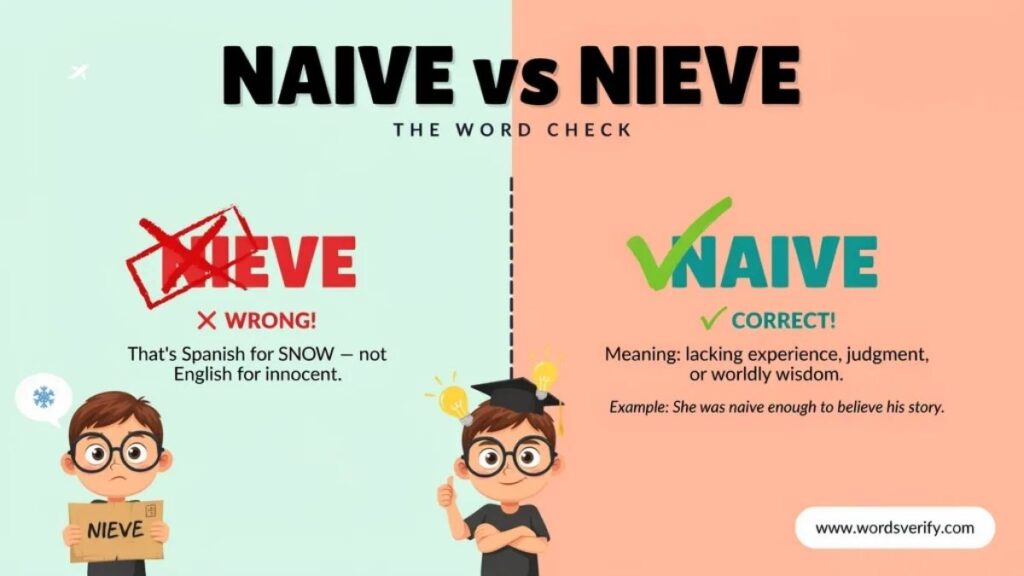
Have you ever typed a word, looked at it twice, and suddenly wondered if you’ve forgotten how to spell? If you’re caught between naive vs nieve, you’re certainly not the only one. These spellings look nearly identical, yet that tiny vowel switch makes all the difference. In standard English, naive is the correct spelling when you mean inexperienced, overly trusting, or lacking practical knowledge. Naïve is also accepted, while nieve has completely different meanings in Spanish and historical English. This guide clears up the confusion, explores each word’s meaning and pronunciation, and gives you simple examples to help you choose the right spelling confidently every time.
Quick Answer
Use naive when you mean someone lacks experience, practical knowledge, or a realistic understanding of a situation.
Naïve is also correct. It’s simply the traditional form of the word.
Nieve is not a standard alternative spelling of naive.
For example:
- She was naive about the risks.
- He made a naive assumption.
- It would be naive to trust every offer you receive online.
But this would be incorrect:
- She was nieve about the risks.
The correct spelling is:
N-A-I-V-E
A useful thing to remember is that the A comes before the I.
Naive vs Nieve at a Glance
If the two spellings keep getting mixed up, this quick comparison should clear things up.
| Word | Correct for the English adjective? | Meaning |
|---|---|---|
| Naive | Yes | Lacking experience, worldly knowledge, or realistic judgment |
| Naïve | Yes | Same meaning as naive |
| Nieve | No | Not the standard spelling of the English adjective; has other meanings |
So when you’re describing a person, belief, idea, or assumption that shows a lack of experience or realistic understanding, choose naive.
Learn the difference between often confused words
Carmel vs Caramel difference and Correct usage
What Does Naive Mean?
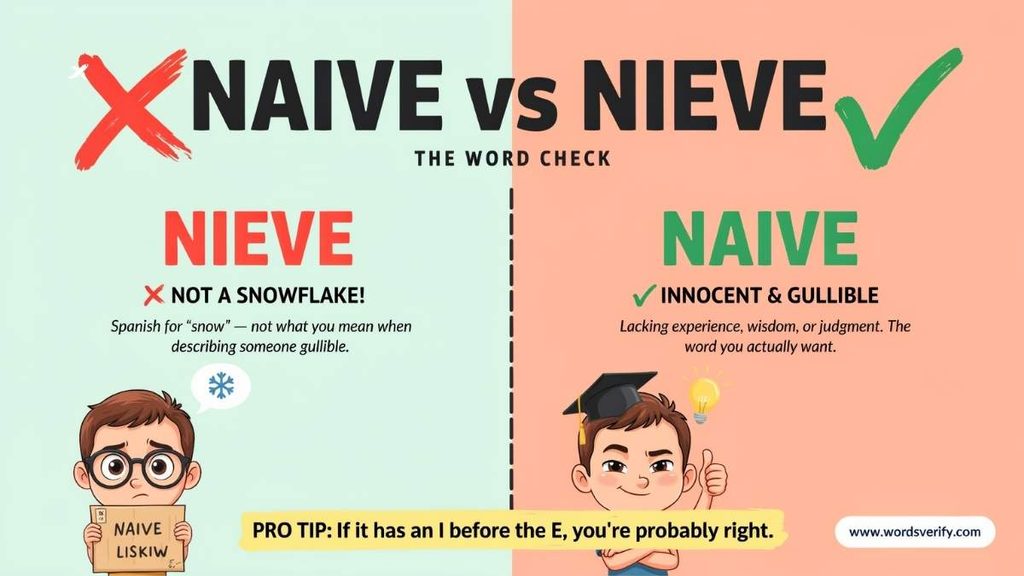
Naive is an adjective used to describe someone who doesn’t have enough experience or worldly knowledge to understand a situation realistically.
A naive person may trust others too easily. They may expect people to be honest, assume things will work out without considering possible problems, or fail to recognize risks that an experienced person would notice.
For example:
She was naive enough to believe that everyone she met online could be trusted.
The sentence doesn’t necessarily mean she was unintelligent. Instead, it suggests that she didn’t have enough experience to recognize that people online aren’t always what they appear to be.
That’s an important part of the word’s meaning.
Being naive isn’t the same thing as being ignorant.
Someone can be highly intelligent and still be naive about a particular subject.
Imagine a brilliant scientist who has never bought a house before. The person may know an enormous amount about science but very little about property negotiations, inspections, or contracts.
If that person assumes the seller will automatically mention every problem with the house, that assumption could be naive.
The issue isn’t intelligence. It’s experience.
The Meaning of Naive in Everyday English
In everyday conversation, naive often describes someone who has a trusting, innocent, or inexperienced outlook.
The word can describe a person, but it can also describe an idea or belief.
Common expressions include:
- A naive person
- A naive child
- A naive student
- A naive assumption
- A naive belief
- A naive idea
- A naive approach
- A naive decision
- A naive attitude
- A naive expectation
For example:
She was naive about the business world.
Here, naive describes the person.
Now consider:
Her assumption was naive.
This time, the word describes the assumption rather than the person.
That difference gives the word plenty of flexibility.
Does Naive Mean unwise?
No. Naive doesn’t directly mean unwise.
The two words can sometimes appear in similar situations, but their meanings aren’t the same.
If someone is unwise, the word usually criticizes their intelligence or judgment.
If someone is naive, the focus is usually on their lack of experience, awareness, or realistic understanding.
For example:
He made a unwise decision.
This directly criticizes the decision.
Compare that with:
He made a naive decision.
This suggests that his decision came from inexperience or an unrealistic understanding of the situation.
The second sentence doesn’t necessarily suggest that he lacks intelligence.
That’s why replacing naive with unwise can make a sentence sound much harsher than intended.
Is Naive the Same as foolish?
Not exactly.
Foolish usually focuses on poor judgment. Naive often focuses on a lack of experience or an overly simple view of a situation.
Consider these examples:
It was foolish to ignore the warning.
The sentence suggests that the person made a poor choice.
It was naive to assume that everything would go according to plan.
This suggests that the person didn’t fully understand how unpredictable the situation could be.
There can be some overlap between the words, but naive often carries a softer sense of inexperience.
Is Naive the Same as Ignorant?
Naive and ignorant can also overlap, but they don’t mean exactly the same thing.
Someone who is ignorant of something simply doesn’t know about it.
Someone who is naive may lack knowledge while also having an unrealistic or overly trusting view.
For example:
She was ignorant of the new rule.
This simply means she didn’t know about the rule.
She was naive about the consequences.
This suggests that she didn’t understand what would happen or didn’t have enough experience to judge the situation realistically.
The distinction becomes especially useful when you want to choose a word that accurately describes someone’s situation without making the statement unnecessarily harsh.
Learn the difference between often confused words
Inquire vs Enquire Difference and Usage
Is Nieve a Word?
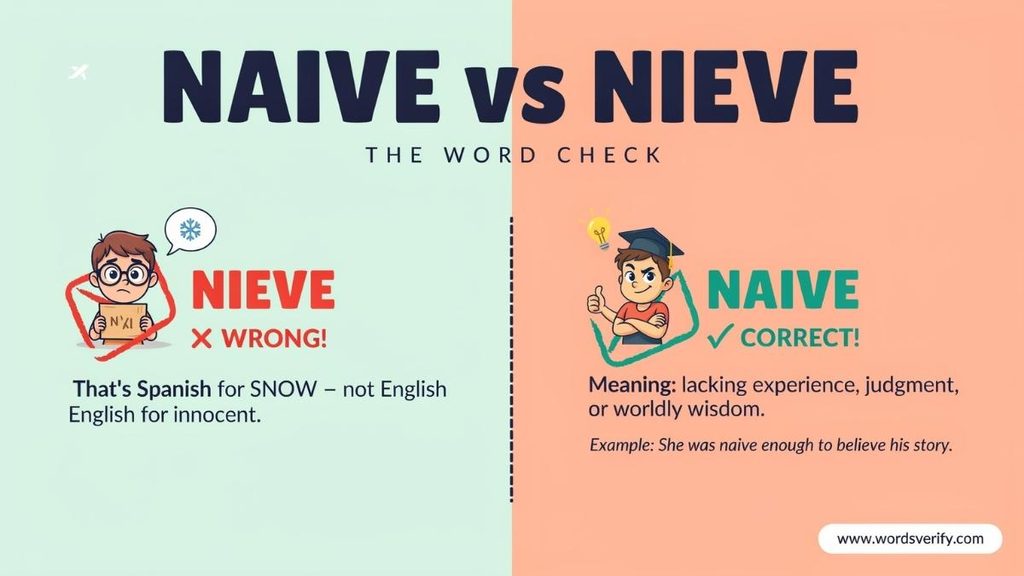
Yes, but context matters.
If you’re asking whether nieve is the correct English spelling of naive, the answer is no.
If you’re asking whether nieve exists as a word at all, the answer is yes.
In Spanish, nieve means “snow.” It’s a normal Spanish word.
For example:
La nieve cubrió las montañas.
That means:
The snow covered the mountains.
Nieve also appears in historical and dialectal English sources with a different meaning associated with a hand or fist.
Those meanings have nothing to do with the modern English adjective naive.
So it’s more accurate to say:
Nieve is not the standard English spelling of naive.
It’s not accurate to say:
Nieve is never a word.
The context makes all the difference.
Is Nieve a Word in English?
Nieve has been recorded in English, particularly in older or regional forms of the language.
Historical and dialectal sources associate it with meanings related to a hand, fist, handful, or grip. These uses aren’t common in modern American English.
If you encounter nieve in an old text, dialect dictionary, or historical discussion, it may be completely legitimate.
That still doesn’t make it an alternative spelling of naive.
For modern standard English, write:
He was naive about the situation.
Don’t write:
He was nieve about the situation.
The second sentence uses the wrong spelling for the intended meaning.
Learn the difference between often confused words
Principal vs Principle Difference and Correct usage
Naive vs Naïve Are Both Correct?
Yes.
Naive and naïve have the same meaning.
The version with the two dots over the i is the traditional spelling. Those dots are called a diaeresis.
Modern English commonly uses naive without the diaeresis. Both forms are accepted.
For example:
She had a naive view of the situation.
and:
She had a naïve view of the situation.
Both are correct.
If you’re writing in American English, naive is perfectly normal and widely used.
There’s no need to add the diaeresis just to make the word correct.
Learn the difference between often confused words
Neice vs Niece Which one Is Correct?
Why Do People Spell Naive vs Nieve?
The mistake is easy to understand.
Look at the two words:
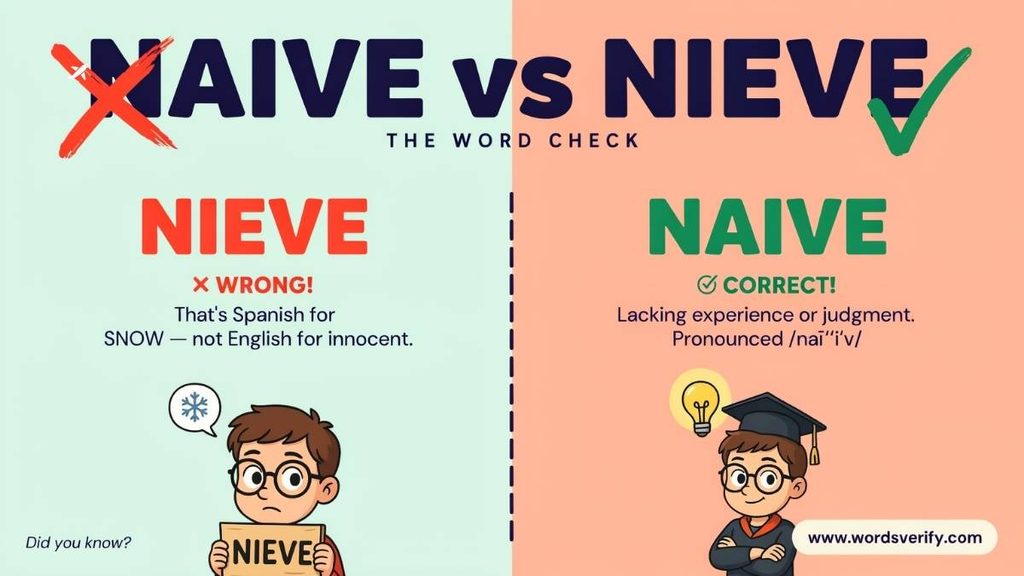
NAIVE vs NIEVE
They contain exactly the same five letters. The only difference is the order of the middle vowels.
That makes the naive vs nieve confusion surprisingly easy to fall into.
English also doesn’t always make spelling predictable from pronunciation. When you hear naive pronounced aloud, the sound doesn’t necessarily remind you that the written word begins with “nai.”
Typing quickly can make the problem worse.
You may know exactly what you want to say but accidentally switch the A and I.
It’s a small error, but small errors are often the ones that survive proofreading because your brain already knows what you intended to write.
How Do You Spell Naive?
The correct spelling is:
N-A-I-V-E
The most useful part to remember is the middle:
AI
not:
IE
A simple memory trick is:
Naive has A before I.
Think of the word as:
NA + IVE = NAIVE
Once you remember the order of those two vowels, the spelling becomes much easier.
How Do You Spell Nieve?
If you’re trying to spell the English adjective meaning inexperienced or overly trusting, don’t use nieve.
The correct spelling is:
naive
However, if you’re writing in Spanish and mean “snow,” then nieve is the correct Spanish word.
This gives you a useful distinction:
| What you mean | Word |
|---|---|
| Inexperienced or overly trusting | Naive |
| Traditional spelling of the same English adjective | Naïve |
| Snow in Spanish | Nieve |
| Historical or dialectal English term connected with a hand or fist | Nieve |
The spelling depends entirely on the meaning.
Learn the difference between often confused words
Grately vs Greatly Meaning, Difference and Usage
Naive Pronunciation How Do You Pronounce Naive?
Naive is commonly pronounced approximately like:
ny-EVE
It has two syllables.
The pronunciation of naive and naïve is the same.
The spelling can look a little unusual because the word came into English through French. That’s one reason the written form may not feel as predictable as some everyday English words.
Still, pronunciation isn’t a reliable way to reconstruct the spelling.
If you know the pronunciation but aren’t sure how to write it, remember:
N-A-I-V-E
Naive in a Sentence
The best way to understand a word is often to see it doing its job in a real sentence.
Here are some natural examples:
- She was naive about the risks of sharing information online.
- He had a naive belief that everyone would keep their promises.
- It would be naive to assume the project will have no problems.
- The student had a naive understanding of the complicated issue.
- His naive approach ignored several important details.
- She wasn’t ignorant. She was simply naive about the situation.
- The young traveler was naive enough to trust a stranger.
- His first business plan showed a naive understanding of the market.
- The child’s naive optimism made everyone smile.
- It was naive to think that one conversation would solve everything.
Notice how the word works in different ways.
Sometimes it describes a person. At other times, it describes a belief, approach, assumption, or expectation.
Nieve in a Sentence
If you’re looking for a nieve example sentence, you need to establish the language and meaning first.
In Spanish:
La nieve está cayendo.
This means:
The snow is falling.
In historical or dialectal English, nieve can appear with a different meaning related to a hand or fist.
But if you’re trying to say that someone lacks experience, you should use naive:
He was naive about the situation.
Not:
He was nieve about the situation.
Naive vs Innocent
Naive and innocent are related, but they aren’t interchangeable.
Innocent often refers to a lack of guilt or harmful intent.
Naive usually refers to a lack of experience or realistic understanding.
For example:
She had innocent intentions.
This tells us that she didn’t mean to cause harm.
She was naive about the situation.
This tells us that she didn’t understand the situation very well.
Someone can be innocent and naive at the same time, but the two words highlight different qualities.
Naive vs Gullible
Gullible is another word that often gets confused with naive.
Someone who is gullible tends to believe things too easily, especially things that aren’t true.
Naive is broader.
A person can be naive about something without being easily fooled.
For example:
He was naive about investing.
This suggests that he lacked practical knowledge.
Now consider:
He was gullible and believed every investment promise he heard.
This places much more emphasis on his tendency to believe things without questioning them.
The words can overlap, but gullible is more directly connected with being easily deceived.
Naive vs Ignorant
The difference becomes clearer when you focus on knowledge.
Ignorant means lacking knowledge about something.
Naive often suggests that a person lacks experience or has an overly simple understanding of something.
For example:
1.She was ignorant of the rule.
2.She didn’t know about it.
3.She was naive about the consequences.
4.She may have known the basic facts but didn’t understand how serious the consequences could be.
5.That small difference can make your writing much more precise.
Naive vs Inexperienced
These two words are very close.
Inexperienced simply means someone hasn’t gained much experience in a particular area.
Naive can suggest something more.
It may indicate unrealistic expectations, excessive trust, or a simplistic understanding of a situation.
Compare:
He was inexperienced at managing a team.
This is a neutral statement about his experience.
He was naive about managing a team.
This suggests that he didn’t fully understand the challenges involved.
The second sentence carries more judgment.
Learn the difference between often confused words
Descision vs Decision Meaning, and Usage
Is Naive Appropriate for Formal Writing?
Yes.
Naive isn’t limited to casual conversation. You can use it in academic, professional, business, and other formal writing.
For example:
The argument relies on a naive assumption about consumer behavior.
That’s perfectly suitable for formal writing.
However, good writing doesn’t stop at choosing a grammatically correct word. You should also make your meaning clear.
Instead of simply saying:
The proposal was naive.
you might explain:
The proposal was based on an unrealistic assumption about customer behavior.
The second sentence gives the reader more information.
So naive is completely acceptable in formal writing, but context should do the rest of the work.
Learn the difference between often confused words
Copys vs Copies Which one Is Correct?
Naive in Different Contexts
Everyday Conversation
I was naive enough to think the repair would be cheap.
This sounds natural and conversational.
Academic Writing
The argument depends on a naive assumption about human behavior.
Here, naive describes a weakness in the assumption.
Business Writing
It would be naive to expect the new system to solve every problem immediately.
The word highlights an unrealistic expectation.
Education
The student’s answer reflected a naive understanding of the historical events.
Here, the word suggests that the student’s understanding lacks important context.
Relationships
Her naive trust made it difficult for her to recognize dishonest behavior.
The word describes an overly trusting attitude.
Learn the difference between often confused words
The vs Thee Meaning, Difference and Pronunciation
Common Mistakes With Naive vs Nieve
Using Nieve Instead of Naive
This is the main spelling mistake.
Remember:
NAIVE
The A comes before the I.
Assuming Naïve Is Incorrect
It’s not.
Naïve is an accepted spelling of naive.
Thinking Naive Means ignorant
It doesn’t.
Naive generally focuses on experience, awareness, or judgment rather than intelligence.
Using Naive When Gullible Is More Accurate
If someone believes almost anything they’re told, gullible may be the better word.
Assuming Pronunciation Tells You the Spelling
English pronunciation doesn’t always give you enough information to spell a word correctly.
When in doubt, remember the five letters:
N-A-I-V-E
A Simple Real Life Example
Imagine someone buying a used car for the first time.
The buyer assumes the seller will automatically explain every problem with the vehicle. After all, an honest seller should be truthful, right?
That assumption may be naive.
The buyer simply doesn’t have enough experience to understand how carefully they need to inspect the car or ask questions.
Now imagine another person receives a message saying they’ve won a large prize. The message asks them to send money to claim it.
Their friends warn them it’s probably a scam, but they believe the message anyway.
That person may be described as gullible.
The difference is subtle but useful.
Naive often points to a lack of experience or realistic understanding.
Gullible focuses more strongly on being easily deceived.
Learn the difference between often confused words
Pleaded vs Pled Which One Is Correct?
Naive vs Nieve Which One Should You Use?
If you’re writing standard American English and you mean inexperienced, overly trusting, or lacking worldly knowledge, use naive.
You can also use naïve.
Don’t use nieve as a replacement for either spelling.
There are special situations where nieve is correct. For example, Spanish uses nieve for “snow.” Historical and dialectal English also has separate uses for the word.
But those are different words with different meanings.
For everyday English, the choice is easy:
Naive = correct
Naïve = also correct
Nieve = not the standard spelling of naive.
Practice Session Naive vs Nieve
Test your understanding of the difference between naive vs nieve. Fill in each blank with the correct word.
- It would be ______ to believe that every person you meet online is trustworthy.
- The young student had a ______ understanding of how difficult the subject would be.
- She was ______ about the risks because she had never dealt with a situation like this before.
- His ______ assumption caused him to overlook several important details.
- It was ______ of him to think that the problem would disappear on its own.
- The child had a ______ belief that everyone was honest and kind.
- The manager said it would be ______ to expect instant results from the new system.
- Although she was intelligent, she was ______ about the realities of running a business.
- His ______ approach to the complicated problem showed his lack of experience.
- The traveler was ______ enough to trust a stranger without asking questions.
- In Spanish, ______ means “snow.”
- The correct English spelling is ______, not “nieve.”
- She made a ______ decision because she didn’t fully understand the consequences.
- It would be ______ to assume that everything will go exactly as planned.
- His ______ attitude came from having very little experience with difficult situations.
- The student’s answer reflected a ______ understanding of the topic.
- She wasn’t foolish; she was simply ______ about how the industry worked.
- The proposal was based on a ______ belief about customer behavior.
- It can be ______ to trust every promise without checking the facts.
- The two accepted English spellings are naive and ______.
- He had a ______ expectation that the negotiations would be easy.
- The young employee was ______ about the challenges of managing a large team.
- Her ______ optimism made her believe that everyone would cooperate.
- If you mean “inexperienced or overly trusting,” the correct spelling is ______.
- Don’t write “nieve” when you mean ______ in standard English.
Answers
- naive
- naive
- naive
- naive
- naive
- naive
- naive
- naive
- naive
- naive
- nieve
- naive
- naive
- naive
- naive
- naive
- naive
- naive
- naive
- naïve
- naive
- naive
- naive
- naive
- naive
Here’s a trusted source for clear more words Comparison:
FAQs
Why is naive sometimes written as naïve?
Naive is sometimes written as naïve because the diaeresis shows that the two vowels should be pronounced separately. Both spellings are correct in English.
Can naive describe an idea instead of a person?
Yes. Naive can describe an idea, belief, assumption, plan, or approach that shows limited experience or an unrealistic understanding of a situation.
Can naive be used for children?
Yes. A child may be described as naive when they have limited life experience or naturally trust others. The word doesn’t necessarily suggest that the child lacks intelligence.
Does naive always have a negative meaning?
No. Depending on the context, naive can suggest innocence or a lack of experience rather than something seriously wrong. However, it can sound critical when it describes poor judgment or unrealistic thinking.
What is the difference between naive and inexperienced?
Inexperienced simply means lacking experience. Naive can go further by suggesting that someone has an overly trusting, simplistic, or unrealistic view of a situation.
Can you use naive to describe a decision?
Yes. You can describe a decision as naive when it results from limited experience or an unrealistic assessment of the circumstances.
What is the adverb form of naive?
The adverb is naively. For example, “He naively assumed that everyone would keep their promises.”
What is the noun form of naive?
The related noun is naivety or naiveté. Both forms refer to a lack of experience or worldly understanding.
Is naive a common English word?
Yes. Naive is a common English adjective used in everyday conversation as well as academic, professional, and formal writing.
Can naive describe an assumption?
Yes. “Naive assumption” is a natural phrase for an assumption based on limited experience or an overly simple understanding of a situation.
Does naive mean someone is easy to trick?
Not necessarily. A naive person may be inexperienced or overly trusting, while someone who is easy to trick is more specifically described as gullible.
Can an intelligent person be naive?
Yes. Intelligence and experience aren’t the same thing. Someone can be highly intelligent while still being naive about an unfamiliar situation.
Is naive appropriate in professional writing?
Yes. Naive is appropriate in professional writing when it accurately describes an unrealistic assumption, limited understanding, or lack of practical experience.
Can naive describe something positive?
Sometimes. In certain contexts, naive can suggest innocence, openness, or a lack of cynicism. The overall meaning depends on how the word is used.
What words are commonly confused with naive?
Words such as innocent, gullible, inexperienced, ignorant, foolish, and unsophisticated can overlap with naive, but each has a slightly different meaning.
Does the spelling naieve exist?
No. Naieve is not the standard spelling. The correct English spelling is naive, with nai at the beginning.
Why is the spelling of naive difficult to remember?
The vowel sequence can cause confusion because the word is pronounced differently from how many English words with similar letter patterns sound. People also commonly reverse the A and I and write nieve.
Can naive be used without an accent mark?
Yes. Naive without the diaeresis is completely acceptable in modern English.
Is there a difference in meaning between naive and naïve?
No. Naive and naïve have the same meaning. The difference is simply the spelling convention.
Can nieve be used as an English translation of snow?
No. In standard English, the word for snow is snow. Nieve is the Spanish word for snow.
Is nieve related to the English word naive?
No. Although the spellings look similar, nieve and naive are separate words with different origins and meanings.
How can you remember the spelling of naive?
Remember the vowel order: AI. Write NAIVE, not NIEVE. A simple reminder is “A before I in naive.”
What is the best word to use instead of naive in formal writing?
It depends on the intended meaning. Words such as inexperienced, unrealistic, uninformed, unsophisticated, or overly trusting may work when they describe the specific idea more precisely.
Can naive be used to describe someone’s behavior?
Yes. For example, “His naive behavior showed that he had little experience dealing with difficult situations.”
Is naive a spelling mistake?
No. Naive is the correct standard spelling. The spelling mistake occurs when someone writes nieve while intending to use the English adjective.
Can nieve appear in a dictionary?
Yes. Dictionaries may include nieve because it has legitimate meanings in Spanish and in historical or dialectal English. Its dictionary presence doesn’t make it an alternative spelling of naive.
What is the easiest way to tell naive vs nieve apart?
Look at the middle letters. Naive contains AI, while nieve contains IE. If you’re describing someone who lacks experience, choose naive.
Conclusion
The naive vs nieve confusion may involve only two swapped vowels, but those little letters can create a surprisingly big spelling mistake. When you want to describe someone who lacks experience, practical knowledge, or a realistic understanding of a situation, naive is the correct spelling in standard English. Naïve is equally acceptable and carries the same meaning.
Nieve, however, belongs to a different word story. In Spanish, it means “snow,” and it also appears in historical and dialectal English with separate meanings. It isn’t an alternative spelling of naive.
So, when you’re describing inexperience, don’t let those vowels play musical chairs. Remember N-A-I-V-E, and you’ll have the right word every time.

Lisa AJS is an experienced blogger and language enthusiast at Words Verify, dedicated to making grammar simple, practical, and enjoyable. She writes engaging content on commonly confused words, grammar mistakes, word meanings, and everyday language challenges.