Some English words seem determined to test your spelling skills, and “emaculate vs immaculate” is a perfect example. One tiny letter can turn a perfectly polished word into a spelling mistake. If you’ve ever paused over “emaculate vs immaculate,” you’re not alone. This mix-up is easy to make because both forms look and sound remarkably similar. However, only one is the standard choice when you mean spotless, flawless, or completely free from mistakes. In this guide, you’ll discover the correct spelling, meaning, pronunciation, usage, and word origin of immaculate. You’ll also learn a simple memory trick that makes this tricky spelling much easier to remember.
Emaculate vs Immaculate Quick Answer
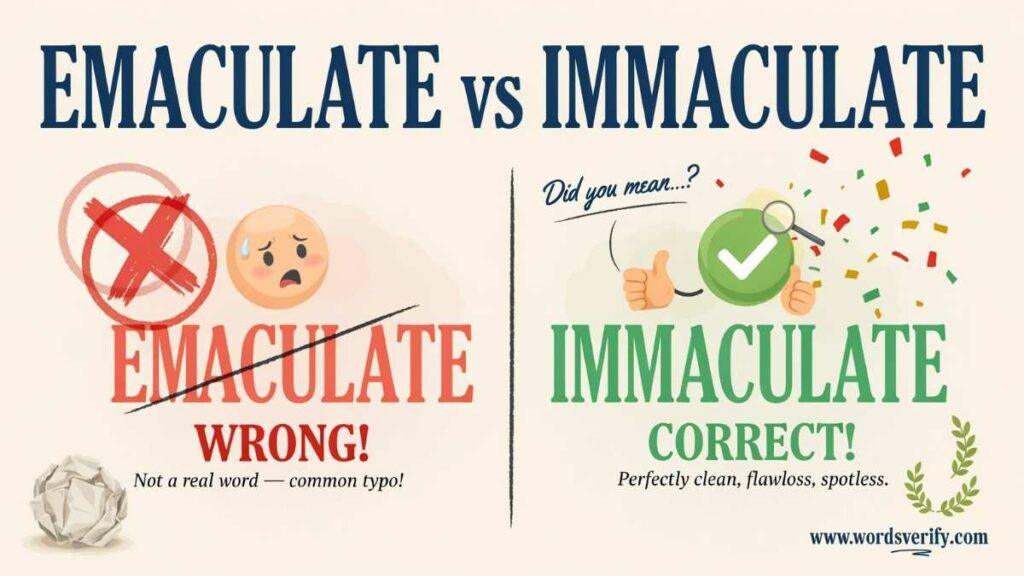
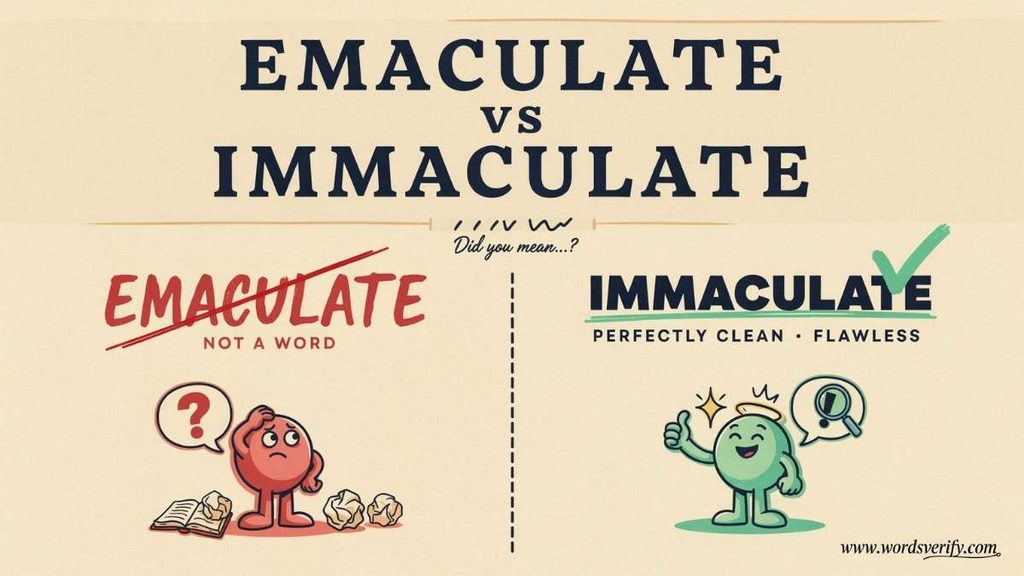
If you’re asking which spelling to use in ordinary English, choose immaculate.
The word immaculate is an adjective. It can describe something that is extremely clean, neat, flawless, pure, or free from mistakes.
Emaculate is much less common. It has a rare historical use as a verb meaning to remove blemishes or stains. Most of the time, however, someone who writes emaculate is trying to spell immaculate.
| Word | Modern use | Part of speech | Meaning |
|---|---|---|---|
| Immaculate | Common | Adjective | Perfectly clean, flawless, pure, or free from mistakes |
| Emaculate | Rare | Verb | To remove blemishes |
| Imaculate | Incorrect spelling | — | Misspelling of immaculate |
| Emmaculate | Incorrect spelling | — | Misspelling of immaculate |
| Immacculate | Incorrect spelling | — | Misspelling of immaculate |
So if you write, “The hotel room was immaculate,” you’ve got it right.
If you write, “The hotel room was emaculate,” you’re almost certainly using the wrong spelling.
What Does Immaculate Mean?
The word immaculate describes something that has no stain, blemish, noticeable flaw, or defect.
Its most familiar meaning relates to cleanliness. An immaculate room isn’t merely clean enough. It is exceptionally clean and carefully maintained.
For example:
- The kitchen was immaculate.
- Her white dress remained immaculate throughout the evening.
- The hotel room was immaculate.
- His office is always immaculate.
The word can also describe quality or performance. In that setting, it means something close to flawless or faultless.
For example:
- The pianist gave an immaculate performance.
- Her timing was immaculate.
- The presentation was immaculate.
- The team maintained an immaculate record.
So immaculate isn’t limited to mops, soap, and spotless countertops. It can describe anything that appears exceptionally clean, polished, or free from faults.
Immaculate for Physical Cleanliness
Imagine entering a kitchen where the counters shine, the floor is spotless, every appliance is neatly arranged, and not a single dirty dish is sitting in the sink.
You could call that kitchen immaculate.
The word suggests more than basic cleanliness. It often implies that someone has taken considerable care to keep the place in excellent condition.
Consider these examples:
- The house was immaculate from top to bottom.
- The hotel staff kept every room immaculate.
- Her car was immaculate inside and out.
- The laboratory was kept in immaculate condition.
There is a subtle difference between saying something is clean and saying it is immaculate.
“Clean” tells you there is little or no dirt.
“Immaculate” suggests a higher standard. It gives the impression that every detail has been carefully looked after.
Immaculate for Perfection and Quality
The word takes on a broader meaning when it describes an activity or performance.
A football player can have an immaculate record. A musician can give an immaculate performance. A writer can produce immaculate prose.
None of these examples has anything to do with physical cleanliness.
Here, immaculate means exceptionally accurate, polished, or free from mistakes.
For example:
- The athlete delivered an immaculate performance.
- Her technique was immaculate.
- He gave an immaculate presentation.
- The designer produced an immaculate final draft.
This is one reason the word is more versatile than it may initially appear.
Immaculate for Appearance
You can also use immaculate when someone looks exceptionally neat and polished.
For example:
- He arrived in an immaculate suit.
- She looked immaculate at the ceremony.
- His uniform was immaculate.
- The actor appeared immaculate on the red carpet.
An immaculate appearance usually suggests careful grooming, clean clothing, and attention to detail.
It doesn’t mean the person is physically perfect. Instead, it describes the quality of their presentation.
Someone can walk into a room wearing ordinary clothes and still look immaculate if everything is clean, neat, pressed, and carefully arranged.
Immaculate in Religious Language
The word also has a well-established religious use.
The best-known example is Immaculate Conception.
This expression has a specific meaning in Catholic theology. It refers to the belief that Mary was conceived without original sin. It does not mean the conception of Jesus.
The adjective immaculate carries the older sense of being unstained or free from sin in this context.
That historical meaning helps explain why the word can refer to more than physical cleanliness. The central idea is freedom from a stain, blemish, or fault.
Learn the difference between tricky more English words
Vinal vs Vinyl Which one Is Correct?
Is Emaculate a Word?
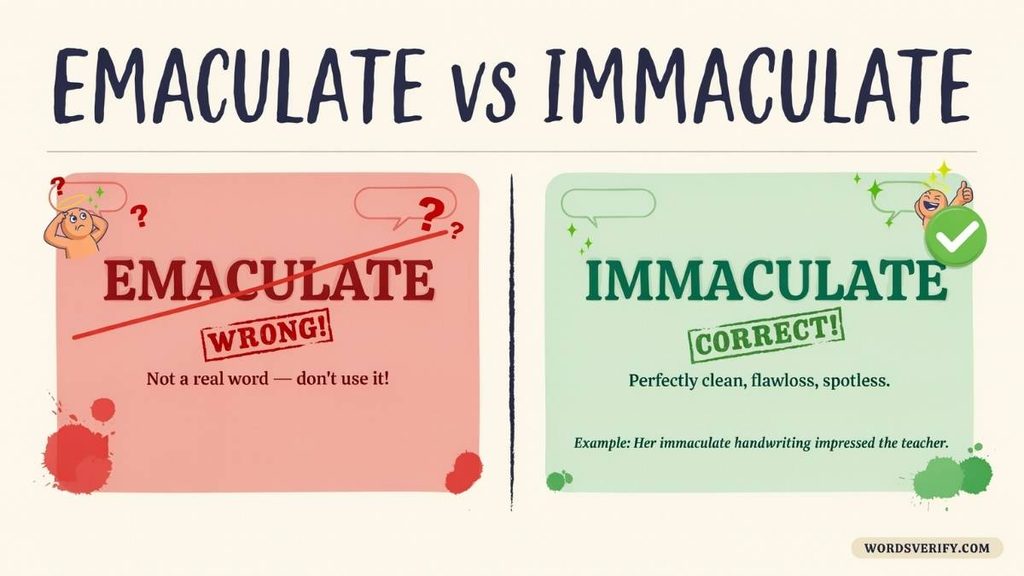
This question needs a slightly more careful answer than it might seem.
Emaculate does exist as a rare historical English verb. It means to remove blemishes or stains.
However, that isn’t the meaning people usually intend when they write emaculate today.
Most modern writers who use emaculate are trying to write immaculate.
For example:
Incorrect for the intended adjective:
The apartment was emaculate.
Correct:
The apartment was immaculate.
The historical verb has a different grammatical function.
You might encounter emaculate in an older or highly specialized text. In ordinary conversation, schoolwork, business writing, or online communication, it isn’t a normal alternative to immaculate.
Emaculate Definition
The rare verb emaculate means to remove blemishes, stains, or defects.
That meaning comes from the word’s history. It is related to the same Latin idea of a blemish or spot that appears in immaculate.
The distinction can be summarized simply:
- Emaculate refers to the act of removing a blemish.
- Immaculate describes a condition in which there is no blemish.
The two words are therefore related in meaning, but they aren’t interchangeable.
For modern readers, the historical verb may sound unusual or even incorrect. That’s another reason it’s important to consider context before deciding what a word means.
Learn the difference between tricky more English words
Encorporate vs Incorporate Which one Is Correct?
The Difference Between Emaculate vs Immaculate
The difference between emaculate vs immaculate involves both spelling and word function.
| Feature | Immaculate | Emaculate |
|---|---|---|
| Common in modern English | Yes | No |
| Normal adjective | Yes | No |
| Historical verb | No | Yes |
| Meaning | Free from stains, flaws, or faults | To remove blemishes |
| Everyday writing | Appropriate | Usually inappropriate |
| Common spelling choice | Correct | Usually a misspelling when the adjective is intended |
For the average writer, the practical rule is easy.
If you mean spotless, flawless, or perfectly maintained, write immaculate.
How to Spell Immaculate Correctly
The correct spelling is:
immaculate
It contains two m’s near the beginning.
A useful way to break the word down is:
im + mac + u + late
That gives you:
immaculate
The most common mistakes happen near the beginning. Writers may accidentally remove one of the m’s or replace the first part with em-.
Watch for these forms:
- emaculate
- imaculate
- emmaculate
- immacculate
All of these are incorrect when you mean the standard adjective immaculate.
Why Is Immaculate Difficult to Spell?
The spelling isn’t particularly intuitive when you only hear the word.
English pronunciation doesn’t always reveal every letter. Unstressed sounds can become less distinct in normal speech, which makes it easy to reconstruct a word incorrectly.
The double m also creates a problem.
When writing quickly, it is tempting to type imaculate instead of immaculate. The missing letter doesn’t change how the word sounds very much, so the mistake can easily survive a quick proofreading session.
Another problem comes from the opening sound. Some writers hear it as though the word begins with “em,” which can lead to emaculate.
The best solution isn’t to rely on pronunciation alone. Remember the spelling visually:
IMMA
That small detail does a lot of work.
Learn the difference between tricky more English words
Performed vs Preformed which one is correct?
Common Misspellings of Immaculate
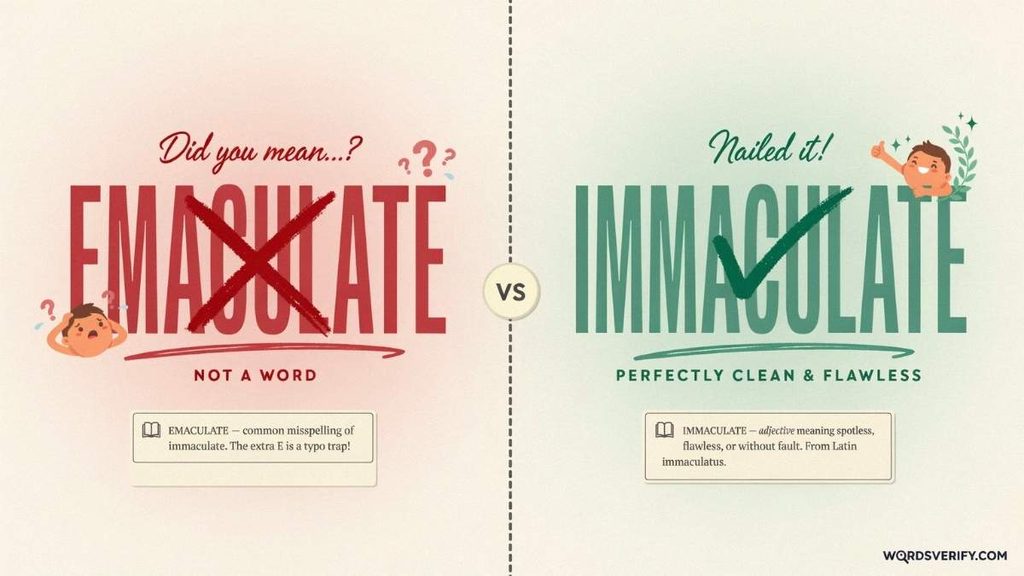
Several incorrect forms appear because of pronunciation, typing mistakes, or uncertainty about the repeated letters.
Emaculate
This is one of the most common mistakes.
Incorrect:
The hotel was emaculate.
Correct:
The hotel was immaculate.
Imaculate
This spelling drops one of the m’s.
Incorrect:
Her room was imaculate.
Correct:
Her room was immaculate.
Emmaculate
This version combines an incorrect opening with a doubled m.
Incorrect:
The house was emmaculate.
Correct:
The house was immaculate.
Immacculate
This spelling adds an unnecessary c.
Incorrect:
The building was immacculate.
Correct:
The building was immaculate.
These mistakes may look minor. In formal writing, however, they can make an otherwise polished sentence look careless.
Learn the difference between tricky more English words
Offered vs Offerred Which one Is Correct?
Immaculate Pronunciation
The standard US English pronunciation of immaculate is:
/ɪˈmæk.jə.lət/
The strongest stress falls on the middle syllable.
The pronunciation is one reason some people make the emaculate mistake. English spelling often contains letters that aren’t obvious from casual speech.
If you’re learning the word, don’t try to pronounce every letter with equal force. The word has a natural rhythm, and the stressed middle syllable carries much of its sound.
Once you’ve heard it several times and connected the sound with the written form immaculate, the spelling becomes easier to recognize.
Immaculate Word Origin
The history of immaculate provides an excellent clue to its meaning.
The word comes through Latin immaculatus, meaning “unstained” or “unspotted.” It ultimately connects with the Latin noun macula, meaning a spot, stain, or blemish.
That history gives the word a clear underlying idea:
without a stain or blemish
The Latin prefix associated with negation developed into the beginning of the English word. This helps explain why the spelling begins with im- rather than em-.
The connection with macula also appears in other English vocabulary. In anatomy, for example, a macula is a specialized spot or area.
The history therefore isn’t just an interesting language fact. It helps explain why immaculate has meanings involving cleanliness, purity, and freedom from flaws.
Emaculate Word Origin
Emaculate comes from a different Latin formation related to the idea of removing spots or blemishes.
The historical verb carries an active meaning:
to remove a blemish
Immaculate, on the other hand, describes the resulting condition:
free from blemishes
This explains why the two words can look strangely similar while behaving differently.
They share a connection to the same underlying idea of a spot or blemish. Their word formation and grammatical roles aren’t the same.
Immaculate as a Part of Speech
Immaculate is an adjective.
It describes a person, object, condition, performance, or quality.
It can appear before a noun:
- an immaculate room
- an immaculate record
- an immaculate uniform
- an immaculate performance
- an immaculate appearance
or It can also follow a linking verb:
- The room was immaculate.
- Her appearance looked immaculate.
- His record remained immaculate.
- The car was immaculate.
The adverb form is immaculately.
For example:
- She was immaculately dressed.
- The room was immaculately maintained.
- The report was immaculately prepared.
The distinction is straightforward. Immaculate describes something. Immaculately describes how something is done or presented.
Learn the difference between tricky more English words
Tapping vs Taping which one is correct?
Immaculate in a Sentence
The best way to understand a word is to see how it behaves in real sentences.
Everyday examples
- The house looked immaculate after the cleaning.
- His shoes were immaculate despite the long journey.
- The hotel room was immaculate.
- She keeps her kitchen immaculate.
- The garden was immaculate before the guests arrived.
Professional examples
- Her presentation was immaculate.
- The designer delivered an immaculate final draft.
- The technician returned the equipment in immaculate condition.
- His professional record remained immaculate.
- The team’s execution was immaculate.
Figurative examples
- The athlete produced an immaculate performance.
- Her reputation remained immaculate.
- His timing was immaculate.
- The novelist’s prose was remarkably polished and precise.
- The singer delivered an immaculate performance.
These examples show how the word can move naturally from physical cleanliness to figurative excellence.
Learn the difference between tricky more English words
Emersion vs Immersion which one is correct?
Emaculate in a Sentence
Using emaculate in modern everyday writing requires caution because most readers will interpret it as a misspelling of immaculate.
In its rare historical verb sense, it can mean removing blemishes.
For example:
The process was designed to emaculate the surface.
That sentence is grammatically possible in the historical sense. However, it sounds unusual to a modern reader.
A clearer modern alternative would be:
The process was designed to remove the blemishes from the surface.
Clarity matters more than showing off an obscure word.
If the intended meaning is “perfectly clean,” use immaculate.
Immaculate vs Flawless
The words immaculate and flawless overlap considerably, but they aren’t identical.
Flawless focuses on the absence of defects, errors, or imperfections.
Immaculate can also mean flawless, but it has a stronger association with cleanliness, purity, neatness, and excellent condition.
Compare these examples:
Her performance was flawless.
This strongly emphasizes that she made no mistakes.
Her appearance was immaculate.
This emphasizes her polished and exceptionally neat appearance.
You could use immaculate for a performance too. In that case, it suggests exceptional precision and execution.
Immaculate vs Impeccable
Impeccable is another close relative.
It often describes:
- Manners
- Judgment
- Taste
- Professional conduct
- Behavior
- Technique
For example:
Her manners were impeccable.
His professional judgment was impeccable.
Immaculate is especially natural when cleanliness or physical condition matters:
The kitchen was immaculate.
His uniform was immaculate.
There is overlap, particularly when describing performance or appearance. Still, the two words have slightly different personalities.
Immaculate vs Spotless
Spotless is perhaps the closest everyday alternative when you’re talking about cleanliness.
Compare:
The kitchen was spotless.
and:
The kitchen was immaculate.
Both sentences work perfectly.
Spotless focuses directly on the absence of dirt or stains. Immaculate can suggest cleanliness plus careful maintenance, order, and overall perfection.
If you want a plain everyday word, spotless is often the easier choice.
If you want a stronger word that suggests exceptional condition, immaculate works well.
Immaculate vs Pristine
Pristine describes something that is exceptionally clean, fresh, pure, or apparently untouched.
For example:
- The forest remained pristine.
- The book was in pristine condition.
- The beach looked pristine.
- The antique was surprisingly pristine.
The distinction is subtle.
Pristine often suggests something that remains in its original or untouched condition.
Immaculate emphasizes freedom from dirt, flaws, or blemishes.
Both can describe excellent physical condition, but the image they create isn’t quite the same.
Immaculate vs Perfect
It can be tempting to treat immaculate and perfect as exact synonyms.
They’re not.
Perfect has an extremely broad meaning. It can describe something that meets every requirement or contains no faults.
Immaculate is more specific. It often focuses on cleanliness, appearance, condition, purity, or freedom from noticeable defects.
For example:
The car was immaculate.
This tells you the car was exceptionally clean and well maintained.
It doesn’t necessarily mean the engine was perfect, the design was perfect, or every mechanical component was flawless.
That small distinction makes word choice important.
Learn the difference between tricky more English words
Conex vs Connex which one is correct?
Immaculate Synonyms
Depending on the context, useful alternatives include:
- Spotless
- Flawless
- Faultless
- Impeccable
- Pristine
- Unblemished
- Untarnished
- Clean
- Pure
- Perfect
However, don’t replace immaculate with one of these words automatically.
A spotless kitchen sounds natural.
An impeccable kitchen sounds unusual.
An impeccable reputation sounds completely natural.
A pristine forest sounds natural.
A pristine performance may work in some contexts but doesn’t sound as natural as flawless performance.
Good vocabulary isn’t about choosing the biggest word available. It’s about choosing the word that fits the situation.
Immaculate Antonyms
Common opposites include:
- Dirty
- Stained
- Messy
- Untidy
- Flawed
- Imperfect
- Blemished
- Tarnished
- Defective
- Damaged
The best antonym depends on the context.
1.The opposite of an immaculate room might be messy or dirty.
2.The opposite of an immaculate performance might be flawed.
3.The opposite of an immaculate reputation might be tarnished.
Learn the difference between tricky more English words
Spoiled vs Spoilt Which One Is Correct?
Why Do People Confuse Emaculate vs Immaculate?
Several factors make this spelling mistake understandable.
First, pronunciation doesn’t clearly reveal every letter. English contains many words whose spelling can’t be predicted perfectly from their sound.
Second, the repeated m is easy to overlook. When typing quickly, writers often produce imaculate.
Third, the opening sound may lead some people toward emaculate.
Finally, people sometimes remember the overall shape of a word without remembering its exact spelling. When that happens, the brain fills in the missing details based on familiar patterns.
This is common in English. The mistake doesn’t necessarily mean someone doesn’t understand the word. They may understand the meaning perfectly while struggling with the spelling.
A Simple Trick to Remember Immaculate
The easiest memory trick is to focus on the first four letters:
IMMA
When you mean “spotless” or “flawless,” think:
IMMAculate
Not:
EMAc ulate
Not:
IMAc ulate
The word’s Latin connection gives you another useful clue.
Since macula relates to a spot or blemish, immaculate carries the idea of being without a spot.
That makes the spelling easier to remember because it gives the word an internal logic.
Learn the difference between tricky more English words
Perfer vs Prefer which one is correct?
Immaculate in Everyday English
You can use immaculate in many situations.
Home and surroundings
- immaculate house
- immaculate kitchen
- immaculate bathroom
- immaculate garden
- immaculate office
Appearance
- immaculate suit
- immaculate uniform
- immaculate appearance
- immaculately dressed
Work and performance
- immaculate technique
- immaculate presentation
- immaculate performance
- immaculate record
- immaculate execution
Writing
- immaculate prose
- immaculate grammar
- immaculate formatting
- immaculate editing
The word is especially useful when clean, neat, or good doesn’t quite express the level of quality you mean.
Learn the difference between tricky more English words
Quiet vs Quite and which one is correct?
What Does Immaculate Condition Mean?
The phrase immaculate condition means that something is exceptionally well preserved, clean, and free from visible damage or flaws.
You might see it in descriptions of:
- Cars
- Furniture
- Collectibles
- Clothing
- Homes
- Electronics
- Books
For example:
The vintage car remains in immaculate condition.
That sentence suggests far more than “the car isn’t dirty.” It implies that the vehicle has been carefully maintained and looks exceptionally well preserved.
What Does Immaculate Appearance Mean?
An immaculate appearance is one that looks exceptionally neat, clean, polished, and well maintained.
For example:
The chef arrived with an immaculate appearance.
The phrase can refer to clothing, grooming, cleanliness, and general presentation.
It doesn’t mean the person’s physical features are perfect. Instead, it describes the impression created by their appearance.
Immaculate Writing
The phrase immaculate writing describes writing that is highly polished and largely free from errors.
It can suggest:
- Correct grammar
- Accurate spelling
- Clear punctuation
- Precise word choice
- Strong organization
- Careful editing
- Consistent formatting
However, immaculate writing isn’t simply writing with perfect grammar.
A grammatically correct paragraph can still be dull, confusing, repetitive, or poorly organized. Strong writing requires clarity and purpose as well.
So when someone calls a piece of writing immaculate, they’re usually praising the overall polish rather than only its spelling.
A Practical Comparison of emaculate vs immaculate
Consider two descriptions of the same hotel room.
Description one:
The room was clean and tidy.
This tells the reader that the room was in good basic condition.
Description two:
The room was immaculate.
This creates a stronger impression. The room was exceptionally clean, orderly, and well maintained.
Now change the subject:
The pianist gave an immaculate performance.
The meaning shifts naturally. The pianist didn’t become cleaner. The performance was exceptionally precise and free from noticeable errors.
This is the key to understanding immaculate: the central idea is freedom from blemishes or faults, but the specific type of “blemish” depends on the context.
Common Mistakes to Avoid
When using this word in formal or everyday writing, keep these points in mind for emaculate vs immaculate.
- Don’t write emaculate when you mean perfectly clean.
- Don’t drop one of the m’s in immaculate.
- Don’t add an unnecessary c.
- Don’t confuse immaculate with immaculately.
- Don’t assume immaculate and perfect always mean exactly the same thing.
- Don’t use an obscure word when a familiar word communicates the idea more clearly.
The last point is especially useful. English has thousands of unusual words. Knowing them is interesting. Using them unnecessarily isn’t always helpful.
Practice Session Emaculate vs Immaculate
Choose the correct word or form emaculate vs immaculate complete each sentence.
Fill in the Blanks
- The hotel room was completely __________ after the staff finished cleaning it.
- She arrived at the interview wearing an __________ suit.
- His academic record was __________ throughout college.
- The kitchen looked __________ after the renovation.
- Please check the __________ spelling before submitting your essay.
- The jeweler returned the diamond in __________ condition.
- Her presentation was polished and __________.
- The old manuscript was preserved in __________ condition.
- He takes pride in keeping his car __________.
- The word “emaculate” is often used as a __________ of “immaculate.”
- The designer’s attention to detail was __________.
- The office was kept __________ by the staff.
- She gave an __________ performance during the final round.
- The white carpet remained __________ despite the busy event.
- His handwriting was remarkably neat and __________.
- The house had an __________ appearance when the guests arrived.
- The report was __________ly prepared and contained no obvious errors.
- The correct spelling contains two __________ at the beginning.
- The restaurant maintained an __________ level of cleanliness.
- The phrase “immaculate condition” describes something that is extremely clean, well-preserved, or free from __________.
- If you mean “spotless” or “flawless,” choose __________ rather than “emaculate.”
- The athlete maintained an __________ record during the season.
- The room was so __________ that not even a speck of dust was visible.
- Her work was __________ly organized from beginning to end.
- When describing something as perfectly clean or flawless, the standard English word is __________.
Answers
- immaculate
- immaculate
- immaculate
- immaculate
- immaculate
- immaculate
- immaculate
- immaculate
- immaculate
- misspelling
- immaculate
- immaculate
- immaculate
- immaculate
- immaculate
- immaculate
- immaculately
- m’s
- immaculate
- flaws
- immaculate
- immaculate
- immaculate
- immaculately
- immaculate
Here’s a trusted source for clear more words Comparison:
FAQs
How do you spell immaculate correctly?
The correct spelling is immaculate. It contains two m’s at the beginning: i-m-m-a-c-u-l-a-t-e.
Why is immaculate often misspelled as emaculate?
The mistake usually happens because the first “m” is easy to overlook when the word is pronounced quickly. Since “emaculate” looks and sounds plausible, it can slip into writing unnoticed.
What does immaculate mean when describing a person?
When describing a person, immaculate can mean exceptionally neat, well-groomed, polished, or free from faults. For example, “She arrived in an immaculate suit.”
Can immaculate describe someone’s work?
Yes. Immaculate can describe work that is exceptionally neat, accurate, or free from errors. For example, “His report was immaculate.”
Can immaculate describe clothes?
Yes. You can use immaculate for clothing that looks perfectly clean, neat, and well maintained. For example, “He wore an immaculate white shirt.”
Can immaculate describe a room or house?
Yes. An immaculate room or house is extremely clean, tidy, and well kept. It suggests a level of cleanliness beyond simply being “clean.”
Is immaculate always related to cleanliness?
No. Immaculate can describe more than physical cleanliness. It can also mean flawless, faultless, pure, or completely free from imperfections depending on the context.
Can immaculate describe writing?
Yes. Immaculate writing can suggest writing that is exceptionally polished, accurate, clear, and free from mistakes. The exact meaning depends on the context.
What does immaculate condition mean?
“Immaculate condition” means something is in exceptionally clean, neat, or well-preserved condition with little or no visible damage, wear, or imperfection.
What is an example of immaculate in everyday English?
A natural example is: “The kitchen was immaculate after the cleaning was finished.” Here, immaculate means extremely clean and tidy.
Is immaculate formal or informal?
Immaculate works in both formal and everyday English. It’s common when describing cleanliness, appearance, presentation, quality, or an unusually high standard.
What adverb comes from immaculate?
The adverb is immaculately. For example: “The office was immaculately maintained.”
What noun comes from immaculate?
The noun immaculacy refers to the quality or state of being immaculate. It’s a relatively uncommon word compared with the adjective “immaculate.”
What is the difference between immaculate and spotless?
Both words can describe something extremely clean. Spotless focuses mainly on the absence of dirt, stains, or marks. Immaculate can go further by suggesting exceptional neatness, perfection, or freedom from flaws.
What is the difference between immaculate and pristine?
Pristine usually emphasizes a condition that is fresh, pure, or seemingly untouched. Immaculate emphasizes exceptional cleanliness, neatness, or flawlessness.
Can immaculate mean perfect?
Yes, in some contexts. Immaculate can mean completely flawless or free from mistakes. However, it doesn’t always mean perfect in every possible sense.
Can immaculate be used before a noun?
Yes. It commonly appears before nouns in phrases such as immaculate appearance, immaculate condition, immaculate record, and immaculate room.
Can immaculate be used after a linking verb?
Yes. For example: “The apartment is immaculate.” Here, the adjective follows the linking verb “is” and describes the apartment.
Is immaculate spelled with one or two m’s?
It is spelled with two m’s: immaculate. Writing “imaculate” or “emaculate” when you mean the standard adjective is a spelling error.
What is the easiest way to remember the spelling of immaculate?
emaculate vs immaculate Break the word into im + maculate and remember the double “m” at the beginning. Think: im-maculate, not e-maculate.
Does immaculate have a negative meaning?
No. Immaculate is generally positive when used to describe cleanliness, appearance, quality, or performance. Its exact meaning depends on the sentence.
Conclusion
A single letter can cause an impressive amount of spelling trouble. The difference between “emaculate” vs “immaculate” is a perfect example. When you want to describe something as spotless, flawless, perfectly clean, or free from mistakes, “immaculate” is the standard English word.
“Emaculate” may appear in rare or historical usage as a verb meaning to remove blemishes. However, it isn’t the correct choice when you mean “spotless” or “flawless” in modern everyday English.
Remember the spelling as “im + maculate.” That extra “m” is easy to forget, but it belongs there. Once you remember it, you can confidently describe an immaculate room, an immaculate appearance, or immaculate work without letting this sneaky spelling mistake trip you up again emaculate vs immaculate.

Lisa AJS is an experienced blogger and language enthusiast at Words Verify, dedicated to making grammar simple, practical, and enjoyable. She writes engaging content on commonly confused words, grammar mistakes, word meanings, and everyday language challenges.