
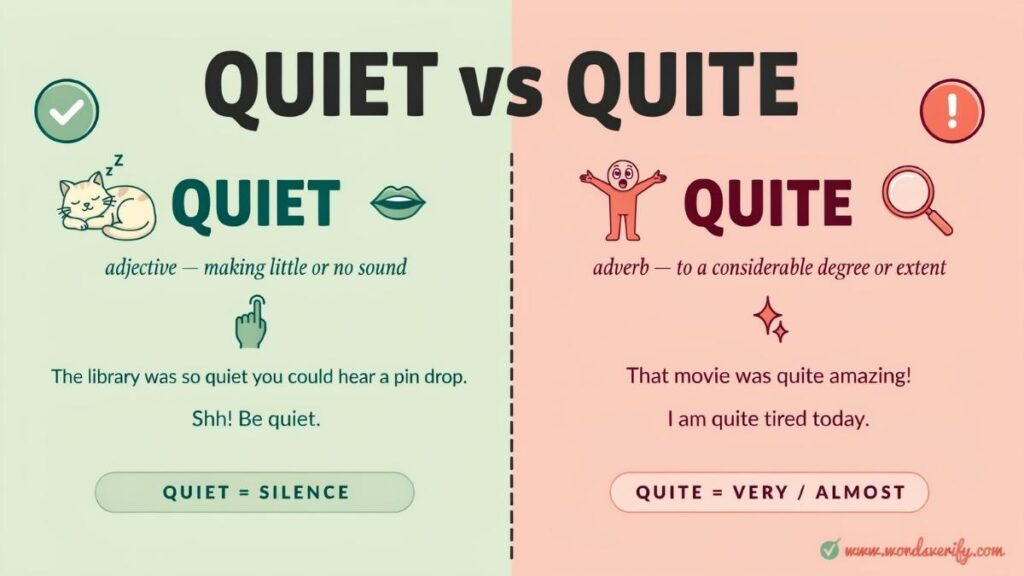
Ever found yourself staring at quiet vs quite and wondering which one belongs in your sentence? You’re not alone. These two words look almost like twins, but their meanings are anything but identical. Quiet relates to little or no noise, while quite is an adverb that can mean fairly, rather, very, or completely, depending on the context. One tiny spelling difference can change your entire sentence. Luckily, this common grammar mix-up is easy to fix. In this guide, you’ll learn the difference between quiet and quite, explore clear examples, spot common mistakes, and discover simple tricks that make choosing the right word much easier.
The Quick Answer
The main difference is meaning.
Quiet describes something with little or no noise. It can also describe someone who doesn’t talk much or a situation that feels calm and peaceful.
Quite is an adverb. It usually adds emphasis or shows degree. Depending on the sentence, it can mean fairly, rather, very, considerably, or completely.
Compare these two sentences:
- The library is quiet.
- The library is quite large.
In the first sentence, quiet describes the noise level. In the second, quite tells us how large the library is.
Here’s a simple comparison:
| Word | Meaning | Common use | Example |
|---|---|---|---|
| Quiet | Little noise, calm, or peaceful | Adjective, noun, verb | The room is quiet. |
| Quite | Fairly, rather, very, or completely | Adverb | The room is quite large. |
| Quit | Stop, leave, or give up | Verb | He decided to quit. |
So, which one is correct? It depends on what you want to say.
What Does Quiet Mean?
Quiet usually refers to a low level of noise. It can describe a place, person, voice, activity, or period of time.
For example:
- The classroom is quiet.
- She spoke in a quiet voice.
- We live on a quiet street.
- He is a quiet person.
- We had a quiet evening at home.
Quiet doesn’t always mean complete silence. A quiet room might still have a clock ticking, someone typing, or traffic outside. It simply means the noise level is low.
That’s an important distinction between quiet and silent. Something can be quiet without being completely silent.
Quiet as an Adjective
Quiet is most commonly used as an adjective.
It can describe:
- A person who doesn’t talk much.
- A place with little noise.
- A voice that isn’t loud.
- A neighborhood with little traffic.
- A peaceful or calm situation.
For example:
“The neighborhood is quiet at night.”
Here, quiet tells us something about the neighborhood.
Likewise:
“She has a quiet personality.”
This doesn’t necessarily mean she never speaks. It suggests that she tends to be reserved or not especially talkative.
Quiet as a Noun
Quiet can also work as a noun when it refers to a state or period of calm and low noise.
Consider these examples:
- I enjoy the quiet of the countryside.
- After the concert, the quiet felt strange.
- She needed some quiet after a busy day.
In these sentences, quiet names a condition rather than describing another noun.
That’s also why the familiar expression “peace and quiet” works so well.
If someone says, “I just want some peace and quiet,” they usually mean they want a break from noise, activity, or disturbance.
Quiet as a Verb
Quiet can also function as a verb. It means to make someone or something less noisy or less disturbed.
For example:
- The teacher quieted the class.
- She tried to quiet the crying baby.
- The crowd gradually quieted.
- The music helped quiet his thoughts.
You may also hear the phrase “quiet down.”
For example:
“The children finally quieted down.”
Here, the children became less noisy.
So quiet isn’t limited to one part of speech. It can work as an adjective, noun, and verb.
Understand confusing English more words simply
Weiner vs Wiener which one is correct?
What Does Quite Mean?
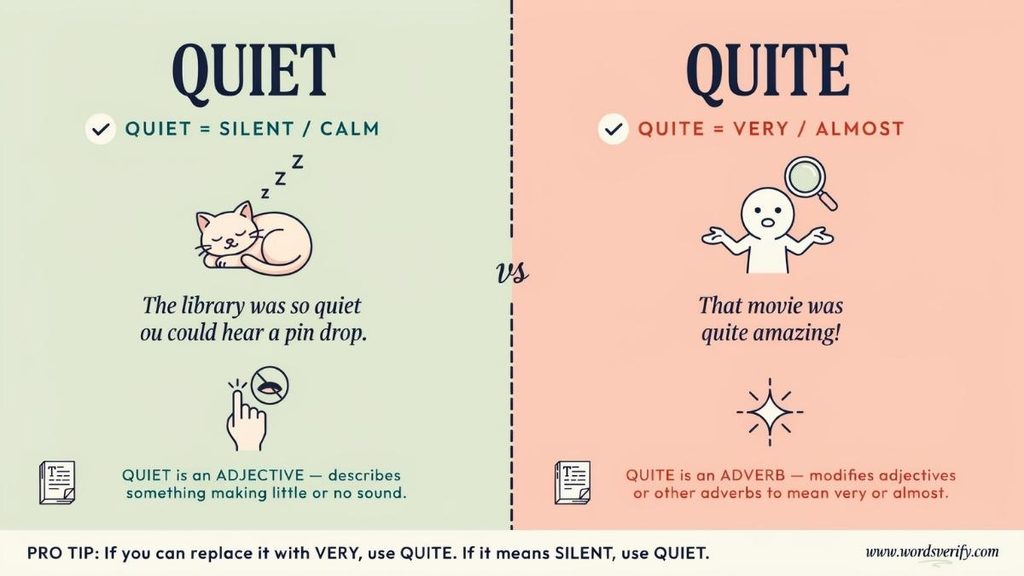
Quite is very different from quiet.
It is mainly an adverb that expresses degree. It tells you how strongly something is true.
Depending on the context, quite can mean:
- Fairly
- Rather
- Very
- Considerably
- Completely
- Entirely
For example:
- The test was quite difficult.
- The restaurant is quite expensive.
- She is quite confident.
- That explanation was quite helpful.
- I’m quite certain about the answer.
In each sentence, quite modifies another word or phrase. It isn’t talking about noise.
Quite Can Mean “Fairly” or “Rather”
In many everyday sentences, quite means something similar to fairly or rather.
For example:
“The movie was quite interesting.”
This can mean the movie was fairly or rather interesting.
Other examples include:
- The weather is quite warm.
- The book is quite useful.
- The test was quite challenging.
- The restaurant is quite expensive.
The exact strength of quite depends on the context.
Quite Can Express Stronger Meaning
Quite can also express a stronger degree. In some sentences, it can come close to very, completely, or entirely.
For example:
- She was quite certain.
- The answer is quite clear.
- That seems quite impossible.
- He was quite alone.
Context matters here. Quite doesn’t always carry exactly the same level of emphasis.
Its meaning can also vary somewhat between American English and British English. British speakers may use quite in ways that give it either a moderate or stronger meaning depending on the adjective and context.
For everyday American English, however, the basic idea remains useful: quite usually tells you the degree of something.
Quiet vs Quite The Main Difference
The easiest way to understand the difference is to remember this:
Quiet describes a condition. Quite describes degree.
Look at these sentences:
- The office is quiet.
- The office is quite large.
The first sentence describes the noise level of the office.
The second sentence describes the size of the office and adds emphasis to the adjective large.
| Feature | Quiet | Quite |
|---|---|---|
| Main meaning | Little noise or calmness | Degree or emphasis |
| Common part of speech | Adjective | Adverb |
| Other uses | Noun and verb | Mainly adverb |
| Related idea | Silence, calm, peace | Fairly, rather, very, completely |
| Example | The room is quiet. | The room is quite large. |
| Syllables | Two | One |
Once you understand that difference, most sentences become much easier to handle.
Understand confusing English more words simply
Flaky vs Flakey Which one Is Correct?
Quiet vs Quite Pronunciation
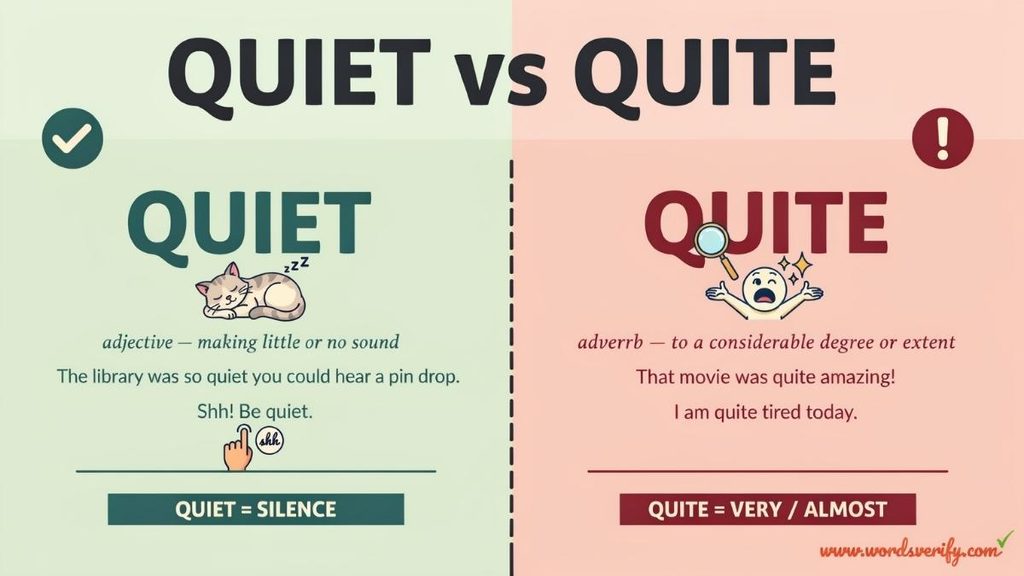
The pronunciation difference can help you remember the spelling.
Quiet has two syllables.
Quite has one syllable.
Say quiet slowly and you’ll hear the two-part rhythm. Quite, on the other hand, is a single syllable.
A useful comparison is:
| Word | Syllables | Rhymes with |
|---|---|---|
| Quiet | 2 | Diet |
| Quite | 1 | Kite |
Quiet sounds like it has an extra step in the middle. Quite moves through the word in one syllable.
This pronunciation difference is especially helpful for people learning English because the spellings look so similar.
Quiet Pronunciation
Quiet contains two syllables. The first part begins with a “kw” sound and the word then moves into a second syllable.
The important thing to remember is that quiet is not pronounced as a single syllable.
Quite Pronunciation
Quite has one syllable and rhymes with words such as:
- Kite
- Light
- Night
- Right
- Sight
So, when you’re comparing quiet and quite pronunciation, listen for the extra syllable in quiet.
Are Quiet vs Quite Homophones?
No. Quiet and quite aren’t exact homophones in standard English.
Homophones have different spellings and meanings but the same pronunciation. Examples include:
- Right and write
- Two and too
- Flower and flour
Quiet and quite sound similar, but they’re not pronounced identically.
The biggest clue is the syllable count. Quiet has two syllables, while quite has one.
That’s why it’s more accurate to think of them as commonly confused or similar-sounding words rather than true homophones.
Understand confusing English more words simply
Web Site vs Website which one is correct?
Quiet vs Quite in a Sentence
The easiest way to learn the difference is to see both words in realistic sentences.
Examples With Quiet
- The library is quiet.
- Please keep your voice quiet.
- We found a quiet place to study.
- The street becomes quiet after midnight.
- She prefers a quiet neighborhood.
- The children became quiet when the teacher entered.
- I enjoy the peace and quiet of the countryside.
Examples With Quite
- The library is quite large.
- The book is quite interesting.
- The test was quite difficult.
- She is quite confident.
- The restaurant is quite popular.
- That explanation was quite clear.
- The weather has become quite warm.
Notice how each word has a different job.
Quiet describes something. Quite changes the degree of another word.
Can Quiet vs Quite Appear in the Same Sentence?
Absolutely.
In fact, one of the best ways to understand these words is to see them working together.
Consider:
“The library was quite quiet.”
Both words are correct.
Quite tells us the degree of quietness. Quiet describes the library’s noise level.
Another example:
“It was quite a quiet evening.”
Again, the words perform different jobs.
Quite adds emphasis, while quiet describes the evening.
This may look strange at first because the words are so similar. Grammatically, however, the sentence is perfectly natural.
Understand confusing English more words simply
Ingrained vs Engrained which one is correct?
How Do You Know Which One to Use?
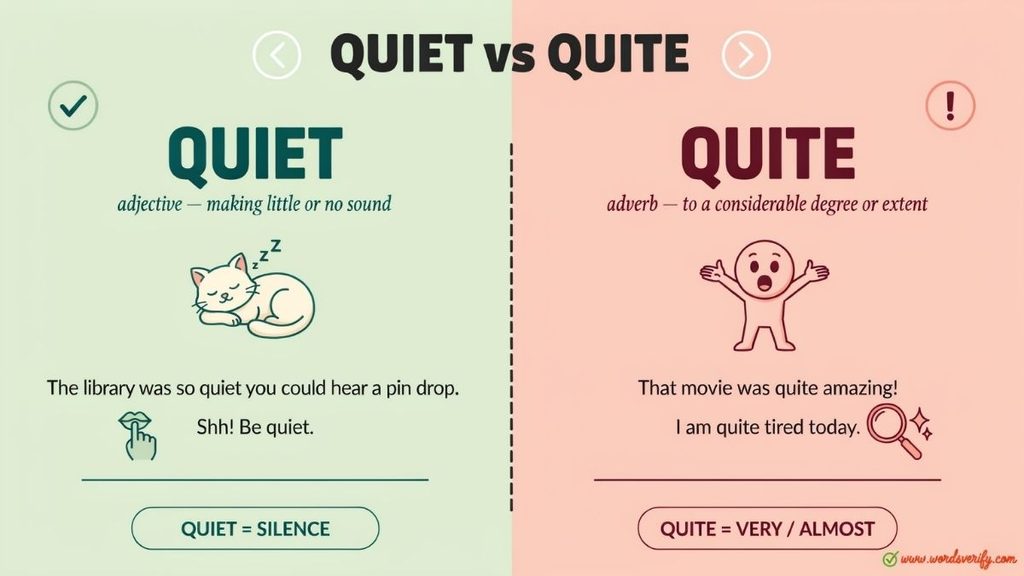
When you’re stuck between the two, focus on meaning rather than spelling.
Use Quiet When You Mean:
- Not noisy
- Peaceful
- Calm
- Nearly silent
- Not very talkative
- Low in activity or disturbance
Examples:
- Please be quiet.
- It’s a quiet room.
- He is a quiet person.
- We need a quiet place.
- The neighborhood is quiet at night.
Use Quite When You Mean:
- Fairly
- Rather
- Very
- Considerably
- Completely
- Entirely
Examples:
- The room is quite large.
- She is quite talented.
- The question was quite difficult.
- I’m quite certain.
- The situation is quite different.
A Simple Substitution Trick
A quick substitution test can solve many spelling problems.
If you can replace the word with silent, peaceful, or calm, you probably need quiet.
For example:
“The room is quiet.”
Try:
“The room is silent.”
The basic idea remains.
Now try a sentence with quite:
“The movie was quite interesting.”
Replace quite with fairly:
“The movie was fairly interesting.”
The sentence still works.
This gives you a simple test:
- Can you replace it with silent or peaceful? Use quiet.
- Can you replace it with fairly, rather, or very? Use quite.
It isn’t a perfect test for every possible sentence, but it works extremely well in everyday writing.
Understand confusing English more words simply
Weeped vs Wept and which one is correct?
Common Mistakes With Quiet vs Quite
These words often cause problems because a single letter changes the entire meaning.
“Please Be Quite”
Incorrect:
“Please be quite.”
If you’re asking someone to stop making noise, use quiet.
Correct:
“Please be quiet.”
“The Movie Was Quiet Interesting”
Incorrect:
“The movie was quiet interesting.”
If you mean that the movie was fairly or very interesting, use quite.
Correct:
“The movie was quite interesting.”
Confusing Quiet With Quit
Quit is another word entirely.
Compare these:
- Please quiet the children. = Make them less noisy.
- The children are quiet. = They aren’t making much noise.
- The children quit playing. = They stopped playing.
- The children are quite tired. = They are fairly or very tired.
Those four sentences look similar, but each word has a different meaning.
Assuming Quiet Means Complete Silence
Quiet doesn’t necessarily mean absolute silence.
A quiet room may still have:
- A ticking clock
- Soft typing
- Distant traffic
- Whispering
- Air-conditioning noise
Silent usually suggests a stronger absence of sound.
So quiet and silent are related, but they’re not always interchangeable.
Understand confusing English more words simply
Zeroes vs Zeros Which one is correct?
Quiet vs Quite Grammar Parts of Speech
Grammar provides another useful way to separate the words.
| Word | Part of speech | Example |
|---|---|---|
| Quiet | Adjective | The room is quiet. |
| Quiet | Noun | I enjoy the quiet. |
| Quiet | Verb | She quieted the class. |
| Quite | Adverb | The class was quite large. |
Is Quiet an Adjective?
Yes.
“The neighborhood is quiet.”
Quiet describes the neighborhood.
Is Quiet a Noun?
Yes.
“I need some quiet.”
Here, quiet names a state of calm or low noise.
Is Quiet a Verb?
Yes.
“The teacher tried to quiet the students.”
Here, quiet means to make the students less noisy.
Is Quite an Adverb?
Yes.
“The test was quite difficult.”
Quite modifies difficult by showing degree.
Understanding these parts of speech makes the spelling difference much easier to remember.
Understand confusing English more words simply
Hanukkah vs Chanukah Which one Is Correct?
Common Expressions With Quiet
Certain phrases appear again and again in everyday English.
Keep Quiet
This means to remain silent or avoid talking.
“Please keep quiet during the presentation.”
Be Quiet
This asks someone to stop making noise or talking.
“The baby is sleeping, so please be quiet.”
Quiet Down
This means to become quieter or make someone or something quieter.
“The students eventually quieted down.”
Peace and Quiet
This refers to a calm period without noise or disturbance.
“After a long week, she wanted some peace and quiet.”
Quiet Place
A quiet place has little noise or activity.
“I need a quiet place to study.”
Understand confusing English more words simply
Creeped vs Crept Which One Is Correct?
Common Expressions With Quite
Quite also appears in many familiar expressions.
Quite a Few
This means a fairly large number.
“Quite a few people attended the event.”
Quite a Lot
This means a considerable amount or number.
“She knows quite a lot about history.”
Quite Often
This means fairly or very frequently.
“We quite often eat dinner together.”
Quite Sure
This means confident about something.
“I’m quite sure that’s the right answer.”
Quite Different
This emphasizes a noticeable difference.
“The second version is quite different from the first.”
Understand confusing English more words simply
Worshiped vs Worshipped Which one Is Correct?
Quiet vs Quite in Everyday Writing
The difference remains the same whether you’re writing an email, having a conversation, or working on an assignment.
In Emails
“The office is unusually quiet today.”
Here, quiet describes the noise level.
“The proposal is quite detailed.”
Here, quite describes the degree of detail.
In Academic Writing
“The experiment was conducted in a quiet room.”
Quiet describes the room.
“The results were quite significant.”
Quite adds emphasis to significant.
In Conversation
“It’s so quiet here.”
This describes the lack of noise.
“It’s quite cold today.”
This expresses the degree of coldness.
The context may change, but the grammar doesn’t.
Understand confusing English more words simply
Judgement vs Judgment Which one Is Correct?
A Simple Example That Explains Everything
Imagine two friends walking into a library.
One says:
“The library is quiet.”
That means the library isn’t noisy.
The other says:
“The library is quite large.”
That means the library has considerable size.
Then one friend says:
“The library is quite quiet today.”
Now both words appear together.
Quite tells us the degree of quietness. Quiet tells us what condition the library is in.
That’s the entire quiet and quite difference in one sentence.
Quiet vs Quite Spelling
The spelling difference is small but important.
Quiet:
q-u-i-e-t
Quite:
q-u-i-t-e
Quit:
q-u-i-t
| Word | Spelling pattern | Meaning |
|---|---|---|
| Quiet | q-u-i-e-t | Little noise or calm |
| Quite | q-u-i-t-e | Degree or emphasis |
| Quit | q-u-i-t | Stop or leave |
If spelling is the main problem, remembering the extra “e” and the position of the vowels can help.
More importantly, connect the spelling to the meaning. Memorizing letters alone isn’t always enough.
How to Remember Quiet vs Quite
A few simple memory tricks can make the difference stick.
Quiet Means Silence
Think:
Quiet = low noise.
Picture a library, bedroom, or peaceful garden.
Quite Means Degree
Think:
Quite = how much?
For example:
“The movie was quite good.”
You’re talking about the degree of goodness.
Remember the Syllables
Quiet has two syllables.
Quite has one.
That difference is useful when you’re speaking and writing.
Keep Quit Separate
Quit means stop.
So the three words become:
- Quiet = little noise
- Quite = degree
- Quit = stop
That’s short enough to remember without needing a grammar textbook beside you.
Quick Reference
| If you mean… | Use | Example |
|---|---|---|
| Little noise | Quiet | The room is quiet. |
| Peaceful | Quiet | We had a quiet evening. |
| Calm person | Quiet | He is quiet. |
| A calm state | Quiet | I need some quiet. |
| Make less noisy | Quiet | She quieted the baby. |
| Fairly | Quite | It was quite good. |
| Rather | Quite | The test was quite hard. |
| Very | Quite | She was quite surprised. |
| Completely | Quite | I’m quite certain. |
| Stop or leave | Quit | He decided to quit. |
Practice Session Quiet vs Quite
Fill in each blank with the correct word: quiet, quite, or quit.
- Please be ______ while the baby is sleeping.
- The movie was ______ interesting.
- She decided to ______ her job and start her own business.
- We found a ______ place to read.
- The classroom became ______ after the teacher entered.
- I’m ______ sure that I locked the door.
- He wants to ______ smoking this year.
- The library is usually very ______.
- That was ______ an impressive performance.
- Could you keep your voice ______, please?
- The neighborhood is ______ peaceful at night.
- She was ______ surprised by the news.
- We enjoyed a ______ afternoon by the lake.
- This exercise is ______ easy once you understand the rule.
- He decided to ______ the competition because of an injury.
- The room was ______ ______ after everyone left.
- The children became ______ when the lights went out.
- I’ve had ______ enough of this argument.
- Please stay ______ during the examination.
- The restaurant was ______ crowded last night.
- She is ______ confident about her answer.
- We need a ______ place to discuss the problem.
- He plans to ______ his bad habit.
- The house was surprisingly ______ despite being near the highway.
- The instructions were ______ clear and easy to follow.
Answers
- quiet
- quite
- quit
- quiet
- quiet
- quite
- quit
- quiet
- quite
- quiet
- quite
- quite
- quiet
- quite
- quit
- quite quiet
- quiet
- quite
- quiet
- quite
- quite
- quiet
- quit
- quiet
- quite
Here’s a trusted source for clear more words Comparison:
FAQs
What does “quite” mean?
“Quite” is an adverb that can mean fairly, rather, very, or completely. Its exact meaning depends on the context and the variety of English being used.
Is it quiet busy or quite busy?
The correct phrase is “quite busy.” Here, “quite” modifies the adjective “busy” and means fairly or rather busy.
What does “quiet” mean?
“Quiet” describes something with little or no noise. It can also describe a calm place, a person who doesn’t talk much, or a situation without much activity.
Does “quite” mean to be silent?
No. “Quite” does not mean silent. “Quiet” is the word associated with little or no sound.
Does “quite” have two meanings?
Yes. Depending on context, “quite” can express a moderate degree, such as “fairly,” or a stronger degree, such as “completely” or “very.”
When should I use quiet or quite?
Use “quiet” when you’re talking about silence, low noise, or calmness. Use “quite” when you want to modify another word and mean fairly, rather, very, or completely.
Where do we use “quite”?
“Quite” is usually used before an adjective or adverb. For example, “quite interesting,” “quite slowly,” and “quite difficult.”
What does “quite busy” mean?
“Quite busy” means fairly busy, rather busy, or, depending on context and variety of English, very busy. It indicates a noticeable level of activity.
Can I say “quite a bit”?
Yes. “Quite a bit” is a common expression meaning a considerable amount or a lot. For example, “She knows quite a bit about grammar.”
What is “quite” in a sentence?
“Quite” functions mainly as an adverb. For example, in “The movie was quite interesting,” it modifies “interesting.”
What is a better word than “quiet”?
The best alternative depends on the meaning. Possible synonyms include “silent,” “peaceful,” “calm,” “still,” or “tranquil.” However, they aren’t always interchangeable.
What does “be quiet” mean?
“Be quiet” means to stop talking or making noise, or to make less noise. It can sound direct or even rude depending on the situation and tone.
Does “quite” mean “no sound”?
No. “Quiet” relates to little or no sound. “Quite” has a completely different grammatical role and meaning.
Is it “quiet good” or “quite good”?
The correct phrase is “quite good.” Here, “quite” modifies “good” and means fairly, rather, or very good depending on context.
What does “quite literally” mean?
“Quite literally” emphasizes that something is meant in its exact, non-figurative sense. For example, “The box was quite literally empty” means there was nothing inside it.
What is another word for “quite”?
Depending on the context, alternatives include “fairly,” “rather,” “very,” “completely,” or “entirely.” The right replacement depends on what “quite” means in the sentence.
Do Americans use the word “quite”?
Yes. Americans use “quite” in everyday and formal English. Its frequency and the strength of its meaning can vary depending on context and speaker.
Is “quite literally” correct?
Yes. “Quite literally” is grammatically correct when “quite” emphasizes that the statement should be understood literally. However, using it simply for emphasis can sometimes sound unnecessary.
How do I say “quite”?
“Quite” is pronounced as one syllable. It has the same vowel sound as words such as “bite” and “white,” although exact pronunciation can vary slightly by accent.
What is the opposite of “quite”?
There isn’t one universal opposite because “quite” has several meanings. Depending on context, words such as “slightly,” “barely,” or “partly” may express a contrasting idea.
conclusion
The difference between quiet vs quite may be small on the page, but it’s certainly not small in meaning. Quiet is about little or no noise, while quite is an adverb that can mean fairly, rather, very, or completely, depending on the sentence. If you write, “The library was quite,” you’ve accidentally made the library sound like it forgot the rest of its sentence!
The easiest trick is to remember the meaning before you check the spelling. If you’re talking about silence, calm, or a lack of noise, choose quiet. If you’re adding meaning such as fairly, very, or completely, choose quite. With a little practice, this once-confusing pair will become quite easy—and your writing can stay wonderfully quiet.

Lisa AJS is an experienced blogger and language enthusiast at Words Verify, dedicated to making grammar simple, practical, and enjoyable. She writes engaging content on commonly confused words, grammar mistakes, word meanings, and everyday language challenges.