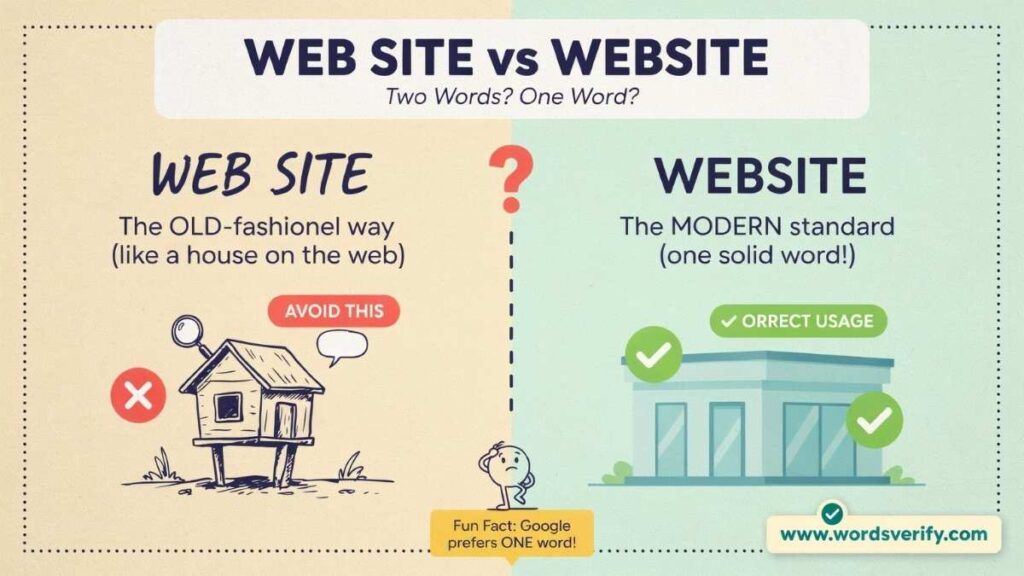
Web site vs website? That tiny space can cause an oddly large amount of confusion. You may have written the word dozens of times and still paused to wonder which version is actually correct. The confusion makes sense because both forms have appeared in English, particularly during the early days of the internet. Today, however, one spelling has become the clear modern choice. This guide breaks down the difference between web site vs website, explains how the spelling evolved, and clears up common mistakes involving spaces, hyphens, capitalization, and everyday usage. By the end, you’ll know which form to use and why, without second-guessing yourself.
Quick Answer
The preferred modern spelling is website.
Here’s how the three common forms compare:
| Form | Meaning | Modern usage |
|---|---|---|
| website | A site on the World Wide Web | Standard |
| web site | Same basic meaning | Older form |
| web-site | Same basic meaning | Older hyphenated form |
The plural of website is websites.
For example:
- Please visit our website for more information.
- The company’s website contains product details.
- Several websites offer free educational resources.
So, if you’re wondering, “web site or website which is correct?” the practical answer is website.
What Does Website Mean?
A website is a collection of connected pages and other online content that people can access through the World Wide Web.
A website can belong to a business, school, government agency, nonprofit organization, news outlet, or individual. Some websites have only a few pages. Others contain millions of pages and serve huge numbers of visitors.
A typical website might include:
- A homepage
- An About page
- Contact information
- Product or service pages
- Blog posts or articles
- Images and videos
- Forms
- Login areas
- Shopping features
- Help and support sections
For example, an online store may have a single website containing product pages, a shopping cart, checkout, customer support, and company information.
All those pages can belong to the same website.
That brings up another common point of confusion. A website isn’t necessarily the same thing as a web page.
A web page is one individual page. A website can contain many web pages.
Think of a website as a book and its individual web pages as the pages inside it. The comparison isn’t perfect because modern websites can do much more than books can, but it makes the basic relationship easy to understand.
What Does Web Site Mean?
Web site has essentially the same meaning as website.
The main difference is the spelling.
When the World Wide Web was new, writers experimented with different ways of writing new internet terms. Some used “web site” as two words. Others used “web-site” with a hyphen. Over time, website became the dominant form.
This sort of change happens often in English.
New expressions frequently begin as separate words. As people use them again and again, they may develop into hyphenated compounds or eventually become single words.
The spelling changes while the meaning stays largely the same.
Web Site vs Website What’s the Difference?
The main difference between web site vs website is their spelling and their place in the history of English usage.
Both forms can refer to a site on the World Wide Web. However, they aren’t equally common in modern writing.
Website is the established contemporary form.
Web site is an older form that you’ll mainly encounter in older publications, archived content, or writing that follows a particular legacy style.
Web-site is an older hyphenated variation that isn’t normally used today.
So, when people ask about the website vs web site difference, they’re generally asking about spelling and usage rather than meaning.
Replacing “web site” with “website” usually doesn’t change what the sentence means.
Learn the difference between tricky more English words
Ingrained vs Engrained which one is correct?
Website Modern Spelling vs Web Site Old Spelling
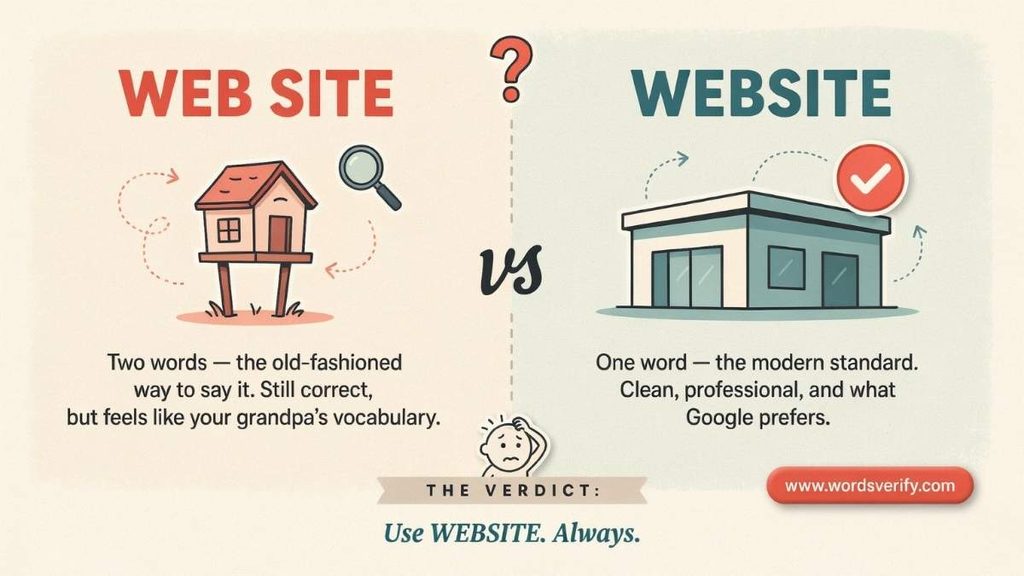
English doesn’t stay frozen.
Words and expressions change as people use them. Sometimes a change affects pronunciation or meaning. In other cases, it simply changes the way a word is written.
The history of website is a good example.
The World Wide Web was developed by Tim Berners-Lee at CERN, and the first website went online in 1991. During the early years of the web, internet terminology wasn’t always consistent because the technology itself was still new.
Different writers used different spellings for emerging terms.
Over time, website became increasingly common. As the internet became part of everyday life, the one-word form began to look more natural to readers.
Eventually, it became the standard modern spelling.
When Did Website Become One Word?
If you’re wondering when did website become one word, there isn’t one exact date when everyone suddenly changed the spelling.
The term appeared in the 1990s, and several spellings were used during that period. As usage developed, website became increasingly established.
This gradual change is typical of English.
Think about how quickly technology creates new vocabulary. Words that once sounded technical can become ordinary parts of everyday conversation. Once a term becomes familiar, people often shorten or combine it naturally.
That’s essentially what happened with website.
Website Preferred Spelling in Modern English
If you’re looking for the website preferred spelling, use website in contemporary writing.
This is particularly straightforward in American English.
Style guides and dictionaries provide useful evidence for this modern usage. For example, the Chicago Manual of Style uses and recommends the one-word form.
It’s also helpful to understand the difference between a dictionary and a style guide.
A dictionary records words, spellings, meanings, and usage information. A style guide provides recommendations for how writers should handle language in a particular editorial setting.
That distinction explains why an older spelling can still appear in historical material even though a modern style guide prefers a different form.
Website Correct Spelling Is It Website vs Web Site?
So, is it website or web site?
For modern American English, write:
website
It’s one word.
Here are some examples:
- The university redesigned its website.
- You can find the application on the website.
- The company’s website includes customer reviews.
- Several websites provide free learning resources.
- The school’s website contains admission information.
If you’re searching for the correct spelling website, the answer is straightforward: website.
Learn the difference between tricky more English words
Weeped vs Wept and which one is correct?
Is Website One Word?
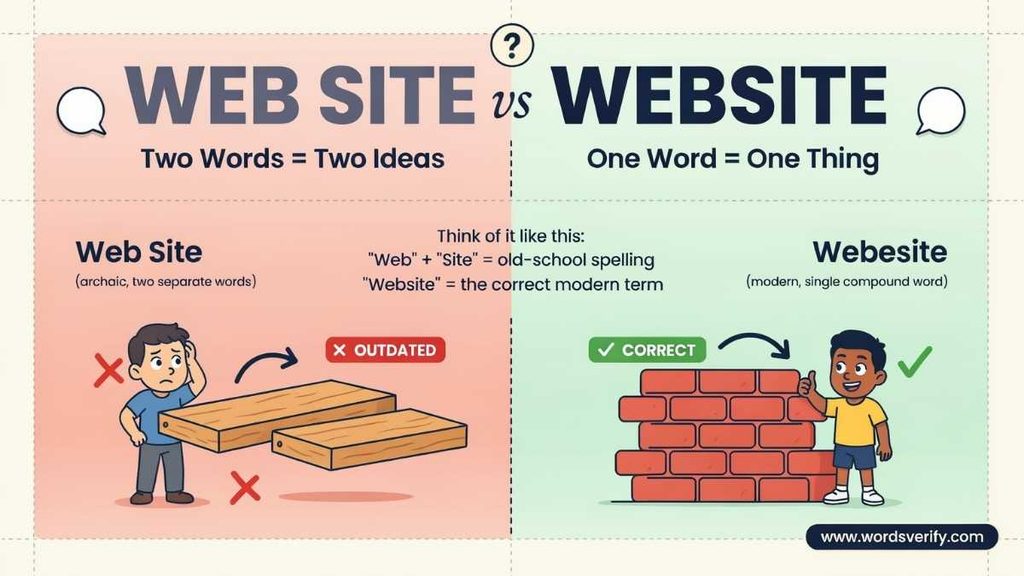
Yes. Website is one word.
That’s the simplest rule to remember.
Write:
website
Not:
web site
And normally not:
web-site
The plural follows the same pattern:
websites
For example:
- Many websites publish free educational material.
- Several websites cover the same topic.
- These websites offer different services.
You don’t need to separate the word when making it plural.
Is Web Site One Word or Two?
The answer depends on which form you’re talking about.
Website is one word.
Web site is two words.
Web-site is a hyphenated compound.
Here’s the difference at a glance:
| Form | Structure |
|---|---|
| website | One word |
| web site | Two words |
| web-site | Hyphenated |
If you’re writing in contemporary American English, website is the normal choice.
Website vs Web Site Comparison
| Feature | Website | Web site |
|---|---|---|
| Number of words | One | Two |
| Meaning | Site on the World Wide Web | Same basic meaning |
| Current usage | Common | Less common |
| Modern American English | Preferred | Older form |
| Historical material | Possible | Frequently encountered |
| Plural | Websites | Web sites |
| Normal modern choice | Yes | No |
This makes the website vs web site question much easier to understand.
The two forms don’t represent two different kinds of internet locations. They’re different spellings of essentially the same term.
Learn the difference between tricky more English words
Zeroes vs Zeros Which one is correct?
When Should You Use Website?
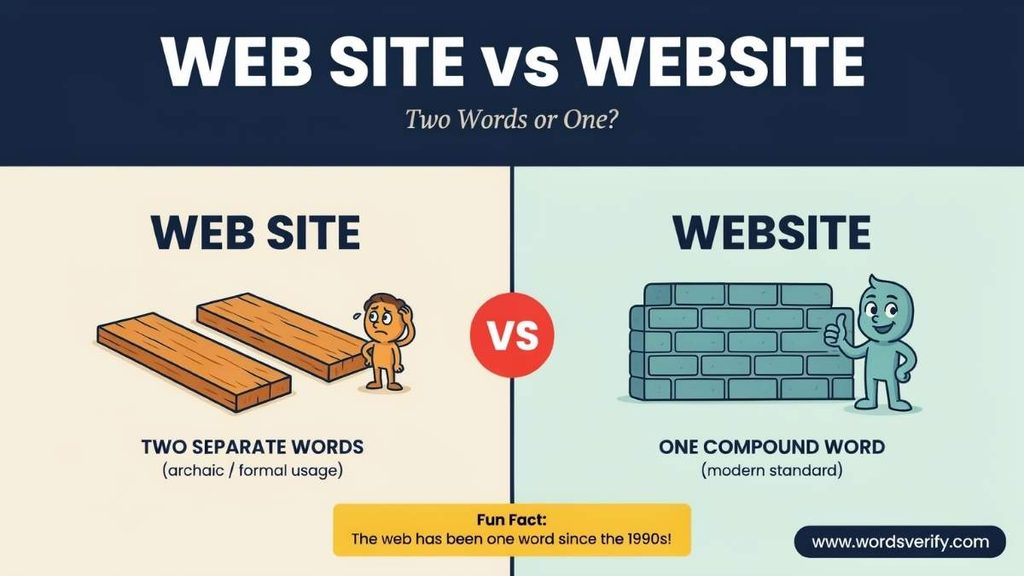
For almost all modern writing, use website.
It works naturally in:
- Emails
- School assignments
- College papers
- Business documents
- News writing
- Blog posts
- Marketing materials
- Technical documentation
- Resumes
- Everyday messages
For example:
The school website contains the application form.
The sentence looks natural because website has become the normal form in contemporary English.
Website in Professional Writing
Consistency matters in professional writing.
If you’re preparing a report, company document, newsletter, or business email, using the current standard spelling helps the writing feel polished.
For example:
The customer can manage the account through the website.
That’s the spelling most modern readers expect.
Website in Technical Writing
Technology writing uses the word constantly.
You might see:
- Website development
- Website design
- Website security
- Website hosting
- Website traffic
- Website accessibility
- Website content
- Website builder
- Website creation
- Website maintenance
For example:
The developer improved the website’s accessibility.
The company hired a designer to redesign its website.
In both cases, the spelling stays the same.
Learn the difference between tricky more English words
Hanukkah vs Chanukah Which one Is Correct?
When Might “Web Site” Still Appear?
Although website is the standard modern form, you may still encounter web site.
There are several reasons for this.
- Historical material: Older articles and books may use the spelling that was common at the time.
- Direct quotations: When quoting an older source, the original spelling may need to remain unchanged.
- Archived publications: Newspapers, manuals, and websites from the early days of the internet may use “web site.”
- Legacy style: Some organizations may retain older editorial conventions.
- Historical discussions: Writers describing the development of internet terminology may intentionally use older forms.
In these situations, there’s no need to pretend the older spelling never existed.
Language has a history, and old spellings can tell us something about how that history developed.
Is Web Site Grammatically Wrong?
Not exactly.
This is an important distinction between grammar and usage.
The phrase web site isn’t grammatically nonsensical. Readers understand it, and it has been used in published English.
However, something can be understandable and historically established without being the preferred spelling today.
For contemporary American English, website is the better default.
If you’re editing a modern article, changing “web site” to “website” usually makes the text more consistent with current usage.
If you’re reproducing an older source or quoting someone directly, keeping “web site” may be appropriate.
Context matters.
Is Web Site Outdated?
In contemporary writing, web site is generally considered an older form.
That doesn’t mean readers won’t understand it. They certainly will.
The issue is simply that website has become the normal spelling.
This happens frequently in English. Older forms don’t always disappear completely. Sometimes they survive in historical texts, specialized publications, or personal writing.
So “outdated” doesn’t necessarily mean “wrong.” It often means that another form has become more common and more widely preferred.
Website Spelling Rules to Remember
The website spelling rules are easy once you strip away the history.
- Write website as one word.
- Use websites for the plural.
- Don’t normally use web-site.
- Don’t normally use web site in contemporary writing.
- Follow your employer’s or publisher’s house style when one exists.
- Preserve older spelling when historical accuracy or a quotation requires it.
These rules will cover almost every situation you’ll face as a modern writer.
Learn the difference between tricky more English words
Creeped vs Crept Which One Is Correct?
Common Mistakes With Website Spelling
Mixing Website and Web Site
One of the most noticeable mistakes is switching between forms in the same piece of writing.
For example, a document might use “website” in one paragraph and “web site” in another.
Readers can still understand the meaning, but the inconsistency makes the writing look less polished.
Pick one modern form and use it consistently.
For contemporary writing, that form is website.
Using Web-Site
The hyphenated version has an older feel.
Modern English doesn’t normally need the hyphen in this word.
Unless you’re reproducing historical wording or following a specific style, website is the better choice.
Confusing Website With Web Page
A website and a web page aren’t the same thing.
A website can contain hundreds, thousands, or even millions of individual pages.
For example, a company’s website might include:
- A homepage
- An About page
- A contact page
- Product pages
- Blog articles
- Help pages
Each page forms part of the larger website.
Confusing Website With URL
A URL is an address used to locate a resource online.
A website is the larger online presence or collection of resources.
One website can have many URLs.
For example, the homepage can have one URL while the contact page has another.
Using an Apostrophe for the Plural
Don’t write:
website’s
when you simply mean more than one website.
Write:
websites
The apostrophe has a different job.
For example:
The website’s homepage loads quickly.
Here, “website’s” shows possession. The homepage belongs to the website.
But:
Several websites offer free courses.
Here, “websites” is simply plural.
Learn the difference between tricky more English words
Worshiped vs Worshipped Which one Is Correct?
Website vs Webpage What’s the Difference?
The terms website and web page are closely related, but they aren’t interchangeable.
A web page is a single page that you can access online.
A website is a larger collection that may contain many pages.
For example, an online newspaper may have one website containing thousands of articles. Each article may exist as an individual web page.
A useful way to remember the relationship is this:
Website = the larger collection
Web page = one individual page
The distinction becomes especially useful when you’re writing technical, educational, or professional content.
Website, Domain Name, Web Address and URL
Internet terminology can get confusing because several related terms often appear together.
They don’t all mean the same thing.
| Term | Meaning |
|---|---|
| Website | A collection of connected online content |
| Web page | One individual online page |
| Domain name | A human-readable name associated with an internet domain |
| URL | A specific address for an online resource |
| Homepage | The main or introductory page of a website |
| Web browser | Software used to access websites |
Suppose a company operates a website.
Its homepage has a URL. Its contact page has another URL. Individual product pages have additional URLs.
The website is the larger structure. The URLs help visitors reach specific resources within it.
Website Design and Website Development
The modern one-word spelling appears throughout technology and digital business.
You’ll commonly see phrases such as:
- Website design
- Website development
- Website creation
- Website builder
- Website generator
- Website HTML
- Website formatting
- Website security
- Website hosting
- Website maintenance
For example:
Good website design makes information easier to find.
The developer used HTML to structure the website.
The company chose a website builder to create its online presence.
Notice that website remains one word in each example.
A Brief Case Study How Website Became Standard
The history of website gives us a useful look at how English adapts to new technology.
When the World Wide Web appeared, people needed new words to describe unfamiliar concepts. Naturally, writers experimented with different forms.
During the early years of the web, terms such as “web site,” “web-site,” and “website” appeared in written material.
As internet use expanded, the terminology became more familiar.
The closed form eventually became the standard.
This kind of change isn’t unusual. English frequently combines words that people use together over and over.
Once a compound becomes familiar, readers may begin to recognize it as a single unit.
That’s essentially what happened with website.
Learn the difference between tricky more English words
Judgement vs Judgment Which one Is Correct?
What Do Style Guides Say About Website?
Style guides can help writers make consistent decisions about spelling and usage.
Chicago Manual of Style
The Chicago Manual of Style uses website and has guidance supporting the one-word form.
For writers who follow Chicago style, the choice is therefore straightforward.
Use website.
AP Stylebook
The AP Stylebook is widely used by journalists and other professional writers.
Its guidance is updated over time as editorial conventions change. Writers who follow AP style should check the current edition or online guidance for specific questions.
The broader point remains clear: website is the established modern spelling.
Merriam-Webster
Dictionaries play a different role from style guides.
A dictionary documents words, meanings, spellings, and usage. Merriam-Webster lists website as an established English word.
That supports what modern readers already see in everyday writing: the one-word spelling has become firmly established.
Learn the difference between tricky more English words
Wich vs Which what’s the difference?
Website Capitalization
Spelling and capitalization are separate issues.
In a normal sentence, write:
The website contains more information.
You don’t normally capitalize “website” simply because it relates to the internet.
At the beginning of a sentence, however, it becomes capitalized because English capitalization rules require the first word of a sentence to begin with a capital letter.
For example:
Website visitors can create an account.
In titles, capitalization depends on the style being used.
Website Examples in Everyday Writing
Here are some examples of the standard spelling:
- The company launched a new website.
- Visit the website for more information.
- Her website includes a portfolio.
- Several websites cover the topic.
- The school’s website provides admission information.
- The website was updated yesterday.
- Customers can contact support through the website.
- The team is improving the website design.
- The homepage is easy to navigate.
- The website contains useful resources.
The word fits naturally into all these sentences because website is now part of ordinary English.
A Simple Memory Trick
If you keep forgetting whether to use web site or website, don’t overthink it.
Remember this:
Modern writing = website.
That’s the rule worth remembering.
If you’re writing something today, the one-word spelling is the natural choice.
If you’re reading something older and see “web site,” the space isn’t a disaster. It’s simply a clue that the material may follow an older spelling convention.
Learn the difference between tricky more English words
Curtesy vs Courtesy Which one Is Correct?
Practice Session Web Site vs Website
Test yourself by filling in each blank with the correct word or phrase.
Fill in the Blanks
- Please visit our ______ for more information.
- The company launched a new ______ last month.
- The plural form of website is ______.
- In modern English, ______ is generally preferred over “web site.”
- “Web site” is written as ______ separate words.
- The hyphenated form “web-site” is an ______ spelling.
- You can find the application form ______ our website.
- I found the article ______ the internet.
- A website can contain many individual ______ pages.
- A specific address used to locate an online resource is called a ______.
- A website’s main or introductory page is usually called the ______.
- The standard modern spelling is written without a space or ______.
- A collection of connected online pages and content is called a ______.
- Several ______ provide free educational resources.
- A single page within a website is called a web ______.
- “Website” is normally written in ______ unless capitalization is required by the sentence.
- The phrase “on our ______” is grammatically natural when referring to information available there.
- A ______ name is the human-readable name associated with an internet domain.
- “Web site” may still appear in ______ publications and archived material.
- The standard expression is “______ the internet,” not “in the internet.”
- A website that allows users to buy products online is commonly called an online ______.
- Website, webpage, URL, and domain name are related but have ______ meanings.
- When writing modern American English, choose ______ instead of “web-site.”
- A web app usually provides more ______ functions than a basic informational website.
- If you’re unsure how to spell the word, remember: ______ is one word.
Answers
- website
- website
- websites
- website
- two
- older
- on
- on
- web
- URL
- homepage
- hyphen
- website
- websites
- page
- lowercase
- website
- domain
- older
- on
- store
- different
- website
- interactive
- website
Here’s a trusted source for clear more words Comparison:
FAQs
Is website one word or two words?
Website is one word. It is the standard modern spelling used in contemporary American English.
Which is correct, web site or website?
Website is the preferred modern spelling. Web site is an older two-word form that you may still encounter in older writing.
Is web site two words?
Yes. When written as “web site,” it consists of two separate words. However, modern English generally uses the single-word form “website.”
Is website one word in AP style?
Yes. AP style uses “website” as one word. Writers following AP style should use the current spelling consistently.
Why is website spelled as one word?
Website developed as a compound term during the growth of the World Wide Web. Although writers once used forms such as “web site” and “web-site,” the one-word spelling gradually became standard.
Is web site still acceptable?
You may encounter web site in older publications, archived material, historical writing, or legacy style conventions. For most modern writing, website is the preferred form.
Is web-site a correct spelling?
Web-site is an older hyphenated form. It is rarely needed in modern English, where website is the normal spelling.
What is the plural of website?
The plural of website is websites. For example, “Several websites provide free educational resources.”
Should website be capitalized?
Usually, website is written in lowercase unless it begins a sentence or appears in a context that requires capitalization. It isn’t normally capitalized simply because it refers to the internet.
Do you say “on a website” or “at a website”?
Use “on a website” when referring to information or content available there. For example, “I found the information on the website.”
Do you say “on our website” or “in our website”?
“On our website” is the standard expression. For example, “You can find the application form on our website.”
What is the difference between a website and a web page?
A website is a collection of connected online pages and content, while a web page is one individual page within that website.
Is a website the same as a URL?
No. A website is an online collection of content, while a URL is a specific web address used to locate a particular resource, such as a page or file.
Is a domain name the same as a website?
Not exactly. A domain name is the human-readable name associated with a domain, while a website is the online content and structure accessed through it.
What are the different types of websites?
Common types include business websites, news websites, educational websites, blogs, online stores, government websites, portfolio sites, forums, and social networking sites.
What is another name for a website?
Depending on the context, a website may be called a web presence, web property, internet site, or site. However, these terms aren’t always exact synonyms.
What is another word for “site”?
In an internet context, site can mean a website. In other contexts, site can mean a location, place, or area, so the intended meaning depends on the sentence.
Why is a website called a “web” site?
The term comes from the World Wide Web. Websites are connected through the web, which is why “web” became part of the terminology used to describe them.
Are web apps the same as websites?
No. A website primarily presents information or content, while a web app usually provides interactive functions that allow users to perform tasks. The two can overlap, so the distinction isn’t always absolute.
Can a website also be a web app?
Yes. Some websites include extensive interactive features and can function like web applications. The distinction depends on what users can do rather than simply how the site looks.
What is an example of a web page?
A company’s About page, a news article, a product page, or a contact page can each be an individual web page within a larger website.
What is the difference between a website and an internet site?
Website is the standard modern term for a collection of online pages and content available through the World Wide Web. Internet site is understandable but less common as a general term.
Do you say “on the internet” or “in the internet”?
The standard expression is “on the internet.” For example, “I found the article on the internet.”
Is “website grammar” different from ordinary English grammar?
No. The word website follows normal English spelling and usage rules. Questions about it mainly involve compound-word spelling, capitalization, pluralization, and prepositions.
How do you spell website correctly?
Spell it as website: one word, with no space and no hyphen. The plural is websites.
What is the difference between website and web site spelling?
The difference is simply how the compound is written. Website is one word, while web site is two words. The one-word form is the standard modern spelling.
When should I use website instead of web site?
Use website in modern emails, academic writing, professional documents, articles, websites, and everyday communication unless a particular style or historical context requires the older form.
Learn the difference between tricky more English words
Indexes vs Indices which one is correct?
conclusion
The web site vs website debate may seem like a tiny spelling question, but that little space has created plenty of unnecessary confusion. Fortunately, modern English makes the choice simple: use “website” as one word.
“Web site” has a legitimate history and may still appear in older books, archived articles, quotations, or legacy writing. However, it isn’t the form most writers would choose today. The hyphenated “web-site” is even less common.
So, whether you’re writing an email, school assignment, business document, or article, stick with “website.” One word, no hyphen, and no need for a grammar detective to solve the case. Sometimes English really does give us an easy answer.

Lisa AJS is an experienced blogger and language enthusiast at Words Verify, dedicated to making grammar simple, practical, and enjoyable. She writes engaging content on commonly confused words, grammar mistakes, word meanings, and everyday language challenges.