
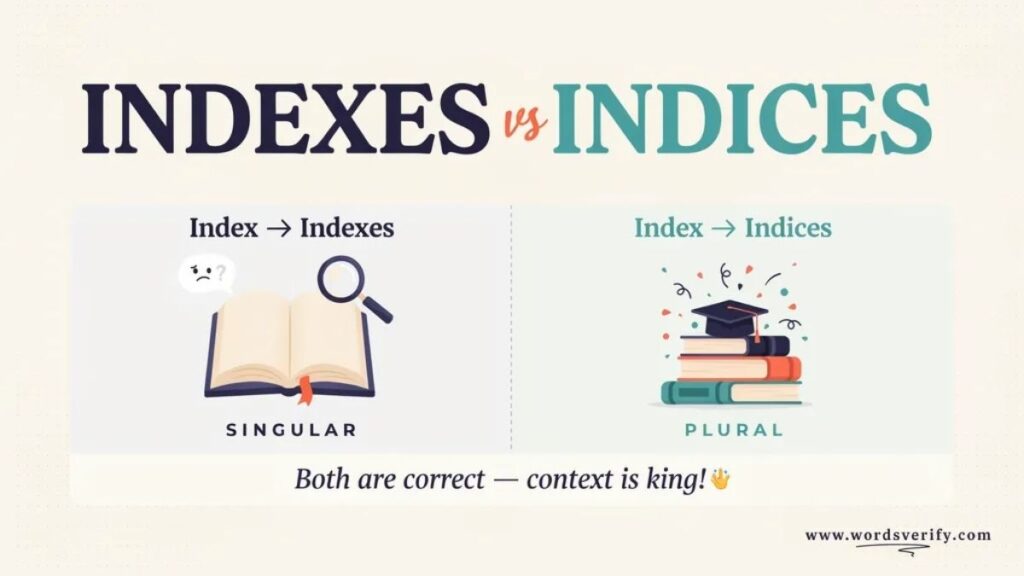
Ever typed indexes vs indices and then wondered whether one tiny word was about to expose a grammar mistake? You’re not alone. English has a funny way of turning simple plurals into surprisingly tricky choices. Luckily, this one doesn’t require a grammar detective. Both indexes and indices are correct plural forms of index, but they’re often used in different contexts. Indexes is common in everyday writing, books, databases, and computing, while indices appears frequently in mathematics, science, economics, and finance. In this guide, you’ll learn how the two forms differ, avoid common mistakes, and choose the right one with confidence.
Quick Answer
The plural of index is either indexes or indices.
Indexes follows the regular English pattern of adding -es to a word ending in x.
Indices comes from the traditional Latin plural of index. English has kept that older form, particularly in technical and academic language.
| Singular | Plural | Common contexts |
|---|---|---|
| index | indexes | General English, books, databases, computing |
| index | indices | Mathematics, science, economics, statistics, finance |
For example:
- The book contains several indexes.
- The database uses several indexes.
- Researchers compared several scientific indices.
- Investors followed several stock market indices.
All four sentences are correct.
The important point is that indexes isn’t a mistake, and indices isn’t automatically the better or more formal choice.
What Does Index Mean?
Before looking at the plural forms, it helps to understand what index means.
An index can be a list, a reference point, a measurement, or a way of identifying something. The exact meaning changes depending on the subject.
A book index, for example, helps you find information quickly. A database index helps software locate records. In mathematics, an index can identify a particular item in a sequence or structure. In economics, an index can represent changes in a particular group of measurements.
Here are a few examples:
- The textbook has an index at the back.
- The database uses an index to locate records.
- The index identifies a particular element in the sequence.
- The price index measures changes in prices.
The word stays the same, but its meaning shifts with the context.
That’s one reason you’ll encounter both plural forms across different subjects.
Indexes Definition and Examples
Indexes is the regular English plural of index.
It can refer to multiple reference lists, database structures, measurements, or positions.
For example:
- The encyclopedia contains several indexes.
- The library updated its alphabetical indexes.
- The database has several indexes.
- The software searches its indexes quickly.
- The program stores the indexes of matching elements.
In each sentence, indexes functions as a plural noun.
Indexes as a Noun
When you use indexes as a noun, you’re talking about more than one index.
For example:
The reference book contains separate indexes for names and subjects.
Here, indexes means multiple reference lists.
You can use the same form when discussing databases:
The administrator created three indexes for the database.
Again, indexes refers to several things.
Indexes as a Verb
There’s an interesting little wrinkle here: indexes can also be a verb.
For example:
The search engine indexes new pages every day.
Here, indexes doesn’t mean several lists. It describes an action.
The same applies to software:
The application indexes the files automatically.
This gives indexes two possible grammatical roles:
| Example | Role |
|---|---|
| The book contains several indexes. | Plural noun |
| The software indexes the files. | Verb |
That second use is especially common in computing.
Understand confusing English more words simply
Learnt vs Learned What’s the Difference?
Indices Definition and Examples

The Indices is another accepted plural of index.
It comes from the traditional Latin form and remains widely used in English, especially in specialized subjects.
For example:
- Scientists compared several environmental indices.
- Economists examined different price indices.
- Investors followed several market indices.
- The equation contains multiple indices.
- Researchers developed new health indices.
In each example, indices is simply the plural of index.
The word may look more unusual if you mostly read general English, but it’s completely standard.
Why Does Index Have Two Plurals?
This is where the history of English enters the picture.
The word index comes from Latin. The traditional Latin plural is indices.
When English borrowed the word, it retained that traditional plural. Over time, English speakers also began treating index like an ordinary English noun and formed the plural indexes.
Both forms survived.
That’s why modern English has:
index → indexes
and
index → indices
This kind of variation isn’t particularly strange in English. The language has borrowed thousands of words from other languages, and some retained older plural forms while also developing regular English ones.
So, knowing that indices is the traditional Latin plural explains where the word came from. It doesn’t make indexes incorrect.
Understand confusing English more words simply
Canceled vs Cancelled Which one Is Correct?
Indexes vs Indices What’s the Difference?
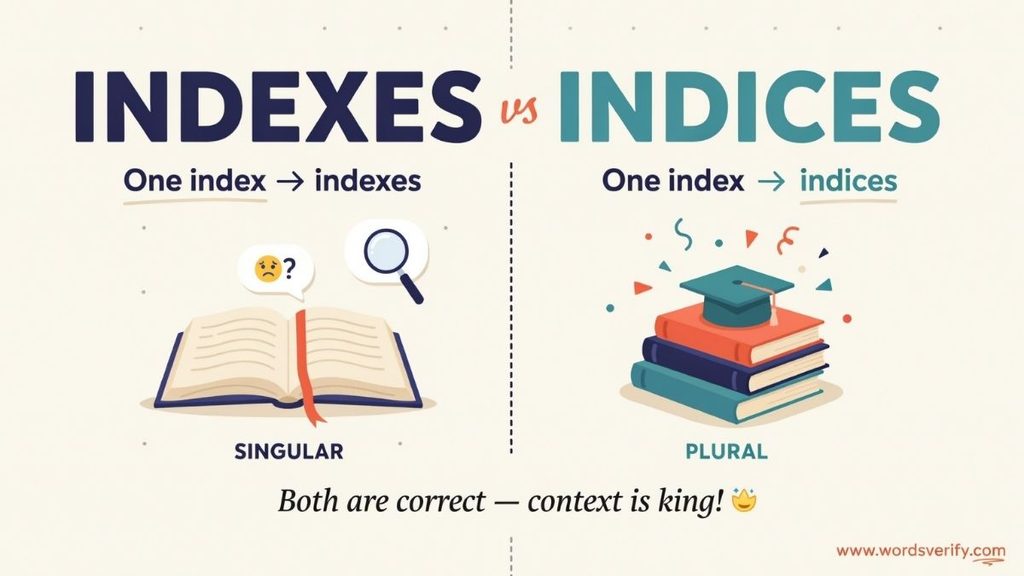
The main difference between indexes vs indices is usage, not correctness.
In broad terms, indexes is more common in everyday and practical contexts. Indices appears more often in technical, mathematical, and academic contexts.
That gives us a useful general pattern:
| Context | Common choice |
|---|---|
| Books | indexes |
| Catalogs | indexes |
| Databases | indexes |
| Computing | indexes |
| Programming | indexes |
| Mathematics | indices |
| Science | indices |
| Statistics | indices |
| Economics | indices |
| Finance | indices |
But treat this as a guide, not a rigid grammar rule.
You can find indexes in scientific or academic writing, just as you can find indices outside highly technical subjects.
Language isn’t always as tidy as a two-column chart.
Indexes vs Indices in Books
When you’re talking about books, indexes is a very natural choice.
A book index usually appears near the end of a nonfiction work. It gives readers an alphabetical list of important subjects, names, places, or concepts and shows where those topics appear.
For example:
| Index entry | Pages |
|---|---|
| Climate change | 24, 57, 103 |
| Energy | 31, 64, 117 |
| Renewable energy | 72, 89, 121 |
| Solar power | 75, 94, 126 |
A large reference book might even contain multiple indexes, such as:
- Subject indexes
- Name indexes
- Author indexes
- Geographic indexes
- Keyword indexes
- Catalog indexes
In this setting, indexes is straightforward and familiar.
You may encounter indices in publishing as well, but there’s no need to replace indexes just because indices sounds more traditional.
Indexes vs Indices in Mathematics
Mathematics is one area where indices is especially common.
An index can identify a particular member of a sequence or another mathematical structure.
For example:
The numbers identify individual members of the sequence. In mathematical writing, you may see these called indices.
You’ll encounter the term in discussions of:
- Sequences
- Matrices
- Arrays
- Tensors
- Summations
- Mathematical notation
There’s one important detail here. An index isn’t necessarily the same thing as an exponent.
Consider:
The 4 is an exponent, because it tells you that x is raised to the fourth power.
Now consider:
The i identifies a particular element of a sequence or collection.
Depending on the mathematical context, the terminology can overlap in ways that confuse beginners. The safest approach is to look at what the symbol is actually doing.
Indexes vs Indices in Science
Scientific writing frequently uses indices for measurements or calculated values.
A scientific index can combine several measurements into a single number. Researchers can then use that number to compare conditions, populations, locations, or changes over time.
For example, researchers might develop an environmental index using information about air quality, water quality, soil conditions, and other factors.
When discussing several such measurements, indices is common.
You may encounter terms such as:
- Environmental indices
- Biological indices
- Diversity indices
- Health indices
- Scientific indices
Still, don’t assume that indexes becomes incorrect simply because you’re writing about science.
The field’s established terminology matters more than an absolute rule about the plural.
Indexes vs Indices in Economics
Economics uses indexes to represent changes in groups of related measurements.
A price index, for example, can help describe how prices change over time.
When discussing multiple measures, economists commonly use indices.
You might see phrases such as:
- consumer price indices
- economic indices
- price indices
- production indices
However, indexes also appears in economic writing.
The important thing is to follow the terminology used by the publication, institution, textbook, or audience you’re writing for.
Indexes vs Indices in Finance
Finance provides another context where both forms appear.
A stock market index represents the performance of a selected group of securities. Different indexes can represent different parts of a market.
When talking about more than one, you’ll often encounter stock market indices.
For example:
Investors monitored several international stock market indices.
You can also find stock market indexes, particularly in general-audience financial writing.
The plural doesn’t change the meaning of the financial instrument. It’s simply a different plural form of index.
Indexes vs Indices in Computing
If you work with computers, indexes will probably look very familiar.
A database index is a structure that helps a database locate information efficiently.
Imagine a customer database with millions of records. If users frequently search for customers by email address, a database administrator might create an index for that column.
The database can then use the index to locate relevant records without examining every record in the same way.
That’s why computing terminology commonly includes phrases such as:
- Database indexes
- Search indexes
- Unique indexes
- Composite indexes
- Indexing
- Index scans
In ordinary computing discussions, indexes is often the more familiar choice.
Indexes vs Indices in Programming
Programming uses index in a slightly different but related way.
An index can identify the position of an element inside a sequence, list, or array.
Suppose you have:
["red", "blue", "green"]
With zero-based indexing, the positions are:
| Index | Value |
|---|---|
| 0 | red |
| 1 | blue |
| 2 | green |
So, the word blue has an index of 1.
When discussing several positions, programmers commonly use indexes:
The program checks the indexes of the matching elements.
Technical documentation may also use indices, particularly when it follows mathematical terminology.
So, indexes vs indices in programming isn’t a question of right versus wrong. Both can appear, although indexes is very common in everyday programming language.
Indexes vs Indices in Python
Python uses zero-based indexing for common sequence types such as lists and strings.
For example:
fruits = ["apple", "banana", "orange"]
The positions are:
| Index | Item |
|---|---|
| 0 | apple |
| 1 | banana |
| 2 | orange |
The first element is at index 0.
Python programmers commonly say indexes when discussing multiple positions. However, indices also appears in technical discussions.
For example:
The indexes identify the positions of the matching elements.
and
The indices identify the positions of the matching elements.
Both can be understood in the programming context.
Indexes vs Indices for Arrays
Arrays provide another clear example.
Consider:
scores = [95, 88, 91, 76]
The array positions are:
| Index | Value |
|---|---|
| 0 | 95 |
| 1 | 88 |
| 2 | 91 |
| 3 | 76 |
The index tells you where an element appears.
Programming discussions commonly use indexes, while mathematical writing often favors indices.
The difference is mostly one of convention and audience.
Understand confusing English more words simply
Finaly vs Finally Which one Is Correct?
Indexes vs Indices in British English
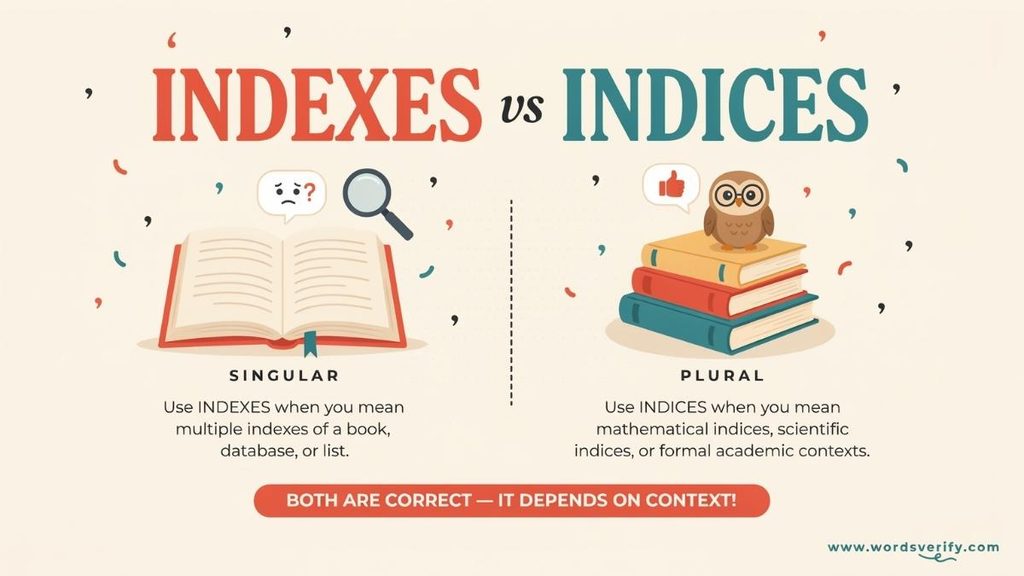
Both forms are accepted in British English.
There isn’t a rule saying British English must use indices while American English must use indexes.
British writers use both forms depending on the context.
For example:
The book contains several indexes.
is perfectly acceptable.
So is:
Researchers compared several economic indices.
The subject matter plays a much bigger role than geography.
Understand confusing English more words simply
Aide vs Aid which one is correct?
Indexes vs Indices in American English
American English also accepts both forms.
Indexes is especially common in general writing, publishing, computing, and databases.
Indices remains common in mathematics, science, economics, statistics, and finance.
For example:
The software creates indexes for frequently searched fields.
and:
The researchers compared several economic indices.
Both sentences use standard English.
Understand confusing English more words simply
Sneek vs Sneak Which one is Correct?
Indexes or Indices in Legal Writing
Legal writing can use either form.
A legal reference work might contain indexes of cases, statutes, regulations, or legal subjects.
On the other hand, a legal document dealing with financial or economic data might refer to indices.
For example:
The report compares several economic indices.
The best choice depends on the terminology used in the particular legal or professional context.
There’s no rule that says indices is automatically more appropriate simply because legal writing tends to be formal.
Is Indexes Correct?
Yes. Indexes is correct.
It is a standard English plural of index.
Examples include:
- The book contains several indexes.
- The library maintains subject indexes.
- The database uses multiple indexes.
- The program checks several indexes.
Remember that indexes can also be a verb:
The search engine indexes new pages every day.
That distinction is worth remembering because indices cannot normally replace indexes when you’re using index as a verb.
You wouldn’t write:
The search engine indices new pages.
For the verb, indexes is the standard form.
Is Indices Correct?
Yes. Indices is correct, too.
It’s the traditional plural form inherited from Latin and remains standard English.
Examples include:
- Scientists compared several indices.
- Economists studied price indices.
- Investors followed market indices.
- The equation contains several indices.
If you see indices in a mathematics textbook or research paper, there’s nothing unusual about it.
What Is the Correct Plural of Index?
The correct plural of index is either indexes or indices.
So if someone asks, “What is the plural form of index?” the answer is:
Index → indexes or indices
There’s no need to memorize one as correct and the other as incorrect.
Instead, remember that the two forms developed through different paths:
Indexes is the regular English plural.
Indices is the traditional Latin-derived plural.
Both are now established in English.
Understand confusing English more words simply
Crier vs Cryer Which one Is Correct?
Common Mistakes With Indexes and Indices
Even though the rule is simple, a few mistakes come up repeatedly.
1. Assuming One Form Is Wrong
This is the most common misunderstanding.
Someone sees indices and assumes it must be the only correct plural because it looks more traditional.
Another person sees indexes and assumes indices must be incorrect because it doesn’t follow the usual English plural pattern.
Both assumptions miss the point.
Both forms are valid.
2. Using Indices Just to Sound Formal
A more unusual word isn’t automatically a better word.
If you’re talking about the indexes at the back of a book, indexes is clear and natural.
Using indices simply because it sounds sophisticated can make ordinary writing feel unnecessarily stiff.
Good writing should sound natural to the people reading it.
3. Switching Between Forms Without a Reason
If you’re writing about database structures, choose the form that fits your audience and use it consistently.
For example:
The database uses three indexes. These indexes improve search performance.
There’s no need to suddenly switch to indices in the next sentence.
Consistency makes technical writing easier to follow.
4. Forgetting That Indexes Can Be a Verb
Remember:
The system indexes the files.
Here, indexes is a verb.
It means the system creates or maintains an index for the files.
Indices cannot be used in that grammatical role.
Understand confusing English more words simply
Labelling vs Labeling Which one Is Correct?
When Should You Use Indexes?
If you’re wondering when to use indexes instead of indices, think about ordinary English and practical reference systems.
Indexes is particularly natural when you’re talking about:
- Books
- Catalogs
- Libraries
- Databases
- Search systems
- Websites
- Computing
- Programming
- General reference lists
For example:
The encyclopedia contains several indexes.
The database has separate indexes for frequently searched fields.
The program records the indexes of matching values.
In these situations, indexes usually feels straightforward and familiar.
Understand confusing English more words simply
Manuel vs Manual which one is correct?
When Should You Use Indices?
Use indices when it matches the terminology of your field or audience.
It’s especially common in:
- Mathematics
- Science
- Statistics
- Economics
- Finance
- Academic research
- Technical writing
For example:
The researchers compared several scientific indices.
The economists analyzed several price indices.
The equation contains multiple indices.
Again, this is a matter of convention rather than a strict rule.
A Simple Way to Remember the Difference
Here’s an easy memory trick:
Indexes = everyday and practical contexts
Think about books, databases, websites, and computer programs.
Indices = specialized and technical contexts
Think about mathematics, science, economics, and finance.
The trick won’t cover every possible sentence, but it will get you close in most situations.
When in doubt, check the terminology normally used by your field or publication.
Indexes vs Indices Which One Should You Choose?
If you’re still stuck between the two, ask yourself one simple question:
What am I talking about?
If you’re talking about a book’s reference pages, a database, a catalog, or a computer program, indexes will often be the natural choice.
If you’re discussing mathematical notation, scientific measurements, economic indicators, or financial markets, indices may fit the terminology better.
But neither form is automatically superior.
The choice is about usage, audience, and context.
Understand confusing English more words simply
Potatoes vs Potatos Which one Is Correct?
Practice Session Indices vs Indexes
Fill in each blank with index, indices, or indexes.
- The book contains an alphabetical ______ at the back.
- Several financial ______ showed changes in the market.
- The plural of “index” can be written as “______” or “indices.”
- Scientists compared several health ______ in their study.
- The library uses computer ______ to organize its records.
- In mathematics, the plural form “______” is commonly used.
- The author added an ______ to help readers find important topics.
- Several economic ______ were analyzed in the report.
- The database contains multiple ______ of customer information.
- “Index” is the singular form, while “______” is one of its plural forms.
- The researchers examined different statistical ______.
- The textbook includes detailed ______ at the end of each chapter.
- A price ______ can be used to track changes in the cost of goods.
- The scientist compared several performance ______.
- The search system creates alphabetical ______ for the documents.
- In this mathematical expression, the ______ identifies the position of a term.
- The report discusses several stock-market ______.
- The publisher created separate ______ for names and subjects.
- The word “indices” refers to more than one ______.
- Economists use various ______ to measure changes in prices.
- The website has several ______ that help users locate information.
- Each ______ provides a different way to organize the data.
- The researchers collected data from several social ______.
- The glossary and ______ make the textbook easier to navigate.
- Both “indices” and “______” are accepted plural forms of “index.”
Answer Session
- index
- indices
- indexes
- indices
- indexes
- indices
- index
- indices
- indexes
- indexes
- indices
- indexes
- index
- indices
- indexes
- index
- indices
- indexes
- index
- indices
- indexes
- index
- indices
- indexes
- indexes
Here’s a trusted source for clear more words Comparison:
FAQs
Are indices and indexes the same thing?
Yes. Both are plural forms of the noun index. In many contexts, they can be used interchangeably. The preferred form often depends on the field and the variety of English.
How do you pluralize index?
You can pluralize index as either indexes or indices. Both forms are established in English.
Is indices singular or plural?
Indices is plural. The singular form is index.
Is indexes a correct plural of index?
Yes. Indexes is a standard English plural and is especially common when referring to lists, databases, catalogs, or multiple alphabetical indexes.
Is indices a correct plural of index?
Yes. Indices is a standard plural, traditionally derived from Latin. It’s especially common in mathematics, science, economics, and finance.
Why is the plural of index indices?
Indices comes from the Latin plural form of index. English retained this classical plural alongside the regular English form indexes.
Why do some people say indices instead of indexes?
The choice often depends on context and professional convention. For example, mathematicians and financial writers frequently use indices, while database and publishing contexts often use indexes.
What is the difference between indexes and indices?
There is usually no difference in basic meaning. Both refer to more than one index. However, particular fields may favor one form over the other.
What is an index in simple words?
An index is an organized list or system that helps you find, measure, or track something. A book index helps you locate topics, while a stock index tracks a group of investments.
What is an example of an index?
A book’s alphabetical list of topics and page numbers is one example. In finance, the S&P 500 is an example of a stock-market index.
What is more than one index called?
More than one index can be called indexes or indices. Both are grammatically correct plurals.
Do you say stock indices or stock indexes?
Both expressions are correct. Stock indices is common in financial writing, while stock indexes is also widely used.
Is “indices” only used in mathematics?
No. Indices appears in mathematics, but you can also find it in finance, economics, statistics, science, and other technical fields.
Is “indexes” only used for books?
No. Indexes can refer to many types of indexes, including book indexes, database indexes, search indexes, and financial indexes.
What is another word for an index?
The best alternative depends on the meaning. Possible words include list, catalog, guide, indicator, measure, directory, or reference, but they aren’t exact replacements in every context.
What is an index also called in finance?
A financial index can also be described as a market index, stock-market index, or benchmark, depending on what it measures and how it’s being used.
What is another name for indices?
There isn’t one universal replacement. Depending on the context, indexes, indicators, benchmarks, or measures may work.
Is index the same as indices?
No. Index is singular, while indices is plural.
Can “indexes” and “indices” be used in the same document?
Yes, but consistent usage usually makes formal writing easier to read. If a particular field or style guide favors one form, follow that convention throughout the document.
When should you use “indices” instead of “indexes”?
Indices is often preferred in mathematical, scientific, economic, and financial contexts. However, this isn’t a universal grammar rule. Indexes can also be correct.
When should you use “indexes” instead of “indices”?
Indexes is often natural when referring to book indexes, database indexes, search systems, or other organized lists. Again, context and professional style can influence the choice.
Is “indices” more formal than “indexes”?
Not necessarily. Indices may sound more technical in some contexts because professional fields commonly use it. However, indexes is also standard English and isn’t inherently informal.
Is “indexes” wrong in financial English?
No. Indexes is grammatically correct in financial writing. Indices is also widely used, so either form may appear depending on the publication or writer.
Is “indices” wrong in American English?
No. American English uses indices, particularly in technical and academic contexts. Indexes is also common, especially for certain types of lists and databases.
What is the difference between an index and an indicator?
An index usually combines or organizes information to represent something, while an indicator generally provides a sign or measurement of a particular condition. The terms can overlap in some contexts, but they aren’t always interchangeable.
What is the plural of index in mathematics?
In mathematics, indices is commonly used as the plural of index. Indexes is still grammatically possible in English, depending on the context and style.
What is the plural of index in a book?
For books, indexes is a very common plural form. Indices can also be used, although it may sound more specialized depending on the context.
What is the plural of index in computing?
In computing, indexes is commonly used, particularly for database indexes and search indexes. Indices can also appear in technical writing.
Can index have different meanings?
Yes. Index can refer to a list in a book, a database structure, a mathematical value or position, or a statistical or financial measure. The plural form can vary with context.
Why does English have two plurals for index?
English has kept the Latin-derived indices while also developing the regular English plural indexes. Both forms became established, with different fields developing their own preferences.
Understand confusing English more words simply
Moulding vs Molding which one is correct?
Conclusion
Still wondering whether it’s indexes vs indices? Good news: you don’t have to pick a winner. Both are correct plural forms of index, so this is one of those English grammar puzzles that looks harder than it really is.
Indexes is the regular English plural and works naturally in everyday writing, books, catalogs, databases, computing, and programming. Indices is the traditional Latin-derived form and is especially common in mathematics, science, statistics, economics, and finance.
The common mistake is assuming that indices is the “proper” version and indexes is somehow wrong. It isn’t. Likewise, using indices everywhere just to sound more formal isn’t necessary.
When choosing between them, think about your context and your readers. Follow the terminology commonly used in your field, and stay consistent throughout your writing.
So, the next time index needs a plural, you can relax. Indexes and indices are both grammatically correct. English may have given you two doors, but luckily, neither one leads to a grammar disaster.

Lisa AJS is an experienced blogger and language enthusiast at Words Verify, dedicated to making grammar simple, practical, and enjoyable. She writes engaging content on commonly confused words, grammar mistakes, word meanings, and everyday language challenges.