
Have you ever written “canceled” and wondered if an extra “l” had mysteriously disappeared? Then you spot “cancelled” somewhere else and suddenly question everything you learned about spelling. The canceled vs cancelled confusion is surprisingly common, but the answer is simpler than it looks. Both spellings are correct; they simply belong to different English varieties. American English generally uses “canceled,” while British English typically uses “cancelled.” In this guide, you’ll discover why the spellings differ, how grammar rules shape each form, and which version to choose for your audience.
Quick Answer
Both canceled and cancelled are correct spellings. The difference comes from regional English conventions.
- Canceled is the standard spelling in American English.
- Cancelled is the standard spelling in British English and is also common in Australian and Canadian English.
- Both words have the same meaning and function as the past tense and past participle of cancel.
- The same pattern appears with canceling and cancelling.
For example:
American English: The flight was canceled.
British English: The flight was cancelled.
So, if you’re wondering canceled or cancelled which is correct, choose the spelling that matches your audience and keep it consistent throughout your writing.
Canceled vs Cancelled What Is the Difference?
The difference between canceled vs cancelled isn’t a difference in meaning or grammar. Both words are forms of the verb “cancel.”
The main distinction is how different varieties of English spell the word.
| Form | Common usage | Example |
|---|---|---|
| Canceled | American English | The flight was canceled. |
| Cancelled | British English | The flight was cancelled. |
| Cancelled | Australian English | The event was cancelled. |
| Cancelled | Common Canadian usage | The appointment was cancelled. |
So, if you’re asking, “Is canceled or cancelled correct?” the answer depends on the English variety you’re using.
For American English, use canceled.
For British English, use cancelled.
Neither spelling is automatically wrong.
What Does “Canceled” Mean?
The canceled meaning is simple. It describes something that was planned, arranged, scheduled, or ordered but will no longer happen.
For example:
The airline canceled the flight.
The flight had been scheduled, but the airline decided it wouldn’t operate.
The word can describe many everyday situations, including:
- A canceled appointment
- A canceled flight
- A canceled event
- A canceled meeting
- Canceled plans
- A canceled order
- A canceled subscription
- A canceled class
The word comes from the verb “cancel,” which means to stop something that had been planned or arranged.
For example:
She canceled her doctor’s appointment.
The appointment existed on the schedule. She then decided it should no longer take place.
What Does “Cancelled” Mean?
The cancelled meaning is exactly the same.
The only difference is the spelling.
In British English, you might see:
She cancelled her doctor’s appointment.
An American reader would usually expect:
She canceled her doctor’s appointment.
Both sentences mean the same thing.
This is why it helps to think of canceled and cancelled as regional versions of the same word, rather than as two different words with different definitions.
Why Is Cancelled Spelled With Two Ls?
If you’ve wondered why is cancelled spelled with two l’s, the answer lies in English spelling conventions.
British English generally keeps the double “l” when forming the past tense and present participle of “cancel.”
That gives you:
- cancel
- cancelled
- cancelling
American English commonly uses:
- cancel
- canceled
- canceling
This difference developed as American English and British English developed their own spelling conventions.
It’s not simply a case of one country adding an unnecessary letter. Both patterns have become established forms of English spelling.
Why Is Canceled Spelled With One L?
The question why is canceled spelled with one l has a similar answer.
American English generally uses one “l” in the past-tense and present-participle forms:
- canceled
- canceling
This is now the normal American spelling.
For example:
The school canceled classes because of the storm.
You wouldn’t normally write “cancelled” in standard American English unless you’re deliberately following another spelling convention or reproducing someone else’s wording.
So when you see the American spelling canceled, that missing second “l” isn’t a mistake.
Learn how to use confusing more words correctly
Finaly vs Finally Which one Is Correct?
Canceled American English vs Cancelled British English
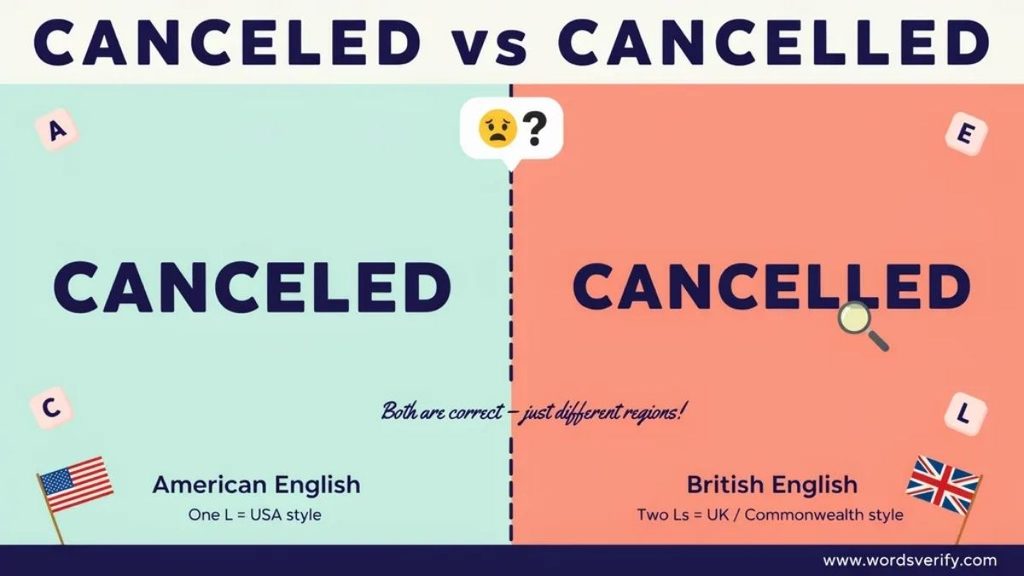
The easiest way to remember the difference is to connect each spelling with its main regional variety.
American English
American English generally uses:
- cancel
- canceled
- canceling
- cancellation
British English
British English generally uses:
- cancel
- cancelled
- cancelling
- cancellation
Notice something interesting: “cancellation” keeps two “l”s in both common varieties.
English spelling doesn’t always behave like a perfectly neat mathematical formula. That’s why memorizing the most common forms can be more useful than trying to force every word into one spelling rule.
Canceled vs Cancelled in American English
When comparing canceled vs cancelled American English, canceled is the usual choice.
Here are some natural examples:
- The airline canceled the flight.
- The manager canceled the meeting.
- We canceled our plans.
- The store canceled my order.
- She canceled her appointment.
- The school canceled classes for Friday.
If you’re writing for an American audience, these forms will look natural and familiar.
American newspapers, businesses, schools, websites, and everyday writers commonly use the one-L spelling.
Canceled vs Cancelled in British English
British English writers usually choose cancelled over canceled
Examples include:
- The railway station cancelled the train.
- She cancelled her appointment.
- The organizers cancelled the concert.
- They cancelled their holiday plans.
- The shop cancelled the order.
- bad weather cancelled the outdoor meeting.
If you’re writing for a British audience, “cancelled” is the spelling readers will generally expect.
What About Canadian English?
Canadian English can sometimes make spelling questions a little more complicated because it contains influences from both American and British English.
Cancelled and cancelling are widely used in Canadian English.
That means Canadian English cancelled is a familiar and accepted form.
However, Canadian spelling isn’t identical to British spelling in every situation. Different publications and organizations can also follow different style guides.
So if you’re writing for a Canadian audience, the safest approach is to follow the style guide used by the publication, school, company, or organization.
What About Australian English?
Australian English commonly uses the double-L forms:
- cancelled
- cancelling
For example:
The flight was cancelled because of severe weather.
You can also see “cancelled” in Australian business writing, news reporting, travel information, and everyday communication.
This follows a broader pattern in Australian English, which shares many spelling conventions with British English.
Learn how to use confusing more words correctly
Aide vs Aid which one is correct?
Is Canceled or Cancelled Correct in International English?
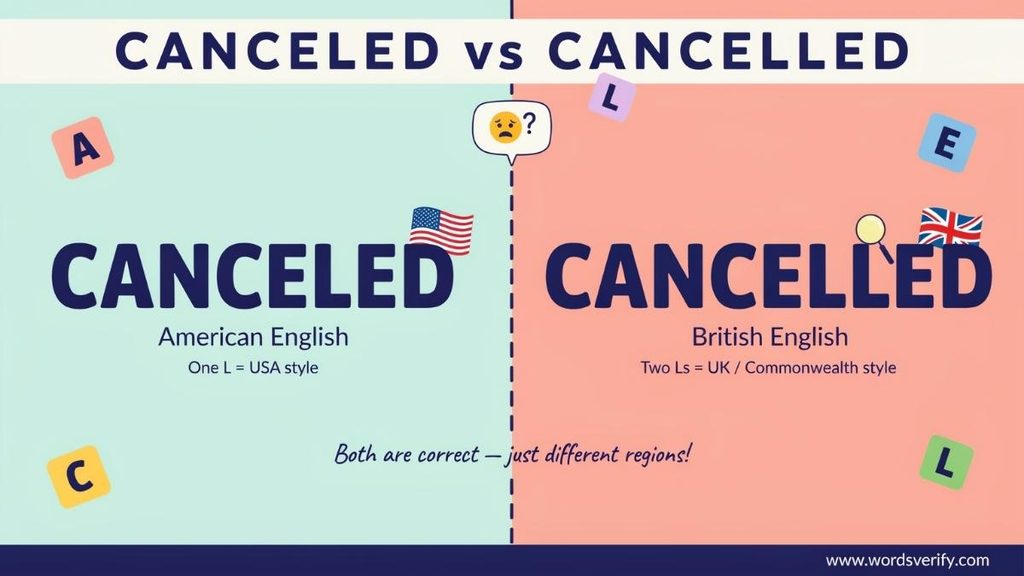
International English doesn’t have one single spelling system that every country follows.
Instead, English has developed into several major regional varieties.
1.A reader in the United States may expect:
canceled
2.A reader in the United Kingdom may expect:
cancelled
3.A reader in Australia may also expect:
cancelled
A Canadian reader may encounter either form depending on the publication or style being followed.
That’s why consistent spelling matters so much.
If a document begins with American spelling, continue using American spelling. If it follows British spelling, stay with British spelling.
What Is the Past Tense of Cancel?
The past tense of cancel has two common regional spellings:
| English variety | Past tense |
|---|---|
| American English | canceled |
| British English | cancelled |
For example:
American English:
The company canceled the order yesterday.
British English:
The company cancelled the order yesterday.
The grammar is identical.
The spelling changes.
What Is the Past Participle of Cancel?
The past participle of cancel follows the same regional pattern.
American English:
canceled
British English:
cancelled
You can use the past participle with helping verbs such as “has,” “have,” or “had.”
For example:
The airline has canceled the flight.
Or:
The airline had canceled the flight before we arrived.
In British English:
The airline has cancelled the flight.
Again, the meaning doesn’t change.
Learn how to use confusing more words correctly
Crier vs Cryer Which one Is Correct?
Canceling vs Cancelling Which Is Correct?
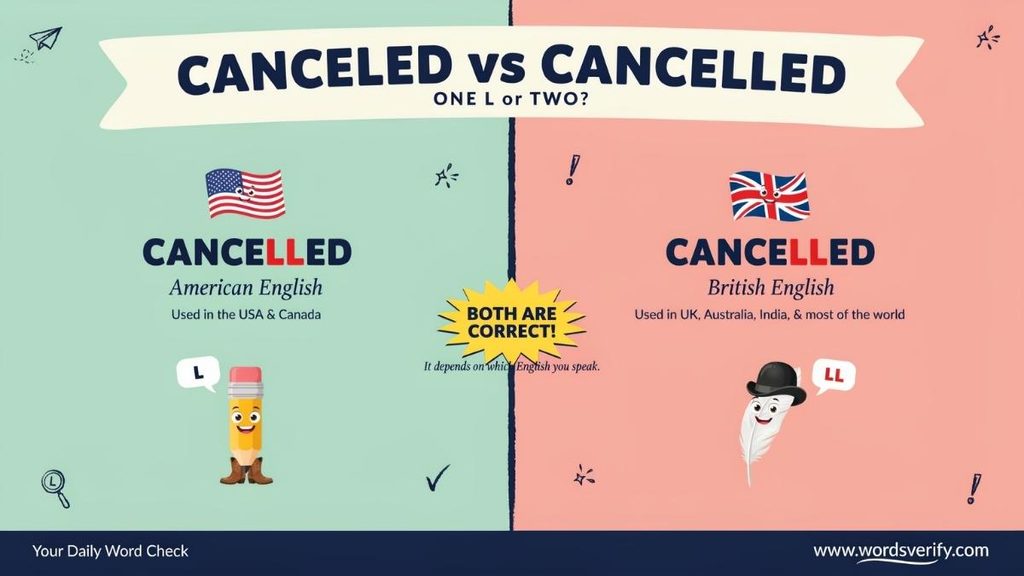
The question of canceling or cancelling follows the same regional distinction.
American English uses:
canceling
British English uses:
cancelling
For example:
She is canceling her subscription.
British English:
She is cancelling her subscription.
The difference may look small, but it becomes noticeable when you’re writing a long article or formal document.
If you’re using American English, keep the one-L pattern.
If you’re using British English, keep the double-L pattern.
Cancellation Spelling One L or Two?
Here’s where the word family gets slightly tricky.
The common spelling is:
cancellation
That’s two “l”s.
So American English can use:
canceled
canceling
cancellation
At first glance, that might seem inconsistent. However, English spelling contains many word-specific patterns that don’t always follow a single simple rule.
writers in american usage occasionally use cancelation with one “l” but ordinary formal writing almost always requires cancellation.
For most readers, “cancellation” is the form to use.
Examples include:
- The airline announced the cancellation.
- A cancellation fee may apply.
- We received a cancellation notice.
- The cancellation surprised everyone.
Learn how to use confusing more words correctly
Labelling vs Labeling Which one Is Correct?
Canceled vs Cancelled in a Sentence
Seeing the two spellings side by side makes the distinction easier.
American English
The concert was canceled because of heavy rain.
British English
The concert was cancelled because of heavy rain.
Both sentences are correct.
Here are more examples.
| Situation | American English | British English |
|---|---|---|
| Appointment | The appointment was canceled. | The appointment was cancelled. |
| Flight | The flight was canceled. | The flight was cancelled. |
| Event | The event was canceled. | The event was cancelled. |
| Plans | Our plans were canceled. | Our plans were cancelled. |
| Order | The order was canceled. | The order was cancelled. |
| Meeting | The meeting was canceled. | The meeting was cancelled. |
Canceled vs Cancelled Appointment
Both forms are correct.
If you’re using American English:
My doctor canceled the appointment.
If you’re using British English:
My doctor cancelled the appointment.
The same distinction appears in appointment reminders, emails, calendars, booking systems, and customer messages.
For example, an American business might write:
Your appointment has been canceled.
A British business might write:
Your appointment has been cancelled.
There’s no difference in what happened.
Learn how to use confusing more words correctly
Potatoes vs Potatos Which one Is Correct?
Which Spelling Should You Use?
The same regional rule applies to events.
American English:
The festival was canceled because of severe weather.
British English:
The festival was cancelled because of severe weather.
You can use either form when writing about:
- Concerts
- Festivals
- Conferences
- Classes
- Sports events
- School activities
- Public gatherings
The key is to match your spelling to the variety of English you’re using.
Canceled vs Cancelled Flight
Travel websites and airline messages provide plenty of examples of this spelling difference.
An American airline may write:
Your flight has been canceled.
A British airline may write:
Your flight has been cancelled.
Both messages tell you the same thing: the scheduled flight won’t operate as planned.
The spelling doesn’t indicate a different type of cancellation.
Canceled vs Cancelled Plans
The phrase “canceled plans” is common in American English.
For example:
We canceled our plans because the weather got worse.
In British English, the same sentence would normally use:
We cancelled our plans because the weather got worse.
Again, the only change is the spelling.
Canceled vs Cancelled Order
The word also appears frequently in shopping and customer service.
American English:
The company canceled my order.
British English:
The company cancelled my order.
The word cancel fits orders naturally because customers or companies can stop an order before someone completes or ships it .
Learn how to use confusing more words correctly
Moulding vs Molding which one is correct?
Common Mistakes With Canceled and Cancelled
A few mistakes appear again and again.
Thinking “cancelled” is always wrong
It isn’t.
British english and other regional varieties widely use cancelled as the standard form .
Thinking “canceled” is always wrong
It isn’t.
“Canceled” is the standard American form.
Assuming one spelling is universally correct
English isn’t identical everywhere.
Regional spelling differences are a normal part of the English language.
Mixing the two forms without a reason
Using both forms in the same document can make the writing look inconsistent.
For example:
The meeting was canceled, but the conference was cancelled.
If both sentences belong to the same American English document, using “canceled” consistently would usually make more sense.
Forgetting about “canceling” and “cancelling”
The same regional distinction appears in the present participle.
American English:
canceling
British English:
cancelling
Learn how to use confusing more words correctly
Manuel vs Manual which one is correct?
The Consonant Doubling Rule Explained Simply
You may have heard of the consonant doubling rule in English grammar and spelling.
This rule helps explain why writers double final consonant when they add a suffix . Factors such as syllable structure, vowel sounds, and stress can affect whether doubling occurs.
However, “cancel” deserves a little caution.
It’s tempting to create a simple rule such as:
British English always doubles the final consonant, while American English never does.
That isn’t accurate.
English spelling contains many exceptions and word-specific patterns. Regional spelling conventions also differ from word to word.
The useful lesson here is not to invent a universal formula. Instead, learn the established forms:
American English
- canceled
- canceling
British English
- cancelled
- cancelling
Does Syllable Stress Explain the Difference?
Syllable stress can help explain some English spelling patterns, especially when writers decide whether to double a final consonant before adding an ending. However, it doesn’t fully explain the difference between canceled and cancelled.
The word cancel has two syllables, with the stress falling on the first syllable: CAN-cel. Because the final syllable lacks strong stress, syllable stress alone does not determine whether you need one “l” or two
Instead, regional spelling conventions provide the clearer explanation. American English uses canceled, while British English uses cancelled.
So, rather than trying to force one spelling rule to solve the mystery, remember the established forms and follow the English variety you’re writing in.
How to Choose the Right Spelling
When you’re unsure which form to use, ask yourself a few simple questions.
- Who will read the writing?If you’re writing mainly for Americans, use American spelling.
- What style does your organization follow?A company, newspaper, school, or publisher may have its own style guide.
- Which spelling have you already used?Once you’ve chosen a regional convention, keep it consistent.
- Are you quoting another source?If you’re reproducing someone’s exact wording, don’t silently change their regional spelling.
- Is the audience international?Pick one consistent form that fits the purpose and audience of the document.
Learn how to use confusing more words correctly
Sneek vs Sneak Which one is Correct?
Canceled or Cancelled AP Style
AP Style uses canceled with one “l.”
It also uses canceling with one “l.”
However, AP Style uses cancellation with two “l”s.
That distinction is worth remembering because it shows why you shouldn’t simply apply “one L” to every word related to cancel.
For writers working in American journalism and communications, following AP Style means using the forms required by that style guide.
For other types of writing, the organization’s own style guide may take priority.
Canceled or Cancelled on Social Media
Social media brings people from different English-speaking regions together, so you’ll often notice both spellings in the same conversation.
For example, an American user might write:
The organizers canceled the show.
A British user might write:
The organizers cancelled the show.
Both sentences express the same idea. The spelling simply reflects different regional conventions.
Social media has also given the word cancel another meaning. People now use it when they discuss public criticism, withdrawing support, or “cancel culture.”
Compare these two examples:
The organizers canceled the concert.
Here, the organizers decided that the event would no longer take place.
Now consider:
Fans canceled the celebrity online.
In this context, people withdrew their support or publicly criticized the celebrity.
The surrounding words make the intended meaning clear. The spelling still depends on whether the writer follows American or British English.
Learn how to use confusing more words correctly
Laid Down vs Lied Down which one is correct?
A Simple Way to Remember Canceled vs Cancelled
Don’t try to memorize a complicated spelling lecture.
Use this simple pair:
American English → canceled
British English → cancelled
Then remember the related forms:
| American English | British English |
|---|---|
| canceled | cancelled |
| canceling | cancelling |
| cancellation | cancellation |
That small table covers most everyday situations.
Quick Reference
| Question | Answer |
|---|---|
| Are both spellings correct? | Yes |
| American spelling? | canceled |
| British spelling? | cancelled |
| Australian spelling? | commonly cancelled |
| Canadian spelling? | commonly cancelled |
| American present participle? | canceling |
| British present participle? | cancelling |
| Past tense? | canceled/cancelled |
| Past participle? | canceled/cancelled |
| Common noun form? | cancellation |
Learn how to use confusing more words correctly
Lieing vs Lying Which one Is Correct?
Practice Session Canceled vs Cancelled
Test your knowledge with these 25 fill-in-the-blank questions. Choose canceled, cancelled, canceling, cancelling, cancellation, or another appropriate form where needed.
Fill in the Blanks
- The airline ________ the flight because of severe weather.
- In American English, the preferred spelling is usually ________.
- In British English, the preferred spelling is usually ________.
- Sarah is ________ her appointment for Friday.
- The British newspaper reported that the concert was ________.
- The company announced the ________ of the event.
- We had to ________ our dinner reservation.
- The customer received an email about the ________ of the order.
- The manager ________ the meeting yesterday.
- The British airline said the flight had been ________.
- In American English, writers usually spell the present participle as ________.
- In British English, writers usually spell the present participle as ________.
- The school ________ classes because of the snowstorm.
- The theater announced the ________ of tonight’s performance.
- We received a notice saying that our appointment had been ________.
- Which spelling is standard in American English: ________ or cancelled?
- Which spelling is standard in British English: canceled or ________?
- The store ________ my order before it shipped.
- The organizers are ________ the outdoor event because of the storm.
- The airline’s ________ policy explains when customers can receive a refund.
- The word “cancel” is a ________ that describes the act of stopping or calling something off.
- “Canceled” and “cancelled” have the same ________ but different regional spellings.
- American English generally uses one ________ in “canceled.”
- British English generally uses two ________ in “cancelled.”
- To keep your writing consistent, choose one regional spelling and use it ________.
Answers
- canceled
- canceled
- cancelled
- canceling
- cancelled
- cancellation
- cancel
- cancellation
- canceled
- cancelled
- canceling
- cancelling
- canceled
- cancellation
- canceled
- canceled
- cancelled
- canceled
- cancelling
- cancellation
- verb
- meaning
- L
- Ls
- consistently
Here’s a trusted source for clear more words Comparison:
FAQs
What is the difference between “canceled” and “cancelled”?
Both words have the same meaning. Canceled is the usual American English spelling, while cancelled is the usual British English spelling.
Is “cancelled” grammatically correct?
Yes. Cancelled is a standard spelling in British English and other varieties that commonly follow British spelling conventions.
Is “canceled” grammatically correct?
Yes. Canceled is the standard American English spelling of the past tense and past participle of “cancel.”
Why does British English use two Ls?
British English traditionally uses cancelled and cancelling. This spelling convention distinguishes them from the American forms canceled and canceling.
Why do American English writers use one L?
American English generally simplifies the spelling to canceled and canceling. This convention became established in American spelling.
Is “cancellation” spelled with one L or two?
The standard spelling is cancellation, with two Ls. This form is widely used in both American and British English.
Is “cancelation” also a word?
You may encounter cancelation, especially in some American sources, but cancellation is the much more common standard spelling in general formal writing.
Is “cancelling” correct in American English?
American English normally uses canceling with one L. Cancelling is the standard British form and is also common in several other English varieties.
What is the past participle of “cancel”?
The past participle is canceled in American English and cancelled in British English. For example, “The company has canceled the order” and “The company has cancelled the order.”
Can “canceled” and “cancelled” appear in the same document?
They can, but switching between them without a reason can make your writing look inconsistent. Choose the spelling that matches your audience or style guide and use it consistently.
Is “cancelled” pronounced differently from “canceled”?
No. The two spellings normally have the same pronunciation. The difference appears in spelling, not in the way the word is spoken.
Which spelling should international writers use?
There isn’t one universal choice. Follow the spelling convention expected by your intended readers, employer, school, publication, or style guide. Most importantly, remain consistent.
Is “got canceled” correct?
Yes. “Got canceled” is grammatically possible, especially in informal American English. For example: “The game got canceled because of the storm.” More formal writing might use “The game was canceled.”
Is “has been canceled” correct?
Yes. “Has been canceled” is grammatically correct and uses the present perfect passive construction. In British English, you would normally write “has been cancelled.”
What is the opposite of “cancel”?
Depending on the context, possible opposites include confirm, continue, approve, proceed with, or keep. The best choice depends on what you are canceling.
Can “cancel” be used as a noun?
In standard modern English, cancel is primarily a verb. However, informal usage can treat it as a noun in certain contexts, particularly online or in entertainment-related language.
What is the noun form of “cancel”?
The most common noun is cancellation. For example: “We received a cancellation notice this morning.”
Does “cancel” always mean something will not happen?
Not necessarily. It can mean stopping a planned event, appointment, order, or service. In newer informal usage, it can also describe withdrawing support for a person, brand, or idea.
Why do people use “cancel” differently on social media?
Online, cancel can refer to publicly withdrawing support from someone after criticism or controversy. This meaning differs from the traditional sense of stopping an event or arrangement.
Is “cancel culture” the same as canceling an event?
No. Canceling an event means stopping or calling off something that was planned. Cancel culture refers to a social phenomenon involving public criticism and withdrawal of support, often through online platforms.
What are common phrases with “canceled” or “cancelled”?
Common expressions include canceled appointment, cancelled appointment, canceled flight, cancelled flight, canceled plans, cancelled plans, canceled order, and cancelled order. The spelling depends on the English variety.
How can I remember the difference between “canceled” and “cancelled”?
Use a simple memory rule: American English = one L; British English = two Ls. Then remember that cancellation normally keeps two Ls in both varieties.
conclusion
The canceled vs cancelled debate may involve only one little letter, but that extra l can create a surprisingly big spelling headache. Fortunately, the rule is much simpler than it first appears.
Use canceled in American English and cancelled in British English. The same regional difference appears in canceling and cancelling. Both forms are correct when they match the variety of English you’re using.
The key is consistency. If you’re writing for an American audience, stick with the American spelling. For a British audience, follow British spelling throughout your work.
So, the next time you wonder whether you’ve accidentally lost an l, don’t panic. Check your audience, choose the appropriate form, and keep writing. That tiny letter doesn’t have to cause a full-blown grammar crisis!

Lisa AJS is an experienced blogger and language enthusiast at Words Verify, dedicated to making grammar simple, practical, and enjoyable. She writes engaging content on commonly confused words, grammar mistakes, word meanings, and everyday language challenges.