
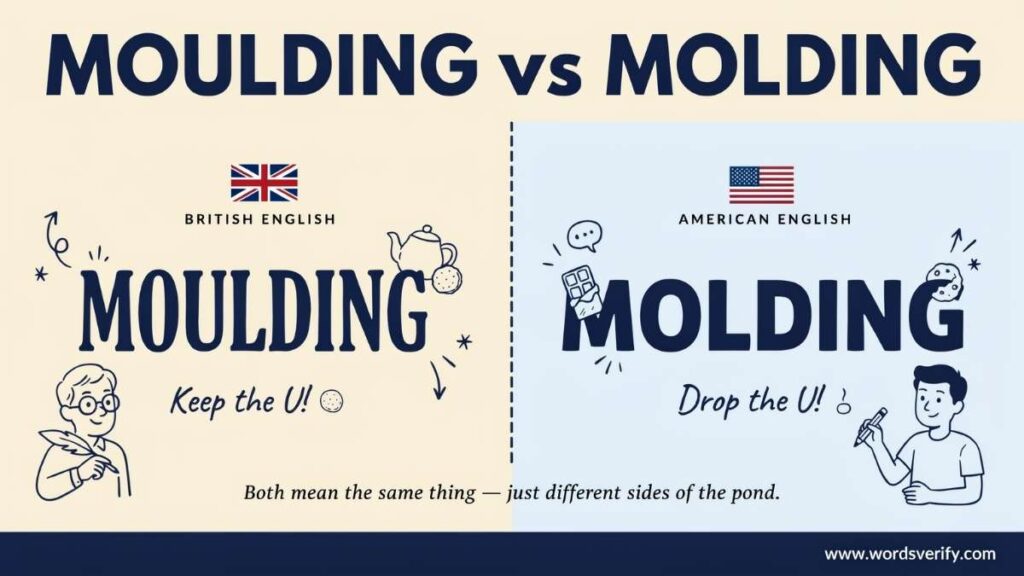
Moulding vs molding may look like a one-letter spelling battle, but that little “u” can cause plenty of confusion. Is one spelling wrong, or do both have a place in English? Fortunately, you don’t need to wrestle with the dictionary to figure it out. Both spellings are correct, but your choice depends on the variety of English you’re using. “Moulding” is common in British English, while “molding” is preferred in American English. In this guide, you’ll learn what each spelling means, where it’s used, the common mistakes to avoid, and how to choose the right one with confidence.
The Quick Answer
Moulding and molding belong to the same word family. They come from the verbs mould and mold, which have the same basic meanings.
British English uses mould:
- mould
- moulding
- moulded
- moulds
American English uses mold:
- mold
- molding
- molded
- molds
The difference becomes easier to remember when you look at the whole word family rather than just the two forms.
| Feature | British English | American English |
|---|---|---|
| Base verb | mould | mold |
| Present participle | moulding | molding |
| Past tense | moulded | molded |
| Noun for decorative feature | moulding | molding |
| Shaping clay | moulding clay | molding clay |
| Shaping food | moulding food | molding food |
| Figurative use | moulding a person | molding a person |
| Ceiling decoration | crown moulding | crown molding |
Neither spelling is a mistake. The important thing is to use the form that matches the variety of English you’re writing.
Learn the difference between everyday English mistakes
Manuel vs Manual which one is correct?
What Does Moulding Mean?
Moulding is the British English spelling of molding. It can have several closely related meanings.
At its simplest, moulding means shaping something into a particular form. The word can also describe the finished material or decorative feature produced through shaping.
Moulding as the Act of Shaping
When you change the shape of a material by pressing, bending, forming, or otherwise working with it, you can describe the process as moulding.
For example:
- The artist is moulding the clay into a small bowl.
- She spent the afternoon moulding wax figures.
- The children enjoyed moulding the soft clay.
- The factory uses machines for moulding plastic parts.
The material doesn’t have to be clay. People can mould wax, plastic, dough, chocolate, and many other substances.
Moulding as a Decorative Feature
Moulding can also mean a shaped strip of material used to decorate or finish part of a building.
You might find moulding around:
- Ceilings
- Doors
- Windows
- Walls
- Floors
- Architectural openings
For example, a decorative strip where the wall meets the ceiling may be called crown moulding.
A home with older or traditional architecture may have elaborate moulding around its doors and windows. A modern home might use simple, straight moulding for a cleaner appearance.
Moulding in a Figurative Sense
Moulding doesn’t always involve a physical material.
The word can also describe the process of influencing someone’s character, behavior, skills, or development.
For example:
Teachers can play an important role in moulding a child’s character.
No one is literally reshaping the child like a piece of clay. The word is being used as a metaphor. Experiences, education, family, and other influences can gradually shape the way a person thinks and behaves.
Learn the difference between everyday English mistakes
Sneek vs Sneak Which one is Correct?
What Does Molding Mean?
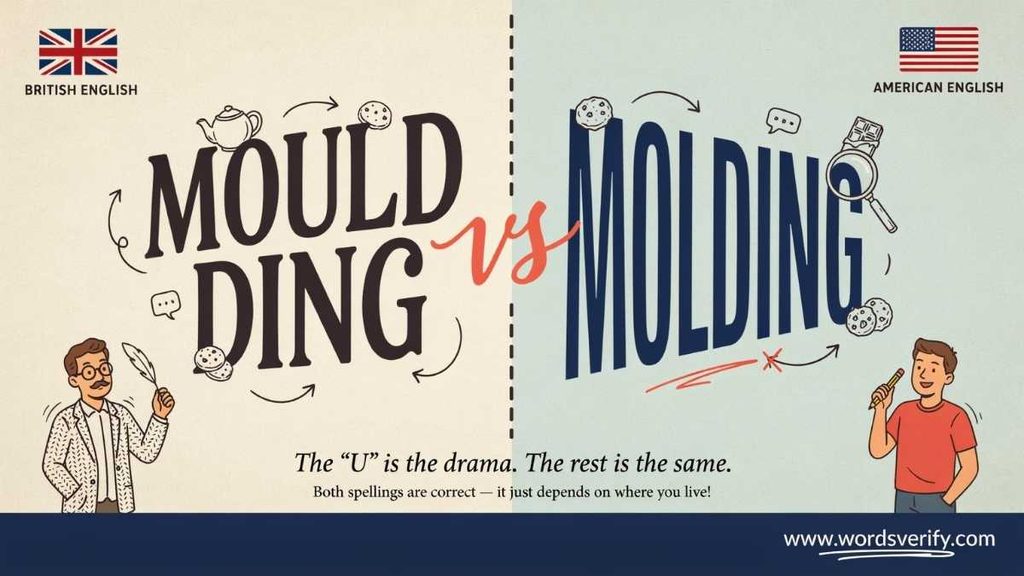
Molding is the American English spelling of the same word.
It can describe the process of shaping something, the influence that shapes a person or idea, or a decorative feature used in architecture.
Molding as a Verb Form
Molding is the present participle of the American English verb mold.
For example:
- She is molding the clay into a flower.
- The machine is molding plastic components.
- He is molding the wax into a detailed figure.
- The artist enjoys molding different materials by hand.
The word describes an action in each sentence.
Molding as a Noun
Molding can also refer to a decorative architectural feature.
For example:
- The living room has beautiful crown molding.
- We replaced the old door molding.
- The contractor installed new baseboard molding.
- The walls have simple decorative molding.
In American homes, molding can serve both a practical and decorative purpose. It can cover transitions between surfaces while also adding visual detail.
Molding in a Figurative Sense
American English also uses molding to describe the development or influence of a person.
For example:
Her childhood experiences played a major role in molding her character.
Here, molding means shaping or influencing rather than physically changing someone’s form.
Learn the difference between everyday English mistakes
Laid Down vs Lied Down which one is correct?
Why Does Moulding Have a “U”?
The extra “u” comes from the spelling tradition used in British English.
British English writes the base word as mould. American English generally writes it as mold.
The difference continues when the words take other forms:
| British English | American English |
|---|---|
| mould | mold |
| moulding | molding |
| moulded | molded |
| moulds | molds |
This is one of many regional spelling differences between British and American English.
You can see similar differences in words such as:
- colour / color
- honour / honor
- labour / labor
That doesn’t mean one variety follows a “correct” spelling system while the other doesn’t. Both have established conventions.
Learn the difference between everyday English mistakes
Lieing vs Lying Which one Is Correct?
Moulding vs Molding in British and American English
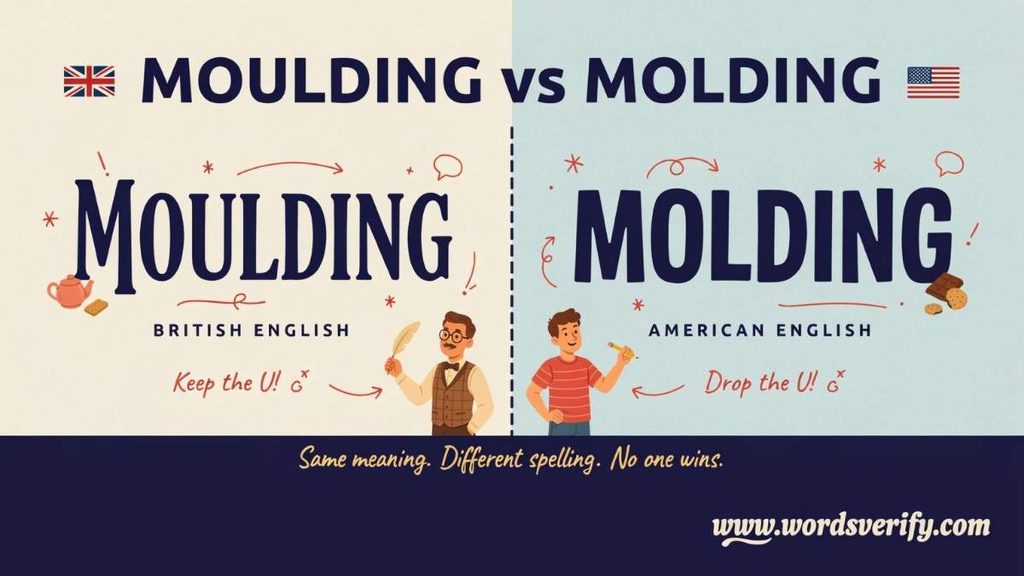
The easiest way to choose between the two spellings is to consider your audience.
Moulding in British English
British English generally uses moulding.
You’ll commonly see it in expressions such as:
- decorative moulding
- crown moulding
- ceiling moulding
- wall moulding
- door moulding
- wood moulding
- moulding clay
- moulding food
The same spelling appears in related forms such as moulded and moulds.
Molding in American English
American English generally uses molding.
Common expressions include:
- decorative molding
- crown molding
- ceiling molding
- wall molding
- door molding
- wood molding
- molding clay
- molding food
American manufacturers, home-improvement companies, interior designers, and construction professionals commonly use molding when writing for an American audience.
What About Canadian English?
Canadian English can be a little less straightforward.
Canadian English has influences from both British and American English. As a result, you may encounter both molding and moulding in Canadian writing.
The preferred form can depend on the publication, organization, industry, or individual style guide.
The safest approach is to follow the spelling used by the organization or publication you’re writing for.
Australian English generally follows many British spelling conventions, so moulding is commonly seen there. However, individual organizations can establish their own preferences.
Learn the difference between everyday English mistakes
Sergeant vs Sargeant which one is correct?
Moulding vs Molding Clay?
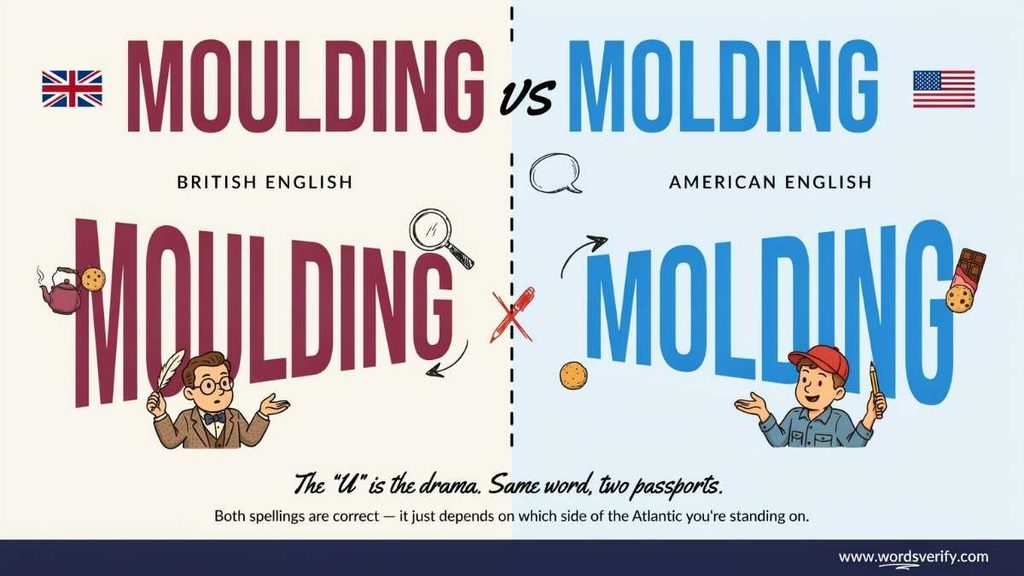
Both forms can describe the process of shaping clay.
British English:
The children were moulding clay into different shapes.
American English:
The children were molding clay into different shapes.
The action doesn’t change. The spelling simply follows the regional variety of English.
Clay is one of the easiest materials to associate with the word because artists often physically shape it with their hands or tools.
You can mould or mold clay by:
- Pressing it with your fingers
- Rolling it into a sheet
- Pinching it into a shape
- Cutting it with a tool
- Forming it around an object
- Pressing it into a mold
- Adding details to the surface
This is why you may encounter both clay moulding and clay molding when reading books, instructions, or craft guides from different countries.
Moulding vs Molding a Person?
The phrase molding or moulding a person usually has a figurative meaning.
It refers to influencing someone’s character, behavior, abilities, beliefs, or development.
For example, an American writer might say:
Parents have a significant influence on molding a child’s character.
A British writer might say:
Parents have a significant influence on moulding a child’s character.
The meaning is the same.
The expression comes from the physical idea of shaping material. Just as a sculptor shapes clay into a particular form, experiences and relationships can help shape a person’s development.
You may also see expressions such as:
- moulding a child’s character
- molding a child’s character
- moulding young minds
- molding young minds
- moulding future generations
- molding future generations
The spelling changes, but the figurative idea remains unchanged.
Learn the difference between everyday English mistakes
Affect vs Effect which one is correct?
Moulding vs Molding Food?
Moulding or molding food means shaping food into a particular form.
For example:
- The chef is molding the rice into small portions.
- The baker is moulding the dough into individual rolls.
- The cook used a mold to shape the dessert.
- The chef is molding chocolate into decorative pieces.
You can use the word when discussing foods such as rice, chocolate, gelatin, dough, butter, desserts, and confectionery.
Again, regional spelling determines which form you use.
American English:
molding food
British English:
moulding food
There is an important distinction here. The word mold can also refer to a type of fungus. That meaning has nothing to do with molding food into a shape.
Context makes the difference clear.
Learn the difference between everyday English mistakes
Further vs Farther which one is correct?
Moulding vs Molding in Construction and Interior Design
One of the most common places you’ll encounter these words is in construction and interior design.
Molding or moulding can refer to a shaped strip of material used to decorate, finish, or frame part of a building.
Common materials include:
- Wood
- MDF
- Plastic
- Plaster
- Polyurethane
- Composite materials
The exact material depends on the building, design, budget, and intended use.
Crown Moulding vs Molding
The phrase crown moulding vs molding is a perfect example of regional spelling.
American English normally uses:
crown molding
British English normally uses:
crown moulding
Both refer to decorative material installed where a wall meets a ceiling.
The architectural feature remains the same.
Only the spelling changes.
Ceiling Moulding vs Ceiling Molding
The same distinction applies to ceiling terminology.
American English:
The dining room has decorative ceiling molding.
British English:
The dining room has decorative ceiling moulding.
If you’re reading American interior-design content, molding will usually appear. British sources are more likely to use moulding.
Wall Moulding vs Wall Molding
Wall molding or wall moulding can be used as a decorative architectural detail.
It may create:
- Rectangular wall panels
- Raised borders
- Framing around artwork
- Decorative sections on a wall
- Traditional architectural patterns
The style can range from very simple to highly detailed.
Baseboard Moulding vs Baseboard Molding
Baseboard molding is common American terminology. It refers to trim installed along the bottom of a wall near the floor.
In British usage, related terminology can vary. You may encounter moulding as part of the description, although terms such as skirting board are also common.
This is a good example of why spelling and vocabulary are not always the same thing. Two varieties of English can differ not only in spelling but also in the words they prefer for particular objects.
Learn the difference between everyday English mistakes
Treck vs Trek Which one Is Correct?
Moulding vs Trim Are They the Same?
Moulding and trim overlap, but they aren’t always exact synonyms.
Trim is a broad term for finishing material used around different parts of a building.
Molding or moulding generally describes a shaped or profiled piece used for decorative or architectural purposes.
In simple terms, molding can be a type of trim.
For example, a decorative piece around a doorway may be described as door molding. A wider discussion of the materials used to finish a doorway might simply call them trim.
The exact terminology can vary between manufacturers, contractors, designers, and regions.
Moulding vs Molding as Verb Forms
The grammar becomes much easier when you start with the base verb.
British English:
mould → moulding → moulded
American English:
mold → molding → molded
For example:
British English:
She moulded the clay yesterday.
American English:
She molded the clay yesterday.
The tense and grammatical function remain the same.
Only the spelling convention changes.
This pattern is useful because it prevents a common mistake: treating moulding and molding as unrelated words.
They’re simply regional forms of the same word family.
Learn the difference between everyday English mistakes
Attornies vs Attorneys Which one Is Correct?
Common Mistakes With Moulding and Molding
These two spellings cause a few predictable problems.
Assuming Moulding Is Wrong
An American reader who isn’t familiar with British spelling may think moulding is misspelled.
It isn’t.
Moulding is a standard British English spelling.
Assuming Molding Is Wrong
The reverse mistake can happen too.
Someone accustomed to British English may see molding and assume the writer forgot the “u.”
That isn’t necessarily the case. Molding is the standard American spelling.
Mixing the Two Forms
Switching between the forms can make writing look inconsistent.
For example:
The room has crown molding, decorative wall moulding, and new door molding.
If the entire piece follows American English, the second form stands out.
A consistent American version would use molding throughout:
The room has crown molding, decorative wall molding, and new door molding.
A British English version would normally use moulding consistently.
Forgetting the Base Word
1.If you aren’t sure which spelling to choose, look at the base word.
2.If you use mould, write moulding.
3.If you use mold, write molding.
That one rule solves most spelling questions involving this word.
Learn the difference between everyday English mistakes
Lose vs Loose which one is correct?
Moulding and Molding in Manufacturing
The word also appears frequently in manufacturing.
Manufacturers use molding or moulding processes to shape materials into specific forms. Depending on the manufacturing method, materials such as plastic, rubber, metal, or composite substances can be formed into components.
American technical writing commonly uses terms such as:
- Injection molding
- Blow molding
- Compression molding
- Plastic molding
British English generally uses the corresponding forms:
- Injection moulding
- Blow moulding
- Compression moulding
- Plastic moulding
The manufacturing process itself doesn’t change because of the spelling.
The terminology simply follows the regional spelling convention.
A Useful Comparison
| Context | British English | American English |
|---|---|---|
| Base verb | mould | mold |
| Present participle | moulding | molding |
| Past tense | moulded | molded |
| Shaping clay | moulding clay | molding clay |
| Shaping food | moulding food | molding food |
| Influencing a person | moulding a person | molding a person |
| Decorative ceiling | ceiling moulding | ceiling molding |
| Crown trim | crown moulding | crown molding |
| Wall decoration | wall moulding | wall molding |
| Door trim | door moulding | door molding |
| Manufacturing | moulding | molding |
The table shows the main pattern clearly: the meaning stays consistent while the spelling follows the English variety.
How to Remember Moulding vs Molding
You don’t need a complicated trick to remember these words.
Remember the Base Verb
The simplest method is:
mould → moulding
mold → molding
If you remember the base word, the longer form follows naturally.
Think About the English Variety
If you’re writing American English, choose molding.
If you’re writing British English, choose moulding.
For example, if your writing already uses “color” rather than “colour,” “honor” rather than “honour,” and other American forms, molding will usually fit your style.
Stay Consistent
Once you’ve chosen your spelling, stick with it.
A reader doesn’t need to see both versions unless you’re specifically explaining the difference between them.
Practice Session Moulding vs Molding
Fill in each blank with moulding or molding. Pay attention to the variety of English used in each sentence.
- The carpenter installed decorative ________ around the doors.
- In American English, ________ is the usual spelling.
- The British spelling of the word is ________.
- The designer chose elegant crown ________ for the living room.
- The artist is ________ the clay into a small bowl.
- In American English, the artist is ________ the clay into a small bowl.
- The house has beautiful wooden ________ along the walls.
- British English commonly uses ________ with a “u.”
- The factory uses plastic ________ to create different shapes.
- The teacher believes that education plays a role in ________ young minds.
- The contractor replaced the damaged door ________.
- The American contractor ordered new door ________.
- She enjoys ________ clay into different shapes.
- The museum displayed traditional clay ________ techniques.
- The room looked more elegant after the new crown ________ was installed.
- In American writing, ________ is generally preferred over moulding.
- In British writing, ________ is generally preferred over molding.
- The company specializes in architectural ________.
- The sculptor spent hours ________ the wet clay by hand.
- Good teachers can help with the ________ of a child’s character.
- The old building still has its original wooden ________.
- The American magazine used the spelling ________ throughout the article.
- The British architect described the decorative ________ around the ceiling.
- Both ________ and molding refer to shaping or forming something, depending on the context.
- If you’re writing for a U.S. audience, choose ________ for consistency.
Answers
- moulding
- molding
- moulding
- moulding
- moulding
- molding
- moulding
- moulding
- molding
- molding
- moulding
- molding
- moulding
- moulding
- moulding
- molding
- moulding
- moulding
- molding
- molding
- moulding
- molding
- moulding
- moulding
- molding
Here’s a trusted source for clear more words Comparison:
FAQs
Which is correct, moulding vs molding?
Both moulding and molding are correct spellings. “Moulding” is standard in British English, while “molding” is the usual American English spelling.
Is it crown molding or crown moulding?
Both are correct. Crown molding is preferred in American English, while crown moulding is common in British English and other varieties that use British spelling.
Is it baseboard molding or baseboard moulding?
Both spellings are acceptable. In the United States, baseboard molding is the standard form. British English generally uses baseboard moulding.
Are moulding and molding the same?
Yes. They have the same meaning and pronunciation. The difference is mainly a matter of regional spelling, with British English favoring “moulding” and American English favoring “molding.”
Is wood trim called moulding or molding?
It can be called either, depending on the variety of English. In the U.S., wood molding is more common. In British English, wood moulding is preferred.
What are some common types of moulding used as trim?
Common types include crown molding, baseboard molding, door and window casing, chair rails, picture rails, and panel molding. Each serves a different decorative or functional purpose.
What is another name for moulding?
Depending on its use, moulding can also be called trim, millwork, decorative trim, or architectural trim. However, these terms aren’t always exact synonyms.
What is decorative molding called?
Decorative molding is often called ornamental molding or decorative trim. Crown molding, panel molding, and picture-frame molding are examples of decorative styles.
What are the main types of wood molding and trim?
Common wood molding and trim include crown molding, baseboards, casing, chair rails, picture rails, and panel molding. The choice depends on where the trim is installed and the look you want.
What is MDF in molding?
MDF stands for medium-density fiberboard. It’s an engineered wood product commonly used for interior trim because it has a smooth surface and can be painted easily.
What is the difference between trim and molding?
Trim is a broad term for finishing materials used around parts of a building, such as doors, windows, floors, and ceilings. Molding is a type of trim that usually has a shaped or decorative profile.
Are baseboards and moldings the same?
Not exactly. Baseboards are a type of molding or trim installed where walls meet floors. Molding is a broader category that includes baseboards, crown molding, casing, and other decorative profiles.
Is wall molding spelled moulding or molding?
Both spellings are correct. Wall molding is the American English form, while wall moulding follows British English spelling.
What are baseboards on the ceiling called?
Trim installed where a wall meets a ceiling is generally called crown molding or coving, depending on its shape and regional terminology. Baseboard usually refers specifically to trim along the floor.
Why does British English spell moulding with a “u”?
British English traditionally retains the “u” in words such as mould, colour, and honour. American English simplified several of these spellings, resulting in forms such as mold, color, and honor.
Does molding have the same pronunciation as moulding?
Yes. Molding and moulding are pronounced the same way. The difference is in spelling, not pronunciation.
How do you choose between moulding and molding?
Choose the spelling that matches your audience and the variety of English you’re using. For U.S. writing, use molding. For British English, use moulding. The most important thing is to remain consistent.
Is molding only used for interior decoration?
No. Molding can refer to the process of shaping materials such as clay, plastic, or metal, as well as decorative architectural trim. Its meaning depends on the context.
What is the difference between molding and moulding in construction?
There is no difference in construction meaning. American construction writing generally uses molding, while British construction writing generally uses moulding. Both can describe decorative or functional architectural trim.
conclusion
Moulding vs molding may look like a tiny spelling puzzle, but once you know the rule, there’s little left to worry about. Both spellings are correct and carry the same basic meanings. The main difference is regional: “moulding” is generally used in British English, while “molding” is the standard American spelling. You’ll find both forms in contexts such as shaping materials, decorative trim, and influencing growth or development. The best choice depends on the variety of English you’re writing in. Just remember: British English keeps the “u,” while American English leaves it out. One small letter, two accepted spellings, and thankfully, no grammar drama!

Lisa AJS is an experienced blogger and language enthusiast at Words Verify, dedicated to making grammar simple, practical, and enjoyable. She writes engaging content on commonly confused words, grammar mistakes, word meanings, and everyday language challenges.