
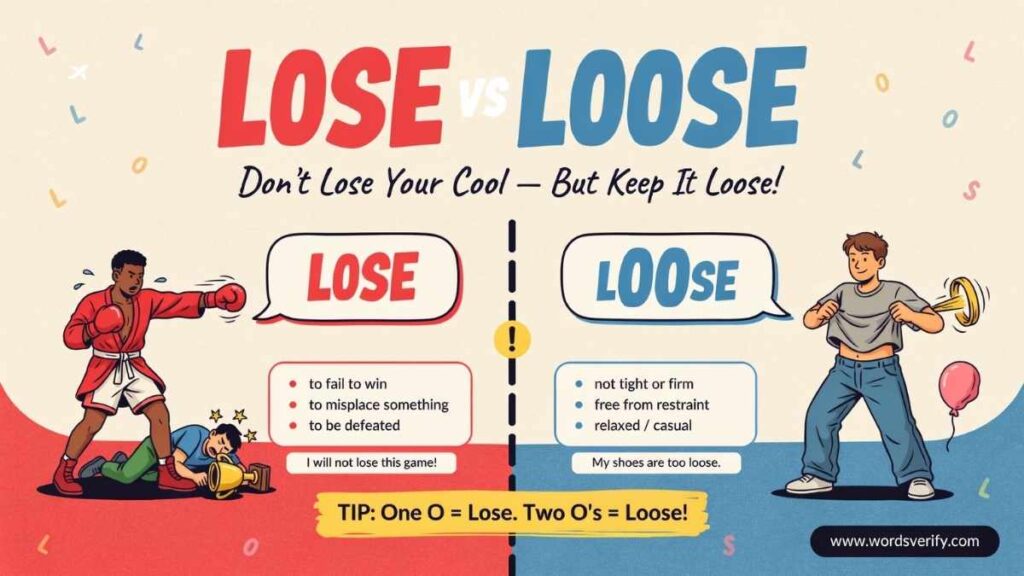
English can be wonderfully expressive, but sometimes it seems determined to make simple spelling unnecessarily tricky. Lose vs loose is one of those confusing pairs that can leave even careful writers second-guessing themselves. Add one extra “o,” and the meaning changes completely. You might lose your keys, but your shoelaces can be loose. You can lose weight, but you certainly can’t “loose” it. These tiny mistakes are common, yet they’re easy to fix once you understand what each word means and how to use it. In this guide, you’ll learn the difference between lose and loose with clear explanations and practical examples.
Quick Answer
Use lose when you mean to misplace something, fail to win, suffer a loss, or no longer have something.
Use loose when you mean something is not tight, not firmly fixed, or free.
Here’s the easiest way to remember it:
| Word | Main meaning | Example |
|---|---|---|
| Lose | Misplace, fail to win, or no longer have | I don’t want to lose my phone. |
| Loose | Not tight or firmly attached | These shoes feel loose. |
A simple memory trick is to associate lose with a loss. Both words are connected with losing something.
For loose, think about something that has extra space. A loose shirt isn’t tight. A loose tooth isn’t firmly attached.
What Does Lose Mean?
Lose is a verb. It has several common meanings, but they all involve something being gone, missed, or not successfully kept.
You can lose an object, lose a game, lose money, lose time, lose confidence, or lose an opportunity.
Lose Means to Misplace Something
When you can’t find something because you don’t know where you put it, you have lost it.
Examples:
- I always lose my keys.
- She lost her phone at the airport.
- Don’t lose your wallet.
- He lost his glasses somewhere in the house.
- I think I’ve lost my notebook.
Notice that lose is the present-tense form.
For example:
I often lose my keys.
When talking about something that already happened, the past tense is lost.
I lost my keys yesterday.
Lose Means to Fail to Win
You can also lose a competition, game, race, match, or argument.
Examples:
- Our team lost the game.
- She doesn’t want to lose the competition.
- They lost the final match.
- He lost the race by two seconds.
- I hate losing at chess.
In this sense, lose is the opposite of win.
Lose Means to No Longer Have Something
The word can also describe something that disappears from your possession or life.
Examples:
- He lost his job last year.
- She lost her confidence after the mistake.
- The company lost several important customers.
- They lost their chance to participate.
- We don’t want to lose this opportunity.
The thing being lost doesn’t have to be a physical object.
You can lose time, money, hope, confidence, interest, patience, control, or an opportunity.
Lose Means to Reduce Weight
One of the most common uses of lose is in the expression lose weight.
Examples:
- She wants to lose weight.
- He lost five pounds over the summer.
- I’m trying to lose a little weight.
- Regular exercise can help you lose weight.
The correct expression is lose weight, not “loose weight.”
Forms of Lose
Like other common verbs, lose changes depending on the tense.
| Form | Example |
|---|---|
| Lose | I don’t want to lose. |
| Loses | She often loses her keys. |
| Losing | He is losing patience. |
| Lost | I lost my wallet. |
One important point can prevent another common mistake:
Lose → lost
The past tense of lose is lost, not “losed.”
Examples:
- I lose my keys sometimes.
- I lost my keys yesterday.
- She loses her phone frequently.
- She lost her phone last week.
Learn how to use confusing more words correctly
Humour vs Humor Difference and Correct usage
What Does Loose Mean?

Loose is most commonly an adjective. It describes something that isn’t tight, firmly attached, or securely held.
Think of a loose shoelace, loose clothing, or a loose screw.
Examples:
- My shirt is too loose.
- The dog got loose from the yard.
- There is a loose screw on the chair.
- Her tooth is loose.
- The lid is loose.
Unlike lose, loose is usually describing a condition.
Something is loose because it isn’t tight or secure.
Loose Means Not Tight
This is probably the easiest meaning to remember.
If something has too much space around it or isn’t firmly fitted, it’s loose.
Examples:
- These pants are too loose.
- His jacket feels loose around the shoulders.
- The knot is loose.
- My shoelaces are loose.
- The handle has become loose.
The opposite of loose in this context is usually tight.
For example:
These shoes are loose.
These shoes are tight.
Loose Means Not Firmly Attached
Something can also be loose when it isn’t securely connected.
Examples:
- There is a loose wire behind the computer.
- One of the table legs is loose.
- The door handle is loose.
- A loose tile needs to be repaired.
- The screw became loose over time.
Here, the object hasn’t necessarily fallen off yet. It simply isn’t firmly attached.
Loose Can Mean Free
Loose can also describe someone or something that has escaped or isn’t being held securely.
Examples:
- The dog broke free and ran loose.
- Keep the horse from running loose.
- The children were allowed to run loose in the yard.
- The bird got loose from its cage.
In these examples, loose means free from control or restraint.
Loose as a Verb
Although loose is most often an adjective, it can also be a verb.
As a verb, loose means to release or set free.
Examples:
- The hunter loosed the arrow.
- They loosed the animals from the enclosure.
- The rope was loosed from the post.
This use is less common in everyday conversation than the adjective loose.
Learn how to use confusing more words correctly
Insite vs Insight difference and Correct usage
Lose vs Loose quick Comparison
The easiest way to see the difference is to compare them directly.
| Lose | Loose |
|---|---|
| Usually a verb | Usually an adjective |
| Means to misplace something | Means not tight |
| Can mean fail to win | Can mean not firmly attached |
| Can mean no longer have something | Can mean free or unrestricted |
| Can mean reduce weight | Can be used as a verb meaning release |
| Opposite of win in some contexts | Often opposite of tight |
Consider these two sentences:
I don’t want to lose my jacket.
This means you don’t want to misplace or no longer have your jacket.
My jacket is loose.
This means the jacket isn’t tight.
The words may look similar, but the meanings are completely different.
Lose vs Loose Weight?
This is one of the most common mistakes.
The correct phrase is:
Lose weight
Examples:
- I want to lose weight.
- She is trying to lose weight.
- He lost weight after changing his diet.
- They want to lose a few pounds.
“Loose weight” is incorrect when you’re talking about reducing body weight.
Why? Because lose means to get rid of or no longer have something.
You lose weight.
You don’t make your weight “loose.”
Lose vs Loose Someone?
The correct expression is usually lose someone.
Examples:
- I don’t want to lose you.
- She was afraid she would lose her friend.
- We lost him in the crowd.
- He didn’t want to lose contact with his family.
Here, lose means no longer have someone with you or no longer maintain a relationship or connection.
Loose someone doesn’t have the same meaning.
However, loose can appear in a different construction when it means release.
For example:
They loosed the prisoner.
This means they released the prisoner.
That’s a different meaning from lose someone.
Lose vs Loose Money?
The correct expression is lose money.
Examples:
- I don’t want to lose money.
- The business lost money last year.
- He lost a lot of money on the investment.
- Poor planning can cause a company to lose money.
“Loose money” doesn’t mean the same thing.
You may describe coins or cash as being loose in a pocket, but when you mean financial loss, use lose.
For example:
I lost $50.
The money is gone.
Lose vs Loose Power?
The correct expression depends on what you’re trying to say.
Use lose power when electricity or energy stops being available.
Examples:
- The building lost power during the storm.
- My laptop will lose power if I don’t charge it.
- The neighborhood lost power overnight.
Use loose when something isn’t securely attached.
For example:
The power cable is loose.
The cable isn’t firmly connected.
This is a perfect example of why context matters.
Lose vs Loose Hope?
The correct expression is lose hope.
Examples:
- Don’t lose hope.
- She refused to lose hope.
- They began to lose hope after several failed attempts.
- We shouldn’t lose hope yet.
Here, lose means no longer have something.
You can lose hope, but hope isn’t something that becomes physically loose.
Lose vs Loose Your Keys?
The correct phrase is lose your keys.
Examples:
- I always seem to lose my keys.
- Don’t lose your house keys.
- She lost her keys at work.
- He thought he had lost his car keys.
If your keys aren’t attached to anything securely, you might describe them as being loose. However, if you can’t find them, you’ve lost them.
Lose vs Loose a Game?
The correct phrase is lose a game.
Examples:
- We don’t want to lose the game.
- They lost the game yesterday.
- She hates to lose.
- Our team lost by one point.
Use lose when talking about failing to win.
“Loose a game” is incorrect in this context.
Why Do People Confuse Lose and Loose?
There are a few reasons these words cause problems.
First, their spelling is very similar. Both begin with “lo.”
Second, their pronunciation is similar enough that some speakers may not clearly notice the difference.
Third, loose contains an extra “o,” which can make people think of it as a variation of lose.
However, the extra letter isn’t just decoration. The words have different meanings and different pronunciations.
Learning the meaning behind each word makes the distinction much easier.
Learn how to use confusing more words correctly
Ballot vs Bullet difference and correct usage
How to Pronounce Lose and Loose
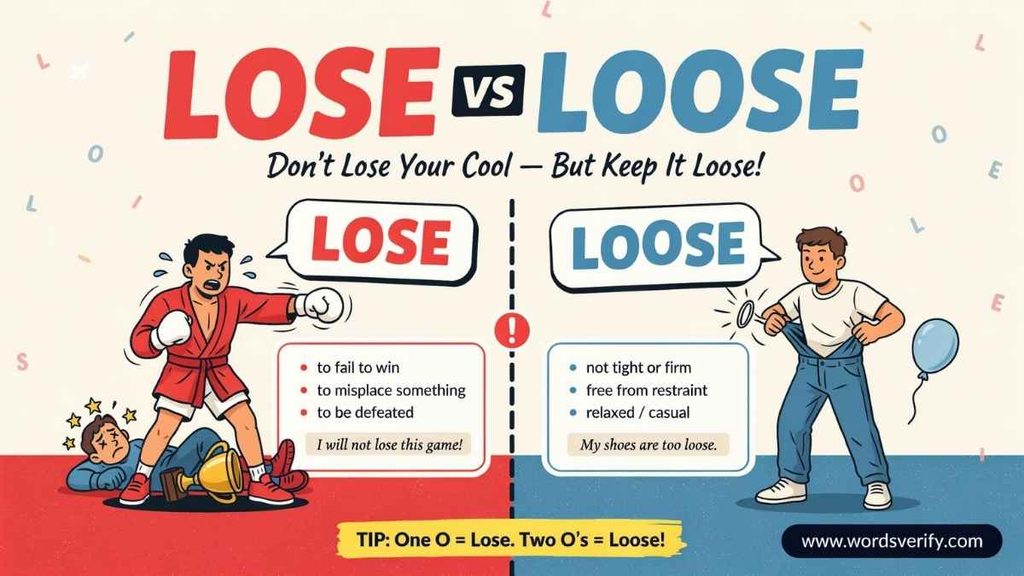
The pronunciation difference can help you remember the spelling.
Lose is pronounced like “looz.”
Loose is also pronounced with a “z” sound at the end, but it has a longer vowel sound.
You can think of them approximately like this:
Lose: looz
Loose: looos
The spelling difference is subtle, but the meanings are much easier to separate.
Lose, Lost, Loss, Loose, and Loosen
These related-looking words can create even more confusion.
Here’s a quick comparison:
| Word | Part of speech | Meaning | Example |
|---|---|---|---|
| Lose | Verb | Misplace, fail to win, no longer have | Don’t lose your phone. |
| Lost | Past tense/adjective | No longer have or unable to find the way | I lost my wallet. |
| Loss | Noun | The act or result of losing | The company suffered a loss. |
| Loose | Adjective/verb | Not tight or release | My shirt is loose. |
| Loosen | Verb | Make less tight | Loosen the knot. |
These words are connected, but they aren’t interchangeable.
For example:
I lost my keys.
My keys are loose in my bag.
The loss was unexpected.
My shoelace is loose.
Loosen the knot.
Each sentence uses a different word for a reason.
Learn how to use confusing more words correctly
Honor vs Honour difference and Correct usage
Common Mistakes With Lose and Loose

Here are some mistakes you may see online or in everyday writing.
I Don’t Want to Loose My Phone
Correct:
I don’t want to lose my phone.
The sentence means you don’t want to misplace your phone.
I Want to Loose Weight
Correct:
I want to lose weight.
Use lose when talking about reducing weight.
Don’t Loose Hope
Correct:
Don’t lose hope.
Hope can be lost, but it doesn’t become loose.
We Loosed the Game
Correct:
We lost the game.
The past tense of lose is lost.
My Shoes Are Too Lose
Correct:
My shoes are too loose.
The shoes aren’t tight enough, so loose is the correct word.
Learn how to use confusing more words correctly
Steer vs Stear difference and Correct usage
A Simple Memory Trick for Lose and Loose
Here’s a quick trick:
Lose = loss
Both contain one “o.”
Think:
Lose → loss → something is gone
Examples:
- Lose your keys.
- Lose a game.
- Lose money.
- Lose hope.
- Lose weight.
For loose, think:
Loose = extra space
Examples:
- Loose shoes.
- Loose clothing.
- Loose screws.
- Loose wires.
- A loose knot.
You can also remember:
Loose has more room.
The extra “o” in loose can remind you of extra space.
It isn’t a formal spelling rule, but it’s a useful memory trick.
Everyday Examples of Lose
Here are some natural examples you may encounter in everyday English:
- Be careful not to lose your passport.
- I always lose track of time when I read.
- She doesn’t want to lose her job.
- We could lose the match if we stop trying.
- Don’t lose your confidence.
- He lost his wallet on the bus.
- The company may lose customers.
- I don’t want to lose this opportunity.
- They lost their way in the forest.
- She lost interest in the project.
Everyday Examples of Loose
Now compare those with examples using loose:
- This shirt is too loose.
- My shoelaces are loose.
- The screw is loose.
- One of the floorboards is loose.
- The dog was running loose.
- The knot came loose.
- The handle feels loose.
- Her hair was loose around her shoulders.
- The tooth is loose.
- The lid is loose.
Notice how loose often describes something that isn’t tight, secure, or restrained.
Can Lose and Loose Appear in the Same Sentence?
Yes. In fact, putting them together can make their meanings easier to understand.
Examples:
- Don’t lose your shoes because the laces are loose.
- I didn’t lose the screw, but it became loose.
- She didn’t want to lose the dog after it got loose.
- If the knot is loose, you might lose the package.
- He lost his grip when the handle became loose.
The words can work together because they describe different situations.
Learn how to use confusing more words correctly
Tying vs Tieing difference and Correct usage
Common Expressions With Lose
The word lose appears in many everyday expressions.
Lose Your Mind
This can mean becoming extremely upset, angry, excited, or confused depending on context.
Example:
I thought I was going to lose my mind waiting for the computer to restart.
Lose Track of Time
This means you become so involved in something that you don’t notice how much time has passed.
Example:
I lost track of time while reading the book.
Lose Interest
This means you stop being interested in something.
Example:
He lost interest in the project after several delays.
Lose Your Temper
This means to become angry.
Example:
Try not to lose your temper during the meeting.
Lose Touch
This means to stop communicating with someone regularly.
Example:
We lost touch after college.
Learn how to use confusing more words correctly
Cudos vs Kudos difference and Correct usage
Common Expressions With Loose
Loose also appears in several familiar expressions.
On the Loose
This means free or not captured or controlled.
Example:
The escaped animal was still on the loose.
Let Loose
This means to release someone or something or allow yourself to behave more freely.
Example:
The children were finally allowed to let loose and play.
Cut Loose
This can mean to become more relaxed or to separate from someone or something.
Example:
After finishing the exam, everyone wanted to cut loose and relax.
Learn how to use confusing more words correctly
Seel vs Seal Difference and correct usage
Which Word Should You Use?
When you’re stuck between lose and loose, ask yourself what you’re trying to describe.
If you’re talking about misplacing something, use lose.
I don’t want to lose my wallet.
If you’re talking about failing to win, use lose.
Our team may lose the game.
If you’re talking about reducing weight, use lose.
She wants to lose weight.
If you’re talking about something not being tight, use loose.
My shoes are loose.
If you’re talking about something not being firmly attached, use loose.
The screw is loose.
If you’re talking about something being free from restraint, use loose.
The dog got loose.
That simple test will solve most lose-or-loose problems.
Learn how to use confusing more words correctly
Peices vs Pieces difference and correct usage
Practice Session Lose vs Loose
Fill in each blank with the correct word: lose vs loose.
- Be careful not to _____ your wallet at the airport.
- These jeans are too _____ around the waist.
- Our team doesn’t want to _____ the championship game.
- I don’t want to _____ my favorite pair of sunglasses.
- The screw holding the handle is _____.
- She hopes to _____ a few pounds before summer.
- Don’t _____ confidence just because you made one mistake.
- The dog managed to get _____ from its leash.
- He tends to _____ track of time while reading.
- We could _____ power during the storm.
- The knot is too _____ to hold the package securely.
- She _____ her phone somewhere on the train.
- You shouldn’t _____ patience with people who are trying to help.
- The jacket feels a little _____ around the shoulders.
- They don’t want to _____ their chance to compete.
- His shoelaces became _____ while he was running.
- Our team _____ the match by two points.
- Try not to _____ your keys before leaving.
- The horse broke free and ran _____ through the field.
- She doesn’t want to _____ interest in her studies.
- One of the buttons on my coat is _____.
- He _____ his passport during the trip.
- Don’t _____ hope when the solution is still possible.
- The children were allowed to run _____ in the park.
- I don’t want to _____ money on something I don’t need.
Answers
- lose
- loose
- lose
- lose
- loose
- lose
- lose
- loose
- lose
- lose
- loose
- lost
- lose
- loose
- lose
- loose
- lost
- lose
- loose
- lose
- loose
- lost
- lose
- loose
- lose
Here’s a trusted source for clear more words Comparison:
FAQs
What is the difference between lose and loose?
Lose is a verb meaning to misplace something, fail to win, or no longer have something. Loose usually describes something that isn’t tight, firmly attached, or controlled.
How do you remember the spelling of lose and loose?
A simple trick is to connect lose with loss. Use loose when something has extra space or isn’t tight.
Is it correct to say “lose your keys”?
Yes. Lose your keys is correct when you mean you can’t find them or no longer have them.
Is “loose” always an adjective?
No. Loose is commonly an adjective, but it can also be a verb meaning to release or set free.
What is the opposite of loose?
The most common opposite of loose is tight. For example, “These shoes are loose” contrasts with “These shoes are tight.”
What is the opposite of lose?
The opposite depends on the context. Find, win, and keep can all contrast with lose in different situations.
Is “lose” always a verb?
In standard English, lose is primarily used as a verb. Related forms include lost and the noun loss.
What is the difference between lost and loose?
Lost is the past tense of lose and can mean something is missing or cannot be found. Loose means not tight, firmly attached, or restrained.
What is the difference between loss and loose?
Loss is a noun describing the act or result of losing something. Loose usually describes something that isn’t tight or secure.
Is “losing” spelled with one or two o’s?
Losing is spelled with one “o” after the “l”: losing. The spelling “loosing” has a different meaning and is not the normal form of lose.
Why is “loosing” different from “losing”?
Losing comes from lose and means no longer having something or failing to win. Loosing comes from the verb loose and means releasing or setting something free. The latter is much less common.
Can “loose” and “lose” be used in the same sentence?
Yes. For example: “Be careful not to lose the screw if it becomes loose.” Each word has a different meaning.
What does “get loose” mean?
Get loose generally means to become free from something that was holding or controlling you. For example, “The dog got loose from its leash.”
What does “let loose” mean?
Let loose means to release something or allow someone to behave more freely. It can also mean to relax and enjoy yourself.
What does “on the loose” mean?
On the loose means free from capture, restraint, or control. For example, “The escaped dog was still on the loose.”
Is “loose” pronounced differently from “lose”?
Yes. Although the pronunciations are similar, loose has a longer vowel sound. The distinction becomes clearer when you hear the words in natural speech.
Is “loose” related to the word “loosen”?
Yes. Loosen means to make something less tight. For example, “Loosen the knot.” Loose describes the resulting condition: “The knot is loose.”
Can you say “lose control”?
Yes. Lose control is a standard expression meaning to stop being able to control yourself or a situation.
Can you say “loose control”?
Not when you mean to stop having control. In that context, the correct expression is lose control.
Learn how to use confusing more words correctly
Advise vs Advice which one is correct
conclusion
The lose vs loose confusion is a classic example of how one little letter can cause a surprisingly big grammar mistake. Lose is used when something goes missing, you fail to win, or you no longer have something. You can lose your keys, lose a game, lose hope, or lose weight. Loose is used when something isn’t tight, firmly attached, or under control. Your shoes can be loose, a screw can be loose, or a dog can run loose. The easiest trick to remember is simple: lose is linked to loss, while loose means not tight. Keep that distinction in mind, and this confusing pair won’t trip you up again.
.

Lisa AJS is an experienced blogger and language enthusiast at Words Verify, dedicated to making grammar simple, practical, and enjoyable. She writes engaging content on commonly confused words, grammar mistakes, word meanings, and everyday language challenges.