
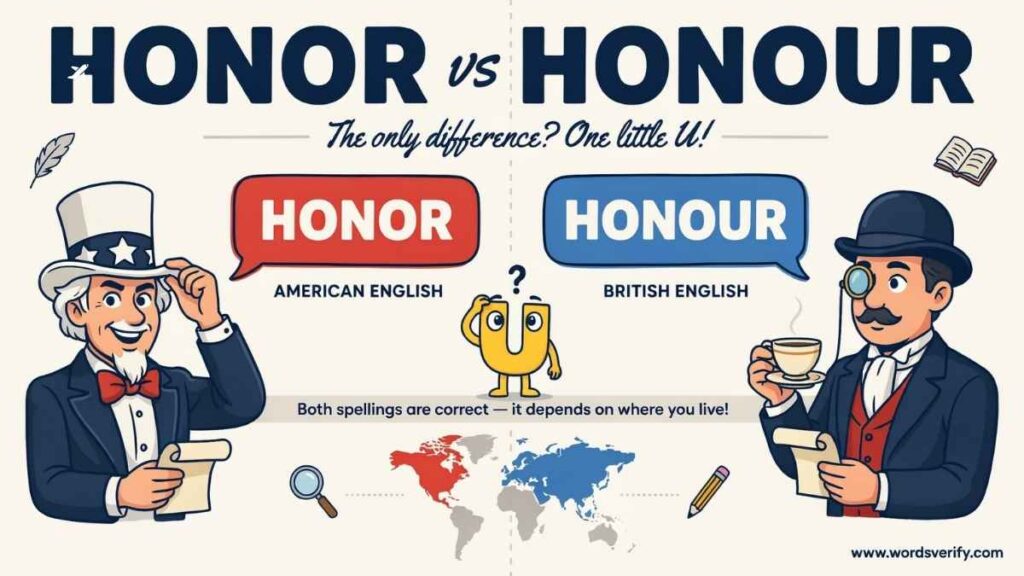
Have you ever typed honor and then wondered, “Wait, shouldn’t there be a u in there?” You’re certainly not alone. The honor vs honour confusion is common because American and British English use different spellings for the same word. American English generally uses honor, while British English prefers honour. The meaning doesn’t change, and neither spelling is wrong. In this guide, you’ll discover why these spellings differ, when to use each one, and how to avoid common mistakes. By the end, that tiny missing “u” should cause far less confusion in your writing.
quick Answer
Honor and honour are two accepted spellings of the same English word.
| Word | Common variety | Meaning |
|---|---|---|
| Honor | American English | Respect, dignity, recognition, or fulfillment of an obligation |
| Honour | British English | The same meanings |
If you’re writing for an American audience, use honor. If you’re following British English, use honour.
Canadian English commonly uses honour as well, although Canadian English has its own language conventions and isn’t simply identical to British English.
The most important rule is consistency. Once you’ve chosen an English variety, stick with it throughout your writing.
Learn how to use confusing more words correctly
Ballot vs Bullet difference and correct usage
What Does Honor vs Honour Mean?
The meaning of honor and honour goes beyond simply showing respect. Depending on the sentence, the word can describe dignity, reputation, recognition, moral character, or a special privilege.
It can also describe the act of respecting someone, recognizing an achievement, remembering a person, or keeping a promise.
Honor vs Honour as a Noun
As a noun, the word can describe respect or admiration for someone.
For example:
The soldier was treated with honor.
Here, honor refers to respect and dignity.
It can also describe a special distinction or privilege:
She received an honor for her years of community service.
In another context, it can describe someone’s moral character:
He was known as a man of honor.
Common noun meanings include:
- Respect or esteem
- Dignity
- Recognition for an achievement
- A special privilege
- Moral integrity
- A person’s reputation
- A tribute to someone
- A commitment to a principle or promise
The exact meaning depends on the sentence.
Honor vs Honour as a Verb
Honor and honour can also work as verbs.
To honor someone can mean to show respect, recognize their achievements, celebrate them, or remember them.
For example:
The school honored the teacher for 30 years of service.
The family gathered to honor their grandfather’s memory.
The city honored the firefighters who saved lives.
The verb can also mean to keep or fulfill something that has been promised or agreed upon.
For example:
The company agreed to honor the original agreement.
In British English, the same sentences would use honour.
The meaning doesn’t change.
Learn how to use confusing more words correctly
Grately vs Greatly Meaning, Difference and Usage
Honor vs Honour What’s the Difference?
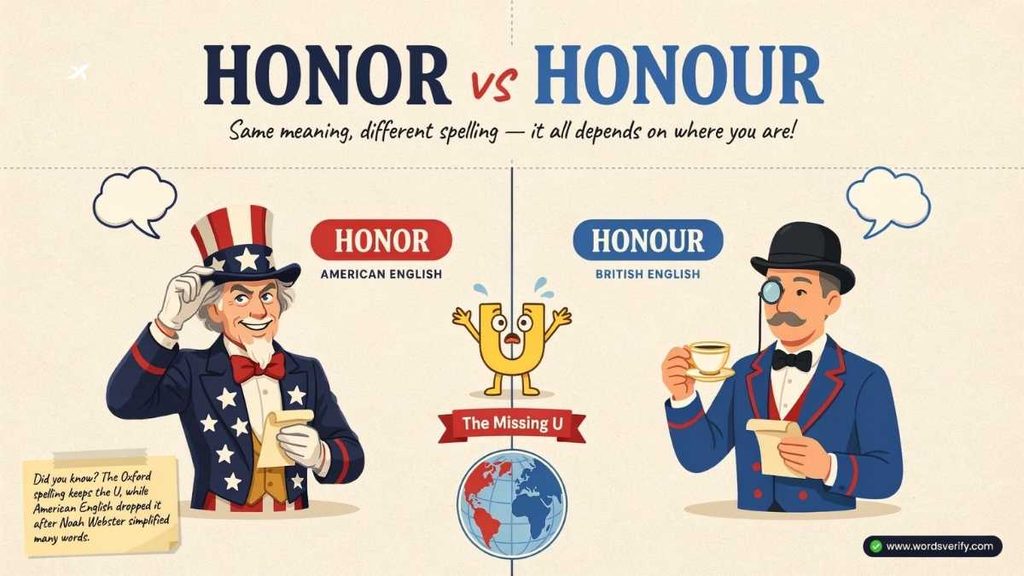
The difference between honor and honour is mainly a matter of spelling.
American English generally removes the u, while British English retains it.
| American English | British English |
|---|---|
| honor | honour |
| honored | honoured |
| honoring | honouring |
| honorable | honourable |
| honorably | honourably |
| dishonor | dishonour |
| dishonorable | dishonourable |
The pronunciation and meaning remain essentially the same.
This spelling pattern isn’t unique to honor. You can see it in several other words too.
| American English | British English |
|---|---|
| color | colour |
| favor | favour |
| labor | labour |
| neighbor | neighbour |
| behavior | behaviour |
| valor | valour |
| odor | odour |
| rumor | rumour |
Once you recognize this pattern, the difference becomes much easier to remember.
Honor in American English
American English uses honor without the letter u.
You’ll find this spelling in everyday writing as well as formal documents, school assignments, newspapers, books, business communication, and government material.
Here are some common examples:
- It was an honor to meet the author.
- The university gave her an honor for her research.
- The ceremony was held in honor of the veterans.
- The company agreed to honor the contract.
- He acted with honor throughout his career.
- She was placed on the honor roll.
- The community gathered to honor his memory.
If you’re writing in American English, these forms should remain consistent.
Honour in British English
British English normally keeps the u and spells the word honour.
For example:
- It was an honour to meet the author.
- The university gave her an honour for her research.
- The ceremony was held in honour of the veterans.
- The company agreed to honour the contract.
- He acted with honour throughout his career.
- She was placed on the honour roll.
- The community gathered to honour his memory.
These aren’t different meanings. They’re simply British spellings of the same word.
Learn how to use confusing more words correctly
Neice vs Niece Which one Is Correct?
Why Does British English Spell Honour With a U?

The spelling has a long history.
The English word developed through older forms of French and ultimately traces back to Latin. French influence helped establish spelling patterns such as -our in English.
British English retained this pattern in words such as honour, colour, favour, and labour.
American English later developed its own spelling preferences. Noah Webster played an important role in promoting several American spelling forms, including shorter versions of words ending in -our.
That is why American English commonly uses:
- honor instead of honour
- color instead of colour
- favor instead of favour
- labor instead of labour
The American forms aren’t shortened versions in the sense of being incomplete. They are established standard spellings in American English.
Is Honor vs Honour the Correct Spelling?
Both spellings are correct.
The better question is: Which English variety are you using?
1.If you’re writing in American English, use honor.
2.If you’re writing in British English, use honour.
3.If you’re writing for a Canadian audience, honour is commonly used.
4.If you’re writing for a particular publication, school, company, or organization, follow its preferred style guide.
There isn’t a universal rule saying that one spelling is correct and the other is wrong.
Learn how to use confusing more words correctly
Principal vs Principle Difference and Correct usage
Honor vs Honour Pronunciation
The spelling difference doesn’t normally create a major difference in pronunciation.
Both forms are generally pronounced with the same basic sound. The exact pronunciation can vary slightly depending on a speaker’s accent.
The important point is that the u in honour doesn’t create an extra syllable.
So you don’t need to pronounce honour as though it contains an additional sound between the n and r.
In normal speech, an American speaker saying honor and a British speaker saying honour are clearly saying the same word despite the spelling difference.
Honor vs Honour in Canadian English
Canadian English is an interesting middle ground because it shares features with both American and British English.
For this word, honour is widely used in Canadian English.
You may see sentences such as:
The ceremony was held in honour of the volunteers.
Canadian English also commonly uses other British-style spellings such as colour and favour.
However, Canadian English isn’t simply British English used in Canada. It has its own vocabulary, spelling preferences, and language conventions.
If you’re writing specifically for Canadian readers, check the style requirements of the publication or organization when consistency matters.
Learn how to use confusing more words correctly
Inquire vs Enquire Difference and Usage
in Everyday Expressions
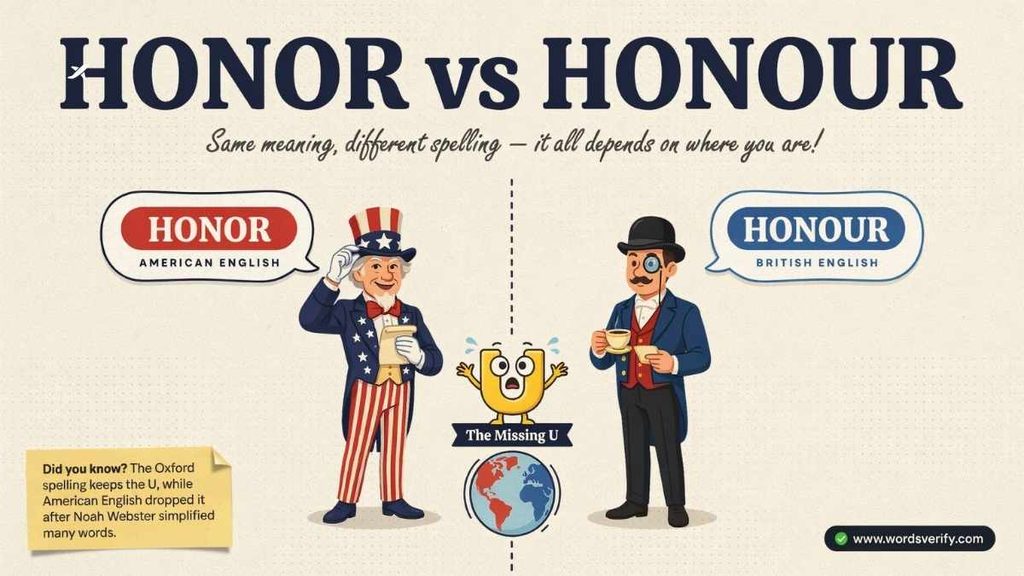
The word appears in many familiar expressions. The spelling follows the same regional pattern.
In Honor of vs In Honour of
American English:
The concert was held in honor of the retiring teacher.
British English:
The concert was held in honour of the retiring teacher.
The phrase means that something is being done as a sign of respect or recognition.
Such an Honor vs Such an Honour
American English:
It was such an honor to receive the award.
British English:
It was such an honour to receive the award.
Both sentences express gratitude and appreciation.
Your Honor vs Your Honour
The spelling also changes in formal forms of address.
American English uses Your Honor in relevant judicial contexts.
British English uses Your Honour in contexts where that form of address applies.
The difference is spelling rather than a simple difference in the meaning of the word itself.
Honor Roll vs Honour Roll
American English commonly uses honor roll.
British English uses honour roll.
The term refers to a list recognizing students for academic achievement or distinction.
Honor vs Honour on a Wedding Invitation
Wedding invitations sometimes use the word in phrases such as:
“It is an honor to invite you…”
or:
“It is an honour to invite you…”
Neither version is automatically more formal or elegant.
If the invitation follows American English, honor is the natural choice.
If it follows British English, honour is appropriate.
The same principle applies to wedding websites, programs, announcements, and other formal wedding material.
The important thing is to choose one spelling system and use it consistently.
Honor vs Honour in School and Academic Writing
Students often wonder which spelling they should use in an essay or assignment.
The answer depends on the English variety expected by the school or instructor.
For American English:
The student received an honor for academic achievement.
For British English:
The student received an honour for academic achievement.
If your teacher, university, or publication requires a particular style, follow that requirement rather than switching between spelling systems.
This matters because inconsistent spelling can make otherwise strong writing look careless.
For example, using color in one paragraph and colour in another suggests that two spelling systems have been mixed.
The same thing can happen with honor and honour.
Learn how to use confusing more words correctly
Carmel vs Caramel difference and Correct usage
Related Forms of Honor and Honour
The spelling difference continues when you change the word’s form.
Honored vs Honoured
American English uses honored.
British English uses honoured.
Examples:
- The organization honored her achievements.
- The organization honoured her achievements.
Honoring vs Honouring
American English uses honoring.
British English uses honouring.
Examples:
- The city is honoring its veterans.
- The city is honouring its veterans.
Honorable vs Honourable
American English uses honorable.
British English uses honourable.
Examples:
- He made an honorable decision.
- He made an honourable decision.
Honorably vs Honourably
American English uses honorably.
British English uses honourably.
These forms follow the same broad regional spelling distinction.
Learn how to use confusing more words correctly
Naive vs Nieve difference and Correct usage
Common Mistakes With Honor and Honour
Although the rule is simple, several misunderstandings come up frequently.
Thinking Honour Is Wrong
Someone accustomed to American English may see honour and assume it’s misspelled.
It isn’t.
Honour is the standard spelling in British English and is also used in other varieties.
Thinking Honor Is Wrong
The reverse can happen with British English readers.
Honor isn’t an incorrect or incomplete form. It’s the standard American spelling.
Mixing the Two Styles
Consider this sentence:
The color of the medal represents the honour of the recipient.
It isn’t difficult to understand, but the spelling is inconsistent if the writer intends to follow one regional style.
A consistent American version would be:
The color of the medal represents the honor of the recipient.
A consistent British version would be:
The colour of the medal represents the honour of the recipient.
Thinking the Meaning Changes
The extra u doesn’t create a new meaning.
Honor and honour refer to the same basic concept.
Assuming the Pronunciation Changes Completely
The spelling looks different, but the word isn’t suddenly pronounced as a different word.
The difference is primarily written.
Learn how to use confusing more words correctly
Eying vs Eyeing difference and Correct usage
How to Remember Honor vs Honour
A simple memory trick can save you a lot of hesitation.
Remember:
American English: honor
British English: honour
Then connect the spelling with another familiar pair:
color → colour
Once you remember that American English often drops the u in this group of words, honor becomes easier to recognize.
Still, don’t rely on the pattern for every word. English has plenty of exceptions.
When Should You Use Honor or Honour?
Use the spelling that matches your audience and your chosen English variety.
- If you’re writing for readers in the United States, use honor.
- If you’re writing in British English, use honour.
- If you’re writing for Canadian readers, honour is commonly appropriate.
- If you’re completing an assignment, follow your instructor’s required English variety.
- If you’re writing for a publication, follow its style guide.
- If you’re editing an existing document, keep its established spelling system unless you’re deliberately changing the style.
- If you’re writing a long article, check related forms such as honored/honoured and honorable/honourable as well.
The goal isn’t to memorize which version is “better.” The goal is to know which version belongs in your particular piece of writing.
Learn how to use confusing more words correctly
Humour vs Humor Difference and Correct usage
Honor vs Honour Examples in Sentences
Seeing both forms side by side makes the distinction much clearer.
| Situation | American English | British English |
|---|---|---|
| Recognition | It was an honor. | It was an honour. |
| Respect | We honor our heroes. | We honour our heroes. |
| Tribute | In honor of her memory | In honour of her memory |
| Promise | We will honor the agreement. | We will honour the agreement. |
| Past tense | They honored him. | They honoured him. |
| Ongoing action | They are honoring her. | They are honouring her. |
| Adjective | an honorable person | an honourable person |
| Academic award | honor roll | honour roll |
| Courtroom form | Your Honor | Your Honour |
A Simple Comparison to Remember
If you’re still unsure, keep this little table nearby:
| If you’re using… | Write… |
|---|---|
| American English | honor |
| British English | honour |
| American English | honored |
| British English | honoured |
| American English | honoring |
| British English | honouring |
| American English | honorable |
| British English | honourable |
That’s really the heart of the matter.
Learn how to use confusing more words correctly
Insite vs Insight difference and Correct usage
Practice Session Honor vs Honour
Choose the correct word or spelling to complete each sentence.
- It was a great ______ to meet the famous author.
- In American English, the correct spelling is ______.
- In British English, the correct spelling is ______.
- The ceremony was held in ______ of the brave firefighters.
- She felt ______ to receive the prestigious award.
- The British spelling of “honored” is ______.
- The American spelling of “honouring” is ______.
- He was placed on the ______ roll for achieving excellent grades.
- The community gathered to ______ the memory of a respected leader.
- She believes that keeping your promises is a matter of ______.
- The judge was addressed as “Your ______” in the United States.
- In British English, the judge may be addressed as “Your ______.”
- He received an ______ for his contribution to education.
- The company promised to ______ the agreement.
- The spelling “honour” is commonly used in ______ English.
- The spelling “honor” is standard in ______ English.
- Honor and honour have the same basic ______.
- The extra “u” in honour does not normally change its ______.
- The soldier served his country with courage and ______.
- The British spelling of “honorable” is ______.
- American English uses “honor,” while British English uses ______.
- The memorial was built in ______ of those who lost their lives.
- She was deeply ______ by the kind gesture.
- Choose one spelling system and remain ______ throughout your writing.
- The choice between honor and honour depends mainly on the English ______ you are using.
Answers
- honor
- honor
- honour
- honor
- honored
- honoured
- honoring
- honor
- honor
- honor
- Honor
- Honour
- honor
- honor
- British
- American
- meaning
- pronunciation
- honor
- honourable
- honour
- honor
- honored
- consistent
- variety
Here’s a trusted source for clear more words Comparison:
FAQs
Why does British English spell honor as honour?
British English traditionally retained the -our spelling, which reflects French influence on English. American English later adopted simplified spellings such as honor, color, and favor.
Does honor mean the same thing as honour?
Yes. Honor and honour have the same meaning and pronunciation in most varieties of English. The main difference is regional spelling.
Is honour only used in British English?
No. Honour is strongly associated with British English, but it is also commonly used in Canadian English and other English varieties influenced by British conventions.
Is honor only used in American English?
Honor is the standard American English spelling. It can also appear in other varieties when writers follow American spelling conventions.
Why is there a difference between American and British spelling?
American and British English developed different spelling conventions over time. American English adopted several simplified forms, while British English retained many traditional spellings.
Does the pronunciation change between honor and honour?
Usually, no. The two spellings are generally pronounced the same. The extra u in honour does not add another syllable.
Is “honor” a noun or a verb?
Honor can be both a noun and a verb. As a noun, it can mean respect or recognition. As a verb, it can mean to show respect or fulfill an obligation.
What is the British spelling of honored?
The British spelling is honoured. American English uses honored.
What is the British spelling of honoring?
British English uses honouring, while American English uses honoring.
What is the difference between honor and honorable?
Honor is a noun or verb, while honorable is an adjective describing someone or something worthy of respect. In British English, the adjective is usually spelled honourable.
Should I use honor or honour in the same document?
Choose the spelling that matches the variety of English you’re using and keep it consistent throughout the document. Mixing American and British spelling can make your writing look inconsistent.
Is “in honor of” different from “in honour of”?
No. They have exactly the same meaning. In honor of is the American spelling, while in honour of is the British spelling.
Is “honor roll” or “honour roll” correct?
Both are correct in their respective varieties of English. Honor roll is standard in American English, while honour roll is common in British English and some other varieties.
Can honor refer to a moral quality?
Yes. Honor can describe a person’s honesty, integrity, strong moral principles, or sense of what is right.
Can honor refer to an award or distinction?
Yes. Honor can describe recognition given to someone for an achievement, contribution, or special quality.
Conclusion
The honor vs honour confusion is really a matter of English variety, not a battle between right and wrong. Honor is the standard spelling in American English, while honour is the usual form in British English and several other varieties. Both words carry the same meaning, whether you’re talking about respect, dignity, recognition, or a privilege.
The simplest rule is to consider your audience and stay consistent. Writing for American readers? Use honor. Following British English? Choose honour. The extra “u” isn’t a spelling mistake—it’s simply part of the British spelling.
Once you know this small regional difference, choosing between honor and honour becomes easy. No need to give that little “u” more attention than it deserves!

Lisa AJS is an experienced blogger and language enthusiast at Words Verify, dedicated to making grammar simple, practical, and enjoyable. She writes engaging content on commonly confused words, grammar mistakes, word meanings, and everyday language challenges.