
Have you ever typed a word, looked at it twice, and suddenly wondered whether you’ve been spelling it wrong all along? If you’re caught between steer vs stear, you’re certainly not the only one. These two spellings look close enough to cause confusion, but only one is correct in standard English. Steer is the right choice when you mean to guide, direct, or control something. It can also refer to a male bovine or appear in the familiar phrase “steer clear.” In this guide, you’ll discover the difference between steer vs stear, learn common mistakes, and see how to use steer correctly.
quick answer
Steer is the correct spelling in standard English.
Stear is generally a misspelling when you intend to use the word steer.
Here is the basic difference:
| Word | Correct spelling? | Meaning |
|---|---|---|
| Steer | Yes | To guide or direct something; also a castrated male bovine |
| Stear | No | Usually an incorrect spelling of steer |
For example:
- Please steer the car carefully.
- She tried to steer the conversation toward another topic.
- The farmer raised a young steer.
- We decided to steer clear of the crowded road.
In each example, steer is the correct spelling.
Learn the difference between tricky more English words
Honor vs Honour difference and Correct usage
What Does Steer Mean?
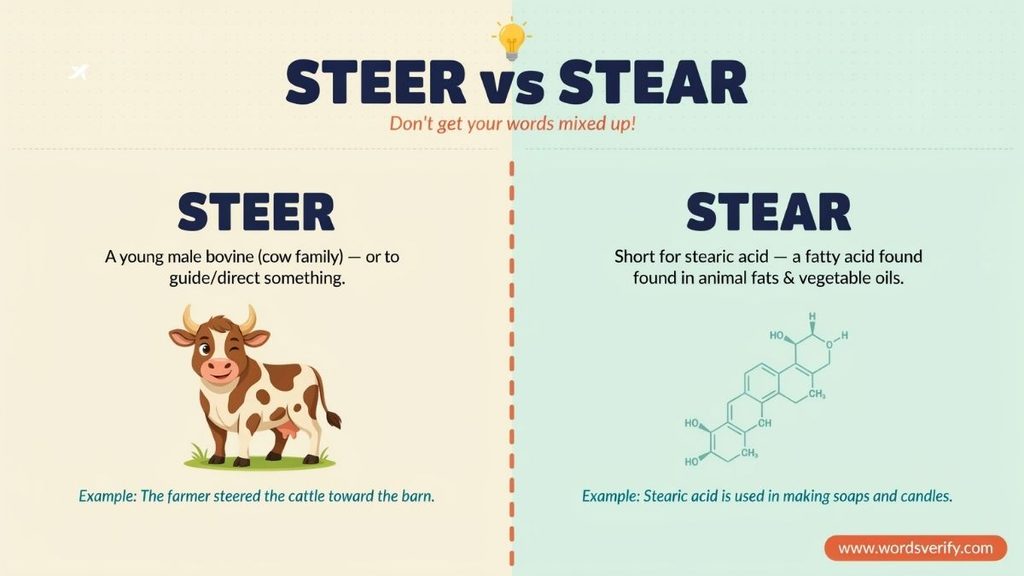
The word steer has several meanings. The meaning depends on how it is used in a sentence.
Most commonly, steer is a verb that means to guide or control the direction of something.
Steer as a Verb
When you steer something, you control where it goes.
The most obvious example is driving.
- She steered the car around the corner.
- He carefully steered the boat toward the dock.
- The cyclist steered around the pothole.
- I had to steer the bicycle back onto the path.
In each sentence, steer describes controlling direction.
However, you don’t have to be talking about a vehicle to use the word.
Steer Someone in a Direction
You can also use steer when someone helps another person make a choice or move toward a particular goal.
For example:
- My teacher steered me toward a career in writing.
- Her advice steered him toward a better decision.
- The manager steered the team in a new direction.
In these examples, nobody is physically driving anything. The word is being used in a figurative sense. It describes guidance or influence.
Steer a Conversation
Another common use appears when people talk about discussions.
You can steer a conversation toward a particular subject or away from one.
For example:
- She steered the conversation toward the main issue.
- He tried to steer the discussion away from personal matters.
- The interviewer steered the conversation back to the candidate’s experience.
- I gently steered the discussion toward a possible solution.
This use is especially common in everyday conversations, interviews, meetings, and professional settings.
Steer a Project or Situation
Steer can also describe guiding a project, organization, or situation.
For example:
- The manager steered the project through a difficult period.
- Her leadership helped steer the company in a better direction.
- The team leader steered the group toward a practical solution.
Here, steer suggests direction and leadership. It doesn’t mean physical movement.
Learn the difference between tricky more English words
Neice vs Niece Which one Is Correct?
What Does Steer Mean as a Noun?
Steer has another meaning that is unrelated to driving or directing.
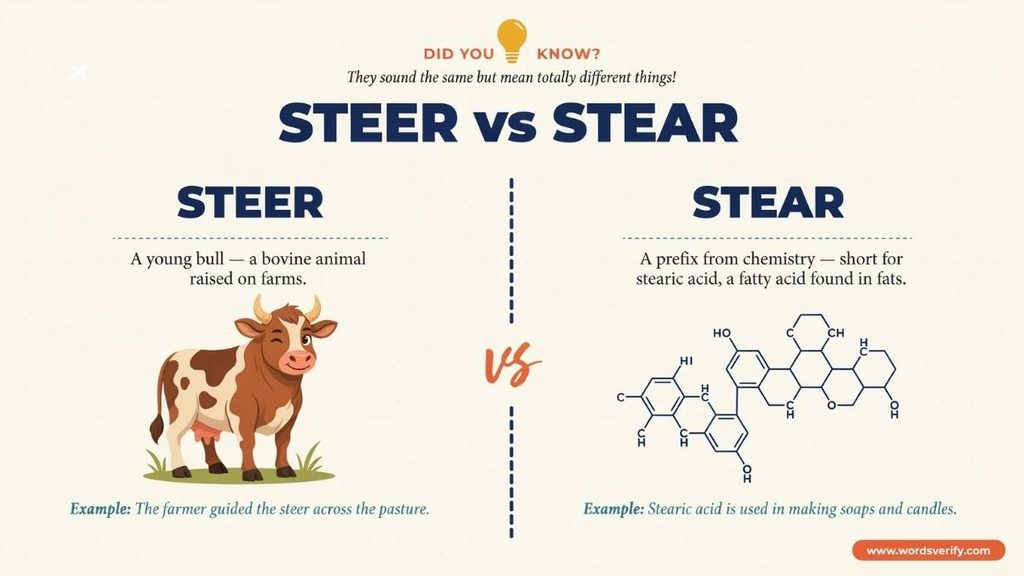
A steer is a male bovine that has been castrated. Steers are commonly raised for beef.
This meaning is mainly used when discussing cattle, farming, ranching, and livestock.
For example:
- The rancher bought several young steers.
- The farmer moved the steer into another pasture.
- The cattle producer raises steers for beef.
If you’re unfamiliar with livestock terminology, it can be easy to confuse the different terms.
Here is a simple comparison:
| Term | Meaning |
|---|---|
| Cow | An adult female bovine |
| Bull | An adult intact male bovine |
| Steer | A castrated male bovine |
| Calf | A young bovine of either sex |
So, steer can refer either to guiding something or to a particular type of male cattle animal.
The surrounding sentence usually makes the intended meaning clear.
Learn the difference between tricky more English words
Principal vs Principle Difference and Correct usage
What Does Stear Mean?
When you mean the verb steer vs stear the noun referring to a castrated male bovine, stear is not the standard spelling.
For example, this spelling is incorrect:
Please stear the car toward the left.
The correct version is:
Please steer the car toward the left.
The same problem appears in the expression steer clear.
Incorrect:
Try to stear clear of that area.
Correct:
Try to steer clear of that area.
If you’re writing in standard English, use steer.
Learn the difference between tricky more English words
Inquire vs Enquire Difference and Usage
Why Do People Write Stear Instead of Steer?

The confusion mostly comes from pronunciation.
English spelling isn’t always as predictable as its pronunciation. Sometimes a word sounds as though it could be spelled several different ways. When people hear steer, they may naturally wonder whether the vowel sound should be represented with ea or another spelling.
That can lead to stear, even though it isn’t the standard spelling for the word.
This type of mistake is common because people often write words from memory based on how they sound.
A useful way to remember the spelling is to connect steer with steering.
Think of these words together:
- Steer
- Steering
- Steering wheel
Once you remember the spelling of steering wheel, it becomes easier to remember that the basic word is steer.
Learn the difference between tricky more English words
Carmel vs Caramel difference and Correct usage
Steer vs Stear Everyday Sentences
Seeing the word in different situations can help you understand how naturally it fits into everyday English.
Driving
- Please steer the car into the right lane.
- He steered around the fallen branch.
- She learned how to steer when she first learned to drive.
- Keep your attention on the road while you steer.
Boats and Water
- The captain steered the boat toward the harbor.
- We had to steer away from the rocks.
- He knows how to steer a small fishing boat.
- The sailor carefully steered around the island.
Conversations
- She steered the conversation toward education.
- He tried to steer the discussion away from the disagreement.
- The teacher steered the conversation back to the lesson.
- The host steered the interview toward the guest’s new project.
Decisions and Situations
- Her advice steered me toward a better choice.
- The director steered the team through a challenging project.
- His experience helped steer the company in a new direction.
- The coach tried to steer the players toward a stronger strategy.
These examples show why steer is such a flexible word. It can describe physical movement as well as ideas, choices, discussions, and decisions.
Learn the difference between tricky more English words
Naive vs Nieve difference and Correct usage
What Does “Steer Clear” Mean?
Steer clear is one of the most familiar expressions that contains the word steer.
To steer clear of something means to avoid it or stay away from it.
For example:
- You should steer clear of that dangerous road.
- I try to steer clear of unnecessary arguments.
- She decided to steer clear of sugary drinks.
- We were told to steer clear of the damaged bridge.
The expression doesn’t require an actual vehicle.
If someone says, “Steer clear of that person,” they mean you should keep your distance or avoid getting involved.
Some alternatives include:
- Avoid
- Stay away from
- Keep away from
- Keep your distance from
- Give something a wide berth
However, steer clear of remains a natural and widely understood expression.
Learn the difference between tricky more English words
Eying vs Eyeing difference and Correct usage
Common Mistakes With Steer
Knowing the correct spelling of steer is only part of the story. Some mistakes happen when people change the word into another form.
Stear Instead of Steer
This is the most common spelling mistake.
Incorrect:
He tried to stear the boat.
Correct:
He tried to steer the boat.
Stearing Instead of Steering
When adding -ing, some people write stearing.
The correct form is steering.
Correct:
She is steering the car carefully.
Incorrect:
She is stearing the car carefully.
Steared Instead of Steered
The past tense can cause a similar problem.
The correct form is steered.
Correct:
He steered the boat toward the shore.
Incorrect:
He steared the boat toward the shore.
The main forms to remember are:
- Steer
- Steers
- Steered
- Steering
Learning these forms together can help you avoid several related spelling mistakes.
Steer vs Guide
Steer and guide are similar, but they aren’t always used in exactly the same way.
Guide often suggests helping someone understand something, find a route, or reach a goal.
For example:
The teacher guided the students through the lesson.
Steer often focuses more strongly on direction or influence.
For example:
The teacher steered the discussion toward the main topic.
Both words involve direction, but the emphasis is slightly different.
Steer vs Direct
Direct can mean giving instructions or controlling where something goes.
For example:
- The officer directed traffic.
- The manager directed the employees toward the correct procedure.
Steer often sounds more natural when you’re describing movement or gradual influence.
For example:
- The driver steered the car through traffic.
- Her advice steered me toward a better decision.
Steer vs Control
Control has a broader meaning than steer.
If you control something, you have power over it or keep it within certain limits.
For example:
She controls the entire project.
This suggests authority and responsibility.
By contrast:
She steered the project toward a successful outcome.
This focuses more on the direction the project took.
The two words can overlap, but they don’t always carry the same emphasis.
Steer vs Drive
Driving and steering are closely connected, but they don’t mean the same thing.
Drive means operating and moving a vehicle.
Steer means controlling the direction of that vehicle.
For example:
He drove the car to work.
This tells us that he operated and traveled in the car.
He steered the car around the obstacle.
This focuses specifically on direction.
You can drive a car while steering it, but steering is only one part of driving.
Learn the difference between tricky more English words
Humour vs Humor Difference and Correct usage
How to Remember the Correct Spelling
If you frequently confuse steer vs stear, use a simple association.
Think about a steering wheel.
The word steering comes from steer:
- Steer
- Steering
- Steering wheel
You already know that steering wheel is spelled with steer at its beginning. That connection can help you remember the correct spelling whenever you hesitate.
Another useful reminder is to associate steer with direction.
You steer something where you want it to go.
That could be a car, boat, conversation, project, or even a decision.
Learn the difference between tricky more English words
Insite vs Insight difference and Correct usage
Practice session Steer vs Stear
Fill in each blank with the correct form of steer, steers, steered, or steering.
- Please ______ the car carefully around the corner.
- She ______ the conversation toward a more positive topic.
- The captain is ______ the boat toward the harbor.
- You should ______ clear of that dangerous road.
- He ______ the bicycle around the large pothole.
- The teacher tried to ______ the discussion back to the main subject.
- Good advice can ______ you toward a better decision.
- The driver is ______ through heavy traffic.
- The farmer owns several young ______.
- She carefully ______ the car into the parking space.
- We decided to ______ clear of the crowded highway.
- The manager ______ the team through a difficult project.
- He knows how to ______ a boat safely.
- The coach tried to ______ the players toward a better strategy.
- The sailor was ______ the ship away from the rocks.
- Her experience helped ______ the company in a new direction.
- The driver ______ around the fallen tree.
- They were told to ______ clear of the damaged bridge.
- She is ______ the conversation toward the main issue.
- The rancher moved the ______ into another pasture.
- Please ______ the vehicle into the left lane.
- His advice ______ me away from making a poor decision.
- Learning how to ______ takes practice for new drivers.
- The interviewer ______ the discussion toward the candidate’s experience.
- Remember to write ______, not “stear,” when you mean to guide or direct something.
Answers
- steer
- steered
- steering
- steer
- steered
- steer
- steer
- steering
- steers
- steered
- steer
- steered
- steer
- steer
- steering
- steer
- steered
- steer
- steering
- steers
- steer
- steered
- steer
- steered
- steer
Here’s a trusted source for clear more words Comparison:
FAQs
Is it steer vs stear a car?
The correct phrase is steer a car. Steer means to control the direction of a vehicle. “Stear a car” is an incorrect spelling.
Why is steer spelled with double e?
The standard spelling is steer, with two e’s. The spelling “stear” is a common mistake caused by the way the word sounds.
What is the past tense of steer?
The past tense of steer is steered. For example, “She steered the car around the corner.”
Is stearing or steering correct?
Steering is correct. The word comes from steer, so the spelling keeps the double e. “Stearing” is incorrect.
Can steer be used for things other than vehicles?
Yes. You can steer a conversation, discussion, project, decision, or situation. In these cases, steer means to guide or influence something in a particular direction.
What does steer clear mean?
Steer clear means to avoid something or stay away from it. For example, “We decided to steer clear of the crowded road.”
Is a steer a male cow?
A steer is a male bovine that has been castrated. Steers are commonly raised for beef. The term is different from “bull,” which refers to an adult intact male bovine.
What is the plural of steer?
The plural of steer is steers. For example, “The rancher owns several steers.”
Can steer be both a noun and a verb?
Yes. As a verb, steer means to guide or direct something. As a noun, a steer is a castrated male bovine.
What is the difference between steer and guide?
Both words can describe directing something, but steer often emphasizes controlling direction or influencing where something goes. Guide can suggest helping someone find a path or reach a goal.
What is the difference between steer and drive?
Drive means to operate and move a vehicle, while steer specifically means to control its direction. You drive a car while steering it.
How do you remember the spelling of steer?
A simple trick is to connect steer with steering wheel. Remembering “steer → steering → steering wheel” can help you avoid writing the incorrect form “stear.”
Is steer only used for physical movement?
No. Steer is also commonly used figuratively. You can steer a conversation toward a particular subject or steer someone toward a better decision.
What does it mean to steer someone in the right direction?
To steer someone in the right direction means to give them guidance or advice that helps them make a better choice or move toward a useful goal.
Learn the difference between tricky more English words
Ballot vs Bullet difference and correct usage
Conclusion
The steer vs stear confusion may seem small, but one misplaced vowel can quickly send your sentence in the wrong direction. The correct spelling is steer. You can use it when you guide a car or boat, direct a conversation, influence a decision, or refer to a castrated male bovine. In contrast, stear is generally a spelling mistake when you mean steer.
When in doubt, think of a steering wheel. The word steering begins with steer, which makes the correct spelling easier to remember. So the next time “stear” tries to sneak into your sentence, steer clear of it and choose steer instead.

Lisa AJS is an experienced blogger and language enthusiast at Words Verify, dedicated to making grammar simple, practical, and enjoyable. She writes engaging content on commonly confused words, grammar mistakes, word meanings, and everyday language challenges.