
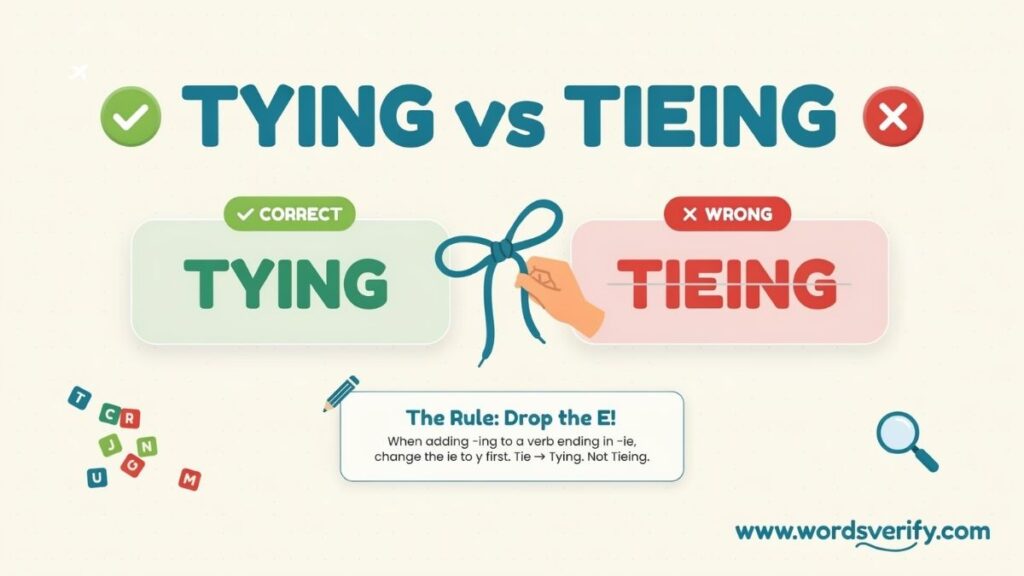
English spelling can be a little sneaky, especially when a word looks as though it should follow a simple rule but refuses to cooperate. “Tying vs tieing” is a perfect example. If you add -ing to tie writing “tieing” may seem perfectly reasonable. However, standard English says otherwise. The correct spelling is “tying.” When a verb ends in “-ie,” the “-ie” changes to “y” before “-ing” is added. In this article, you’ll discover why “tying” is correct, what it means, how it works grammatically, and how to avoid this surprisingly common spelling mistake whenever you use the word Tying vs tieing.
quick answer
Tying is the correct standard spelling.
The word comes from the verb tie, which means to fasten, connect, or secure something. When the verb takes the -ing ending, its final -ie changes to y.
The formation looks like this:
tie → tying
Not:
tie → tieing
For example:
- She is tying her shoes.
- He is tying a ribbon around the box.
- They are tying the ropes together.
- The team scored again, tying the game.
In each sentence, tying is the correct form.
Learn how to use confusing more words correctly
Principal vs Principle Difference and Correct usage
What Does Tying Mean?
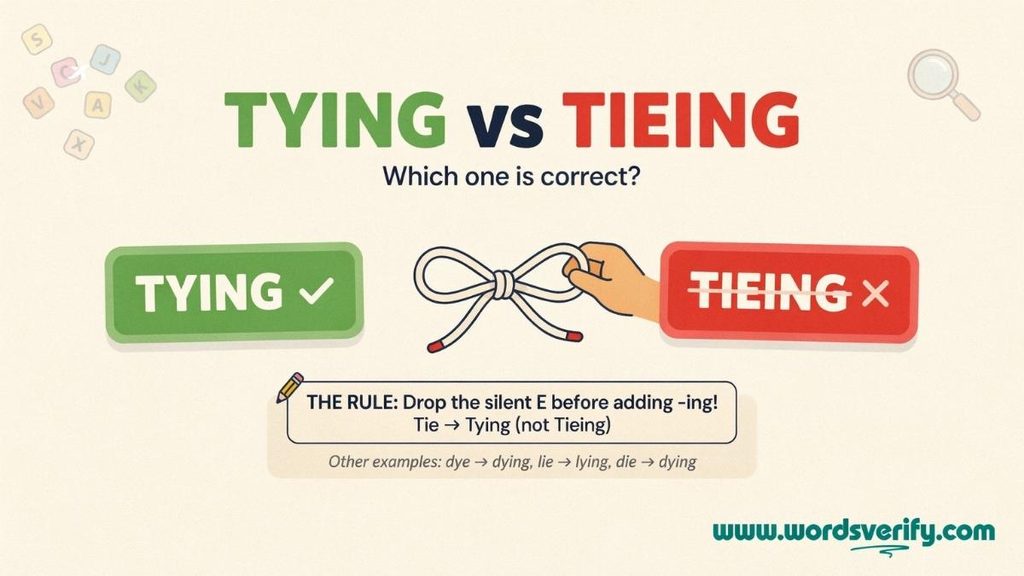
Tying is the present participle and gerund form of the verb tie. Its meaning changes slightly depending on the situation, but the basic idea involves fastening, connecting, securing, or making something equal.
You might use tying when someone is fastening shoelaces, making a knot, attaching one object to another, or even bringing a sports score level.
For example:
- “She is tying her shoes.”
- “He is tying the package with string.”
- “They are tying two ropes together.”
- “The player scored, tying the game.”
The word can describe a physical action, but it can also have a figurative meaning.
The Meaning of Tie
To understand tying, it helps to start with its base verb, tie.
As a verb, tie commonly means to fasten something with a knot, cord, string, rope, or similar material. It can also mean to connect things or make two sides equal in a competition.
Consider these examples:
- “Tie the rope to the post.”
- “She tied a ribbon around the gift.”
- “Please tie your shoelaces.”
- “The two teams are tied at 2–2.”
The word can also appear in expressions such as tie the knot, which means to get married.
When the action is happening now or is being treated as an activity, tie changes to tying.
Learn how to use confusing more words correctly
Inquire vs Enquire Difference and Usage
Why Is Tying Spelled Without the E?
This is where the confusion usually begins.
At first, tie + ing appears to produce tieing. That seems logical because many verbs form their -ing forms by simply adding -ing.
For example:
- walk → walking
- talk → talking
- read → reading
- jump → jumping
However, verbs ending in -ie follow a different spelling pattern.
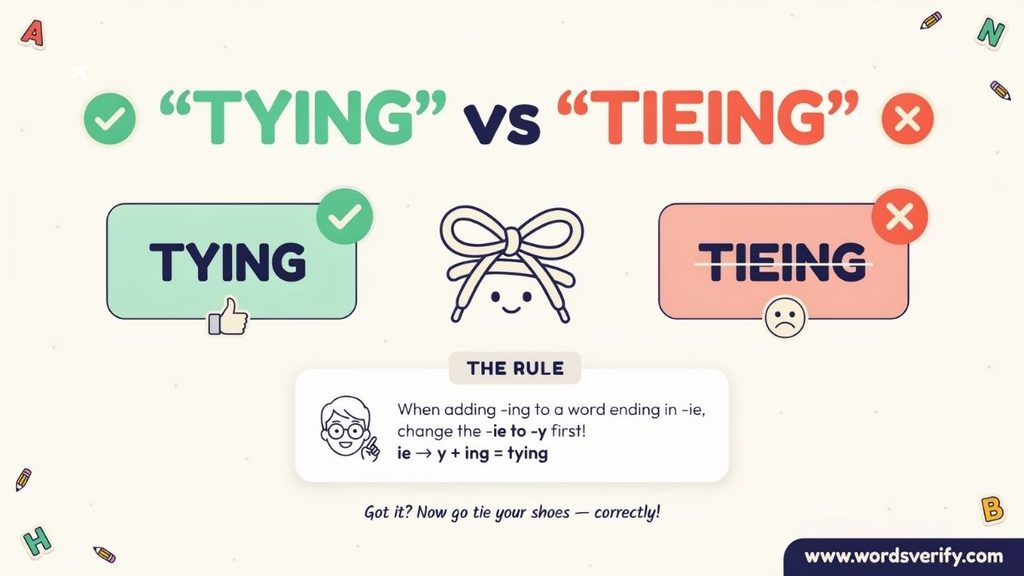
The final -ie changes to y before -ing is added.
So:
tie → ty + ing → tying
The important part isn’t simply dropping the letter e. The entire ending -ie changes to y.
That’s why the correct form is tying.
The -ie to -y Spelling Rule
A useful way to remember the rule is:
When a verb ends in -ie, change -ie to y before adding -ing.
Several common words show the same pattern.
| Base verb | Correct -ing form |
|---|---|
| tie | tying |
| lie | lying |
| die | dying |
| vie | vying |
Look at the pattern closely. The ending changes in each case.
tie → tying
lie → lying
die → dying
vie → vying
Once you notice these examples together, tying no longer seems unusual.
Tying vs Tieing
The difference between tying vs tieing is mainly a matter of standard spelling.
| Word | Standard spelling? | Use |
|---|---|---|
| tying | Yes | Use this form |
| tieing | No | Avoid this form |
For example:
- Correct: “He is tying his shoes.”
- Incorrect: “He is tieing his shoes.”
The second spelling looks understandable, but standard English uses tying.
This is one of those situations where spelling rules don’t always follow the first pattern that comes to mind.
How to Spell Tying
If you’re wondering how to spell tying, there’s a simple way to build the word.
Start with:
tie
Remove the final ie:
t
Change the ending to y:
ty
Then add ing:
tying
So the complete spelling is:
tying
A useful memory trick is to remember that tie loses “ie” and gains “y” before “ing.”
Learn how to use confusing more words correctly
Carmel vs Caramel difference and Correct usage
Is Tieing a Word?
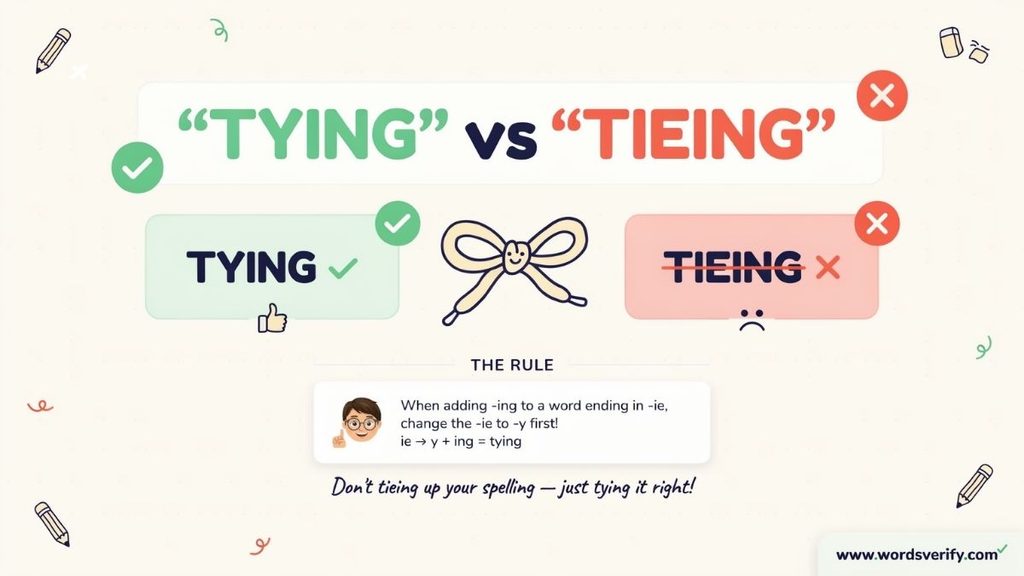
You may occasionally see tieing in writing. That doesn’t make it the standard spelling.
In modern standard English, tying is the accepted form of the -ing version of tie. Therefore, when you’re writing an email, school assignment, article, report, or other ordinary English text, use tying.
For example:
- “She is tying her shoes.”
- “He is tying the rope.”
- “They are tying the package.”
Using tieing in these sentences would be considered a spelling mistake.
Is Tying a Word?
Yes. Tying is a standard English word.
It is formed from the verb tie and the -ing ending. Depending on the sentence, it can function as a present participle or a gerund.
For example:
- “She is tying her shoes.”
Here, tying forms part of the verb phrase is tying.
- “Tying a knot takes practice.”
Here, tying functions as a gerund because the activity acts as the subject of the sentence.
The spelling stays the same even though its grammatical role changes.
Tying as a Present Participle
A present participle is the -ing form of a verb. It commonly appears with forms of be to describe an action that is in progress.
Consider these sentences:
- “I am tying my shoes.”
- “She is tying the ribbon.”
- “He is tying the rope.”
- “They are tying the branches together.”
In each sentence, tying describes something happening at that moment or around the current time.
For instance, in “She is tying the ribbon,” the word is works as the helping verb and tying provides the main action.
Tying as a Gerund
The same -ing form can also work as a noun. When it does, it’s called a gerund.
For example:
“Tying a knot takes practice.”
Here, the activity of tying a knot is the subject of the sentence.
Another example is:
“He enjoys tying fishing knots.”
In this sentence, tying fishing knots describes the activity he enjoys.
Compare the two:
| Sentence | Role of “tying” |
|---|---|
| She is tying her shoes. | Present participle |
| Tying shoes takes practice. | Gerund |
This distinction is useful because it shows that tying isn’t simply a spelling variation of tie. It’s a proper grammatical form with several possible uses.
Learn how to use confusing more words correctly
Naive vs Nieve difference and Correct usage
Present Participle of Tie
The present participle of tie is tying.
The main forms of the verb are:
| Verb form | Example |
|---|---|
| Base form | tie |
| Third-person singular | ties |
| Past tense | tied |
| Past participle | tied |
| Present participle | tying |
You can see how these forms work in sentences:
- “I tie my shoes every morning.”
- “She ties her shoes quickly.”
- “He tied the package yesterday.”
- “They have tied the ropes together.”
- “She is tying her shoes now.”
Each form has a different grammatical job.
What Is the Past Tense of Tie?
The past tense of tie is tied.
This gives you three particularly useful forms:
tie → tied → tying
For example:
- Present: “I tie the rope.”
- Past: “I tied the rope.”
- Present progressive: “I am tying the rope.”
Don’t use tieing when you want the present participle.
The correct sentence is:
“She is tying the rope.”
Not:
“She is tieing the rope.”
Tying Shoes
One of the most familiar uses of tying is tying shoes.
When you tie your shoes, you fasten the shoelaces so the shoes stay securely on your feet.
For example:
- “The child is tying his shoes.”
- “She learned how to tie her shoes at an early age.”
- “He stopped walking because he was tying his shoelaces.”
- “Tying your shoes becomes automatic with practice.”
The phrase is simple, but it’s also a useful way to remember the spelling.
Whenever you think of tie your shoes, the -ing form is tying your shoes.
Tying a Knot
Another common expression is tying a knot.
A knot is formed when rope, string, cord, or another flexible material is looped or crossed in a particular way.
Examples include:
- “He is tying a knot in the rope.”
- “She practiced tying knots before the camping trip.”
- “Tying a secure knot takes practice.”
- “The sailor is tying the rope to the railing.”
Here, tying refers to the physical process of creating or securing something with a knot.
Tying a Bow
Tying a bow is another everyday use.
You might tie a bow on a present, shoelaces, clothing, decorations, or ribbons.
For example:
- “She is tying a bow on the gift.”
- “He learned how to tie a neat bow.”
- “Tying the ribbon took several attempts.”
The meaning remains connected to fastening something.
Learn how to use confusing more words correctly
Eying vs Eyeing difference and Correct usage
Tying Two Things Together
The verb tie doesn’t always involve a traditional knot. It can also mean connecting or securing two things.
For example:
- “They are tying the two ropes together.”
- “She is tying the branches together.”
- “He used string for tying the papers together.”
- “The workers are tying the cables together.”
In these sentences, the important idea is connection.
Tying a Game
Sports give tying another useful meaning.
If a team scores enough points to make the score equal, it ties the game.
Suppose a basketball game has this score:
Team A: 78
Team B: 75
If Team B scores three points, the score becomes:
78–78
Team B has tied the game.
Examples include:
- “The team scored in the final seconds, tying the game.”
- “Her three-pointer is tying the score.”
- “The late goal tied the game.”
There’s an important difference between tying and winning.
| Expression | Meaning |
|---|---|
| tying the game | Making the score equal |
| winning the game | Finishing ahead |
| losing the game | Finishing behind |
So tying a game has nothing to do with ropes or shoelaces. The meaning comes from the idea of bringing two sides together at the same level.
Learn how to use confusing more words correctly
Humour vs Humor Difference and Correct usage
Tying the Knot Meaning
The expression tying the knot is a common English idiom that means getting married.
For example:
- “They are tying the knot this summer.”
- “The couple tied the knot last year.”
- “After years of dating, they decided to tie the knot.”
The phrase has a literal image behind it. A knot joins or secures something. The expression eventually developed a figurative meaning connected with marriage.
You’ll often see the phrase in conversations about weddings, relationships, announcements, and celebrations.
Common Mistakes With Tying
Writing “Tieing”
The most common mistake is simply adding -ing to tie without changing the ending.
Incorrect:
“She is tieing her shoes.”
Correct:
“She is tying her shoes.”
Remember the spelling change:
-ie → y
Treating Every Verb the Same Way
Not every verb forms its -ing version in exactly the same way.
Compare:
| Base verb | -ing form |
|---|---|
| walk | walking |
| read | reading |
| jump | jumping |
| tie | tying |
| lie | lying |
| die | dying |
This is why relying only on the idea of “add -ing” can lead you into trouble.
Confusing Tying With Trying
Tying and trying are easy to confuse because they look similar.
However, they come from different verbs.
tie → tying
try → trying
Their meanings are also different.
- “She is tying her shoes.”
She is fastening them. - “She is trying to tie her shoes.”
She is making an attempt.
That single letter difference changes the entire meaning.
Tying and Other Verbs Ending in -ie
The best way to understand the spelling tying” vs “tieing rule is to compare tie with other verbs that behave in the same way.
| Verb | -ing form |
|---|---|
| tie | tying |
| lie | lying |
| die | dying |
| vie | vying |
Notice that the final -ie doesn’t remain intact.
This pattern is worth learning as a group because it helps you recognize the correct form instead of memorizing every word separately.
Learn how to use confusing more words correctly
Insite vs Insight difference and Correct usage
Tying in Different Types of Writing
The word tying works perfectly well in both casual and formal writing.
You might see it in everyday conversation:
“I’m tying my shoes.”
You might see it in instructions:
“Begin by tying the two ends together.”
You might see it in sports coverage:
“The goal came in the final minute, tying the game.”
You might see it in a school assignment:
“Tying the strands together creates a stronger structure.”
You might also see it in a discussion of relationships:
“They are tying the knot next month.”
The spelling remains tying in every case.
Learn how to use confusing more words correctly
Ballot vs Bullet difference and correct usage
A Simple Way to Remember the Correct Spelling
If you frequently forget whether to write tying vs tieing, don’t try to memorize the entire word in isolation.
Instead, remember the pattern:
tie → tying
Then connect it with:
lie → lying
die → dying
Once the -ie → y pattern becomes familiar, the correct spelling usually comes naturally.
Another useful reminder is:
IE changes to Y before ING.
It’s short, practical, and easy to apply.
Learn how to use confusing more words correctly
Honor vs Honour difference and Correct usage
Tying vs Tieing Quick Comparison
| Question | Correct answer |
|---|---|
| Which spelling is correct? | Tying |
| Is tieing standard? | No |
| What is the base verb? | Tie |
| What is the present participle? | Tying |
| What is the gerund? | Tying |
| What is the past tense? | Tied |
| Does -ie change before -ing? | Yes |
| What does tying shoes mean? | Fastening shoelaces |
| What does tying a game mean? | Making the score equal |
| What does tying the knot mean? | Getting married |
Practice Session Tying vs Tieing
Fill in each blank with the correct form of the word tying vs tieing.
- Sarah is ______ her shoelaces before leaving for school.
- He spent several minutes ______ the rope to the post.
- The player scored a goal, ______ the game in the final minute.
- Dad is ______ a ribbon around the gift.
- She learned how to make a strong knot by ______ two pieces of rope together.
- They are ______ the boat securely to the dock.
- I watched my brother ______ his shoes.
- She is ______ her hair with a colorful band.
- The team is close to ______ the score.
- He is ______ the package with string.
- We saw them ______ the knot carefully.
- The children practiced ______ different types of knots.
- She is ______ the ribbon into a neat bow.
- He injured his finger while ______ the fishing line.
- They were ______ the ropes together to make them longer.
- The two teams are ______ the game at 2–2.
- She is ______ a scarf around her neck.
- He learned that “tieing” is not the standard spelling and that ______ is correct.
- The worker is ______ the cables together.
- She was ______ her shoelaces when the bus arrived.
- They spent the afternoon ______ decorations to the fence.
- He is ______ the knot tightly so it won’t come loose.
- The couple is ______ the knot this weekend.
- I am ______ this string around the box.
- Remember that “tie” becomes ______ when you add “-ing.”
Answers
- tying
- tying
- tying
- tying
- tying
- tying
- tying
- tying
- tying
- tying
- tying
- tying
- tying
- tying
- tying
- tying
- tying
- tying
- tying
- tying
- tying
- tying
- tying
- tying
- tying
Here’s a trusted source for clear more words Comparison:
FAQs
Is it “tying” or “tieing”?
“Tying” is the correct standard spelling. “Tieing” is not the standard modern spelling of the -ing form of “tie.”
Why is “tying” spelled with a Y?
When a verb ends in “-ie,” the “-ie” changes to “y” before “-ing” is added. Therefore, “tie” becomes “tying,” just as “lie” becomes “lying.”
Is “tying” grammatically correct?
Yes. “Tying” is grammatically correct and can function as the present participle or gerund form of the verb “tie.”
What does “tying” mean?
“Tying” means fastening, securing, connecting, or bringing something together with a knot, string, rope, or similar method. Its meaning depends on the context.
Is “tieing” a word?
“Tieing” can appear in historical or nonstandard writing, but it is not the standard modern spelling of the -ing form of “tie.” In normal English writing, use “tying.”
How do you spell “tying” as in “tying my shoes”?
The correct spelling is “tying my shoes.” The word “tie” changes to “tying” when “-ing” is added.
Is it “tying the knot” or “tieing the knot”?
The correct expression is “tying the knot.” It is an idiom that means getting married.
What does “tying the knot” mean?
“Tying the knot” is a common expression meaning to get married or enter into marriage.
What is tying a knot?
Tying a knot means fastening a rope, string, cord, or another flexible material by forming a knot. Different knots serve different purposes.
Is it “tying up” or “tieing up”?
“ Tying up” is correct. For example, “She is tying up the package” uses the standard spelling.
What does “tying up” mean?
“Tying up” can mean fastening something, securing something with a tie or knot, or finishing and dealing with something that remains incomplete. The meaning depends on the sentence.
Can “tying up” have a slang meaning?
Yes. In informal English, “tying someone up” can refer to restraining a person. However, “tying up” can also simply mean fastening or securing something, so context matters.
Is it “tying into” or “tieing into”?
“Tying into” is the correct spelling. Depending on context, it can mean connecting with something, joining something, or becoming closely involved with it.
Is it “tying a game” or “tieing a game”?
“Tying a game” is correct. It means making the score equal, such as when a team scores and brings a game to a tie.
Is it “tying out” or “tieing out”?
“Tying out” is the correct spelling when the phrase is used in a context where “tying” is the intended verb form. “Tieing” should not be used as the standard -ing form of “tie.”
What is the past tense of “tie”?
The past tense of “tie” is “tied.” For example, “She tied the ribbon yesterday.”
What is the present participle of “tie”?
The present participle of “tie” is “tying.” It is used in continuous verb forms, such as “He is tying his shoes.”
What is the difference between “tie” and “tying”?
“Tie” is the base form of the verb, while “tying” is its -ing form. For example, “I tie my shoes every morning” uses the base form, while “I am tying my shoes” uses the present participle.
What are some common examples of “tying”?
Common examples include “tying your shoes,” “tying a knot,” “tying a bow,” “tying a ribbon,” “tying two ropes together,” and “tying the game.”
What spelling rule applies to verbs ending in “-ie”?
For verbs such as “tie,” “lie,” and “die,” the final “-ie” changes to “y” before “-ing” is added. This gives “tying,” “lying,” and “dying.”
How can you remember the spelling of “tying”?
A simple way to remember it is: tie + ing → tying. Think of the final “-ie” changing to “y” before “-ing” is added. This helps you avoid the tempting but incorrect “tieing.”
Learn how to use confusing more words correctly
Steer vs Stear difference and Correct usage
conclusion
The confusion between “tying” vs “tieing” is a classic example of how English spelling can make a simple word feel more complicated than it really is. If you’ve ever added “-ing” to “tie” and thought “tieing” looked right, you’re certainly not alone. However, the correct standard spelling is “tying.”
The rule is simple: verbs ending in “-ie” change the final “-ie” to “y” before “-ing” is added. That gives us “tie” → “tying,” just as “lie” → “lying.” So whether you’re tying your shoes, tying a knot, tying a ribbon, or tying a game, leave that extra “e” behind. It has no business tying up your sentence!

Lisa AJS is an experienced blogger and language enthusiast at Words Verify, dedicated to making grammar simple, practical, and enjoyable. She writes engaging content on commonly confused words, grammar mistakes, word meanings, and everyday language challenges.