
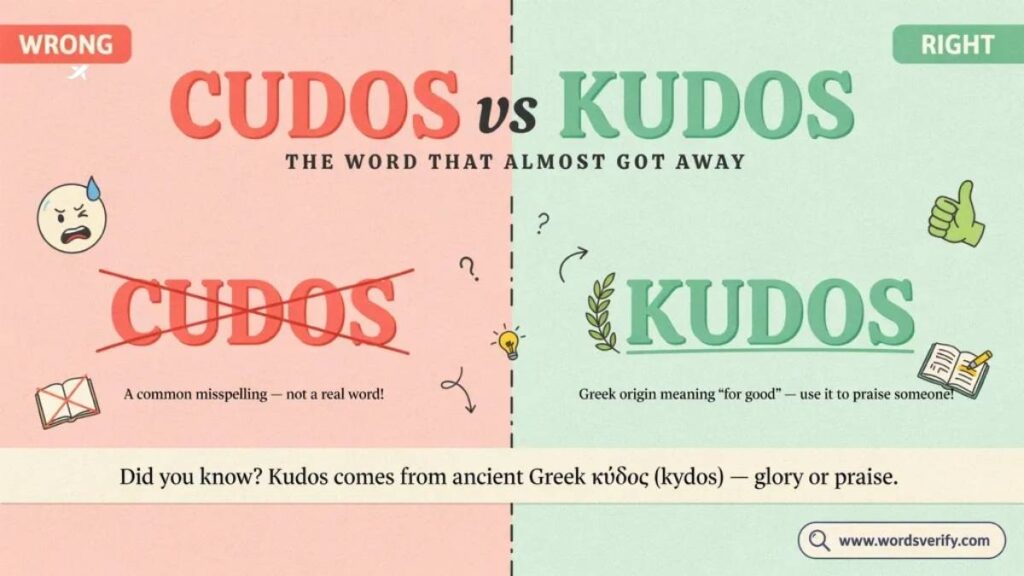
Have you ever typed “cudos” when you meant to praise someone? If so, you’re definitely not alone. The confusion between cudos vs kudos is surprisingly common because the word’s pronunciation can make the incorrect spelling look perfectly reasonable. But one little letter makes all the difference. The correct spelling is “kudos,” a word used to express praise, admiration, or recognition for an achievement. Whether you’re writing a professional email, congratulating a coworker, or simply giving someone credit, knowing the right form keeps your message polished. In this guide, you’ll learn the meaning, spelling, pronunciation, usage, and common mistakes surrounding kudos.on.
quick answer
The correct spelling is kudos.
“Cudos” is generally an incorrect spelling when you are referring to praise, admiration, or recognition.
| Spelling | Correct? | Meaning |
|---|---|---|
| Kudos | Yes | Praise, admiration, or recognition |
| Cudos | No, when intended as “kudos” | Common misspelling of kudos |
For example:
- Kudos to Maria for completing the project ahead of schedule.
- He earned kudos from his manager for solving the problem.
- Kudos to the entire team for their hard work.
You would not normally write:
“Cudos to Maria for completing the project.”
The word you want is “kudos.”
Is Cudos a Word?
If you’re asking whether “cudos” is the correct spelling of the word meaning praise, the answer is no.
“Cudos” commonly appears because people hear the word “kudos” and naturally spell it with a C. The pronunciation can make the mistake especially tempting.
However, there can be unrelated uses of “Cudos” as a name, acronym, or proper noun. That doesn’t make it the standard spelling of the English word used for praise.
When you’re writing about admiration or recognition, use “kudos.”
Understand confusing English more words simply
Tying vs Tieing difference and Correct usage
Is Kudos a Word?

Yes. Kudos is a genuine English word.
It is a noun used when you want to express or describe praise, admiration, recognition, or respect for an achievement.
For example:
- She received kudos for her creative solution.
- Kudos to James for helping the new employees.
- The team earned plenty of kudos after the successful launch.
The word has been part of English for centuries. Its history also explains something interesting about its unusual spelling.
What Does Kudos Mean?
The simplest meaning of kudos is praise or recognition for something done well.
Imagine that someone spends weeks preparing a difficult presentation. The presentation goes extremely well, and afterward, coworkers tell that person how impressed they are.
That praise can be described as kudos.
In simple terms:
Kudos = praise or recognition for an achievement.
Depending on the situation, kudos can also suggest admiration, respect, acclaim, or credit.
For example:
“Kudos to you for staying calm during the difficult meeting.”
This means:
“You deserve praise for staying calm during the difficult meeting.”
Another example:
“The designer received kudos for creating such an effective campaign.”
Here, “kudos” refers to the praise and recognition the designer received.
Kudos Meaning and Usage
“Kudos” usually appears when someone has achieved something, handled something well, or deserves recognition.
It isn’t simply a way of saying that you like someone. There is usually a reason behind the praise.
Compare these two sentences:
“I like Sarah.”
This expresses personal approval or affection.
“Kudos to Sarah for organizing the event so successfully.”
This praises Sarah for a specific achievement.
That difference matters. “Kudos” usually connects praise with something the person has done.
The Origin of Kudos
The spelling becomes easier to remember when you know where the word came from.
“Kudos” comes from the Greek word kydos, which referred to glory, fame, or renown, particularly the honor associated with achievement.
The word entered English around the late 18th century. Etymological sources trace its English use to about 1799 and suggest that it was originally associated with university slang.
There is also an interesting grammatical detail behind the word.
The Greek word was singular even though it ended in a sound that resembles the English plural ending “-s.” English speakers later treated the ending as though it were a plural marker. This eventually contributed to the appearance of the back-formed word “kudo.”
So that final “s” isn’t simply there because “kudos” means several compliments.
That’s one reason the word can feel slightly unusual.
Understand confusing English more words simply
Steer vs Stear difference and Correct usage
How Do You Pronounce Kudos?
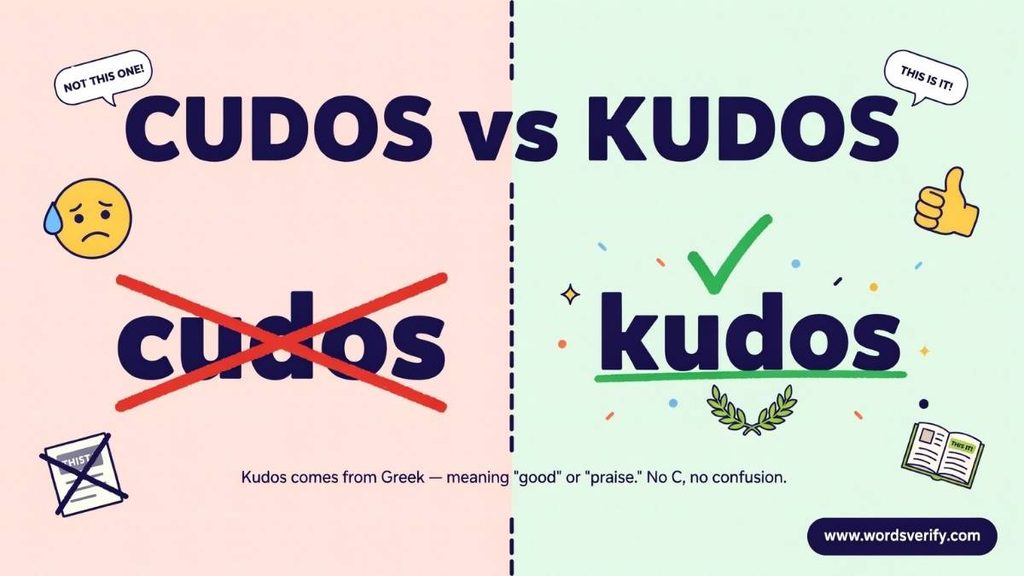
The pronunciation varies slightly between American and British English.
In American English, Cambridge gives the pronunciation as approximately:
KOO-dohs
In British English, it is approximately:
KYOO-doss
The difference is mainly in the first vowel sound.
For American readers, thinking of “kudos” as “KOO-dohs” can help prevent the spelling mistake “cudos.”
The important thing is to connect the sound with the spelling:
Kudos → K
Kudos in a Sentence
Once you know what the word means, using it becomes fairly simple.
Here are some natural examples:
- Kudos to you for finishing the assignment on time.
- She earned kudos for her leadership during the project.
- Kudos to the team for finding a solution so quickly.
- He received kudos from his supervisor for his attention to detail.
- The restaurant deserves kudos for its excellent customer service.
- Kudos to everyone who volunteered at the event.
- The teacher gave the students kudos for their thoughtful presentations.
- You deserve kudos for admitting the mistake and fixing it.
Notice the common pattern. The word often appears with a specific reason for the praise.
Understand confusing English more words simply
Honor vs Honour difference and Correct usage
What Does “Kudos to You” Mean?

“Kudos to you” means you deserve praise or recognition.
It is a friendly way to compliment someone for an achievement or a good action.
For example:
“Kudos to you for completing the marathon.”
This means:
“You deserve praise for completing the marathon.”
You might use the expression with a friend, coworker, classmate, employee, or team member.
It can sound warm and encouraging without being overly formal.
Can You Say “Kudos to Me”?
Yes, you can say “kudos to me,” although the expression can sound humorous or self-congratulatory depending on the context.
For example:
“Kudos to me for remembering everyone’s birthdays this year.”
The speaker is playfully giving themselves credit.
In serious professional writing, however, people usually don’t praise themselves directly with “kudos to me.” It tends to work better as a joke or lighthearted comment.
For example:
“I finally fixed the printer without calling IT. Kudos to me!”
That sentence sounds playful rather than boastful.
Understand confusing English more words simply
Ballot vs Bullet difference and correct usage
Kudos to vs Kudos for?
Both “kudos to” and “kudos for” are correct, but they usually serve different purposes.
Kudos to someone
Use “kudos to” when you are directing praise toward a person, group, or organization.
Examples:
- Kudos to Sarah for leading the project.
- Kudos to the entire team.
- Kudos to our volunteers for their hard work.
- Kudos to the teacher for making the lesson so engaging.
The basic pattern is:
Kudos to + person or group
Kudos for something
Use “kudos for” when you want to identify the action, achievement, or quality being praised.
Examples:
- She received kudos for her excellent presentation.
- He earned kudos for solving the problem quickly.
- The company received kudos for improving its customer service.
- The students got kudos for their creative projects.
The basic pattern is:
Kudos for + action, achievement, or quality
You can also combine them:
“Kudos to Sarah for completing the project early.”
This is one of the most natural ways to use the expression.
Understand confusing English more words simply
Insite vs Insight difference and Correct usage
Is Kudos Singular or Plural?
This is where the word gets interesting.
In modern English, kudos is generally treated as a mass or uncountable noun. Dictionaries such as Cambridge label it as a noun that is not normally counted in the same way as ordinary plural nouns.
For example:
“She received kudos for her work.”
Not:
“She received a kudos for her work.”
And not usually:
“She received three kudos for her work.”
Instead, you can say:
“She received a lot of kudos for her work.”
Or:
“She received plenty of kudos for her work.”
This works because “kudos” can describe praise generally rather than individual units of praise.
Understand confusing English more words simply
Humour vs Humor Difference and Correct usage
Can You Say “A Kudo”?
You may encounter “a kudo” in modern English, especially in informal writing. It developed as a back-formation from the original word “kudos.”
However, if you want your writing to sound polished and conventional, kudos is the safer choice.
Instead of:
“She received a kudo for her work.”
You can write:
“She received kudos for her work.”
Or:
“She received praise for her work.”
The second version is especially useful if you want to avoid any uncertainty about how to treat “kudos.”
Kudos vs Congratulations
“Kudos” and “congratulations” are closely related, but they aren’t identical.
Congratulations usually marks a successful event or achievement.
For example:
“Congratulations on your graduation!”
Kudos emphasizes praise or admiration for what someone has done.
For example:
“Kudos to you for working so hard to graduate.”
The two can overlap, but their focus is slightly different.
Think of it this way:
Congratulations says, “You achieved something. Well done.”
Kudos says, “Your effort or achievement deserves recognition.”
Kudos vs Praise
“Praise” is the broader word.
You can praise someone for many reasons, including their behavior, appearance, effort, skill, or achievement.
“Kudos” tends to have a stronger connection with achievement or something worthy of recognition.
For example:
“The manager praised Anna for her patience.”
This is perfectly natural.
“Kudos to Anna for handling the difficult customer so patiently.”
This sounds like public recognition of how she handled the situation.
Both words can work. “Kudos” simply has a slightly different tone.
Kudos vs Credit
“Credit” can mean recognition for a contribution.
For example:
“Give Maria credit for finding the mistake.”
You could also say:
“Kudos to Maria for finding the mistake.”
But “credit” often focuses on acknowledging someone’s contribution or responsibility for a result. “Kudos” sounds more like praise or admiration.
Understand confusing English more words simply
Eying vs Eyeing difference and Correct usage
Is Kudos Formal or Informal?
“Kudos” sits comfortably between formal and casual English.
You can use it in everyday conversation:
“Kudos to you for helping your neighbor.”
You can also use it in workplace communication:
“Kudos to the marketing team for completing the campaign ahead of schedule.”
However, the word can sound somewhat conversational. In highly formal documents, alternatives such as recognition, commendation, or praise may be more suitable.
The best choice depends on your audience.
How to Use Kudos in Professional Writing
“Kudos” can work well in emails, team messages, announcements, and workplace conversations.
When considering cudos vs kudos, using the correct ‘K’ spelling ensures your professional communication remains accurate and polished.
For example:
“Kudos to everyone who stayed late to finish the project.”
Or:
“The customer service team deserves kudos for maintaining excellent response times.”
It adds warmth to professional communication without sounding overly stiff.
However, in the cudos vs kudos context, using cudos in offically doucment. If you’re writing a report or official statement, “recognition” or “commendation” may fit better.
Understand confusing English more words simply
Naive vs Nieve difference and Correct usage
Common Mistakes With Kudos
The most common mistake is spelling the word with a C in cudos vs kudos .
Cudos
“Cudos to everyone who helped.”
Kudos
“Kudos to everyone who helped.”
Another common mistake is treating “kudos” like a normal plural noun.
Less conventional
“She received a kudo.”
More standard:
“She received kudos.”
A third mistake is using “kudos” without understanding what is being praised.
For example:
“Kudos to him.”
This isn’t necessarily wrong, but it can feel incomplete if the reader doesn’t know what the person did.
A clearer sentence is:
“Kudos to him for helping the new employees.”
The reason for the praise is immediately clear cudos vs kudos.
Understand confusing English more words simply
Carmel vs Caramel difference and Correct usage
Why Do People Spell Kudos as Cudos?
The mistake is understandable because English spelling doesn’t always match pronunciation.
When someone hears “kudos,” the opening sound can make Cudos seem logical.in the cudos vs kudos debate People often associate the sound with words such as “cute,” “cue,” custom or other familiar words beginning with a C sound.
There’s another reason: many English words that sound alike have different spellings. If you’ve never seen “kudos” written down, your brain may simply choose the spelling that feels familiar.
The best solution is repetition.
Whenever you mean praise or recognition, remember:
Kudos starts with K.
A Simple Memory Trick
Think of the K in “kudos” as standing for “kind words.”
Someone receives kudos when you give them kind words because of something they achieved.
So:
K = kind words → kudos
It isn’t the historical origin of the word. It’s simply a memory trick to help you remember the spelling.
What Are Some Synonyms for Kudos?
Depending on the context, you can replace “kudos” with several words.
- Praise
- Recognition
- Admiration
- Acclaim
- Appreciation
- Approval
- Commendation
- Credit
- Honor
- Congratulations
The best synonym depends on the sentence.
For example:
“Kudos to the team.”
Could become:
“Praise to the team.”
However, that doesn’t sound as natural.
A better alternative might be:
“The team deserves recognition.”
This is why synonyms aren’t always interchangeable. Meaning matters, but so does natural usage.
Understand confusing English more words simply
Inquire vs Enquire Difference and Usage
Real Life Examples of Kudos
“Kudos” appears in many everyday situations.
At work
“Kudos to James for finishing the report before the deadline.”
At school
“Kudos to the students for creating such thoughtful presentations.”
In a team
“Kudos to everyone for staying focused during a challenging week.”
In conversation
“You fixed that problem in five minutes. Kudos!”
On social media
“Kudos to everyone who volunteered this weekend.”
In each case, the word expresses recognition for something positive.
Quick Comparison
| Feature | Cudos | Kudos |
|---|---|---|
| Standard spelling for praise | No | Yes |
| Means praise or recognition | No | Yes |
| Commonly used in English | No, as the praise word | Yes |
| Can describe recognition | No | Yes |
| Correct spelling in “kudos to you” | No | Yes |
If you’re talking about praise, recognition, or admiration, choose kudos.
Quick Grammar Check
Before deciding between cudos vs kudos, ask yourself:
“Am I talking about praise or recognition?”
If the answer is yes, write:
Kudos
not:
Cudos
Then check how you’re using it.
- Kudos to Sarah for her hard work.
- He received kudos for his excellent performance.
- Kudos to the team for completing the project.
These are all natural uses.
Practice Session kudos vs cudos
Fill in each blank with the correct word: kudos vs cudos.
- ______ to you for completing the project ahead of schedule.
- She received ______ for her excellent performance.
- ______ to the entire team for their hard work.
- He earned ______ for solving the problem so quickly.
- The manager gave Sarah ______ for her dedication.
- ______ to everyone who helped organize the event.
- The students received ______ for their creative presentations.
- You deserve ______ for handling the difficult situation calmly.
- ______ to James for helping his coworkers.
- The company earned ______ for providing excellent customer service.
- ______ to the volunteers for their valuable contribution.
- She received plenty of ______ for her leadership skills.
- He deserves ______ for admitting his mistake and fixing it.
- ______ to the team for completing the assignment on time.
- The teacher gave the students ______ for their outstanding effort.
- ______ to Maria for organizing such a successful event.
- The employee received ______ from her supervisor.
- ______ to you for staying patient throughout the process.
- The coach gave the players ______ after their impressive victory.
- He earned ______ for coming up with such a practical solution.
- ______ to everyone who contributed to the project.
- The writer received ______ for the quality of her work.
- ______ to the whole department for meeting the deadline.
- She deserves ______ for handling the customer complaint professionally.
- ______ to everyone who worked hard to make the event successful.
Answers
- Kudos
- Kudos
- Kudos
- Kudos
- Kudos
- Kudos
- Kudos
- Kudos
- Kudos
- Kudos
- Kudos
- Kudos
- Kudos
- Kudos
- Kudos
- Kudos
- Kudos
- Kudos
- Kudos
- Kudos
- Kudos
- Kudos
- Kudos
- Kudos
- Kudos
Here’s a trusted source for clear more words Comparison:
FAQs
Is cudos a real word?
“Cudos” is not the standard spelling of the English word used for praise or recognition. When you mean praise, admiration, or credit for an achievement, the correct spelling is “kudos.”
Is it proper to say “kudos to you”?
Yes. “Kudos to you” is a natural and grammatically acceptable expression used to praise someone for an achievement, effort, or good action.
What does “kudos” mean in simple words?
“Kudos” means praise, admiration, or recognition for something someone has done well. In simple terms, it means telling someone that they deserve credit.
Is kudos a compliment?
Yes. “Kudos” can function as a compliment because it expresses approval or admiration for someone’s work, effort, achievement, or contribution.
When can I say “kudos”?
You can say “kudos” when someone deserves recognition for doing something well. For example, you might say, “Kudos to the team for completing the project ahead of schedule.”
Is kudos a professional word?
Yes. “Kudos” can be used in professional conversations, emails, team messages, and workplace announcements. For very formal documents, words such as “recognition” or “commendation” may sound more appropriate.
How do you use “kudos” in a sentence?
You can use it to praise a person, group, or achievement. For example: “Kudos to Emma for handling the customer complaint so professionally.”
How do you say “kudos” to a team member?
You can say, “Kudos to you for your excellent work,” or “Kudos to Sarah for completing the project ahead of schedule.” Both directly recognize the person’s contribution.
How do you say “thank you for the kudos”?
You can respond with phrases such as “Thank you, I appreciate that,” “Thanks for the kind words,” or “I really appreciate the recognition.”
What is another way to say “give kudos”?
Depending on the situation, you can say “give praise,” “give credit,” “recognize someone,” “commend someone,” or “show appreciation.”
What is a professional term for “kudos”?
“Recognition,” “commendation,” “appreciation,” and “acknowledgment” are useful professional alternatives. The best choice depends on whether you’re recognizing an achievement, effort, or contribution.
Can I say “kudos” instead of “congratulations”?
Sometimes. Both expressions can recognize an achievement, but “congratulations” usually celebrates the achievement itself, while “kudos” emphasizes praise or recognition for what someone did.
What is the difference between “thank you” and “kudos”?
“Thank you” expresses gratitude for something someone did for you. “Kudos” expresses praise or recognition for something someone did well. For example, you might thank someone for helping you but give them kudos for doing an excellent job.
Do people still say “kudos”?
Yes. “Kudos” remains a recognized English word and is still used in everyday conversation, workplaces, writing, and public praise.
Do British people say “kudos”?
Yes. “Kudos” is used in British English as well as American English. The pronunciation can differ slightly between the two varieties of English.
Is kudos a British word?
No. “Kudos” isn’t exclusively British. It is used in both British and American English and is understood broadly in standard English.
Why do people say “kudos to you”?
People say “kudos to you” to publicly or directly recognize someone for doing something well. It is essentially a friendly way of saying that the person deserves praise.
What does it mean to give kudos to someone?
To give someone kudos means to praise or recognize them for an achievement, contribution, effort, or positive action.
What can I say instead of “kudos”?
Depending on the context, you can use “well done,” “great job,” “excellent work,” “praise,” “recognition,” “credit,” “appreciation,” or “congratulations.”
How do I say kudos professionally?
In a workplace, you could write, “Kudos to the team for meeting the deadline,” or use a more formal alternative such as, “The team deserves recognition for meeting the deadline.”
What does “kudos” mean in slang?
“Kudos” isn’t really slang. It is a standard English noun that is often used in a relaxed or conversational way to express praise or admiration.
How is kudos pronounced?
In American English, “kudos” is commonly pronounced with two syllables, with the stress on the first syllable. British English has a slightly different pronunciation.
Conclusion
The cudos vs kudos confusion may involve just one letter, but that little C can quickly turn a well-meant compliment into a spelling mistake. When you mean praise, admiration, or recognition for something well done, kudos is the correct choice.
You can use it in everyday phrases such as “kudos to you,” “kudos to the team,” or “she earned kudos for her hard work.” Once you understand the cudos vs kudos difference , meaning and sentence patterns, using the word becomes simple. So, the next time someone does something worth celebrating, give them some kudos . Just remember to give that compliment a K first. After all, even your praise deserves good spelling!

Lisa AJS is an experienced blogger and language enthusiast at Words Verify, dedicated to making grammar simple, practical, and enjoyable. She writes engaging content on commonly confused words, grammar mistakes, word meanings, and everyday language challenges.