

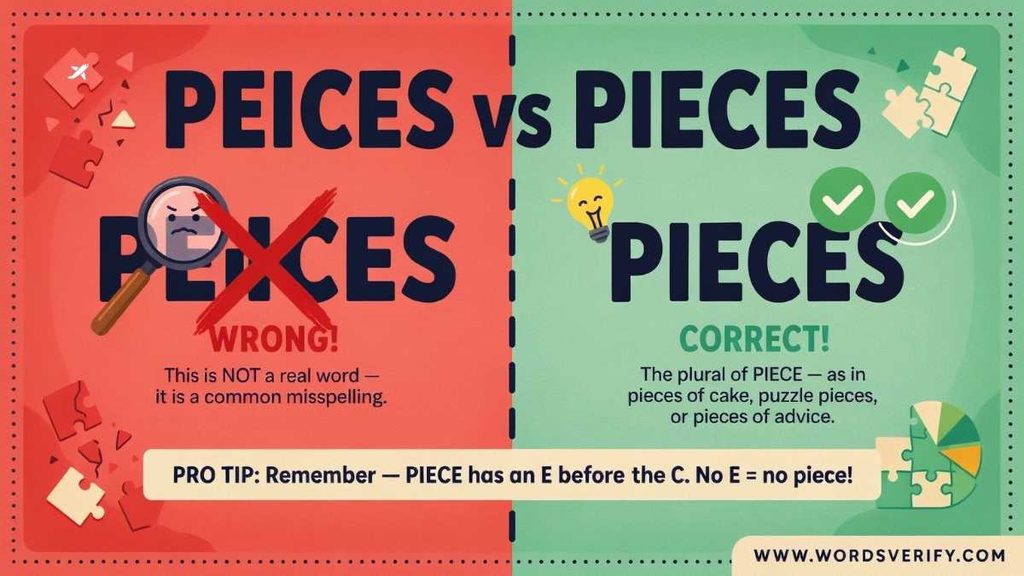
Ever paused over Peices vs Pieces and thought, “Wait, which spelling is actually right?” You’re not alone. English spelling loves to hide little traps, and this one is a classic. Swapping just two vowels can turn the correct pieces into the misspelled peices in seconds. The good news is that this confusion is easy to clear up. In this guide, you’ll learn why pieces is correct, what the word means, how to pronounce it, and how to use it properly in everyday sentences. We’ll also explore common spelling mistakes and simple memory tricks that make pieces much easier to remember.
Quick Answer
The correct spelling is pieces.
Peices is an incorrect spelling and should not be used in standard English.
| Spelling | Correct? | Explanation |
|---|---|---|
| pieces | Yes | Standard English spelling |
| peices | No | Common misspelling |
| piece | Yes | Singular form |
| peice | No | Misspelling of piece |
So, if you’re asking, “Is peices correct?”, the answer is no.
If you’re wondering, “Is pieces correct?”, yes. Pieces is the correct plural form of piece.
For example:
- I bought three pieces of chocolate.
- The puzzle has 500 pieces.
- She broke the glass into several pieces.
- We need a few pieces of paper.
Learn the difference between confusing more English words
Seel vs Seal Difference and correct usage
What Does Piece Mean?
Before looking at the plural spelling, it helps to understand the piece meaning.
The noun piece generally refers to a part, portion, section, or individual item that belongs to something larger.
A piece can be physical or abstract.
For example Peices vs Pieces, if you cut a cake, each portion can be called a piece of cake. If a plate breaks, each separated part can be called a piece. You can also talk about a piece of information, a piece of advice, or a piece of evidence.
The exact meaning depends on context.
Common meanings of piece
- A part of something largerThe table was made from several pieces of wood.
- An individual itemShe bought a beautiful piece of furniture.
- A portion of foodHe ate a piece of cake after dinner.
- A work of artThe museum displayed a famous piece of art.
- A work of musicThe pianist performed a difficult piece of music.
- A written workShe published a short piece about travel.
- A part of information or adviceHe gave me an important piece of advice.
The word can therefore describe much more than a physical object.
What Is the Plural of Piece?
The plural of piece is pieces.
The change is simple:
piece → pieces
You add -s to the singular noun.
Examples:
- one piece
- two pieces
- one puzzle piece
- several puzzle pieces
- one piece of paper
- several pieces of paper
The spelling does not change internally when the noun becomes plural.
That means you should remember:
piece + s = pieces
Not:
peice + s = peices
The second version carries the original spelling mistake into the plural form.
Learn the difference between confusing more English words
Cudos vs Kudos difference and Correct usage
Why Is “Peices” Wrong?

The main problem with peices is the order of the vowels.
The correct word is:
p-i-e-c-e
The incorrect spelling is:
p-e-i-c-e-s
The letters i and e have been reversed.
This is why peices can look convincing at first glance. Your brain recognizes most of the letters and may not immediately notice that two vowels are in the wrong order Peices vs Pieces.
It is similar to typing quickly and writing “freind” instead of “friend.” The word looks familiar, but the spelling pattern is wrong.
The correct spelling is:
piece
And the plural is:
pieces
Piece vs Peice
If you’re wondering about piece vs peice, only piece is correct in standard English.
| Word | Status | Example |
|---|---|---|
| piece | Correct | I need one piece of paper. |
| peice | Incorrect | I need one peice of paper. |
Peice is a common spelling error, especially when someone remembers the sounds of the word but not the correct written form.
The pronunciation doesn’t clearly tell you which vowel should come first. That’s why it helps to memorize the written pattern.
Think of it this way:
PIE + CE = PIECE
The word begins with pie, which can give you a useful visual reminder.
Piece vs Pieces
The difference between piece and pieces is grammatical rather than complicated.
Piece is singular.
Pieces is plural.
| Singular | Plural |
|---|---|
| piece | pieces |
| a piece | several pieces |
| one piece | two pieces |
| one piece of cake | two pieces of cake |
| one piece of paper | several pieces of paper |
For example:
Singular:
I found a piece of glass.
Plural:
I found several pieces of glass.
The spelling changes only because the plural ending -s is added.
Learn the difference between confusing more English words
Tying vs Tieing difference and Correct usage
How to Spell Piece Correctly
If you’re asking how to spell piece, the correct spelling is:
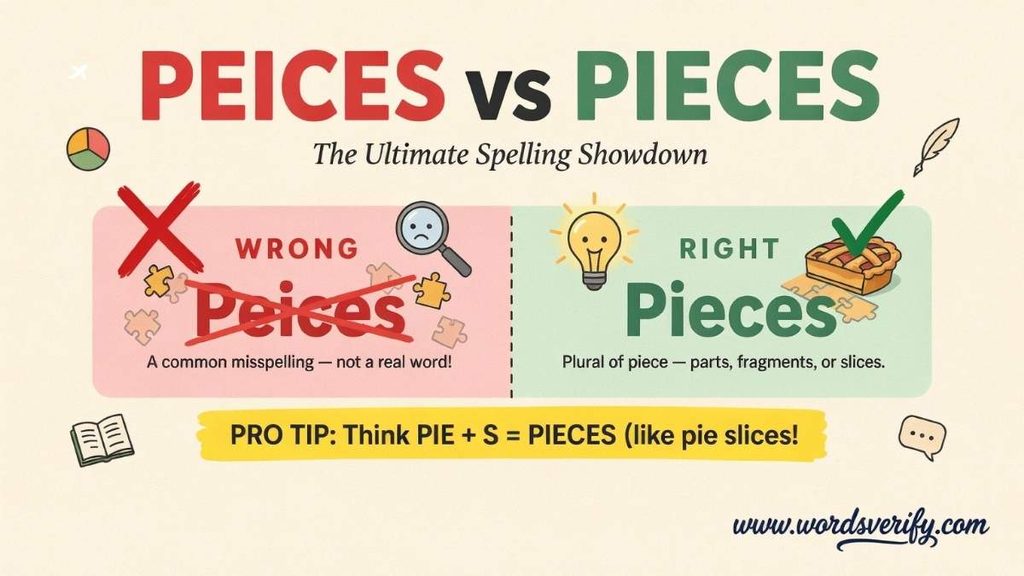
P-I-E-C-E
A simple way to remember it is to focus on the first four letters:
PIE
Then add CE.
So:
PIE + CE = PIECE
Once you remember piece, the plural is straightforward:
PIECE + S = PIECES
This makes how to spell pieces correctly much easier.
Why People Commonly Write “Peice”
The mistake usually comes from the unusual vowel order in English.
Many English learners expect e to come before i in words containing these letters. However, English has several spelling patterns that don’t always match pronunciation.
The familiar mnemonic “i before e except after c” is sometimes helpful, but it isn’t a perfect spelling rule. English has plenty of exceptions, so it’s better to learn the spelling of common words individually Peices vs Pieces.
In piece, the correct sequence is:
ie
The same sequence appears in words such as:
- field
- chief
- belief
- achieve
- brief
- thief
However, don’t assume that every English word follows one simple vowel rule. English spelling has many historical patterns and exceptions.
For piece, the safest approach is simply to remember:
piece = IE
Learn the difference between confusing more English words
Steer vs Stear difference and Correct usage
Pieces Pronunciation
The pieces pronunciation in standard American English is based on the singular word piece.
Piece is pronounced approximately like “peace.”
Its pronunciation is commonly represented as:
/piːs/
The plural pieces adds a final syllable:
/ˈpiːsɪz/
So:
- piece → “peace”
- pieces → “peace-iz”
The pronunciation can actually help you identify the word in conversation, but it won’t tell you whether to write ie or ei.
That’s why spelling practice still matters.
Common Examples of Pieces
The word pieces appears in everyday English in many different situations.
Here are some natural examples:
- The children picked up the broken pieces of the toy.
- I need two pieces of paper.
- She cut the apple into small pieces.
- The puzzle has hundreds of pieces.
- We found several pieces of information that helped.
- The artist displayed her latest pieces.
- The furniture arrived in separate pieces.
- He ate three pieces of pizza.
- The machine contains several small pieces.
- She put the puzzle pieces together.
Notice that pieces can refer to physical objects, portions, artwork, information, or parts of a larger whole.
Pieces of Something
One of the most common patterns is:
pieces of + noun
For example:
- pieces of paper
- pieces of cake
- pieces of wood
- pieces of glass
- pieces of furniture
- pieces of information
- pieces of evidence
- pieces of advice
- pieces of equipment
The phrase tells us that we are talking about separate portions, units, or examples of something.
For example:
The teacher gave us several pieces of information.
Here, pieces doesn’t necessarily mean physical objects. It means separate bits or units of information.
Pieces of Advice and Information
There is an important grammar point here.
In standard English, advice and information are generally treated as uncountable nouns.
That means we don’t normally say:
two advices
or
three informations
Instead, we use piece to make the idea countable.
Correct:
- a piece of advice
- two pieces of advice
- several pieces of advice
- a piece of information
- three pieces of information
- several pieces of information
For example:
She gave me two useful pieces of advice.
And:
We received several pieces of information about the project.
This is one reason the word piece is so useful in English grammar.
Learn the difference between confusing more English words
Honor vs Honour difference and Correct usage
Common Expressions With Peices vs Pieces
The word appears in many familiar English expressions Peices vs Pieces.
Piece of Cake
Piece of cake can literally mean a portion of cake.
It can also be an idiom meaning something is very easy.
Example:
The test was a piece of cake.
The sentence doesn’t necessarily mean the test involved actual cake. It means the test was easy.
Piece by Piece
Piece by piece means one part at a time.
Example:
We assembled the furniture piece by piece.
It can also describe something developing gradually.
Example:
She rebuilt her confidence piece by piece.
In Pieces
In pieces means broken or separated into parts.
Example:
The old chair fell apart in pieces.
It can also be used figuratively.
Example:
After the difficult news, he felt emotionally in pieces.
In One Piece
In one piece means whole, undamaged, or safely intact.
Example:
Thankfully, the package arrived in one piece.
You might also say:
The children came home in one piece after their camping trip.
Put the Pieces Together
This expression can be literal or figurative.
Literally:
She put the puzzle pieces together.
Figuratively:
After hearing everyone’s stories, the detective put the pieces together.
In the figurative sense, it means understanding how separate facts or clues connect.
Piece of Paper, Furniture, and Other Common Uses
English speakers frequently use piece with nouns that describe things as individual units.
Examples include:
- a piece of paper
- a piece of furniture
- a piece of equipment
- a piece of land
- a piece of music
- a piece of art
- a piece of evidence
- a piece of information
- a piece of advice
- a piece of work
These combinations are useful because English doesn’t always make every noun plural in the same way.
For example, furniture is generally uncountable.
Instead of saying:
three furnitures
we say:
three pieces of furniture
Similarly, we say:
two pieces of equipment
rather than:
two equipments
Understanding this pattern can help you avoid more than just a spelling mistake.
Learn the difference between confusing more English words
Ballot vs Bullet difference and correct usage
Common Spelling Mistakes With Piece
Because the word is short, people often make quick typing errors.
Some common incorrect forms include Peices vs Pieces:
- peice
- peices
- peice of cake
- peices of paper
- peices of information
The correct forms are:
- piece
- pieces
- piece of cake
- pieces of paper
- pieces of information
The key is to fix the singular spelling first.
If you remember piece, you’ll naturally get the plural pieces right.
Is “Peices” a Word?
If you’re asking “is peices a word?”, the answer is no in standard English.
Peices is generally a misspelling of pieces.
You may encounter it online, in informal writing, in comments, or in documents containing typing errors. Seeing a spelling frequently doesn’t make it an accepted standard spelling.
The standard form is:
pieces
Is “Peice” a Word?
The same applies to peice.
If you’re wondering “is peice a word?”, it is not the standard spelling of the noun.
The correct form is:
piece
This means:
peice → incorrect
piece → correct
And:
peices → incorrect
pieces → correct
Learn the difference between confusing more English words
Insite vs Insight difference and Correct usage
A Simple Memory Trick
Here’s an easy way to remember the correct spelling.
Think of the word pie.
The beginning of piece is:
pie
Then add:
ce
So:
pie + ce = piece
For the plural:
piece + s = pieces
You can also remember the complete sequence visually:
PIECE
The letters are:
P-I-E-C-E
Not:
P-E-I-C-E
If you train yourself to look for PIE at the beginning, the spelling becomes much easier to recognize.
Learn the difference between confusing more English words
Humour vs Humor Difference and Correct usage
How to Avoid This Common Spelling Error
If you frequently type Peices vs Pieces, try these simple habits.
- Memorize the singular first.
Learn piece before worrying about pieces. - Look at the vowel order.
The correct order is ie, not ei. - Use the “pie” reminder.
The first three letters of piece spell pie. - Read the complete word.
Don’t rely only on pronunciation. - Practice the word in sentences.
Writing the word in context makes the spelling easier to remember. - Watch for fast-typing errors.
Many spelling mistakes happen because two nearby letters are accidentally reversed.
Learn the difference between confusing more English words
Eying vs Eyeing difference and Correct usage
Practice session Peices vs Pieces
Fill in each blank with the correct form Peices vs Pieces.
- I ate one ___ of cake after dinner.
- The children picked up the broken ___ of glass.
- She gave me a useful ___ of advice.
- We need three ___ of paper for the project.
- He found a missing ___ of the puzzle.
- The old chair broke into several ___.
- I would like another ___ of pizza, please.
- The artist displayed several beautiful ___ of artwork.
- She gave us two important ___ of information.
- Please cut the apple into small ___.
- He carried a heavy ___ of wood.
- The puzzle has 1,000 ___.
- I found one ___ of evidence near the door.
- The furniture arrived in separate ___.
- She wrote an interesting ___ about her travels.
- The children put the puzzle ___ together.
- He bought a new ___ of equipment for the workshop.
- We found several ___ of paper scattered across the room.
- She broke the chocolate into small ___.
- I only need one ___ of information to finish the report.
- The musician performed a beautiful ___ of music.
- The vase fell and shattered into many ___.
- He gave me several ___ of advice before my interview.
- Thankfully, the package arrived in one ___.
- The detective slowly put the ___ together and solved the mystery.
Answers
- piece
- pieces
- piece
- pieces
- piece
- pieces
- piece
- pieces
- pieces
- pieces
- piece
- pieces
- piece
- pieces
- piece
- pieces
- piece
- pieces
- pieces
- piece
- piece
- pieces
- pieces
- piece
- pieces
Here’s a trusted source for clear more words Comparison:
FAQs
When should you use “piece” instead of “pieces”?
Use piece when you’re talking about one item or one part. Use pieces when you’re talking about more than one. For example, “I found one piece” but “I found three pieces.”
Why is “peices” a common spelling mistake?
“Peices” is often written by mistake because people reverse the i and e in piece. The correct spelling keeps the vowels in the order ie: p-i-e-c-e.
Is “pieces” pronounced differently from “piece”?
Yes. Piece is pronounced like “peace,” while pieces has an additional syllable at the end and sounds roughly like “peace-iz.”
Can “pieces” refer to parts of something broken?
Yes. Pieces can describe separate parts created when something breaks, such as “The plate fell into several pieces.”
Can “piece” describe something that is not physical?
Yes. You can use piece for abstract things, too. Common examples include a piece of advice, a piece of information, and a piece of evidence.
Why do we say “pieces of advice” instead of “advices”?
In standard English, advice is generally an uncountable noun. When you want to refer to individual items of advice, piece provides the countable unit: “two pieces of advice.”
Why do we say “pieces of information”?
Information is generally uncountable in English. Instead of saying “informations,” standard English uses expressions such as pieces of information to refer to separate facts or details.
Can “piece” refer to a work of art or music?
Yes. A piece can mean an individual work of art, music, literature, or another creative work. For example, “The pianist performed a beautiful piece.”
What does “piece together” mean?
Piece together means to combine separate parts, facts, or clues to understand or create something complete. For example, “The investigators pieced together what happened.”
What does “piece by piece” mean?
Piece by piece means gradually or one part at a time. For example, “She rebuilt the model piece by piece.”
Can “pieces” be used with numbers?
Yes. When referring to more than one item, use the plural pieces after a number. For example, “two pieces,” “five pieces,” or “twenty pieces.”
Can “piece” be used before an uncountable noun?
Yes. Piece of can make certain uncountable nouns refer to individual units. Examples include “a piece of furniture,” “a piece of equipment,” and “a piece of information.”
What is the difference between “piece of” and “pieces of”?
Piece of refers to one unit, while pieces of refers to multiple units. For example, “a piece of paper” means one, while “pieces of paper” means more than one.
Is “piece” always a noun?
No. Piece is commonly used as a noun, but it can also function as a verb. As a verb, to piece together means to combine separate parts into a whole.
What are some common words that follow “piece of”?
Common combinations include piece of cake, piece of paper, piece of advice, piece of information, piece of evidence, piece of furniture, piece of land, and piece of music.
How can you remember the spelling of “piece”?
A useful memory trick is to notice that piece begins with pie. Think pie + ce = piece, then add s to form pieces.
Does “pieces” have the same spelling in American and British English?
Yes. Pieces is spelled the same way in both American and British English. The spelling does not change based on the variety of English.
Can “piece” mean a section of writing?
Yes. A piece can refer to an individual article, essay, story, or other written work. For example, “She wrote a thoughtful piece about language.”
What does “piece of work” mean?
Piece of work can simply refer to a particular work or creation. Depending on context and tone, it can also describe a person, sometimes humorously or critically.
What does “in one piece” mean?
In one piece means remaining whole, undamaged, or safe. For example, “The package arrived in one piece.”
Learn the difference between confusing more English words
Naive vs Nieve difference and Correct usage
conclusion
The Peices vs Pieces confusion is a perfect example of how two tiny vowels can create an unnecessarily big spelling headache. Fortunately, the solution is simple: pieces is the correct spelling, while peices is a common misspelling. The singular form is piece, and adding s gives you pieces.
Still second-guessing yourself? Think of the word pie. The correct spelling starts with those three letters: pie + ce = piece. Add s, and you have pieces. This little trick can help you avoid the mistake whether you’re writing about puzzle pieces, pieces of cake, pieces of advice, or pieces of information. English spelling may have its quirks Peices vs Pieces, but this one is easy to keep in one piece!

Lisa AJS is an experienced blogger and language enthusiast at Words Verify, dedicated to making grammar simple, practical, and enjoyable. She writes engaging content on commonly confused words, grammar mistakes, word meanings, and everyday language challenges.