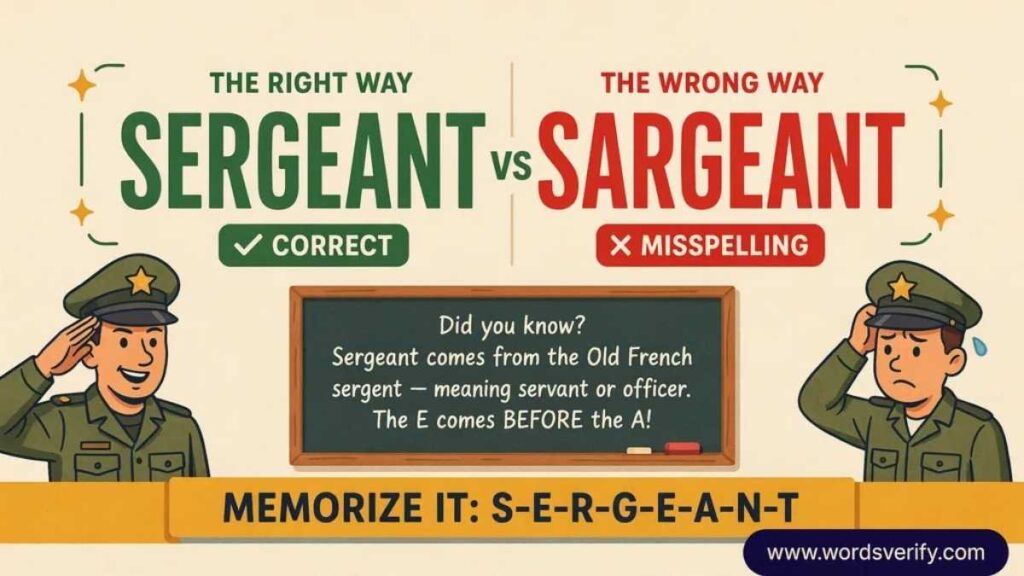
Sergeant vs sargeant which spelling gets the official salute? This tricky word has confused plenty of writers because its pronunciation doesn’t make its spelling obvious. When you hear “sergeant,” it sounds roughly like “SAR-jənt,” making “sargeant” vs“sargent” seem like reasonable guesses. Unfortunately, English doesn’t always play fair with spelling. The correct form is sergeant when you mean the military or police rank. In this guide, we’ll clear up the sergeant vs sargeant confusion, explain the word’s meaning and pronunciation, and highlight common mistakes. By the end, you’ll know which spelling to use and won’t have to second-guess this troublesome rank again.
Quick Answer
The correct spelling of the military and police rank is sergeant.
“Sargeant” is a misspelling. “Sargent” is also incorrect when you mean the rank, although Sargent is a legitimate surname.
| Word | Correct for the rank? | Meaning |
|---|---|---|
| Sergeant | Yes | A military or police rank |
| Sargeant | No | Common misspelling of sergeant |
| Sargent | No | A surname, but not the standard spelling of the rank |
So, if you’re writing about an Army sergeant or police sergeant, use “sergeant.”
Learn how to use confusing more words correctly
Cudos vs Kudos difference and Correct usage
What Does Sergeant Mean?
Sergeant is a noun that refers to a rank or position in military and law enforcement organizations.
In the military, a sergeant is generally a noncommissioned officer who has leadership responsibilities. The exact duties and position of a sergeant depend on the branch, country, and specific unit.
For example:
- The sergeant instructed the soldiers to prepare for inspection.
- She was promoted to sergeant after several years of service.
- The sergeant led the team during the training exercise.
In police departments, sergeant is also commonly used as a supervisory rank. A police sergeant may supervise officers, coordinate activities, review reports, and handle other responsibilities assigned by the department.
The important point is simple: when you mean the rank, the spelling is “sergeant.”
Sergeant vs Sargeant
“Sergeant” is correct.
“Sargeant” is a common misspelling caused largely by pronunciation. When people hear the word, they may naturally try to spell it based on the way it sounds.
That can lead to:
- sergeant → correct
- sargeant → incorrect
- sargent → incorrect for the rank
The spelling is unusual compared with the pronunciation, so this is one of those English words that can trip you up.
Consider these examples:
- Correct: The sergeant called the soldiers together.
- Incorrect: The sargeant called the soldiers together.
- Incorrect: The sargent called the soldiers together.
Only the first sentence uses the standard spelling for the rank.
Why Is “Sargeant” Incorrect?
“Sargeant” looks logical because the word sounds as though it begins with “sar” or “sarge.”
However, English spelling doesn’t always follow pronunciation perfectly. Sergeant is an old word with a long history, and its spelling developed through earlier forms of the language.
The word ultimately traces back through French to older forms related to Latin. Over time, pronunciation changed while the spelling retained elements of its earlier history.
That’s why “sergeant” can look strange when you first learn it.
English has plenty of words with this kind of mismatch. The spelling often preserves something from the word’s history even when modern pronunciation has changed.
How to Spell Sergeant Correctly
The correct spelling is:
S-E-R-G-E-A-N-T
A useful way to practice it is to break the word into smaller parts:
ser + geant
You don’t need to pronounce those parts separately. They’re simply a visual reminder of the letter order.
If you often write “sargeant,” pay particular attention to the letters after “ser.”
The correct sequence is:
sergeant
Not:
sargeant
Not:
sargent
Writing the word several times can also help make the unusual spelling familiar.
Learn how to use confusing more words correctly
Tying vs Tieing difference and Correct usage
Sergeant Pronunciation vs Spelling
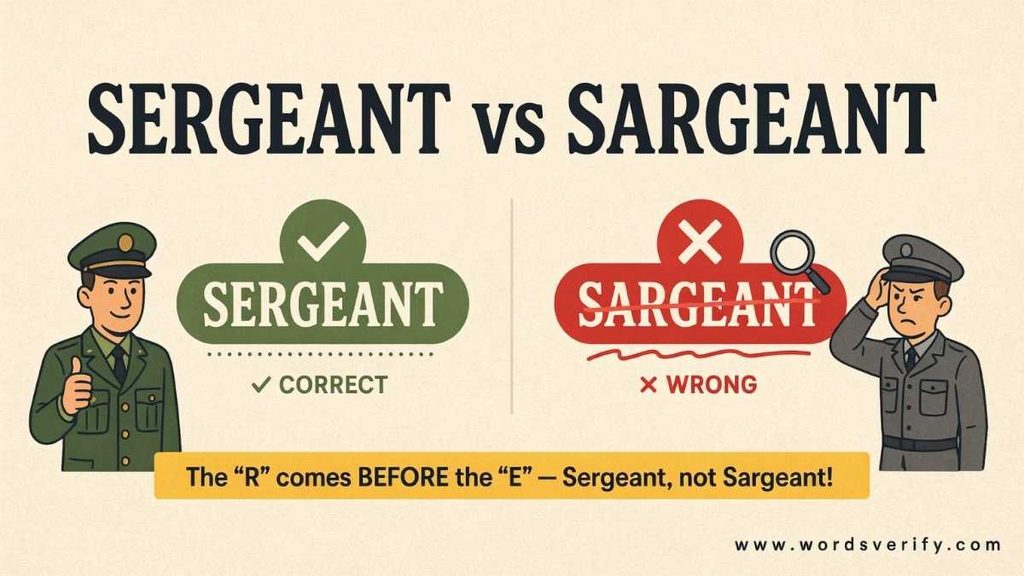
One major reason people misspell sergeant is pronunciation.
In American English, sergeant is generally pronounced approximately like:
“SAR-jənt”
The final part is much weaker than the spelling might suggest. You don’t pronounce every letter clearly as it appears on the page.
This creates a familiar English problem: the spelling and pronunciation don’t line up neatly.
That’s why someone who hears the word before seeing it written might reasonably guess “sargeant” or “sargent.”
However, pronunciation doesn’t change the standard spelling.
Remember:
- Pronunciation: roughly “SAR-jənt”
- Spelling: sergeant
Why Is Sergeant Pronounced Differently From How It Looks?
The answer lies in the history of the word.
Sergeant entered English through French, and its spelling and pronunciation changed over centuries. English speakers eventually developed a pronunciation that differs considerably from the way a modern reader might expect the word to sound.
This kind of historical sound change is common in English.
For example, many English words contain letters that no longer sound the way they once did. Pronunciation evolves naturally, while written forms can remain relatively stable.
Sergeant is a good example of this.
So if you’ve ever thought, “Why does sergeant sound like sargeant?” you’re noticing a real spelling-pronunciation mismatch.
The important distinction is that the sound may resemble “sargeant,” but the written rank remains “sergeant.”
Learn how to use confusing more words correctly
Seel vs Seal Difference and correct usage
Sergeant vs Sargent What’s the Difference?
When referring to the military or police rank, use sergeant.
“Sargent” can still appear in English, but it has a different use. Most notably, Sargent is a surname.
One well-known example is the American artist John Singer Sargent.
So these two forms should not automatically be treated as interchangeable.
| Spelling | Common use |
|---|---|
| Sergeant | Military or police rank |
| Sargent | Surname |
| Sargeant | Misspelling of sergeant |
For example:
- The sergeant addressed the unit.
- John Singer Sargent was a famous American painter.
Changing “Sargent” to “sergeant” in the second sentence would change the name and make the sentence incorrect.
Is Sargeant Correct?
No. “Sargeant” is not the standard spelling of the military or police rank.
If you’re writing about a sergeant in the Army, Marines, police department, or another organization that uses the rank, write “sergeant.”
For example:
Correct: The sergeant inspected the equipment.
Incorrect: The sargeant inspected the equipment.
The misspelling is understandable, but it should be corrected in formal writing.
Is Sargent Correct?
“Sargent” is not the standard spelling of the military or police rank.
However, Sargent is a legitimate surname.
That distinction matters.
If someone’s last name is Sargent, you should spell their name exactly that way. But if you’re referring to the rank, use “sergeant.”
For example:
- Sergeant Davis reported for duty.
- John Singer Sargent created many famous paintings.
The words look similar, but they serve different purposes.
Sergeant in the Military
Sergeant is a military rank used by armed forces in several countries.
The exact position of a sergeant varies depending on the military organization. In the United States, sergeant is a noncommissioned officer rank.
In the U.S. Army, Sergeant is designated E-5.
The Army also has several other noncommissioned officer ranks above and around it, including Staff Sergeant, Sergeant First Class, Master Sergeant, First Sergeant, and Sergeant Major.
A sergeant may have responsibilities involving:
- Leading soldiers.
- Training personnel.
- Maintaining discipline and standards.
- Supervising daily tasks.
- Supporting unit operations.
- Passing instructions from higher leadership to junior personnel.
The specific responsibilities depend on the unit, position, specialty, and assignment.
Sergeant in the Police
Sergeant is also commonly used as a police rank in the United States.
A police sergeant often has supervisory responsibilities. Depending on the department, a sergeant may oversee officers during a shift, review reports, respond to incidents, or provide guidance to junior officers.
For example:
“The police sergeant arrived at the scene and spoke with the officers.”
Here, “sergeant” refers to the officer’s rank.
The spelling doesn’t change just because the word is being used in law enforcement instead of the military.
So:
- military sergeant → correct
- police sergeant → correct
- military sargeant → incorrect
- police sargeant → incorrect
Sergeant Rank and Related Titles
The word sergeant appears in several military titles.
Some examples include:
- Sergeant
- Staff Sergeant
- Sergeant First Class
- Master Sergeant
- First Sergeant
- Sergeant Major
These titles can represent different levels of responsibility and authority.
The exact structure varies by military branch and country, so you shouldn’t assume that every organization uses the titles in exactly the same way.
The spelling of sergeant remains the same, however.
Learn how to use confusing more words correctly
Peices vs Pieces difference and correct usage
Sergeant Abbreviation
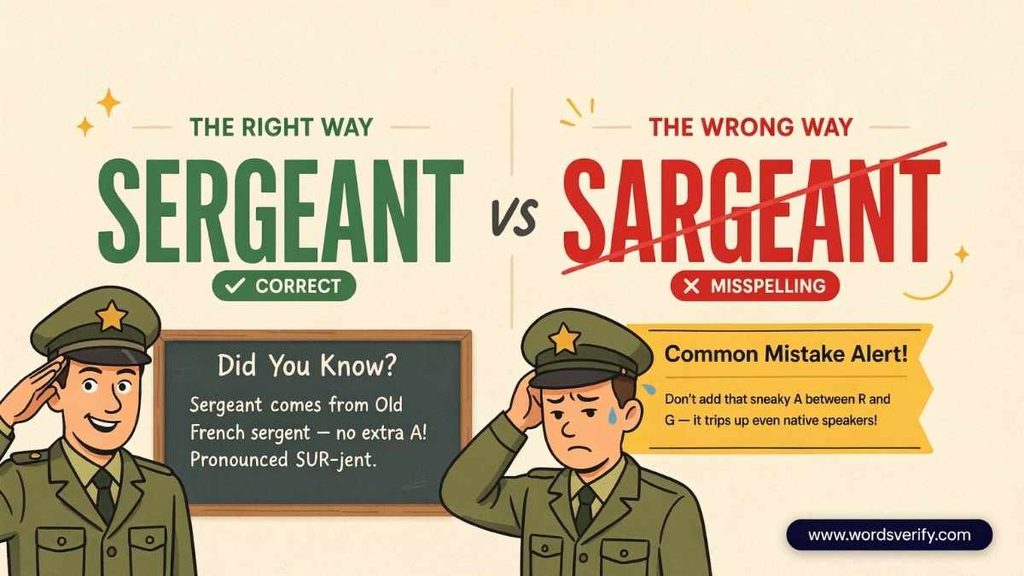
The common abbreviation for sergeant is Sgt.
You may see it in military, police, government, historical, and other formal contexts.
For example:
- Sgt. Davis reported to the commander.
- Sgt. Miller led the training session.
- Sgt. Brown was assigned to the evening shift.
The abbreviation may appear with or without a period depending on the organization’s style guide.
In American English, “Sgt.” is a familiar form.
If you’re writing the full rank, spell it:
sergeant
If you’re using the abbreviation, write:
Sgt.
Sargent or Sergeant Abbreviation
The abbreviation does not make “sargent” correct.
For example:
Correct: Sgt. Williams
Not: Sarg. Williams
If you mean the rank, the full word is sergeant and the common abbreviation is Sgt.
Learn how to use confusing more words correctly
Advise vs Advice which one is correct
Common Spelling Mistakes With Sergeant
Because the pronunciation can be misleading, several variations appear in everyday writing.
The most common ones include:
- Sargeant
- Sargent
- Sergent
- Seargent
- Sargeantt
These forms can look convincing at first glance. None is the standard spelling of the rank.
The safest approach is to remember the exact form:
sergeant
Sergeant vs Sargeant vs. Sargent
Here’s the easiest comparison to remember:
| Term | Correct? | Use |
|---|---|---|
| Sergeant | Yes | Military or police rank |
| Sargeant | No | Misspelling |
| Sargent | Not for the rank | Surname |
| Sgt. | Yes | Abbreviation for sergeant |
This distinction solves most of the confusion.
1.If you mean the rank, choose “sergeant.”
2.If you mean a person whose surname is Sargent, keep “Sargent.”
3.If you want a shortened form of the rank, “Sgt.” works.
Learn how to use confusing more words correctly
Lose vs Loose which one is correct?
Common Mistakes When Writing Sergeant
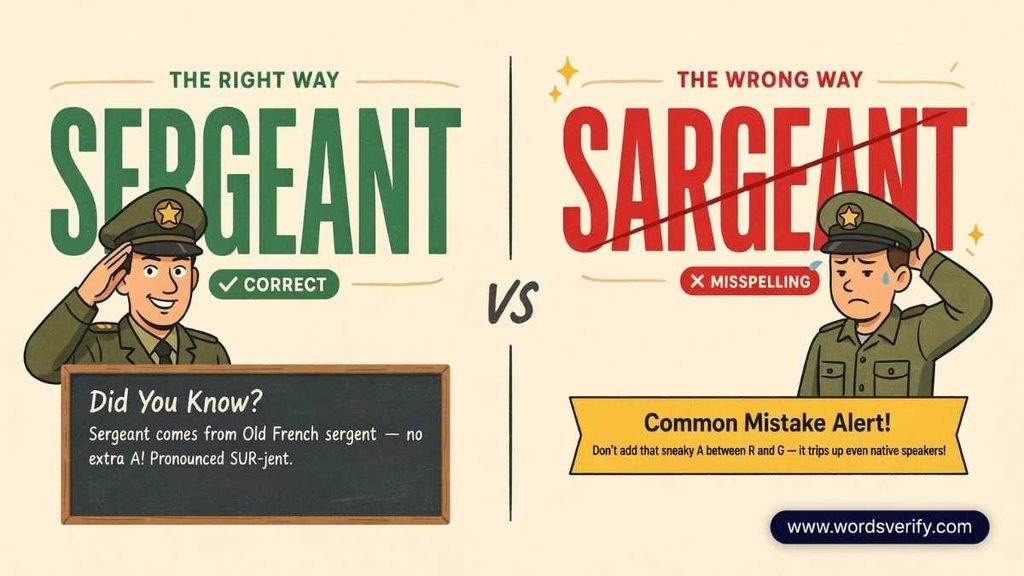
Even people who know the word sometimes make mistakes with it.
Here are a few situations to watch for.
Using “Sargeant”
This is probably the most obvious spelling mistake.
Incorrect: The sargeant gave the order.
Correct: The sergeant gave the order.
Using “Sargent” for the rank
The spelling looks close, but it’s still wrong when you mean the rank.
Incorrect: He was promoted to sargent.
Correct: He was promoted to sergeant.
Confusing the surname Sargent with the rank
Sargent can be a person’s last name.
For example:
John Singer Sargent
That doesn’t make “sargent” an alternative spelling of the military rank.
Confusing spelling with pronunciation
You may hear something close to “sarge-unt,” but you should still write “sergeant.”
Sound it out if you need to, but don’t spell it exactly as it sounds.
Learn how to use confusing more words correctly
Attornies vs Attorneys Which one Is Correct?
Examples of Sergeant in a Sentence
Seeing the word in context makes the spelling easier to remember.
- The sergeant checked the soldiers’ equipment.
- The Army sergeant spoke with the new recruits.
- The police sergeant reviewed the incident report.
- She earned the rank of sergeant after years of service.
- The sergeant organized the team before the exercise.
- The officer was promoted to sergeant.
- The sergeant gave clear instructions to the unit.
- The police sergeant supervised the evening shift.
Notice that “sergeant” stays the same whether the sentence refers to the military or law enforcement.
Singular and Plural Forms
The singular form is:
sergeant
The plural form is:
sergeants
You simply add “s” to make the plural.
Examples:
- one sergeant
- two sergeants
- several sergeants
For example:
“The sergeants attended the meeting.”
The plural form does not become “sergeants” with any additional spelling change.
Is “Sarge” a Correct Word?
“Sarge” is an informal shortened form of sergeant.
It can appear in casual speech, dialogue, fiction, or informal settings.
For example:
“Hey, Sarge, are we ready to leave?”
However, “Sarge” should not replace “sergeant” in formal documents when you need the official rank.
Think of it as a nickname or informal form rather than the standard spelling of the rank.
Learn how to use confusing more words correctly
Treck vs Trek Which one Is Correct?
A Simple Memory Trick for Sergeant
If you frequently confuse sergeant vs sargeant, focus on the first four letters.
The correct word begins:
serg-
So remember:
serg + eant = sergeant
You can also connect the word to its abbreviation:
sergeant → Sgt.
If you remember “Sgt.” as the standard abbreviation, it can help remind you that “sargeant” isn’t the official spelling.
Another useful trick is to remember that “Sargent” is a surname. If you’re talking about a rank, use the longer form “sergeant.”
Why Does English Have Words Like Sergeant?
English spelling has developed over many centuries. Words entered the language from different sources, including French, Latin, Greek, Germanic languages, and others.
Pronunciation also changed over time.
That means modern English contains many words whose spelling reflects an older stage of the language.
Sergeant is one of them.
The unusual spelling isn’t a random mistake. It reflects the history of the word and the changes that occurred as it became part of English.
This is also why trying to spell every English word exactly as it sounds doesn’t always work.
Sergeant Guide
| Question | Answer |
|---|---|
| Correct spelling? | Sergeant |
| Is sargeant correct? | No |
| Is sargent correct for the rank? | No |
| Can Sargent be a word? | Yes, as a surname |
| Military rank? | Yes |
| Police rank? | Yes |
| Common abbreviation? | Sgt. |
| Informal form? | Sarge |
| Approximate US pronunciation? | “SAR-jənt” |
| Plural? | Sergeants |
Learn how to use confusing more words correctly
Further vs Farther which one is correct?
A Real-World Example of sergeant vs sargeant
Imagine you’re writing a sentence about a U.S. Army unit.
You might write:
“The sergeant checked the team’s equipment before training began.”
Now imagine you write:
“The sargeant checked the team’s equipment.”
The meaning is still understandable, but the spelling is incorrect.
The same issue appears in police writing:
“The police sergeant reviewed the report.”
Not:
“The police sargeant reviewed the report.”
In both cases, the correct spelling is sergeant.
How to Choose the Right Word
When you’re unsure whether to write sergeant, sargeant, or sargent, ask yourself what you mean.
- If you mean a military or police rank, use sergeant.
- If you’re referring to someone’s surname, check whether their name is Sargent.
- If you want the common abbreviation, use Sgt.
- If you’re writing informal dialogue, Sarge may work when the context calls for it.
- If you’re writing a formal document, use the official spelling and title.
This quick check can prevent a surprisingly common spelling mistake.
Learn how to use confusing more words correctly
Affect vs Effect which one is correct?
Practice Session Sergeant vs Sargeant
Fill in each blank with the correct word: sergeant vs sargeant, sargent, Sgt., or Sarge.
- The Army ________ inspected the soldiers’ equipment.
- Is “________” the correct spelling for the military rank?
- The police ________ reviewed the incident report.
- The correct spelling is ________, not “sargeant.”
- ________ is a common abbreviation for sergeant.
- “Sargeant” is a common spelling ________ of “sergeant.”
- The soldier was promoted to ________.
- The informal shortened form of sergeant is ________.
- John Singer ________ was a famous American painter.
- The ________ gave the team instructions before training.
- Several ________ attended the meeting.
- “________” is not the standard spelling of the military rank.
- The police officer was promoted to ________.
- The word ________ can refer to a military or police rank.
- The correct spelling begins with the letters “______.”
- The ________ supervised the officers during the evening shift.
- The abbreviation “Sgt.” stands for ________.
- If you mean the military rank, write “________,” not “sargent.”
- The soldiers followed their ________ during the exercise.
- “Sargent” can be a surname, but “________” is the correct spelling of the rank.
- The word ________ is pronounced roughly like “SAR-jənt” in American English.
- The plural form of sergeant is “________.”
- “Sarge” is an informal form of ________.
- The ________ checked the unit before the inspection.
- When writing about a police rank, always use ________.
Answers
- sergeant
- sergeant
- sergeant
- sergeant
- Sgt.
- mistake
- sergeant
- Sarge
- Sargent
- sergeant
- sergeants
- sargeant
- sergeant
- sergeant
- serg
- sergeant
- sergeant
- sergeant
- sergeant
- sergeant
- sergeant
- sergeants
- sergeant
- sergeant
- sergeant
Here’s a trusted source for clear more words Comparison:
FAQs
What is the correct spelling sergeant vs sargeant?
The correct spelling is “sergeant.” “Sargeant” is a common misspelling and should not be used for the military or police rank.
Is “sargeant” a word?
“Sargeant” is not the standard spelling of the military or police rank. It is generally treated as a misspelling of “sergeant.”
Is “sargent” a correct spelling of sergeant?
No. “Sargent” is not the standard spelling of the rank. However, Sargent is a legitimate surname, so the word can be correct when used as someone’s family name.
Why is sergeant spelled with an “e”?
The spelling comes from the word’s historical development through French and earlier forms of the language. Its modern pronunciation changed over time, while much of the traditional spelling remained.
How do you pronounce sergeant?
In American English, “sergeant” is generally pronounced roughly like “SAR-jənt.” The pronunciation is quite different from what the spelling might lead you to expect.
Why is sergeant pronounced like “sargent”?
The pronunciation developed through historical changes in English and French. As the spoken form changed, the traditional spelling remained, creating the noticeable difference between how “sergeant” looks and sounds.
What does sergeant mean?
A sergeant is a rank used in military and law enforcement organizations. In the U.S. military, sergeant is a noncommissioned officer rank. Police departments may also use sergeant as a supervisory rank.
What is the abbreviation for sergeant?
The common abbreviation in American English is “Sgt.” For example, “Sergeant Miller” can be written as “Sgt. Miller” when an abbreviation is appropriate.
What is the plural of sergeant?
The plural of “sergeant” is “sergeants.” For example: “Several sergeants attended the meeting.”
Is “Sarge” another spelling of sergeant?
No. “Sarge” is an informal shortened form or nickname for “sergeant.” It may appear in casual conversation or dialogue, but “sergeant” is the standard formal spelling.
Is sergeant used as both a military and police rank?
Yes. “Sergeant” is used as a rank in various military organizations and is also commonly used by police departments. The duties and level of authority can differ between organizations.
What is the difference between sergeant vs Sargent?
“Sergeant” refers to the military or police rank. “Sargent” is commonly used as a surname. They may look similar, but they have different uses.
What rank comes after sergeant in the U.S. Army?
In the U.S. Army, Staff Sergeant (E-6) is the next enlisted rank above Sergeant (E-5). Exact rank structures can differ among military branches and countries.
Is sergeant a commissioned officer?
In the U.S. Army, a sergeant is a noncommissioned officer (NCO), not a commissioned officer. NCOs have leadership and supervisory responsibilities within the enlisted structure.
Should “sergeant” be capitalized?
Usually, “sergeant” is lowercase when used as a general rank: “The sergeant arrived.” It may be capitalized when it forms part of a formal title or follows an organization’s specific style rules.
What is the correct spelling of sergeant in British English?
The standard British English spelling is also “sergeant.” The unusual spelling is shared across major varieties of English, although pronunciation can vary.
Can “sergeant” be used as a surname?
Yes, although “Sergeant” is much more commonly encountered as the rank. A surname should always be written according to the person’s actual family name.
What are common misspellings of sergeant?
Common mistakes include “sargeant,” “sargent,” “sergent,” and “seargent.” The standard spelling is “sergeant.”
How can I remember how to spell sergeant?
A simple trick is to remember the opening letters “serg-.” Write the word as “sergeant,” rather than trying to spell it from its pronunciation. Repeated exposure to the correct form also makes the unusual spelling easier to remember.
conclusion
The sergeant vs sargeant confusion may seem like a small spelling problem, but this tricky word has fooled plenty of writers. The correct spelling for the military or police rank is sergeant. “Sargeant” is a misspelling, while “Sargent” is usually a surname, not another spelling of the rank. The unusual pronunciation is what makes sergeant so easy to get wrong. It sounds roughly like “SAR-jənt,” but the spelling follows its own historical path. So, when you’re writing about the rank, stick with sergeant. Remember that simple distinction, and this troublesome word won’t have you marching back to the dictionary every time.

Lisa AJS is an experienced blogger and language enthusiast at Words Verify, dedicated to making grammar simple, practical, and enjoyable. She writes engaging content on commonly confused words, grammar mistakes, word meanings, and everyday language challenges.