Have you ever written further vs farther and then stared at the sentence wondering which one actually belongs there? You’re not alone. These two words are easy to mix up because they look alike, sound similar, and both can relate to distance. Traditionally, farther is used for physical or measurable distance, while further usually means additional, more, progress, or figurative distance. But modern American English isn’t always so strict, which adds another twist to the confusion. In this guide, you’ll learn when to use further and farther, explore clear everyday examples, uncover common mistakes, and pick up a simple trick for getting the right word every time.
Quick Comparison
| Word | Common meaning | Typical use | Example |
|---|---|---|---|
| Farther | Physical or measurable distance | Real space or location | We walked farther than yesterday. |
| Further | Additional, more, or greater degree | Ideas, information, progress, or figurative distance | We need further discussion. |
| Further | Physical distance in modern usage | Distance, especially when the distinction isn’t important | The store is further down the road. |
| Farther | Comparative distance | Comparing how far something is | She ran farther than I did. |
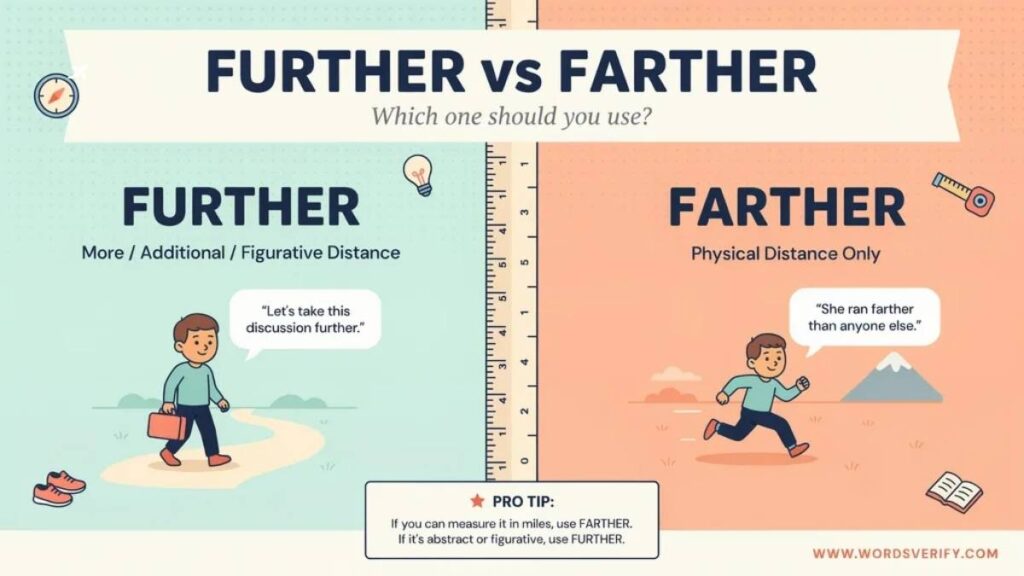
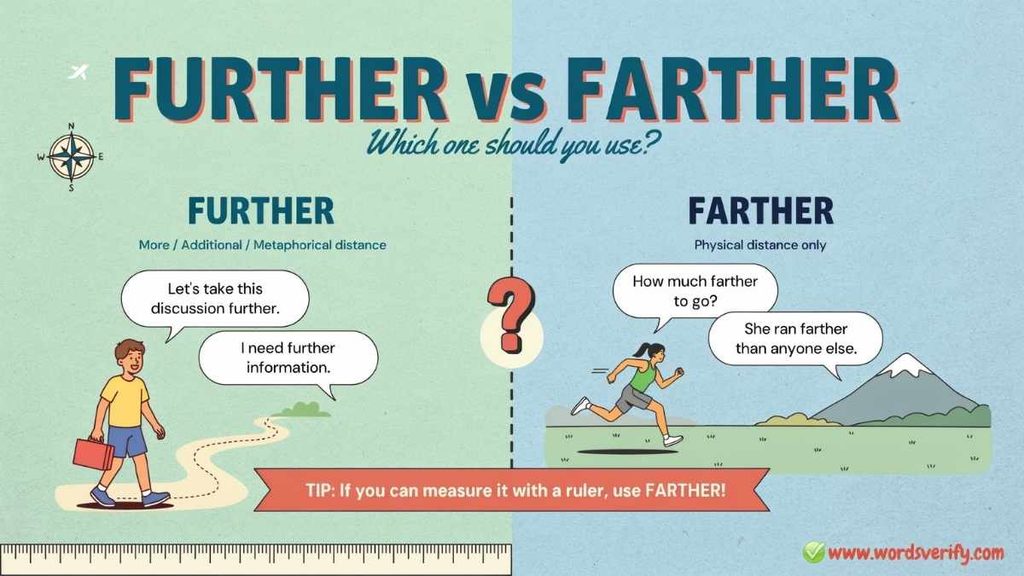
A simple way to remember the traditional rule is:
Farther = physical distance
Further = additional or figurative meaning
That rule works in many situations, but it isn’t the whole story.
What Does Farther Mean?
Farther is mainly used when you’re talking about physical distance.
Think about something you can measure in miles, feet, yards, or another unit of distance. If the sentence describes movement or location in real space, farther often fits naturally.
For example:
- We drove farther than we planned.
- The second gas station is farther away.
- She can run farther than her brother.
- The hikers went farther into the forest.
- How much farther is the airport?
In each sentence, you can imagine a real distance between two physical points.
Farther for Physical Distance
This is the clearest use of the word.
Suppose you’re on a road and someone asks how much longer you need to drive. You might say:
“We have to go farther before we reach the town.”
You’re talking about actual space. The destination is physically ahead of you.
The same idea works with measurable distance:
- The hotel is farther from the beach.
- We walked farther than five miles.
- The mountain is farther away than it looks.
- Which runner traveled farther?
When the distance can reasonably be measured, farther is a natural choice.
Farther Than
“Farther than” is commonly used when comparing two distances.
For example:
- New York is farther than Boston from our starting point.
- Mark ran farther than I did.
- The new office is farther than the old one.
- We traveled farther than expected.
The word farther shows that one distance exceeds another.
Farther Away
“Farther away” is another common expression.
For example:
- The cabin is farther away than I remembered.
- Move the chair farther away from the table.
- The stars looked farther away through the fog.
Here, the meaning clearly involves physical space.
Learn the difference between confusing more English words
Honor vs Honour difference and Correct usage
What Does Further Mean?
Further has several meanings. It can mean additional, more, to a greater degree, or to advance something.
It’s especially common when you’re talking about ideas, information, discussion, progress, education, or development.
For example:
- We need further information.
- Let’s discuss this further.
- The company plans to further its research.
- She wants to further her education.
- We need further discussion before making a decision.
None of these sentences describes physical distance.
Instead, further carries the idea of more or additional.
Further as Additional
One of the most common meanings of further is “additional.”
Consider this sentence:
“Please contact us if you need further information.”
You aren’t asking for information that is physically farther away. You want more information.
Other examples include:
- The manager requested further details.
- We need further evidence.
- I’ll provide further instructions tomorrow.
- The issue requires further investigation.
- They scheduled a meeting for further discussion.
This is where further becomes much more natural than farther.
Further as Progress
Further can also describe movement toward a goal or development.
For example:
- She wants to further her career.
- The program helps students further their education.
- The research could further our understanding of the disease.
- His work furthered the project.
In these sentences, further works as a verb.
It means to advance, promote, or help something develop.
You can’t replace further with farther in these examples.
“She wants to farther her career” is incorrect.
“She wants to further her career” is correct.
Further as a Verb
This use sometimes gets overlooked because people usually think of further as an adverb or adjective.
As a verb, further means to help something progress or develop.
For example:
- The training will further your skills.
- The new evidence may further the investigation.
- She worked hard to further her career.
- The project could further scientific research.
- His actions furthered the company’s goals.
Here, further doesn’t describe distance at all.
It describes advancement.
Further vs Farther for Distance
This is where the confusion gets interesting.
The traditional grammar rule says to use farther for physical distance and further for figurative distance.
For example:
“How much farther do we have to walk?”
The distance is physical.
But:
“We need to look further into the problem.”
The distance is figurative. You’re talking about examining something more deeply.
That distinction is still useful.
However, American English has become flexible about this rule. Further is also commonly used for physical distance, especially in everyday speech.
For example:
“The store is further down the road.”
Many American English speakers use this naturally.
You may also see:
“How much further do we have to go?”
This sentence is common even though the distance is physical.
So it’s better to understand the traditional distinction without treating it as an absolute rule in every modern sentence.
Learn the difference between confusing more English words
Steer vs Stear difference and Correct usage
Further vs Farther The Main Difference
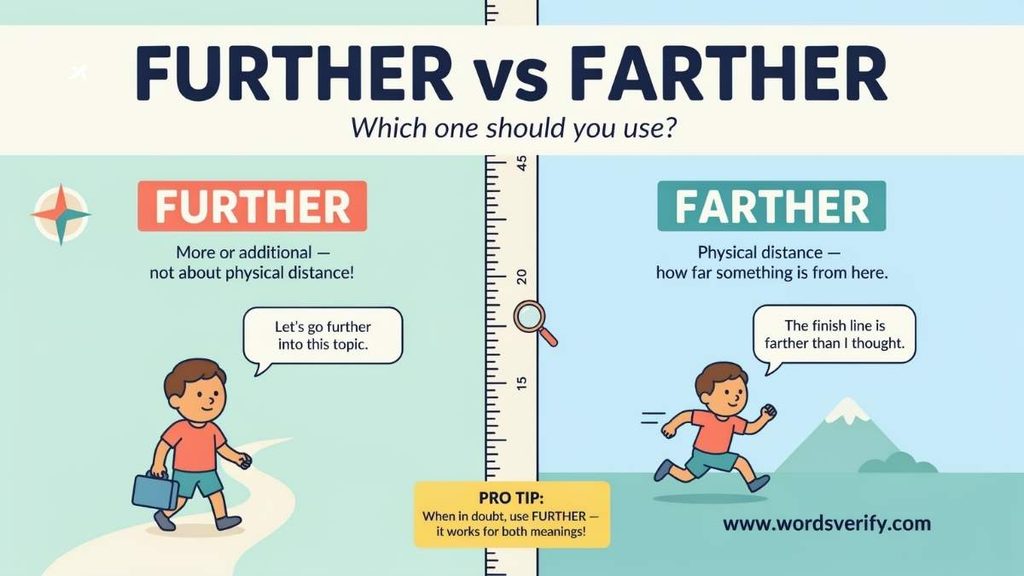
The easiest traditional distinction looks like this:
Farther focuses on distance in physical space.
Further focuses on additional meaning, degree, progress, or figurative distance.
Compare these sentences:
“The restaurant is farther down the street.”
You’re describing a physical location.
“We need to discuss the matter further.”
You’re asking for more discussion.
Now consider:
“The argument couldn’t go any further.”
Here, further describes progress or development rather than physical distance.
This distinction gives you a reliable starting point when you’re unsure.
Learn the difference between confusing more English words
Treck vs Trek Which one Is Correct?
Further vs Farther Down the Road
This expression can cause confusion because both words appear in real-world usage.
Farther Down the Road
Use farther when you’re clearly talking about a physical location.
For example:
- The gas station is farther down the road.
- There’s a grocery store farther down the road.
- We found a parking lot farther down the road.
You’re talking about an actual place on a road.
Further Down the Road
Further can also be used here.
It often suggests a later point in time or progress rather than a strictly physical location.
For example:
“We can deal with that further down the road.”
This means you’ll deal with the issue later.
You aren’t talking about driving farther along an actual road.
Interestingly, “further down the road” can also describe physical location in modern American English. Context tells you what the writer means.
Further vs Farther From the Truth
This expression has a much clearer answer.
The standard phrase is:
“Nothing could be further from the truth.”
Here, further is used in a figurative sense.
You’re not measuring physical distance between two objects. You’re saying that an idea is completely different from reality.
For example:
“The rumor couldn’t be further from the truth.”
This is a common and established expression.
Using farther in this phrase may appear occasionally, but further is the standard choice.
One Step Further vs Farther?
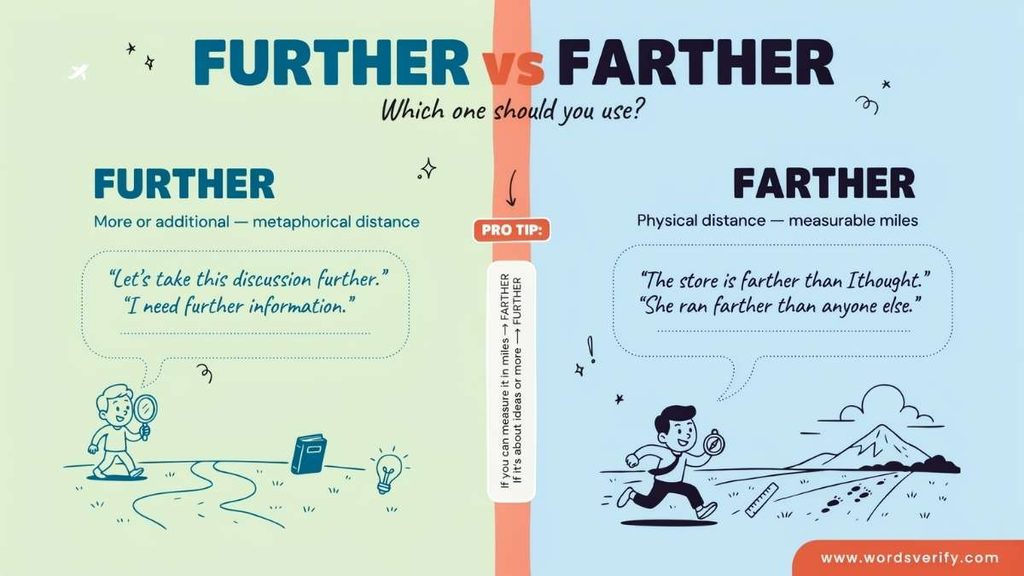
The correct choice depends on what “step” means.
If you’re describing progress, use further:
“She took her research one step further.”
The step represents advancement.
If you’re describing literal physical movement, farther can make sense:
“He walked one step farther.”
The person physically moved an additional distance.
Compare:
- We need to take this discussion one step further.
- He moved one step farther from the door.
The first sentence describes progress. The second describes physical space.
Learn the difference between confusing more English words
Tying vs Tieing difference and Correct usage
Look No Further vs Farther?
The established expression is:
Look no further.
For example:
“Look no further for the perfect solution.”
This means you don’t need to search anymore.
The meaning is figurative or idiomatic rather than physical.
You may encounter “look no farther” in some contexts, especially when the writer is emphasizing physical distance. However, look no further is the familiar standard expression when you’re telling someone they’ve found what they’re looking for.
Common Expressions With Further
Further appears in many everyday phrases.
Here are some you’ll see regularly:
- Further information
- Further discussion
- Further action
- Further education
- Further research
- Further progress
- Further details
- Further investigation
- Until further notice
- Look no further
- Nothing could be further from the truth
- Further development
In most of these expressions, further means “additional,” “more,” or “to a greater degree.”
For example:
“Until further notice” means until you receive additional notice.
“Further education” refers to education beyond an earlier stage.
“Further discussion” means more discussion.
Learn the difference between confusing more English words
Cudos vs Kudos difference and Correct usage
Common Expressions With Farther
Farther is most natural when the sentence involves physical distance.
For example:
- Farther away
- Farther north
- Farther south
- Farther east
- Farther west
- Farther down the road
- Farther from home
- Farther than expected
- Run farther
- Walk farther
These examples involve movement or location in physical space.
For instance:
“The hikers traveled farther north before stopping for the night.”
The word farther compares physical distance.
Farther North or Further North?
Both can appear, but farther north is especially natural when you’re describing physical movement or location.
For example:
“The storm moved farther north.”
You’re describing a physical direction.
However, “further north” is also used in modern English, especially when the writer isn’t emphasizing the traditional distinction.
If you’re writing a sentence where the physical-distance comparison matters, farther is a safe choice.
Further Information or Farther Information?
This one is straightforward.
The correct phrase is:
Further information
Why?
Because further means additional or more.
For example:
“Please contact the office for further information.”
You wouldn’t use farther because information doesn’t have a physical distance.
The same applies to:
- further details
- further instructions
- further explanation
- further evidence
- further research
- further discussion
Discuss Further or Discuss Farther?
Use discuss further.
For example:
“We can discuss the issue further tomorrow.”
The meaning is “discuss it more.”
“Discuss farther” doesn’t work because the sentence isn’t about physical distance.
This is a good example of why understanding meaning is more useful than memorizing spelling patterns.
Further From the Truth
Further often appears when talking about figurative distance.
For example:
“His claim is further from the truth than anyone realized.”
The distance isn’t physical. You’re comparing an idea with reality.
Other examples include:
- That explanation couldn’t be further from the truth.
- Her assumption is further from reality than she thinks.
- The report takes us further from understanding the real issue.
These examples use distance as a metaphor.
Learn the difference between confusing more English words
Seel vs Seal Difference and correct usage
Further and Furthest vs Farther and Farthest
The comparative and superlative forms can add another layer of confusion.
| Comparative | Superlative | Common use |
|---|---|---|
| Farther | Farthest | Physical distance |
| Further | Furthest | Additional, figurative, degree, or progress |
Examples:
- She ran farther than I did.
- He ran the farthest in the group.
- We need further information.
- This is the furthest we’ve progressed.
Again, modern usage sometimes overlaps.
You may see further and furthest used for physical distance, especially in American English.
Common Mistakes With Further and Farther
These words become easier when you know the mistakes people commonly make.
Using Farther for Additional Information
Incorrect:
“Please send me farther information.”
Correct:
“Please send me further information.”
Information isn’t a physical distance.
Using Farther for Career Advancement
Incorrect:
“She wants to farther her career.”
Correct:
“She wants to further her career.”
Here, further means advance.
Assuming Further Can Never Describe Physical Distance
This is an outdated oversimplification.
Modern English frequently uses further for physical distance.
For example:
“How much further is the next town?”
You may prefer farther under the traditional rule, but further is widely understood and used.
Treating the Rule as Absolute
The traditional rule is helpful, but language doesn’t always behave like a mathematical formula.
Real English contains established expressions, regional preferences, and changing usage.
That’s why context matters.
Learn the difference between confusing more English words
Peices vs Pieces difference and correct usage
Further vs Farther A Simple Decision Process
When you’re stuck, ask yourself a few questions.
Is the sentence about real physical distance?
If yes, farther is usually the traditional choice.
Example:
“Can you walk farther?”
Does the sentence mean additional or more?
If yes, use further.
Example:
“We need further information.”
Does the sentence describe progress or development?
Use further.
Example:
“The training will further your career.”
Is the distance figurative?
Use further in most traditional and established expressions.
Example:
“Nothing could be further from the truth.”
Does the sentence use a common expression?
Check the established phrase rather than trying to force the physical-distance rule.
For example:
- further education
- further discussion
- look no further
- until further notice
- further information
These expressions naturally use further.
Learn the difference between confusing more English words
Advise vs Advice which one is correct
Further vs Farther Examples in Everyday English
Here are some practical examples that show how the words work in different situations.
Travel
“We drove farther than we expected.”
The distance is physical.
Work
“We need further discussion before approving the proposal.”
Further means additional.
Education
“She decided to further her education.”
Further means advance or develop.
Exercise
“I ran farther today than I did yesterday.”
Farther refers to physical distance.
Research
“Scientists need further research before reaching a conclusion.”
Further means additional.
Conversation
“Let’s discuss this further.”
Further means more deeply or in more detail.
Location
“The next town is farther away.”
Farther refers to physical distance.
Time or progress
“We’ll deal with that further down the road.”
Further refers to a later stage.
Learn the difference between confusing more English words
Lose vs Loose which one is correct?
A Quick Case Study Why Context Matters
Imagine two friends are planning a road trip.
One asks:
“How much farther do we have to drive?”
That’s a physical-distance question.
Later, they start talking about what they’ll do after reaching their destination.
One says:
“We can discuss the hotel arrangements further when we arrive.”
Now the meaning has changed completely.
The first sentence deals with miles and location.
The second deals with additional discussion.
Same conversation. Different meaning. Different word.
This is why simply memorizing “farther equals distance” isn’t enough. You also need to look at what the sentence actually means.
A Memory Trick That Actually Helps
If you want a quick reminder, focus on the letter A in farther.
Think:
Farther = actual distance
That won’t cover every modern usage, but it works well as a starting point.
For further, think:
Further = furthermore = more
If you’re asking for more information, more discussion, more progress, or additional details, further is usually the word you want.
Further vs Farther Quick Reference
| If you mean… | Usually use… | Example |
|---|---|---|
| Physical distance | Farther | We walked farther. |
| Measurable distance | Farther | She ran farther than me. |
| Additional information | Further | We need further information. |
| More discussion | Further | Let’s discuss it further. |
| Career advancement | Further | He wants to further his career. |
| Education | Further | She wants to further her education. |
| Progress | Further | The discovery furthered the research. |
| Figurative distance | Further | Nothing could be further from the truth. |
| Common expression | Further | Until further notice. |
| Physical distance in modern usage | Further can work | How much further is the station? |
Practice Session Further vs Farther
Fill in each blank with further vs farther.
- We walked ______ than we planned.
- Please contact me if you need ______ information.
- The airport is much ______ from here than I expected.
- The manager asked for ______ details about the incident.
- She wants to ______ her career through additional training.
- How much ______ do we need to travel before we reach the hotel?
- The researchers need ______ evidence before reaching a conclusion.
- He ran ______ than his teammates during the race.
- Let’s discuss this issue ______ before making a final decision.
- The company hopes to ______ its work in renewable energy.
- The hikers went ______ into the forest than they had planned.
- We need ______ investigation to understand what happened.
- Nothing could be ______ from the truth.
- The next gas station is ______ away than the one we passed.
- She decided to ______ her education after finishing college.
- We shouldn’t drive any ______ without checking the map.
- The new discovery could ______ our understanding of the subject.
- Please provide ______ instructions before we begin.
- He moved ______ away from the edge of the cliff.
- The discussion went ______ than anyone expected.
- The store is ______ down the road.
- We can deal with that problem ______ down the road.
- She worked hard to ______ her professional goals.
- I don’t think we can go any ______ today.
- The team needs ______ discussion before approving the plan.
Answers
- farther
- further
- farther
- further
- further
- farther
- further
- farther
- further
- further
- farther
- further
- further
- farther
- further
- farther
- further
- further
- farther
- further
- farther
- further
- further
- farther
- further
Here’s a trusted source for clear more words Comparison:
FAQs
Can “further” mean “to a greater extent”?
Yes. “Further” can mean to a greater degree or extent. For example, “The new evidence further supports her argument.”
Is “farther” always about physical distance?
Not necessarily, but physical or measurable distance is its most traditional use. Modern English sometimes uses “further” in the same situations.
Can “further” be used as a verb?
Yes. As a verb, “further” means to advance, promote, or help something develop. For example, “The program aims to further scientific research.”
What does “further” mean in “further notice”?
In the phrase “until further notice,” further means additional. The phrase means something will remain in effect until another notice or instruction is given.
Why is “further education” spelled with further?
“Further education” means additional or advanced education. Since it refers to continuing or additional learning rather than physical distance, further is the appropriate word.
Can “further” describe progress?
Yes. “Further” can describe advancement or development. For example, “The discovery could further our understanding of the problem.”
What does “further” mean in “further discussion”?
It means additional or more discussion. For example, “The proposal needs further discussion before approval.”
Is “further” a comparative word?
Yes. Further is traditionally the comparative form associated with far when referring to additional extent, degree, or figurative distance. It can also appear in comparisons involving physical distance.
Is “farther” a comparative word?
Yes. Farther is a comparative form commonly used to describe greater physical distance. For example, “The second store is farther away.”
What is the superlative form of farther?
The traditional superlative form is “farthest.” It is commonly used for the greatest physical distance, as in “That was the farthest point we reached.”
What is the superlative form of further?
The traditional superlative form is “furthest.” It commonly refers to the greatest degree, extent, or progress, as in “This is the furthest we’ve gotten.”
Can “further” describe something deeper or more detailed?
Yes. Further can mean going beyond the surface or examining something in greater detail. For example, “The report deserves further review.”
Does “farther” refer to distance in time?
Traditionally, farther is associated with physical distance, while further is generally preferred for figurative or nonphysical distance such as time. However, actual usage can vary.
Can “further” mean “continue”?
Yes. In some contexts, further suggests continuing or moving something along. For example, “The meeting furthered the conversation about the new policy.”
What does “further” mean in “further action”?
It means additional action. For example, “No further action is required” means no additional steps are necessary.
Why is “further” common in formal writing?
Further is useful in formal writing because it can express ideas such as additional information, continued discussion, development, or advancement. Phrases like “further review” and “further details” are especially common.
Can farther and further be interchangeable?
Sometimes. Modern English allows overlap, particularly when referring to physical distance. However, some expressions strongly favor one word, so replacing them automatically isn’t always a good idea.
Does “further” have more meanings than “farther”?
Generally, yes. Further can refer to additional things, degree, progress, development, and figurative distance. Farther has a narrower association with physical or measurable distance.
How can I tell whether distance is physical or figurative?
Ask whether you could measure the distance in physical space. If you’re describing miles, feet, movement, or location, you’re dealing with physical distance. If you’re describing progress, ideas, truth, understanding, or development, the distance is figurative.
Is “further” used more broadly in American English?
Yes. American English commonly uses further in several contexts, including some physical-distance situations. This broader usage is one reason the traditional farther-versus-further rule can feel less clear today.
Why does “further” appear in “further investigation”?
Because further means additional in that phrase. “Further investigation” means more investigation rather than investigation involving physical distance.
Can “farther” be used with numbers or measurements?
Yes. Farther works naturally with measurable distances. For example, “The trail extends five miles farther than the old route.”
Is “further” appropriate for abstract ideas?
Yes. Further frequently appears with abstract ideas. You can further an argument, further your understanding, further a discussion, or further a goal.
What is the easiest way to remember further and farther?
A useful traditional shortcut is farther for physical distance and further for additional, figurative, or abstract meanings. Just remember that modern English sometimes uses further for physical distance too.
Learn the difference between confusing more English words
Attornies vs Attorneys Which one Is Correct?
conclusion
The further vs farther confusion doesn’t have to send your grammar skills running for the hills. In traditional usage, farther is generally used for physical or measurable distance, while further refers to something additional, greater in degree, progress, or figurative distance.
For example, you can walk farther down a road, ask for further information, or take your research one step further. However, modern American English often uses further for physical distance as well, so the traditional rule isn’t as rigid as it once seemed.
When you’re stuck, look at the meaning rather than the spelling. Are you talking about actual distance, or do you mean more, additional, or continued progress? Once you spot that difference, choosing further or farther becomes much easier—and far less frustrating.

Lisa AJS is an experienced blogger and language enthusiast at Words Verify, dedicated to making grammar simple, practical, and enjoyable. She writes engaging content on commonly confused words, grammar mistakes, word meanings, and everyday language challenges.