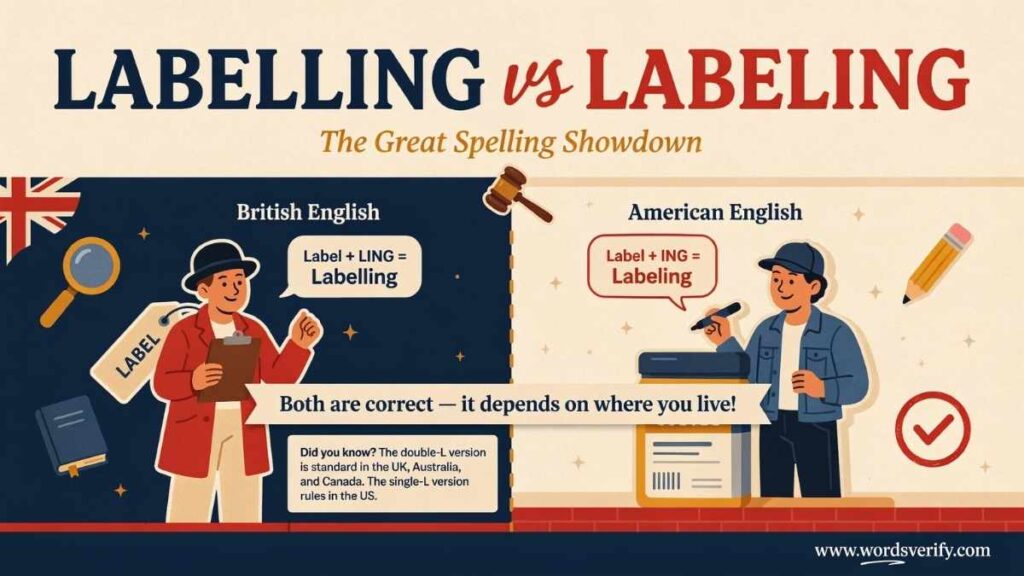
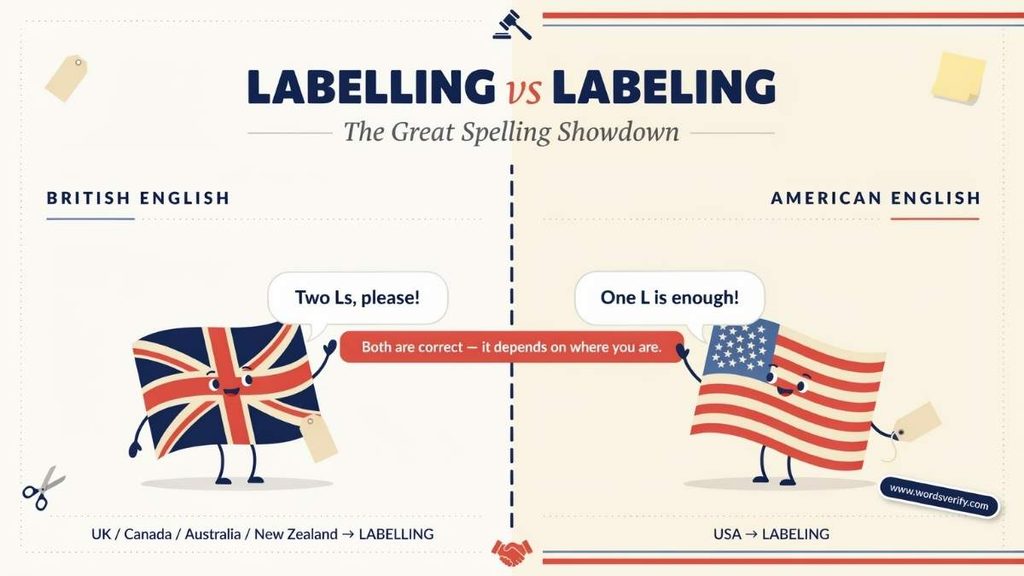
Have you ever paused over Labelling vs Labeling and wondered which spelling is actually correct? You’re not alone. That extra “l” can turn an ordinary word into a surprisingly tricky spelling puzzle. The good news is that both forms are correct; the choice depends on the variety of English you’re using. Labeling is the standard American spelling, while labelling is commonly used in British English and several other varieties. The meaning doesn’t change at all. In this guide, you’ll learn the difference, explore clear examples, spot common spelling mistakes, and discover an easy way to remember which form to use.
Quick Answer
Both labeling and labelling are standard English spellings. Neither one is a misspelling.
| Spelling | Common English variety | Example |
|---|---|---|
| labeling | American English | The company is labeling the boxes. |
| labelling | British English | The company is labelling the boxes. |
| labeled | American English | The boxes were labeled clearly. |
| labelled | British English | The boxes were labelled clearly. |
The meaning stays the same in both varieties.
If you’re writing for an American audience, use labeling. If you’re following British English conventions, use labelling.
What Does Labelling vs Labeling Mean?
The word refers to the act of putting a label on something or giving something a name, description, or category.
Sometimes the meaning is very literal. For example, you might label a box with its contents so you know what’s inside.
At other times, the meaning is more abstract. Someone might label a behavior as unusual or label a person according to a particular characteristic.
Here are some common uses:
- Labeling a package with an address.
- Labeling a bottle with its contents.
- Labeling food with ingredient information.
- Labeling parts of a diagram.
- Labeling folders to keep documents organized.
- Labeling an idea or behavior with a particular description.
The spelling changes depending on the variety of English, but the basic meaning remains the same.
Label as a Noun
The word label can work as a noun.
A label is a piece of information attached to an object. It can identify the object, describe it, provide instructions, or give other useful information.
For example:
Check the label before opening the bottle.
A clothing label might tell you the size and care instructions. A food label can provide information about ingredients and nutrition. A shipping label can show an address and other delivery details.
In each case, the label helps you identify or understand something.
Label as a Verb
Label can also work as a verb. In this form, it means to put a label on something or to give something a particular description or category.
For example:
Please label the containers.
Here, the speaker wants someone to identify the containers by putting information on them.
The verb can also have a more figurative meaning:
It’s unfair to label someone as lazy after one mistake.
No physical label is involved in that sentence. Instead, the word means to assign a particular description or category to someone.
Learn the difference between confusing more English words
Potatoes vs Potatos Which one Is Correct?
Labelling vs Labeling The Main Difference
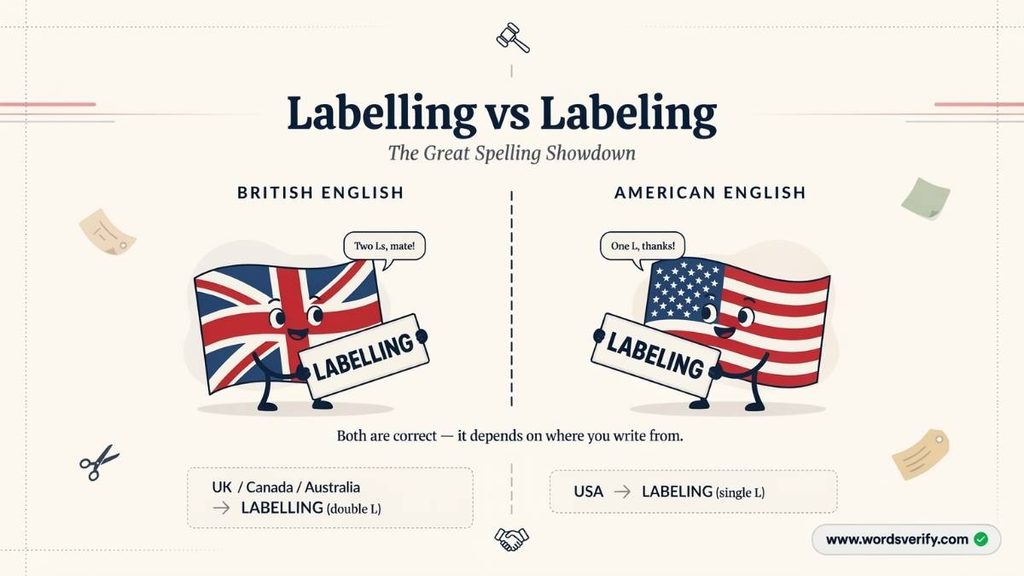
The main difference is spelling.
American English generally uses:
label → labeling → labeled
British English generally uses:
label → labelling → labelled
The extra l in British English doesn’t create a different word. It simply reflects a different spelling convention.
This is one of many spelling differences that developed between varieties of English.
Labeling in American English
American English normally spells the word labeling with one l before the ending.
For example:
The company is labeling its new products.
You will commonly see this form in American newspapers, books, websites, school assignments, reports, and business writing.
Labelling in British English
British English normally uses labelling with two l’s.
For example:
The company is labelling its new products.
The meaning is exactly the same as in the American version.
Learn the difference between confusing more English words
Moulding vs Molding which one is correct?
Why Does British English Use Two L’s?
The difference comes from spelling conventions rather than a difference in meaning or pronunciation.
British English commonly doubles the final consonant in certain words when adding endings such as -ed and -ing. American English often uses a different convention for words such as label.
This gives us:
| American English | British English |
|---|---|
| labeling | labelling |
| labeled | labelled |
| traveling | travelling |
| traveled | travelled |
| modeling | modelling |
| modeled | modelled |
However, English spelling rules aren’t always perfectly predictable. Different words can follow different patterns, so it’s better to learn the accepted spelling of each word rather than applying one rule to every situation.
Labelling vs Labeling Comparison
Here’s a quick side-by-side look at the two forms.
| Feature | Labeling | Labelling |
|---|---|---|
| Main usage | American English | British English |
| Number of l’s before -ing | One | Two |
| Meaning | Same | Same |
| Pronunciation | Essentially the same | Essentially the same |
| Base word | label | label |
| Past form | labeled | labelled |
| Gerund/present participle | labeling | labelling |
The difference is therefore mainly a matter of regional spelling.
Labeled vs Labelled
The same distinction appears when the verb changes to the past tense or past participle.
American English uses labeled:
The boxes were labeled correctly.
British English uses labelled:
The boxes were labelled correctly.
Both sentences are grammatically correct.
The mistake comes when a writer starts with one spelling system and then switches to another without realizing it.
For example, a document might use labeling in one paragraph and labelled in another. Readers will still understand the meaning, but the writing becomes inconsistent.
For polished writing, choose one spelling style and stick with it.
Learn the difference between confusing more English words
Manuel vs Manual which one is correct?
Labelling vs Labeling in Everyday Situations
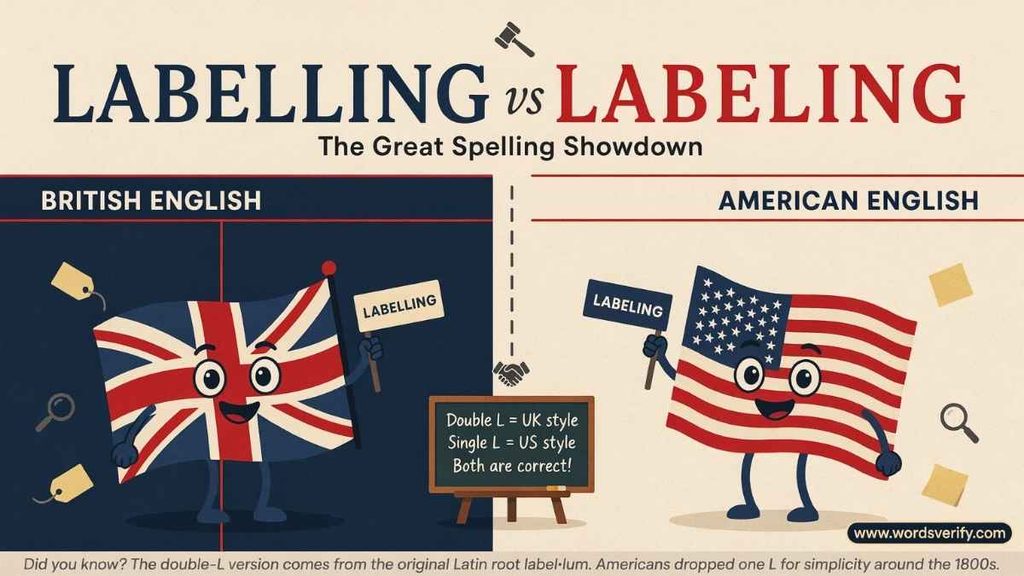
The word appears in many ordinary situations. It’s not limited to product packaging.
Labeling Products
Businesses use labels to provide information about products.
A product label might include:
- The product name.
- Ingredients or materials.
- Quantity or size.
- Instructions.
- Warnings.
- Storage information.
- Manufacturer or distributor information.
For example:
The company is labeling every package before it leaves the warehouse.
British English would normally use:
The company is labelling every package before it leaves the warehouse.
Labeling Food
Food packaging is another common place where this word appears.
A food label can provide information such as:
- Ingredients.
- Allergen information.
- Nutrition information.
- Net quantity.
- Storage instructions.
- Manufacturer or distributor details.
- Relevant dates or product information.
American English generally uses food labeling, while British English commonly uses food labelling.
It’s worth separating the spelling question from the legal side of food labeling. Food labeling requirements vary between countries and can also differ according to the type of product.
Labeling Diagrams
Students often need to label diagrams.
For example, a science assignment might ask you to label:
- The parts of a flower.
- The organs of the human body.
- Parts of a plant cell.
- Sections of the digestive system.
- Components of an electrical circuit.
In this context, labeling means identifying each part by adding the correct name.
Labeling Files and Folders
Labels are also useful for organization.
You might label:
- Computer folders.
- Storage boxes.
- Office files.
- Shelves.
- Cables.
- Laboratory samples.
- Photographs.
A clear labeling system makes it easier to find things later. That’s especially useful when you’re dealing with a large number of files or objects.
Labeling Theory and Labelling Theory
You may also come across the terms labeling theory and labelling theory.
These terms are associated with sociology and describe an approach that examines how social labels and categories can affect the way people are viewed and treated.
The spelling follows regional conventions:
| American English | British English |
|---|---|
| labeling theory | labelling theory |
The concept doesn’t change because the spelling changes.
This is a useful example of how regional spelling differences can appear in academic and professional language as well as everyday writing.
Learn the difference between confusing more English words
Sneek vs Sneak Which one is Correct?
Labeling Examples in Sentences
Here are several examples using the American spelling:
- The workers are labeling the boxes.
- The teacher asked the students to label the diagram.
- The company is labeling its new products.
- Each bottle was labeled with a product number.
- The store updated its product labeling.
- Clear food labeling helps customers understand what they are buying.
Now compare the British forms:
- The workers are labelling the boxes.
- The teacher asked the students to label the diagram.
- The company is labelling its new products.
- Each bottle was labelled with a product number.
- The store updated its product labelling.
- Clear food labelling helps customers understand what they are buying.
Notice that label itself doesn’t change. The regional difference appears mainly in the forms labeling/labelling and labeled/labelled.
Labeled in a Sentence vs Labelled in a Sentence
If you’re looking for a simple labeled in a sentence example, consider:
The samples were labeled with identification numbers.
For British English:
The samples were labelled with identification numbers.
Both sentences are correct.
Here are more examples:
| American English | British English |
|---|---|
| The box was labeled correctly. | The box was labelled correctly. |
| She labeled each folder. | She labelled each folder. |
| The bottles are clearly labeled. | The bottles are clearly labelled. |
| The diagram is labeled with arrows. | The diagram is labelled with arrows. |
The meaning stays unchanged.
Learn the difference between confusing more English words
Laid Down vs Lied Down which one is correct?
Labeling and Labelling Pronunciation
The pronunciation of labeling and labelling is essentially the same in ordinary English.
The extra l in the British spelling doesn’t add another syllable. Both forms are generally pronounced with three syllables, with the main stress falling on the first syllable.
The important point is that the spelling difference is mainly visible on the page. When spoken, the two forms sound alike or extremely similar across standard varieties of English.
American Spelling of Labeling
The American spelling of labeling uses one l:
label + ing → labeling
This is the normal form in American English.
If you’re writing for readers in the United States, use labeling in your articles, reports, assignments, product descriptions, and other formal or informal writing.
For example:
The company is labeling each package before shipment.
The related past-tense form is:
The company labeled each package before shipment.
Using labeling and labeled together keeps the American spelling consistent.
British Spelling of Labelling
The British spelling of labelling uses two l’s:
label → labelling
The past-tense form is:
label → labelled
For example:
The company is labelling each package before shipment.
And:
The company labelled each package before shipment.
These forms are standard in British English.
Learn the difference between confusing more English words
Lieing vs Lying Which one Is Correct?
Australian and Canadian English
The situation becomes slightly more interesting when looking at Australian and Canadian English.
Australian English
Australian English generally follows British-style spelling for labelling and labelled.
For example:
The company is labelling its products.
However, Australian English has its own established usage and style conventions. It isn’t simply a copy of British English in every respect.
Canadian English
Canadian English uses a mixture of British and American spelling conventions. In the case of label, labelling and labelled are commonly used.
So, if you’re wondering about labeling vs labelling in Canada, the answer isn’t that Canadian English follows American spelling across the board. Canadian spelling has its own patterns and preferences.
| Variety | Common form | Past form |
|---|---|---|
| American English | labeling | labeled |
| British English | labelling | labelled |
| Australian English | labelling | labelled |
| Canadian English | labelling | labelled |
Individual organizations may follow their own style guides, so formal writers should always check the preferred style when one is provided.
Is Labeling or Labelling More Correct?
There isn’t one spelling that is universally correct for every English-speaking audience.
If you’re using American English, labeling is the standard choice.
If you’re using British English, labelling is the standard choice.
The same principle applies to labeled and labelled.
Calling one form “wrong” without considering the variety of English can create unnecessary confusion. Regional spelling is a normal part of language variation.
Learn the difference between confusing more English words
Sergeant vs Sargeant which one is correct?
Common Mistakes With Labeling and Labelling
Mixing the Two Spellings
The most common problem is switching between regional forms.
For example:
The products were labelled before the company began labeling them.
The sentence is understandable, but it combines British and American spelling.
If you’re writing in American English, use:
The products were labeled before the company began labeling them.
For British English, use:
The products were labelled before the company began labelling them.
Assuming Labelling Is a Misspelling
American readers may occasionally assume that labelling contains an unnecessary letter.
It doesn’t. The spelling is standard in British English and other varieties that commonly follow British spelling conventions.
Assuming Labeling Is Incorrect
The reverse mistake happens too.
Labeling isn’t an error simply because British English uses labelling. It is the standard American form.
Changing the Base Word
Another mistake is treating label and labeling as completely unrelated words.
The base verb is simply:
label
From it, we get forms such as:
- label
- labels
- labeled
- labelled
- labeling
- labelling
The regional difference appears in the forms with -ed and -ing.
Learn the difference between confusing more English words
Affect vs Effect which one is correct?
How to Choose the Right Spelling
Choosing between the two forms doesn’t have to be complicated.
For American English
Use:
labeling
And use:
labeled
This is the natural choice for US-focused writing.
For British English
Use:
labelling
And use:
labelled
This fits British spelling conventions.
For Australian English
Labelling and labelled are commonly used.
For Canadian English
Labelling and labelled are also commonly used, although Canadian English has its own broader mix of spelling conventions.
Most Important of All Stay Consistent
Once you’ve chosen a spelling style, apply it throughout the document.
If your article uses American English, don’t switch randomly between labeling and labelling.
Likewise, if you’ve chosen British English, keep labelling and labelled consistent with the rest of your writing.
Learn the difference between confusing more English words
Further vs Farther which one is correct?
A Simple Way to Remember the Difference
Here’s an easy memory trick:
American English → labeling
British English → labelling
Think of the British form as the one with the extra l.
You can also remember the past forms together:
American: labeled → labeling
British: labelled → labelling
This gives you a small pattern instead of four separate spellings to memorize.
Learn the difference between confusing more English words
Treck vs Trek Which one Is Correct?
Practice Session Labelling vs Labeling
Fill in each blank with the correct form of Labelling vs Labeling.
- In American English, ________ products correctly helps customers find important information.
- In British English, food ________ must be clear and easy to read.
- The teacher ________ each diagram before the science lesson began. (American English)
- The teacher ________ each diagram before the science lesson began. (British English)
- Please ________ each folder before placing it in the cabinet.
- The boxes were clearly ________ with their contents. (American English)
- The boxes were clearly ________ with their contents. (British English)
- Proper ________ can make a product easier to identify. (American English)
- Proper ________ can make a product easier to identify. (British English)
- The bottle has several warning ________ on the front.
- The museum is ________ each exhibit with its name and date. (American English)
- The museum is ________ each exhibit with its name and date. (British English)
- The nurse checked the ________ on every medicine bottle.
- The students spent the afternoon ________ their classroom supplies. (American English)
- The students spent the afternoon ________ their classroom supplies. (British English)
- The package was ________ as fragile before it was shipped. (American English)
- The package was ________ as fragile before it was shipped. (British English)
- The scientist is ________ samples according to their type. (American English)
- The scientist is ________ samples according to their type. (British English)
- Always read the product ________ before using a new item.
- The company uses clear ________ to identify different products. (American English)
- The company uses clear ________ to identify different products. (British English)
- She forgot to ________ the file before sending it to her manager.
- The researcher carefully ________ each section of the chart. (American English)
- The researcher carefully ________ each section of the chart. (British English)
Answers
- labeling
- labelling
- labeled
- labelled
- label
- labeled
- labelled
- labeling
- labelling
- labels
- labeling
- labelling
- labels
- labeling
- labelling
- labeled
- labelled
- labeling
- labelling
- label
- labeling
- labelling
- label
- labeled
- labelled
Here’s a trusted source for clear more words Comparison:
FAQs
What is correct, labelling or labeling?
Both labelling and labeling are correct spellings. Labeling is the standard form in American English, while labelling is commonly used in British English and other varieties of English.
Is labelling spelled correctly in English?
Yes. Labelling is a correct English spelling. It is commonly used in British English, where the final consonant is doubled before adding “-ing.”
Is labeling spelled with one L or two?
Labeling has one “l” in the middle in American English. Labelling has two “l’s” and is commonly used in British English.
What does labeling mean?
Labeling means putting a name, description, symbol, or identifying information on something. It can also mean assigning a category or description to a person, idea, or thing.
What is the difference between label and labeling?
Label can be a noun or a verb. A label is a name or identifying marker, while to label means to attach or assign one. Labeling is the “-ing” form of the verb.
How do Americans spell labeling?
Americans generally spell it labeling, with one “l” before “-ing.” The related past-tense form is labeled.
Is labelling used in the UK?
Yes. Labelling is the common British English spelling. British English also generally uses labelled for the past tense and past participle.
Why does British English use labelling instead of labeling?
British English commonly doubles the final consonant in certain words before adding suffixes such as “-ing” and “-ed.” That produces labelling and labelled from label.
Is labelled or labeled correct in American English?
Labeled is the standard American English spelling. Labelled is commonly used in British English and some other varieties.
Is lable a correct spelling?
No. Lable is a misspelling. The correct spelling is label, with the “e” before the final “l.”
Why is label not spelled lable?
The standard spelling is label. The word contains “-el,” not “-le,” so lable is incorrect.
What does labeling someone mean?
Labeling someone means assigning a particular description, category, or characteristic to that person. For example, calling someone “lazy” based on one incident is a form of labeling.
What is labeling yourself?
Labeling yourself means describing or categorizing yourself with a particular identity, trait, role, or characteristic. For example, someone might describe themselves as an introvert or a perfectionist.
What is another word for labeling?
Depending on the context, alternatives to labeling include identifying, classifying, categorizing, describing, naming, and tagging. The best alternative depends on what “labeling” means in the sentence.
What are examples of labeling?
Common examples include labeling food packages, labeling storage boxes, labeling diagrams, labeling files, labeling products, and assigning descriptions or categories to people or ideas.
Is pre-labeled or pre-labelled correct?
Both forms can be correct depending on the variety of English. Pre-labeled follows American English spelling, while pre-labelled follows the spelling commonly used in British English.
What is the difference between labeling and labelling?
There is no difference in meaning. The main difference is regional spelling. Labeling is standard American English, while labelling is commonly used in British English.
What is a shipping label?
A shipping label is a label attached to a package that provides information needed for delivery, such as the recipient’s address and other shipping details.
What is labeling theory?
Labeling theory is a sociological concept that examines how assigning labels or categories to people can influence how they are perceived and how they may respond to those labels. In British English, it is commonly written labelling theory.
What is the difference between labeling and tagging?
Both can involve identifying something, but they aren’t always interchangeable. Labeling often involves giving something a name, description, or category, while tagging commonly means attaching a keyword, marker, or digital identifier.
What is labeling in grammar?
In grammar or language study, labeling can mean identifying or naming the role of a word or phrase, such as identifying a word as a noun, verb, adjective, or other grammatical element.
Why should you be consistent with labeling and labelling?
Consistency makes your writing easier to read and prevents unnecessary spelling variation. If you’re using American English, choose labeling and labeled. If you’re following British English, use labelling and labelled.
conclusion
So, Labelling vs Labeling? The answer is simple: both are correct. The difference is mainly regional, not grammatical. Labeling is the standard spelling in American English, while labelling is commonly used in British English and other varieties that follow the same spelling pattern.
The meaning doesn’t change, and neither spelling is a mistake when used in the appropriate variety of English. The real trick is consistency. If you’re writing for an American audience, choose labeling and labeled. If you’re following British English, use labelling and labelled. Once you get used to that extra “l,” this small spelling puzzle is hardly worth sticking a label on!

Lisa AJS is an experienced blogger and language enthusiast at Words Verify, dedicated to making grammar simple, practical, and enjoyable. She writes engaging content on commonly confused words, grammar mistakes, word meanings, and everyday language challenges.