
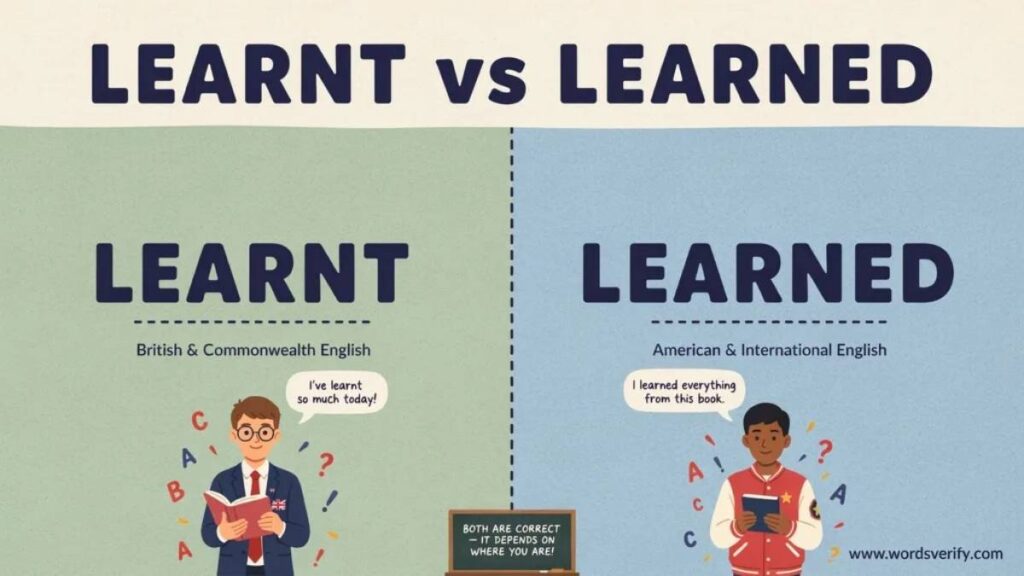
Ever typed “learned” and paused, wondering if “learnt” would be the better choice? You’re not alone. The confusion over learnt vs learned can make a simple sentence feel like a surprise grammar test. Fortunately, both forms are correct, but your choice often depends on the variety of English you’re using. American English generally prefers learned, while British English commonly uses both learned and learnt. There’s another twist, too: learned can also describe someone who is highly educated or scholarly, and its pronunciation changes. In this guide, you’ll discover the difference, avoid common mistakes, understand regional usage, and learn exactly when each form fits naturally.
The Quick Answer
Both learned and learnt are accepted forms of the verb learn.
The basic pattern is simple:
- American English generally favors learned.
- British English commonly uses learned and learnt.
- Canadian, Australian, and other varieties of English may use either form depending on regional and individual usage.
- Both forms can work as the past tense of learn.
- Both forms can also work as the past participle of learn.
- Learned has an additional meaning when it describes someone as educated or scholarly.
For example, an American speaker might say, “I learned how to drive at seventeen.”
A British speaker might say, “I learnt how to drive at seventeen.”
The message is the same. The preferred form differs.
Understand confusing English more words simply
Laid Down vs Lied Down which one is correct?
What Is the Difference Between Learned and Learnt?
The difference between learned and learnt is mainly a matter of regional preference.
Both words come from the verb learn, which means to gain knowledge, develop a skill, understand something, or gain knowledge through experience.
Consider these two sentences:
“I learned French at school.”
“I learnt French at school.”
Both mean that the person acquired knowledge of French. The first sounds especially natural in American English, while the second is strongly associated with British English.
This is a useful reminder that English doesn’t always have one single form for every situation. Different varieties of English have developed their own spelling and usage patterns over time.
Learned and Learnt at a Glance
| Feature | Learned | Learnt |
|---|---|---|
| Base verb | Learn | Learn |
| Past tense | Yes | Yes |
| Past participle | Yes | Yes |
| American English | Very common | Less common |
| British English | Common | Common |
| Meaning as a verb | Gain knowledge or skill | Gain knowledge or skill |
| Can mean educated or scholarly | Yes | No |
The important point is that neither form is automatically wrong.
Understand confusing English more words simply
Canceled vs Cancelled Which one Is Correct?
What Does Learned Mean?
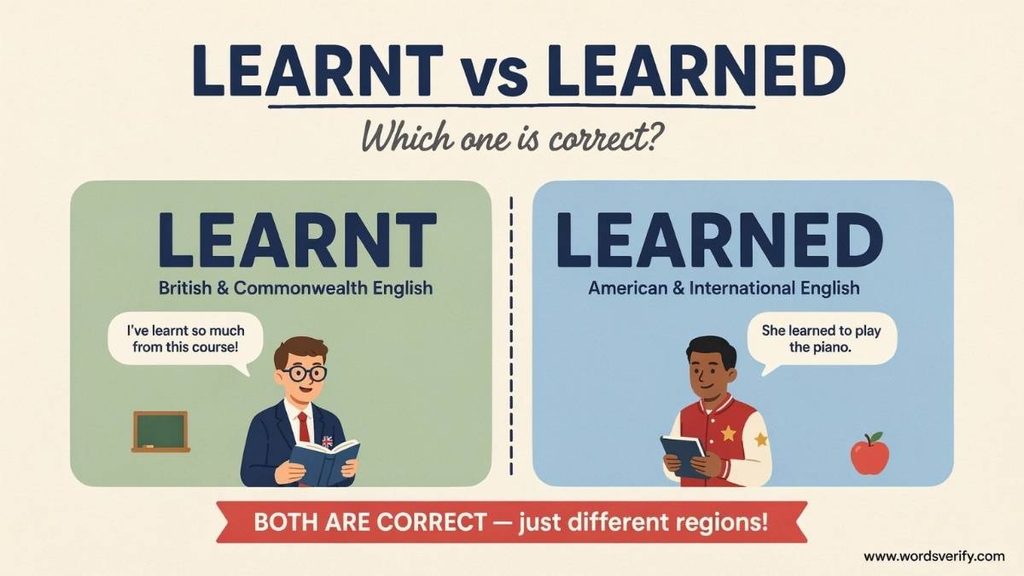
Learned has two main uses.
First, it works as a past-tense and past-participle form of learn. Second, it can function as an adjective meaning educated, knowledgeable, or scholarly.
Those uses look identical in writing, but they aren’t always pronounced the same way.
Learned as the Past Tense
The past tense describes something that happened in the past.
Here are some examples:
- I learned the answer yesterday.
- She learned to swim when she was six.
- We learned about the problem during the meeting.
- He learned an important lesson from the experience.
- They learned the rules before the competition.
In each sentence, learned tells us that the learning happened in the past.
Learned as the Past Participle
Learned can also function as the past participle of learn.
You often see it after auxiliary verbs such as have, has, or had.
For example:
- I have learned a lot this year.
- She has learned three new skills.
- They had learned the rules before the test.
- We have learned from our mistakes.
British English can use learnt in the same structures:
- I have learnt a lot this year.
- She has learnt three new skills.
- They had learnt the rules before the test.
- We have learnt from our mistakes.
So, if you’re searching for the learned past participle, the answer is learned. If you’re asking about the learnt past participle, learnt is also correct in varieties where that form is used.
Learned as an Adjective
Here’s where the word becomes more interesting.
Learned can describe someone who has gained extensive knowledge through education and study.
For example:
“The learned professor gave a fascinating lecture on ancient history.”
Here, learned doesn’t mean that the professor learned something yesterday. It means the professor is highly educated or scholarly.
You may encounter the adjective in phrases such as:
- A learned scholar
- A learned professor
- A learned writer
- A learned discussion
- A learned opinion
This adjective also has a different pronunciation from the verb form.
Understand confusing English more words simply
Finaly vs Finally Which one Is Correct?
What Does Learnt Mean?
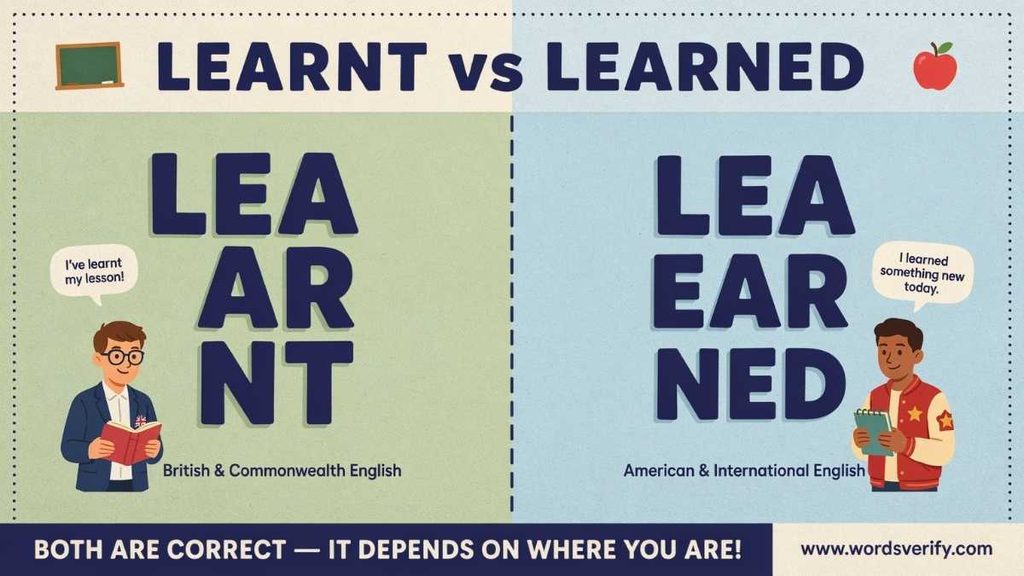
Learnt is another past-tense and past-participle form of learn.
It’s particularly common in British English.
For example:
- I learnt something new today.
- She learnt how to play the piano.
- We learnt a great deal from the experience.
- They had learnt the procedure before the training session.
In American English, these sentences would normally use learned instead.
It’s important to remember that learnt isn’t a casual shortcut or a spelling mistake. It’s an established English verb form.
So, if you’re wondering is learnt correct, the answer is yes.
Understand confusing English more words simply
Aide vs Aid which one is correct?
Learnt vs Learned in American English
When you’re writing American English, learned is usually the natural choice.
For example:
- I learned how to use the new software.
- She learned an important lesson from the mistake.
- We learned about the changes yesterday.
- He learned the truth during the meeting.
An American reader will understand learnt, but the form may sound noticeably British or less familiar in ordinary US writing.
This can matter when you’re writing:
- School assignments
- Business emails
- Reports
- Articles
- Resumes
- Professional documents
If your audience expects American English, learned will usually fit more naturally.
Why Do Americans Use Learned?
English has developed differently in different parts of the world.
American English has generally favored the -ed form:
learn → learned
British English has retained strong use of:
learn → learnt
Neither development makes the other form incorrect.
This is simply one example of regional differences in English.
Learnt vs Learned in British English
British English gives writers more flexibility.
Both forms are used:
“I learned a lot from the course.”
“I learnt a lot from the course.”
You’ll see learnt frequently in British writing and conversation. At the same time, learned is also completely acceptable.
That means there isn’t a strict rule saying British speakers must use learnt.
Personal preference, context, publication style, and regional habits can all influence the choice.
This explains why the learned vs learnt British English question doesn’t have a single answer.
Both forms belong to British English.
Learned vs Learnt in the UK and US
A simple comparison helps make the difference clearer.
| English variety | General usage |
|---|---|
| US English | Learned is strongly preferred |
| UK English | Learned and learnt are both used |
| Canadian English | Both forms occur |
| Australian English | Both forms occur |
| New Zealand English | Both forms occur |
These are general patterns rather than absolute rules.
English varies within countries as well. A British writer may prefer learned, while another may naturally choose learnt. Similar variation occurs in other English-speaking countries.
That’s why regional language differences should be treated as useful guidelines rather than rigid laws.
both as Past Tense and Past Participle
One of the easiest ways to understand these words is to look at the complete verb pattern.
| Verb form | American English | British English |
|---|---|---|
| Base form | learn | learn |
| Present participle | learning | learning |
| Past tense | learned | learned / learnt |
| Past participle | learned | learned / learnt |
This gives us the basic pattern:
learn → learned / learnt → learned / learnt
So, what is the past tense of learn?
It can be learned or learnt.
What is the past participle of learn?
It can also be learned or learnt.
The choice depends mainly on the variety of English being used.
Understand confusing English more words simply
Crier vs Cryer Which one Is Correct?
Learnt vs Learned in a Sentence
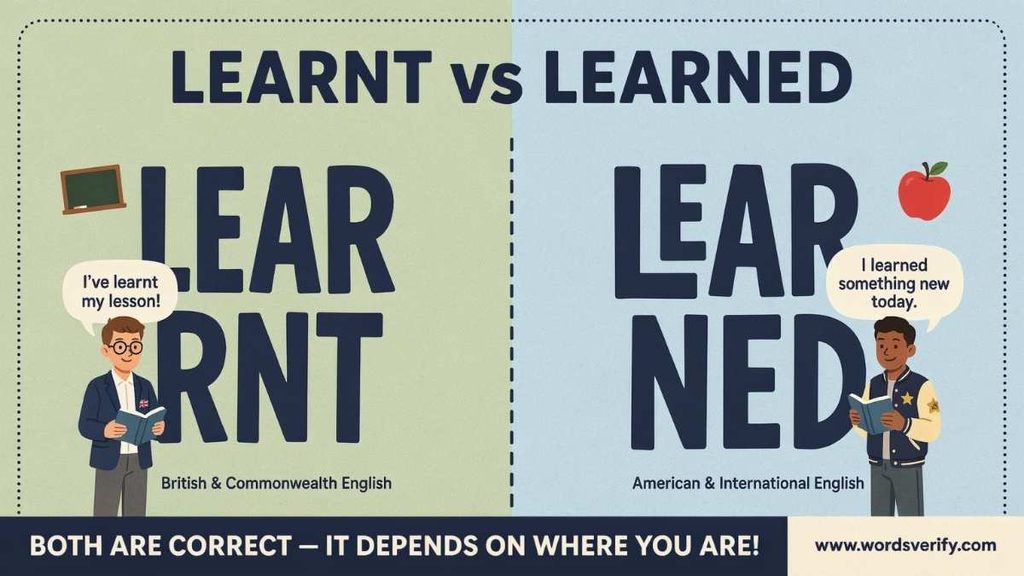
Sometimes the easiest way to understand grammar is to see the forms in everyday sentences.
Examples With Learned
- I learned something interesting today.
- She learned how to fix the computer.
- We learned the truth after the meeting.
- He learned from his mistakes.
- They learned the rules before the game.
- I’ve learned a lot from my teachers.
- She learned an important lesson from the experience.
Examples With Learnt
- I learnt something interesting today.
- She learnt how to fix the computer.
- We learnt the truth after the meeting.
- He learnt from his mistakes.
- They learnt the rules before the game.
- I’ve learnt a lot from my teachers.
- She learnt an important lesson from the experience.
Notice the pattern. The meaning doesn’t change simply because learned becomes learnt.
The main difference is the variety of English.
Lessons Learned or Lessons Learnt?
The phrase lessons learned is especially common in American English.
For example:
“The team reviewed the lessons learned from the project.”
British English may use:
“The team reviewed the lessons learnt from the project.”
Both expressions communicate the same idea.
A lesson learned or learnt is something useful that someone discovered through experience.
You might encounter these phrases in:
- Business reports
- Project reviews
- School discussions
- Training documents
- Personal reflections
- Management reports
Lessons Learned From Experience
The phrase often describes knowledge gained by actually doing something.
For example:
“The biggest lessons learned from experience often come from mistakes.”
A British writer might use:
“The biggest lessons learnt from experience often come from mistakes.”
Neither version changes the underlying idea.
Learnt vs Learned the Hard Way
The expression learned the hard way means gaining knowledge through a difficult, unpleasant, or costly experience.
For example:
“I learned the hard way that ignoring small problems can create much bigger ones.”
A British speaker may say:
“I learnt the hard way that ignoring small problems can create much bigger ones.”
Both are natural within their respective varieties.
The phrase works because learning doesn’t always happen in a classroom. Sometimes experience teaches the lesson, and it doesn’t always do so gently.
Things I Learned and Things I Learnt
Both expressions are correct.
American English commonly uses:
“These are the things I learned during my first year at college.”
British English may use:
“These are the things I learnt during my first year at college.”
The same pattern applies to several familiar expressions:
- What I learned
- What I learnt
- I learned from the best
- I learnt from the best
- Things I learned from experience
- Things I learnt from experience
The variety of English determines which form sounds more natural.
Understand confusing English more words simply
Labelling vs Labeling Which one Is Correct?
Learned Pronunciation Verb vs Adjective
Pronunciation adds an interesting twist to learned.
When learned functions as a verb, it’s normally pronounced as one syllable.
For example:
“She learned the answer.”
When learned means educated or scholarly, it’s pronounced with two syllables.
For example:
“The learned professor spoke about ancient philosophy.”
| Use | Syllables | Meaning |
|---|---|---|
| Learned as a verb | 1 | Gained knowledge |
| Learned as an adjective | 2 | Educated or scholarly |
This difference can surprise English learners because the spelling remains exactly the same.
Learned Verb Pronunciation
As a verb, learned normally has one syllable.
Examples include:
- She learned the answer.
- He learned a new skill.
- We learned the rules.
- They have learned from experience.
Learned Adjective Pronunciation
When learned means educated or scholarly, it has two syllables.
For example:
“The learned professor discussed ancient philosophy.”
In this sentence, learned describes the professor’s education and knowledge rather than a specific learning event.
Common Mistakes With Learned and Learnt
Several misunderstandings appear again and again.
Assuming Learnt Is Wrong
Some people see learnt and immediately assume it’s a spelling mistake.
It isn’t.
Learnt is an established English verb form and is especially common in British English.
Assuming Learned Is Only American
That’s also too restrictive.
British English uses learned as well as learnt. A British writer can use learned without making a grammar error.
Thinking One Form Has a Different Meaning
When learned and learnt function as forms of learn, they generally express the same meaning.
The distinction is mainly regional.
Confusing the Adjective With the Verb
The word learned has two different grammatical uses.
Compare:
“She learned the answer.”
Here, learned is a verb.
“She is a learned scholar.”
Here, learned is an adjective meaning highly educated or scholarly.
The pronunciation changes because the grammatical function changes.
Mixing Regional Styles Without a Reason
Using both forms isn’t automatically grammatically wrong. However, consistency usually makes writing feel smoother.
If you’re writing in American English, learned will normally be the natural choice.
If you’re writing in British English, you may choose learned or learnt depending on the style you’re following.
Understand confusing English more words simply
Potatoes vs Potatos Which one Is Correct?
Should I Use Learned or Learnt?
If you’re unsure when to use learned or learnt, think about your audience first.
Choose Learned When:
- You’re writing standard American English.
- Your main audience is in the United States.
- You’re following a US-based style guide.
- You’re writing a typical American academic document.
- You’re preparing business or professional writing for US readers.
Choose Learnt When:
- You’re writing in a British English style.
- Your publication prefers learnt.
- You’re maintaining a British voice in dialogue.
- You’re following an established British writing style.
Either Form Can Work When:
- You’re explaining regional English.
- You’re discussing English grammar.
- You’re comparing British and American usage.
- You’re quoting someone and preserving their original wording.
The goal isn’t to memorize a complicated rule. Think about your audience and keep your usage consistent.
Understand confusing English more words simply
Moulding vs Molding which one is correct?
Learned vs Learnt in Formal Writing
Both forms can appear in formal English.
The important thing is to match the form to the variety of English you’re using.
For example, an American business report might say:
“The team learned several important lessons during the project.”
A British report could say:
“The team learnt several important lessons during the project.”
Neither form is inherently informal.
The surrounding writing, grammar, vocabulary, and consistency matter much more than choosing one form simply because it looks more formal.
A Simple Everyday Example
Imagine someone starts cooking for the first time.
After burning dinner, they realize that leaving a pan unattended wasn’t such a good idea.
Later, they might say:
“I learned to keep an eye on the stove.”
A British speaker might say:
“I learnt to keep an eye on the stove.”
The experience is the same. The lesson is the same. The meaning is the same.
Only the preferred verb form changes.
That’s why learned and learnt shouldn’t be treated as completely different vocabulary words when they’re functioning as the past form of learn.
What Does “Learnt or Learned V3” Mean?
If you’ve seen V3 in an English grammar lesson, it usually means the past participle form of a verb.
For learn, the pattern looks like this:
| Verb form | Word |
|---|---|
| V1 | learn |
| V2 | learned / learnt |
| V3 | learned / learnt |
For example:
“I learned the lesson yesterday.”
Here, learned functions as the past tense.
“I have learned the lesson.”
Here, learned functions as the past participle.
British English can use learnt in those same grammatical positions.
So, when someone searches for learnt or learned v3, they’re asking about the past participle. The answer can be learned or learnt, depending on the variety of English.
A Simple Way to Remember the Difference
If you mainly write American English, remember one simple point:
Learned is your usual choice.
If you write British English, remember this:
Learned and learnt are both accepted.
Seeing learnt in British writing doesn’t mean you’ve found a spelling mistake. Likewise, seeing learned in British writing doesn’t mean the writer has used an American form incorrectly.
English has room for both.
Understand confusing English more words simply
Manuel vs Manual which one is correct?
Practice Session Learnt vs Learned
Fill in each blank with the correct word: learnt vs learned
- I ______ a valuable lesson from my first job.
- She ______ how to play the piano when she was seven.
- We have ______ a great deal from this experience.
- In British English, “I ______ the truth yesterday” can use either form.
- He ______ the hard way that preparation matters.
- They had ______ the rules before the competition began.
- I ______ how to cook from my grandmother.
- She has ______ several useful skills during her training.
- The students ______ about ancient history at school.
- In American English, “I ______ something new today” normally uses which form?
- He ______ from his mistakes and became more careful.
- We have ______ that small details can make a big difference.
- She ______ to drive before she moved to the city.
- The team ______ several important lessons from the project.
- I had ______ the procedure before starting the job.
- Which form is especially common in British English: “I ______ a lot from the course”?
- The child ______ how to read at an early age.
- They have ______ an important lesson about patience.
- After the mistake, she ______ to double-check her work.
- He ______ from the best teachers in the field.
- The workers had ______ the new safety procedures before the inspection.
- Which form is generally preferred in American English: “We ______ about the changes yesterday”?
- I have ______ that experience can sometimes be the best teacher.
- She ______ the lesson after making the same mistake twice.
- The students ______ many useful skills during the training program.
Answers
- learned
- learnt
- learned
- learnt
- learned
- learnt
- learned
- learnt
- learned
- learned
- learnt
- learned
- learnt
- learned
- learnt
- learnt
- learned
- learnt
- learned
- learnt
- learned
- learned
- learnt
- learned
- learnt
Here’s a trusted source for clear word meanings:
FAQs
Is “learned” or “learnt” more common in British English?
Both are used in British English. Learnt is especially common, while learned is also a standard and accepted form.
Why do people say “learnt” instead of “learned”?
Learnt is an established form of the verb learn. It has a long history in English and remains widely used in British English and some other varieties.
Is “learnt” a real English word?
Yes. Learnt is the past tense and past participle of learn in varieties of English that use the form.
Is “I just learnt” grammatically correct?
Yes. I just learnt is grammatically correct, particularly in British English. American English generally uses I just learned.
Can Americans use “learnt”?
Yes, Americans will understand learnt, but learned is much more common in standard American English.
What are the two meanings of “learned”?
Learned can be the past tense or past participle of learn. It can also be an adjective meaning highly educated, knowledgeable, or scholarly.
Why is “learned” pronounced differently in “learned professor”?
When learned means educated or scholarly, it is normally pronounced with two syllables or When it functions as the past form of learn, it is normally pronounced with one syllable.
When should you use “learnt” instead of “learned”?
Use learnt when it fits the variety or style of English you’re writing. It’s particularly common in British English. American English generally prefers learned.
Is “I have learned” grammatically correct?
Yes. I have learned uses learned as the past participle of learn and is completely grammatical.
What does “I have learnt” mean?
“I have learnt” means that you have gained knowledge, understanding, or a skill through study or experience. It is especially common in British English.
What is the past simple of “learn”?
The past simple can be learned or learnt. American English generally uses learned, while British English uses both.
What is the past participle of “learn”?
The past participle can be learned or learnt. For example, “She has learned the rules” and “She has learnt the rules” are both correct.
Is “I learned” grammatically correct?
Yes. I learned is the simple past form of learn and is especially common in American English.
Which is correct: “I learned a lot” or “I’ve learned a lot”?
Both are correct, but they can emphasize slightly different time relationships. I learned a lot refers to a completed past experience, while I’ve learned a lot connects the learning to the present.
Is “I’ve learned my lesson” correct?
Yes. “I’ve learned my lesson” is a standard expression meaning that someone has gained an important understanding from a mistake or experience.
Is “Today I learned” or “Today I learnt” correct?
Both can be correct. Today I learned is more natural in American English, while Today I learnt is common in British English.
Can “learned” and “learnt” be used in the same sentence?
Yes, although using the same regional form consistently usually makes your writing smoother. The two forms don’t normally have different meanings when they function as forms of learn.
Is “lessons learned” or “lessons learnt” correct?
Both are correct. Lessons learned is especially common in American English, while lessons learnt is frequently used in British English.
Is “learned the hard way” correct?
Yes. Learned the hard way means gaining knowledge through a difficult or unpleasant experience. British English may use learnt the hard way.
Is “I learned from the best” grammatically correct?
Yes. I learned from the best is grammatically correct and means that someone gained knowledge or skills from an excellent teacher, expert, or example.
What is the difference between “learn” and “study”?
Study usually means spending time reading, practicing, or attending lessons to gain knowledge. Learn refers to the knowledge or skill that you actually gain as a result.
Can “learned” be used as an adjective?
Yes. Learned can describe someone who has extensive knowledge or education, as in “a learned professor” or “a learned scholar.”
Is “learnings” correct English?
Learnings exists in English and can refer to insights or knowledge gained from an experience, especially in business contexts. However, lessons, insights, or knowledge gained often sound more natural in everyday writing.
Does “learned” have the same meaning as “learnt”?
When both words function as forms of the verb learn, they generally have the same meaning. The main distinction is regional usage.
Which form should I use in American English?
Use learned in most American English writing. It is the usual past tense and past participle of learn in US usage.
Which form should I use in British English?
Both learned and learnt are accepted. If you’re following a particular publication or style guide, use the form it prefers.
Are “learned” and “learnt” interchangeable in formal writing?
They can be interchangeable when they function as forms of learn. However, consistency matters, especially in formal documents written for a particular regional audience.
Understand confusing English more words simply
Sneek vs Sneak Which one is Correct?
conclusion
The learnt vs learned confusion doesn’t need to turn into a full-blown grammar headache. Both forms are correct when they serve as the past tense or past participle of learn. The main difference comes down to regional usage. American English generally prefers learned, while British English comfortably uses both learned and learnt.
So, before you panic over that extra “t,” take a quick look at your audience. Writing for American readers? Learned is usually the natural choice. Using British English? Either form can fit.
There’s one final twist worth remembering: learned can also mean highly educated or scholarly, and it has a different pronunciation in that sense. Once you know these simple differences, this grammar puzzle becomes much easier to crack.

Lisa AJS is an experienced blogger and language enthusiast at Words Verify, dedicated to making grammar simple, practical, and enjoyable. She writes engaging content on commonly confused words, grammar mistakes, word meanings, and everyday language challenges.