
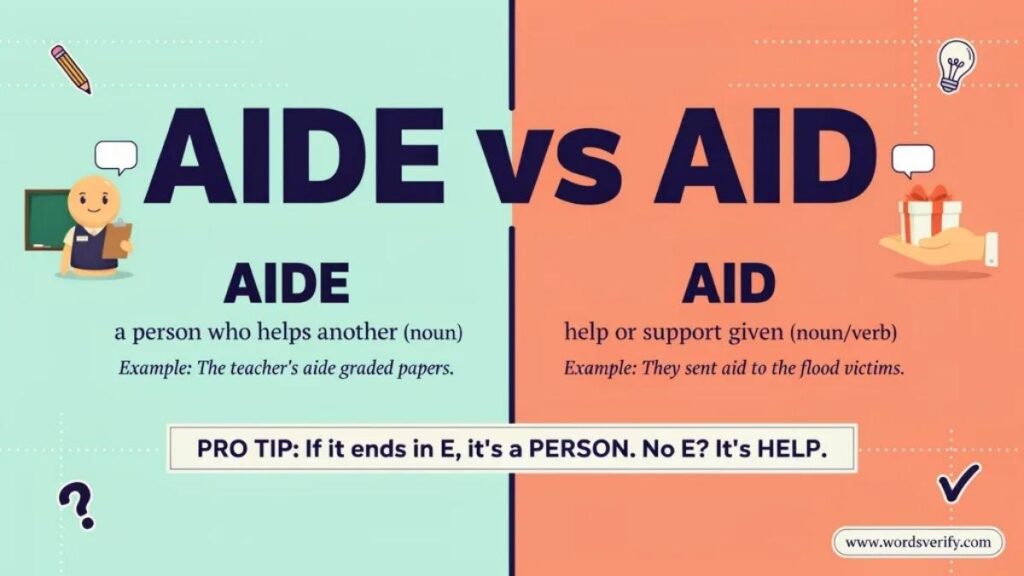
Ever paused over aide vs aid and wondered which word actually belongs in your sentence? It’s an easy mix-up because both words sound the same, yet their meanings are quite different. Aid refers to help, support, or assistance, and it can be used as both a noun and a verb. Aide means a person who provides assistance as part of their role or job. That extra “e” may look small, but it changes the meaning completely. Using the wrong word can leave your sentence scratching its head. Fortunately, the difference is simple to understand. Let’s break it down with clear meanings, examples, and practical tips.
The Quick Answer
The easiest way to remember the difference is to ask whether you’re talking about help or a person.
| Word | Meaning | Part of Speech | Example |
|---|---|---|---|
| aid | Help, assistance, or support | Noun and verb | The organization provided aid. |
| aide | A person who assists | Noun | The teacher’s aide helped the students. |
So, use aid when you mean help.
Use aide when you mean a person who provides that help.
That one distinction will solve most cases.
What Does Aid Mean?
The word aid means help or assistance. It can describe something given to a person, group, or organization to make a difficult situation easier.
For example:
The victims received emergency aid after the storm.
Here, aid means help.
The word can also describe something that makes a task easier:
The map was a useful aid during the journey.
Again, the map isn’t a person. It simply helps the travelers.
Aid as a Noun
As a noun, aid refers to help, support, or assistance.
You’ll see it in many everyday expressions.
- The hospital provided medical aid.
- The student received financial aid.
- The volunteers delivered disaster aid.
- The teacher used a diagram as a visual aid.
- The injured player needed first aid.
In each sentence, aid refers to assistance or something that provides help.
It doesn’t refer to the person providing that assistance.
Aid as a Verb
One useful thing about aid is that it can also act as a verb.
As a verb, aid means to help.
For example:
The treatment aided his recovery.
The guide aided the hikers during the difficult climb.
The new equipment may aid the investigation.
Volunteers arrived to aid the victims.
You can often replace aid with “help” without changing the basic meaning.
For instance:
The treatment aided his recovery.
means roughly the same thing as:
The treatment helped his recovery.
This is an important point in English grammar because aid can function as both a noun and a verb.
Learn how to use confusing more words correctly
Crier vs Cryer Which one Is Correct?
What Does Aide Mean?
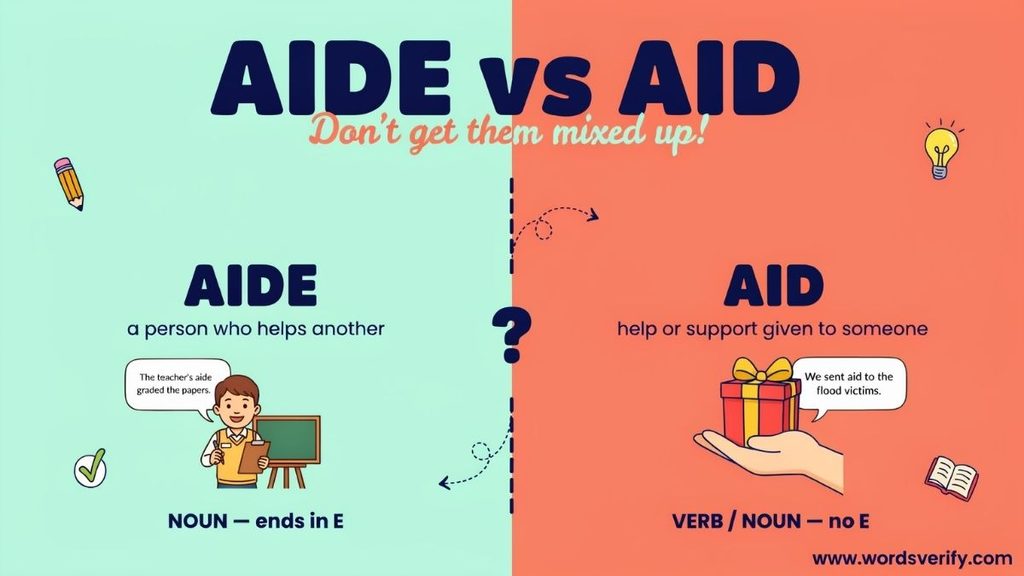
The word aide refers to a person who helps or assists someone else.
For example:
The teacher’s aide helped the children with their work.
The aide is a person. That’s the key point.
You might also hear the word in professional settings:
- A teacher’s aide assists a teacher.
- A research aide helps with research tasks.
- A political aide assists a politician.
- A legislative aide works with a legislator.
- An executive aide helps an executive with various responsibilities.
- A home health aide assists people with certain daily care needs.
The exact duties depend on the job, but the basic meaning stays the same: an aide is a person who assists.
Learn how to use confusing more words correctly
Labelling vs Labeling Which one Is Correct?
Aide vs Aid The Main Difference
The difference between these words comes down to what they refer to.
Aid refers to help.
Aide refers to a person.
Consider a classroom.
A teacher might use a chart to explain a difficult subject. That chart is a visual aid because it helps students understand the lesson.
The teacher might also have an aide who helps organize materials and assists students.
Now look at these two sentences:
The teacher used a visual aid.
The teacher’s aide helped the students.
The first sentence talks about something that provides help.
The second talks about someone who provides help.
That’s the central difference between aid and aide.
Aide vs Aid Comparison
| Feature | Aid | Aide |
|---|---|---|
| Meaning | Help or assistance | A person who assists |
| Part of speech | Noun and verb | Noun |
| Refers to a person | Usually no | Yes |
| Can mean “to help” | Yes | No |
| Example | Financial aid | Teacher’s aide |
| Another example | Hearing aid | Political aide |
| Pronunciation | Usually the same | Usually the same |
Although the words sound alike, their meanings are not interchangeable.
Learn how to use confusing more words correctly
Potatoes vs Potatos Which one Is Correct?
When to Use Aide vs Aid
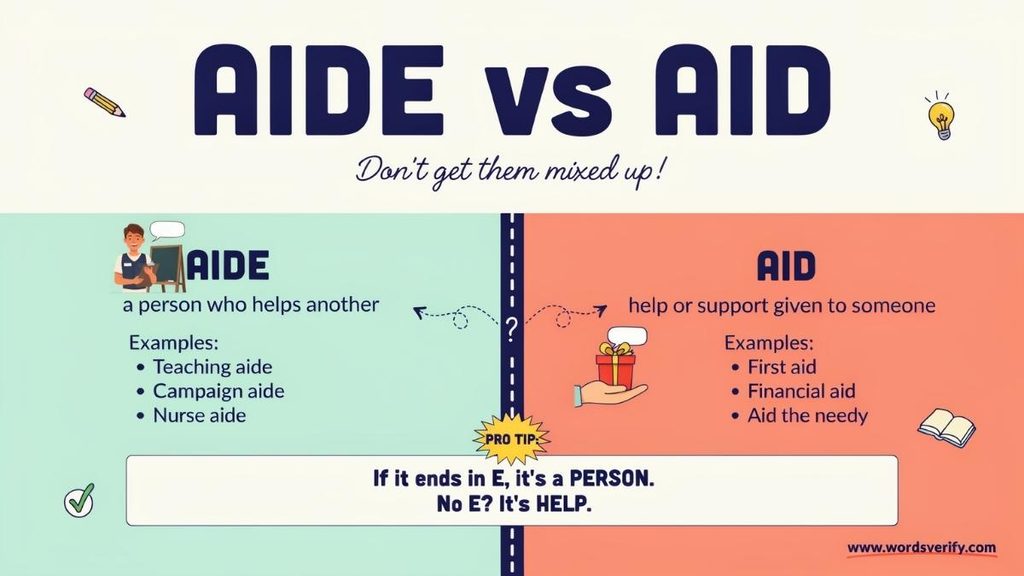
If you’re unsure which spelling to choose, try replacing the word with “help.”
If “help” fits, you probably need aid.
The organization provided aid to the families.
You could say:
The organization provided help to the families.
Now try replacing the word with “assistant.”
The teacher’s aide helped prepare the classroom.
You could replace aide with assistant:
The teacher’s assistant helped prepare the classroom.
That gives you a quick and practical way to decide between the two.
A Simple Person-or-Help Test
Ask yourself one question:
Am I talking about a person or about help?
If you’re talking about help, use aid.
If you’re talking about a person, use aide.
For example:
- The patient received medical aid.
- The medical aide helped the patient.
- The college offered financial aid.
- The student’s aide helped with the paperwork.
- The chart was a visual aid.
- The teacher’s aide displayed the chart.
The pattern is easy to spot once you see it in context.
Visual Aid or Visual Aide?
The correct expression is visual aid when you’re talking about something used to help explain information.
A visual aid might be a:
- Chart
- Diagram
- Photograph
- Map
- Graph
- Slide
- Illustration
For example:
The professor used a diagram as a visual aid.
The diagram helps explain the subject. It isn’t a person.
That’s why visual aide isn’t the standard spelling when you mean a chart, picture, or other teaching material.
Teacher Aide vs Aid?
This one can be confusing because both “aid” and “aide” are real words.
If you’re talking about a person who helps a teacher, aide is the appropriate word.
The teacher’s aide helped the students complete their assignments.
You may also see teacher aide used as a job title in some settings. The word aide still refers to the person.
However, if you’re talking about something that helps a teacher, aid may be appropriate.
For example:
The handbook is a useful teaching aid.
Here, the handbook is a resource, not a person.
Teacher’s Aide vs Aid?
Compare these sentences:
The teacher’s aide organized the classroom.
Here, aide means a person.
The software became an aid to the teacher.
Here, aid means something that provides assistance.
The apostrophe doesn’t determine the spelling by itself. The meaning does.
Hearing Aid or Hearing Aide?
The standard term for the device is hearing aid.
A hearing aid is a device designed to help a person hear sounds more effectively.
For example:
She adjusted her hearing aid before the meeting.
The device provides assistance, so aid is the correct word.
A hearing aide would mean something quite different because aide refers to a person.
So when you’re talking about the device, write:
hearing aid
First Aid or First Aide?
The correct expression is first aid.
First aid means immediate care given to someone who has been injured or becomes suddenly ill.
For example:
The campers learned first aid before their trip.
He gave the injured cyclist first aid.
Here, aid means assistance or care.
The expression isn’t first aide because it doesn’t refer to a person.
Home Health Aide vs Aid?
When you’re talking about a person who provides certain types of care and assistance in a person’s home, home health aide is the standard expression.
For example:
The home health aide arrived in the morning to assist the patient.
The word aide refers to the worker.
If you’re talking about assistance rather than the worker, aid may be appropriate in a different construction.
Compare:
The family received health aid.
This sentence discusses assistance.
A home health aide visited the family.
This sentence identifies a person.
Job Aid or Aide?
The phrase job aid usually refers to something that helps a person perform a particular task.
It could be a checklist, guide, diagram, instruction sheet, or reference document.
For example:
The employee used a job aid to follow the new procedure.
The job aid isn’t an employee. It’s a tool.
If you’re talking about a person who assists with work, you would need wording that clearly describes that person’s role rather than automatically using “job aide.”
This distinction is worth remembering because workplace documents often serve as aids even when no human assistant is involved.
Financial Aid or Aide?
When you’re talking about financial assistance, use financial aid.
For example:
She received financial aid to help pay for college.
The program provides financial aid to eligible students.
Financial aid can take different forms depending on the program. It may include grants, scholarships, loans, or work-study opportunities.
The important spelling point is simple: financial aid means financial assistance.
You wouldn’t normally write “financial aide” when referring to money or funding.
Medical Aid or Aide?
Medical aid means medical help or assistance.
For example:
The injured traveler needed immediate medical aid.
Here, aid refers to medical assistance.
An aide, however, is a person.
The medical aide helped prepare the patient.
The two sentences involve help, but the words perform different jobs.
One refers to assistance. The other refers to a person providing assistance.
Political Aide vs Aid?
A political aide is a person who assists a politician or political organization.
For example:
The political aide prepared the documents for the meeting.
You may also encounter terms such as:
- Presidential aide
- Senator’s aide
- Legislative aide
- Government aide
- Chief aide
- Personal aide
In each case, aide refers to a person.
On the other hand, government aid means assistance provided by a government.
Compare:
The government provided aid to the affected community.
The government aide attended the meeting.
The first sentence refers to assistance. The second refers to a person.
Research Aide vs Aid?
A research aide is a person who assists with research work.
For example:
The research aide organized the survey responses.
But research aid can refer to something that helps someone conduct research.
For example:
The database is a valuable research aid.
Again, the distinction is based on meaning.
A person is an aide.
A helpful resource is an aid.
Learn how to use confusing more words correctly
Moulding vs Molding which one is correct?
Common Mistakes With Aid and Aide
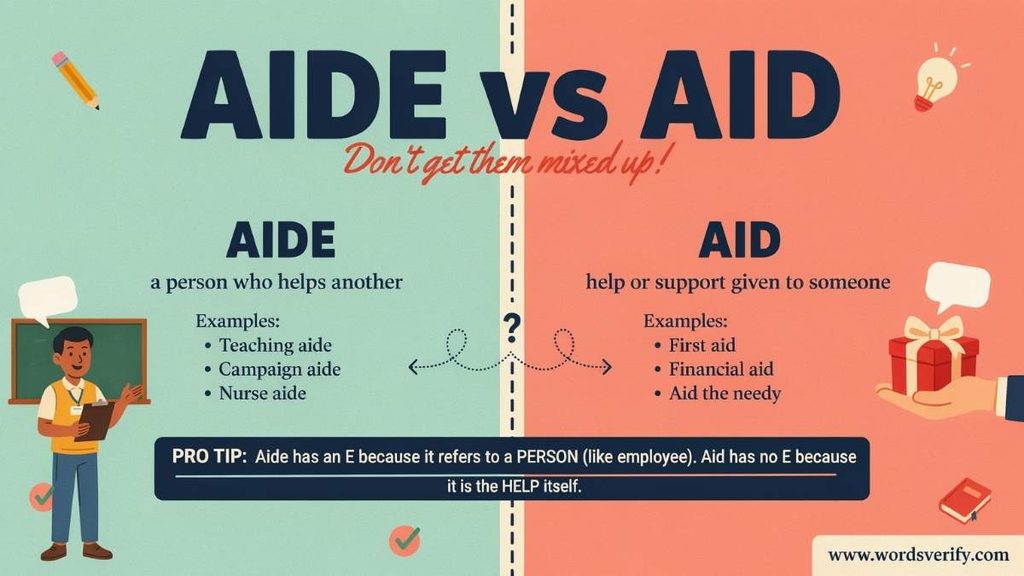
Because the words sound identical, people often choose the spelling based on sound. Unfortunately, that won’t work here.
Using Aide for General Help
Incorrect:
The charity provided emergency aide.
If you’re talking about assistance, use aid.
Correct:
The charity provided emergency aid.
Using Aid for a Person
Incorrect:
The teacher’s aid helped the students.
If you mean a person who assists the teacher, use aide.
Correct:
The teacher’s aide helped the students.
Writing Hearing Aide for the Device
Incorrect:
He bought a new hearing aide.
Correct:
He bought a new hearing aid.
The device provides help with hearing, so aid is the correct word.
Writing First Aide
Incorrect:
Everyone at the camp learned first aide.
Correct:
Everyone at the camp learned first aid.
First aid describes medical assistance.
Treating the Two Spellings as Interchangeable
Although aid and aide sound the same, you can’t simply choose whichever spelling looks better.
Their meanings are different.
Think about it this way: sound tells you almost nothing here. Meaning tells you everything.
Learn how to use confusing more words correctly
Manuel vs Manual which one is correct?
Aid and Aide Examples
Here are some straightforward examples to make the difference stick.
Examples With Aid
- The organization provided emergency aid after the flood.
- She received financial aid for college.
- The nurse administered first aid.
- The chart was a useful visual aid.
- The country received humanitarian aid.
- The new treatment may aid recovery.
- Volunteers arrived to aid the victims.
- The lawyer explained how legal aid works.
- The government announced additional disaster aid.
- The map served as a useful aid during the journey.
Examples With Aide
- The teacher’s aide helped organize the classroom.
- The senator’s aide arranged the appointment.
- The home health aide assisted the patient.
- The research aide collected the survey information.
- The executive’s aide organized the schedule.
- The political aide prepared the briefing materials.
- The school aide helped students find their classrooms.
- The legislative aide reviewed the documents.
- The medical aide assisted the staff.
- The chief aide accompanied the official.
Aid and Aide in Side-by-Side Sentences
Sometimes a direct comparison makes the distinction much easier to remember.
| Aid | Aide |
|---|---|
| The organization provided aid. | The organization sent an aide. |
| She received financial aid. | Her aide prepared the paperwork. |
| He needed medical aid. | The medical aide assisted him. |
| The chart was a visual aid. | The teacher’s aide displayed the chart. |
| The government offered disaster aid. | The government aide attended the meeting. |
The sentences may describe similar situations, but the words identify different things.
Learn how to use confusing more words correctly
Sneek vs Sneak Which one is Correct?
Aid vs Aide Pronunciation
Another reason this pair causes trouble is pronunciation.
In standard English, aid and aide are generally pronounced the same way.
That makes them homophones. Homophones are words that sound alike but have different meanings or spellings.
For example, when someone says “aid,” you can’t always know from the sound whether they mean aid or aide.
Context does the heavy lifting.
If someone says:
“The school needs more aid.”
The surrounding words tell you that they mean assistance.
If someone says:
“The school hired an aide.”
The article “an” and the context suggest a person.
When writing, therefore, don’t rely on pronunciation. Think about the meaning first.
Learn how to use confusing more words correctly
Laid Down vs Lied Down which one is correct?
Aid Grammar and Aide Grammar
The grammatical difference is just as useful as the meaning difference.
How Aid Works in a Sentence
Aid can be a noun or a verb.
As a noun:
The organization provided aid.
As a verb:
The organization aided the victims.
In the first sentence, aid names assistance.
In the second, aided describes an action.
How Aide Works in a Sentence
Aide is a noun that refers to a person.
For example:
The aide answered the phone.
The aide helped prepare the room.
You wouldn’t normally use aide as a verb to mean “help.”
That’s why knowing the part of speech can quickly solve the spelling problem.
Is Aide Always a Noun?
In standard modern English, aide is a noun.
It refers to a person who assists someone else.
For example:
The aide helped the director prepare for the meeting.
By contrast, aid can serve two common grammatical roles.
- Noun: The organization provided aid.
- Verb: The treatment may aid recovery.
This makes aid more flexible grammatically.
Where Did Aid and Aide Come From?
The two words are closely related in history because both developed from words connected with helping.
Aid entered English through French and ultimately traces back to Latin roots associated with helping.
Aide came into English from French and developed as a word for a helper or assistant.
Their related origins help explain why they look and sound so similar today.
Still, modern English gives them different jobs.
Aid focuses on assistance.
Aide focuses on the person providing assistance.
Learn how to use confusing more words correctly
Lieing vs Lying Which one Is Correct?
How to Remember Aide vs Aid
A simple memory trick can save you from second-guessing the spelling.
Think:
Aid = assistance.
Aide = assistant.
The words aren’t identical in meaning, but the connection is easy to remember.
You can also use the person test.
Ask:
“Can I point to a person?”
If yes, aide may be the word you need.
If you’re talking about help, money, treatment, equipment, a resource, or the act of helping, aid is usually the right choice.
For example:
- A teacher needs aid with a difficult task.
- A teacher may ask an aide for assistance.
- A patient may receive medical aid.
- A patient may be assisted by an aide.
Once you make that distinction, the spelling becomes much easier.
A Classroom Example
Imagine a teacher preparing a science lesson.
She wants to explain the water cycle, so she creates a large diagram showing evaporation, condensation, and precipitation.
That diagram is a visual aid.
It helps students understand the lesson.
The teacher also works with a teacher’s aide who hands out worksheets, helps organize materials, and supports students during the activity.
Now compare the two:
The diagram was a visual aid.
The teacher’s aide distributed the worksheets.
Both involve helping, but one is a resource and the other is a person.
That’s why the spelling matters.
An Emergency Example
Picture a community recovering after a severe storm.
A relief organization sends food, water, medicine, clothing, and other supplies. Those resources can be described as humanitarian aid or disaster aid.
Meanwhile, a person working for the organization may help coordinate the response.
That person could be an aide if the job title or context calls for that term.
For example:
The organization provided emergency aid to affected families.
An aide helped coordinate the distribution center.
Again, the difference is straightforward.
Aid is the assistance. Aide is the person.
Quick Facts About Aid and Aide
| Question | Answer |
|---|---|
| Does aid mean help? | Yes |
| Can aid be a verb? | Yes |
| Can aid be a noun? | Yes |
| Does aide refer to a person? | Yes |
| Is aide a noun? | Yes |
| Do aid and aide usually sound alike? | Yes |
| Is “first aid” correct? | Yes |
| Is “hearing aid” correct? | Yes |
| Is “visual aid” correct? | Yes |
| Is “teacher’s aide” correct? | Yes |
| Is “financial aid” correct? | Yes |
| Can aid and aide be used interchangeably? | No |
Learn how to use confusing more words correctly
Sergeant vs Sargeant which one is correct?
Practice session Aide vs Aid
Fill in each blank with aide vs aid.
- The nurse gave the injured man first ______.
- The teacher’s ______ helped students with their assignments.
- The organization provided financial ______ to families affected by the disaster.
- The senator’s ______ scheduled several meetings for next week.
- This guide will ______ you in completing the application.
- She received a hearing ______ to improve her ability to hear conversations.
- The president’s ______ spoke with reporters after the meeting.
- Volunteers arrived to provide medical ______ after the accident.
- The classroom ______ helped the teacher organize the lesson materials.
- The new software can ______ employees in managing their daily tasks.
- Many students depend on financial ______ to pay for college.
- The research ______ helped the professor collect information for the study.
- The charity sent emergency ______ to communities affected by the flood.
- A visual ______ can make a difficult lesson easier to understand.
- The politician thanked his personal ______ for handling the arrangements.
- The treatment may ______ the patient’s recovery.
- The government announced additional disaster ______ for affected communities.
- The teacher used a chart as a visual ______ during the presentation.
- The legislative ______ prepared documents for the committee meeting.
- The training manual serves as a useful job ______ for new employees.
- The volunteer ______ helped distribute food and water.
- Regular practice can ______ you in improving your writing skills.
- The school hired an ______ to provide extra support in the classroom.
- The hospital received medical ______ from several charitable organizations.
Answers
- aid
- aide
- aid
- aide
- aid
- aid
- aide
- aid
- aide
- aid
- aid
- aide
- aid
- aid
- aide
- aid
- aid
- aid
- aide
- aid
- aide
- aid
- aide
- aid
Here’s a trusted source for clear more words Comparison:
FAQS
What does “aide” mean?
“Aide” is a noun that means a person whose role is to provide help or assistance. For example, a political aide may assist an elected official with daily duties.
What does “aid” mean?
“Aid” means help, support, or assistance. It can be a noun or a verb. For example, “The organization provided aid to the victims” uses aid as a noun, while “This medicine may aid recovery” uses it as a verb.
Is a person called an aide or aid?
A person is called an aide, not an aid. An aide is someone who helps another person as part of a job or role. “Aid” refers to the help itself.
Is it “teacher’s aide” or “teacher’s aid”?
Teacher’s aide is the standard expression when referring to a person who assists a teacher. “Aid” would mean help rather than the person providing it.
Is “job aid” or “job aide” correct?
Job aid is correct when you mean a tool, guide, checklist, or resource that helps someone perform a task. “Job aide” would refer to a person who provides assistance, although it is not the usual term for a workplace helper.
Is “work aid” or “work aide” correct?
It depends on the meaning. Work aid refers to something that helps you complete a task, while work aide would mean a person who assists with work. The first is much more common when discussing workplace tools or resources.
Is “hearing aid” or “hearing aide” correct?
Hearing aid is correct because it refers to a device that helps a person hear. “Hearing aide” would incorrectly suggest that the device is a person.
Is “first aid” or “first aide” correct?
First aid is correct. It means immediate care given to someone who is injured or suddenly ill. The word “aid” refers to the help being provided.
Is “financial aid” or “financial aide” correct?
Financial aid is correct when referring to money or financial assistance. For example, a student may receive financial aid to help pay for college.
Can “aid” be used as a verb?
Yes. Aid can function as a verb meaning “to help” or “to assist.” For example, “The treatment aided his recovery.”
Is “aide” always a noun?
In standard English, aide is used as a noun. It refers to a person who assists someone else, often in a professional role.
What is another word for “aide”?
Depending on the context, alternatives for “aide” include assistant, helper, attendant, associate, or support worker. The best choice depends on the person’s specific role.
What is another word for “aid”?
Depending on the context, synonyms for “aid” include help, assistance, support, relief, service, or assistance.
What are the main types of aid?
Aid can take many forms, including financial aid, humanitarian aid, medical aid, emergency aid, disaster aid, educational aid, legal aid, and foreign aid. The type depends on who receives the assistance and what kind of support is provided.
How do you remember the difference between aide and aid?
A simple memory trick is: aid is help, while an aide is a helper. If you can replace the word with “assistance,” use “aid.” If you can replace it with “assistant,” use “aide.”
Do “aid” and “aide” sound the same?
Yes. In standard English, aid and aide are pronounced the same. They are homophones, which means they sound alike but have different meanings and spellings.
Can “aid” be used in a sentence?
Yes. For example: “The volunteers provided aid to families affected by the storm.” Here, “aid” means help or assistance.
Can “aide” be used in a sentence?
Yes. For example: “The senator’s aide arranged the meeting.” Here, “aide” refers to a person who assists the senator.
What is the difference between an aide and an assistant?
Both words can describe someone who provides support. Aide is often used for a person assisting someone in a specific professional or organizational role, while assistant is a broader term that applies to many types of jobs.
Does “aid” have an E at the end?
No. The word meaning help or assistance is spelled aid. The spelling aide refers to a person who provides assistance.
Is “aide” a real English word?
Yes. Aide is a standard English noun used for someone who assists another person. Common examples include a teacher’s aide, political aide, and legislative aide.
Learn how to use confusing more words correctly
Affect vs Effect which one is correct?
conclusion
Ever paused over aide vs aid and wondered which word actually belongs in your sentence? It’s an easy mix-up because both words sound the same, yet their meanings are quite different. Aid refers to help, support, or assistance, and it can be used as both a noun and a verb. Aide means a person who provides assistance as part of their role or job. That extra “e” may look small, but it changes the meaning completely. Using the wrong word can leave your sentence scratching its head. Fortunately, the difference is simple to understand. Let’s break it down with clear meanings, examples, and practical tips.

Lisa AJS is an experienced blogger and language enthusiast at Words Verify, dedicated to making grammar simple, practical, and enjoyable. She writes engaging content on commonly confused words, grammar mistakes, word meanings, and everyday language challenges.