
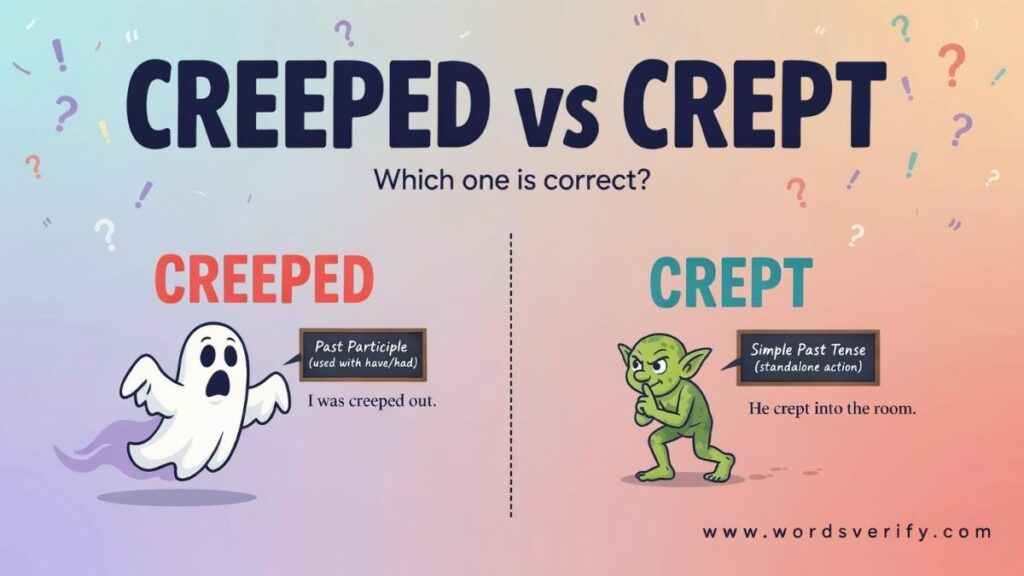
English grammar loves to turn tiny words into surprisingly big headaches. Take “creeped” and “crept.” They look like they should be interchangeable, but English has other plans. If you’ve ever stopped while writing and wondered, “Is it creeped vs crept?” you’re dealing with a common verb-form confusion. The good news is that the difference becomes simple once you know what each form means and where it belongs. In this guide, we’ll break down creeped vs crept with clear explanations, everyday examples, and common mistakes to avoid. By the end, you’ll know which form to use without second-guessing every sentence.
The Basic Difference
The quickest way to understand creeped vs crept is to look at what the verb describes.
| Word | Common use | Example |
|---|---|---|
| crept | Slow, quiet, careful, or gradual movement | The cat crept under the bed. |
| crept | Gradual change or appearance | Doubt crept into his mind. |
| creeped | Usually used with “out” to describe an uneasy reaction | The movie creeped me out. |
| creeping | Present participle | The fog is creeping across the field. |
| creep | Present/base form | I creep quietly through the hallway. |
In ordinary use, crept is the past tense and past participle of creep.
Meanwhile, creeped has a more specific modern use, especially in creeped out.
That distinction explains most of the confusion surrounding creeped vs crept grammar.
What Is the Past Tense of Creep?
The standard past tense of creep is crept.
Creep is an irregular verb, so you don’t normally form its past tense by simply adding “-ed.”
The main verb forms are:
| Verb form | Form |
|---|---|
| Base form | creep |
| Present | creep / creeps |
| Past tense | crept |
| Past participle | crept |
| Present participle | creeping |
So the basic pattern is:
creep → crept → crept
For example:
- I creep quietly through the hallway.
- I crept quietly through the hallway.
- I have crept quietly through the hallway.
This is why crept past tense is the standard answer when someone asks, “What is the past tense of creep?”
Fix common more word mistakes in English
Worshiped vs Worshipped Which one Is Correct?
What Does Crept Mean?
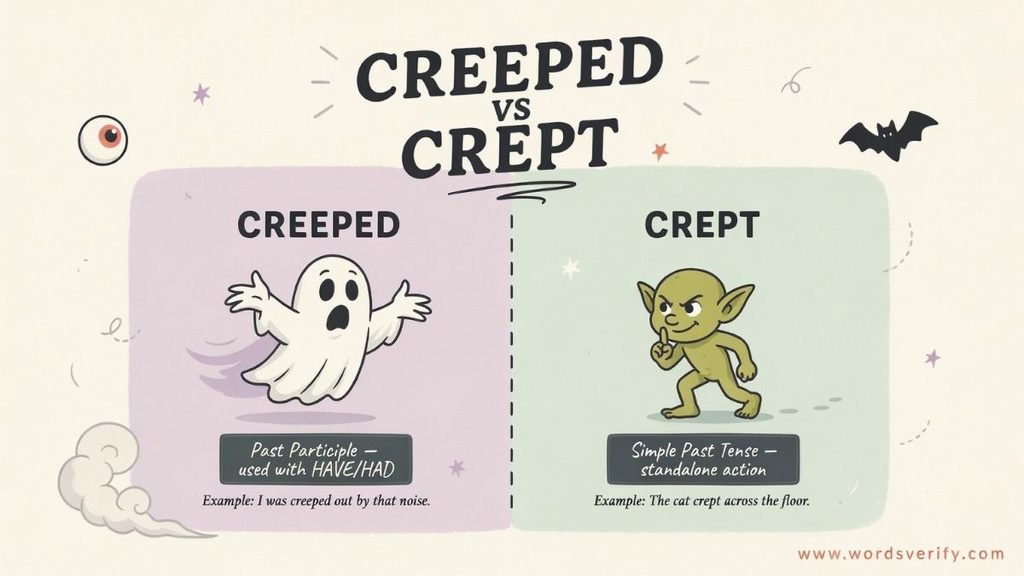
The crept meaning is connected to the idea of moving slowly, quietly, carefully, or gradually.
A person might creep because they don’t want to make noise. An animal might creep toward its target. Fog can creep across a field. A problem can even creep into a situation without anyone noticing immediately.
For example:
- The cat crept beneath the sofa.
- She crept into the bedroom.
- The fox crept through the grass.
- He crept downstairs after everyone had gone to bed.
- Darkness crept across the valley.
Notice that none of these sentences needs “creeped.” They all describe movement or gradual development.
Crept Can Describe More Than Physical Movement
One interesting thing about crept is that it doesn’t always involve a person or animal physically moving.
English speakers often use “creep” to describe something that happens slowly or almost unnoticed.
For example:
- Prices crept higher during the year.
- A feeling of doubt crept into her mind.
- Several mistakes crept into the report.
- Darkness crept across the town.
- The deadline crept up on us.
Here, nothing is literally crawling along the ground. The word creates the idea of something developing slowly and quietly.
That figurative use is an important part of the crept definition.
What Is the Past Participle of Creep?
The standard past participle of creep is also crept.
That gives you:
creep → crept → crept
The past participle appears with helping verbs such as “has,” “have,” and “had.”
For example:
- She has crept downstairs.
- They have crept into the room.
- He had crept behind the wall.
- The fog had crept across the road.
So if you’re wondering about creep past participle, the answer is crept.
The same form works for both the simple past and the past participle.
Is Creeped a Word?
Yes, creeped is a word.
That’s where things get interesting.
Because “crept” is the traditional past tense of the ordinary verb “creep,” it can seem strange to see “creeped” in a sentence. However, English uses creeped in certain constructions, especially creeped out.
For example:
- That movie creeped me out.
- The strange house creeped her out.
- The story creeped everyone out.
- I was creeped out by the noise.
In these sentences, “creeped” isn’t describing slow physical movement. It’s describing an emotional reaction caused by something.
So the answer to “Is creeped grammatically correct?” depends on the construction.
Yes, “creeped” can be grammatically correct.
However, it isn’t the standard replacement for crept when you’re describing ordinary movement.
Fix common more word mistakes in English
Judgement vs Judgment Which one Is Correct?
What Does Creeped Mean?
The creeped meaning most people encounter today relates to the expression creeped out.
When something “creeps someone out,” it makes that person feel uncomfortable, uneasy, nervous, disturbed, or frightened.
For example:
The strange painting creeped me out.
The painting didn’t physically move. Instead, it caused an uncomfortable reaction.
You can change the person experiencing that reaction:
- The movie creeped me out.
- The movie creeped her out.
- The movie creeped him out.
- The movie creeped us out.
- The movie creeped them out.
The expression works naturally in everyday informal English.
Why Do We Say “Creeped Out”?
The phrase creep out developed as a separate phrasal-verb use of “creep.”
It doesn’t mean that someone physically crept somewhere.
Instead, it means that something caused a person to feel uncomfortable, uneasy, or frightened.
For example:
- That abandoned house creeped me out.
- The strange voice creeped her out.
- The horror movie creeped us out.
- His behavior really creeped them out.
The expression is especially common in conversations about scary movies, strange situations, unsettling people, unusual places, or anything that gives someone an uncomfortable feeling.
That’s why creeped out can sound perfectly natural even though crept is the standard past form of ordinary “creep.”
Fix common more word mistakes in English
Wich vs Which what’s the difference?
Creeped Out vs Crept Out
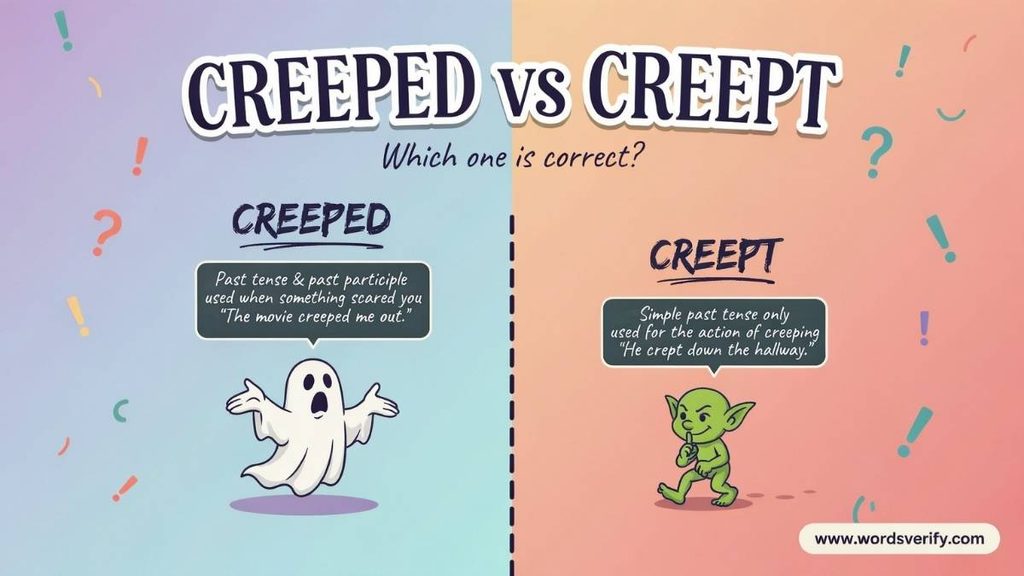
These two expressions look almost identical, but the meanings are different.
Crept Out
Crept out normally describes quiet or slow physical movement away from somewhere.
For example:
- The cat crept out of the room.
- He crept out of the house before sunrise.
- She crept out of bed without waking anyone.
Here, someone or something physically moves out.
Creeped Out
Creeped out describes an emotional reaction.
For example:
- The old house creeped me out.
- That movie creeped her out.
- I was creeped out by the strange noise.
Here, nobody is quietly leaving a room. Something is making someone feel uneasy.
This is one of the easiest ways to separate crept out from creeped out.
| Expression | Meaning |
|---|---|
| crept out | Moved or left quietly |
| creeped out | Caused someone to feel uncomfortable or frightened |
Fix common more word mistakes in English
Curtesy vs Courtesy Which one Is Correct?
When Should You Use Crept?
Use crept when “creep” describes slow, quiet, careful, stealthy, or gradual movement.
Physical movement
- The cat crept under the table.
- The mouse crept across the kitchen floor.
- The child crept toward the door.
- The fox crept through the grass.
Quiet movement
- She crept into the room.
- He crept downstairs.
- They crept away from the sleeping dog.
Gradual movement
- The fog crept across the highway.
- Darkness crept over the hills.
- The temperature crept higher.
- Prices crept upward during the summer.
Gradual development
- Doubt crept into his mind.
- Fear crept into her voice.
- Several errors crept into the final document.
In each case, crept gives the sentence an idea of slow or almost unnoticed movement.
Fix common more word mistakes in English
Indexes vs Indices which one is correct?
When Should You Use Creeped?

Use creeped mainly when you’re talking about something that caused an uncomfortable or unsettling reaction.
The most common structure is:
something + creeped + someone + out
Examples include:
- The movie creeped me out.
- That story creeped her out.
- The abandoned building creeped them out.
- The strange message creeped everyone out.
You can also use the phrase “was creeped out”:
- I was creeped out by the noise.
- She was creeped out by the empty house.
- We were creeped out by the strange behavior.
This form is especially common in conversational American English.
Can You Use Creeped for Physical Movement?
For standard English, crept is the natural choice when you’re describing ordinary physical movement.
Write:
The cat crept through the grass.
rather than:
The cat creeped through the grass.
Likewise:
She crept quietly into the room.
is the standard form.
The important thing isn’t simply memorizing that one word is “right” and the other is “wrong.” The better approach is to understand the meaning.
If something is moving slowly or quietly, crept is the normal choice.
If something causes an uncomfortable reaction, creeped out is the normal expression.
Fix common more word mistakes in English
Learnt vs Learned What’s the Difference?
Creeped vs Crept in American English
In American English, you’ll regularly hear and see both forms, but they tend to appear in different contexts.
“Crept” is the standard past form of the ordinary verb.
“Creeped” commonly appears in the expression “creeped out.”
For example:
Movement:
The dog crept toward the gate.
Reaction:
The dog creeped me out.
This distinction also applies to written English. In formal writing, use crept when describing the ordinary action of creeping.
If you’re writing dialogue, a personal essay, a review, or another conversational piece, creeped out is perfectly natural when that is the meaning you intend.
Fix common more word mistakes in English
Canceled vs Cancelled Which one Is Correct?
Common Mistakes With Creeped vs Crept
A few mistakes appear again and again.
Thinking “Creeped” Is Always Wrong
This is probably the biggest misunderstanding.
“Creeped” is not simply an incorrect form that should never appear in English.
For example:
That movie creeped me out.
This sentence is natural.
The problem occurs when someone uses “creeped” as the ordinary past tense for physical movement.
Using Creeped for Movement
If you mean that someone moved quietly, use “crept.”
Incorrect for standard usage:
The child creeped across the floor.
Standard:
The child crept across the floor.
Confusing Crept Out and Creeped Out
Consider these sentences:
He crept out of the bedroom.
He quietly left the bedroom.
The bedroom creeped him out.
The bedroom made him uncomfortable.
The words are similar, but the actions are completely different.
Assuming Every Verb Takes “-ed”
English has many irregular verbs.
“Go” becomes “went.” “Take” becomes “took.” “Write” becomes “wrote.” Likewise, “creep” becomes “crept.”
So don’t assume that adding “-ed” automatically creates the correct past tense.
Fix common more word mistakes in English
Finaly vs Finally Which one Is Correct?
Creeped vs Crept Examples
The easiest way to understand the difference is to see the forms in context.
Examples With Crept
- The cat crept through the grass.
- She crept quietly into the kitchen.
- The fox crept toward the fence.
- He crept downstairs after midnight.
- The mouse crept beneath the cabinet.
- Darkness crept across the field.
- A strange feeling crept into her mind.
- The temperature crept higher throughout the afternoon.
- Several errors crept into the report.
- The deadline crept up on us.
Examples With Creeped
- The horror movie creeped me out.
- That abandoned house creeped her out.
- The strange photograph creeped everyone out.
- His behavior creeped me out.
- The noise creeped the children out.
- I was creeped out by the empty hallway.
- We were creeped out when the lights went off.
- That story really creeped him out.
Notice the pattern. The crept examples describe movement or gradual development. The creeped examples describe an emotional reaction.
“I Creeped Out” or “I Crept Out”?
This question causes a lot of confusion because both forms can appear with “out.”
The correct choice depends on what you mean.
If you mean that you physically left somewhere quietly:
I crept out of the room.
If you mean that something made you uncomfortable:
I was creeped out by the strange noise.
You could also say:
I got creeped out when I heard footsteps.
But you wouldn’t normally use “I creeped out” to mean “I became frightened.”
In that situation, “I got creeped out” or “I was creeped out” is much more natural.
Creepy, Creep, and Creeped Out
These related words can also cause confusion.
Creep can be a verb meaning to move slowly or quietly.
The cat crept toward the door.
It can also be a noun referring to an unpleasant or unsettling person.
That guy is a creep.
Creepy is an adjective describing something that causes an unsettling feeling.
That house looks creepy.
Creeped out describes the person’s reaction.
That house creeped me out.
These words belong to the same family, but they don’t perform the same grammatical job.
Fix common more word mistakes in English
Aide vs Aid which one is correct?
Useful Expressions With Creep
“Creep” appears in several common expressions.
1.Creep Up
“Creep up” can describe gradual movement or a gradual increase.
The price crept up during the year.
It can also describe someone approaching quietly:
The cat crept up behind the bird.
2.Creep Up on Someone
This can describe approaching someone quietly.
The fox crept up on its prey.
It can also describe something becoming noticeable gradually.
The deadline crept up on us.
3.Creep Into
“Creep into” can describe physical movement:
She crept into the room.
It can also describe something gradually appearing:
A few mistakes crept into the report.
4.Creep Along
“Creep along” describes slow movement or progress.
Traffic crept along the highway.
The old car crept along the narrow road.
5.Creep Out
“Creep out” has the emotional meaning discussed throughout this article.
That movie creeped me out.
It can also have a literal movement meaning:
The cat crept out of the box.
Again, context determines the meaning.
A Simple Memory Trick
Here’s an easy way to keep the two forms straight.
Think about movement versus reaction.
Movement = crept
The cat crept across the floor.
Reaction = creeped out
The movie creeped me out.
That one distinction covers most everyday situations.
When you’re unsure, ask yourself:
Did someone or something move slowly, or did something cause an uncomfortable feeling?
If it moved, choose crept.
If it caused the feeling, creeped out is likely what you need.
Fix common more word mistakes in English
Crier vs Cryer Which one Is Correct?
Practice Session Creeped vs Crept
Fill in each blank with the correct form: “creeped” vs “crept.”
- The cat ______ quietly across the kitchen floor.
- That horror movie really ______ me out.
- The little boy ______ into his parents’ room after hearing a strange noise.
- A feeling of doubt ______ into her mind.
- The abandoned house ______ me out when I saw it at night.
- The spider ______ slowly across the wall.
- The fog ______ over the valley before sunrise.
- That strange message ______ me out.
- She ______ downstairs so she wouldn’t wake anyone.
- The temperature ______ higher throughout the afternoon.
- The mouse ______ under the sofa and disappeared.
- The unsettling silence ______ him out.
- Darkness ______ across the field as the sun went down.
- The dog ______ out of the room without making a sound.
- The strange behavior of the stranger ______ everyone out.
- Fear ______ into the child’s voice as he heard the noise.
- The snake ______ through the tall grass.
- That old photograph ______ me out for some reason.
- The deadline ______ up on me before I realized it.
- She ______ closer to the door and listened carefully.
- The creepy sound ______ the children out.
- Mist ______ through the open window.
- He ______ away quietly before anyone noticed.
- The strange story ______ me out more than I expected.
- A sense of uncertainty ______ into the conversation.
Answers
- crept
- creeped
- crept
- crept
- creeped
- crept
- crept
- creeped
- crept
- crept
- crept
- creeped
- crept
- crept
- creeped
- crept
- crept
- creeped
- crept
- crept
- creeped
- crept
- crept
- creeped
- crept
Here’s a trusted source for clear more words Comparison:
FAQs
Is “crept out” or “creeped out” correct?
Both expressions can be correct, but they have different meanings. “Creeped out” means feeling or causing discomfort, fear, or uneasiness. “Crept out” usually describes someone or something moving quietly out of a place.
Is “creeped” a word?
Yes, “creeped” is a real English word. It’s commonly used in the expression “creeped out,” as in “That strange noise creeped me out.” For ordinary movement, however, the standard past tense of “creep” is “crept.”
What is the past tense of “creep”?
The standard past tense of “creep” is “crept.” For example, “The cat crept under the table.” “Creeped” is also used in certain contexts, especially when describing something that caused an uneasy feeling.
What is the past participle of “creep”?
The standard past participle of “creep” is “crept.” It can appear with helping verbs such as “has,” “have,” and “had.” For example, “The fog had crept across the field.”
What does “crept” mean?
“Crept” is the past tense and past participle of “creep.” It means moved slowly, quietly, or carefully. It can also describe something that gradually appeared or increased, such as “Doubt crept into his mind.”
What does “creeped” mean?
“Creeped” commonly describes something that caused a person to feel uncomfortable, nervous, or frightened. It is especially common in “creeped out,” as in “The abandoned house creeped me out.”
When should you use “crept” instead of “creeped”?
Use “crept” when “creep” refers to slow, quiet, or gradual movement. For example, “She crept downstairs so nobody would hear her.” It’s also used for gradual changes, such as “The temperature crept higher.”
What does “I’m creeped out” mean?
“I’m creeped out” means “I feel uncomfortable, uneasy, or slightly frightened.” People often use it in informal conversation when something gives them an unsettling feeling.
Is “creeped out” grammatically correct?
Yes. “Creeped out” is an established expression in English. It describes a feeling of uneasiness or the act of making someone feel uncomfortable or frightened.
Can “creeped” describe physical movement?
In standard everyday English, “crept” is the usual choice for physical movement in the past tense. For example, “The child crept across the floor.” “Creeped” is much more strongly associated with the “creeped out” sense.
What is another word for “crept”?
Depending on the context, possible synonyms include “sneaked,” “slipped,” “crawled,” “edged,” and “inched.” The best choice depends on whether the sentence emphasizes quiet movement, slow movement, or gradual movement.
What is another word for “crept into”?
Depending on the meaning, you could use “slipped into,” “entered quietly,” “infiltrated,” or “worked its way into.” For example, “Doubt crept into her mind” could become “Doubt gradually entered her mind.”
What is a better word for “creeped out”?
Possible alternatives include “unnerved,” “disturbed,” “frightened,” “unsettled,” and “spooked.” The best synonym depends on how strong the feeling is.
What does “creep on someone” mean?
“Creep on someone” is informal slang that usually means watching, following, or paying unwanted attention to someone in a way that makes them uncomfortable. The exact meaning can vary with context.
What does “creep” mean in slang?
As a slang noun, “creep” usually refers to a person whose behavior seems unpleasant, strange, intrusive, or uncomfortable. For example, someone might call a person a “creep” if that person repeatedly ignores social boundaries.
Is “creeped out” inappropriate?
“Creeped out” is generally considered informal rather than inappropriate. It’s common in casual conversation and everyday writing. In formal writing, alternatives such as “unsettled,” “disturbed,” or “unnerved” may sound more suitable.
What does “crept” mean in “crept up on me”?
“Crept up on me” means something happened or developed gradually without being noticed at first. For example, “The deadline crept up on me” means the deadline arrived sooner than expected.
What is the opposite of “crept”?
There isn’t one exact opposite in every context. Depending on the sentence, possible opposites include “rushed,” “charged,” “hurried,” or “advanced quickly.” The appropriate opposite depends on what “crept” describes.
What are common mistakes with “creeped” and “crept”?
A common mistake is using “creeped” whenever you need the past tense of “creep.” For physical or gradual movement, “crept” is normally the correct choice. Another mistake is confusing “creeped out” with “crept out.” The first describes an unsettling reaction while the second usually describes quiet movement away.
conclusion
“Creeped” vs “crept” may look like two versions of the same word, but they don’t always do the same job. Use “crept” when someone or something moved slowly, quietly, or gradually. It’s the standard past tense and past participle of “creep.” Use “creeped” when something made you feel uneasy, uncomfortable, or frightened, especially in the expression “creeped out.”
Once you understand the difference, the confusion disappears pretty quickly. A cat can “creep through the grass,” while a scary movie can “creep you out.” So don’t let these tricky forms creep into your writing and cause trouble. Match the verb to the meaning, and you’ll be on solid grammatical ground.

Lisa AJS is an experienced blogger and language enthusiast at Words Verify, dedicated to making grammar simple, practical, and enjoyable. She writes engaging content on commonly confused words, grammar mistakes, word meanings, and everyday language challenges.