
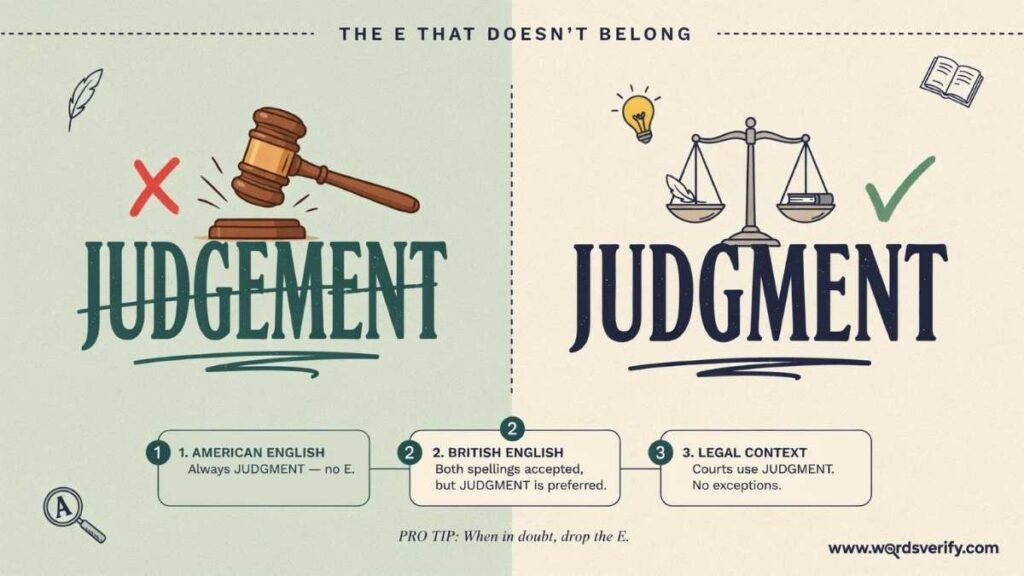
Have you ever typed a word, stared at it, and suddenly wondered whether one tiny “e” belongs there? If so, you’re not alone. The question of judgement vs judgment confuses plenty of writers because both spellings look right, sound identical, and carry the same basic meaning. The twist is that English has more than one spelling tradition. American English generally uses judgment, while judgement is common in general British English. Legal writing adds another layer to the puzzle. This guide clears up the confusion with simple explanations, real examples, pronunciation tips, and common mistakes, so you’ll know exactly which spelling to use.
The Quick Answer
If you only need the basic rule, here it is:
- American English normally uses judgment.
- British English commonly uses judgement in general writing.
- British English also uses judgment, particularly in legal contexts.
- Both spellings have the same basic meaning.
- Both spellings are pronounced the same way.
- In formal writing, consistency matters more than personal preference.
| Point | Judgment | Judgement |
|---|---|---|
| American English | Standard | Less common |
| British English | Used | Common in general writing |
| Pronunciation | Same | Same |
| Basic meaning | Same | Same |
| Legal writing | Common | Depends on the context |
| Main difference | Spelling | Spelling |
The extra e doesn’t turn judgement into a different word. It simply reflects a spelling variation that developed across different forms of English.
What Does Judgment Mean?
The word judgment has several closely related meanings.
In everyday English, it often describes someone’s ability to make sensible decisions.
For example:
She showed good judgment by checking the contract before signing it.
Here, judgment means the ability to think carefully about a situation and make a sensible choice.
The word can also describe an opinion or assessment formed after considering information.
The committee made a careful judgment after reviewing the evidence.
In this case, judgment means an assessment or conclusion.
Then there’s the legal meaning. A judgment can refer to a formal decision made by a court.
The court issued its judgment after hearing both sides.
So, depending on the context, judgment can refer to decision-making ability, an assessment, or a formal court decision.
Learn the difference between everyday English mistakes
Wich vs Which what’s the difference?
What Does Judgement Mean?
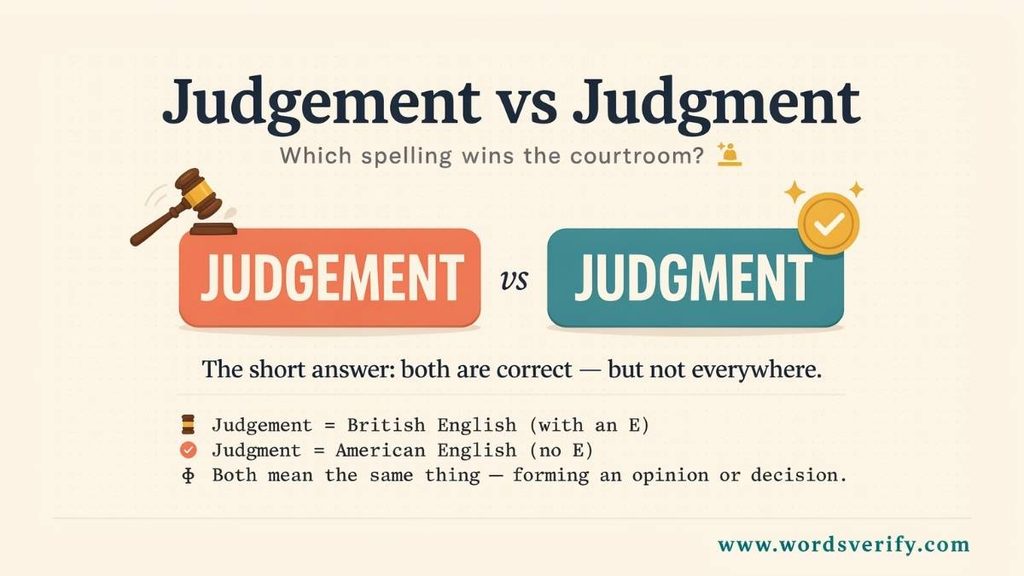
Judgement has the same basic meanings.
British writers commonly use this spelling when talking about someone’s ability to make decisions, an assessment, or an opinion formed after careful thought.
For example:
She showed excellent judgement during the negotiations.
Here, judgement describes her ability to assess the situation and make a sensible choice.
It can also describe an assessment:
The editor made a careful judgement after reading the report.
And in legal contexts, judgement can refer to a court’s decision. However, judgment has a particularly established role in legal writing, so context matters.
The key thing to remember is simple: adding the e doesn’t normally change the meaning.
Judgment vs Judgement What’s the Difference?
The main difference between judgment vs judgement is spelling rather than meaning.
Look at these two sentences:
She showed good judgment.
She showed good judgement.
The meaning hasn’t changed. The first version follows standard American English. The second is common in general British English.
Both forms can refer to:
- The ability to make sensible decisions.
- An opinion formed after considering something.
- An assessment or evaluation.
- A conclusion based on available information.
- A formal decision made by a court.
That last meaning is worth remembering because legal usage doesn’t always follow the spelling pattern you might expect from ordinary British English.
Learn the difference between everyday English mistakes
Curtesy vs Courtesy Which one Is Correct?
Judgment in American English
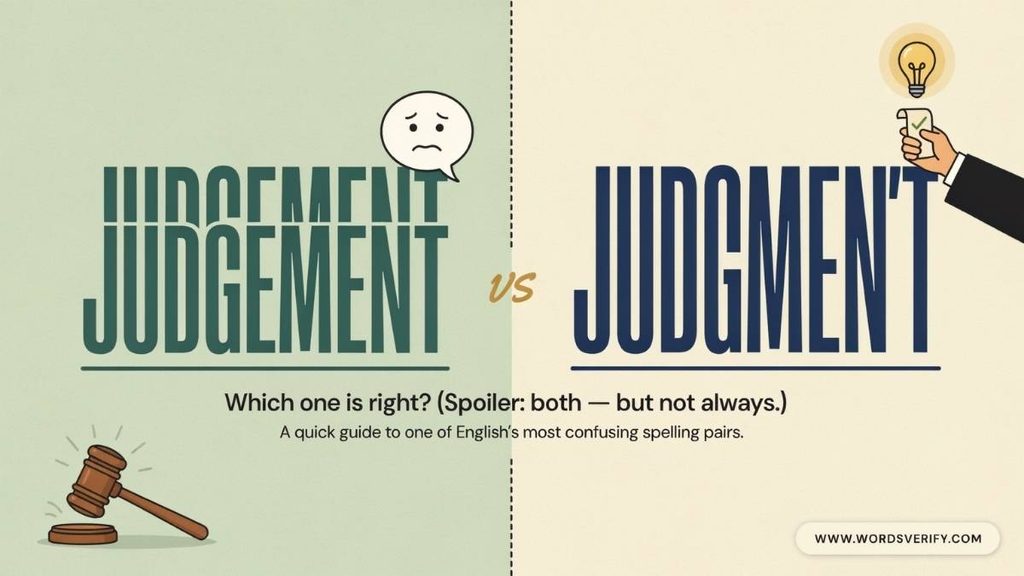
If you’re writing American English, judgment is the spelling you will normally want.
You’ll find it in American school assignments, business documents, newspapers, professional correspondence, and legal writing.
For example:
- She showed excellent judgment during the crisis.
- His judgment improved with experience.
- The manager used sound judgment when reviewing the proposal.
- The court issued its judgment on Monday.
- It was a serious error in judgment.
The spelling judgement can still appear in American sources. English is a global language, and American readers regularly encounter British spelling. However, if you’re intentionally following standard American spelling, judgment is the natural choice.
Learn the difference between everyday English mistakes
Indexes vs Indices which one is correct?
Judgement in British English
British English commonly uses judgement in general writing.
For example:
- She showed excellent judgement.
- His professional judgement helped the team solve the problem.
- It was an error of judgement.
- We shouldn’t pass judgement before hearing all the facts.
- Use your judgement before making a decision.
But there’s an important detail here: British English doesn’t completely avoid judgment.
In fact, judgment has a well-established place in British legal writing.
That’s why the simple rule “America uses judgment and Britain uses judgement” works as a starting point, but it isn’t the whole story.
Is Judgment British English?
Yes.
This often surprises people.
British English uses both judgment and judgement. The spelling with the extra e is common in general writing, while the shorter spelling also appears in established contexts.
Legal writing gives us a good example.
A British legal document may refer to a court’s judgment, even though a general British article might discuss someone’s good judgement.
So, if someone tells you that “judgment is only American,” that’s too broad.
Is Judgement Wrong in American English?
It’s better not to call judgement simply wrong.
It is an established English spelling. However, if you’re deliberately writing standard American English, judgment is normally the form to choose.
Think of it as a regional preference rather than a simple spelling test with one universally correct answer.
For an American school paper, business report, or professional document, use judgment unless the publication or style guide tells you otherwise.
Judgment Pronunciation and Judgement Pronunciation
Here’s one part of the question that’s very easy.
Judgment and judgement are pronounced the same way.
The pronunciation is:
/ˈdʒʌdʒmənt/
The extra e in judgement doesn’t create another syllable or change the sound.
That means you can’t usually tell which spelling someone means just by hearing the word.
The difference only becomes visible when you write it down.
Learn the difference between everyday English mistakes
Learnt vs Learned What’s the Difference?
Judgment Definition and Meaning
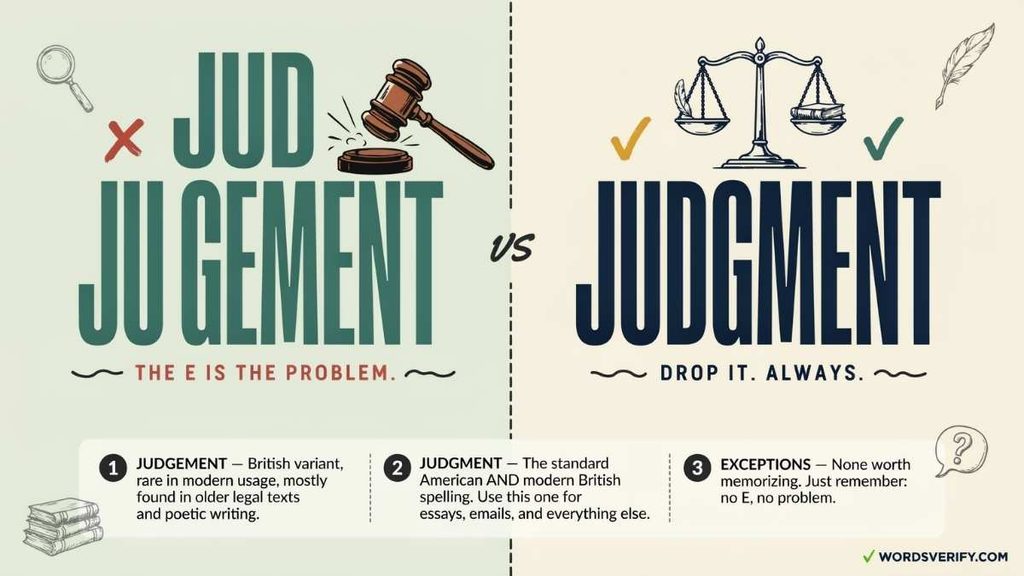
The judgment definition depends slightly on the context, but the central idea involves forming an opinion, assessing something, or making a decision.
Judgment as decision-making ability
This is one of the most common uses.
Good judgment means the ability to make sensible decisions.
He used good judgment and waited for more information.
By contrast, poor judgment suggests an unwise decision or weak assessment of a situation.
Buying the equipment without checking the warranty showed poor judgment.
This use often appears when people talk about someone’s experience, maturity, or ability to assess risk.
Judgment as an opinion or assessment
Judgment can also mean an opinion or conclusion reached after considering facts.
The teacher’s judgment was based on the student’s complete record.
Here, judgment means an assessment.
It doesn’t necessarily mean the assessment was correct. It simply describes the conclusion someone reached after considering the available information.
Judgment as a legal decision
In law, a judgment is a formal decision made by a court.
The judge delivered the final judgment.
This meaning is more specific than the everyday use of the word.
A legal judgment may explain the court’s reasoning and set out the result of the case, depending on the legal system and type of proceeding.
Learn the difference between everyday English mistakes
Canceled vs Cancelled Which one Is Correct?
Judgement Definition and Meaning
The judgement definition follows the same basic pattern.
In British English, judgement can refer to:
- The ability to make sensible decisions.
- An assessment of a person, situation, or event.
- An opinion formed after careful thought.
- A formal legal decision.
For example:
Her professional judgement helped the company avoid a costly mistake.
Here, judgement refers to her ability to assess a situation.
Another example:
The panel reached its judgement after reviewing the evidence.
In this sentence, judgement means a conclusion or assessment.
The spelling changes, but the basic meaning doesn’t.
Judgment vs Judgement in a Sentence
The easiest way to understand the difference is to see both spellings in context.
American English examples
- She showed good judgment during the emergency.
- His professional judgment helped the team solve the problem.
- The manager relied on her judgment.
- It was an error in judgment.
- The court issued its judgment after the hearing.
British English examples
- She showed good judgement during the emergency.
- His professional judgement helped the team solve the problem.
- The manager relied on her judgement.
- It was an error of judgement.
- The editor used careful judgement before publishing the article.
The meaning stays the same. Only the spelling changes.
Learn the difference between everyday English mistakes
Finaly vs Finally Which one Is Correct?
Judgment in Legal Writing
Legal writing deserves special attention because judgment has a specific and important meaning in law.
A legal judgment is a formal decision issued by a court or judge. Depending on the legal system and the type of case, it may explain the issues before the court, discuss the relevant law, consider the arguments or evidence, and state the court’s conclusion.
For example:
The court issued its judgment after considering the evidence.
Here, judgment doesn’t mean someone’s personal opinion. It refers to a judicial decision.
That’s why legal writers need to pay attention to the conventions of the relevant jurisdiction.
Court judgment or court judgement?
You’ll encounter both forms in English-language writing. However, court judgment is especially common in legal terminology.
In American legal writing, judgment is the expected spelling.
In British legal contexts, judgment is also widely used even though judgement remains common in general British writing.
If you’re preparing an actual legal document, the safest approach is to follow the terminology used by the relevant court, jurisdiction, or legal style guide.
Legal Judgment vs General Judgement
The difference becomes clearer when you compare these sentences:
She used good judgment when deciding whether to accept the offer.
The court issued its judgment after hearing the case.
The first sentence concerns decision-making ability.
The second refers to a formal judicial decision.
A British writer might use judgement in the first sentence:
She used good judgement when deciding whether to accept the offer.
Yet the legal context can still call for judgment.
This is one reason the spelling question isn’t quite as simple as “American equals no e, British equals e.”
Learn the difference between everyday English mistakes
Aide vs Aid which one is correct?
Common Phrases With Judgment vs Judgement
The word appears in many everyday expressions.
Good judgment or good judgement
This describes the ability to make sensible decisions.
She has good judgment.
A British writer may write:
She has good judgement.
Sound judgment or sound judgement
This suggests careful and reliable decision-making.
The manager demonstrated sound judgment throughout the crisis.
Poor judgment or poor judgement
This describes an unwise decision or weak decision-making.
Ignoring the warning was poor judgment.
Judgment call
A judgment call is a decision that requires personal assessment because there isn’t necessarily one obvious answer.
Choosing whether to postpone the event was a judgment call.
Pass judgment or pass judgement
To pass judgment means to form or express an opinion about someone or something, often before knowing all the facts.
It’s easy to pass judgment before hearing the whole story.
Reserve judgment or reserve judgement
To reserve judgment means to wait before forming a final opinion.
Let’s reserve judgment until we know what happened.
Against your better judgment or judgement
This means doing something even though you believe it may not be the wisest choice.
Against my better judgment, I agreed to the plan.
These expressions follow the spelling convention of the English variety being used.
Judgment vs Decision Are They the Same?
Not quite.
A decision is a choice or determination.
Judgment can describe the thinking and assessment that leads to that choice. It can also refer to someone’s ability to make good decisions.
Compare these sentences:
The manager made a decision to delay the launch.
The manager showed good judgment by delaying the launch.
The first sentence focuses on the choice.
The second focuses on the quality of the thinking behind that choice.
In law, judgment has an even more specific meaning because it can refer to a formal judicial decision.
Judgment vs Opinion What’s the Difference?
An opinion is what someone thinks about something. A judgment can involve a more considered assessment.
For example:
In my opinion, the restaurant is expensive.
Now compare that with:
The inspector made a professional judgment about the building’s safety.
The first sentence expresses a personal view.
The second describes an assessment based on professional knowledge and observation.
The two ideas can overlap, but context gives each word its particular meaning.
Learn the difference between everyday English mistakes
Crier vs Cryer Which one Is Correct?
Common Mistakes With Judgment and Judgement
Assuming one spelling is always wrong
This is the biggest misunderstanding.
Judgment isn’t a misspelling, and judgement isn’t automatically an error.
Both forms are established.
Treating them as different words
The extra e doesn’t normally create a new meaning.
They’re spelling variants of the same word.
Mixing regional spellings
A document can contain both forms, but switching between them without a reason can make your writing look inconsistent.
For example:
The report examines good judgment and professional judgement.
If you’re writing American English, make the spelling consistent:
The report examines good judgment and professional judgment.
For general British English:
The report examines good judgement and professional judgement.
Assuming British English always uses judgement
That’s too broad.
British English uses judgement often, but judgment is also established. Legal writing is one important example.
Ignoring the style guide
A university, publisher, newspaper, company, or legal organization may have its own preferences.
When a style guide specifies a spelling, follow it.
Learn the difference between everyday English mistakes
Labelling vs Labeling Which one Is Correct?
Judgement vs Judgment in Academic Writing
Academic writing rewards consistency.
If you’re writing for an American institution, judgment will generally fit the expected spelling.
If you’re writing for a British institution, judgement may be preferred in general writing.
Before submitting an assignment, check the institution’s requirements. Some schools and universities specify a particular variety of English or a particular style guide.
A simple editing routine can help:
- Find out whether the assignment requires US or UK English.
- Check the institution’s instructions.
- Check the required style guide.
- Search the document for both spellings.
- Make your general usage consistent.
- Keep direct quotations faithful to the original source when exact wording is required.
That last point matters. If a source uses judgement inside a quotation, don’t casually change it to judgment just because you’re writing American English.
Judgement vs Judgment in Everyday Writing
Everyday writing doesn’t need a complicated rulebook.
If you’re writing American English, use judgment.
If you’re writing general British English, judgement is common.
For example, an American writer might say:
I trust your judgment.
A British writer might write:
I trust your judgement.
Both sentences express the same idea.
The important thing is to choose a spelling that fits the variety of English you’re using and then stick with it.
Judgment vs Judgement Comparison
| Feature | Judgment | Judgement |
|---|---|---|
| Basic meaning | Decision, assessment, opinion, or legal decision | Same basic meanings |
| Pronunciation | Same | Same |
| US English | Standard | Less common |
| General UK English | Used | Common |
| Legal writing | Very common | Depends on context |
| Extra letter | No e | Includes e |
| Example | good judgment | good judgement |
| Main difference | Regional and stylistic spelling | Regional and stylistic spelling |
Judgmental or Judgemental?
The same spelling variation appears in the related adjective.
American English commonly uses:
judgmental
British English can use:
judgemental
For example:
He sounded too judgmental.
A British writer may write:
He sounded too judgemental.
Again, the spelling doesn’t normally change the basic meaning.
How to Spell Judgment
If you’re writing American English, the standard spelling is:
judgment
A simple way to remember it is:
judge + ment = judgment
There’s no missing e.
The shorter spelling is complete and standard in American English.
How to Spell Judgement
For general British English, the common spelling is:
judgement
The extra e is part of the spelling.
However, remember that British English also uses judgment in established contexts, particularly in legal writing.
So instead of memorizing one spelling as universally correct, learn which form fits your audience and context.
Which Should You Use Judgement vs Judgment?
If you’re still asking, “Should I use judgment or judgement?” use this practical guide:
- Writing American English: Use judgment.
- Writing general British English: Judgement is common.
- Writing US legal material: Use judgment.
- Writing British legal material: Check the relevant legal convention because judgment is widely used.
- Writing for a publisher: Follow its house style.
- Writing an academic paper: Follow your institution’s requirements.
- Writing for an international audience: Choose one variety of English and use it consistently.
Once you know your audience, the choice becomes much easier.
Learn the difference between everyday English mistakes
Potatoes vs Potatos Which one Is Correct?
Practice Session Judgement vs Judgment
Fill in each blank with the correct form: judgement vs judgment.
- She showed excellent __________ when dealing with the difficult situation.
- In American English, the standard spelling is __________.
- In general British English, __________ is a common spelling.
- The court issued its final __________ after hearing the case.
- It was an error of __________ to ignore the warning signs.
- Good __________ comes from experience and careful thinking.
- The manager relied on his professional __________ when making the decision.
- The British editor changed “judgment” to “__________” to match the publication’s spelling style.
- The American newspaper used the spelling “__________” throughout the article.
- We should reserve __________ until we know all the facts.
- The judge delivered the court’s __________ after reviewing the evidence.
- She used sound __________ when she decided to wait for more information.
- His poor __________ caused several problems for the team.
- In UK general writing, “__________” is commonly used.
- In US English, “__________” is the preferred spelling.
- The committee made a careful __________ after examining the report.
- Against my better __________, I agreed to the plan.
- The lawyer discussed the court’s __________ with her client.
- Her professional __________ helped the company avoid a costly mistake.
- The two spellings have the same basic meaning, but “judgement” is more common in general __________ English.
- The writer used “__________” because the article followed American English conventions.
- The editor used “__________” because the publication followed British English conventions.
- The judge’s __________ explained the reasons behind the court’s decision.
- It takes good __________ to know when you need more information before making a decision.
- Whether you write “judgment” or “judgement,” consistency is important in formal __________.
Answers
- judgment
- judgment
- judgement
- judgment
- judgment
- judgment
- judgment
- judgement
- judgment
- judgment
- judgment
- judgment
- judgment
- judgement
- judgment
- judgment
- judgment
- judgment
- judgment
- British
- judgment
- judgement
- judgment
- judgment
- writing
Here’s a trusted source for clear more words Comparison:
FAQs
Why is the e dropped in judgment?
American English commonly uses the shorter spelling judgment. The spelling developed as a standard American form, while judgement remains common in British English.
When should I use judgment instead of judgement?
Use judgment when writing standard American English. In general British English, judgement is common, although judgment also appears in established contexts such as legal writing.
Is judgment or judgement used in UK law?
British legal writing commonly uses judgment. However, usage can vary by legal context and publication, so legal writers should follow the relevant jurisdiction or style guide.
Does judgement have two accepted spellings?
Yes. Both judgment and judgement are established English spellings. Their use mainly depends on regional conventions and context.
Is judgment always spelled without an e in American English?
In standard American English, judgment is the usual spelling. Judgement can still appear in American sources, particularly when quoting or reproducing British English.
Is judgmental or judgemental the correct spelling?
Both forms exist. Judgmental is the usual American English spelling, while judgemental is also used in British English.
Is judgment a positive or negative word?
Judgment itself isn’t inherently positive or negative. Its meaning depends on context. Good judgment suggests sensible decision-making, while poor judgment suggests an unwise choice.
What is another word for judgment?
Depending on the context, alternatives include assessment, evaluation, opinion, decision, conclusion, discernment, or discretion. The best substitute depends on what judgment means in the sentence.
Can judgment mean a personal opinion?
Yes. Judgment can refer to an opinion or assessment formed after considering information. For example, someone might make a judgment about a situation after reviewing the available evidence.
What is the difference between judgment and decision?
A decision is a choice or determination. Judgment can describe the reasoning or ability involved in reaching that decision. In legal contexts, judgment can also mean a formal court decision.
What is the difference between judgment and opinion?
An opinion is generally what someone thinks about a subject. Judgment can suggest a more considered assessment or conclusion, although the two words can overlap in some contexts.
What does judgment mean in a legal context?
In law, a judgment is a formal decision issued by a court or judge. It may explain the court’s reasoning and state the result of the case.
Is court judgment different from everyday judgment?
Yes. Everyday judgment can mean someone’s ability to make sensible decisions or an assessment of a situation. A court judgment specifically refers to a formal judicial decision.
How do you pronounce judgment and judgement?
Both spellings normally have the same pronunciation: /ˈdʒʌdʒmənt/. The extra e in judgement doesn’t add another syllable or change the usual pronunciation.
Does the spelling change the meaning of judgment?
No. In ordinary usage, judgment and judgement have the same basic meanings. The difference is primarily spelling rather than meaning.
Is judgment used in British English?
Yes. Although judgement is common in general British English, judgment is also an established British spelling. It appears particularly often in legal contexts.
Which spelling should students use in an essay?
Students should follow the English variety and style guide required by their school or university. American English generally uses judgment, while general British English commonly uses judgement.
Should I use judgment or judgement in formal writing?
Use the spelling that matches your chosen variety of English and remain consistent. If your employer, publisher, university, or style guide specifies a particular form, follow that requirement.
Is judgment used in the phrase “good judgment”?
Yes. In American English, the standard phrase is good judgment. In general British English, good judgement is also common.
Is “error of judgment” grammatically correct?
Yes. Error of judgment is a standard expression, particularly in American English. British English commonly uses error of judgement. Both express the idea of making an incorrect or unwise assessment.
Conclusion
The judgement vs judgment debate looks complicated, but the answer is surprisingly simple. The two spellings share the same basic meaning and pronunciation. The main difference comes from regional usage: judgment is the standard choice in American English, while judgement is common in general British English. British legal writing, however, often uses judgment, adding a small twist to the usual US-versus-UK rule.
So, don’t let one little letter send your writing into a spelling crisis. Choose the form that matches your audience and context, then use it consistently. After all, good writing requires good judgment—and in British English, sometimes good judgement too.

Lisa AJS is an experienced blogger and language enthusiast at Words Verify, dedicated to making grammar simple, practical, and enjoyable. She writes engaging content on commonly confused words, grammar mistakes, word meanings, and everyday language challenges.