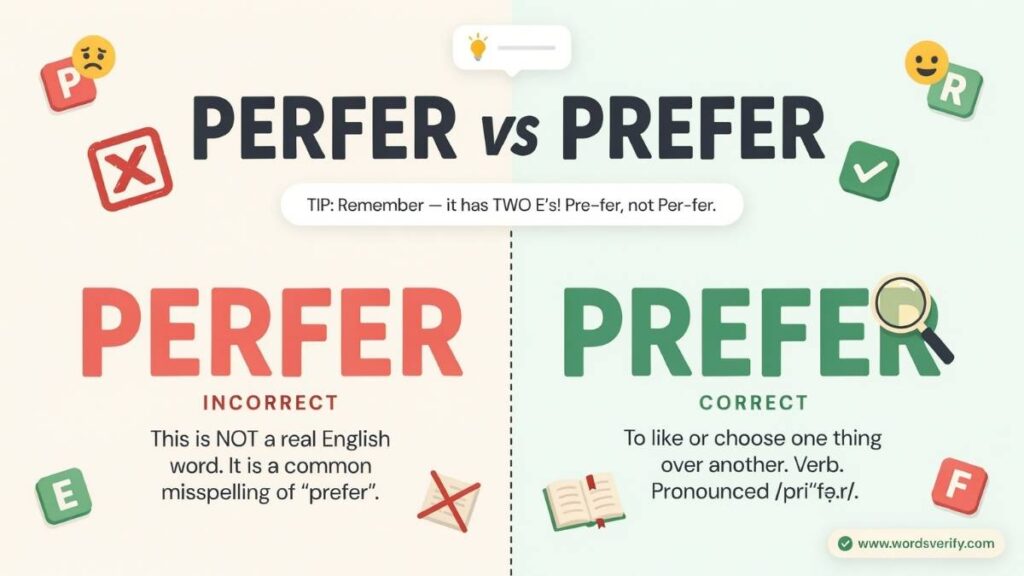
Have you ever written a word, looked at it twice, and suddenly questioned every letter? The perfer vs prefer confusion can cause exactly that. One tiny extra “r” turns a correct spelling into a common mistake, making this simple word surprisingly tricky. The answer, however, is straightforward: prefer is the correct spelling, while perfer is incorrect in standard English. But spelling is only part of the story. This guide will help you understand what prefer means, how to use it naturally, and which grammar mistakes to avoid. By the end, you’ll know how to spell and use prefer confidently without giving that troublesome “r” another chance to cause confusion.
Quick Answer
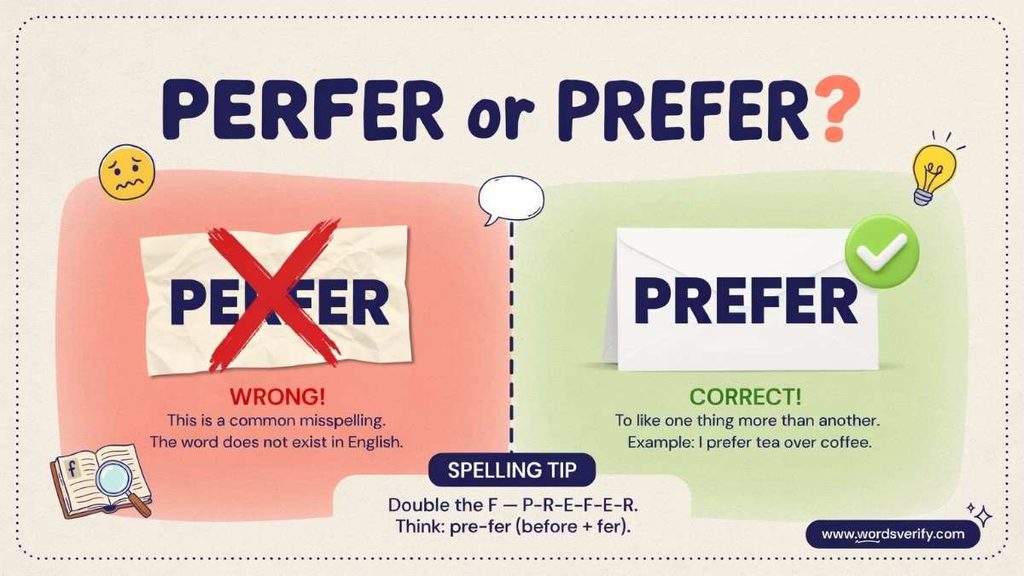
The correct spelling is prefer.
Prefer is a standard English verb meaning to like, choose, or favor one thing more than another.
For example:
I prefer tea to coffee.
She prefers working in the morning.
They prefer to travel by train.
Perfer is generally an incorrect spelling of “prefer” in modern standard English.
So, if you’re writing an email, essay, report, message, or school assignment, use prefer.
Learn the difference between tricky more English words
Worshiped vs Worshipped Which one Is Correct?
What Does “Prefer” Mean?
The verb prefer means that you like, want, or choose one person, thing, or option more than another.
It describes a personal choice or preference.
For example:
I prefer summer to winter.
He prefers cats to dogs.
We prefer quiet restaurants.
She prefers working from home.
In each sentence, the speaker is choosing one option over another.
You can think of “prefer” as a polite way of saying “like better.”
“I prefer tea to coffee” means essentially the same thing as “I like tea better than coffee.”
However, “prefer” is often more natural when you’re comparing two choices.
Is “Perfer” a Word?
If you mean the standard English verb that means “to like or choose one thing more than another,” the correct spelling is prefer, not “perfer.”
“Perfer” is a common spelling mistake.
You might see it in casual messages, social media posts, comments, or informal writing. Seeing a misspelling online doesn’t make it the standard spelling.
The easiest correction is simple:
Incorrect: I perfer tea.
Correct: I prefer tea.
Incorrect: She perfered the blue dress.
Correct: She preferred the blue dress.
Incorrect: He is prefering the first option.
Correct: He is preferring the first option.
The problem isn’t the meaning. Most readers can understand what “perfer” is supposed to mean. The problem is the spelling.
Is “Prefer” a Word?
Yes. Prefer is a standard English verb.
It has been part of English for centuries and is used in everyday conversation, formal writing, academic work, business communication, and many other settings.
Some common forms include:
- Present form: prefer
- Third-person singular: prefers
- Past tense: preferred
- Present participle: preferring
- Noun form: preference
- Adjective forms: preferred and preferable
Examples:
I prefer tea.
She prefers tea.
I preferred tea yesterday.
They are preferring the second option.
My preference is tea.
The preferred option is the first one.
Perfer vs Prefer What’s the Difference?
The difference is mainly spelling.
| Form | Correct? | Meaning |
|---|---|---|
| prefer | Yes | To like or choose one thing more than another |
| perfer | No, in standard modern English | Common misspelling of “prefer” |
| preferred | Yes | Past tense and past participle |
| prefered | No | Common misspelling of “preferred” |
| preferring | Yes | -ing form |
| prefering | No | Common misspelling of “preferring” |
The important word to remember is prefer.
Once you know that spelling, the other forms become easier to recognize.
Learn the difference between tricky more English words
Quiet vs Quite and which one is correct?
Why Do People Spell “Prefer” as “Perfer”?
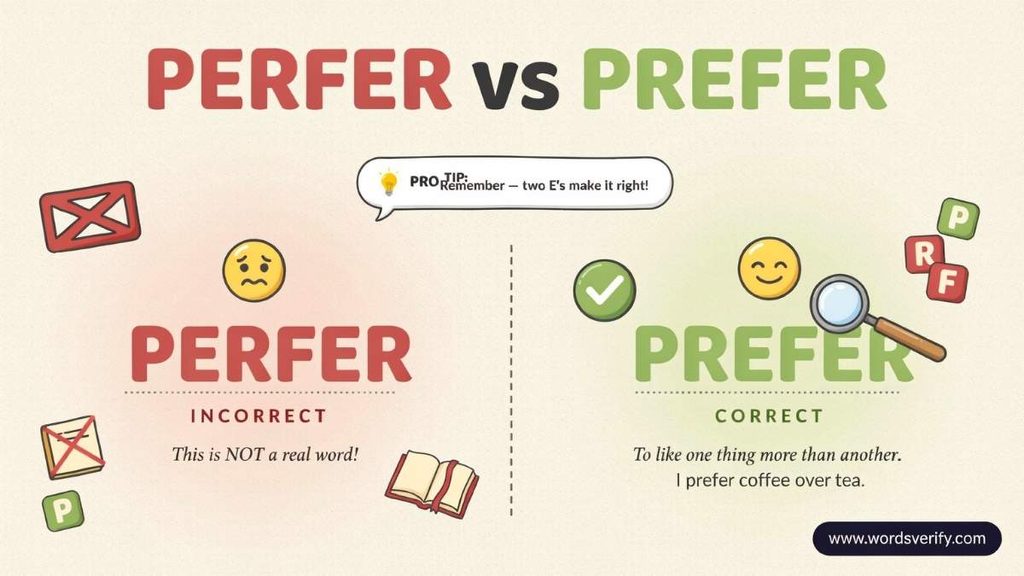
The confusion usually comes from perfer vs prefer pronunciation and spelling patterns.
When people say “prefer” quickly, the middle sounds can blend together. That can make the word feel as though it contains another “r.”
There’s also a spelling pattern behind the confusion. English has many words where an “r” appears before another consonant, so your brain may try to create a familiar-looking pattern.
For example:
perfer vs prefer
They look extremely similar.
The difference is only one letter, but that one letter changes the spelling from correct to incorrect.
A useful memory trick is to remember:
pre + fer = prefer
This is simply a memory aid, not a complete explanation of the word’s historical structure. Its purpose is to help you remember that “prefer” contains “fer,” not “rfer.”
How Do You Spell “Prefer” Correctly?
The spelling is:
P-R-E-F-E-R
Prefer.
Not:
P-E-R-F-E-R
The incorrect version inserts an extra “r” after “pe.”
Try saying the word slowly while writing it:
pre-fer
That can help you avoid writing “perfer.”
Learn the difference between tricky more English words
Weiner vs Wiener which one is correct?
How to Use “Prefer” in a Sentence
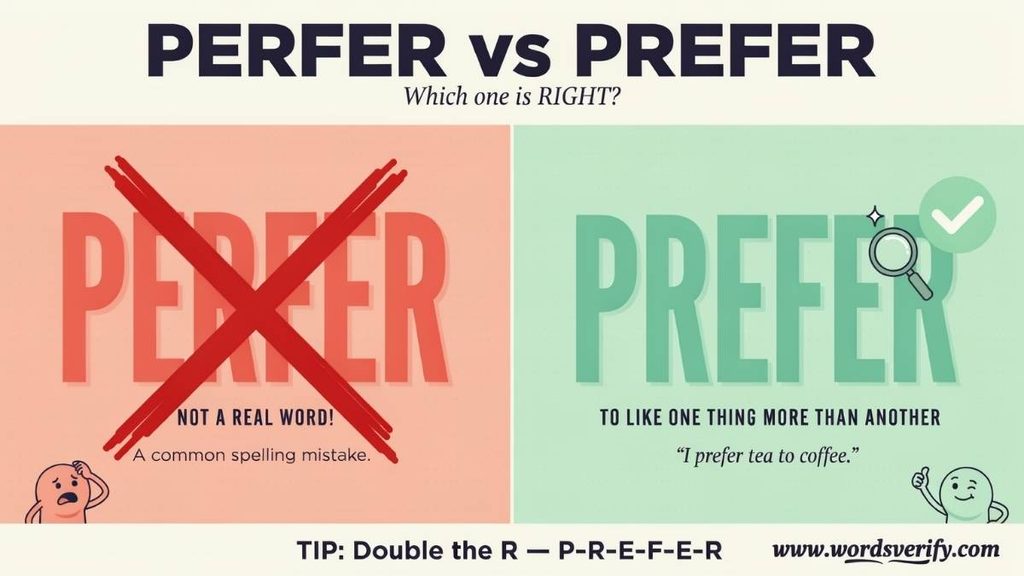
“Prefer” is a flexible verb, but some sentence patterns are more natural than others.
Prefer A to B
One of the most common structures is:
prefer A to B
Examples:
I prefer tea to coffee.
She prefers summer to winter.
They prefer trains to buses.
He prefers fiction to nonfiction.
We prefer the smaller apartment to the larger one.
Notice the word to.
A common learner mistake is to write “prefer A than B.”
For example:
Incorrect: I prefer tea than coffee.
Correct: I prefer tea to coffee.
This is one of the most useful patterns to remember.
Prefer + -ing
You can use “prefer” with a gerund when talking about activities.
Examples:
I prefer walking to driving.
She prefers reading to watching television.
They prefer cooking at home to eating out.
He prefers working alone to working in a large group.
The basic pattern is:
prefer + activity + to + activity
For example:
I prefer swimming to running.
This means that swimming is the activity you like more.
Prefer to + Verb
You can also use “prefer” followed by an infinitive.
Examples:
I prefer to walk.
She prefers to stay home.
We prefer to arrive early.
He prefers to study at night.
This structure is especially useful when you’re talking about what you choose to do.
For example:
I prefer to walk to work.
She prefers to study in the library.
They prefer to eat dinner early.
Prefer to Do Rather Than Do
When comparing two actions, you can use:
prefer to do X rather than do Y
Examples:
I prefer to walk rather than drive.
She prefers to read rather than watch television.
We prefer to stay home rather than go out.
He prefers to work alone rather than join a large team.
This structure makes the comparison clear.
You can also see sentences such as:
I prefer walking rather than driving.
However, “prefer walking to driving” is a particularly clean and traditional comparison pattern.
Would Prefer
“Would prefer” is useful when discussing a specific choice or situation.
For example:
I would prefer tea.
She would prefer to sit outside.
We would prefer to leave early.
They would prefer to meet tomorrow.
There’s an important difference between “prefer” and “would prefer.”
“I prefer tea” can describe a general preference.
“I would prefer tea” often describes what you want in a particular situation.
For example:
At restaurants, I prefer tea to coffee.
Right now, I would prefer tea.
The first sentence describes a general habit. The second expresses a choice in a particular situation.
Prefer To or Prefer Than?
This is a common grammar question.
When you use “prefer” to compare two things, the standard structure is:
prefer A to B
Correct:
I prefer tea to coffee.
She prefers dogs to cats.
They prefer buses to trains.
Not:
I prefer tea than coffee.
The word “than” is commonly associated with comparisons using words such as “better,” “more,” and “less.”
For example:
I like tea better than coffee.
But:
I prefer tea to coffee.
Both sentences express a similar idea, but they use different grammatical structures.
Prefer Over or Prefer To?
You may hear or see both structures in English.
For example:
I prefer tea to coffee.
I prefer tea over coffee.
“Prefer A to B” is the classic structure and is especially useful for learners who want a safe, standard pattern.
“Prefer over” also appears in modern English, particularly when people are emphasizing a choice between alternatives.
Examples:
She prefers working remotely over commuting.
He prefers quality over quantity.
They prefer simplicity over complexity.
If you’re unsure which structure to use, prefer A to B is an excellent pattern to remember.
Prefer vs Like
“Prefer” and “like” are related, but they aren’t exactly the same.
Like means that you enjoy or appreciate something.
Prefer means that you favor one option when comparing it with another.
Compare these:
I like coffee.
I prefer coffee to tea.
The first sentence simply tells us that you like coffee.
The second tells us that coffee is your favored choice when compared with tea.
You can also say:
I like both, but I prefer coffee.
That makes the comparison especially clear.
Prefer vs Choose
“choose and “Prefer” can sometimes appear in similar situations, but they describe different ideas.
Prefer focuses on what you like more.
Choose focuses on the decision you make.
For example:
I prefer tea to coffee.
This tells us about your preference.
I chose tea.
This tells us what you actually selected.
You might prefer one thing but choose another because of price, availability, convenience, or some other reason.
For example:
I prefer flying, but I chose the train because it was cheaper.
That distinction is useful because a preference doesn’t always determine the final decision.
Prefer vs Favor
“Favor” can be a synonym for “prefer,” especially when you’re talking about supporting or selecting one option over another.
For example:
She favors the second proposal.
She prefers the second proposal.
Both sentences can communicate a similar idea.
However, “favor” can have additional meanings. It can also refer to an act of kindness or support.
For example:
Could you do me a favor?
That meaning has nothing to do with choosing between two options.
Prefer vs Rather
“Rather” often appears in expressions such as:
1.I would rather stay home.
2.I would rather walk.
3.I would rather read than watch television.
“Prefer” can express a similar idea:
I prefer to stay home or I prefer walking to driving and I prefer reading to watching television.
One useful difference is that “would rather” often sounds natural when making a particular choice, while “prefer” works very well for general preferences.
Learn the difference between tricky more English words
Flaky vs Flakey Which one Is Correct?
Common Spelling Mistakes With “perfer vs prefer”
“Prefer” causes more spelling mistakes than you might expect.
Here are some of the most common ones.
Perfer
Incorrect: I perfer tea.
Correct: I prefer tea.
Prefered
Incorrect: She prefered the red one.
Correct: She preferred the red one.
The past tense doubles the “r” before adding “-ed.”
Prefering
Incorrect: He is prefering the first option.
Correct: He is preferring the first option.
The “r” is doubled before “-ing.”
She prefer
Incorrect: She prefer coffee.
Correct: She prefers coffee.
With he, she, or it in the present tense, use prefers.
Prefer Than
Incorrect: I prefer tea than coffee.
Correct: I prefer tea to coffee.
This is a grammar mistake rather than a spelling mistake, but it’s extremely common.
Learn the difference between tricky more English words
Web Site vs Website which one is correct?
The Word Forms of “Prefer”
Learning the related forms together can make the spelling easier perfer vs prefer.
| Word form | Example |
|---|---|
| prefer | I prefer tea. |
| prefers | She prefers tea. |
| preferred | He preferred tea yesterday. |
| preferring | They are preferring the quieter room. |
| preference | My preference is tea. |
| preferable | This option is preferable. |
| preferably | I’d preferably leave early. |
The most commonly used forms are “perfer vs prefer” “preferred,” and “preference.”
Preferred vs Prefered?
The correct spelling is preferred.
There are two “r” letters before “-ed.”
Correct:
preferred
Incorrect:
prefered
Examples:
She preferred the blue dress.
We preferred the earlier train.
He preferred the quieter room.
Why does the spelling double the “r”?
The final consonant is doubled when forming “preferred,” which gives us:
prefer → preferred
This is worth memorizing because “prefered” is a very common spelling error.
Preferring or Prefering?
The correct spelling is preferring.
Correct:
preferring
Incorrect:
prefering
Examples:
She is preferring the second option.
They are preferring smaller groups.
He is preferring the quieter location.
The spelling follows the same doubling pattern:
prefer → preferring
Remember the double “r.”
Learn the difference between tricky more English words
Ingrained vs Engrained which one is correct?
Prefer in American and British English
The spelling prefer is standard in both American and British English.
There is no American spelling “perfer” and British spelling “prefer.”
That means the difference isn’t about regional English.
Whether you’re writing for readers in the United States, the United Kingdom, Canada, Australia, or elsewhere, the standard spelling is:
prefer
For example:
American English: I prefer tea to coffee.
British English: I prefer tea to coffee.
The spelling stays the same.
How to Pronounce “Prefer”
“Prefer” is commonly pronounced approximately like:
prih-FUR
The stress usually falls on the second syllable.
The pronunciation can contribute to the spelling confusion because the sounds may run together in natural speech.
That’s another reason people sometimes write “perfer.”
When learning the word, it can help to separate it into two parts:
pre-fer
Then write it:
prefer
What Is the Noun Form of Prefer?
The noun form is preference.
A preference is a choice or liking for one thing over another.
Examples:
My preference is tea.
Everyone has different preferences.
Her preference is to work in the morning.
Do you have a preference?
The relationship is easy to remember:
prefer → preference
For example:
I prefer tea.
My preference is tea.
What Are Some Synonyms for “Prefer”?
Depending on the sentence, several words can express a similar idea.
Common alternatives include:
- Favor
- Choose
- Select
- Pick
- Like better
- Opt for
- Want
- Prioritize
However, these words aren’t always interchangeable.
For example, “choose” usually describes an actual decision, while “prefer” often describes a personal liking or general preference.
Compare:
I prefer the blue shirt.
I chose the blue shirt.
The first sentence describes your preference. The second tells us what you selected.
Learn the difference between tricky more English words
Weeped vs Wept and which one is correct?
Everyday Examples of “Prefer”
Here are some natural examples you might use in everyday English:
- I prefer tea to coffee.
- She prefers mornings to evenings.
- We prefer eating at home.
- He prefers to walk to work.
- They prefer small hotels.
- I prefer reading to watching movies.
- She prefers the blue one to the green one.
- Would you prefer tea or coffee?
- I would prefer to leave early.
- He prefers working alone.
- We prefer to travel by train.
- She prefers simple designs.
- I prefer cold weather to hot weather.
- They prefer online meetings.
- He prefers quality over quantity.
These examples show how naturally “prefer” can fit into ordinary conversation.
How to Remember “Prefer”
If you repeatedly write “perfer,” try a simple memory trick.
Think:
PRE + FER = PREFER
The word starts with “pre,” followed by “fer.”
You can also associate it with this sentence:
I prefer the correct spelling.
That gives you the correct spelling while reminding you what the word means.
Another useful trick is to connect the word with “preference.”
Prefer and preference share the same beginning:
prefer
preference
If you remember one, the other becomes easier.
Learn the difference between tricky more English words
Zeroes vs Zeros Which one is correct?
A Quick Correction Guide
| Incorrect | Correct |
|---|---|
| perfer | prefer |
| prefered | preferred |
| prefering | preferring |
| she prefer | she prefers |
| I prefer tea than coffee | I prefer tea to coffee |
| he perfer tea | he prefers tea |
| I perfered the first option | I preferred the first option |
Keep this table in mind when proofreading your writing.
Common Mistakes to Avoid
Before using “prefer,” check these points.
- Don’t write “perfer” when you mean “prefer.”
- Don’t write “prefered.” Use “preferred.”
- Don’t write “prefering.” Use “preferring.”
- Use “prefers” with he, she, and it in the present tense.
- Use “prefer A to B” when comparing two things.
- Use “prefer to + verb” when describing an action you favor.
- Use “would prefer to” for a specific choice or request.
- Don’t automatically replace “prefer” with “choose.” The two words emphasize different ideas.
Learn the difference between tricky more English words
Hanukkah vs Chanukah Which one Is Correct?
Practice Session Perfer vs Prefer
Choose the correct word or form of perfer vs prefer.
- I ______ tea to coffee.
- She ______ to work in the morning.
- They ______ walking to driving.
- He ______ the blue shirt to the red one.
- We ______ to stay home tonight.
- My sister ______ reading to watching television.
- I would ______ to sit near the window.
- She ______ the earlier appointment yesterday.
- The correct spelling is ______, not “perfer.”
- He ______ coffee every morning.
- I ______ to travel by train.
- They ______ quiet restaurants to crowded ones.
- She ______ working alone to working in a large group.
- We ______ the first option last week.
- The correct past tense of “prefer” is ______.
- The correct -ing form of “prefer” is ______.
- My personal ______ is tea.
- I prefer tea ______ coffee.
- He prefers ______ walk rather than drive.
- Would you ______ tea or coffee?
- She ______ the second proposal.
- I prefer ______ at home to eating out.
- “Prefered” is incorrect. The correct spelling is ______.
- “Prefering” is incorrect. The correct spelling is ______.
- I ______ simple designs to complicated ones.
Answers
- prefer
- prefers
- prefer
- prefers
- prefer
- prefers
- prefer
- preferred
- prefer
- prefers
- prefer
- prefer
- prefers
- preferred
- preferred
- preferring
- preference
- to
- to
- prefer
- prefers
- eating
- preferred
- preferring
- prefer
Here’s a trusted source for clear more words Comparison:
FAQs
What is the difference between “perfer” vs “prefer”?
“Prefer” is the correct spelling in standard English. “Perfer” is a common misspelling. Prefer means to like, favor, or choose one thing more than another.
What does “prefer” mean in simple words?
“Prefer” means to like one thing more than another. For example, “I prefer tea to coffee” means you like tea more than coffee.
What does “perfer” mean?
“Perfer” is generally a misspelling of “prefer.” If you want to express a choice or preference in standard English, use “prefer.”
How do you use “prefer” correctly?
You can use “prefer” to talk about general likes, choices, or comparisons. Common structures include “prefer A to B,” “prefer to do,” and “prefer doing to doing.”
What comes after “prefer”?
Several structures can follow “prefer.” You can use a noun, an -ing form, or an infinitive.
Examples:
1.I prefer tea.
2.I prefer walking to driving.
3.I prefer to walk.
Is “I prefer” a complete sentence?
“I prefer” can be grammatically correct, but it usually needs additional information to explain what you prefer.
For example:
I prefer tea.
I prefer to stay home.
In casual conversation, “I prefer” can sometimes stand alone when the context already makes the choice clear.
Is “I prefer tea to coffee” correct?
Yes. “I prefer tea to coffee” is a standard and natural way to compare two things.
The basic structure is:
prefer A to B
Is “I prefer tea over coffee” correct?
Yes, “prefer … over …” is used in modern English. However, “prefer A to B” is the traditional comparison pattern and is especially useful for learners.
Should you say “prefer to” or “prefer than”?
For a direct comparison, use prefer A to B, not “prefer A than B.”
Correct: I prefer tea to coffee.
Incorrect: I prefer tea than coffee.
Which is correct: “I prefer doing” or “I prefer to do”?
Both can be correct.
You can say:
I prefer walking.
I prefer to walk.
When comparing activities, “prefer doing A to doing B” is also natural:
I prefer walking to driving.
Which is correct: “I prefer to go” or “I prefer going”?
Both are grammatically correct.
“I prefer to go” uses the infinitive structure, while “I prefer going” uses the -ing form. The best choice depends on the sentence and context.
What does “I would prefer” mean?
“I would prefer” usually expresses a particular choice, request, or preference in a specific situation.
For example:
I would prefer to sit outside.
It often sounds slightly more polite or tentative than simply saying “I prefer.”
What is the difference between “I prefer” and “I would prefer”?
“I prefer” often describes a general preference, while “I would prefer” commonly describes what you want in a particular situation.
For example:
I prefer tea to coffee.
This describes a general preference.
I would prefer tea, please.
This expresses a choice in the current situation.
What is the verb form of “prefer”?
“Prefer” is already the base form of the verb.
Its main forms are:
- prefer
- prefers
- preferred
- preferring
For example:
I prefer tea.
She prefers tea.
He preferred tea yesterday.
They are preferring the quieter option.
What is the past tense of “prefer”?
The past tense is preferred.
Example:
She preferred the earlier appointment.
Remember that “prefered” is incorrect.
What is the correct -ing form of “prefer”?
The correct form is preferring, with two r’s.
Example:
She is preferring the quieter room.
“Prefering” is a common spelling mistake.
How do you pronounce “prefer”?
“Prefer” is commonly pronounced with the stress on the second syllable. The pronunciation can sometimes contribute to the spelling confusion because the sounds run together in natural speech.
What word goes with “prefer”?
The word that commonly follows “prefer” depends on the sentence structure. Common patterns include:
- prefer A to B
- prefer to + verb
- prefer + -ing
- would prefer to + verb
What is another way to say “I prefer”?
Depending on the context, you could say:
- I favor…
- I would rather…
- I like … better.
- I would choose…
- I would opt for…
These expressions aren’t always exact substitutes, so choose one that fits the meaning of your sentence.
What is a synonym for “prefer”?
Common synonyms include favor, choose, select, pick, opt for, and like better. The best synonym depends on whether you’re describing a preference or an actual decision.
Can you use “prefer” in a sentence?
Yes. Here are a few examples:
- I prefer tea to coffee.
- She prefers to work in the morning.
- We prefer walking to driving.
- He prefers quiet places.
- They would prefer to leave early.
Is “prefer” a word?
Yes. “Prefer” is a standard English verb. It means to like, favor, or choose one thing more than another.
What is the difference between “prefer” and “choose”?
“Prefer” describes what you like or favor more, while “choose” usually describes the decision you actually make.
For example:
I prefer the blue shirt.
I chose the blue shirt.
You can prefer one option but choose another for practical reasons.
What is the noun form of “prefer”?
The noun form is preference.
For example:
My preference is tea.
Everyone has different preferences.
What are the related forms of “prefer”?
The main related forms are:
- Prefer — base verb
- Prefers — third-person singular
- Preferred — past tense and past participle
- Preferring — -ing form
- Preference — noun
- Preferable — adjective
- Preferably — adverb
Is “prefer over” grammatically correct?
Yes. “Prefer over” appears in contemporary English, particularly when comparing alternatives.
For example:
She prefers quality over quantity.
However, “prefer A to B” remains a very useful and traditional structure for direct comparisons.
Learn the difference between tricky more English words
Creeped vs Crept Which One Is Correct?
Conclusion
The perfer vs prefer confusion may look like a tiny spelling issue, but that extra “r” can quickly turn a simple word into a grammar headache. The correct spelling is prefer, and once you remember it, the confusion becomes much easier to avoid.
Use prefer when you want to show that you like, favor, or choose one thing more than another. For comparisons, remember the useful pattern “prefer A to B,” as in “I prefer tea to coffee.” Also watch for common mistakes such as perfer vs prefer, and prefering.
English already has plenty of spelling surprises. There’s no reason to give that extra “r” a permanent seat at the table. Stick with prefer, and your writing will stay clear, correct, and confident.

Lisa AJS is an experienced blogger and language enthusiast at Words Verify, dedicated to making grammar simple, practical, and enjoyable. She writes engaging content on commonly confused words, grammar mistakes, word meanings, and everyday language challenges.