
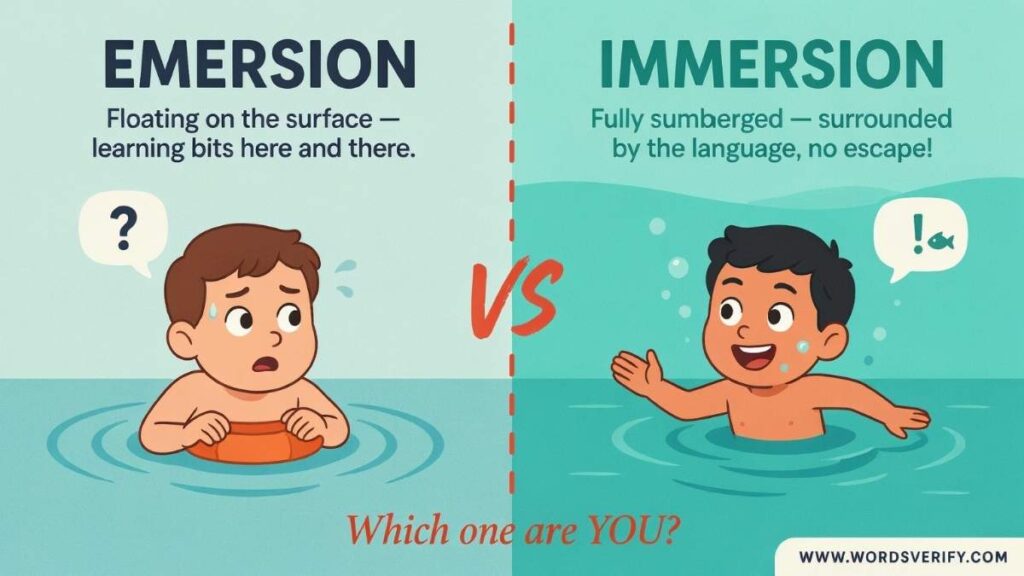
Have you ever looked at emersion vs immersion and wondered if one tiny letter could really cause so much confusion? It can! The emersion vs immersion mix-up is easy to make because these words look almost identical, yet their meanings move in opposite directions. Immersion usually means going into something, being surrounded by it, or becoming deeply involved. Emersion, however, describes coming out, becoming exposed, or reappearing after being hidden. Mixing them up can make an otherwise clear sentence sound rather strange. Fortunately, once you understand what each word means and where it belongs, this tricky grammar mistake becomes much easier to avoid.
Quick Answer
Immersion means entering something, being surrounded by something, or becoming deeply involved in an experience.
Emersion means coming out of something, becoming exposed, or reappearing after being hidden.
For example:
- A swimmer goes into the water and experiences immersion.
- When the swimmer comes back out, that movement can be described as emersion.
- A student who learns French through constant exposure is participating in language immersion.
- When a star becomes visible again after being hidden during an astronomical event, its return is called emersion.
Both words are correct. The key is using the right one for the situation.
What Does Immersion Mean?
Immersion has both a literal and a figurative meaning.
In its literal sense, immersion means putting something into a liquid or becoming completely covered by it. If you place an object under water, you immerse it. If your entire body goes beneath the surface, you’ve experienced physical immersion.
For example:
The equipment remained under water during the immersion process.
The word also has a much broader meaning. You can become immersed in an activity without going anywhere near a swimming pool.
You might become immersed in a novel, research project, conversation, video game, hobby, or work assignment. In these situations, immersion means becoming so involved that the activity captures most of your attention.
For example:
She became so immersed in the mystery novel that she lost track of time.
No water is involved here. The word describes intense involvement and concentration.
What Does Emersion Mean?
Emersion has a much narrower role in everyday English.
It describes coming out of something, becoming exposed after being covered, or becoming visible again after being hidden.
Imagine a marine animal resting underwater. When the tide recedes and the animal or surrounding surface becomes exposed to air, that change can be described as emersion in a scientific context.
Emersion also has an important use in astronomy. When one celestial body temporarily blocks another from an observer’s view, the hidden object eventually becomes visible again. That return to visibility is called emersion.
So while immersion often describes entering or becoming covered, emersion describes the movement or change that takes place when something comes out or becomes exposed.
Learn the difference between tricky more English words
Conex vs Connex which one is correct?
The Main Difference Between Emersion vs Immersion
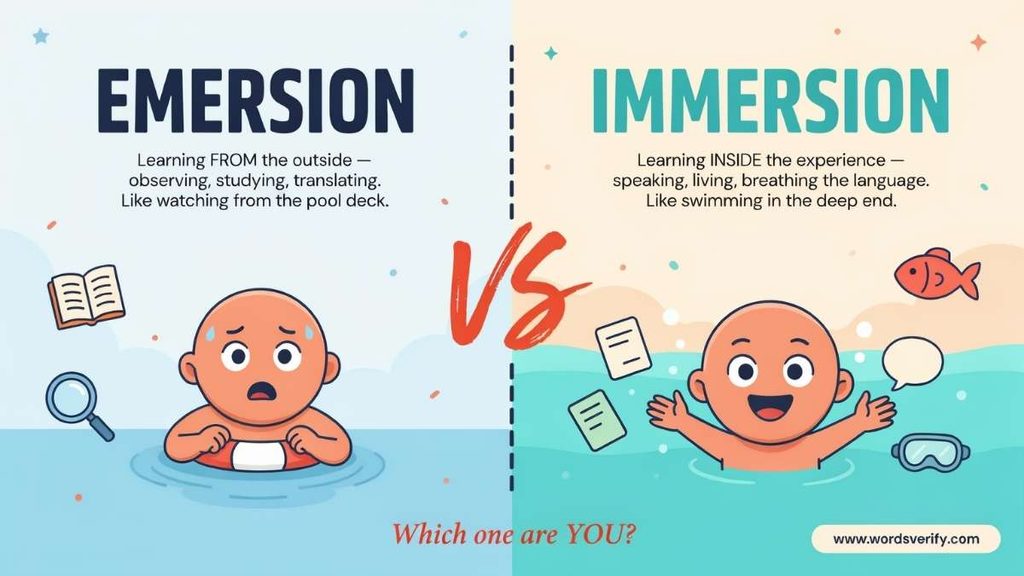
The clearest difference comes down to direction.
Immersion describes movement into something or a state of being surrounded by something.
Emersion describes movement out of something or a return to visibility.
Picture someone stepping into a swimming pool.
When the person enters the water, that’s immersion.
When the person climbs out, that’s emersion.
This simple image makes the difference easier to remember. However, there’s an important detail: immersion has many figurative meanings that emersion doesn’t share.
You can be immersed in a book, language, culture, project, or hobby. You wouldn’t normally use emersion for those situations.
Immersion in Water
The physical meaning of immersion is one of the easiest places to start.
When something goes beneath the surface of a liquid, it becomes immersed.
For example:
- The diver was fully immersed in the water.
- The technician immersed the sample in a solution.
- The instructions require complete immersion for several minutes.
- The swimmer practiced controlled immersion in cold water.
The related verb is immerse.
For example:
The researcher immersed the specimen in water.
The noun is immersion:
The immersion lasted for five minutes.
This physical meaning forms the foundation for many of the word’s other uses.
Immersion as Deep Involvement
Immersion doesn’t always involve physical movement.
It can also describe complete mental involvement.
When you’re deeply absorbed in an activity, you’re immersed in it. A person can become immersed in reading, music, research, gaming, writing, or work.
For example:
After starting the novel, he became so immersed in the story that he didn’t notice the time.
Here, immersion describes a mental state rather than a physical one.
The person isn’t literally inside the story. Instead, their attention is so focused on it that everything else becomes less important.
That’s why expressions such as complete immersion, deep immersion, and immersion in a task sound natural.
Language Immersion
Language immersion is one of the most familiar uses of the word.
A language immersion program gives learners extensive exposure to the language they’re trying to learn. Instead of hearing the language only during a short lesson, students may hear, speak, read, and write it throughout much of the day.
For example:
The school offers a Spanish immersion program for elementary students.
The students aren’t being physically submerged in Spanish. They’re surrounded by the language through regular use.
That’s why language immersion is correct while language emersion isn’t.
The same idea appears in expressions such as:
- Language immersion program
- Immersion learning
- Immersion classroom
- Immersion education
- Immersion in a foreign language
The central idea remains the same: sustained exposure and active involvement.
Cultural Immersion
Cultural immersion means becoming deeply involved in another culture.
Simply visiting another country doesn’t necessarily create cultural immersion. A tourist might spend a week visiting famous landmarks without becoming deeply involved in everyday local life.
Cultural immersion goes further.
Someone might live with a local family, learn the language, eat local food, participate in community activities, follow local customs, and experience ordinary life from a closer perspective.
For example:
Living with a host family gave the students a meaningful cultural immersion experience.
The word immersion works because the people are becoming deeply involved in a new environment.
Learn the difference between tricky more English words
Spoiled vs Spoilt Which One Is Correct?
Immersion in Education
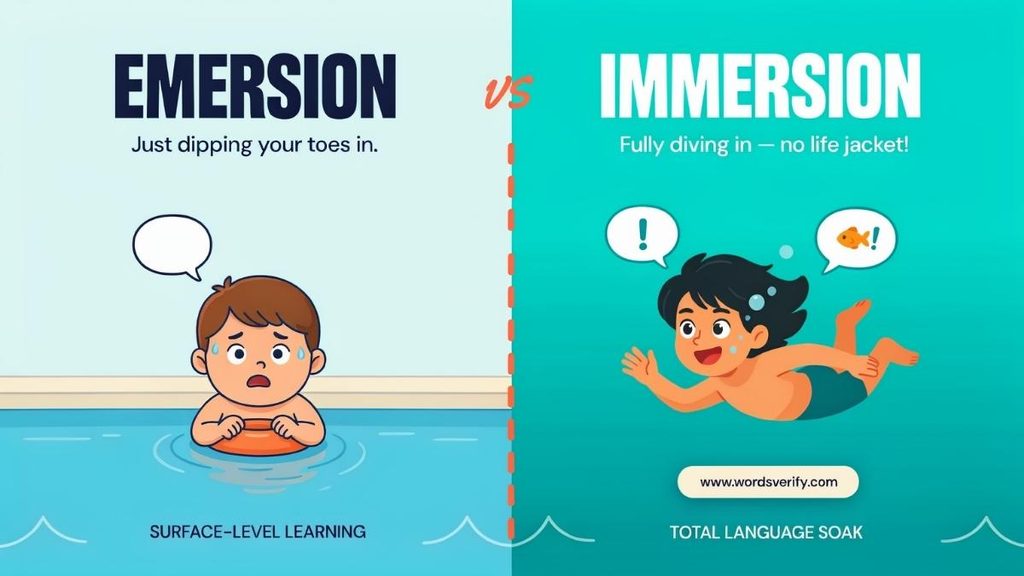
Education often uses immersion to describe learning through sustained involvement.
Language programs provide the clearest example, but the concept can extend to other learning environments as well.
A student might spend an extended period working directly with a subject instead of studying it only through short lessons or isolated exercises.
An immersive educational experience may include:
- Hands-on activities
- Real-world projects
- Simulated environments
- Extensive language practice
- Collaborative learning
- Experiential activities
The common thread is active participation.
Instead of simply standing outside the subject and observing it, the learner becomes part of the learning environment.
Immersion in the Workplace
The same idea applies to professional life.
A new employee might spend their first few weeks learning the company’s systems, procedures, customers, and workplace culture.
That experience could be described as an immersion in the workplace.
For example:
The training program gives new employees an intensive immersion in the company’s operations.
Here, immersion means deep exposure and involvement.
You can also become immersed in a specific project:
Once the project began, the team became fully immersed in the work.
That sentence sounds natural because immersion can describe intense concentration and involvement.
Immersion in Technology and Entertainment
Modern technology has given immersion another popular use.
People often talk about immersive games, immersive films, immersive theater, and immersive virtual reality.
An immersive experience makes you feel deeply involved in what you’re seeing, hearing, or doing.
Virtual reality is an obvious example. A headset can create a simulated environment that surrounds the user’s vision and sound. The stronger the feeling of being inside that environment, the more immersive the experience may feel.
The word isn’t limited to technology, though.
A good novel can create an immersive world.
A film can create an immersive atmosphere.
A museum exhibit can create an immersive experience.
The physical surroundings don’t have to disappear. The important idea is strong involvement and attention.
Learn the difference between tricky more English words
Perfer vs Prefer which one is correct?
What Does Emersion Mean in Science?
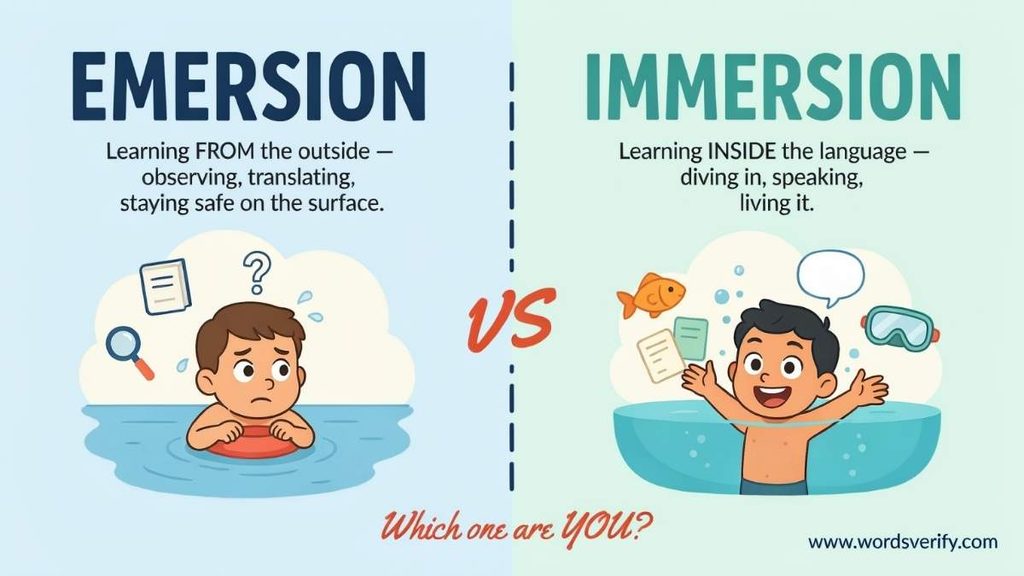
Emersion appears much more often in specialized scientific language than in casual conversation.
Marine science provides a useful example.
Intertidal environments regularly move between being covered by seawater and being exposed to air.
When the tide rises and water covers an area, immersion occurs.
When the tide falls and that area becomes exposed, emersion occurs.
This difference matters because organisms living in intertidal environments must cope with very different conditions during these periods.
During immersion, they may remain covered by water.
During emersion, they may face exposure to air, temperature changes, evaporation, and other environmental stresses.
In this context, the distinction isn’t simply about choosing between two similar words. The terms describe different environmental conditions.
Emersion in Astronomy
Astronomy provides one of the clearest technical examples of the difference.
Suppose a star appears to pass behind another celestial body from an observer’s point of view.
The star disappears from view.
That disappearance is called immersion.
Later, the star becomes visible again.
That reappearance is called emersion.
The two terms therefore describe opposite points in the same observational event.
You can think of the sequence this way:
- The celestial object is visible.
- Another object moves in front of it.
- The object disappears from view.
- The obstruction moves away.
- The object becomes visible again.
The disappearance is immersion, while the return to view is emersion.
This specialized use explains why emersion is a legitimate word even though you rarely hear it in ordinary conversation.
Learn the difference between tricky more English words
Quiet vs Quite and which one is correct?
Emersion and Emergence Are Not the Same
Another source of confusion is the word emergence.
Emersion and emergence look similar, and their meanings can overlap in certain situations. However, they aren’t interchangeable in ordinary English.
Emergence usually describes something appearing, developing, or becoming noticeable.
For example:
The emergence of new technology has changed the workplace.
You wouldn’t normally replace emergence with emersion in that sentence.
Emersion has a more specific sense involving coming out, becoming exposed, or reappearing.
Compare these examples:
- The emergence of a new trend surprised researchers.
- The diver’s emersion brought him back to the surface.
- The star’s emersion occurred after the occultation.
The first sentence describes something developing or becoming visible.
The second describes coming out of water.
The third describes astronomical reappearance.
The words may look similar, but context determines which one belongs.
Immersion vs Submersion
Immersion and submersion are closely related, but they aren’t always interchangeable.
Submersion specifically emphasizes being beneath the surface of a liquid or being covered by it.
Immersion can describe that physical state, but it also has many figurative meanings.
For example:
The equipment survived complete submersion in water.
That sentence focuses on the equipment being under water.
Now compare:
She experienced complete immersion in Japanese culture.
No liquid appears in the second sentence.
This gives you a useful distinction:
- Submersion is mainly physical.
- Immersion can be physical or figurative.
- Immersion is common in education, culture, work, entertainment, and language learning.
- Submersion generally doesn’t carry those broader meanings.
Emersion vs Immersion in Psychology
The word immersion also appears in psychology and related fields when researchers discuss deep involvement, absorption, attention, or engagement.
Someone might become psychologically immersed in a story, game, activity, or simulated environment.
However, the phrase immersion-emersion stage has a more specific history.
It appears in discussions of racial identity development associated with William E. Cross Jr.’s work on Nigrescence theory. In that specialized context, Immersion-Emersion refers to a particular stage within a theoretical model.
It shouldn’t be treated as a general rule about the ordinary meanings of Emersion vs Immersion.
That distinction matters because the same words can have a specialized meaning within a particular theory.
When discussing psychology, always consider the larger framework rather than assuming that emersion simply means the opposite of immersion in every situation.
Learn the difference between tricky more English words
Weiner vs Wiener which one is correct?
Common Mistakes With Emersion vs Immersion
These words lead to several predictable mistakes.
Using emersion for language learning
Incorrect:
The school offers an English emersion program.
Correct:
The school offers an English immersion program.
Language learning uses immersion because students become deeply surrounded by the language.
Using emersion for deep concentration
Incorrect:
She was in complete emersion while reading the book.
Correct:
She was completely immersed in the book.
The figurative meaning belongs to immersion.
Using emersion instead of emergence
Incorrect:
The emersion of social media changed communication.
Better:
The emergence of social media changed communication.
Emergence is the normal choice for something appearing, developing, or becoming prominent.
Assuming emersion is always the direct opposite of immersion
The relationship works well in certain literal and technical contexts.
It doesn’t mean every figurative use of immersion has an opposite called emersion.
You can be immersed in a novel, for example, but you wouldn’t normally describe finishing the novel as “emersion.”
English doesn’t always create perfectly symmetrical word pairs.
Learn the difference between tricky more English words
Flaky vs Flakey Which one Is Correct?
Emersion vs Immersion Examples
Here are some straightforward examples that make the difference easier to see.
Examples of immersion
- The diver experienced complete immersion in the cold water.
- The students joined a French immersion program.
- She became immersed in the book.
- The researchers studied immersion in the aquatic environment.
- The company created an immersive training experience.
- He spent the weekend immersed in his new hobby.
- The virtual reality game provided an intense sense of immersion.
Examples of emersion
- The marine organisms experienced emersion as the tide receded.
- The researcher recorded the animal’s emersion from the water.
- The star’s emersion was observed after the occultation.
- The study examined repeated cycles of immersion and emersion.
- The celestial body’s emersion marked its return to view.
The pattern is clear. Immersion has a broad range of everyday uses, while emersion usually appears when the context specifically involves coming out, exposure, or reappearance.
Learn the difference between tricky more English words
Web Site vs Website which one is correct?
Emersion vs Immersion in a Sentence
If you’re unsure how to use each word naturally, these examples can help.
Immersion
The students improved their French through daily immersion in the language.
He became so immersed in his work that he forgot to check the time.
The instructions require complete immersion of the equipment in water.
Emersion
The organism experienced emersion when the tide moved away from the shore.
Astronomers recorded the star’s emersion after the occultation.
The researchers measured the effects of repeated Emersion vs Immersion.
Notice the pattern. Immersion fits comfortably into everyday English, while emersion usually needs a specific physical or scientific context.
How to Choose the Right Word
When you’re stuck between emersion vs immersion, don’t rely only on the spelling. Think about what is actually happening.
Step 1: Is something going into something?
Use immersion.
A person enters water.
An object goes into a liquid.
A learner enters a language-rich environment.
A reader becomes deeply involved in a story.
Step 2: Is something coming out?
Emersion may be appropriate.
An organism becomes exposed as water retreats.
A submerged object rises out of the water.
A celestial body becomes visible after being hidden.
Step 3: Is something simply appearing or developing?
Use emergence.
A new technology appears.
A new trend develops.
A problem becomes noticeable.
A new field begins to grow.
Step 4: Consider the context
If you’re writing about education, language, culture, work, books, games, or everyday experiences, immersion will usually be the natural choice.
If you’re writing about astronomy, marine science, or another technical subject, emersion may be the more precise term.
A Simple Memory Trick
Here’s an easy way to keep the words straight:
Immersion = in.
Emersion = emerge.
Picture someone jumping into a pool.
Going in means immersion.
Coming back out means emersion.
Now imagine a star disappearing behind another celestial object.
Its disappearance is associated with immersion.
Its return to view is emersion.
The trick works because it connects each word with the basic direction of movement.
Learn the difference between tricky more English words
Ingrained vs Engrained which one is correct?
Emersion vs Immersion Quick Comparison
| Feature | Immersion | Emersion |
|---|---|---|
| Basic idea | Going in or becoming surrounded | Coming out or becoming exposed |
| Everyday use | Very common | Relatively rare |
| Water | Yes | Yes |
| Deep involvement | Yes | No, not normally |
| Language learning | Yes | No |
| Cultural experiences | Yes | No |
| Workplace | Yes | Rare |
| Virtual reality | Yes | No |
| Marine science | Yes | Yes |
| Astronomy | Yes | Yes |
| General appearance | No | Not usually; use emergence |
| Common word | Yes | No |
Learn the difference between tricky more English words
Weeped vs Wept and which one is correct?
Practice Session Emersion vs Immersion
Choose the correct word to complete each sentence: Emersion vs Immersion
- The students improved their Spanish through complete ________ in the language.
- The diver experienced full ________ when she went beneath the surface.
- The star’s ________ was observed after it disappeared behind another celestial body.
- The ________ of the new technology changed how people communicate.
- The company offers an ________ training experience for new employees.
- The researchers studied the effects of repeated ________ and emersion on marine organisms.
- He became so deeply ________ in the novel that he forgot about dinner.
- As the tide receded, the organisms experienced ________ from the water.
- The school introduced a French language ________ program.
- The telescope captured the celestial body’s ________ after the occultation.
- The ________ of a new species attracted the attention of scientists.
- The swimmer’s ________ lasted several minutes before she returned to the surface.
- Living with a local family gave the students a valuable cultural ________ experience.
- The researchers recorded the animal’s ________ as the shoreline became exposed.
- She was completely ________ in her research project.
- The ________ of the trend was gradual rather than sudden.
- The virtual reality game created a highly ________ experience.
- The study examined the relationship between tidal immersion and ________.
- The diver slowly emerged from the water after complete ________.
- The ________ of the previously hidden star marked its return to view.
- The teacher used hands-on activities to create greater student ________ in the subject.
- The ________ of the problem became obvious after further investigation.
- The equipment was designed to withstand prolonged ________ in water.
- The marine animals must survive both immersion and ________ as the tide changes.
- She became so ________ in the documentary that she didn’t notice her phone ringing.
Answers
- immersion
- immersion
- emersion
- emergence
- immersive
- immersion
- immersed
- emersion
- immersion
- emersion
- emergence
- immersion
- immersion
- emersion
- immersed
- emergence
- immersive
- emersion
- immersion
- emersion
- immersion
- emergence
- immersion
- emersion
- immersed
Here’s a trusted source for clear more words Comparison:
FAQs
Is emersion the opposite of immersion?
In some literal and technical contexts, yes. Immersion describes entering or becoming covered by something, while emersion describes coming out, becoming exposed, or reappearing. However, emersion isn’t the opposite of every figurative use of immersion.
Is emersion a real English word?
Yes. Emersion is a legitimate English word, although it is much less common than immersion. It appears especially in scientific contexts such as astronomy and marine science.
When should you use emersion instead of immersion?
Use emersion when something comes out of a covered or submerged state or becomes visible again. For example, a celestial body’s return to view after an occultation can be called emersion.
Is emersion commonly used in everyday English?
No. Emersion is relatively rare in everyday conversation. Most people encounter it in technical or scientific writing. Immersion is much more common and has many everyday uses.
What is emersion in astronomy?
In astronomy, emersion refers to the reappearance of a celestial body after it has been hidden by another object during an occultation or similar event.
What is immersion in astronomy?
In astronomy, immersion can refer to the disappearance of a celestial body from view when another object begins to block it during an occultation.
What is the difference between immersion and emergence?
Immersion involves entering, being covered, or becoming deeply involved. Emergence generally means appearing, developing, or becoming noticeable. Emersion is more specifically associated with coming out or becoming visible again.
Can immersion describe a mental state?
Yes. Immersion can describe becoming completely absorbed in an activity, story, task, game, or experience. For example, someone can become deeply immersed in a novel.
Can emersion be used for coming out of water?
Yes. Emersion can describe becoming exposed after being submerged or covered by water, particularly in scientific or technical contexts.
Is “language emersion” correct?
No. The standard expression is “language immersion.” It describes learning a language through extensive exposure and regular use.
Why is immersion more common than emersion?
Immersion has developed many everyday and figurative uses. People commonly talk about immersion in language, culture, education, work, books, games, and virtual reality. Emersion has a narrower meaning and is often limited to technical contexts.
Can immersion be used figuratively?
Yes. This is one of its most common uses. You can be immersed in your work, a hobby, a book, a conversation, or a new culture without any water being involved.
What is the difference between immerse and submerge?
Immerse means to put something into a liquid or become deeply involved in something. Submerge specifically emphasizes putting something completely beneath the surface of a liquid or covering it with water.
What is the difference between emersion and resurfacing?
Both can describe something coming back to the surface, but resurfacing is much more common in everyday English. Emersion is a more specialized term and is often used in scientific contexts.
Can you use emersion for becoming interested in something?
Generally, no. Use immersion when you mean becoming deeply involved or absorbed in an activity. For example, “She became immersed in painting” sounds natural, while “She became emersed in painting” does not.
Is “immersive” related to immersion?
Yes. Immersive is the adjective form associated with immersion. It describes something that makes you feel deeply involved or surrounded by an experience, such as an immersive game or immersive learning environment.
What is an immersive experience?
An immersive experience is one that captures your attention and makes you feel deeply involved in what you’re seeing, hearing, learning, or doing. Virtual reality is a common example.
Can immersion refer to culture?
Yes. Cultural immersion describes becoming deeply involved in another culture through experiences such as living with local people, learning the language, participating in traditions, and experiencing everyday life.
Is “emersion” the same as “emergence”?
No. Although the words look and sound similar, they have different uses. Emersion refers to coming out, becoming exposed, or reappearing, while emergence generally refers to appearing, developing, or becoming known.
What is the easiest way to remember Emersion vs Immersion
Think of “immersion” as going in and “emersion” as coming out. If something becomes deeply involved or surrounded, immersion is usually the right choice. If something reappears after being hidden, emersion may be appropriate.
Learn the difference between tricky more English words
Zeroes vs Zeros Which one is correct?
Conclusion
Emersion vs immersion may look like linguistic twins, but they don’t mean the same thing. Immersion usually means going into something, being surrounded by it, or becoming deeply involved. Emersion, by contrast, refers to coming out, becoming exposed, or reappearing after being hidden. When something simply appears, develops, or becomes noticeable, emergence is usually the better choice.
The easiest way to remember the difference is to think of “immersion” as going in and “emersion” as coming out. Once you connect each word with its meaning and context, the confusion becomes much easier to avoid. So the next time these tricky look-alikes show up, you’ll know exactly which one belongs.

Lisa AJS is an experienced blogger and language enthusiast at Words Verify, dedicated to making grammar simple, practical, and enjoyable. She writes engaging content on commonly confused words, grammar mistakes, word meanings, and everyday language challenges.