
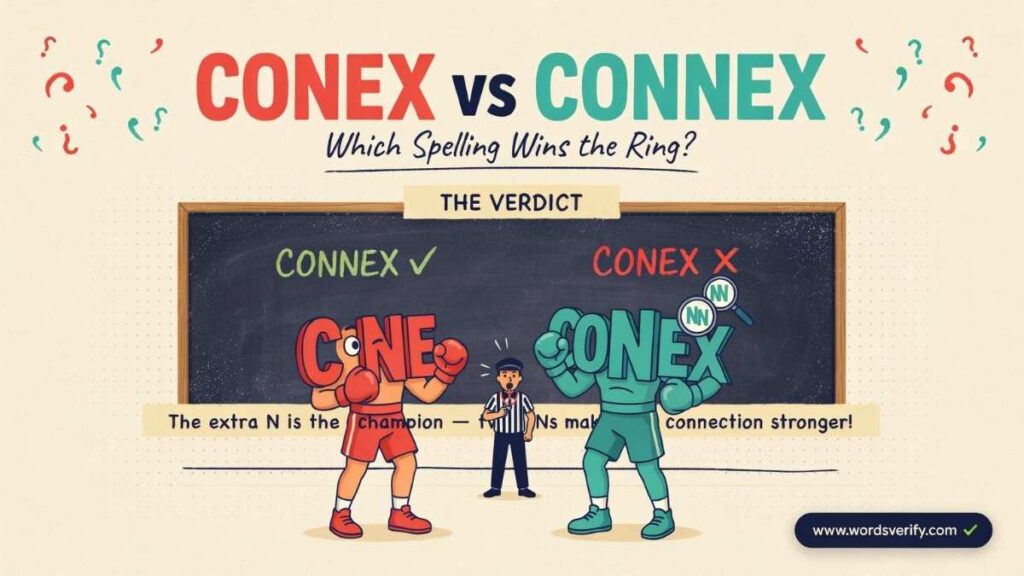
Have you ever typed “conex” and then wondered, “Wait, should there be another n?” Welcome to the surprisingly tricky world of conex vs connex. This small spelling difference can cause plenty of confusion, especially when both forms appear in discussions about shipping and storage containers. But don’t worry—there’s no need to wrestle with the keyboard. This guide breaks down the difference between conex vs connex in simple terms. You’ll discover their meanings, origins, spelling, pronunciation, common uses, and how they relate to shipping containers. By the end, you’ll know which form fits your sentence and why that extra “n” sometimes shows up.
Quick Answer
Conex vs connex generally refer to the same thing:
A strong, reusable steel container designed for shipping, storage, and transporting cargo. “Conex” is the more common spelling today, while “connex” is a recognized variant. The term “CONEX” originated from “Container Express,” the name used for a U.S. military container system. So, which spelling is correct? Both can be correct depending on the context. The difference is mainly in spelling and usage, not in the container’s basic purpose, design, or function.
Understand confusing English more words simply
Hanukkah vs Chanukah Which one Is Correct?
What Does Conex Mean?
The word “conex” comes from “Container Express,” a term associated with the U.S. military’s early containerization efforts.
The basic idea was simple but powerful. Instead of moving individual boxes, crates, and supplies separately, the military could pack materials into reusable steel containers and move the entire container from one location to another.
That approach reduced repeated handling and made military logistics more efficient.
The U.S. military used CONEX containers extensively during the Korean War era. The system became an important part of the development of military containerization.
Today, however, the word has a broader everyday meaning. Someone working in construction may call a steel storage container a “conex” even when there is no connection to military operations.
That broader use is why you’ll see the word in conversations about construction sites, storage yards, farms, warehouses, and shipping.
Conex Definition in Simple Terms
A practical definition of “conex” is:
A large steel container used for transporting, storing, or protecting cargo and equipment.
In historical writing, however, the term can refer specifically to the military Container Express system.
That distinction is important because modern shipping containers developed into a much broader international system.
What Is a Conex Box?
A conex box is a large steel container designed to hold cargo or other materials.
Depending on the situation, people may use one for:
- Construction equipment
- Building supplies
- Tools
- Machinery
- Agricultural equipment
- Inventory
- Household storage
- Temporary workspaces
- Freight transportation
- Long-term outdoor storage
The phrase “conex box” doesn’t tell you the exact size or condition of the container.
For example, one conex box might be 20 feet long while another might be 40 feet long. One might be suitable for international freight while another might have spent years sitting at a construction site.
That’s why the name alone isn’t enough when you’re buying one.
Understand confusing English more words simply
Spoiled vs Spoilt Which One Is Correct?
What Does Connex Mean?

“Connex” is another spelling used for a large metal cargo container.
In the container sense, it can refer to the same general type of object as “conex.”
The extra “n” doesn’t create a new class of container.
This is one of those spelling differences that looks more important than it actually is. When someone says “connex,” you can usually understand what they mean from the context.
The situation changes if “Connex” forms part of an official company, product, organization, or service name. In that case, the official spelling should stay exactly as it appears.
Conex vs Connex
Both spellings can appear in real English, but they have different backgrounds.
“CONEX” has the strongest historical connection to “Container Express.” That’s the spelling to use when you’re specifically discussing the original military term.
“Conex” is also common as a modern lowercase noun.
“Connex” is an established variant spelling in container-related usage.
So, if you’re wondering whether “conex” is correct, yes, it is.
If you’re wondering whether “connex” is correct, it can be correct as well when used as the container noun or as part of an official name.
The important thing is not to assume that the spelling tells you what kind of container you’re looking at.
Conex vs Connex The Main Difference
The biggest difference is spelling and historical context.
| Feature | Conex | Connex |
|---|---|---|
| Number of “n” letters | One | Two |
| Historical connection | Container Express | Variant spelling |
| Container meaning | Large cargo or storage container | Large cargo container |
| Different container size? | No | No |
| Different construction? | No | No |
| Different capacity? | No | No |
| Historical military usage | Strong | Less precise |
| Can be a proper name? | Yes, depending on context | Yes, depending on context |
In other words, the difference isn’t normally physical.
A seller could describe a container as a “conex” while another seller calls a similar container a “connex.” You still need to check the actual specifications.
Understand confusing English more words simply
Perfer vs Prefer which one is correct?
Why Do People Confuse Conex vs Connex?

The confusion makes sense once you hear the words aloud.
They generally sound the same in ordinary conversation. When someone says the word, you can’t see whether they’ve written one “n” or two.
That creates a spelling problem rather than a pronunciation problem.
Several things make the confusion even more common.
The Words Sound Alike
The pronunciation usually doesn’t help you decide which spelling to use.
If you hear someone say the word on a construction site, in a warehouse, or during a conversation about storage, you have to rely on context or ask how they spell it.
English Spelling Isn’t Always Predictable
English contains plenty of words whose spelling can’t be reliably guessed from pronunciation.
“Conex” and “connex” are a good example. Both spellings can represent essentially the same spoken word in the container context.
Online Listings Use Both Forms
Search through container listings and you’ll likely encounter both spellings.
One seller might advertise a “20-foot conex container.”
Another might call a similar product a “20-foot connex container.”
That doesn’t necessarily mean the products differ.
It may simply reflect the seller’s preferred spelling.
Informal Industry Language Spreads Quickly
Construction and storage industries often rely on practical shorthand.
Workers may say “conex” because everyone around them understands what they mean.
Over time, that informal term becomes normal everyday language.
Understand confusing English more words simply
Quiet vs Quite and which one is correct?
Conex vs Shipping Container
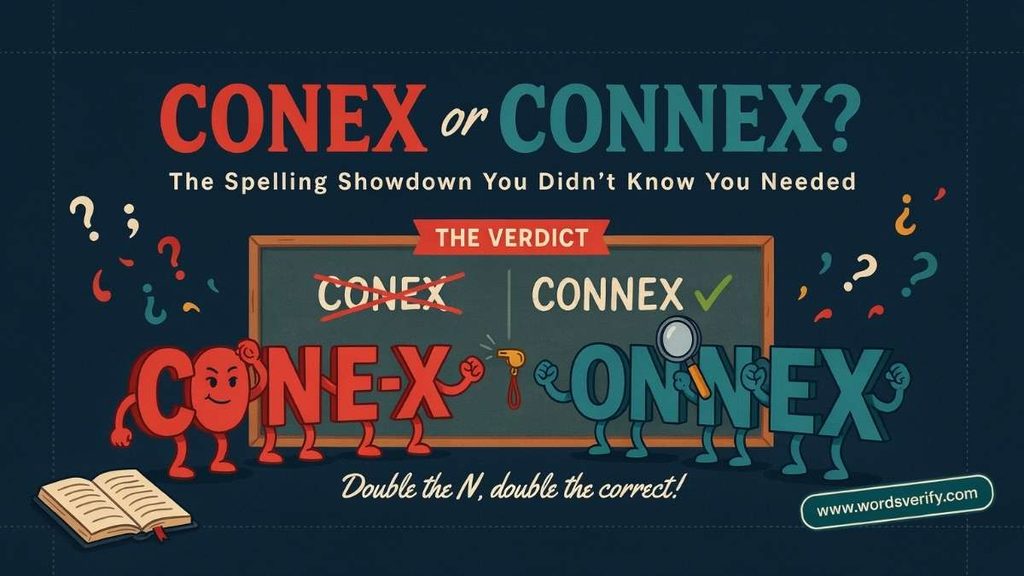
The relationship between “conex” and “shipping container” deserves special attention.
A modern shipping container is a standardized freight container designed for transportation through different modes such as ships, trains, and trucks.
A conex may refer to one of these containers in everyday American usage.
However, the historical CONEX system was a specific military development. It shouldn’t automatically be treated as identical to every modern shipping container.
That’s the key distinction.
Think of “conex” as a common name with military roots and “shipping container” as a broader modern description.
Is a Conex the Same as a Shipping Container?
In everyday conversation, often yes.
If someone says, “We need a conex for the job site,” they may simply mean a shipping container that will be used for storage.
Technically, though, the terms don’t carry exactly the same scope.
“Shipping container” is the broader term.
“CONEX” has a specific historical origin.
A modern container may meet international standards without ever being referred to as a CONEX in a technical document.
Conex vs ISO Container
An ISO container belongs to an internationally standardized system.
ISO standards cover important characteristics such as container dimensions, ratings, and classification.
This standardization makes intermodal transportation possible.
A suitable container can travel by:
- Ship
- Rail
- Truck
The cargo stays inside the container while the container moves between transportation systems.
That is one of the great advantages of containerized freight.
A container described casually as a “conex” may also be an ISO-standard container. However, the word “conex” itself doesn’t guarantee compliance with a particular ISO requirement.
If that matters, check the container’s actual markings and documentation.
Understand confusing English more words simply
Weiner vs Wiener which one is correct?
Conex Size and Dimensions
One common misunderstanding is that “conex” describes a particular size.
It doesn’t.
There are different sizes and configurations of containers that people may casually call conexes.
Common modern sizes include:
| Container type | Approximate external length | Approximate external width | Approximate external height |
|---|---|---|---|
| 20-foot standard | 20 feet | 8 feet | 8 feet 6 inches |
| 40-foot standard | 40 feet | 8 feet | 8 feet 6 inches |
| 20-foot high cube | 20 feet | 8 feet | About 9 feet 6 inches |
| 40-foot high cube | 40 feet | 8 feet | About 9 feet 6 inches |
Exact measurements can vary depending on the design and applicable standard.
So when someone asks for the “conex size,” the better question is:
“What size container do you need?”
20-Foot Containers
A 20-foot container is popular for storage because it offers substantial space without requiring the footprint of a 40-foot unit.
It’s often practical for:
- Construction sites
- Farms
- Small businesses
- Workshops
- Equipment storage
- General household storage
40-Foot Containers
A 40-foot container provides considerably more length.
It’s useful when a project requires more storage capacity or larger quantities of cargo.
However, more space isn’t always better.
A 40-foot container requires more room for placement and delivery. The property must also provide adequate access for the delivery vehicle.
High-Cube Containers
High-cube containers provide additional vertical space.
They’re particularly useful when you need extra headroom or want to store tall items.
That additional height can also matter when someone converts a container into a workshop or office.
Understand confusing English more words simply
Flaky vs Flakey Which one Is Correct?
Connex Size and Connex Dimensions
Searching for “connex size” or “connex dimensions” doesn’t lead to a different measurement system.
A 20-foot connex is still approximately 20 feet long.
A 40-foot connex is still approximately 40 feet long.
The spelling doesn’t determine:
- Length
- Width
- Height
- Internal volume
- Payload capacity
- Maximum gross weight
- Door dimensions
Those characteristics depend on the actual container.
This is an important point for anyone shopping for a container. Never choose equipment based only on the words “conex” or “connex.”
Conex Storage Container
A conex storage container is often simply a shipping container being used for storage.
That’s common on construction sites.
Imagine a contractor with thousands of dollars’ worth of tools and materials sitting outdoors. Leaving everything exposed to weather and theft isn’t practical.
A lockable steel container provides a much better solution.
It can hold:
- Power tools
- Hand tools
- Lumber
- Electrical supplies
- Plumbing materials
- Landscaping equipment
- Machinery
- Spare parts
The same basic container can serve an entirely different purpose in a warehouse or on a farm.
This is why the phrase “storage container” describes use rather than necessarily describing a unique type of construction.
Connex Storage Container
A “connex storage container” generally means the same type of steel container used for storage.
Again, the spelling doesn’t determine its physical characteristics.
If you’re comparing two listings, look beyond the name.
Check the:
- Condition
- Size
- Floor
- Roof
- Doors
- Walls
- Rust
- Delivery requirements
- Modification history
- Price
Those factors tell you far more than whether the seller uses one “n” or two.
Conex Container History
The history of the conex container is closely connected to the rise of containerized military logistics.
Before containerization became widespread, military supplies often moved through multiple stages of handling.
Cargo might be packed, loaded, unloaded, sorted, and loaded again.
Every extra handling stage required labor.
It also created opportunities for damage and delay.
The CONEX approach changed the process by allowing supplies to remain together inside a reusable steel container.
During the Korean War era, this system became an important part of U.S. military logistics.
The idea proved valuable because the container itself became the unit of movement.
That basic concept later fit naturally into the much larger development of commercial containerized transportation.
Understand confusing English more words simply
Web Site vs Website which one is correct?
How Modern Shipping Containers Developed
Modern shipping containers eventually became part of a global intermodal system.
Instead of designing containers around one company’s needs or one transportation method, the industry moved toward standardized dimensions and handling systems.
That standardization transformed international freight.
A container could leave a factory by truck, travel by rail, reach a port, and then cross an ocean by ship without workers having to unload and repack the cargo at every stage.
That’s why today’s shipping container industry depends so heavily on standard dimensions and compatible handling equipment.
The modern system is much broader than the original military use of CONEX containers.
Conex Spelling and Connex Spelling
The “conex” spelling has a straightforward historical explanation.
It comes from the shortened form of “Container Express.”
The “connex” spelling is a variant that developed in common usage.
Neither spelling changes the physical container.
So if you’re asking, “What is the conex correct spelling?” the answer depends on what you mean.
For the historical military term:
CONEX is the clearest form.
For the common container noun:
conex is widely used.
For the variant:
connex is also found in established usage.
For a company or product:
Use its official spelling.
Understand confusing English more words simply
Ingrained vs Engrained which one is correct?
Is Conex Capitalized?
The question “is conex capitalized?” doesn’t have one answer for every sentence.
Use CONEX when you’re referring to the historical abbreviation connected to Container Express.
For example:
The Army used CONEX containers to transport supplies.
When “conex” functions as an ordinary modern noun, lowercase is common.
For example:
The contractor ordered a conex for the construction site.
The same principle applies to capitalization in historical writing and everyday commercial writing.
Is Connex Capitalized?
“Connex” should be capitalized when it forms part of an official name that uses a capital letter.
Otherwise, lowercase “connex” can function as an ordinary noun.
The safest rule is simple:
Follow the context and preserve official names exactly.
Understand confusing English more words simply
Weeped vs Wept and which one is correct?
Conex Pronunciation
The word “conex” is usually pronounced as two syllables.
“Connex” is generally pronounced the same way when referring to a container.
That explains why the spelling causes so much confusion.
You can hear the word dozens of times without ever knowing whether the speaker would write it with one “n” or two.
The historical origin provides a useful memory trick:
Container Express → CONEX
Conex Plural
The ordinary plural of “conex” can be written as conexes.
For example:
“The company delivered three conexes.”
However, “conex containers” or “conex boxes” may sound more natural in many situations.
The same idea applies to “connex.”
You may see “connexes,” but “connex containers” is often easier for readers to understand.
One common mistake is adding an apostrophe.
“Conex’s” isn’t the normal plural.
The apostrophe should not appear simply because you’re talking about more than one container.
Understand confusing English more words simply
Zeroes vs Zeros Which one is correct?
Conex for Sale What Should You Look For?
If you’re searching for a conex for sale, don’t let the name do all the thinking.
Two containers with different labels can be nearly identical.
Before buying, inspect the actual equipment.
Check the Structure
Look carefully at:
- Corner posts
- Roof
- Side walls
- End walls
- Bottom rails
- Door frames
- Floor
- Major welds
Heavy corrosion or structural damage can be much more serious than ordinary surface rust.
Check the Doors
Container doors should open and close properly.
Inspect the locking bars and hinges.
Check the door seals as well. A container that doesn’t close properly can allow water to enter.
Check the Roof
The roof deserves special attention because leaks can damage everything stored inside.
Look for holes, severe corrosion, damaged seams, and poor repairs.
Ask About the Floor
Many shipping containers use heavy-duty flooring designed for cargo.
However, years of use can leave floors damaged or contaminated.
If you’re storing equipment or materials, inspect the floor before purchasing.
Confirm the Container’s Condition
Ask whether the container is:
- New
- One-trip
- Used
- Wind and water tight
- Cargo-worthy
- Suitable for international shipping
- Modified for another purpose
Those descriptions can have important practical consequences.
Connex for Sale
A search for “connex for sale” can bring up essentially the same market as a search for “conex for sale.”
The extra “n” doesn’t mean you’re looking at a special type of container.
Instead of comparing the spelling, compare the actual product.
For example:
| What to compare | Why it matters |
|---|---|
| Length | Determines available space |
| Height | Affects storage and clearance |
| Width | Matters for placement |
| Condition | Determines repair needs |
| Roof | Helps prevent water damage |
| Doors | Affects security and usability |
| Floor | Important for stored materials |
| Rust | Can affect service life |
| Delivery | Can add significant cost |
| Modifications | May affect structural integrity |
The container with the better specifications and condition may be the better purchase regardless of what the seller calls it.
A Real-World Example Choosing a Container for a Construction Site
Imagine a contractor needs a container for tools.
One seller advertises a “20-foot conex.”
Another advertises a “20-foot connex.”
At first, the names look different.
But the contractor discovers that both containers are approximately the same size.
The first has a damaged roof and heavy corrosion around one corner.
The second has a sound roof, working doors, and a solid floor.
Which one is better?
The second one.
The spelling didn’t determine quality.
The physical condition did.
This example shows why container terminology should never replace a proper inspection.
Another Example Writing About Military History
Now imagine you’re writing about the Korean War.
Calling the historical system “CONEX” makes sense because you’re discussing the military Container Express system.
Using the word “shipping container” alone could make the historical discussion less precise.
At the same time, if the article moves forward into modern international freight, “shipping container” or “intermodal container” may become the more appropriate term.
Good writing follows the subject rather than forcing one word into every paragraph.
Another Example Writing a Purchase Order
A purchase order that says:
“Provide one connex.”
doesn’t provide enough information.
The supplier still doesn’t know exactly what the buyer wants.
A clearer description would specify the required:
- Container length
- Container height
- Condition
- Type
- Quantity
- Delivery location
- Required documentation
- Intended use
Technical writing should remove uncertainty rather than create it.
Common Mistakes With Conex vs Connex
Assuming the Two Spellings Describe Different Containers
They generally don’t.
The difference is usually spelling rather than equipment.
Calling Every Modern Container a Historical CONEX
This confuses modern shipping technology with a specific military system.
Modern containers may share the same basic concept of standardized cargo transportation without being historical CONEX containers.
Assuming “Connex” Comes From “Connect”
The spelling may look familiar because of words such as “connect,” but the historical origin of CONEX is Container Express.
Changing an Official Name
If a company or product officially uses “Connex,” don’t change it simply because “Conex” seems historically correct.
Names belong to the organizations that use them.
Adding an Apostrophe to the Plural
Write “conexes,” not “conex’s,” when you mean more than one container.
Assuming the Word Gives You the Container’s Specifications
It doesn’t.
A container’s dimensions, weight rating, condition, and certification matter far more than whether the listing says conex vs connex.
Which Term Should You Use?
The best word depends on your reader.
1.If you’re discussing U.S. military history, use CONEX.
2.If you’re speaking casually about a steel container at a construction site, conex is widely understood.
3.If your readers may not know the term, shipping container is clearer.
4.If you’re discussing international freight, intermodal container, freight container, or ISO container may be more precise depending on the subject.
5.If you’re referring to an official business or product, use its established name.
There’s no need to force one spelling into every situation.
Conex vs Connex Quick Comparison
| Question | Answer |
|---|---|
| Are conex and connex different containers? | Usually no |
| Does the spelling determine size? | No |
| Does the spelling determine weight capacity? | No |
| Does CONEX have a military history? | Yes |
| Does CONEX relate to Container Express? | Yes |
| Is “conex” used as a modern common noun? | Yes |
| Is “connex” used as a variant spelling? | Yes |
| Can both appear in container listings? | Yes |
| Is “shipping container” broader? | Yes |
| Should technical buyers rely on the spelling? | No |
| Should official names keep their original spelling? | Yes |
A Simple Memory Trick
If you keep forgetting whether it is “conex” or “connex,” remember the historical origin.
Container Express = CONEX
That’s the easiest way to remember the original spelling.
Then keep one more rule in mind:
The extra “n” doesn’t create a different box.
1.If you’re buying one, check the dimensions and condition.
2.If you’re writing about history, use CONEX.
3.If you’re writing for a general audience, “shipping container” may be the clearest choice.
Practice Session Conex vs Connex
Fill in each blank with the correct word or phrase Conex vs Connex
- A ______ is a strong steel container commonly used for storage and transportation.
- “Connex” is an accepted spelling ______ of “conex.”
- The historical term ______ is associated with “Container Express.”
- Many construction companies use ______ containers to store tools and materials.
- A ______ container can be used for both cargo transportation and storage.
- The word “conex” is usually written in ______ when it is used as a common noun.
- “Conex” and “connex” generally refer to the ______ type of container.
- A 40-foot ______ can provide plenty of storage space for equipment.
- “Shipping container” is often a clearer term in ______ or technical writing.
- CONEX has its historical roots in the ______ military.
- Most traditional conex containers are constructed mainly from ______.
- The plural of “conex” can be written as ______.
- A high-cube container is ______ than a standard container.
- The term “sea can” is an informal name for a ______ container.
- The spelling difference between “conex” and “connex” does not normally indicate a difference in container ______.
- A conex can be modified with windows, doors, ventilation, and ______.
- ISO containers follow international ______ standards.
- When referring to the historical military system, ______ is the appropriate capitalization.
- Before buying a used conex, inspect its floor, roof, doors, and ______ for corrosion.
- The word “conex” is common in the storage and ______ industries.
- A conex can be used to store construction materials, machinery, tools, and other ______.
- In everyday speech, some people use “conex box” and “______ container” to mean essentially the same thing.
- The pronunciation of “conex” and “connex” is generally ______.
- “Conex” is usually the more ______ spelling in modern container-related usage.
- If exact specifications matter, describe the container’s size, type, condition, and other relevant ______.
Answers
- conex
- variant
- CONEX
- conex
- conex
- lowercase
- same
- conex
- formal
- U.S.
- steel
- conexes
- taller
- shipping
- size
- electrical systems
- ISO
- CONEX
- steel
- construction
- goods
- shipping
- similar
- common
- specifications
Here’s a trusted source for clear more words Comparison:
Frequently Asked Questions
Is “conex” a standard English word?
Yes. “Conex” is widely used as a noun for a large steel cargo or storage container, especially in American English and the storage and construction industries.
Is “connex” an accepted spelling?
Yes. “Connex” appears as a spelling variant of “conex” in container-related usage. However, “conex” is generally more common in modern everyday use.
Does “conex” refer to a specific container size?
No. “Conex” describes the type or common name of the container, not its exact dimensions. Conex containers can come in several standard sizes, including 20-foot and 40-foot versions.
Is a conex the same as an ISO container?
Not necessarily. “Conex” is a common industry term, while “ISO container” refers to containers designed to meet international ISO standards. A conex may be an ISO-compliant container, but the terms aren’t automatically interchangeable.
What is the difference between a conex box and a shipping container?
In everyday use, there may be little or no difference. “Conex box” is commonly used for a steel shipping or storage container, while “shipping container” is the broader and more internationally recognized term.
Should “conex” be capitalized?
Usually, no. When used as a common noun, “conex” is normally lowercase. “CONEX” is appropriate when referring specifically to the historical military term or an official name.
What is the plural of conex?
“Conexes” can be used as the plural form. You may also see “conex boxes” or “conex containers,” which can sound clearer in professional writing.
How is “conex” pronounced?
“Conex” is commonly pronounced like “KON-eks.” “Connex” is generally pronounced the same way when it refers to a container.
Where did the word CONEX come from?
CONEX is associated with “Container Express,” a U.S. military container system developed for transporting and storing supplies. The term later became common in broader container use.
Are conex containers made of steel?
Most traditional conex containers are made primarily from steel because steel provides the strength and durability needed for cargo transport and storage.
Can a conex container be used for long-term storage?
Yes. Conex containers are often used for long-term storage because they provide a secure, weather-resistant space for equipment, materials, tools, and other goods when properly maintained.
What is a high-cube conex container?
A high-cube conex is a taller version of a standard shipping container. A common high-cube configuration is 9 feet 6 inches tall, compared with about 8 feet 6 inches for a standard container.
Can a conex container be modified?
Yes. Conex containers can be modified for uses such as workshops, offices, storage rooms, shelters, and other structures. Common modifications include doors, windows, ventilation, insulation, and electrical systems.
Is “sea can” the same as “conex”?
In many regions, “sea can” is an informal term for a shipping container, and people may use it interchangeably with “conex.” However, terminology varies by region and industry.
What should you check when buying a used conex container?
Check the container’s structural condition, doors, roof, floor, seals, corrosion, previous repairs, and overall watertightness. The container’s size and condition often matter more than whether the seller calls it a conex vs connex.
Is “conex” used outside the United States?
Yes. The term appears in container-related use outside the United States, although “shipping container,” “cargo container,” and “ISO container” may be more common in international or technical contexts.
Can “conex” and “connex” be used interchangeably?
In ordinary container-related writing, they can often be used interchangeably because they generally refer to the same type of container. However, preserve the spelling of a specific brand, company name, or official designation.
Is “CONEX” an abbreviation or a regular noun?
Historically, CONEX is connected to the term “Container Express.” Over time, “conex” also developed into a common noun used for steel shipping and storage containers.
What is the clearest term to use in formal writing?
“Shipping container” or “intermodal container” is often clearer in formal or technical writing. Use “conex” when the audience is familiar with the term or when the historical context makes it relevant.
conclusion
The conex vs connex confusion may look like a tiny spelling issue, but it can leave you wondering which version belongs on the page. In most modern contexts, both forms refer to the same type of steel cargo or storage container. “Conex” is widely used in everyday language, while “connex” appears as an established spelling variant. For historical discussions, CONEX connects directly to the military term “Container Express.” When precision matters, however, the best choice may simply be “shipping container,” “storage container,” or “ISO container,” depending on the context. So, don’t let one extra “n” stop you in your tracks. The spelling may vary, but the container still holds the same stuff.

Lisa AJS is an experienced blogger and language enthusiast at Words Verify, dedicated to making grammar simple, practical, and enjoyable. She writes engaging content on commonly confused words, grammar mistakes, word meanings, and everyday language challenges.