
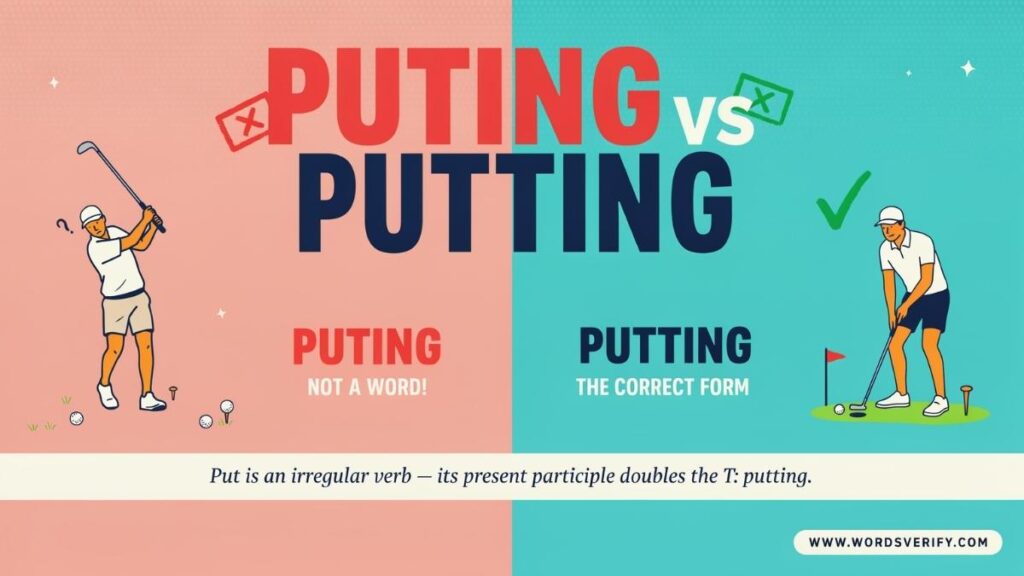
Ever typed “puting” and wondered whether a letter had gone missing? This tiny spelling slip can leave even confident writers second guessing themselves. The confusion between puting vs putting may seem minor, but one little letter makes all the difference. Here’s the good news: the rule is simple once you understand it. “Putting” is the correct spelling because you double the final T in “put” before adding “-ing.” Whether you’re writing an email, finishing a school assignment, or talking about golf, this guide will help you understand the spelling rule, recognize common mistakes, and write with greater confidence. No grammar detective work required!
Quick Answer puting vs putting
Putting is the correct spelling in standard English. Puting is generally a misspelling when you mean the -ing form of the verb put.
The spelling follows this pattern:
Put + t + ing = putting
Here are a few examples puting vs putting:
- Correct: She is putting the groceries away.
- Incorrect: She is puting the groceries away.
- Correct: He enjoys putting his ideas into writing.
- Incorrect: He enjoys puting his ideas into writing.
The extra T isn’t optional. It forms part of the standard spelling.
| Question | Answer |
|---|---|
| Which spelling is correct? | Putting |
| Is puting correct in ordinary English? | No |
| Why does putting have two Ts? | The final T doubles before adding -ing |
| What does putting mean? | Placing something somewhere or carrying out the action of putting |
| Does putting have a golf-related meaning? | Yes. It refers to striking a golf ball with a putter, usually on the green. |
Both American and British English use the spelling putting. You don’t need to change it for different English-speaking audiences.
What Does Putting Mean?
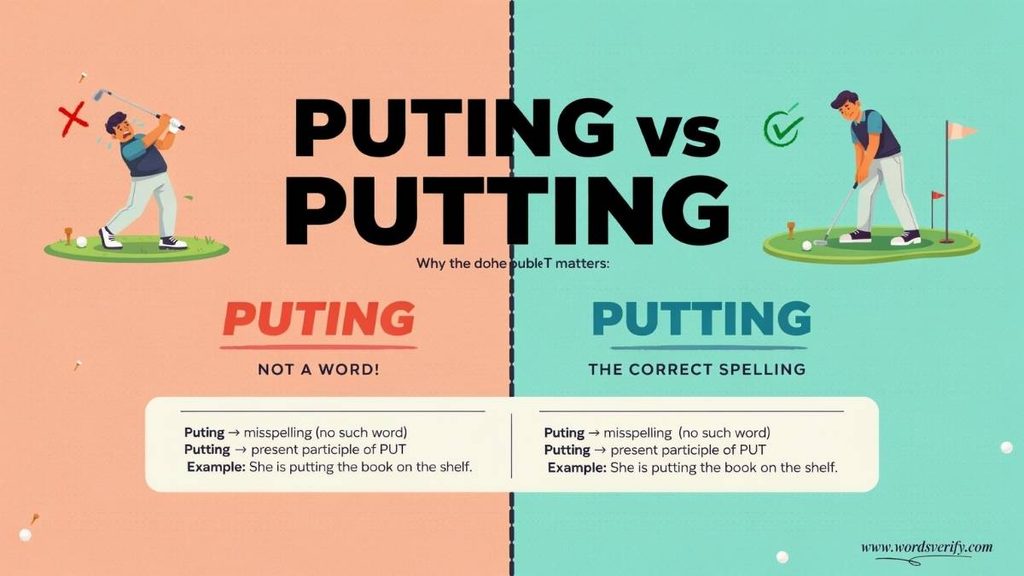
Putting comes from the verb put, which means to place, position, or move something somewhere. Adding -ing creates a form that can describe an ongoing action or name an activity.
For example, when you place your phone on a desk, you’re putting your phone on the desk. If you say, “Putting everything in order takes time,” you’re using the word to name an activity.
The meaning depends on the context or Putting can describe physical placement, an action in progress, or a specific activity in sports.
Putting as a Verb Form
Putting often describes an action that’s happening now or around the present time. It’s the present participle of put and commonly appears with helping verbs such as am, is, are, was, and were.
Consider these examples:
- I’m putting the clean clothes in the closet.
- She is putting her shoes on.
- They are putting the chairs around the table.
- We were putting the finishing touches on the project.
In each sentence, putting describes an action. The helping verb indicates the tense.
The base verb put also has an unusual feature: its simple past form is identical to its base form.
| Verb form | Example |
|---|---|
| Base form | I put the book on the shelf. |
| Simple past | I put the book on the shelf yesterday. |
| Present participle | I am putting the book on the shelf. |
| Present perfect | I have put the book on the shelf. |
| Third-person singular | She puts the book on the shelf. |
Notice that we don’t normally write putted when we mean placing something. The standard past tense is put.
Putting as a Gerund
A gerund is a verb form ending in -ing that functions as a noun. It names an activity rather than simply describing an action in progress.
For example:
“Putting things away keeps the room tidy.”
Here, putting things away names an activity and acts as the subject of the sentence.
More examples include:
- Putting your thoughts on paper can help you organize them.
- She enjoys putting puzzles together.
- Putting others first can be generous, but you should also look after yourself.
- He dislikes putting important tasks off until the last minute.
Compare these two sentences:
- She is putting the books away.
- Putting books away is easy.
In the first sentence, putting forms part of a verb phrase. In the second, it names an activity. The spelling stays the same even though the grammatical function changes.
Putting in Golf
Putting has a specific meaning in golf. It refers to striking a golf ball with a putter, usually on the putting green, to move it toward the hole.
Putting plays an important role in a golfer’s score. A player might reach the green in relatively few strokes but still need several more to finish the hole. A well-controlled putt can save strokes, while poor distance judgment can quickly ruin a promising round.
For example:
“The golfer spent an hour practicing putting before the tournament.”
Good putting technique usually involves:
- Keeping your stance balanced and comfortable.
- Aligning the putter face with your intended target.
- Controlling the rhythm and length of your stroke.
- Reading the green to judge its slope and speed.
- Practicing distance control as well as short putts.
The word putt refers to a golf stroke of this kind. Putting describes the action or activity. Neither term uses the spelling puting.
Putting in Everyday Expressions
Putting appears in many familiar expressions. Sometimes it describes a physical action. In other cases, it conveys a broader idea.
| Expression | Meaning | Example |
|---|---|---|
| Putting something in place | Positioning or organizing something | We’re putting a new system in place. |
| Putting things together | Combining parts or assembling something | She’s putting the furniture together. |
| Putting something down | Placing something on a surface | He is putting the bag down. |
| Putting something away | Returning something to its proper place | I’m putting the dishes away. |
| Putting something on | Dressing in clothing or applying something | She is putting on her coat. |
| Putting something into practice | Applying an idea or skill | He’s putting his training into practice. |
| Putting someone off | Discouraging someone or delaying an action | The high price is putting me off buying the jacket. |
The words around putting help determine its meaning. Putting something down describes a physical action, while putting someone off can mean discouraging them or making them hesitate.
Fix common more word mistakes in English
Offered vs Offerred Which one Is Correct?
Why Is Putting Spelled With Two Ts?
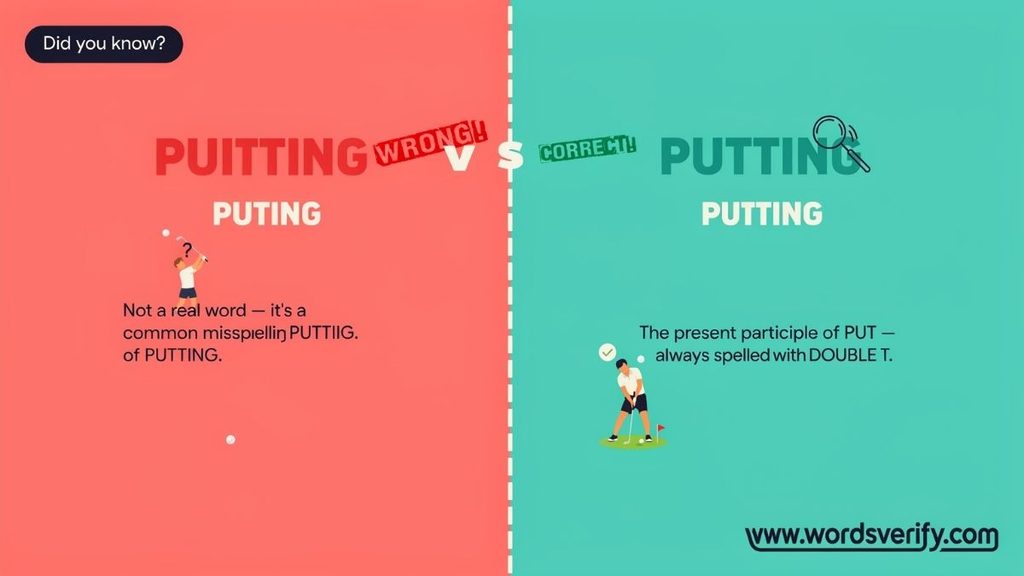
The answer comes from a common English spelling pattern called consonant doubling. When you add a suffix such as -ing to certain verbs, you repeat the final consonant.
The verb put follows this pattern because it has one syllable and ends in a consonant-vowel-consonant sequence.
Look at the word:
- P is the first consonant.
- U represents the short vowel sound.
- T is the final consonant.
When you add -ing, you double the final T.
Put → putting
Without the extra T, the word doesn’t follow the standard spelling pattern for this verb.
The Double-Consonant Rule Explained
The consonant-vowel-consonant pattern is often shortened to CVC. It describes a sequence in which a consonant comes before a vowel and another consonant follows it.
For many one-syllable verbs that follow this pattern, you double the final consonant before adding a vowel-initial suffix such as -ing.
Here are some common examples:
| Base verb | Correct -ing form | Example |
|---|---|---|
| Put | Putting | He is putting the groceries away. |
| Sit | Sitting | She is sitting by the window. |
| Hit | Hitting | The player is hitting the ball. |
| Run | Running | They’re running late. |
| Hop | Hopping | The rabbit is hopping across the grass. |
| Stop | Stopping | The bus is stopping at the corner. |
| Plan | Planning | We’re planning a family trip. |
These words follow a similar spelling pattern. However, consonant doubling doesn’t apply to every verb that ends in a consonant. The word’s syllable structure, vowel sound, and stress pattern also matter.
For example, begin becomes beginning because the final syllable carries the stress. By contrast, open becomes opening because its final syllable is unstressed.
Understanding the Short Vowel Rule
A short vowel has a different sound from its common long-vowel sound. The U in put is a short vowel, as are the vowels in sit and run.
This helps explain why certain verbs double their final consonants before adding -ing. Still, the short vowel alone doesn’t determine the spelling. You must also consider the word’s structure and stress.
Compare these examples:
- Put becomes putting.
- Sit becomes sitting.
- Run becomes running.
- Begin becomes beginning.
- Open becomes opening.
The first four forms double the final consonant, while open keeps a single N. The difference comes from the spelling pattern and stress of the base word.
English spelling has patterns rather than one rule that covers every word. Learning these patterns gives you a reliable starting point.
How to Spell Putting Step by Step
If you find yourself wondering how to spell putting, break the word into smaller parts.
- Start with the base verb: put.
- Identify the final consonant: T.
- Double the final consonant: putt.
- Add -ing: putting.
The result is putting, not puting.
This method works because you’re applying the spelling rule instead of trying to remember the entire word from scratch. Once the pattern becomes familiar, the correct spelling feels much more natural.
Fix common more word mistakes in English
Panic vs Panick Which one Is Correct?
Why Is Puting Incorrect?
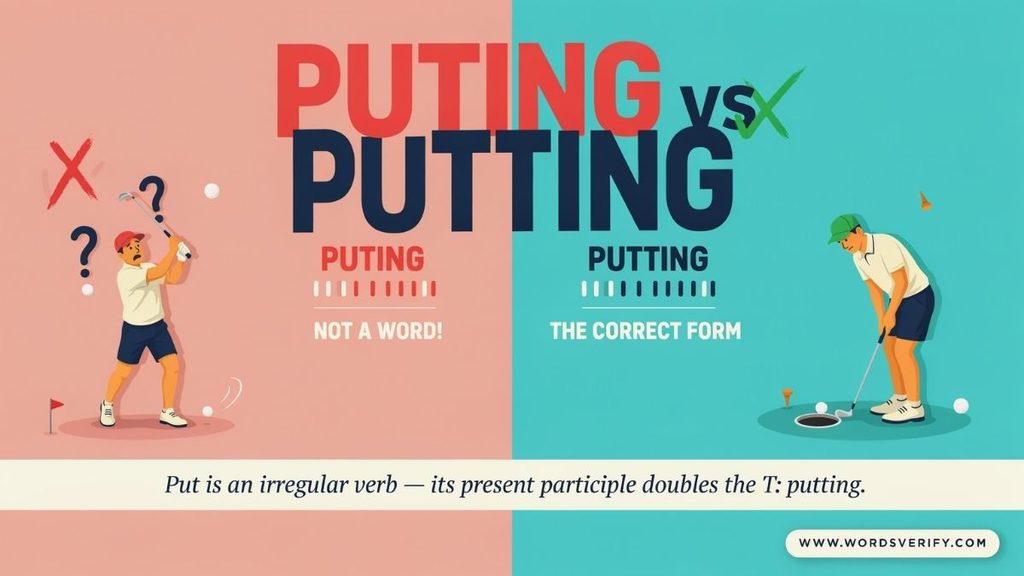
Puting is generally incorrect because it leaves out the second T required in the standard spelling of put + -ing.
The mistake often happens when someone adds -ing without considering whether the final consonant needs to double. Since putting and puting look so similar, the error can slip into a sentence during fast typing.
The intended meaning is usually clear, but the spelling still needs correction.
Common Putting Spelling Mistakes
Several habits can make this mistake more likely puting vs putting.
Forgetting to double the T: The writer remembers to add -ing but overlooks the consonant-doubling rule.
Confusing different spelling patterns: Some verbs drop a final silent E before adding -ing, as in make becoming making. Others double their final consonants, as in put becoming putting. These patterns aren’t interchangeable.
Relying entirely on spell-check: A spelling checker can catch many errors, but it shouldn’t replace careful proofreading. Unusual names and specialized terms can also make automatic suggestions less reliable.
Typing too quickly: When you’re familiar with a word, your fingers may repeat a spelling habit without your noticing. Reviewing the finished sentence can help catch the error.
Incorrect and Correct Examples
| Incorrect | Correct |
|---|---|
| I am puting the keys away. | I am putting the keys away. |
| She is puting on her shoes. | She is putting on her shoes. |
| They are puting the plan into action. | They are putting the plan into action. |
| He enjoys puting things together. | He enjoys putting things together. |
| We are puting everything in place. | We are putting everything in place. |
Each correction follows the same rule. Replace puting with putting.
A Simple Way to Remember the Correct Spelling
Here’s an easy reminder: Put needs two Ts before -ing.
Think of the base word as the starting point. Keep its original letters, double the final T, and attach the suffix.
Remember this pattern for puting vs putting:
- Put → putting
- Sit → sitting
- Hit → hitting
These words reinforce the same general pattern and make the spelling easier to recall.
Fix common more word mistakes in English
Vendor vs Vender which one is correct?
puting vs putting Key Differences
The difference between puting vs putting isn’t a difference in meaning. In ordinary English, puting is simply a misspelling when the intended word is putting.
| Feature | Putting | Puting |
|---|---|---|
| Standard spelling | Correct | Incorrect for the ordinary verb form |
| Base verb | Put | Intended to be put |
| Grammatical use | Present participle or gerund | Usually a spelling error |
| Meaning | Placing something or carrying out the action of putting | Usually intended to mean putting |
| Use in golf | Correct spelling | Incorrect spelling |
| Example | She is putting the book away. | She is puting the book away. |
If you encounter Puting as a proper name or in a specialized context, examine that usage separately. An unusual name doesn’t change the standard spelling of the verb.
Fix common more word mistakes in English
Worse vs Worst which one is correct?
Putting vs Other English Spelling Patterns
Comparing putting with other verbs makes the rules easier to understand. Some verbs double their final consonants, while others drop a silent E or keep their final consonant unchanged puting vs putting.
Words That Double the Final Consonant
These common verbs double their final consonant before adding -ing.
| Base verb | -ing form | Example |
|---|---|---|
| Get | Getting | I’m getting ready. |
| Set | Setting | She’s setting the table. |
| Let | Letting | He’s letting the dog outside. |
| Hit | Hitting | The player is hitting the ball. |
| Swim | Swimming | She’s swimming in the pool. |
| Stop | Stopping | The car is stopping at the light. |
These examples illustrate consonant doubling, although the precise rule depends on the word’s structure and stress pattern.
Words That Drop a Final Silent E
Some verbs follow a different pattern. When a verb ends in a silent E, you usually drop that E before adding -ing.
| Base verb | -ing form | Example |
|---|---|---|
| Make | Making | She’s making dinner. |
| Write | Writing | He’s writing a letter. |
| Take | Taking | I’m taking notes. |
| Dance | Dancing | They’re dancing together. |
| Hope | Hoping | We’re hoping for good news. |
You wouldn’t write makeing or writeing in standard English. The final E disappears because these verbs follow a different spelling pattern from put.
Words That Keep Their Final Consonant
Some verbs end in consonants but don’t double them before adding -ing.
| Base verb | -ing form | Explanation |
|---|---|---|
| Open | Opening | The final syllable is unstressed. |
| Visit | Visiting | The final syllable is unstressed. |
| Offer | Offering | The final syllable is unstressed. |
| Listen | Listening | The final syllable is unstressed. |
The main lesson is simple: don’t double every final consonant automatically. Check the word’s spelling pattern and stress before adding a suffix in puting vs putting.
Is Putting a Verb or a Noun?
Putting can function as either a verb form or a gerund. Its role depends on how you use it in a sentence.
As part of a verb phrase, it describes an action in progress.
Example: “She is putting the books away.”
As a gerund, it names an activity.
Example: “Putting books away keeps the room organized.”
The spelling remains the same in both cases. The ending -ing doesn’t automatically make a word a noun. You need to look at its role in the sentence.
Fix common more word mistakes in English
Piqued vs Peaked which one is correct?
How Is Putting Pronounced?
Putting has two syllables, with the stress on the first syllable in standard American English.
The doubled T is a spelling feature. You don’t pronounce it as two separate T sounds. Instead, say the word naturally, keeping the short vowel sound and the clear consonant between the syllables.
A useful way to practice is to say put first and then add the -ing ending smoothly. This can help you connect the base verb with its correct written form.
Remember that spelling and pronunciation don’t always match letter for letter in English. A doubled consonant can follow a spelling rule without sounding like two separate letters.
What Does Putting Mean in Construction?
In construction, putting generally retains its everyday meaning of placing, positioning, or installing something. It doesn’t have one special technical definition that applies across the entire industry.
For example:
- The crew is putting the bricks in place.
- The electrician is putting the wiring into position.
- Workers are putting the finishing materials together.
- The contractor is putting a safety plan into practice.
In these examples, putting describes positioning a component, assembling materials, or implementing a plan.
When reading construction documents, consider the complete sentence and the terminology used for the project. Don’t assume that putting has a specialized meaning unless the context supports it.
Fix common more word mistakes in English
Inclusivity vs Inclusiveness which one is correct?
What Does Off-Putting Mean?
Off-putting is an adjective that describes something unpleasant, unappealing, or likely to make someone lose interest. It can describe behavior, a smell, a comment, or an experience.
For example:
- His rude attitude was off-putting.
- The strong smell made the room feel off-putting.
- Her dismissive response was off-putting to the new employees.
- The confusing design was off-putting to visitors.
The expression putting someone off can also mean discouraging someone or causing them to delay an action.
For instance, “The high price put me off buying the jacket” means the price discouraged the purchase.
Although off-putting has its own meaning, its spelling still contains the correctly spelled word putting. The double T remains in puting vs putting.
Fix common more word mistakes in English
Emaculate vs Immaculate which one is correct?
Putting Examples in Everyday Sentences
Examples puting vs putting can help you recognize how putting works in different situations. The following sentences show its use in everyday activities, school, work, sports, and common expressions.
Everyday Activities
- She is putting the groceries in the refrigerator.
- I’m putting my phone on silent before the meeting.
- They are putting the furniture together this weekend.
- He keeps putting his keys in the wrong place.
- We’re putting the final details in place.
School and Work
- Putting your notes in order can make studying easier.
- The team is putting its new strategy into practice.
- She’s putting more time into learning English.
- He is putting the report together before the deadline.
- Putting clear instructions in writing reduces confusion.
Sports and Hobbies
- The golfer is putting the ball toward the hole.
- She practices putting before every tournament.
- Putting requires patience and control.
- The player struggled with putting on the fast green.
- He spent the afternoon practicing on the putting green.
Figurative Expressions
- Putting others first can be kind, but your own needs matter too.
- The unexpected delay is putting pressure on the team.
- She’s putting her experience to good use.
- His negative comments were putting everyone off.
- We’re putting the problem behind us and moving forward.
These examples show that putting can describe a physical action, name an activity, or appear in a familiar expression. The spelling never changes to puting.
Fix common more word mistakes in English
Vinal vs Vinyl Which one Is Correct?
Example Correcting the Puting Spelling Mistake
Imagine a student writing this paragraph for an English assignment:
“Every morning, I am puting my books in my bag before leaving home. After school, I enjoy puting everything back in its place.”
The meaning is clear, but the student has repeated the same spelling mistake twice.
Here’s the corrected version:
“Every morning, I am putting my books in my bag before leaving home. After school, I enjoy putting everything back in its place.”
The writer doesn’t need to change the sentence structure or meaning. The only correction is to double the final T in each instance.
This example highlights a useful proofreading habit. When you notice a spelling error, identify the rule behind it. Correcting the underlying habit is more effective than fixing the same mistake repeatedly without understanding why it happens.
How to Improve Your English Spelling
Better spelling comes from learning patterns, noticing recurring errors, and reviewing your writing. You don’t have to memorize every English word individually.
Try these practical techniques:
- Learn the base word first. Start with put before forming putting.
- Review common suffix rules. Learn when to double a consonant, drop a silent E, or keep the final consonant unchanged.
- Practice with complete sentences. Using putting in context helps you remember its correct spelling and meaning.
- Read your work aloud. Reading won’t always reveal a missing letter, but it can help you spot awkward or incomplete sentences.
- Check a reliable dictionary. When you’re unsure about a spelling, look it up instead of relying on guesswork.
- Review repeated mistakes. If you often write puting, make a note of the correct spelling and check for it during proofreading.
- Use spelling tools as a second check. Spell-check software can catch many errors, but you should still review the finished text.
The best approach combines an understanding of spelling patterns with regular practice. Over time, correct forms become easier to recognize and write.
Fix common more word mistakes in English
Encorporate vs Incorporate Which one Is Correct?
Practice Session Puting vs Putting
Complete each sentence with the correct word or verb form puting vs putting.
1. She is ______ her books away before dinner.
2. He kept ______ off his homework until the last minute.
3. I am ______ the finishing touches on my presentation.
4. They are ______ together a new bookshelf.
5. Sarah enjoys ______ flowers in her garden.
6. He ______ his keys on the kitchen counter yesterday.
7. She has ______ all the files in the correct folder.
8. The golfer is practicing his ______ on the green.
9. Please stop ______ your feet on the table.
10. We are ______ our grammar lessons into practice.
11. He is ______ on his jacket before going outside.
12. The teacher is ______ the question to the class.
13. I ______ the package near the front door every morning.
14. She ______ her phone on silent during meetings.
15. They were ______ the chairs in a circle for the meeting.
16. ______ your thoughts on paper can help you organize your ideas.
17. He has been ______ off the meeting for several days.
18. The children are ______ their toys back in the box.
19. She is ______ on a wonderful performance for the school event.
20. I have ______ the wrong address on the form.
21. The coach is ______ the players through a difficult training session.
22. He is ______ too much pressure on himself to succeed.
23. ______ up with constant noise can be exhausting.
24. She is ______ the ingredients into a large mixing bowl.
25. The best way to improve your spelling is by ______ what you learn into practice.
Answers
- putting
- putting
- putting
- putting
- putting
- put
- put
- putting
- putting
- putting
- putting
- putting
- put
- puts
- putting
- Putting
- putting
- putting
- putting
- put
- putting
- putting
- Putting
- putting
- putting
Here’s a trusted source for clear more words Comparison:
FAQs
Why does “put” become “putting” instead of “puting”?
The final consonant T doubles before adding “-ing” because “put” is a one-syllable word with a short vowel sound ending in a consonant. Therefore, “putting” is correct while “puting” is a misspelling in standard English.
What is the difference between a gerund and a present participle in “putting”?
A gerund acts as a noun while a present participle forms part of a verb phrase or describes a noun. For example, “Putting takes practice” uses a gerund. “She is putting the books away” uses a present participle.
Can “putting” appear at the beginning of a sentence?
Yes. You can begin a sentence with “putting” when it introduces an activity or action. For example, “Putting your keys in the same place every day saves time.”
What are the three forms of the verb “put”?
The three principal forms are put, put, and put. The base form, simple past tense, and past participle all use the same spelling.
Examples:
- Present: I put my phone on the desk.
- Past: I put my phone on the desk yesterday.
- Perfect: I have put my phone on the desk.
Is “putting” used in formal writing?
Yes. “Putting” is perfectly acceptable in academic, professional, and formal writing. The best choice depends on context. For example, “putting the findings into context” may work well in a report, while “placing the findings in context” may sound more formal.
What does “putting into practice” mean?
“Putting into practice” means using an idea, skill, plan, or rule in a real situation rather than merely learning about it. For example, “She is putting her grammar lessons into practice by editing her article.”
What does “putting off” mean in a sentence?
“Putting off” commonly means postponing something or making someone feel uncomfortable or discouraged.
Examples:
- “He keeps putting off his homework” means he keeps delaying it.
- “His rude behavior is putting people off” means his behavior is making people uncomfortable or less interested.
What is the difference between “putting on” and “putting up with”?
“Putting on” can mean wearing clothing, applying something, or organizing an event. “Putting up with” means tolerating something unpleasant puting vs putting.
Examples:
- “She is putting on her jacket.”
- “They are putting on a charity concert.”
- “I’m putting up with the noise until the repairs are finished.”
How is “putting” used in golf?
In golf, putting means using a putter to roll the ball across the green toward the hole. A golfer might say, “Her putting improved after several practice sessions.” In this context, “putting” refers specifically to a golf skill.
What does “putting two and two together” mean?
This expression means using available clues to reach a conclusion. For example, “When he saw the wet umbrella and muddy shoes, he put two and two together and realized it had been raining.”
Can “putting” be replaced with “placing” in every sentence?
No. “Placing” works when you mean positioning something in a particular spot, but “putting” appears in many expressions that have different meanings.
For example, “putting on a show” means organizing or presenting a performance. Replacing it with “placing on a show” would sound incorrect. Choose a synonym based on the meaning of the full expression rather than the word alone.
Fix common more word mistakes in English
Performed vs Preformed which one is correct?
conclusion
The spelling confusion is finally put to rest! When choosing between “puting vs putting,” remember that “putting” is the correct spelling in standard English. The rule is easy: double the final T in “put” before adding “-ing.” That extra letter may seem small, but it makes all the difference in puting vs putting.
Whether you’re putting your thoughts on paper, putting the finishing touches on a project, or working on your golf swing, don’t let that second T slip away. Think of it as a tiny grammatical safety net that keeps your spelling on track. Once you understand the rule, you can avoid this common mistake and write with greater confidence. After all, good grammar doesn’t have to be complicated. Sometimes, all it takes is one extra letter in the right place.

Lisa AJS is an experienced blogger and language enthusiast at Words Verify, dedicated to making grammar simple, practical, and enjoyable. She writes engaging content on commonly confused words, grammar mistakes, word meanings, and everyday language challenges.