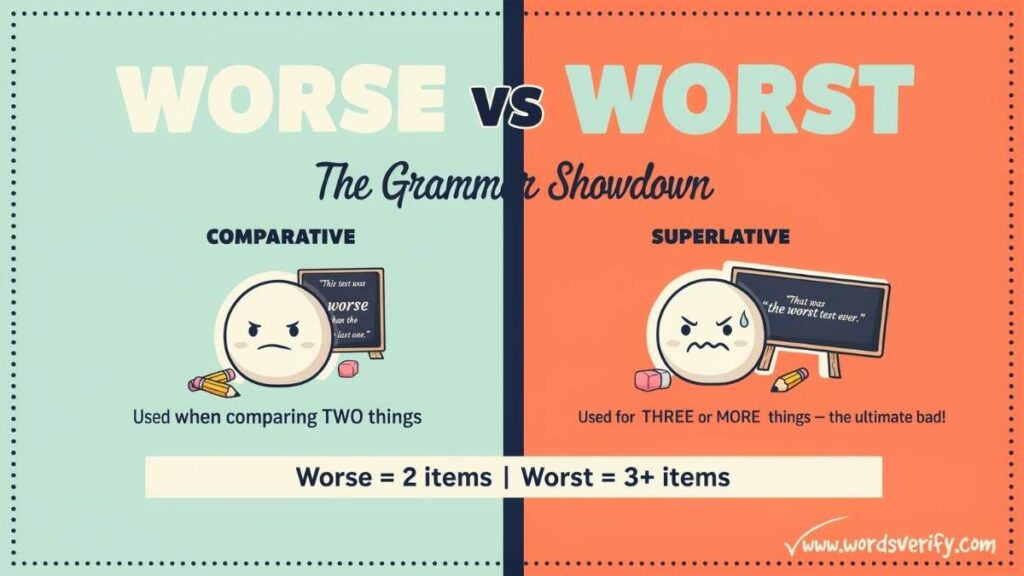
Ever hesitated between worse vs worst and wondered which one belongs in your sentence? You’re not alone! These commonly confused words can turn a simple sentence into a grammar puzzle. Although both describe something negative, they serve different purposes. “Worse” compares two things or describes a situation that’s getting less favorable, while “worst” identifies the least favorable option or the highest degree of something bad. Think of them as steps on a downward staircase: bad, worse, worst. The good news? Once you understand the difference between worse vs worst, you can avoid common grammar mistakes and write with greater confidence.
Quick Answer
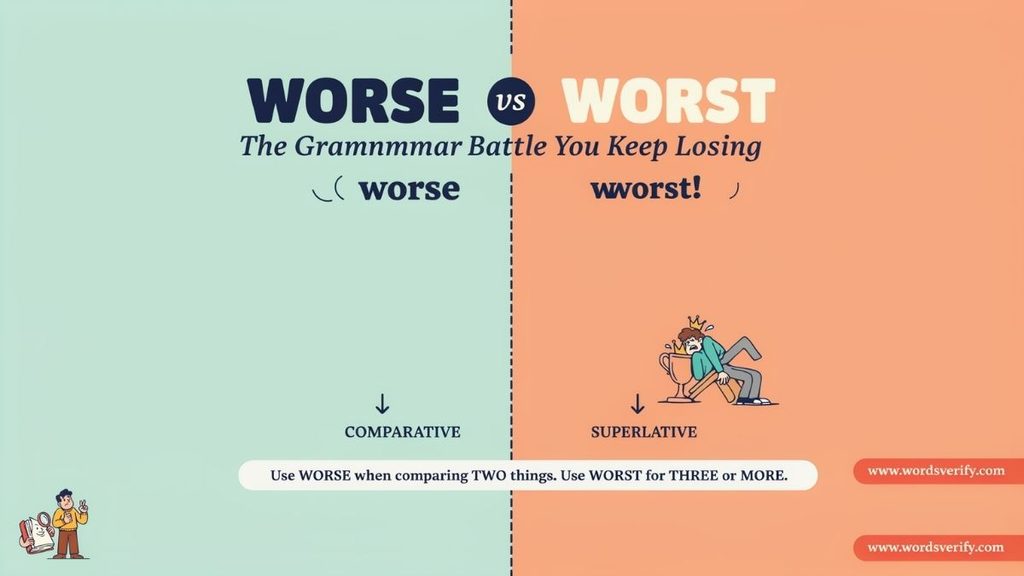
worse vs worst both describe something negative, but they serve different purposes. Use “worse” to compare two things or describe a situation that’s getting more unpleasant. Use “worst” to identify the least favorable option or the highest degree of something bad.
For example, “The weather is worse than yesterday” makes a comparison, while “Today is the worst day of the week” identifies the least favorable day. Remember the simple pattern: bad, worse, worst. When you’re comparing, choose “worse.” When you’re describing the most negative option, choose “worst.”
What Does Worse Mean?
“Worse” is the comparative form of “bad.” It describes something that is less good, less desirable, more unpleasant, or more serious than something else.
You use “worse” when making a comparison. Sometimes the comparison appears directly in the sentence. Other times, readers understand it from the context.
For example:
- My headache is worse than it was this morning.
- The traffic is worse today.
- Her second attempt was worse than her first.
- The food tasted worse than I expected.
- His financial situation became worse after he lost his job.
In each example, “worse” indicates a decline or an unfavorable comparison. The headache has become more painful, the traffic is less manageable, or the second attempt is less successful.
You don’t always need to use the word “than.” In the sentence “The situation is getting worse,” the comparison is implied. The situation is becoming more serious than it was before.
When to Use Worse
Use “worse” when one thing is less favorable than another or when a condition is deteriorating.
Common situations include:
- Comparing quality: This phone is worse than my old one.
- Describing health: Her cough is getting worse.
- Discussing performance: My test score was worse than I expected.
- Explaining a problem: The delay made the situation worse.
- Comparing experiences: The journey was worse than we had imagined.
Remember that “worse” doesn’t necessarily mean something is completely terrible. It simply means that one thing is less favorable than the thing used for comparison.
For instance, a restaurant meal might be worse than the meal you had yesterday without being inedible. The comparison tells you which meal was less enjoyable.
How to Use “Worse Than”
The phrase “worse than” makes a comparison between people, things, experiences, or situations.
Examples:
- This movie is worse than the original.
- The weather is worse than it was yesterday.
- My new commute is worse than my old one.
- The problem turned out to be worse than we thought.
- His handwriting is worse than mine.
The word “than” introduces the comparison. When you’re comparing two things directly, “worse than” is usually the correct construction.
“Worst than” is incorrect in standard English. If you want to make a comparison with “than,” use “worse.”
Can You Use Worse Without Than?
Yes. The word “worse” can stand alone when the comparison is clear from the context.
For example:
- My cold is getting worse.
- Things could be worse.
- The situation looks worse now.
- His condition became worse overnight.
- The second version is worse.
You don’t need to spell out every comparison. Readers can often understand what you mean from the surrounding sentence.
Avoid everyday grammar mistakes with simple tips
Conex vs Connex which one is correct?
What Does Worst Mean?
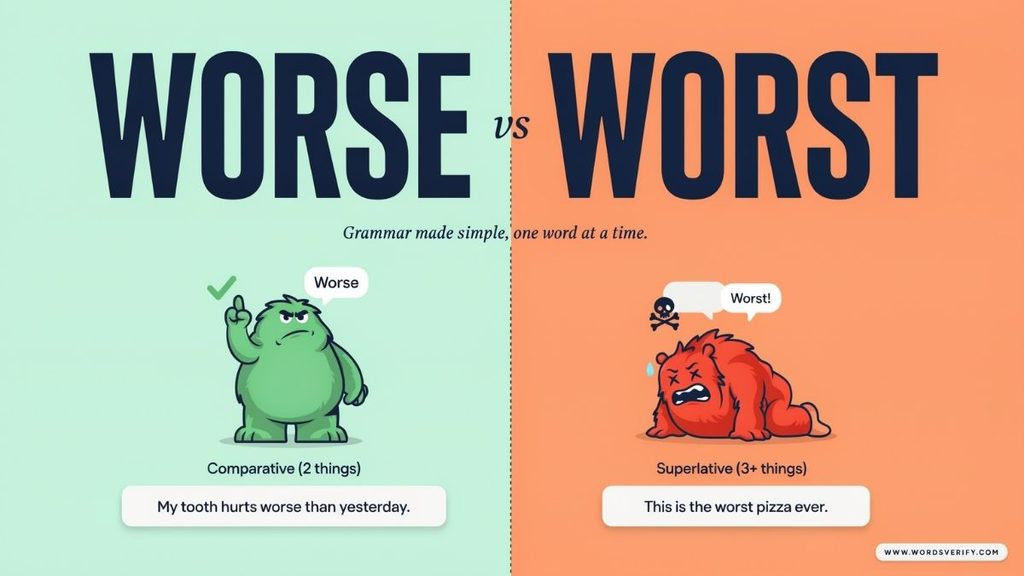
“Worst” is the superlative form of “bad.” It describes the least favorable option in a group or the highest degree of a negative quality.
While “worse” compares things, “worst” usually identifies the bottom of the scale.
For example:
- That was the worst meal I’ve ever eaten.
- Monday was the worst day of my week.
- This is the worst mistake I’ve made.
- She had the worst experience of anyone in the group.
- Of all the available options, this one is the worst.
In these sentences, “worst” identifies something at the lowest or most unfavorable end of a comparison.
Imagine three cups of coffee. The first tastes acceptable, the second tastes worse, and the third tastes awful. If the third cup is the least enjoyable of all three, you could call it the worst.
When to Use Worst
Use “worst” when you want to identify the least favorable choice, the lowest quality, or the most unpleasant experience within a group or situation.
Common examples include:
- Describing an experience: It was the worst vacation I’ve ever had.
- Comparing several options: This is the worst of the three proposals.
- Talking about a mistake: Forgetting the deadline was my worst mistake.
- Describing a condition: His symptoms were at their worst last night.
- Discussing a result: The team recorded its worst performance of the season.
The group being compared doesn’t always need to appear in the sentence. In “That was the worst,” the listener can often understand the comparison from the conversation.
Why Do We Say “The Worst”?
English commonly uses “the” before “worst” when the word identifies a particular person, thing, or experience as the least favorable in a group.
For example:
- This is the worst restaurant in town.
- That was the worst part of the trip.
- She made the worst decision.
- It was the worst possible outcome.
However, “worst” doesn’t always need “the.” You might say, “He performed worst in the final round,” where “worst” describes how he performed compared with others or across rounds.
The right construction depends on the sentence. Don’t add “the” automatically without considering how the word functions.
Avoid everyday grammar mistakes with simple tips
Piqued vs Peaked which one is correct?
Worse vs Worst What’s the Difference?
The main difference worse vs worst comes down to comparison.
| Feature | Worse | Worst |
|---|---|---|
| Grammatical form | Comparative | Superlative |
| Basic meaning | Less good or more unpleasant than another | Least favorable or most unpleasant |
| Typical use | Comparing things or describing decline | Identifying the lowest point on a scale |
| Common pattern | Worse than | The worst |
| Example | This route is worse than the other one. | This is the worst route of all. |
Here’s an easy way to remember the relationship:
- Bad: The first meal was bad.
- Worse: The second meal was worse than the first.
- Worst: The third meal was the worst of all three.
Think of the words as steps on a downward staircase. “Bad” describes an unfavorable condition. “Worse” moves farther down by comparing it with something else. “Worst” reaches the lowest step.
How They Work Together
The word “bad” describes something unfavorable. “Worse” compares one unfavorable thing with another. “Worst” identifies the least favorable option or the most negative degree.
Consider these examples:
- My phone battery is bad.
- My phone battery is worse than yours.
- My phone has the worst battery life of all the phones I’ve owned.
The same pattern works with situations, results, decisions, and experiences.
You can also compare these forms with the positive progression of “good”:
| Basic form | Comparative form | Superlative form |
|---|---|---|
| Bad | Worse | Worst |
| Good | Better | Best |
These forms are irregular. You generally shouldn’t say “more bad” instead of “worse” or “most bad” instead of “worst” in standard English.
Likewise, “good, better, best” follows its own pattern. Learning these word families together can make English comparisons easier to understand.
Avoid everyday grammar mistakes with simple tips
Inclusivity vs Inclusiveness which one is correct?
Common Sentence Patterns With Worse vs Worst
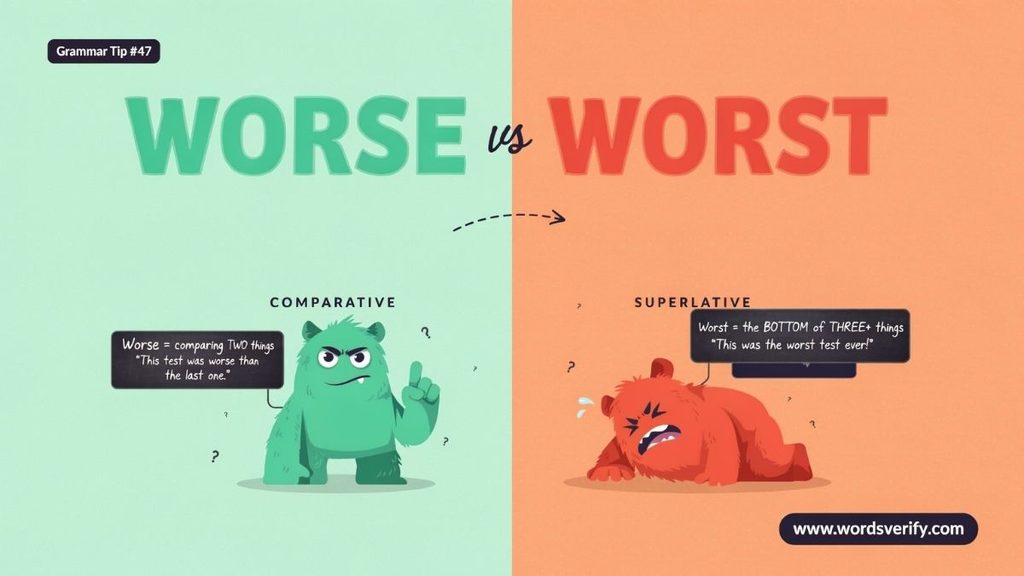
Some expressions cause confusion because the words worse vs worst appear in familiar phrases. The good news is that a few simple patterns will help you choose correctly.
“Made It Worse” or “Made It Worst”?
The correct expression is usually “made it worse.”
Use it when an action causes a problem to become more serious or unpleasant.
Examples:
- His careless comment made the argument worse.
- Adding more water made the soup worse.
- The delay made an already difficult situation worse.
- Trying to fix the computer without instructions made things worse.
“Made it worst” is not the normal construction for this meaning. If an action worsens an existing problem, choose “made it worse.”
“Getting Worse” or “Getting Worst”?
“Getting worse” is correct when something is deteriorating or becoming more serious.
Examples:
- The weather is getting worse.
- My back pain is getting worse.
- The traffic is getting worse every evening.
- The company’s financial situation is getting worse.
“Getting worst” is generally incorrect in these sentences. You’re describing a change over time, so the comparative form “worse” fits.
You could say “getting to its worst” in a different construction, but that phrase means something is approaching its most severe point. It doesn’t replace “getting worse.”
“Worse Than Ever” or “Worst Ever”?
Both expressions are correct, but they serve different purposes.
Use “worse than ever” when something has deteriorated beyond its previous condition.
Examples:
- The traffic is worse than ever.
- His sleep schedule is worse than ever.
- The conflict has become worse than ever.
Use “the worst ever” when identifying an experience or result as the most unfavorable one.
Examples:
- That was the worst storm ever recorded in the area.
- This is the worst meal I’ve ever had.
- The team delivered its worst performance ever.
The first expression highlights a comparison with the past. The second identifies an extreme or record-level negative experience.
“Could Be Worse” or “Could Be Worst”?
“Could be worse” is the natural expression when you mean that a situation might be more unpleasant than it already is.
Examples:
- I missed the bus, but it could be worse.
- We lost the first match, but things could be worse.
- My laptop is old, but it could be worse.
You might use “could be the worst” when discussing a possible ranking or outcome.
For example: “This could be the worst storm of the year.”
The difference is straightforward. “Could be worse” suggests that a more negative situation is possible. “Could be the worst” suggests that something might rank at the bottom of a group or reach the highest degree of severity.
“Worse for Wear” or “Worst for Wear”?
The correct idiom is “worse for wear.” It describes someone or something that looks tired, damaged, or worn out after an experience.
Examples:
- After the long hike, we were all worse for wear.
- The old suitcase looked worse for wear after years of travel.
- He arrived home a little worse for wear after the exhausting journey.
“Worst for wear” is not the standard form of this expression.
Avoid everyday grammar mistakes with simple tips
Emaculate vs Immaculate which one is correct?
Common Expressions With Worse
English uses “worse” in several familiar expressions. Understanding them will help you recognize the word in everyday conversations.
- Getting worse: Becoming more serious or less favorable.
Example: The weather is getting worse. - Worse than ever: More unfavorable than at any previous time.
Example: My allergies are worse than ever this spring. - Worse for wear: Looking tired or damaged after use or an experience.
Example: The old shoes looked worse for wear. - Could be worse: A way of saying that a situation could be more unpleasant.
Example: I lost my umbrella, but it could be worse. - Make matters worse: Cause an already difficult situation to become more difficult.
Example: Complaining loudly only made matters worse. - From bad to worse: Changing from an unfavorable situation to an even less favorable one.
Example: The meeting went from bad to worse when the projector stopped working. - For the worse: In a way that makes a situation less favorable.
Example: His attitude changed for the worse after the disagreement.
These expressions share the idea of deterioration or comparison. When you recognize that meaning, choosing “worse” becomes more natural.
Avoid everyday grammar mistakes with simple tips
Vinal vs Vinyl Which one Is Correct?
Common Expressions With Worst
“Worst” also appears in several everyday expressions. Most of them refer to an extreme negative situation or the least favorable possible outcome.
- The worst: The least favorable person, thing, or situation in a comparison.
Example: That was the worst part of the journey. - Prepare for the worst: Get ready for the most unfavorable possible outcome.
Example: We packed extra supplies in case the weather changed. - At worst: Used to describe the most negative possible outcome in a situation.
Example: At worst, we’ll have to reschedule the meeting. - At its worst: At the most severe or unpleasant point.
Example: The storm was at its worst around midnight. - Worst-case scenario: The most unfavorable outcome being considered.
Example: The worst-case scenario is that we miss the deadline. - Come off worst: End up in the least favorable position after a conflict or comparison.
Example: Both sides argued, but he came off worst.
These expressions show how “worst” points toward an extreme rather than simply comparing one condition with another.
Avoid everyday grammar mistakes with simple tips
Encorporate vs Incorporate Which one Is Correct?
Worse vs Worst in Everyday English
You’ll encounter these worse vs worst words in conversations about health, work, relationships, weather, food, and ordinary problems. The correct choice depends on what you want to express.
Health and Well-Being
Use “worse” to describe a decline in health or symptoms.
- My cough is worse today.
- The pain became worse overnight.
- Her symptoms are getting worse.
Use “worst” to describe the most severe point or the most unpleasant experience.
- Last night was the worst part of my illness.
- The pain was at its worst in the morning.
- That was the worst headache I can remember.
If you’re describing a change, “worse” is usually the right choice. If you’re identifying the most severe point, “worst” may fit better.
Weather and Travel
Weather and travel often provide easy examples of comparison.
- The weather is worse today than it was yesterday.
- This road is worse than the highway.
- That was the worst storm of the season.
- Our flight was the worst part of the trip.
- Traffic gets worse during rush hour.
Notice how “worse” compares conditions, while “worst” identifies an extreme experience or the least favorable option.
Work and School
You can use both words when discussing performance, grades, and results.
- My latest test score was worse than my previous one.
- This draft is worse than the version I submitted yesterday.
- That was the worst grade I received all semester.
- She had the worst presentation in the group.
- His performance became worse after he stopped practicing.
These examples work in casual conversations as well as formal discussions. The key is to identify whether you’re comparing a result or ranking it as the least favorable.
Relationships and Personal Experiences
The words can also describe difficult experiences or behavior.
- Their disagreement became worse after the phone call.
- His behavior was worse than before.
- That was the worst argument we had ever had.
- It was the worst date of her life.
- The situation could have been worse.
Choose “worse” when the situation deteriorates or compares unfavorably with another. Choose “worst” when you want to identify the most unpleasant experience or the lowest point.
Avoid everyday grammar mistakes with simple tips
Performed vs Preformed which one is correct?
Common Mistakes When Using Worse vs Worst
Even fluent English speakers sometimes mix up these words. Most mistakes happen when someone uses the superlative form for worse vs worst simple comparison or the comparative form when identifying the lowest point.
| Incorrect | Correct | Explanation |
|---|---|---|
| This is worst than that. | This is worse than that. | Use “worse than” for a comparison. |
| My cold is getting worst. | My cold is getting worse. | “Worse” describes a deteriorating condition. |
| That was the worse day of my life. | That was the worst day of my life. | “Worst” identifies the most unpleasant day. |
| This is the most worst option. | This is the worst option. | “Worst” already expresses the superlative degree. |
| The delay made it worst. | The delay made it worse. | “Made it worse” is the standard expression. |
| Of the three, this one is worse. | Of the three, this one is the worst. | Use “worst” when identifying the least favorable option among the three. |
Here are a few additional points to remember:
- Don’t use “worst than.” The correct phrase is “worse than.”
- Avoid “more worse” in standard English. “Worse” already expresses the comparative form.
- Avoid “most worst.” “Worst” already expresses the superlative form.
- Don’t assume that “worst” always needs an explicitly named group. The context can make the comparison clear.
- Don’t choose “worse” simply because two things are mentioned. The sentence’s meaning matters. If you’re identifying the least favorable option in a group of two or more, “worst” can still be appropriate.
“You Are the Worst” or “You Are Worse”?
Both sentences can be correct, but they communicate different ideas.
“You are the worst” usually means that someone is behaving extremely badly or is the least favorable person in a particular situation. It can sound playful, critical, or insulting depending on the context.
Examples:
- You ate the last slice of pizza? You are the worst!
- He was the worst player on the team that day.
- That was the worst excuse I’ve ever heard.
“You are worse” compares someone’s behavior or qualities with another person, an earlier version of themselves, or a particular standard.
Examples:
- You are worse at chess than your brother.
- Your behavior is worse today than it was yesterday.
- You are getting worse at remembering appointments.
Use “the worst” to make a superlative judgment. Use “worse” when making a comparison or describing a decline.
Avoid everyday grammar mistakes with simple tips
Offered vs Offerred Which one Is Correct?
How to Use Worse vs Worst in Professional Writing
These words worse vs worst aren’t limited to casual conversation. They also appear in reports, academic work, business discussions, and performance reviews.
In professional writing, make sure the comparison is clear and the wording matches your intended meaning.
Examples:
- The company’s financial results were worse than expected.
- The second proposal presented the worst risk profile of the three options.
- The patient’s condition became worse overnight.
- This approach produced worse results than the previous method.
- The department recorded its worst performance of the year.
When writing a report, avoid vague statements such as “The results were worse” if readers need to know what they were compared with. Explain the reference point when it matters.
For example, “The results were worse than those recorded in the previous quarter” gives readers useful information. It tells them both what changed and what the comparison is based on.
Similarly, “This was the worst result” may leave readers wondering whether you mean the worst result of the day, the year, or the entire study. Add context when precision matters.
A Simple Memory Trick for Worse vs Worst
If you keep mixing up these words, remember this three-step pattern:
- Bad
- Worse
- Worst
“Bad” describes an unfavorable condition. “Worse” compares that condition with another. “Worst” identifies the least favorable point on the scale.
worse vs worst simple examples:
- My first attempt was bad.
- My second attempt was worse than my first.
- My third attempt was the worst of all.
You can also ask yourself a quick question before choosing a word:
- Am I comparing one thing with another or describing a change? Use “worse.”
- Am I identifying the least favorable option or the most severe point? Use “worst.”
This small check can prevent many common grammar mistakes.
Avoid everyday grammar mistakes with simple tips
Tapping vs Taping which one is correct?
Practice session Worse vs Worst
Choose the correct word, worse vs worst to complete each sentence.
- My headache is getting ______ as the day goes on.
- This is the ______ movie I have ever watched.
- Today’s weather is ______ than yesterday’s.
- Monday was the ______ day of my entire week.
- The argument made the situation even ______.
- Of all the restaurants we visited, this one was the ______.
- His performance was ______ than it was last season.
- We should prepare for the ______ before making a decision.
- My new commute is ______ than my old one.
- That was the ______ mistake she could have made.
- The traffic is getting ______ every morning.
- This is the ______ result in the entire competition.
- My phone’s battery life is ______ than yours.
- If ______ comes to worst, we’ll cancel the trip.
- That was the ______ experience of my life.
- Which of these two options is ______?
- His condition became ______ overnight.
- She received the ______ score in the class.
- The delay made matters ______.
- This year has been ______ than last year.
- Of the three proposals, this is the ______.
- I thought the food was bad, but the dessert was even ______.
- The storm was at its ______ around midnight.
- He is my ______ enemy and toughest opponent.
- The situation could be ______, so let’s stay positive.
Answers
- Worse
- Worst
- Worse
- Worst
- Worse
- Worst
- Worse
- Worst
- Worse
- Worst
- Worse
- Worst
- Worse
- Worse
- Worst
- Worse
- Worse
- Worst
- Worse
- Worse
- Worst
- Worse
- Worst
- Worst
- Worse
Here’s a trusted source for clear more words Comparison:
FAQs
Which Is Correct: Worse vs Worst?
worse vs worst Both can be correct in different contexts, but “the worst” is the usual choice when identifying the least favorable option. “The worse” can work when comparing two specific things, especially when the noun is understood.
Example: “Of the two plans, the worse one was rejected.”
Which Is Correct: “Worse Person” or “Worst Person”?
Use “worse person” to compare someone with another person or with their former behavior. Use “the worst person” to identify someone as the least favorable in a group or situation.
Example: “He behaved like a worse person after the argument.” Example: “He was the worst person to ask for advice.”
Is “Do Your Worst” Correct?
Yes. “Do your worst” is a common English expression that challenges someone to do whatever harm or damage they can. It often sounds bold, defiant, or humorous.
Example: “Go ahead and criticize my plan. Do your worst!”
What Does “Do Your Worst” Mean in Slang?
In informal conversation, “do your worst” means “do whatever you can to challenge me or cause trouble.” People often use it jokingly or confidently when they aren’t easily intimidated.
Example: “You think you can beat me at chess? Do your worst!”
Do You Say “Worse Case” or “Worst Case”?
The standard expression is “worst-case scenario.” It refers to the most unfavorable possible outcome.
Example: “In the worst-case scenario, we’ll have to postpone the event.”
“Worse case” is generally incorrect when you mean the most unfavorable possible outcome.
Is It “Worse Day” or “Worst Day”?
Use “worse day” when comparing one day with another. Use “the worst day” when identifying the least enjoyable day in a group or period.
Examples:
- Today is worse than yesterday.
- Monday was the worst day of my week.
Is It “I’m Getting Worse” or “I’m Getting Worst”?
“I’m getting worse” is correct when you mean that your condition, performance, or behavior is deteriorating.
Example: “I’m getting worse at remembering names.”
“Getting worst” isn’t the standard expression for describing a decline.
Is It “Thinking the Worst” or “Thinking the Worse”?
“Thinking the worst” is the usual expression. It means imagining or expecting the most unfavorable outcome.
Example: “I hadn’t heard from her all day, so I started thinking the worst.”
“Thinking the worse” is not the standard expression for this meaning.
Is “I’m the Worse” or “I’m the Worst” Correct?
“I’m the worst” is the natural choice when describing yourself as the least capable or most responsible for something negative in a group or situation.
Example: “I’m the worst at remembering birthdays.”
“I’m the worse” can work in a comparison when the noun or comparison is understood, but it sounds incomplete without context.
Who Has It Worse vs Worst ?
“Who has it worse?” is the natural expression when comparing people’s difficult circumstances.
Example: “Both students have challenging schedules, but who has it worse?”
“Who has it worst?” can also be used when asking who is in the most difficult position among a group. The choice depends on whether you’re making a comparison or identifying the most severe case.
How Do You Say “Worst” Professionally?
In professional writing, you can replace “worst” with a more precise term depending on the situation.
- Least favorable — for comparing options.
- Most severe — for describing a serious problem.
- Lowest-performing — for discussing results or performance.
- Most detrimental — for describing harmful effects.
- Least effective — for evaluating a method or strategy.
Example: Instead of saying “This was our worst result,” you could write, “This was our lowest-performing result of the year.”
Is “Worst” a Past Tense?
No. “Worst” isn’t a past-tense verb. It’s usually an adjective or an adverb. It can also be used as a noun in certain expressions.
Example: “That was the worst decision I made last year.”
The past tense of a verb depends on the verb itself. For example, the past tense of “go” is “went.”
Why Do People Say “Worse” Instead of “Worst”?
People use “worse” when making a comparison or describing something that is becoming less favorable. “Worst” identifies the least favorable option or the highest degree of something bad.
Example: “The traffic is worse today” describes a change. “This is the worst traffic I’ve experienced” identifies an extreme experience.
Is It “Worse Enemy” or “Worst Enemy”?
Both can be correct depending on the meaning.
- “Worse enemy” compares one enemy with another or suggests that someone has become a more serious opponent.
- “Worst enemy” usually identifies the most dangerous or difficult opponent.
Example: “Procrastination is my worst enemy.”
Is It “Worse Year” or “Worst Year”?
Use “worse year” when comparing one year with another. Use “the worst year” when identifying the least favorable year in a period.
Examples:
- This year has been worse than last year.
- That was the worst year of my life.
Is It “10 Times Worse” or “10 Times Worst”?
“10 times worse” is the standard expression when emphasizing how much more serious or unpleasant something is.
Example: “The traffic was 10 times worse than usual.”
“10 times worst” is incorrect in this comparative construction.
Is the Phrase “If Worse Comes to Worst” Correct?
Yes. “If worse comes to worst” is a standard expression meaning that if a situation reaches its most unfavorable possible outcome, a particular action may be necessary.
Example: “We’ll try to repair the laptop, but if worse comes to worst, we’ll replace it.”
What Is a Better Word for “Worst”?
The best alternative depends on the context. Possible choices include:
- Most terrible — for an extremely unpleasant experience.
- Least favorable — for comparing choices.
- Most severe — for serious conditions or problems.
- Lowest — for scores, rankings, or measurements.
- Most disappointing — for unsatisfactory results or experiences.
- Most damaging — for harmful consequences.
Choose a word that explains exactly what makes something the worst rather than simply replacing it with another negative word.
What’s Worse?
“What’s worse” introduces something more unpleasant, serious, or unfavorable than another thing already mentioned or understood.
Example: “I missed the bus, and what’s worse, I left my wallet at home.”
In this sentence, the second problem makes an already bad situation even more frustrating.
Avoid everyday grammar mistakes with simple tips
Emersion vs Immersion which one is correct?
Conclusion
Mastering worse vs worst doesn’t have to be a grammar nightmare! The trick is knowing whether you’re making a comparison or identifying the most unfavorable option. Use “worse” when something is less favorable than another or when a situation is deteriorating. Choose “worst” when describing the least favorable choice or the highest degree of something bad. Remember the simple sequence: bad, worse, worst. For example, “My day is worse than yesterday” compares two days, while “Today is the worst day of the week” identifies the least enjoyable one. Keep these rules in mind, practice with everyday examples, and you’ll make fewer grammar mistakes. Your writing will improve, and your confidence will be better than ever!

Lisa AJS is an experienced blogger and language enthusiast at Words Verify, dedicated to making grammar simple, practical, and enjoyable. She writes engaging content on commonly confused words, grammar mistakes, word meanings, and everyday language challenges.