Have you ever wondered whether something piqued your interest or peaked your interest? You’re not alone! The difference between piqued vs peaked trips up many writers because these words sound alike but mean entirely different things. One sparks your curiosity while the other reaches its highest point. Mix them up and your sentence might miss the mark! Fortunately, mastering this common grammar confusion is easier than you think. In this guide, you’ll discover what piqued and peaked mean, how to use them correctly, and how to remember the difference. By the end, you’ll write with confidence and keep your grammar from reaching a new peak of confusion!
Quick Answer Piqued vs Peaked
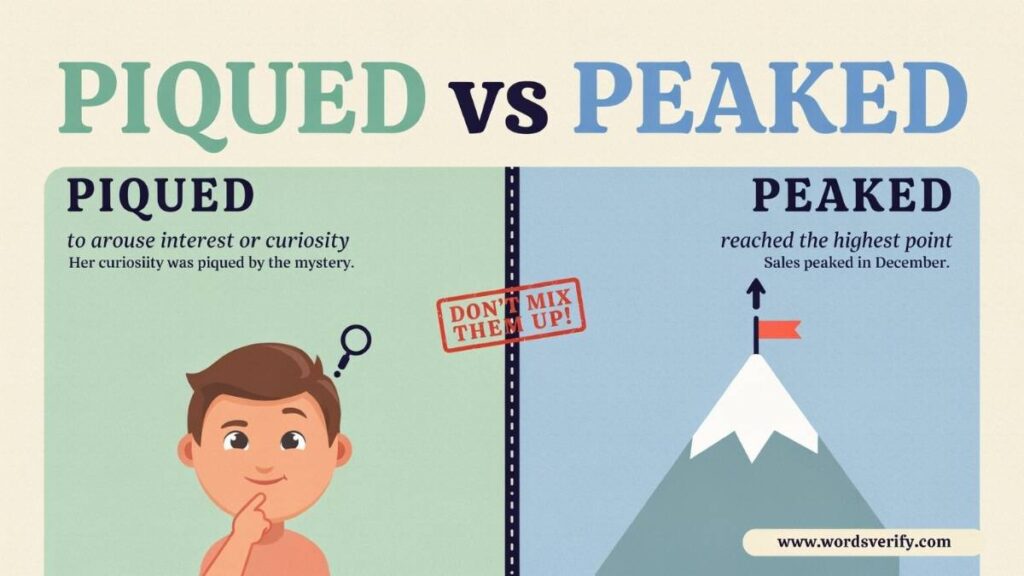
The difference between piqued and peaked comes down to meaning.
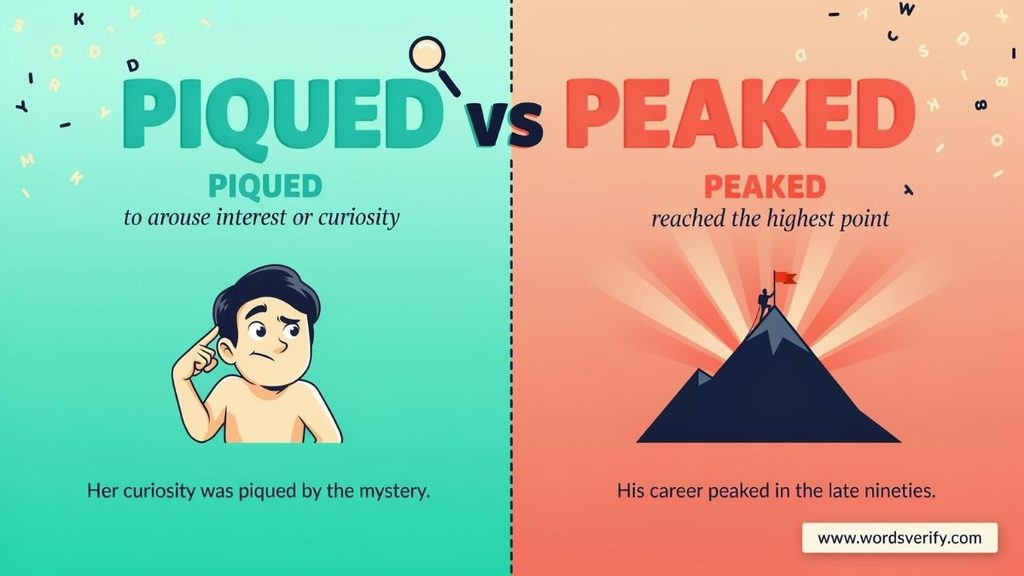
- Piqued means stimulated, aroused, or provoked a feeling such as curiosity, interest, irritation, or pride.
- Peaked means reached the highest point, greatest level, or maximum intensity.
- Peeked means took a quick or secret look at something.
For example, an unusual book title might pique your interest because it makes you curious. If your interest grows and eventually reaches its highest level, it has peaked. If you sneak a look at the final page before finishing the book, you’ve peeked.
at a Glance
| Feature | Piqued | Peaked | Peeked |
|---|---|---|---|
| Base verb | Pique | Peak | Peek |
| Main meaning | Stimulated or provoked | Reached the highest point | Took a quick look |
| Word form | Past tense and past participle | Past tense and past participle | Past tense and past participle |
| Common expression | Piqued my interest | Sales peaked in December | Peeked through the window |
| Typical context | Curiosity, interest, pride, irritation | Popularity, performance, demand | Looking or watching |
| Memory trick | Piqued my curiosity | Reached the peak | Took a peek |
Remember this simple rule: something piques your interest, something peaks at its highest point, and someone peeks at something they want to see.
Learn the difference between tricky more English words
Spoiled vs Spoilt Which One Is Correct?
What Does Piqued Mean?
Piqued is the past tense and past participle of the verb pique. It means stimulated, aroused, or provoked a response. That response might involve curiosity, interest, irritation, resentment, or pride.
In everyday English, piqued appears most often in expressions about interest and curiosity. A strange noise coming from the attic might pique your curiosity. An unexpected job offer might pique your interest. An insulting remark might pique your pride.
The word describes the reaction something triggers. It doesn’t mean that a feeling has reached its highest possible level.
Piqued in Simple English
If you’re wondering what piqued means, think of it as making someone curious, interested, or emotionally stirred.
Consider these examples:
- The unusual painting piqued my curiosity. The painting made me want to learn more about it.
- Her question piqued my interest in astronomy. Her question encouraged me to explore the subject.
- His careless remark piqued my pride. The remark challenged his sense of pride.
- The constant interruptions piqued her irritation. The interruptions provoked her annoyance.
The exact meaning depends on the context. Although piqued often describes positive or neutral reactions when paired with interest or curiosity, it can also describe negative emotions.
Common Expressions With Piqued
Here are several natural expressions that use the word:
- Piqued my interest
- Piqued my curiosity
- Piqued someone’s interest
- Piqued someone’s pride
- Piqued someone’s irritation
For example, you might say, “The interview piqued my interest in the company” or “His unexpected comment piqued her pride.”
Both sentences describe a reaction triggered by something else.
What Does “Piqued My Interest” Mean?
The phrase “piqued my interest” means something caught your attention and made you want to know more about it.
Imagine browsing a bookstore when a title catches your eye: The Mystery of the Missing Lighthouse. You haven’t read a single page, but the title makes you curious about the story. It has piqued your interest.
The expression works in many situations:
- The documentary piqued my interest in marine life.
- The company’s unusual hiring process piqued my interest in the position.
- One unexpected detail piqued the detective’s curiosity.
- Her explanation piqued my interest in learning another language.
- The article sparked my curiosity and encouraged me to investigate further.
The last example uses a different expression with a similar meaning. “Caught my attention” and “sparked my curiosity” are also natural choices when you want to describe something that makes you interested.
What Does “Piqued My Curiosity” Mean?
Piqued my curiosity means that something made you curious enough to ask questions, investigate, or seek an explanation.
For example, consider this sentence:
“The locked room at the end of the hallway piqued my curiosity.”
The room created a desire to discover what was inside. The sentence doesn’t tell you whether the speaker eventually opened the door. It describes the feeling that motivated the speaker to find out more.
Other expressions with a similar meaning include:
- Aroused my curiosity
- Sparked my curiosity
- Stimulated my curiosity
- Made me wonder
- Prompted me to investigate
Piqued Can Also Describe Irritation or Pride
Here’s a detail that’s easy to miss: pique doesn’t always describe pleasant curiosity.
You might encounter expressions such as “piqued his anger,” “piqued her resentment,” or “piqued their pride.” These phrases describe feelings that something has stirred or provoked.
For example, “The criticism piqued his pride, so he worked harder to prove himself.”
The criticism triggered an emotional response. The sentence doesn’t suggest that his pride reached a maximum level. That’s the key distinction between pique and peak.
Learn the difference between tricky more English words
Inclusivity vs Inclusiveness which one is correct?
What Does Peaked Mean?
Peaked is the past tense and past participle of peak. It means reached the highest point or greatest level within a particular period, range, or process.
Think of a mountain. Its summit represents the highest point. When something peaks, it reaches a comparable maximum.
The word frequently appears in discussions of business, sports, popularity, performance, demand, and personal development.
For example:
- Online traffic peaked shortly after the news broke.
- The singer’s popularity peaked in the early 2000s.
- His athletic performance peaked during the championship season.
- Traffic peaked just before the evening commute.
- Interest in the announcement peaked after the interview aired.
In each example, something reaches its greatest level. The word doesn’t mean that an event sparked the interest or caused the activity to begin.
Peaked in Simple English
If you’re asking what peaked means, imagine a line on a graph that rises, reaches its highest point, and then falls or levels off.
That highest point is the peak.
Suppose a store sells 100 products on Monday, 180 on Tuesday, 250 on Wednesday, and 400 on Thursday. If Thursday has the highest daily total, sales peaked that day.
The same idea applies to less measurable things. A person’s popularity may peak during a particular year. A runner may reach peak performance during a championship season. A company’s demand may peak before a major holiday.
The central idea is reaching a maximum, not causing something to become interesting.
Common Expressions With Peaked
| Expression | Meaning | Example |
|---|---|---|
| Sales peaked | Sales reached their highest level | Sales peaked in December. |
| Popularity peaked | Something reached its greatest popularity during the period discussed | The show’s popularity peaked in its third season. |
| Demand peaked | Demand reached its maximum | Demand for air conditioners peaked during the heat wave. |
| Performance peaked | Performance reached its highest level | Her performance peaked during the final round. |
| Interest peaked | Interest reached its highest level | Public interest peaked after the announcement. |
| Career peaked | A person’s career reached its high point | His career peaked after he won the championship. |
Notice the difference between interest being piqued and interest peaking. A surprising announcement can pique public interest. As more people follow the story, that interest may eventually peak.
The two words can describe different stages of the same event.
What Does “Peaked in High School” Mean?
The expression “peaked in high school” usually means that someone’s greatest popularity, success, or social status occurred during high school. It often carries a teasing or critical tone because it suggests that the person’s later life hasn’t matched that earlier high point.
For example:
“He peaked in high school and still talks about winning the football championship.”
The speaker implies that the championship represented the person’s high point. The phrase can be humorous, but it can also sound dismissive. It isn’t an objective judgment about someone’s entire life.
Can Peaked Mean Sickly or Pale?
Yes. Peaked has another meaning as an adjective: looking pale, tired, or unwell. This usage is particularly familiar in British English and some traditional writing.
For example:
- You look a little peaked. Are you feeling all right?
- He looked peaked after several nights of poor sleep.
Here, peaked doesn’t mean that the person reached a maximum level of anything. It describes a pale or sickly appearance.
In everyday American English, people are often more likely to say pale, tired, or under the weather. However, it’s useful to recognize this meaning when reading British English or older writing.
Learn the difference between tricky more English words
Emaculate vs Immaculate which one is correct?
Piqued vs Peaked The Main Difference
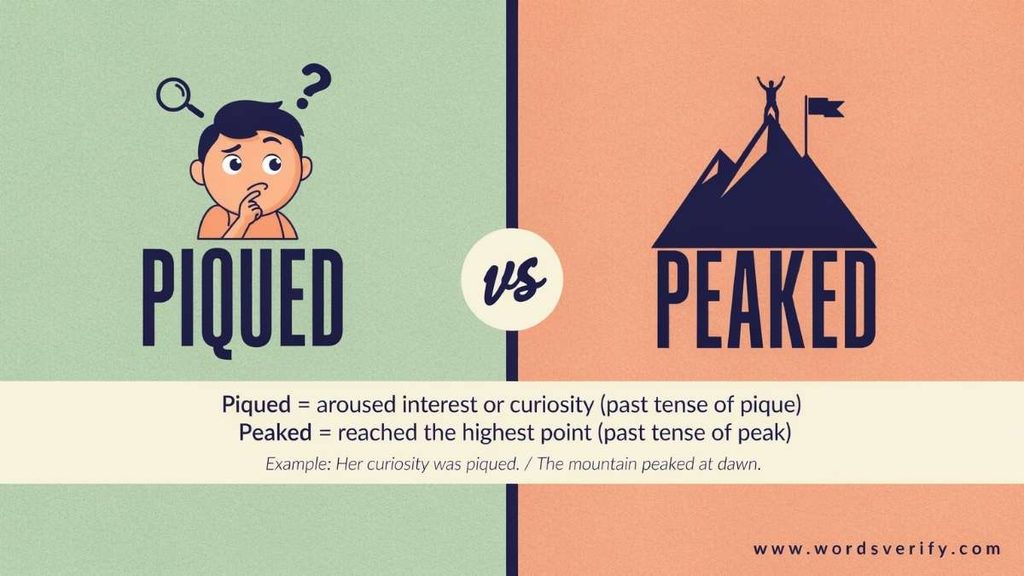
The difference between piqued vs peaked comes down to what happens in the sentence. Piqued describes stimulating or provoking a response. Peaked describes reaching the highest point.
Both words can appear in sentences about interest, which explains why people confuse them. However, the intended meaning helps you identify the correct choice.
Meaning Compared
| Sentence | Correct word | Why it works |
|---|---|---|
| The mysterious letter ___ my curiosity. | Piqued | The letter stimulated curiosity. |
| Demand for the product ___ in August. | Peaked | Demand reached its highest level. |
| The news ___ her interest in the company. | Piqued | The news made her interested in the company. |
| Public interest ___ after the final episode. | Peaked | Public interest reached its maximum. |
| His unexpected comment ___ my pride. | Piqued | The comment provoked a personal reaction. |
| Her performance ___ during the championship. | Peaked | Her performance reached its highest level. |
A useful way to understand the difference is to ask what the subject does. Does it stimulate a feeling, or does it reach a high point?
If a new discovery makes you curious, it piques your curiosity. If that curiosity grows until it reaches its greatest intensity, it peaks.
Can Both Words Appear in the Same Sentence?
Absolutely. Using both words together is an excellent way to understand their meanings.
Consider this example:
“The announcement piqued public interest, which peaked the following week.”
The announcement stimulated interest. Over the following week, that interest grew and reached its highest level.
Here’s another example:
“The coach’s advice piqued the athlete’s interest in nutrition, and that interest peaked during the final month of training.”
The first part explains what sparked the interest. The second identifies when the interest became strongest.
This distinction matters in writing because replacing one word with the other can change the meaning of an otherwise grammatically sound sentence.
Learn the difference between tricky more English words
Vinal vs Vinyl Which one Is Correct?
“Piqued My Interest” vs “Peaked My Interest”
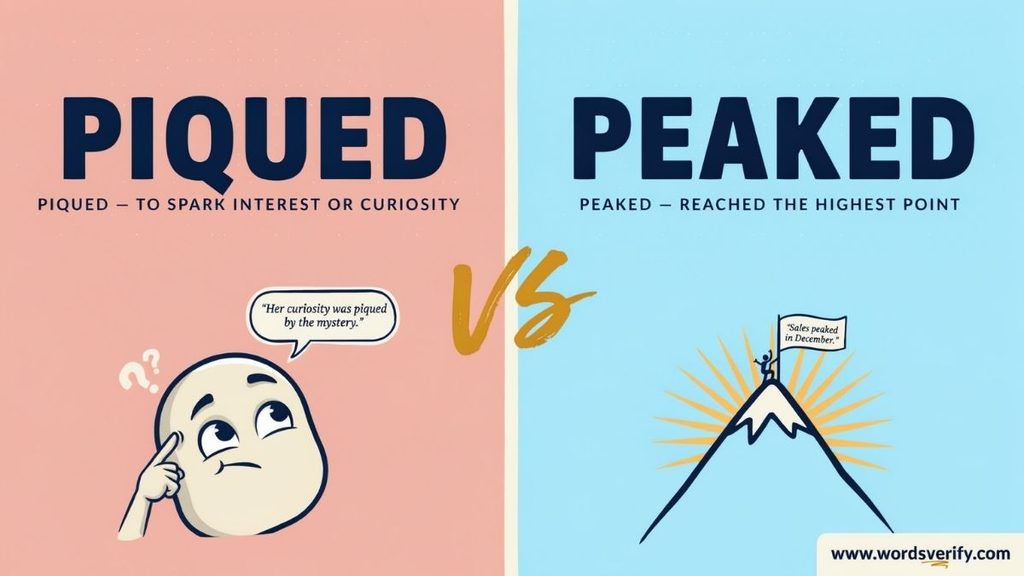
Few examples illustrate this confusion better than the familiar expression “piqued my interest.” If you want to say that something made you curious, this is the correct spelling.
“Peaked my interest” is generally considered incorrect when the intended meaning is to spark curiosity. Although people sometimes use it informally, the expression confuses two different meanings.
Why “Piqued My Interest” Is Correct
The verb pique means to stimulate or provoke. When a book, conversation, person, or discovery piques your interest, it makes you want to know more.
For example:
- The professor’s explanation piqued my interest in psychology.
- A job advertisement piqued her interest in the company.
- His story piqued my curiosity about life in Antarctica.
- The unusual recipe piqued my interest in Korean cooking.
Each sentence describes something that awakens curiosity or encourages further exploration.
The spelling may look unusual because pique isn’t as familiar as peak. The word entered English through French and developed meanings related to stimulating or provoking a feeling.
Is “Peaked My Interest” Ever Correct?
The answer depends on what you mean. If you’re saying that something sparked your curiosity, use piqued my interest. If you’re describing interest reaching its maximum level, use peaked with interest as the subject.
Compare these sentences:
- Correct: The interview piqued my interest in the company.
- Correct: My interest in the company peaked after the interview.
- Usually incorrect for the intended meaning: The interview peaked my interest in the company.
The third sentence uses peaked as though it means stimulated. That’s the problem. In standard usage, peak describes something reaching its own highest point rather than causing something else to become interesting.
A simple alternative is to rewrite the sentence so the meaning becomes clear. Instead of “The interview peaked my interest,” write “The interview piqued my interest” or “The interview increased my interest.”
Piqued Interest vs Peaked Interest
These expressions differ because one describes a trigger and the other describes a level.
Piqued interest means interest that has been stimulated or awakened. A fascinating museum exhibit might pique a child’s interest in dinosaurs.
Peaked interest is sometimes used to describe interest that has reached its highest level. However, the wording can be less clear when it appears directly before a noun. A sentence such as “Interest in renewable energy peaked in June” expresses the meaning more naturally.
Compare the examples:
- “The lecture piqued interest in renewable energy.” The lecture stimulated interest.
- “Interest in renewable energy peaked in June.” Interest reached its highest level in June.
Use piqued interest when something sparks a response. Use interest peaked when the response reaches a maximum.
Learn the difference between tricky more English words
Encorporate vs Incorporate Which one Is Correct?
Piqued vs Peaked Examples in Sentences
Examples help turn a spelling rule into a habit. The following sentences show how each word works in different situations.
Examples With Piqued
- The strange footprints piqued the hikers’ curiosity.
- Her experience working abroad piqued my interest in international careers.
- The detective’s discovery piqued the journalist’s curiosity.
- His unfair accusation piqued her pride.
- The first chapter piqued my interest in the novel.
- A question about artificial intelligence piqued the students’ interest in computer science.
- The unexpected criticism piqued his irritation.
In each sentence, piqued describes a feeling or reaction that something stimulates or provokes.
Examples With Peaked
- Online traffic peaked shortly after the news broke.
- The athlete’s performance peaked during the championship.
- Demand for heaters peaked during the coldest week of winter.
- The band’s popularity peaked after its second album.
- My excitement peaked just before the concert began.
- The company’s profits peaked in the third quarter.
- He looked peaked after spending several days recovering from the flu.
The first six examples describe reaching a maximum. The final example uses peaked as an adjective meaning pale or unwell.
A Short Case Study One Event, Two Different Words
Imagine that a science museum opens an exhibit about the possibility of life on Mars.
On opening day, a news report about the exhibit piques public interest. People begin asking questions, searching for information, and planning visits.
During the following week, visitor numbers rise. By Saturday, the museum records its highest attendance of the month. Attendance has peaked.
The following week, attendance falls to a more typical level.
Both words describe the same story, but they do different jobs. Piqued explains what stimulated interest. Peaked identifies the point when attendance reached its maximum.
This distinction is useful in articles, reports, business writing, and everyday conversations because it allows you to describe both the cause of a reaction and its later development.
Learn the difference between tricky more English words
Performed vs Preformed which one is correct?
Piqued, Peaked, and Peeked What Is the Difference?
English contains many commonly confused words that sound alike but carry different meanings. Piqued, peaked, and peeked are a classic example.
These words are homophones in many standard English accents because they share the same pronunciation. Their spelling and meaning, however, are different.
at a Glance
| Word | Base verb | Meaning | Example |
|---|---|---|---|
| Piqued | Pique | Stimulated or provoked | The mystery piqued my curiosity. |
| Peaked | Peak | Reached the highest point | Sales peaked in December. |
| Peeked | Peek | Took a quick or secret look | She peeked through the curtains. |
What Does Peeked Mean?
Peeked is the past tense and past participle of peek. It means looked quickly, briefly, or secretly, often because someone wants to see something without being noticed.
For example:
- He peeked through the keyhole.
- She peeked at the birthday presents.
- The child peeked around the corner.
- I peeked at the last page before finishing the book.
Unlike piqued, peeked doesn’t describe stimulating curiosity. Unlike peaked, it doesn’t describe reaching the highest point.
Is “Peeked My Interest” Correct?
No, not if you mean that something made you curious. Peeked my interest doesn’t express that meaning in standard English.
Use these distinctions:
- “The headline piqued my interest.” The headline stimulated my curiosity.
- “My interest peaked when the speaker revealed the results.” My interest reached its highest level.
- “I peeked at the results before the presentation.” I took a quick look at the results.
These three sentences demonstrate the difference between pique, peak, and peek without changing the basic situation.
Peek vs. Peak vs Pique
The base forms follow the same pattern:
- Pique means to stimulate or provoke a feeling.
- Peak means to reach the highest point or level.
- Peek means to take a quick look.
When choosing among these commonly confused English words, focus on the action rather than the sound. Ask whether you’re describing a feeling, a maximum, or a glance.
Learn the difference between tricky more English words
Offered vs Offerred Which one Is Correct?
Common Mistakes With Piqued vs Peaked
Even strong writers make spelling mistakes when two words sound identical. Fortunately, most errors involving piqued and peaked become easy to fix once you understand the meaning behind each word.
Writing “Peaked My Interest”
Incorrect for the intended meaning: “The podcast peaked my interest in personal finance.”
Correct: “The podcast piqued my interest in personal finance.”
The podcast stimulated curiosity rather than causing interest to reach its maximum level.
If you want a simpler alternative, write “The podcast sparked my interest in personal finance.” The meaning stays clear without relying on a word that some readers may find unfamiliar.
Confusing Piquing Interest With Interest Peaking
These expressions may contain the same noun, but they describe different events.
Incorrect for the intended meaning: “The documentary peaked my curiosity about space.”
Correct: “The documentary piqued my curiosity about space.”
Also correct: “My curiosity about space peaked after I watched the documentary.”
In the first correct sentence, the documentary stimulates curiosity. In the second, curiosity reaches its highest level after the viewing experience.
Using Peeked Instead of Piqued
Incorrect: “The unusual headline peeked my interest.”
Correct: “The unusual headline piqued my interest.”
Peeked describes looking at something. It doesn’t mean arousing curiosity.
However, you could write, “I peeked at the headline while walking past the newsstand.” In that sentence, peeked correctly describes a quick glance.
Assuming Piqued Always Means Interested
Although piqued my interest is the best-known expression, pique has a broader meaning.
For example, “The rude comment piqued his pride.”
Here, piqued describes a reaction involving pride rather than curiosity. The context tells you which feeling the word describes. Replacing piqued with peaked would change the intended meaning.
Learn the difference between tricky more English words
Tapping vs Taping which one is correct?
Why Do People Confuse Piqued and Peaked?
The confusion isn’t surprising. In most American English accents, pique and peak sound alike. The difference lies in their spelling, history, and meaning rather than their pronunciation.
Several factors make these words easy to mix up:
- Similar pronunciation: Because piqued and peaked sound alike, you can’t always identify the correct spelling by listening.
- Familiar spelling patterns: The word peak is familiar from expressions such as mountain peak and peak performance. Writers may choose it automatically.
- Unfamiliar vocabulary: Some people encounter pique mainly in the phrase piqued my interest and don’t recognize it as a verb.
- Autocorrect and typing habits: Spell-checking tools may not flag a correctly spelled word used in the wrong context.
- Confusing sentence patterns: Both words can appear in sentences about interest, which makes the difference less obvious at first.
These words are a useful reminder that correct spelling involves more than knowing which letters sound right. You must also understand what the sentence means.
How to Remember Piqued vs Peaked
The easiest way to remember these words is to connect each one to a familiar expression. You don’t need a complicated grammar rule or a long list of exceptions.
Piqued = Piqued My Curiosity
Think of piqued whenever something sparks your interest or provokes a feeling.
Memory phrase: Piqued my curiosity.
Example: “The strange noise piqued my curiosity.”
The noise made you wonder what caused it.
Peaked = Reached the Peak
Connect peaked to a mountain summit. A peak represents the highest point, so something that peaks reaches its maximum level.
Memory phrase: Reached the peak.
Example: “The team’s performance peaked during the final match.”
The team’s performance reached its highest level during that match.
Peeked = Took a Peek
Connect peeked to the familiar phrase “take a peek.”
Memory phrase: Peeked through the door.
Example: “She peeked into the room before entering.”
She took a quick look inside.
Learn the difference between tricky more English words
Emersion vs Immersion which one is correct?
Synonyms for Piqued vs Peaked
Synonyms can help you check whether you’ve chosen the correct word. If a replacement makes the sentence clearer while preserving its meaning, it may also help you spot a spelling error.
Synonyms for Piqued
Depending on the context, possible alternatives include:
- Stimulated: The discussion stimulated my interest in history.
- Sparked: The article sparked my curiosity.
- Aroused: The discovery aroused his curiosity.
- Provoked: The remark provoked her irritation.
- Engaged: The lesson engaged the students’ interest.
These words aren’t exact substitutes in every situation. For example, provoked may suggest a stronger or more negative reaction than stimulated.
Synonyms for Peaked
Depending on the sentence, alternatives include:
- Reached its highest point: Attendance reached its highest point in July.
- Topped out: Demand topped out during the summer.
- Hit its maximum: Production hit its maximum in September.
- Reached its height: The trend reached its height in the early 2000s.
- Reached its peak: The athlete reached her peak performance during the final.
Choose a synonym that preserves the meaning and fits the tone of your writing. In formal reports, reached its highest level may be clearer than a conversational expression such as topped out.
When Should You Use Piqued vs Peaked?
When you’re unsure whether to use piqued vs peaked, start by identifying the subject and the action.
Use piqued when something triggers curiosity, interest, irritation, or pride. Use peaked when something reaches the highest point or level within a particular period or range.
Here’s a practical guide:
| Situation | Correct choice | Example |
|---|---|---|
| A book makes you curious | Piqued | The book piqued my interest. |
| A trend reaches its maximum | Peaked | The trend peaked in April. |
| A comment provokes pride | Piqued | His remark piqued her pride. |
| Demand reaches its highest level | Peaked | Demand peaked before Christmas. |
| Someone takes a secret glance | Peeked | He peeked at the answer. |
| Someone looks pale or unwell | Peaked | She looked peaked after the long trip. |
For a quick proofreading check, try replacing piqued with sparked or stimulated. If the sentence keeps its intended meaning, piqued may be the right choice.
Similarly, try replacing peaked with reached its highest point. If that works, you’ve probably found the correct word.
Learn the difference between tricky more English words
Conex vs Connex which one is correct?
Practice session Piqued vs Peaked
Test your understanding of “piqued,” “peaked,” and “peeked” with these 25 fill-in-the-blank questions. Choose the word that best completes each sentence.
Fill in the Blanks
Complete each sentence with the correct word: piqued, peaked, or peeked.
- The mysterious headline ______ my curiosity.
- The company’s sales ______ during the holiday season.
- She ______ through the window to see who was outside.
- The documentary ______ his interest in marine life.
- My excitement ______ when I finally reached the concert venue.
- The little boy ______ at his birthday presents before the party.
- The unexpected discovery ______ the scientist’s interest.
- The temperature ______ at 102 degrees yesterday.
- I ______ into the room to check whether everyone was asleep.
- The teacher’s unusual question ______ the students’ curiosity.
- Her popularity ______ after the release of her first album.
- He ______ through the gap in the curtains.
- The detective’s suspicion was ______ by the strange footprints.
- Demand for the product ______ last summer.
- The children ______ at the surprise decorations.
- The intriguing book cover ______ my interest.
- His athletic performance ______ during his final year of college.
- She ______ out from behind the door.
- The strange noise ______ the dog’s curiosity.
- The athlete’s career ______ when he won the national championship.
- I ______ at the clock to check the time during the meeting.
- The rising cost of fuel ______ the public’s concern.
- Tourist numbers ______ during the summer months.
- The cat ______ around the corner before entering the kitchen.
- The professor’s fascinating lecture ______ my interest in history.
Answers
- piqued
- peaked
- peeked
- piqued
- peaked
- peeked
- piqued
- peaked
- peeked
- piqued
- peaked
- peeked
- piqued
- peaked
- peeked
- piqued
- peaked
- peeked
- piqued
- peaked
- peeked
- piqued
- peaked
- peeked
- piqued
Here’s a trusted source for clear more words Comparison:
FAQs
What is the difference between “peak interest” and “peak performance”?
“Peak interest” is usually a mistaken form of “pique interest,” which means to spark curiosity. “Peak performance” is correct and refers to someone or something performing at its highest level.
Can “pique” be used as a noun?
Yes. As a noun, “pique” can mean a feeling of irritation or resentment, often caused by wounded pride. For example: “He left the meeting in a fit of pique.”
Is “peaked” always related to reaching the highest point?
No. Although “peaked” often means reached a maximum, it can also describe someone who looks pale or unwell. For example: “She looked peaked after staying up all night.” This use is more common in some varieties of English than others.
What is the difference between “at its peak” and “has peaked”?
“At its peak” describes something that is currently at its highest point. “Has peaked” means it has already reached that point. For example, “Tourism is at its peak” describes the current situation, while “Tourism has peaked” suggests the busiest period may be over.
Can “pique” describe anger as well as curiosity?
Yes. The verb “pique” can mean to stimulate interest or curiosity, but it can also mean to provoke or arouse a feeling such as anger or resentment. The surrounding sentence helps clarify the intended meaning.
What are common collocations with “peak”?
Common expressions include “peak season,” “peak hours,” “peak demand,” “peak condition,” “peak level,” and “reach a peak.” These phrases generally describe a maximum level, a busiest period, or an optimal state.
How can you avoid confusing words that sound alike?
Focus on meaning rather than pronunciation. Connect “pique” with sparking curiosity, “peak” with a mountain’s top, and “peek” with taking a quick look. Reading the full sentence aloud and checking whether the meaning fits can also help you catch mistakes.
Is “pique” used in formal writing?
Yes. “Pique” is appropriate in professional and academic writing when you want to describe something that stimulates curiosity or interest. For example, “The report’s unexpected findings piqued the researchers’ interest.”
What does “peak” mean when describing a person’s life or career?
When someone says a person has “peaked,” they usually mean that person has reached their highest level of success, popularity, or achievement. Depending on the context, it can be complimentary or teasing. Saying someone “peaked in high school,” for instance, suggests their best or most successful period happened during those years.
Can “pique” be used with words other than “interest” and “curiosity”?
Yes. You can pique someone’s attention, imagination, or suspicion. For example, “The unusual footprints piqued the detective’s suspicion.” The verb suggests that something has stirred or awakened a response.
conclusion
Understanding piqued vs peaked vs. peeked is easier than scaling a mountain with a grammar book in your backpack! Remember that “piqued” means sparked interest or stirred a feeling, “peaked” means reached the highest point, and “peeked” means took a quick look. Each word has its own purpose, so using the wrong one can send your sentence climbing in the wrong direction. A fascinating story piques your curiosity, excitement peaks before a big event, and a sneaky glance means you’ve peeked. Keep these simple distinctions in mind and you’ll write with greater clarity and confidence. After all, your curiosity should be piqued, your achievements should reach their peak, and your grammar mistakes should disappear without anyone needing to peek at your answers!

Lisa AJS is an experienced blogger and language enthusiast at Words Verify, dedicated to making grammar simple, practical, and enjoyable. She writes engaging content on commonly confused words, grammar mistakes, word meanings, and everyday language challenges.