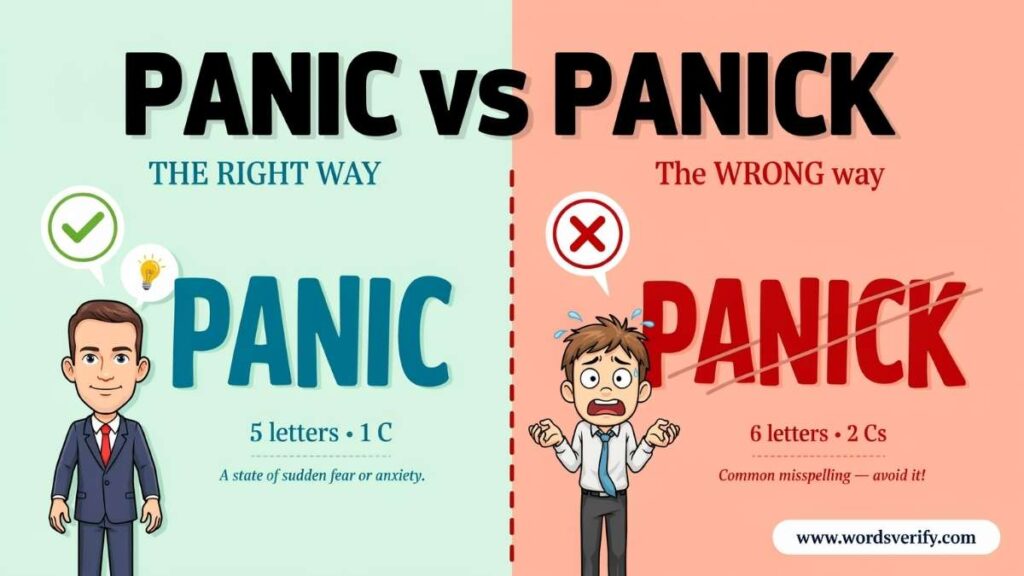
Ever had a spelling mistake turn a perfectly calm sentence into a grammatical panic? The confusion between panic vs panick is more common than you might think. One spelling is correct while the other adds an unnecessary letter to the mix. The tricky part? Words like “panicked” and “panicking” really do contain a k, making the mistake surprisingly easy to understand. Fortunately, you don’t need to panic over English spelling. A simple rule explains the difference and helps you remember the correct form. Let’s explore the meaning, spelling rules, and practical examples so you can write with confidence and avoid this common mistake.
Quick Answer
Panic is the correct spelling. It works as both a noun and a verb and describes sudden fear or a reaction to fear.
Panick is not the standard spelling of this word. Adding a k to the base word is unnecessary.
Consider these examples for Panic vs Panick:
- Correct: Don’t panic when you see the warning light.
- Incorrect: Don’t panick when you see the warning light.
- Correct: She panicked when she couldn’t find her passport.
- Correct: He is panicking about tomorrow’s exam.
Notice how the spelling changes in the last two examples. The base word is panic, but its past-tense form is panicked and its present participle is panicking.
| Word | Correct? | Meaning or use |
|---|---|---|
| Panic | Yes | Base word used as a noun or verb |
| Panick | No | Nonstandard spelling of panic |
| Panics | Yes | Third-person singular present tense |
| Panicked | Yes | Past tense and past participle |
| Panicking | Yes | Present participle or gerund |
| Panicky | Yes | Adjective describing nervousness or alarm |
If you’re wondering whether to write panic vs panick, choose panic when you need the base word.
Learn how to use confusing more words correctly
Vendor vs Vender which one is correct?
What Does Panic Mean?
Panic describes a sudden feeling of intense fear or alarm. It can also refer to the reaction someone has when a situation feels frightening, uncertain, or difficult to control.
Imagine arriving at the airport and discovering that your passport isn’t in your bag. Your heart starts racing as you check every pocket and search through your luggage. That overwhelming feeling of fear is panic.
The word can describe an individual’s reaction or the response of a larger group. A crowd might panic when an alarm sounds unexpectedly. Investors might panic when financial markets fall sharply. In both cases, fear influences how people react.
The meaning depends on how the word appears in a sentence.
Panic as a Noun
As a noun, panic refers to a feeling or state of sudden fear. It often appears in expressions such as “in a panic,” “a wave of panic,” and “panic spread.”
Examples include:
- A wave of panic swept through the crowd when the lights went out.
- She felt a moment of panic before giving her presentation.
- The unexpected announcement caused panic among employees.
- He searched for his keys in a panic because his flight was leaving soon.
- The emergency team acted quickly to prevent panic.
In these sentences, panic names an emotion or state of alarm.
The word also appears in familiar expressions such as panic attack, panic button, panic buying, and panic room. Each expression has a particular meaning, but all relate to fear, urgency, or an attempt to respond to a threat.
Panic as a Verb
As a verb, panic means to become frightened suddenly or react with overwhelming fear. It often describes a person’s response to an unexpected or stressful situation.
For example:
- Don’t panic if the train is delayed.
- She tends to panic before important examinations.
- The passengers panicked when smoke filled the cabin.
- He panics whenever he has to speak in front of a large audience.
- We started to panic when nobody answered the emergency phone.
The verb changes according to the tense. You might panic about a problem today, panicked yesterday, or be panicking right now.
Choosing the right form depends on the sentence. The spelling changes according to the grammatical ending rather than at random.
Panic in Everyday English
Panic doesn’t always describe a serious emergency. People also use it when talking about ordinary problems, such as a missed deadline, an unexpected bill, or a message that sounds more worrying than it really is.
Consider these sentences:
- I panicked when my computer froze before the meeting.
- There’s no need to panic because the file has a backup.
- She panics whenever she thinks she’s running late.
People sometimes use panic humorously to exaggerate a minor problem. Someone might say, “I panicked when the restaurant ran out of fries.” The statement makes an ordinary inconvenience sound dramatic for comic effect.
The spelling remains the same whether the situation is serious or amusing.
Learn how to use confusing more words correctly
Worse vs Worst which one is correct?
Why Is Panick Incorrect?
The main difference between panic vs panick is spelling. Standard modern English uses panic as the base form of the word. Panick adds an unnecessary k.
English contains many words that end in ck, including stick, brick, and quick. That familiar pattern might lead you to assume that panic should follow the same spelling. However, the established spelling of panic doesn’t include a final k.
The confusion becomes more understandable when you encounter panicked and panicking. Both forms contain ck, so you might assume that the base word must contain those letters, too. It doesn’t.
Is Panick a Real Word?
Panick isn’t the standard spelling of the English word panic. In ordinary writing, dictionaries and standard spelling conventions recognize panic as the correct form.
You might encounter panick in a username, brand name, fictional title, or informal online post. Someone may deliberately choose that spelling for a particular purpose. Such uses don’t change the accepted spelling of the ordinary English word.
It’s also important to distinguish an unusual spelling from an archaic one. An archaic spelling has a documented history of earlier use. Finding an occasional old text or modern name containing panick isn’t enough to establish it as an accepted obsolete spelling.
Unless you’re reproducing a historical source or referring to a proper name, use panic.
Panic vs Panick Key Differences
| Feature | Panic | Panick |
|---|---|---|
| Standard spelling | Correct | Incorrect |
| Meaning | Sudden fear or a reaction to fear | No standard independent meaning as a variant of panic |
| Base form | Yes | No |
| Use as a noun | Yes | Not as the standard form |
| Use as a verb | Yes | Not as the standard form |
| Formal writing | Appropriate | Avoid |
| Past tense | Panicked | Not applicable |
| Present participle | Panicking | Not applicable |
The difference isn’t a matter of personal preference or American versus British spelling. Panic is the standard form in both varieties of English.
Learn how to use confusing more words correctly
Piqued vs Peaked which one is correct?
Panic, Panicked, and Panicking The Spelling Rule
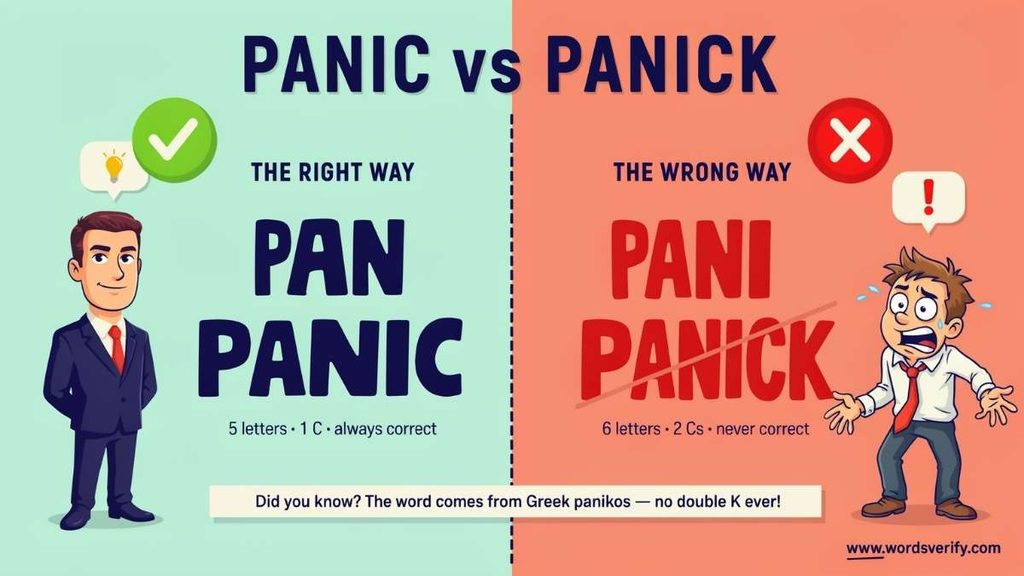
Here’s where English spelling becomes interesting panic vs panick. The word panic changes when you add certain endings. The base word ends in c, but its past-tense and present-participle forms use ck.
This spelling convention helps preserve the hard k sound before certain suffixes. It doesn’t mean that panick becomes a correct base form.
Why Does Panicked Have a K?
The correct past tense of panic is panicked, not paniced.
When you add the past-tense ending -ed to panic, you insert a k before the ending. This produces the spelling panicked and preserves the hard k sound.
Compare these examples:
- Panic becomes panicked.
- Picnic becomes picnicked.
- Mimic becomes mimicked.
- Traffic becomes trafficked.
These verbs follow a similar spelling pattern. The added k helps maintain the intended consonant sound before the ending.
For example:
- Correct: She panicked when the fire alarm went off.
- Incorrect: She paniced when the fire alarm went off.
The incorrect form may look logical if you simply attach -ed to panic. However, standard English spelling requires panicked.
Why Is Panicking Spelled With a K?
The same principle explains panicking. When you add -ing to panic, the spelling changes to panicking.
The sequence is simple:
Panic → Panicking
The final c becomes ck before the suffix. You don’t add another k after the existing ck.
Examples:
- Correct: He is panicking about the results.
- Incorrect: He is paniccing about the results.
- Incorrect: He is panickking about the results.
The correct form contains one c followed by one k before -ing. That spelling preserves the hard k sound.
Why Is Panic Spelled Without a K?
The base word follows its established spelling. English doesn’t require every word to use the same letter combination in every grammatical form.
In panic, the final c represents the hard k sound. When you add certain vowel-starting suffixes, the spelling convention uses ck to preserve that sound.
This is why the base word remains panic while the derived forms include panicked and panicking.
Consider the word mimic:
- Mimic is the base form.
- Mimicked is the past tense.
- Mimicking is the present participle.
You wouldn’t normally write mimick as the base word simply because mimicked contains ck. The same logic applies to panic.
What About Panicky?
Panicky is the correct adjective form. It describes someone or something that seems nervous, frightened, or alarmed.
When you add -y to panic, the spelling becomes panicky. The added k preserves the hard k sound before the ending.
Examples include:
- The room grew tense and panicky.
- She gave a panicky response to the unexpected news.
- His panicky expression made everyone ask what had happened.
Panicky differs slightly from panicked. Panicky describes a nervous or frightened quality, while panicked often describes someone who has experienced panic or feels overwhelmed by it.
Learn how to use confusing more words correctly
Inclusivity vs Inclusiveness which one is correct?
Panic vs Panick vs Panicking Understanding the Grammar
Although these words come from the same base, you can’t always substitute one for another. Each form has a different grammatical purpose.
| Form | Grammatical use | Example |
|---|---|---|
| Panic | Base verb or noun | Don’t panic. |
| Panics | Third-person singular present tense | She panics before interviews. |
| Panicked | Past tense or past participle | They panicked during the storm. |
| Panicking | Present participle or gerund | He is panicking about the deadline. |
| Panicky | Adjective | His panicky voice revealed his fear. |
When to Use Panic
Use panic when you need the base verb or the noun.
As a verb:
- I don’t want to panic before the interview.
- People sometimes panic when plans change unexpectedly.
- Try not to panic over a small mistake.
As a noun:
- Panic spread through the station.
- Her initial panic soon faded.
- The announcement caused widespread panic.
In “Don’t panic,” the word functions as a verb. In “The panic subsided,” it functions as a noun.
When to Use Panics
Use panics with a singular third-person subject in the simple present tense, such as he, she, or it.
Examples:
- She panics whenever she hears unexpected noises.
- He panics when he can’t find his phone.
- The dog panics during thunderstorms.
The final s marks the present-tense form. It doesn’t change the base word to panicks.
When to Use Panicked
Use panicked for a completed past action or as a past participle.
Examples:
- She panicked when she missed the last bus.
- They panicked after hearing the alarm.
- He has panicked over similar problems before.
- The passengers were panicked by the sudden announcement.
In the final example, panicked describes the passengers’ emotional state.
Remember that panicked serves as both the simple past form and the past participle of panic.
When to Use Panicking
Use panicking for an ongoing action or when the verb acts as a noun-like gerund.
Examples:
- She is panicking about her final exam.
- The passengers were panicking when help arrived.
- Panicking won’t make the problem disappear.
- He kept panicking even after the situation improved.
In “Panicking won’t help,” the word functions as a gerund. It names the action rather than simply describing what someone is doing.
What Is the Plural of Panic?
The answer depends on whether you’re using panic as a noun or a verb.
As a verb, panics is the form used with a singular third-person subject. As a noun, panic is generally uncountable when it refers to an emotion or a general state of fear.
For example:
- The crowd felt panic.
- Panic spread through the building.
- Several episodes of panic occurred during the incident.
Writers may use panics as a noun when referring to separate episodes or outbreaks of fear. However, panic is usually uncountable in everyday usage. Don’t confuse the verb form panics with a plural noun.
Learn how to use confusing more words correctly
Emaculate vs Immaculate which one is correct?
Panic vs Panick Examples in Sentences
panic vs panick Examples make spelling rules easier to remember because they show how words work in real situations. These sentences cover everyday conversations, schoolwork, professional writing, and emergencies.
Everyday Situations
- Don’t panic if you can’t find your wallet immediately.
- She panicked when her phone battery died before the trip.
- He is panicking because he forgot to set his alarm.
- The children began to panic when they couldn’t find their parents.
- There’s no reason to panic over a minor scheduling change.
Each sentence uses a correct form of panic. None requires the misspelled base form panick.
Workplace and Academic Situations
- The student panicked when the teacher announced a surprise quiz.
- Don’t panic if your presentation slides stop working.
- She is panicking about the project deadline.
- The manager remained calm while the rest of the team started to panic.
- Panicking before an interview can make it harder to organize your thoughts.
Correct spelling matters in professional and academic communication. A single mistake won’t necessarily prevent readers from understanding you, but repeated errors can distract them from your message.
Emergency Situations
- The passengers panicked when smoke appeared in the hallway.
- The emergency workers told everyone not to panic.
- Panic spread through the crowd after the loud explosion.
- The family tried to remain calm during the power outage.
- The sudden alarm caused a brief moment of panic.
In emergency-related writing, panic describes fear or a reaction to a perceived threat. It shouldn’t be treated as a precise medical diagnosis simply because someone feels frightened.
Incorrect and Correct Examples
| Incorrect sentence | Correct sentence |
|---|---|
| Don’t panick about the meeting. | Don’t panic about the meeting. |
| She paniced when the lights went out. | She panicked when the lights went out. |
| He is paniccing over the results. | He is panicking over the results. |
| She gave a panickky response. | She gave a panicky response. |
| He always panicks before exams. | He always panics before exams. |
These examples highlight three common problems: misspelling the base word, applying a suffix incorrectly, and choosing the wrong grammatical form.
Learn how to use confusing more words correctly
Vinal vs Vinyl Which one Is Correct?
Common Mistakes When Spelling Panic
English spelling errors often happen when a familiar pattern seems more logical than the established spelling. Panic creates several opportunities for this kind of confusion.
Writing Panick Instead of Panic
This is the main mistake in the panic versus panick debate. Writers add a k because they expect the word to follow the pattern of words such as kick or stick.
The solution is straightforward: memorize the base word as panic. Add the k only when forming the appropriate derived forms, such as panicked, panicking, and panicky.
Writing Paniced Instead of Panicked
The mistake paniced occurs when someone adds -ed without adjusting the final consonant spelling.
Remember the sequence:
- Panic: base form.
- Panicked: past tense.
- Panicking: present participle.
The extra k belongs in the derived forms. It isn’t part of the base spelling.
Confusing Panic With Panicky
Both words are correct, but they serve different purposes.
- Panic can be a noun or a verb.
- Panicky is an adjective describing a nervous or frightened state.
For example, “She began to panic” describes an action. “She sounded panicky” describes how she sounded.
Typing Too Quickly
Sometimes a spelling error isn’t a grammar problem at all. It’s simply a typing mistake.
You might know the correct spelling perfectly well yet type panick because your fingers add an extra letter automatically. This happens with many commonly misspelled English words.
A quick proofreading check can catch these errors. Look at the base word first and then confirm that you’ve added the correct ending.
Learn how to use confusing more words correctly
Encorporate vs Incorporate Which one Is Correct?
Easy Ways to Remember the Correct Spelling
You don’t need to memorize a long list of rules to get this word right. A few simple techniques can help you remember its correct forms.
Memorize the Word Family
Learn these forms together:
Panic → Panics → Panicked → Panicking → Panicky
Seeing the words as a family helps you recognize how they relate to one another. It also makes the spelling changes easier to remember.
Remember That the Base Word Has No K
When you’re unsure how to spell the word, return to the simplest form: panic.
Don’t let the ck in panicked convince you that panick must be correct. The extra letter appears because of the spelling pattern used before certain suffixes.
Use a Simple Sentence
Try remembering this sentence:
“Don’t panic when you see panicked or panicking.”
It reinforces the difference between the base word and its derived forms. A short sentence can be more useful than memorizing an abstract rule.
Proofread With Context
Spell-check tools can help identify panick as a likely error. However, they won’t always catch every mistake, especially when a misspelled form appears in a name or the intended meaning is unclear.
Read the entire sentence after checking the spelling. Ask yourself two questions:
- Does the sentence need the base word panic or another form?
- Does the ending match the tense and grammatical role?
This habit helps prevent both spelling and grammar mistakes.
Learn how to use confusing more words correctly
Performed vs Preformed which one is correct?
Is Panic Spelled Differently in American and British English?
No. Panic is the standard spelling in both American and British English. The forms panicked, panicking, and panicky are also standard in both varieties.
Some English words have different American and British spellings. For example, American English generally uses color while British English uses colour. That difference doesn’t apply to panic.
| Word form | American English | British English |
|---|---|---|
| Base form | Panic | Panic |
| Third-person singular | Panics | Panics |
| Past tense | Panicked | Panicked |
| Present participle | Panicking | Panicking |
| Adjective | Panicky | Panicky |
Therefore, panick isn’t an acceptable British alternative to panic. Use the same standard spelling whether you’re writing for an American or British audience.
Panic vs Panicky Meaning and Usage
Panic and panicky are related, but they don’t mean precisely the same thing in a sentence.
Panic refers to a state of fear or the act of becoming frightened. Panicky describes someone or something that displays nervousness or alarm.
Compare these examples:
- She began to panic when the announcement came over the speakers.
- She gave a panicky response to the announcement.
The first sentence describes an emotional reaction. The second describes the nature of the response.
panic vs panick Other useful expressions include:
- Panic-stricken: Overwhelmed by fear.
- Panic attack: An episode of intense fear or discomfort that may include physical symptoms.
- Panic buying: Buying goods in unusually large quantities because of fear or concern.
- Panic button: A device or control used to request urgent help.
These expressions are related, but each serves a different purpose. Choose the one that fits the situation rather than using panic as a catch-all term.
A Practical Example Correcting Panic Related Spelling
Consider a student writing the following paragraph for an English assignment:
“Maria began to panick when she realized she had forgotten her notes. She paniced before the presentation and kept paniccing whenever she thought about speaking.”
The reader can understand the intended meaning, but the paragraph contains three spelling mistakes.
Here’s the corrected version:
“Maria began to panic when she realized she had forgotten her notes. She panicked before the presentation and kept panicking whenever she thought about speaking.”
The corrections follow a clear pattern:
| Original error | Correction | Reason |
|---|---|---|
| Panick | Panic | The base word ends in c. |
| Paniced | Panicked | Add k before the past-tense ending. |
| Paniccing | Panicking | Use ck before the -ing ending. |
The lesson is simple: don’t treat each form as a separate word that requires unrelated memorization. Learn the base spelling and the suffix pattern together.
Learn how to use confusing more words correctly
Offered vs Offerred Which one Is Correct?
Practice Session Panic vs Panick
Fill in each blank with the correct word or form Panic vs Panick . Choose carefully because English spelling loves a little drama!
Fill in the Blanks
- Try not to ______ when you see a difficult question on the exam.
- She ______ when she realized she had missed her flight.
- The loud noise caused ______ among the people in the room.
- He started ______ when he couldn’t find his wallet.
- The passengers began to ______ when the alarm sounded.
- I felt ______ when I couldn’t remember my speech.
- The sudden announcement ______ everyone in the building.
- Don’t let a small mistake make you ______.
- She was ______ about arriving late for the interview.
- The crowd remained calm instead of breaking into ______.
- He began ______ when he realized he had lost his phone.
- The child looked ______ after getting separated from his parents.
- We should stay calm and avoid ______ during an emergency.
- The driver ______ when a deer suddenly crossed the road.
- A little preparation can help prevent unnecessary ______.
- She tends to feel ______ before speaking in front of a large audience.
- The unexpected power outage caused people to ______ briefly.
- He was ______ when he couldn’t find his passport at the airport.
- The coach told the players not to ______ after conceding a goal.
- The thought of missing the deadline made him feel ______.
- The audience started ______ when smoke appeared near the stage.
- She didn’t ______ even when the situation became stressful.
- The emergency drill helped everyone respond without ______.
- He ______ for a moment before realizing the alarm was only a test.
- Remember that “panicked” and “panicking” are correct forms of the verb ______.
Answers
- panic
- panicked
- panic
- panicking
- panic
- panicky
- panicked
- panic
- panicked
- panic
- panicking
- panicky
- panicking
- panicked
- panic
- panicky
- panic
- panicked
- panic
- panicky
- panicking
- panic
- panic
- panicked
- panic
Here’s a trusted source for clear more words Comparison:
FAQs
Why is panic sometimes misspelled as panick?
Panic is often misspelled as panick because English spelling can be confusing. Words such as “panicked” and “panicking” contain a k sound and the letters ck, which may lead writers to add an unnecessary k to the base word.
How do you remember the spelling of panic?
Remember that the base word ends in ic: panic. When you add certain endings that begin with e or i, the final c changes to ck to preserve the hard k sound. For example, panic becomes panicked and panicking.
Is panic countable or uncountable?
Panic can be both countable and uncountable, depending on its meaning. You might say “a sudden panic” to describe a particular episode or “panic spread through the crowd” to describe a general feeling of fear.
What is the past tense of panic?
The past tense of panic is panicked. For example, “She panicked when she realized she had lost her keys.” The spelling changes from panic to panicked by adding a k before the -ed ending.
Is panicking spelled with one k or two?
Panicking is spelled with one k after the c changes to ck. The correct spelling is panicking, not paniccing or panicing. The spelling change preserves the hard k sound when you add the -ing ending.
Can panic be used as an adjective?
Panic itself is primarily a noun or verb. To describe something related to sudden fear, you can use adjectives such as “panicked,” “panicky,” or “panic-stricken.” For example, “He gave a panicked response” describes someone reacting with fear.
What is the difference between panicked and panicky?
Panicked describes someone who is experiencing or showing panic at a particular moment. Panicky describes a nervous or easily alarmed state. For example, “She looked panicked after hearing the news” and “I feel panicky before public speaking” show the difference.
Is panic used differently in formal and informal writing?
Panic works in both formal and informal writing. In everyday conversation, you might say, “Don’t panic!” In formal writing, you could write, “The unexpected announcement caused widespread panic.” The spelling remains the same in both contexts.
What does the phrase “in a panic” mean?
The phrase “in a panic” means feeling sudden fear, anxiety, or confusion that makes it difficult to think clearly. For example, “He searched for his passport in a panic before leaving for the airport.”
What is the difference between panic and fear?
Fear is an emotional response to a perceived threat and can be mild or intense. Panic is usually a sudden, overwhelming reaction that may make it harder to think or act calmly. Fear doesn’t always lead to panic.
Is “panic-stricken” a correct word?
Yes, panic-stricken is a correct adjective meaning overwhelmed by sudden fear or alarm. For example, “The panic-stricken passengers hurried toward the exits.” The word describes an intense reaction rather than naming the feeling alone.
How do you use panic in a sentence correctly?
You can use panic as a noun or a verb. Here are two examples:
- Noun: “A wave of panic swept through the room.”
- Verb: “Try not to panic when plans change unexpectedly.”
Both sentences use the correct spelling and demonstrate different grammatical roles.
What is the difference between panic and pandemonium?
Panic refers to sudden, intense fear or anxiety. Pandemonium refers to wild confusion, noise, or disorder, often involving many people. Panic can cause pandemonium, but the words describe different things.
Is “panicky” informal or acceptable in standard English?
Panicky is an accepted English adjective. It often appears in everyday conversation and informal writing, but it is also suitable when the context calls for a direct description of nervousness or alarm. For example, “His voice sounded panicky.”
Can you use panic as part of a compound word?
Yes. Panic appears in established compounds and expressions such as “panic attack,” “panic button,” “panic buying,” and “panic-stricken.” These expressions describe different situations involving sudden fear, urgent reactions, or widespread alarm.
Learn how to use confusing more words correctly
Tapping vs Taping which one is correct?
conclusion
English spelling has a talent for making simple words surprisingly confusing. Fortunately, the difference between panic vs panick is easy to remember once you know the rule. Panic is the correct spelling while panick is a common misspelling. Although “panicked” and “panicking” contain a k, that doesn’t mean the original word needs one.
Here’s the trick: keep panic as it is when using the base form. When adding certain endings, change the final c to ck, as in “panicked” and “panicking.” This small spelling rule can save you from a surprisingly common grammar mistake.
Next time you write about a stressful moment, remember that you can panic about the situation but never need to panic about the spelling. Keep the extra k where it belongs and let your writing stay clear, confident, and correct. After all panic vs panick, English can be dramatic enough without giving one little letter a starring role!

Lisa AJS is an experienced blogger and language enthusiast at Words Verify, dedicated to making grammar simple, practical, and enjoyable. She writes engaging content on commonly confused words, grammar mistakes, word meanings, and everyday language challenges.