
Is it “flys” vs “flies”? One tiny spelling mistake can make your sentence stumble, even when your ideas are soaring! Although these words look similar, they don’t share the same place in standard English. Whether you’re writing about buzzing insects, describing someone who flies through the sky, or explaining how quickly time passes, the correct spelling makes all the difference. Fortunately, this grammar mix-up is easy to fix once you know the rule. In this guide, you’ll discover why “flies” is usually correct, when “flys” might appear as a special name, and how to avoid this common spelling mistake with confidence.
Quick Answer Flys vs Flies
Flies is the standard spelling for both the plural of the insect fly and the third-person singular present-tense form of the verb fly. In ordinary English writing, use flies rather than flys.
Consider these examples:
- Correct: Several flies are buzzing around the kitchen.
- Incorrect: Several flys are buzzing around the kitchen.
- Correct: She flies to Chicago every month.
- Incorrect: She flys to Chicago every month.
- Correct: Time flies when you’re having fun.
- Incorrect: Time flys when you’re having fun.
The spelling stays the same whether you’re talking about insects or describing an action.
| Word or phrase | Correct usage | Explanation |
|---|---|---|
| Flies | Correct | Standard plural noun or verb form |
| Flys | Generally incorrect | Not the standard form for these grammatical uses |
| One fly | Correct | Singular noun |
| Two flies | Correct | Plural noun |
| He flies a plane | Correct | Present-tense verb with a singular subject |
| Time flies | Correct | Expression meaning time passes quickly |
| Flys by | Generally incorrect | Use flies by with a singular subject |
Remember this simple pattern: one fly, several flies; I fly, but she flies.
Envision vs Invision which one is correct?
What Does Flies Mean?
The word flies has two main grammatical uses. It can be a noun referring to multiple insects or a verb describing the action of flying. The spelling remains the same, but the surrounding words help you understand its meaning.
Flies as the Plural of Fly
As a noun, flies refers to two or more insects commonly known as flies. These insects belong to the order Diptera, which includes houseflies, fruit flies, blow flies, and many other species.
A singular noun names one thing, while a plural noun names two or more. Therefore, one insect is a fly, but several insects are flies.
For example:
- A fly landed on my sandwich.
- Two flies circled the open trash can.
- Houseflies gathered near the kitchen window.
- Fruit flies appeared around the ripe bananas.
- Several flies buzzed around the outdoor lights.
In each example, flies refers to multiple insects.
The spelling follows a common English rule. When a word ends in a consonant followed by y, you generally change the y to i and add es to form its regular plural. That’s why fly becomes flies rather than flys.
The same pattern appears in words such as baby to babies, puppy to puppies, and city to cities.
Flies as the Present-Tense Form of Fly
Flies also functions as a verb. It describes an action performed by a person, bird, airplane, or another subject that travels through the air. The word can also describe something passing quickly, as in the familiar expression time flies.
In the simple present tense, English verbs often change when the subject is he, she, it, or another singular noun.
Compare these sentences:
- I fly to Dallas for work.
- You fly to Dallas for work.
- They fly to Dallas for work.
- She flies to Dallas for work.
- The bird flies over the trees.
- The airplane flies above the clouds.
Notice the difference between I fly and she flies. The subject changes, so the verb form changes too.
The same pattern applies to other verbs ending in a consonant followed by y. You write he tries, she carries, and it dries. You don’t write he trys, she carrys, or it drys in standard English.
That’s why he flies a plane is grammatically correct. The subject he is third-person singular, so the verb takes the ies ending.
Bespectacled vs Bespeckled What’s the Difference?
What Does Flys Mean?
If you’re wondering whether flys is a real word, the answer depends on how it’s being used. Flys is not the standard spelling of the plural noun fly or the third-person singular form of the verb fly. However, you might encounter it in a business name, username, brand name, or another context where someone has deliberately chosen that spelling.
Seeing a spelling online doesn’t automatically make it correct in an ordinary sentence. Standard spelling follows established English conventions, while names may follow the preferences of the person or organization that created them.
Is Flys a Word in English?
The question comes up because flys looks logical. Many English words form plurals by adding s, and many present-tense verbs take the same ending. Why shouldn’t fly follow that pattern?
The reason is the consonant-plus-y spelling rule. In standard English, fly changes to flies in both its plural noun form and its third-person singular present tense.
Here are the forms worth remembering:
- Base form: fly.
- Plural noun or third-person singular verb: flies.
- Past tense: flew.
- Past participle: flown.
- Present participle: flying.
Flys may appear in informal writing or as an intentional spelling in a name. However, it isn’t the standard form for the ordinary grammatical uses discussed here.
When Can Flys Appear as a Name?
Names don’t always follow everyday spelling rules. A business might use Flys in its name, a person might choose it as a username, or a product might use the spelling as part of its branding.
Imagine a fictional clothing company called Flys Apparel. If that’s the company’s official name, you should preserve its spelling when referring to the business.
That doesn’t mean you should write, “The flys are buzzing around the room.” In that sentence, you’re talking about insects, so flies remains correct.
The distinction is straightforward: a name can have a nonstandard spelling without changing the standard spelling of the underlying word.
Visible vs Visable Which one Is Correct?
Flys vs Flies Key Differences at a Glance
When comparing flys and flies, focus on the meaning and grammatical role rather than how the words sound. Both spellings may represent the same intended word in casual writing, but only flies is standard for the ordinary noun and verb forms.
| Feature | Flies | Flys |
|---|---|---|
| Standard spelling | Yes | No, not for the usual noun or verb forms |
| Plural of the insect fly | Correct | Incorrect |
| Present-tense form with he, she, or it | Correct | Incorrect |
| Example | The bird flies south. | The bird flys south. |
| Use in a proper name | Possible | Possible |
| Recommended in everyday writing | Yes | Only when preserving an intentional name or spelling |
The main point is that flies can serve two grammatical functions. It can refer to several insects or describe an action. Flys isn’t the standard form for either use.
Flys vs Flies Which Is Correct?
When choosing between the two spellings in an ordinary English sentence, use flies.
You need it when:
- You’re referring to more than one fly insect.
- You’re describing an action performed by he, she, it, or a singular noun in the present tense.
- You’re talking about an aircraft flying.
- You’re using the expression time flies.
- You’re describing something passing quickly, as in the afternoon flies by.
For example, “The pilot flies the airplane every morning” is correct. So is “The flies gathered around the fruit.” The first sentence uses flies as a verb, while the second uses it as a plural noun.
Heros vs Heroes Which one Is Correct?
Why Does Fly Change to Flies?
English spelling can seem unpredictable until you learn the patterns behind it. The change from fly to flies follows a common rule that applies to many words ending in a consonant followed by y.
The basic pattern is simple: change the y to i and add the appropriate ending.
For regular plural nouns and third-person singular present-tense verbs, that ending is es. The result is ies.
| Base word | Correct form | Example |
|---|---|---|
| Fly | Flies | The bird flies overhead. |
| Baby | Babies | The babies are sleeping. |
| City | Cities | Three cities border the river. |
| Puppy | Puppies | The puppies need food. |
| Try | Tries | She tries her best. |
| Carry | Carries | He carries a backpack. |
| Study | Studies | She studies English every evening. |
| Party | Parties | The family attends two parties. |
This pattern explains why flys is a common spelling mistake. Writers recognize the base word and add s without accounting for the final y.
The Consonant-Plus-Y Rule
To apply the rule correctly, look at the letter immediately before the final y.
In fly, the letter before y is l, which is a consonant. Therefore, the y changes to i before the ending is added.
The same process works with baby, city, and puppy. Their regular plural forms are babies, cities, and puppies.
Verbs follow the same pattern in the third-person singular present tense:
- I try, but she tries.
- They carry, but he carries.
- We study, but she studies.
- I fly, but he flies.
This is a spelling rule rather than a change in the basic meaning of the word. English uses different written patterns to form these grammatical endings.
When Do You Keep the Y and Add S?
Not every word ending in y changes to ies. When a word ends in a vowel followed by y, you generally keep the y and add s to form a regular plural or a third-person singular present-tense verb.
Compare these examples:
| Base word | Correct form | Explanation |
|---|---|---|
| Boy | Boys | Vowel o comes before y |
| Toy | Toys | Vowel o comes before y |
| Key | Keys | Vowel e comes before y |
| Day | Days | Vowel a comes before y |
| Play | Plays | Vowel a comes before y |
| Enjoy | Enjoys | Vowel o comes before y |
| Fly | Flies | Consonant l comes before y |
| Try | Tries | Consonant r comes before y |
This distinction prevents a common mistake: changing every final y to ies without checking the preceding letter.
For example, play becomes plays, not plaies. Meanwhile, fly becomes flies, not flys.
Does the Rule Apply to Both Nouns and Verbs?
Yes. The same spelling pattern appears in plural nouns and third-person singular present-tense verbs.
As a noun, fly becomes flies when you refer to more than one insect. As a verb, fly becomes flies when the subject is he, she, it, or another singular noun.
However, the grammatical functions remain different:
- Noun: The flies disappeared.
- Verb: The airplane flies above the clouds.
A noun names a person, place, thing, or idea. A verb expresses an action or state. The spelling rule affects both forms, but the sentence determines which form you’re using.
Minuscule vs Miniscule which one is correct?
Flys vs Flies a Plane Which Is Correct?
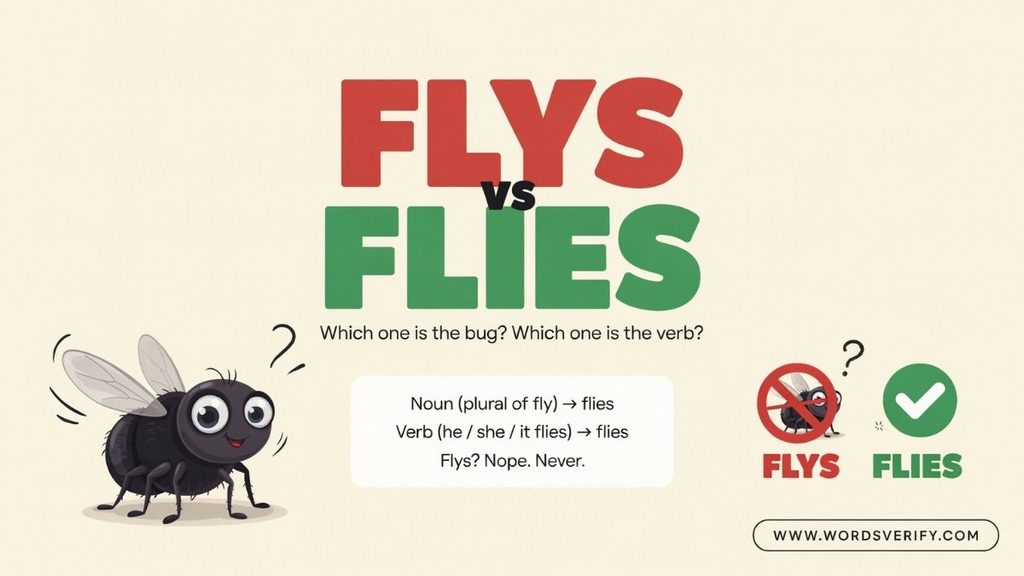
When discussing aviation, the correct expression is flies a plane, not flys a plane.
The verb fly describes operating an aircraft or traveling through the air. In the simple present tense, the verb changes to flies when its subject is third-person singular.
Consider these examples:
- I fly a small airplane on weekends.
- You fly the aircraft during training.
- He flies a plane for a commercial airline.
- She flies to Boston every Tuesday.
- The pilot flies through the clouds.
In the sentence “He flies a plane,” the subject is he. Since he is third-person singular, the verb takes the ies form.
What Is the Plural of Fly Airplane?
This question can be confusing because fly has different grammatical uses. If you’re talking about operating an airplane, the base verb doesn’t become plural in the same way a noun does.
You can say:
- The pilot flies one airplane.
- The pilots fly several airplanes.
- She flies two different routes.
- They fly the same route every week.
Notice that the plural subject pilots takes fly, not flies. English present-tense verbs generally use the base form with I, you, we, and they. The ies ending usually appears with third-person singular subjects.
If you mean several aircraft, the plural of airplane is airplanes or If you mean several people who operate aircraft, you can say pilots. If you’re asking about the verb form, the correct choice depends on the subject.
Is “He Flies a Plane” Grammatically Correct?
Absolutely. “He flies a plane” follows the standard rules for subject-verb agreement in the simple present tense.
| Subject | Correct verb form | Example |
|---|---|---|
| I | Fly | I fly a small plane. |
| You | Fly | You fly safely. |
| We | Fly | We fly on Fridays. |
| They | Fly | They fly commercial aircraft. |
| He | Flies | He flies a plane. |
| She | Flies | She flies to Denver. |
| The pilot | Flies | The pilot flies every morning. |
The subject determines the verb form. You don’t need a special aviation rule to spell flies correctly. The ordinary English present-tense rule does the work.
Indure vs Endure Which one Is Correct?
Time Flies vs Flys Which Spelling Is Correct?
You’ve probably heard the expression “time flies when you’re having fun.” It’s a familiar way to describe how quickly time seems to pass when you’re enjoying yourself or concentrating on something interesting.
The correct expression is time flies, never time flys in standard English.
For example:
- Time flies when you’re talking to an old friend.
- The summer flies by when you’re busy.
- A good book makes the evening fly by.
- The weeks seem to fly by before a big event.
In these examples, flies or fly describes time passing quickly. Time doesn’t literally grow wings, of course. The expression uses the idea of flight to convey speed.
Why Do We Say “Time Flies”?
The expression works because time is a singular noun. When a singular third-person subject takes the verb fly in the simple present tense, the verb becomes flies.
Compare these sentences:
- Time flies when you’re having fun.
- The hours fly when you’re busy.
- The days fly by during vacation.
- The year flies by faster than expected.
In the first sentence, time is treated as a singular subject, so the verb takes flies. In the second sentence, hours is plural, so the verb remains fly.
This is a useful example of how subject-verb agreement and spelling rules work together. The meaning matters, but the grammatical structure matters too.
Scary vs Scarry which one is correct?
Flies By vs Flys By How Should You Write It?
When you want to describe something passing quickly, use flies by when the subject is third-person singular.
For example:
- The afternoon flies by when you’re working on a fun project.
- Time flies by during the holidays.
- She watches the scenery as the train flies by.
- The weeks fly by when you’re preparing for a wedding.
The final example uses fly because the subject weeks is plural. The others use flies because their subjects are singular.
The correct choice isn’t always flies simply because the sentence describes something moving quickly. You must identify the subject and choose the appropriate verb form.
| Sentence | Correct form | Reason |
|---|---|---|
| Time ___ by quickly. | Flies | Time is singular |
| The days ___ by quickly. | Fly | Days is plural |
| The afternoon ___ by. | Flies | Afternoon is singular |
| The hours ___ by. | Fly | Hours is plural |
| My vacation ___ by. | Flies | Vacation is singular |
| The holidays ___ by. | Fly | Holidays is plural |
The phrase flys by is generally a spelling error in ordinary writing. Once you identify the subject, the correct form becomes much easier to spot.
Breeched vs Breached which one is correct ?
Flys vs Flies Examples in Everyday Sentences
Sometimes the fastest way to learn a spelling rule is to see it in action. These examples cover insects, aircraft, everyday activities, and expressions about time.
Flies as a Noun
When flies refers to insects, it is a plural noun.
- The flies gathered around the uncovered food.
- Several flies entered the house through an open window.
- Fruit flies appeared near the bowl of bananas.
- The farmer used screens to keep flies out of the barn.
- Two flies landed on the picnic table.
- Houseflies can transfer germs from contaminated surfaces to food.
- The children watched the flies buzzing around the garden.
- A few flies escaped when someone opened the door.
Each sentence refers to more than one insect. If you’re talking about just one, use fly instead.
Flies as a Verb
When flies describes an action, it usually appears with a third-person singular subject in the simple present tense.
- She flies to Chicago for business meetings.
- He flies a small aircraft on weekends.
- The eagle flies high above the valley.
- A plane flies over our neighborhood every afternoon.
- My father flies to visit his family twice a year.
- The bird flies away whenever someone approaches.
- Time flies when you’re having a good conversation.
- The kite flies above the trees on a windy day.
These sentences show how flies works as a verb. The subject determines the form.
Fly as a Verb
The base form fly appears with I, you, we, and they in the simple present tense. It also follows certain helping verbs, such as will, can, and should.
- I fly to work-related events several times a year.
- They fly to Florida every winter.
- We fly home on Sunday.
- You can fly directly to the city.
- She will fly to California next month.
- The birds should fly south before winter.
- Many insects fly toward bright lights.
- The pilots can fly in challenging conditions when properly trained.
These examples show why you shouldn’t replace every occurrence of fly with flies. The correct form depends on the subject and the grammatical structure.
Flys as a Spelling Mistake
Here are some common misspellings and their corrections.
| Incorrect sentence | Correct sentence |
|---|---|
| The flys are buzzing near the window. | The flies are buzzing near the window. |
| She flys to New York every month. | She flies to New York every month. |
| He flys a plane for work. | He flies a plane for work. |
| Time flys when you’re having fun. | Time flies when you’re having fun. |
| The afternoon flys by. | The afternoon flies by. |
| The bird flys over the lake. | The bird flies over the lake. |
| The flys landed on the fruit. | The flies landed on the fruit. |
These corrections follow two connected principles: the consonant-plus-y spelling rule and subject-verb agreement.
Shiney vs Shiny which one is correct?
Common Mistakes With Flys vs Flies
Even a simple spelling distinction can cause problems when writers rely on habit instead of grammar. Here are the mistakes worth watching for.
Adding S Instead of IES
The most common error is writing flys because it seems logical to add s to the base word.
That approach works with many words, such as book to books and car to cars. However, words ending in a consonant plus y generally follow a different pattern when forming regular plurals or third-person singular present-tense verbs.
Remember these examples:
- Fly becomes flies.
- Baby becomes babies.
- City becomes cities.
- Try becomes tries.
- Carry becomes carries.
The rule isn’t limited to insects or aircraft. Once you recognize the pattern, you’ll spot it in many everyday words.
Confusing Nouns With Verbs
Another common mistake occurs when writers don’t identify the grammatical role of flies.
Compare these examples:
- The flies are near the window.
- The bird flies near the window.
In the first sentence, flies is a plural noun. In the second, flies is a verb.
Although the spelling is identical, the word performs a different job in each sentence. The surrounding words reveal its function.
Forgetting Subject-Verb Agreement
Writers sometimes choose flies whenever they see the verb fly, even when the subject is plural.
For example:
- Incorrect: The birds flies over the lake.
- Correct: The birds fly over the lake.
- Incorrect: My friends flies to Boston.
- Correct: My friends fly to Boston.
The problem here isn’t the spelling of flies itself. It’s the mismatch between a plural subject and a third-person singular verb.
When proofreading, check both spelling and agreement. A word can be spelled correctly yet still be wrong for the sentence.
Trusting Autocorrect Without Checking the Rule
Spell checkers and grammar checkers can catch many errors, but they’re not substitutes for understanding how English works. A tool may flag flys in a sentence, yet you still need to recognize why flies is correct.
Similarly, a company name or username might legitimately contain Flys. Automatically changing every occurrence could introduce an error if you’re trying to preserve that name.
Use writing assistance as a second pair of eyes rather than as the final authority.
Fly vs Flie Which Spelling Is Correct?
If you’ve wondered whether to write fly or flie, the correct choice depends on what you’re trying to say. Fly is the standard spelling of the base word, while flie is generally a misspelling in ordinary English.
The correct forms include:
- Fly: A single insect or the base form of the verb.
- Flies: The plural of the insect or the third-person singular present-tense verb.
- Flying: The -ing form of the verb.
- Flew: The simple past tense.
- Flown: The past participle.
For example, you can write, “A fly landed on the table,” “The bird flies over the house,” or “The bird flew away.”
The word flie doesn’t belong in these standard forms. Although English has irregular plurals such as child to children and foot to feet, fly to flies follows a regular spelling pattern.
Puting vs Putting Which one Is Correct?
Fly, Flies, Flying, Flew, and Flown Understanding the Verb Forms
The verb fly is irregular because its past-tense forms don’t follow the usual pattern of adding -ed. However, its present-tense form flies follows the familiar consonant-plus-y spelling rule.
Understanding the full verb conjugation helps prevent mistakes beyond the immediate spelling difference.
| Verb form | Correct spelling | Example |
|---|---|---|
| Base form | Fly | Birds fly south in winter. |
| Third-person singular present | Flies | The eagle flies above the valley. |
| Simple past | Flew | The bird flew away yesterday. |
| Past participle | Flown | The plane has flown across the country. |
| Present participle | Flying | The children watched the flying birds. |
What Is the Past Tense of Fly?
The simple past tense of fly is flew, not flied in ordinary contexts involving actual flight.
For example:
- She flies to Denver every month.
- She flew to Denver last month.
- She has flown to Denver several times.
Use flies for a present-tense action with a third-person singular subject or Use flew for a completed action in the past. Use flown with helping verbs such as has, have, or had.
This distinction matters because changing fly to flies doesn’t indicate past time. It changes the present-tense form to agree with the subject.
Flys vs Flies in American and British English
Fortunately, you don’t need to memorize two different spellings for this word. American and British English both use flies as the standard plural of fly and the third-person singular present-tense form of the verb.
For example, both varieties use these forms:
- The flies are buzzing around the kitchen.
- She flies to London every month.
- Time flies when you’re having fun.
- The bird flies over the garden.
American and British English differ in the spelling of some words, such as color and colour. However, the distinction between flys vs flies isn’t one of those regional differences.
If you’re writing for an American audience, use flies. If you’re writing for a British audience, use flies as well.
How to Remember the Correct Spelling of Flies
A simple memory trick can save you from making the same mistake repeatedly.
Remember: consonant plus y changes to ies.
Since fly ends in a consonant, l, followed by y, change the y to i and add es to form flies.
Try remembering these pairs:
- Fly becomes flies.
- Try becomes tries.
- Cry becomes cries.
- Carry becomes carries.
- Study becomes studies.
Then compare them with words that keep their y:
- Boy becomes boys.
- Toy becomes toys.
- Play becomes plays.
- Enjoy becomes enjoys.
Another helpful trick is to remember this sentence: “One fly, two flies; I fly, she flies.” It covers both the plural noun and the present-tense verb in a single line.
When you’re unsure, identify the word’s role in the sentence and look at the letter before the final y. That quick check usually settles the question.
Practice session Flys vs Flies
Test your understanding of “flys” vs “flies” by filling in each blank with the correct word. Choose carefully because one tiny letter can make your grammar take flight in the wrong direction!
Fill in the Blanks
Complete each sentence with flys vs flies.
- A butterfly ______ over the colorful flowers.
- Time ______ when you’re having fun.
- Several ______ gathered around the fruit.
- My uncle ______ to New York for work.
- The bird ______ south every winter.
- A housefly ______ through the open window.
- The airplane ______ above the clouds.
- She watches as the kite ______ across the sky.
- The little boy gets excited when he sees ______ in the garden.
- Our pilot ______ passengers to different countries.
- The dragonfly ______ close to the pond.
- Time ______ by faster than we expect.
- A bee ______ past my ear.
- He ______ home every Friday evening.
- The eagle ______ high above the mountains.
- Many ______ buzz around the outdoor lights.
- My sister ______ to work twice a month.
- The insect ______ toward the bright lamp.
- The plane ______ over the ocean.
- A swarm of ______ entered through the open door.
- The superhero ______ across the city in the movie.
- Summer always seems to pass quickly because time ______.
- The bird ______ away when the cat approaches.
- The airplane ______ from London to Paris every morning.
- The word “flys” is usually incorrect, while “______” is the standard spelling.
Answer
Check your answers after completing all sentences.
- flies
- flies
- flies
- flies
- flies
- flies
- flies
- flies
- flies
- flies
- flies
- flies
- flies
- flies
- flies
- flies
- flies
- flies
- flies
- flies
- flies
- flies
- flies
- flies
- flies
Here’s a trusted source for clear more words Comparison:
FAQs
Is “flys” ever a correct word?
“Flys” is generally incorrect in standard English when used as the plural of “fly” or as a verb. However, it may appear in brand names, surnames, or other proper names.
Why does “fly” become “flies” instead of “flys”?
When a word ends in a consonant followed by y, you usually change the y to ies to form its plural. For example, “fly” becomes “flies,” just as “baby” becomes “babies.”
What is the difference between “flies,” “flying,” and “flew”?
These are different forms of the verb “fly.” “Flies” describes a present action with a singular subject, “flying” describes an ongoing action, and “flew” is the simple past tense. For example, “The bird flies,” “The bird is flying,” and “The bird flew away.”
Is “fly’s” different from “flies”?
Yes. “Fly’s” is the singular possessive form, showing that something belongs to one fly. For example, “The fly’s wings are delicate.” “Flies” is the plural form of the noun or the present-tense verb used with a singular subject.
Why do people write “flys” instead of “flies”?
People often write “flys” because they apply the usual rule of adding s to form a plural. However, English spelling has a special rule for words ending in a consonant plus y, which is why “flies” is correct.
Is “flies” both a noun and a verb?
Yes. As a noun, “flies” refers to more than one flying insect. As a verb, it describes an action, as in “The pilot flies every week.” The meaning depends on how the word functions in the sentence.
What are some easy examples of “flies” in sentences?
Here are three examples:
- Several flies gathered near the window.
- My brother flies to Chicago every month.
- Time flies when you’re having fun.
How can I remember the correct spelling of “flies”?
Remember the simple pattern: consonant + y usually changes to ies when forming a plural. One fly becomes two flies. If you remember that example, you’ll have a handy way to avoid this common spelling mistake.
Conclusion
Choosing between “flys” vs “flies” may seem like a tiny detail, but even one misplaced letter can send your writing off course. In standard English, “flies” is the correct spelling for the plural of “fly” and the verb used when someone or something moves through the air. “Flys” is generally considered incorrect unless it appears in a proper name or brand.
Remember this simple spelling rule: when a word ends in a consonant followed by y, you usually change the y to ies to form the plural. That’s why one fly becomes two flies! Keep this rule in mind and you’ll avoid this common grammar mistake with ease. After all, your sentences should be free to fly without carrying unnecessary spelling errors along for the ride.

Lisa AJS is an experienced blogger and language enthusiast at Words Verify, dedicated to making grammar simple, practical, and enjoyable. She writes engaging content on commonly confused words, grammar mistakes, word meanings, and everyday language challenges.