Have you ever stared at a word so long that even the simplest spelling starts looking suspicious? Welcome to the scary vs scarry confusion! One extra letter can turn a straightforward spelling question into a tiny grammar mystery. The good news? You don’t need a detective’s magnifying glass to solve it. “Scary” is the correct everyday adjective for something frightening, while “Scarry” is uncommon and may appear as a surname or in specialized contexts. In this guide, you’ll discover their meanings, spelling differences, and practical examples so you can write confidently without letting one extra R haunt your sentences.
Quick Answer Scary vs Scarry
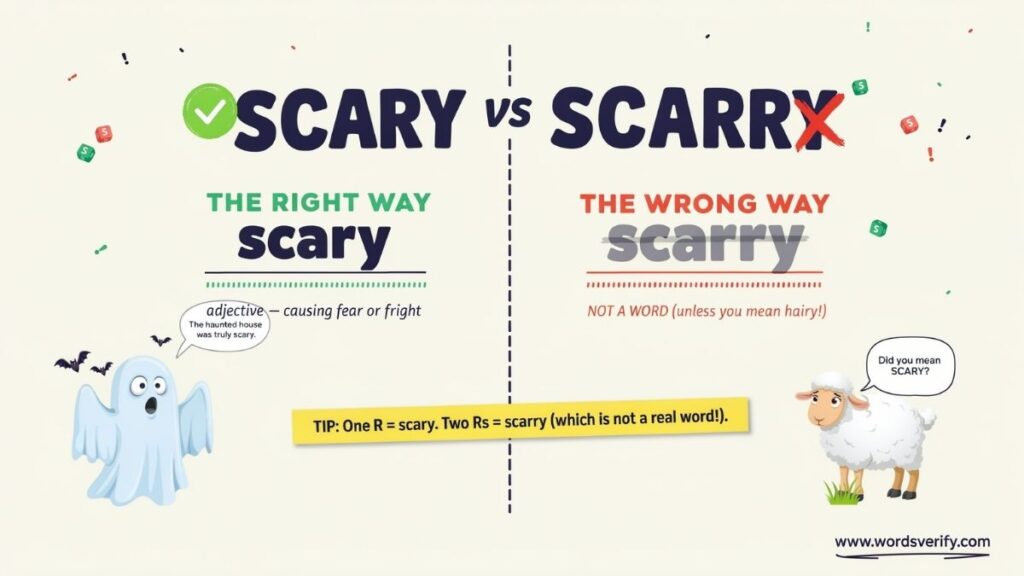
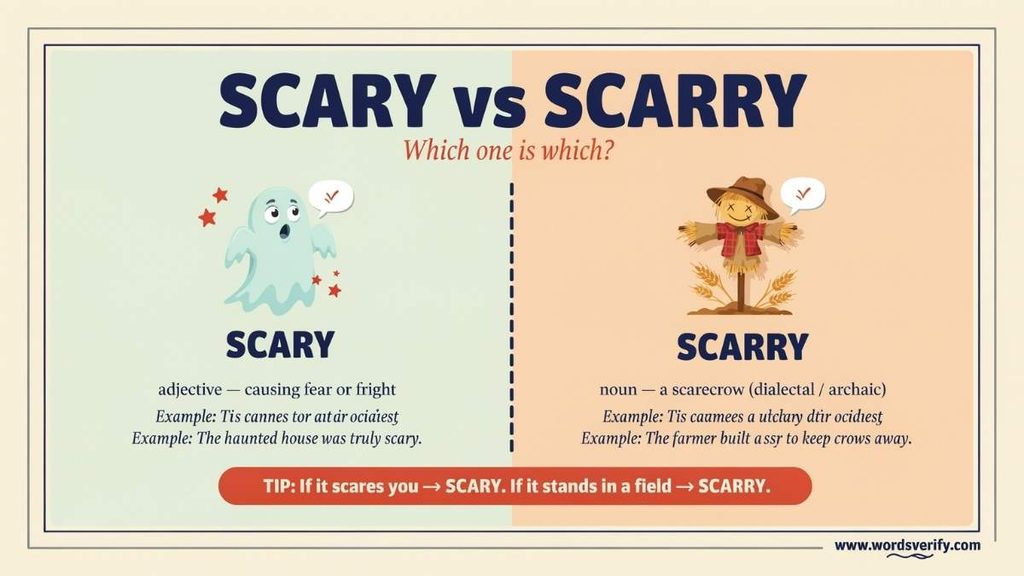
Scary is the correct spelling when you mean frightening, alarming, or likely to cause fear. Scarry isn’t the standard spelling of that adjective, although it can be correct as a surname or appear in rare descriptive usage.
Consider these examples:
- Correct: The abandoned house looked scary at night.
- Incorrect for the intended meaning: The abandoned house looked scarry at night.
- Correct proper name: Richard Scarry wrote and illustrated popular children’s books.
Here’s a quick comparison of the two spellings.
| Feature | Scary | Scarry |
|---|---|---|
| Standard adjective meaning frightening | Yes | No |
| Associated with fear | Yes | Not in its usual usage |
| Possible rare meaning related to scars | No | Yes, in certain references |
| Used as a surname | Possible, but uncommon in this context | Yes |
| Common in everyday English | Yes | No |
| Example | A scary story | Richard Scarry |
The rule is simple: use scary when describing something frightening. Choose scarry only when you have a specific reason to use the rare adjective or a proper name.
What Does Scary Mean?
Scary describes something that makes you feel afraid, nervous, threatened, or uneasy. It can refer to a real danger, an imagined threat, a disturbing experience, or a movie designed to make your heart race.
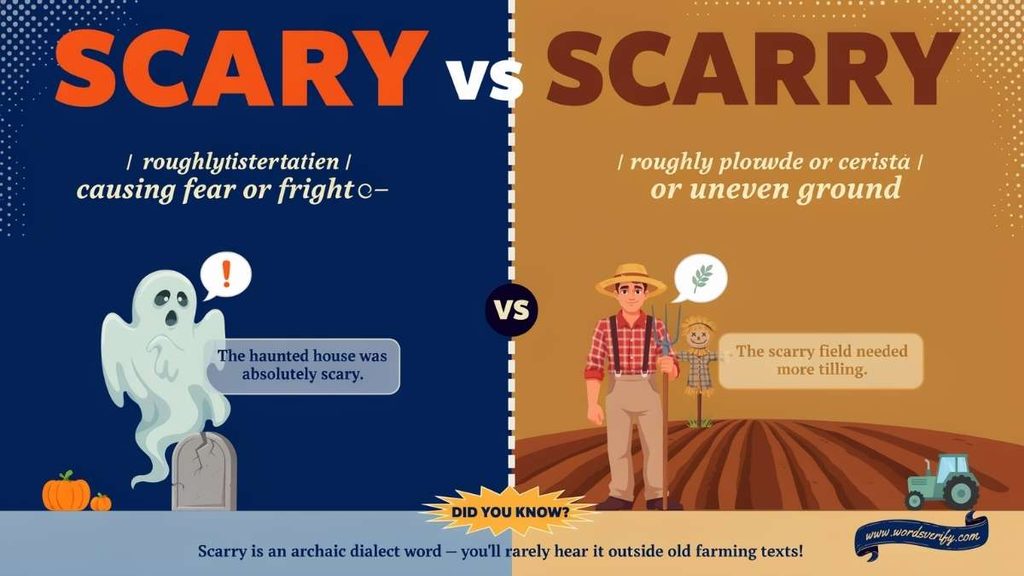
Scary is an adjective meaning frightening or causing fear. It can describe a person, place, object, event, sound, or situation that creates a sense of danger or uneasiness.
For example:
- The thunderstorm became scary when lightning struck a nearby tree.
- That scary movie kept me awake half the night.
- Walking alone through the dark tunnel was a scary experience.
- The doctor explained the results without making the situation sound scarier than it was.
In each sentence, scary describes something that produces fear or worry. The word doesn’t necessarily mean someone faces immediate danger. A fictional ghost can be scary even though it poses no real-world threat.
The Meaning of Scary in Everyday Life
Although scary often appears in horror stories, its meaning extends far beyond ghosts, monsters, and creepy old houses.
People also use it to describe uncertainty, risk, or unfamiliar situations. A first job interview can feel scary. So can speaking before a large audience, moving to a new city, or receiving an unexpected phone call late at night.
The intensity depends on the context. A scary movie might make you jump out of your seat, while a difficult financial decision might leave you anxious for days.
| Context | Example | Meaning |
|---|---|---|
| Entertainment | The horror film was scary. | It created fear or suspense. |
| Physical danger | That was a scary car accident. | It caused fear because someone might have been hurt. |
| Uncertainty | Starting over felt scary. | It created anxiety about the unknown. |
| Appearance | The mask looked scary. | It appeared frightening. |
| Unexpected events | Hearing footsteps upstairs was scary. | It caused alarm or uneasiness. |
This flexibility makes scary a useful everyday adjective. It communicates fear without requiring a lengthy explanation.
Difference Between a Scary Movie and a Scary Situation?
A scary movie is a film intended to frighten, unsettle, or create suspense. It might use supernatural creatures, threatening characters, sudden sounds, or psychological tension.
A scary situation is an event or circumstance that causes fear. It may involve a genuine threat or simply create a strong sense of uncertainty.
For example, watching a character escape a burning building can be scary in a movie. Finding yourself trapped in a burning building is a scary situation with real consequences.
The adjective remains the same in both cases. Only the context changes.
Fix common more word mistakes in English
Breeched vs Breached which one is correct ?
What Does Scarry Mean?
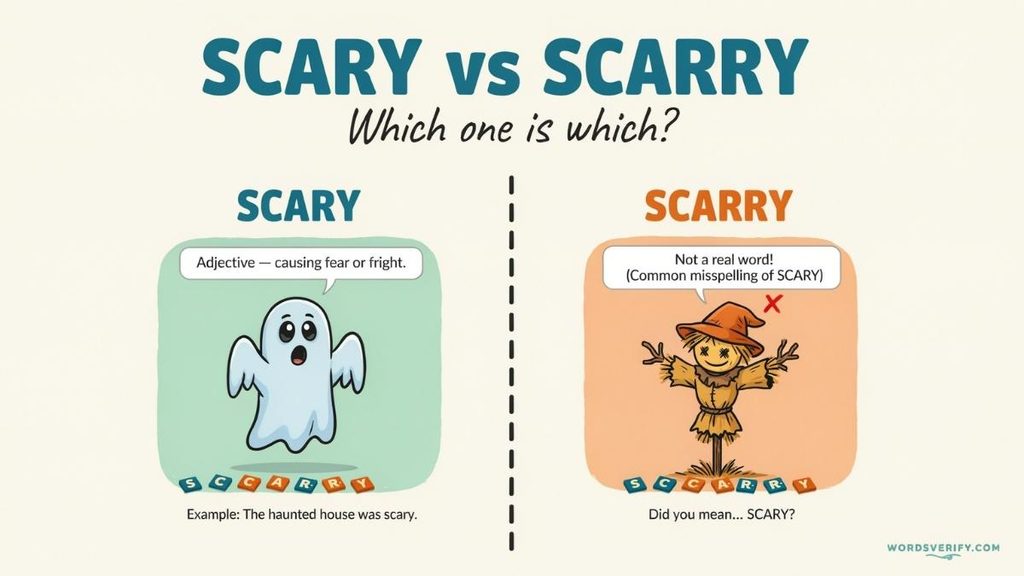
Scarry requires a little more explanation because it isn’t simply another standard spelling of scary. Although it’s uncommon in everyday writing, scarry may function as a rare adjective meaning marked by or covered with scars in certain dictionary references.
A scar is a mark left on the skin or other tissue after a wound heals. In a descriptive context, scarry may characterize something bearing such marks. However, scarred is much more familiar and natural in modern English.
Consider these examples:
- More natural: His hands were scarred from years of hard work.
- Rare descriptive use: The old surface appeared scarry and uneven.
- Incorrect for the intended meaning: The haunted house was scarry.
The second example illustrates the kind of meaning associated with the rare adjective. It isn’t a recommendation to use scarry in ordinary writing. Most readers will understand scarred more readily.
Scarry as a Rare Adjective Related to Scars
The definition of scarry isn’t as widely established in everyday English as the definition of scary. Some dictionaries and historical references may record scarry as an adjective connected with scars. Its precise meaning can vary by source.
When you encounter this word in an older text or specialized description, pay attention to the surrounding sentence. The writer may be describing a surface marked by healed wounds rather than something that frightens people.
Compare these expressions:
- Scarred skin: Skin with visible marks left by wounds or injuries.
- A scarred tree: A tree trunk marked by cuts, damage, or healed injuries.
- A scarred landscape: Land visibly altered by erosion, mining, fire, or other damage.
- A scary landscape: A landscape that makes someone feel frightened.
The distinction matters because physical marks and emotional reactions are different ideas. A scarred landscape might look peaceful, while a scary landscape might contain no scars at all.
Does Scarry Mean Covered With Scars?
In rare descriptive usage, scarry may refer to something marked by scars or characterized by scar-like marks. Nevertheless, scarred is the clearer and more widely understood choice when you want to describe something covered with scars.
For example:
- The boxer had a scarred eyebrow.
- The old tree had a scarred trunk.
- Decades of mining left the hillside scarred.
- The frightening scene made the children nervous.
Notice that scarred describes a physical condition, while frightening describes an emotional effect.
The phrase covered with scars is also more precise than scarry for most readers. If clarity is your goal, there’s little reason to choose a rare word when a familiar alternative communicates the idea more effectively.
Can Scarry Describe Rocky and Steep Places?
Descriptions of rugged terrain sometimes involve words that refer to rough, scarred, or broken surfaces. However, you shouldn’t assume that scarry is a standard geographical adjective meaning rocky, steep, or mountainous.
If you’re describing difficult terrain, choose a more familiar and precise word:
- Rocky: Full of rocks or covered with exposed rock.
- Steep: Rising or falling sharply.
- Rugged: Rough, uneven, and difficult to cross.
- Scarred: Visibly marked or damaged by natural processes or human activity.
- Eerie: Strange and unsettling in a way that creates uneasiness.
For example, “The hikers crossed a steep, rocky hillside” communicates the terrain clearly. “The hikers crossed a scary hillside” emphasizes their emotional response instead.
This distinction is useful in travel writing, nature descriptions, and technical reports.
Fix common more word mistakes in English
Shiney vs Shiny which one is correct?
Is Scarry a Word?
Yes, Scarry is a real surname, and scarry may appear as a rare adjective in certain references. However, that doesn’t make it an acceptable replacement for scary in ordinary sentences about fear.
This question illustrates an important principle of English spelling: a word can exist without being the correct word for your sentence.
English contains surnames, archaic terms, regional expressions, technical vocabulary, and uncommon adjectives that resemble familiar words. Their existence doesn’t make them interchangeable.
| Sentence | Correct? | Explanation |
|---|---|---|
| The scary noise startled everyone. | Yes | Scary means frightening. |
| The scarry noise startled everyone. | No, for this meaning | Scary is the standard spelling for something frightening. |
| Richard Scarry wrote children’s books. | Yes | Scarry is the author’s surname. |
| The old wall was scarred by years of damage. | Yes | Scarred describes visible damage. |
Who Is Richard Scarry?
Richard Scarry was an American children’s author and illustrator known for colorful picture books filled with busy animal characters, everyday activities, and detailed scenes. His books helped generations of children explore vocabulary, community life, and storytelling through illustrations.
His surname is spelled Scarry, with two r’s. That spelling is correct because surnames have their own established forms. You shouldn’t change a person’s name to match a more common word.
For example:
- Richard Scarry is a proper name.
- Scary is the adjective in “a scary story.”
- Scarry doesn’t become the correct adjective simply because it appears in a well-known author’s name.
This is a useful lesson for commonly confused words. Context tells you whether you’re reading a person’s name or an ordinary descriptive word.
Fix common more word mistakes in English
Puting vs Putting Which one Is Correct?
Scary vs Scarry The Main Differences Explained
The difference between scary vs scarry becomes easier to understand when you examine their meanings, grammatical roles, and typical contexts.
Scary vs Scarry Meaning
The most important distinction is meaning.
Scary refers to something that causes fear, alarm, or uneasiness. It’s a standard adjective that appears frequently in conversation, fiction, journalism, and everyday writing.
Scarry, when used as a rare adjective, may refer to something bearing scars. It also functions as a surname. Neither use makes it a normal substitute for scary.
| Intended meaning | Best word | Example |
|---|---|---|
| Causing fear | Scary | The abandoned building looked scary. |
| Producing anxiety | Scary | Waiting for the results was scary. |
| Bearing marks from wounds | Scarred | His scarred hands showed years of hard work. |
| Referring to the children’s author | Scarry | Richard Scarry created beloved illustrated books. |
| Describing a person or place as frightening | Scary | The stranger’s behavior was scary. |
Scary vs Scarry Grammar
Both forms can appear in adjective-like contexts, but they don’t have the same status or meaning.
An adjective describes a noun or provides information about a subject. In “a scary movie,” scary describes the movie. In “the movie was scary,” it follows the linking verb was and describes the subject.
The same grammatical position doesn’t automatically make two words interchangeable. Meaning and established usage still matter.
Compare these sentences:
- The scary dog barked loudly.
- The scarred dog had visible marks on its skin.
The first sentence describes the dog’s effect on someone. The second describes the dog’s physical condition. Neither sentence needs scarry.
Scary vs Scarry Pronunciation
In many English accents, scary vs Scarry have the same pronunciation or sound nearly identical. Both typically contain two syllables, with stress on the first syllable.
That similarity helps explain why people confuse the spellings. When two words sound alike, you can’t always rely on pronunciation to choose the correct form.
For example, hearing someone describe a frightening movie won’t tell you whether they would write scary or mistakenly type scarry. You need to understand the word’s meaning and standard spelling.
The best strategy is to connect the adjective to its familiar base word: scare.
Fix common more word mistakes in English
Panic vs Panick Which one Is Correct?
Why Is Scary Spelled With One R?
English spelling can seem unpredictable, but the formation of scary follows a recognizable pattern. The word is related to scare, a verb meaning to frighten someone.
When the adjective scary is formed, the final e in scare disappears and the letter y takes its place.
The basic pattern is:
Scare → Scary
This relationship explains why the standard adjective contains one r. Adding another r doesn’t follow the established spelling of the word.
Understanding the Scary Spelling Pattern
Consider these related forms:
| Word | Part of speech | Meaning |
|---|---|---|
| Scare | Verb or noun | To frighten; an instance of fear |
| Scared | Adjective or verb form | Feeling frightened; having frightened someone |
| Scary | Adjective | Causing fear |
| Scarier | Comparative adjective | More frightening |
| Scariest | Superlative adjective | Most frightening |
| Scaring | Verb form or participle | Causing someone to feel fear |
These words belong to the same general word family, but each serves a different grammatical purpose.
For example:
- The sudden noise could scare the baby.
- The baby felt scared.
- The noise was scary.
- The second noise was scarier.
- The final noise was the scariest of all.
The pattern is consistent. None of these standard forms requires the double-r spelling scarry.
An Easy Trick for Remembering the Correct Scary Spelling
If you’re unsure how to spell scary, remember this simple phrase:
“A scare can be scary, but scary doesn’t need an extra R.”
This reminder connects the adjective to the verb and reinforces the correct spelling.
You can also use a three-step check:
- Ask yourself whether you mean something that causes fear.
- Connect the meaning to the word scare.
- Write scary with one r.
This technique works particularly well when you’re writing quickly and don’t want to stop to consult a dictionary.
Fix common more word mistakes in English
Vendor vs Vender which one is correct?
Scary vs Scariest How to Spell the Related Forms
The confusion doesn’t end with scary vs scarry. Some writers also hesitate when they need comparative and superlative forms. Fortunately, these follow a clear spelling pattern.
Scary vs Scarier
Use scarier when comparing two people, places, things, or experiences.
Examples:
- The second horror movie was scarier than the first.
- Walking through the forest at night felt scarier than walking through it during the day.
- The storm grew scarier as the wind picked up.
Because scary ends in a consonant followed by y, the y changes to i before the comparative ending -er.
The resulting spelling is scarier, not scarryer.
Scary vs. Scariest
Use scariest when identifying the most frightening person, thing, or experience within a group.
Examples:
- That was the scariest scene in the entire movie.
- Of all the haunted houses we visited, this one was the scariest.
- Losing contact with the hiking group was the scariest part of the trip.
The same spelling change applies: scary becomes scariest when you add the superlative ending -est.
Quick Comparison of the Forms
| Form | When to use it | Example |
|---|---|---|
| Scary | Describing something frightening | The story is scary. |
| Scarier | Comparing two things | This story is scarier than that one. |
| Scariest | Identifying the most frightening option | This is the scariest story in the book. |
Remember that scarryer and scarryest aren’t the standard spellings of these forms.
Fix common more word mistakes in English
Worse vs Worst which one is correct?
Common Scary vs Scarry Spelling Mistakes
Spelling mistakes often happen because the brain recognizes a word’s sound before it recalls the correct letter pattern. That’s particularly true when two forms look and sound similar.
Adding an Extra R
The most common error is writing scarry when you mean scary. The extra letter may seem harmless, but it creates a nonstandard spelling for the intended adjective.
Incorrect: That was a scarry experience.
Correct: That was a scary experience.
The solution is to remember the connection between scare and scary. One extra letter doesn’t make the word more frightening. It simply makes the spelling incorrect for that meaning.
Confusing Scary With Scarred
Another potential source of confusion is scarred. It describes something bearing scars or showing marks from an injury or damage.
Compare these sentences:
- The scary movie featured a mysterious creature.
- The scarred creature had marks across its face.
In the first sentence, scary describes the emotional effect. In the second, scarred describes physical appearance.
Although the words share several letters, they express different ideas. Choosing the right one depends on what you want to communicate.
Trusting Spell-Check Without Checking the Meaning
Spell-check tools are useful, but they don’t always understand your intended meaning. A surname such as Scarry may be valid even when the same spelling would be incorrect as an adjective in your sentence.
For example, a spell-checker might accept a name while overlooking the fact that you’ve used the wrong word elsewhere.
To avoid these spelling mistakes:
- Read the sentence for meaning rather than spelling alone.
- Check whether the word describes fear or refers to scars.
- Consult a trusted dictionary when an unfamiliar form appears.
- Read the sentence again after correcting it.
Dictionaries can help clarify word meanings, related forms, and established usage. When a rare adjective appears in an unfamiliar context, check its definition rather than assuming it means the same as a similar-looking word.
Fix common more word mistakes in English
Piqued vs Peaked which one is correct?
Scary Synonyms Words That Mean Frightening
Scary is useful because it’s familiar and flexible. However, you can make your writing more precise by choosing a synonym that describes the particular kind of fear you want to convey.
Not every frightening experience feels the same. A ghost story may be creepy, a sudden accident may be alarming, and a life-threatening event may be terrifying.
Common Synonyms for Scary
| Synonym | Meaning or nuance | Example |
|---|---|---|
| Frightening | Causing fear | The sudden noise was frightening. |
| Terrifying | Causing intense fear | The climbers faced a terrifying drop. |
| Alarming | Causing concern about possible danger | The doctor noticed an alarming change. |
| Creepy | Causing an unpleasant or uneasy feeling | The empty house felt creepy. |
| Spooky | Mysterious or suggestive of ghosts | The fog made the cemetery look spooky. |
| Eerie | Strange and unsettling | An eerie silence filled the room. |
| Horrifying | Causing shock, disgust, or intense fear | The documentary showed a horrifying event. |
| Dreadful | Very unpleasant or frightening, depending on context | They heard a dreadful scream. |
| Intimidating | Making someone feel nervous or less confident | The interview panel looked intimidating. |
| Unsettling | Disturbing a person’s sense of comfort | His unexplained behavior was unsettling. |
| Chilling | Producing a strong feeling of fear or dread | She told a chilling story. |
| Fearsome | Inspiring fear or respect | The warrior had a fearsome reputation. |
These words can improve your writing because they convey more than a general sense of fright.
For example, “The noise was scary” works perfectly well. However, “The noise was eerie” suggests something strange and mysterious, while “The noise was alarming” suggests a possible threat.
Terrifying vs Scary What’s the Difference?
Scary and terrifying overlap in meaning, but terrifying generally suggests a stronger degree of fear.
A mildly disturbing scene can be scary without being terrifying. Someone who narrowly escapes a serious accident might describe the experience as terrifying because the danger felt immediate and severe.
Compare these examples Scary vs Scarry:
- The movie was scary enough to make me jump.
- The near collision was terrifying because we almost hit another car.
The first sentence describes fear produced by entertainment. The second describes an intense reaction to a potentially dangerous event.
Still, the distinction isn’t absolute. People experience fear differently, so what seems scary to one person may feel terrifying to another.
Scaring vs Scary
These forms are related to the verb scare, but they play different grammatical roles.
Scaring usually describes the act of causing fear. Scary describes the person, thing, or situation that causes it.
Examples:
- The barking dog is scary.
- The barking dog is scaring the children.
- The sudden noise was scary.
- The sudden noise was scaring everyone in the room.
In the first sentence of each pair, the adjective describes a quality. In the second, the verb form emphasizes the action of causing fear.
Fix common more word mistakes in English
Inclusivity vs Inclusiveness which one is correct?
Scary vs Scarry Examples How to Use Each Correctly
Examples make spelling rules easier to remember because they show how a word behaves in real sentences.
Examples of Scary in a Sentence
Here are practical examples of the standard adjective scary:
- The scary movie featured a haunted house and a mysterious stranger.
- Hearing footsteps behind me on the empty street was scary.
- The pilot remained calm during a scary moment of turbulence.
- Starting a new job can feel scary even when you’re excited.
- The children told scary stories around the campfire.
- It was scary to realize how close the car had come to the edge.
- The news report described a scary increase in the number of accidents.
- The costume looked scary, but the person wearing it was friendly.
In each example, scary describes something that produces fear, nervousness, or alarm.
Examples of Scarry in a Sentence
Because scarry is uncommon as an adjective, examples require more context. The following sentences illustrate its possible rare descriptive use and its established use as a proper name.
- The old surface was described as scarry in a historical account of its damaged condition.
- Richard Scarry became widely known for his illustrated children’s books.
- The family displayed a collection of Richard Scarry’s books.
- The researcher recorded an uncommon use of scarry in a historical text.
The first and fourth examples illustrate rare usage rather than common modern phrasing. Without a specific dictionary entry or source context, it’s best not to treat scarry as a routine substitute for scarred.
For ordinary writing, these alternatives are clearer:
- The surface was marked with scars.
- The damaged wall had an uneven appearance.
- The old tree was scarred by repeated storms.
A Practical Example Choosing the Right Word
Imagine you’re writing a short description of an abandoned hospital for a story.
Your first draft reads:
“The scarry building stood at the end of the road. Its walls were covered in scars from years of neglect. Walking inside was a scarry experience.”
The paragraph contains two uses of scarry where the intended meaning is frightening. It also mentions physical damage, which calls for a different word.
A clearer revision would read:
“The scary building stood at the end of the road. Its walls were scarred from years of neglect. Walking inside was a frightening experience.”
Notice the three distinct choices:
- Scary describes the building’s frightening atmosphere.
- Scarred describes the physical damage to the walls.
- Frightening provides variety while preserving the intended meaning.
This example shows why spelling and word choice go hand in hand. Correcting the extra r helps, but choosing the most precise word makes the writing stronger.
Fix common more word mistakes in English
Emaculate vs Immaculate which one is correct?
American vs British English Is the Spelling Different?
Some English words have different spellings in American and British English. For example, American English generally uses color, while British English uses colour.
However, scary follows the same standard spelling in both varieties. Scarry isn’t a standard regional alternative for the adjective meaning frightening.
This means you don’t need to worry about choosing a different spelling based on your audience’s location.
For example:
- American English: The movie was scary.
- British English: The movie was scary.
- Incorrect in either variety for the intended meaning: The movie was scarry.
The spelling remains consistent across both varieties of English.
Fix common more word mistakes in English
Vinal vs Vinyl Which one Is Correct?
How to Use Scary Correctly in Everyday Writing
Knowing the definition is useful, but understanding how a word fits different situations makes your writing more natural.
Scary in Casual Conversations
In everyday conversation, scary is a straightforward way to describe something frightening or unsettling.
For example:
- That movie was scary.
- The drive through the storm was scary.
- I had a scary dream last night.
- The sudden noise gave me a scary feeling.
These sentences sound natural because scary is familiar and easy to understand.
Scary in Academic and Professional Writing
Scary can also work in professional or academic writing, especially when the goal is to communicate plainly. However, a more precise adjective may suit formal discussions better.
For example:
- Casual: The report showed a scary rise in accidents.
- More formal: The report showed an alarming rise in accidents.
- Casual: The situation became scary.
- More precise: The situation became increasingly dangerous.
The best choice depends on your audience and purpose. Scary isn’t inherently unprofessional, but words such as alarming, hazardous, and concerning may convey more specific information.
Scary in Creative Writing
Creative writers often use scary to describe characters, settings, sounds, and events. The word is simple, but the details surrounding it can create a powerful effect.
Compare these sentences:
- The forest was scary.
- The forest fell silent as the branches scraped against the windows and something moved behind the trees.
The first sentence communicates fear directly. The second builds suspense through specific details.
Both approaches can work. If you want to create a vivid scene, combine a clear adjective with concrete descriptions that help readers imagine what the character sees, hears, or feels.
Practice Session Scary vs Scarry
Fill in each blank with the correct word Scary vs Scarry. Check your answers in the answer key at the end.
Fill in the Blanks
1. The horror movie was so ______ that I couldn’t sleep afterward.
2. The children felt ______ when they heard strange noises outside.
3. That abandoned house looks ______ at night.
4. The sudden thunderstorm gave us quite a ______.
5. My little brother gets ______ whenever he watches ghost stories.
6. The dark forest looked ______ in the moonlight.
7. The loud bang ______ the sleeping cat.
8. She told us a ______ story around the campfire.
9. The experience left an emotional ______ that took years to heal.
10. I was ______ when the lights suddenly went out.
11. The movie’s ending was even more ______ than its beginning.
12. The strange figure in the window looked ______.
13. My dog ______ whenever someone knocks loudly on the door.
14. The abandoned hospital had an eerie and ______ atmosphere.
15. He tried to ______ his friends by jumping out from behind the door.
16. The little girl wasn’t ______ of the dark anymore.
17. The thunder was so loud that it ______ everyone in the house.
18. The old photograph showed a ______ but beautiful scene.
19. The sudden appearance of the clown was really ______.
20. After watching the thriller, I felt ______ walking home alone.
21. The word ______ describes something that causes fear.
22. The word ______ describes the feeling of being frightened.
23. The unexpected noise gave me a terrible ______.
24. The character’s face was ______ by a deep wound.
25. Remember to spell ______ with one R when describing something frightening.
Answers
- scary
- scared
- scary
- scare
- scared
- scary
- scared
- scary
- scar
- scared
- scary
- scary
- scares
- scary
- scare
- scared
- scared
- haunting
- frightening
- scared
- scary
- scared
- scare
- scarred
- scary
Here’s a trusted source for clear more words Comparison:
FAQs
Is it scary vs scarry?
Scary is the correct spelling of the common English adjective meaning frightening or causing fear. Scarry is uncommon and may appear as a surname or in specialized contexts. For everyday writing, use scary.
What is the meaning of scarry?
Scarry is an uncommon word that may appear in specialized references or as a surname. In ordinary English, use scarred to describe someone or something marked by scars and scary to describe something frightening.
Which is correct, scary or scarey?
Scary is the correct standard spelling. Scarey is a common misspelling that adds an unnecessary letter before the Y. For example, write “That was a scary movie,” not “That was a scarey movie.”
What does “scaries” mean?
Scaries is an informal plural noun used in expressions such as “the Sunday scaries.” It describes feelings of anxiety or dread about something approaching, especially the return to work or school after the weekend.
How do you spell scary?
The correct spelling is S-C-A-R-Y. Remember that scary has one R and ends in Y. You can use it to describe anything that causes fear, such as a scary story, a frightening sound, or a creepy situation.
What does “scarly” mean?
Scarly is not a common standard English word. It may appear as a name, a typo, or an unusual informal form. Depending on your intended meaning, you may want scary for something frightening or scarred for something marked by scars.
What does “she’s scary” mean?
“She’s scary” means that a woman or girl frightens someone or seems intimidating. The phrase can describe her appearance, behavior, voice, or actions. Depending on the context, it may be serious, playful, or teasing.
What does “scar” mean in slang?
In slang, scar can refer metaphorically to lasting emotional harm caused by a painful experience. For example, “That breakup left a scar” suggests that the experience had a lasting emotional effect. The exact meaning depends on the context.
What does “scares” mean?
Scares can function as a verb or a plural noun. As a verb, it means causes fear, as in “Thunder scares the dog.” As a noun, it refers to frightening experiences or sudden feelings of fear, as in “We had a few scares during the storm.”
Why do some people say scary instead of scared?
Scary vs scared describe different things. Scary describes something that causes fear, while scared describes someone who feels fear. For example, “The movie is scary” means the movie causes fear, while “I am scared” means you feel frightened.
Is “scarey” a valid Scrabble word?
Scarey is generally treated as a misspelling of scary rather than a standard playable word. Scrabble validity depends on the official word list used for the game. Check the relevant dictionary before playing an unusual spelling.
What is a word for scary but beautiful?
Words such as haunting, eerie, ethereal, and otherworldly can describe something that is both beautiful and frightening. Haunting works particularly well for an image, melody, or scene that feels beautiful yet unsettling.
Why do they call it the Sunday scaries?
The Sunday scaries refers to the anxiety or dread some people feel on Sunday as they think about the upcoming workweek or school responsibilities. The expression combines the day of the week with scaries, an informal term for anxious feelings.
Why do people say “I am scary”?
People say “I am scary” when they mean that they frighten others or appear intimidating. If they mean they feel frightened themselves, the correct expression is “I am scared.” The difference comes down to causing fear versus experiencing it.
What is a fancy way to say “scary”?
More expressive alternatives to scary include terrifying, formidable, ominous, chilling, and unnerving. Choose the word that matches the situation. Terrifying suggests intense fear, while ominous describes something that seems to warn of danger or trouble.
What is another word for “scarily”?
Alternatives to scarily include frighteningly, alarmingly, eerily, and unnervingly. The best choice depends on the sentence. For example, “The house was eerily quiet” sounds more natural than “The house was scarily quiet” in some contexts.
What does “scarify” mean?
Scarify means to cut or scratch a surface, often to prepare it for treatment or improve its condition. In gardening, scarifying a lawn involves removing built-up thatch. The word is different from scare, which means to frighten someone.
What is a slang word for “scary”?
Informal alternatives include creepy, spooky, freaky, and sketchy. Creepy often describes something unsettling, spooky is common for ghostly or supernatural situations, and freaky can suggest something strange or disturbing.
How do you say “very scary”?
You can say terrifying, extremely frightening, downright creepy, or absolutely chilling. For example, “The abandoned hospital was downright creepy” creates a stronger impression than simply calling it scary.
What is the opposite of scary?
The opposite of scary is usually reassuring, comforting, or unthreatening. Depending on the context, you could also use safe, pleasant, or peaceful. For example, a comforting voice can make a frightening situation feel less scary.
Is it scar or scare?
Scar and scare are different words. A scar is a mark left after a wound heals, while scare means to frighten someone or refers to a sudden feeling of fear. For example, “The accident left a scar” and “The loud noise gave me a scare.”
What is a metaphor for a scar?
A scar can serve as a metaphor for a lasting emotional wound or a reminder of a difficult experience. For example, “Her heart carried the scars of betrayal” suggests emotional pain rather than physical marks.
Does “scarce” mean rare?
Yes, scarce means limited in supply or difficult to find. Rare has a similar meaning, but scarce often emphasizes that there isn’t enough of something available. For example, clean drinking water may be scarce during a drought.
What is meant by “scary”?
Scary means frightening or likely to cause fear, worry, or uneasiness. You can use it for real situations, imaginary creatures, or unsettling experiences. For example, “Walking through the dark forest alone was scary.”
Is 3:00 a.m. creepy?
Three a.m. isn’t inherently creepy, but the quiet surroundings, darkness, and tiredness can make ordinary sounds or situations feel unsettling. The feeling often comes from the atmosphere and your expectations rather than the time itself.
Why isn’t horror scary anymore?
Horror may feel less frightening when you’ve watched many similar films and recognize familiar plot twists, sound effects, and jump scares. Predictability can reduce suspense. Fresh storytelling, believable characters, and psychological tension can make horror frightening again.
Which is correct: “I scare” or “I am scared”?
Both expressions can be correct, but they mean different things. “I scare people” means you cause fear, while “I am scared” means you feel frightened. In everyday conversation, the second expression is more common when describing your own fear.
Is “scary” or “scarey” the correct spelling?
Scary is the correct standard spelling in American English. Scarey is a nonstandard variant and is generally considered a misspelling. Remember the simple rule: when you mean frightening, write scary.
conclusion
Scary vs Scarry Spelling mistakes can be sneaky, but this one doesn’t have to haunt your writing! When choosing between scary vs scarry, remember that scary is the standard adjective for something frightening. Whether you’re describing a horror movie, a sudden noise, or a creepy experience, scary is the word you need. Scarry is uncommon in everyday English and is best known as a surname. If you mean something that causes fear, stick with scary and leave the extra R out of the picture. With this simple distinction in mind, you can avoid unnecessary spelling confusion and write with confidence. After all, your sentences should send chills down someone’s spine not shivers through your grammar!

Lisa AJS is an experienced blogger and language enthusiast at Words Verify, dedicated to making grammar simple, practical, and enjoyable. She writes engaging content on commonly confused words, grammar mistakes, word meanings, and everyday language challenges.