
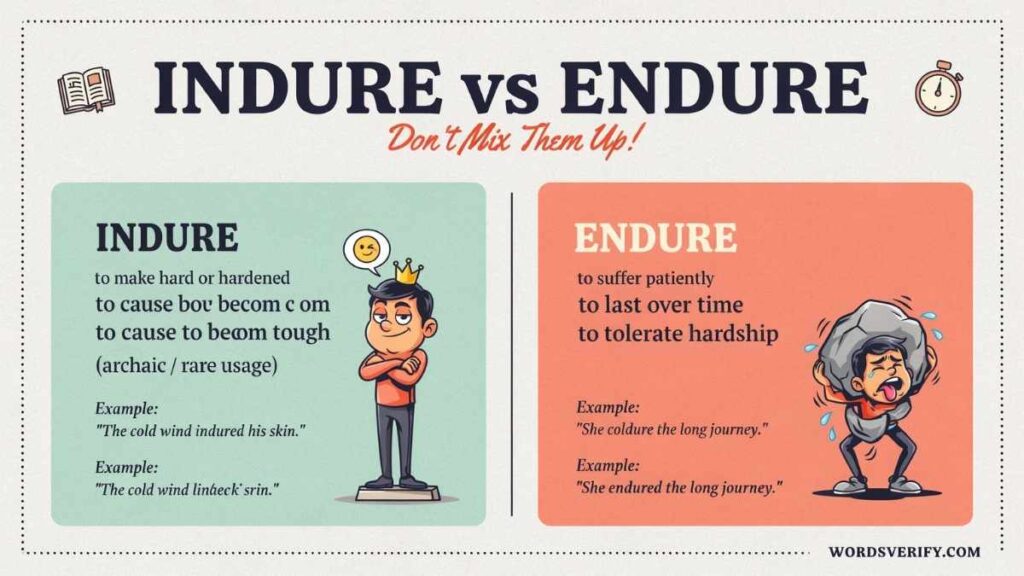
Have you ever questioned a spelling so much that the correct word suddenly looks wrong? That’s the tricky little puzzle behind indure vs endure! Although these spellings differ by just one letter, they aren’t interchangeable in modern English. If you’ve been writing “indure” and hoping spellcheck won’t notice, it’s time to clear up the confusion. The correct spelling is easier to remember than you might think. In this guide, you’ll discover what “endure” means, how to use it in everyday sentences, why “indure” causes confusion, and how to avoid this common spelling mistake with confidence.
quick answer Indure vs Endure
Endure is the spelling you should use in modern English. Although indure appeared in older writing as a variant, it isn’t the standard form today.
Consider these examples for indure vs endure:
- Correct: She had to endure months of uncertainty before receiving an answer.
- Incorrect in modern writing: She had to indure months of uncertainty before receiving an answer.
- Correct: Their friendship has endured despite years of separation.
- Incorrect in modern writing: Their friendship has indured despite years of separation.
The same rule applies to related words. Use endured, enduring, and endurance rather than indured, induring, or indurance.
| Question | Answer |
|---|---|
| Which spelling is correct today? | Endure |
| What does endure mean? | To withstand hardship or continue to exist |
| Is indure a word? | It appears in historical English but isn’t standard modern usage. |
| What is the past tense of endure? | Endured |
| What is the noun form? | Endurance |
| Do American and British English use different spellings? | No. Both use endure. |
The rule is easy to remember: when writing in modern English, choose endure.
Breeched vs Breached which one is correct ?
What Does Endure Mean?
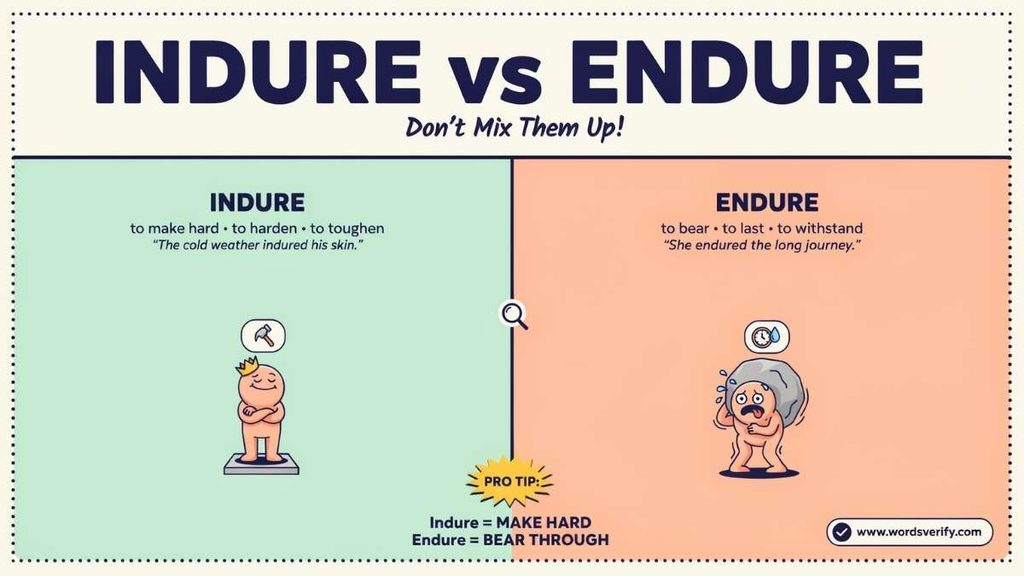
Endure has two main meanings. It can describe going through something unpleasant or difficult, and it can describe something that continues to exist over time.
Both meanings involve persistence. A person might endure pain during recovery, while a tradition might endure for centuries. In either case, something continues despite a challenge or the passage of time.
Endure Means to Withstand Hardship
The first meaning of endure involves experiencing something difficult without escaping it immediately. It can refer to physical pain, emotional distress, criticism, pressure, or uncomfortable circumstances.
For example, an athlete may endure pain during a demanding race. A student might endure weeks of exam preparation, while a family may endure financial difficulties during an uncertain period.
The word emphasizes the experience of facing something challenging. It doesn’t mean that the person enjoys the situation or remains cheerful throughout it. Someone can feel exhausted, frightened, or discouraged and still endure a difficult experience.
Here are a few examples:
- The hikers endured freezing temperatures during their climb.
- She endured harsh criticism without abandoning her goals.
- The family endured financial difficulties while searching for stable employment.
- He endured considerable pain until medical help arrived.
- The team endured intense pressure during the final minutes of the match.
In each sentence, endure describes a difficult experience that someone must face or withstand.
Endure Means to Last Over Time
Endure can also describe something that continues to exist despite changing circumstances. This meaning often appears in discussions about traditions, relationships, buildings, ideas, and cultural influence.
For example, a tradition may endure because each generation continues to practice it. A friendship may endure despite geographical distance, and a famous story may endure because readers continue to find meaning in it.
Consider these sentences:
- The tradition has endured for hundreds of years.
- Their friendship endured despite the distance between them.
- The ancient structure endured for centuries.
- Her influence continues to endure through the work of her students.
- The story has endured because every generation finds something meaningful in it.
This use of endure often appears in historical writing, literature, and discussions about culture. It suggests more than simply existing for a long time. Depending on the context, it can also emphasize survival through difficulties or change.
For example, saying that a tradition lasted for generations tells you how long it continued. Saying that it endured for generations may also suggest that it survived challenges along the way.
Endure Meaning in Simple English
In simple terms, endure means to put up with something difficult or continue to exist over time.
Here are some common uses:
- Endure pain: Experience pain without immediately escaping the situation.
- Endure criticism: Face negative comments or judgment.
- Endure hardship: Live through difficult circumstances.
- Endure pressure: Withstand demands or stress.
- Endure over time: Continue to exist despite changing conditions.
The meaning depends on the subject and context. When you describe a person, endure often refers to hardship or discomfort. When you describe a tradition, building, or idea, it usually refers to lasting over time.
Shiney vs Shiny which one is correct?
Why Is Indure Considered Incorrect in Modern English?
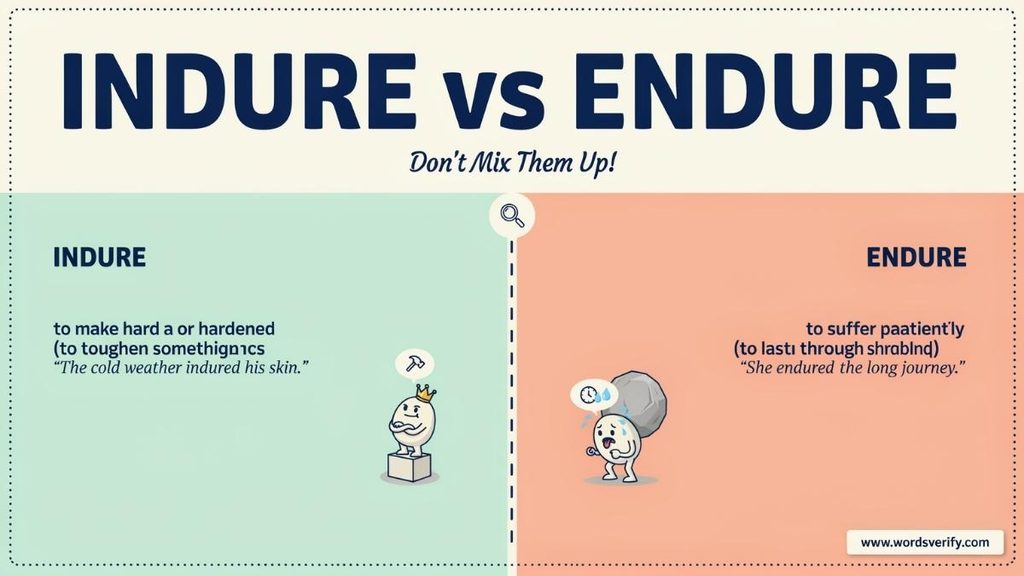
The confusion between indure vs endure partly comes from the history of English spelling. English has changed considerably over the centuries, and older texts sometimes contain spellings that look unusual today.
Indure isn’t simply a random combination of letters. It appeared in historical English as a variant of endure. However, modern English settled on endure as the standard spelling.
That distinction matters. A word can appear in an old book without being appropriate for a modern essay, business email, or everyday message.
If you encounter indure in a historical document, don’t automatically assume the writer made a mistake. The spelling may reflect the conventions of the time. When writing today, however, endure is the form to use.
Is Indure a Real Word?
The answer depends on what you mean by a real word.
Historically, indure existed as a variant of endure. In standard modern English, however, it isn’t the normal spelling of the verb meaning to withstand hardship or continue to exist.
English contains many historical spellings that have fallen out of everyday use. Some survive in old documents, while others appear in specialized discussions of language history. Their existence doesn’t mean that modern writers can freely substitute them for today’s standard forms.
If you find indure in an older book, examine the surrounding passage before deciding what the writer intended. The word may carry the same meaning that endure does today.
For contemporary writing, use endure.
Why Do People Spell Endure as Indure?
Several everyday habits can lead to this indure vs endure mistake.
- Spelling by sound: The first vowel may be difficult to identify from pronunciation alone. English spelling doesn’t always follow a predictable sound-to-letter pattern.
- Typing too quickly: A writer may accidentally enter the wrong vowel while drafting a message or document.
- Remembering an older spelling: Someone who has seen indure in a historical text might assume that both forms remain equally acceptable today.
- Guessing from familiar patterns: Some English words begin with similar sounds but use different letters. Guessing can produce a spelling that looks reasonable but isn’t standard.
- Skipping proofreading: A quick review often catches small errors before they reach the reader.
The best solution is to learn the standard spelling, remember its related forms, and check your work before publishing it.
Puting vs Putting Which one Is Correct?
Indure vs Endure Key Differences
The difference between indure vs endure concerns spelling and modern usage rather than two separate meanings.
Endure is the established form in contemporary English. Indure is a historical variant that you may encounter in older material, but it isn’t an ordinary alternative in modern writing.
| Feature | Endure | Indure |
|---|---|---|
| Status today | Standard English spelling | Historical or nonstandard variant |
| Meaning | To withstand, tolerate, or continue to exist | Historically used as a variant of endure |
| Part of speech | Verb | Historical verb variant |
| Modern writing | Recommended | Generally avoid |
| Past tense | Endured | Indured is not standard |
| Present participle | Enduring | Induring is not standard |
| Noun form | Endurance | Indurance is not standard |
You don’t need to choose between two modern words with different meanings. You simply need to recognize the accepted spelling and understand why the older variant sometimes appears.
Indure vs Endure Spelling in Everyday Writing
Imagine you’re writing a report about a town that survived a severe winter.
You might write:
“The residents endured weeks of freezing temperatures.”
The sentence uses the standard spelling and clearly describes the difficult conditions the residents experienced.
Now consider this version:
“The residents indured weeks of freezing temperatures.”
Readers will probably understand your meaning, but the spelling is nonstandard. In academic or professional writing, even a small error can distract from your message.
The same rule applies to phrases such as endure a long delay, endure criticism, endure difficult times, and the tradition continues to endure. In each case, use the standard spelling.
Panic vs Panick Which one Is Correct?
American vs British English Is There a Difference?
No. Endure is the standard spelling in both American and British English.
Some English words change spelling depending on the variety of English. For example, American English uses color, while British English generally uses colour. Endure doesn’t follow that pattern.
Both varieties use the same word forms:
- Endure
- Endures
- Endured
- Enduring
- Endurance
For example:
- American English: The company endured several difficult years.
- British English: The company endured several difficult years.
The spelling remains unchanged, although pronunciation can vary slightly between regional accents.
How to Remember the Correct Spelling of Endure
A simple memory trick can help you avoid repeating the same mistake.
Remember this sentence: Endure begins with E, just like even.
You can also connect the word to a familiar situation: Even when the journey becomes difficult, we endure.
This is a spelling reminder rather than a connection between the words’ origins. Its purpose is simply to help you remember the correct first letter.
Here are a few more ways to strengthen your spelling:
- Learn the word family. Remember endure, endured, enduring, and endurance together.
- Read complete sentences. Seeing the word in context helps reinforce its spelling and meaning.
- Write your own examples. Describe a difficult experience or something that has lasted for years.
- Consult a dictionary. A reliable dictionary provides the accepted spelling, definition, pronunciation, and grammatical information.
- Proofread your work. Read your writing carefully before submitting or publishing it.
These habits can improve your spelling beyond this single word. They also help you recognize other English words that look or sound similar.
Vendor vs Vender which one is correct?
Common Mistakes to Avoid When Using Endure
Correct spelling is only part of using a word well. You also need to understand its grammatical forms and choose it when it expresses the meaning you intend indure vs endure.
Confusing Endure With Endurance
Endure and endurance belong to the same word family, but they serve different grammatical purposes.
- Endure is a verb: “The runners endured the heat.”
- Endurance is a noun: “The runners showed remarkable endurance.”
The verb describes an action or experience. The noun describes the ability to withstand hardship, discomfort, or prolonged effort.
Using Endure When Last Would Sound More Natural
Although endure can mean to continue over time, it often suggests persistence through difficult conditions.
Compare these sentences:
- “The meeting lasted two hours.”
- “The community endured years of uncertainty.”
The first sentence simply describes duration. The second emphasizes the difficult circumstances the community experienced.
You could say that a meeting endured for two hours, but the wording might suggest that it was unpleasant or difficult to sit through. In ordinary conversation, lasted would usually sound more natural.
Confusing Endure With Tolerate
Endure and tolerate have similar meanings, but they aren’t interchangeable in every sentence.
To tolerate something means to allow or put up with it, even when you dislike it. Endure often emphasizes bearing an unpleasant experience over a period of time.
For example:
- “I tolerate occasional interruptions.” This suggests that the speaker puts up with them.
- “I endured hours of interruptions during the interview.” This emphasizes the prolonged and difficult experience.
Choosing the right verb helps readers understand not only what happened but also how the experience affected the person.
Getting the Verb Forms Wrong
The related forms are easy to learn once you see them together.
| Verb form | Correct spelling | Example |
|---|---|---|
| Base form | Endure | We must endure the challenge. |
| Third-person singular | Endures | She endures criticism with patience. |
| Simple past | Endured | They endured a difficult winter. |
| Past participle | Endured | He has endured many setbacks. |
| Present participle | Enduring | They are enduring difficult conditions. |
| Noun | Endurance | The journey required endurance. |
| Adjective | Enduring | Their work left an enduring legacy. |
Notice that the initial E remains in every form. Indured, induring, and indurance aren’t standard modern spellings of these words.
Worse vs Worst which one is correct?
Endure Word Origin Where Does the Word Come From?
The word endure has a long history that connects English with Old French and Latin. Its development shows how words can change in spelling and meaning as they move between languages.
English borrowed endure through Old French forms related to endurer. The word ultimately traces back to Latin indurare, meaning to harden or make hard. The Latin verb is connected to durus, meaning hard.
Over time, the English word developed the meanings used today: to withstand suffering, tolerate hardship, or continue to exist.
This history helps explain the connection between endurance and firmness. When people endure hardship, they persist through difficult conditions. When a tradition endures, it remains in existence despite changes around it.
However, word origins don’t determine modern spelling by themselves. The Latin connection doesn’t make indure the correct contemporary form. Modern standard usage does that, and the established spelling is endure.
For more information about the word’s history and meaning, consult a trusted dictionary such as Merriam-Webster or Oxford Learner’s Dictionaries.
Piqued vs Peaked which one is correct?
Endure Synonyms and Antonyms
Learning synonyms and antonyms helps you express ideas more precisely. Several words overlap with endure, but each carries its own meaning and emphasis.
Synonyms of Endure
| Synonym | Meaning | Example |
|---|---|---|
| Withstand | Resist or remain unaffected by pressure or force | The bridge withstood the storm. |
| Tolerate | Put up with something unpleasant | She tolerated the noise. |
| Bear | Accept or carry a difficult burden | He could barely bear the pain. |
| Survive | Remain alive or continue after danger or hardship | The village survived the flood. |
| Persevere | Continue despite difficulties | She persevered through repeated setbacks. |
| Persist | Continue despite resistance or opposition | The problem persisted for weeks. |
| Last | Continue for a period of time | The concert lasted three hours. |
| Sustain | Maintain something or bear a particular burden | The athlete sustained a demanding pace. |
The best synonym depends on the sentence. You might withstand pressure, tolerate noise, bear grief, or persevere through a difficult task.
Antonyms of Endure
An antonym is a word with an opposite or contrasting meaning. Because endure has more than one meaning, its antonyms depend on the context.
| Antonym | Meaning | Example |
|---|---|---|
| Surrender | Give up resistance | The team refused to surrender. |
| Abandon | Give up or leave something behind | They abandoned the plan. |
| Succumb | Give in to a force, illness, or pressure | The old structure succumbed to years of neglect. |
| Quit | Stop an activity or effort | She refused to quit. |
| Disappear | Cease to be present | The custom gradually disappeared. |
| Fade | Gradually lose strength or influence | The memory began to fade. |
These words aren’t universal opposites. Quit, for instance, contrasts with persevering through a challenge, while disappear contrasts with continuing to exist. Choose the word that matches the meaning of endure in your sentence.
Inclusivity vs Inclusiveness which one is correct?
Examples of Endure in Everyday English
Examples make a word easier to understand because they show how people use it in real situations.
1.Examples About Pain and Hardship
- The injured athlete endured considerable pain before reaching the medical tent.
- The family endured financial difficulties while searching for stable employment.
- She endured months of uncertainty before learning the results.
- The workers endured extreme heat during the repair project.
- He endured harsh criticism but continued improving his skills.
2.Examples About Time and Persistence
- The tradition continues to endure because younger generations still practice it.
- Their friendship endured despite years of living in different countries.
- The ancient building endured for centuries before restoration began.
- Her influence continues to endure through the work of her students.
- The story has endured because each generation finds something meaningful in it.
3.Examples in Formal Writing
- The researchers endured several setbacks before completing the experiment.
- The institution endured major changes in leadership and policy.
- Historical records show how the community endured prolonged hardship.
- The material was designed to endure repeated exposure to harsh weather.
- The novel explores the suffering people endure during periods of conflict.
These sentences show how endure applies to physical experiences, emotional challenges, social conditions, and lasting influence.
Emaculate vs Immaculate which one is correct?
A Practical Example Endure or Last?
Imagine a historic stone bridge that remains in use after 300 years.
If a report says, “The bridge lasted for 300 years,” it communicates the structure’s duration.
If the report says, “The bridge endured centuries of harsh weather,” it emphasizes the difficult conditions the structure withstood.
Both sentences can be correct, but they focus on different aspects of the same situation. The first highlights time. The second highlights resistance to hardship.
This distinction helps you use endure accurately instead of treating it as a fancy replacement for every occurrence of last.
Practice session Indure vs Endure
Test your understanding of the difference between “indure” vs “endure” with these 25 fill-in-the-blank questions. Choose the correct word or form of “endure” to complete each sentence.
Fill in the Blanks
- She had to ______ many challenges before achieving her dream.
- True friendships can ______ even when people live far apart.
- The athletes ______ the exhausting race despite the heat.
- He hopes his legacy will ______ for generations.
- We must ______ difficult situations with patience and courage.
- The old bridge has ______ decades of harsh weather.
- Their love continued to ______ despite numerous obstacles.
- The patients are ______ long waiting times at the hospital.
- Her kindness has created an ______ impression on everyone.
- The team ______ a disappointing defeat and prepared for the next match.
- Some traditions ______ for hundreds of years.
- She showed remarkable ______ during her recovery.
- The soldiers were forced to ______ harsh conditions.
- The building has ______ several powerful storms.
- Their friendship has ______ many misunderstandings.
- It was difficult to ______ the pain after the injury.
- The artist hopes his work will ______ beyond his lifetime.
- The community has ______ years of hardship and uncertainty.
- The word “indure” is not the standard spelling in ______ English.
- A strong person can ______ setbacks without giving up.
- The ancient monument has ______ the passage of time.
- Her ______ patience helped her handle the difficult situation.
- The family ______ a challenging period but eventually found peace.
- Good memories can ______ long after an experience ends.
- Learning to ______ disappointment can help you grow emotionally.
Answers
- Endure
- Endure
- Endured
- Endure
- Endure
- Endured
- Endure
- Enduring
- Enduring
- Endured
- Endure
- Endurance
- Endure
- Endured
- Endured
- Endure
- Endure
- Endured
- Modern
- Endure
- Endured
- Enduring
- Endured
- Endure
- Endure
Here’s a trusted source for clear more words Comparison:
FAQs
Why is “indure” considered an outdated spelling?
“Indure” appeared in older English texts as a variant of “endure.” Over time, “endure” became the established spelling in modern English. Today, use “endure” in standard writing.
Can “endure” describe something other than suffering?
Yes. “Endure” can describe something that lasts or remains strong over time. For example, “The author’s influence continues to endure” describes a lasting legacy rather than suffering.
What is the difference between “endure” and “persist”?
“Endure” often emphasizes withstanding hardship or lasting through time. “Persist” emphasizes continuing an action or effort despite difficulty. For example, “She endured the pressure” differs from “She persisted in pursuing her goal.”
What adjective is derived from “endure”?
“Enduring” is a common adjective meaning lasting for a long time. For example, “They built an enduring friendship.” “Endurable” is another related adjective meaning capable of being endured or tolerated.
What do you call someone who can endure a lot?
A person who can withstand hardship may be described as resilient, strong, tough, or steadfast. “Resilient” is especially useful when someone recovers from difficulties and keeps moving forward.
What is the difference between “endurance” and “resilience”?
“Endurance” is the ability to withstand difficulty over time. “Resilience” is the ability to recover, adapt, or bounce back after challenges. A person can demonstrate both qualities during a difficult period.
What does it mean to endure a situation?
To endure a situation means to experience a challenging, unpleasant, or demanding circumstance without giving up or escaping it. For example, “He endured a stressful work environment while searching for a better opportunity.”
What is a more polite way to say “tolerate”?
Depending on the context, you can use “accept,” “bear with,” “make allowances for,” or “be patient with.” For example, “Please bear with us while we resolve the issue” sounds more courteous than “Please tolerate the delay.”
What is the difference between “endure” and “bear”?
Both words can mean to withstand something difficult. “Endure” often emphasizes continuing through hardship, while “bear” can suggest carrying an emotional or physical burden. For example, “She endured years of uncertainty” and “He could barely bear the grief” express slightly different shades of meaning.
What does “enduring” mean when describing emotions?
“Emotionally enduring” generally refers to continuing to cope with emotional challenges over time. However, it isn’t a fixed technical term. Depending on the intended meaning, “emotional resilience” or “emotional endurance” may sound clearer.
Which word describes something that is difficult to endure?
Words such as “unbearable,” “intolerable,” “insufferable,” and “excruciating” can describe something extremely difficult to endure. “Unbearable” is the most common choice for everyday writing.
Can “endure” be used in academic and professional writing?
Yes. “Endure” works well in academic essays, reports, professional communication, and formal writing. For example, “The organization endured significant financial pressure before recovering.”
What is the difference between “endure” and “persevere”?
“Endure” means to withstand hardship or continue to exist over time. “Persevere” means to keep working toward a goal despite obstacles. You might endure a difficult training program while persevering in your effort to improve.
What does “endure” mean in a spiritual context?
In spiritual writing, “endure” often means remaining faithful, patient, or steadfast through trials and uncertainty. Its precise meaning depends on the religious tradition and the passage in which the word appears.
How can you use “endure” without making a sentence sound negative?
Connect the word with growth, strength, lasting relationships, or meaningful achievements. For example, “Their enduring friendship inspired everyone around them.” This use highlights something lasting and valuable rather than something painful.
conclusion
The difference between indure vs endure comes down to one little letter, but that letter makes all the difference! Endure is the correct spelling in modern English, whether you’re describing a difficult experience, overcoming a challenge, or something that lasts over time. Although indure appeared as a historical spelling, it isn’t the standard choice in contemporary writing. Now you can put that spelling mystery to rest without letting confusion test your patience. Remember the correct form, practice using it in sentences, and keep your writing clear and confident. After all, life’s challenges may be hard to endure, but spelling mistakes are easy to avoid!

Lisa AJS is an experienced blogger and language enthusiast at Words Verify, dedicated to making grammar simple, practical, and enjoyable. She writes engaging content on commonly confused words, grammar mistakes, word meanings, and everyday language challenges.