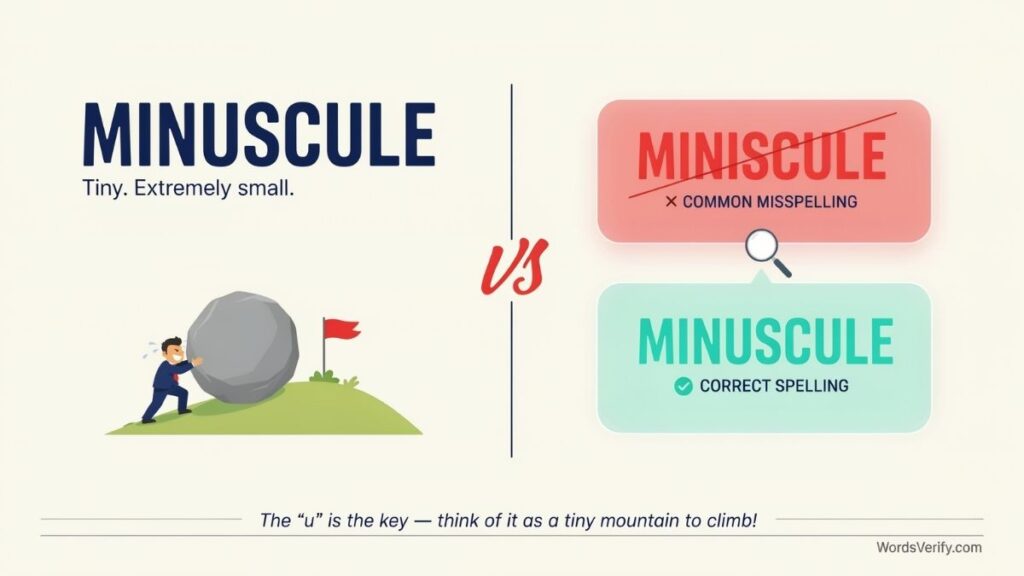
A tiny spelling difference can cause surprisingly big confusion! When it comes to minuscule vs miniscule, that extra “i” may look innocent, but it raises an important question: which spelling should you use? Although both forms appear in writing, they aren’t treated equally by all dictionaries and style guides. In this guide, you’ll learn why minuscule is the preferred spelling, whether miniscule is always considered incorrect, and how to use the word confidently. With clear definitions, practical examples, and easy memory tips, you’ll soon master this small but surprisingly tricky spelling distinction. Let’s settle the confusion once and for all!
Quick Answer Minuscule vs Miniscule
The main difference between minuscule vs miniscule is spelling, not meaning. Both forms generally express the idea of something extremely small, but minuscule is the traditional and preferred spelling.
| Feature | Minuscule | Miniscule |
|---|---|---|
| Spelling | Standard and preferred | Common variant |
| Meaning | Extremely small or negligible | Generally the same intended meaning |
| American English | Recommended | Recognized as a variant in some dictionaries |
| British English | Standard spelling | Also appears as a variant |
| Formal writing | Recommended | Usually best avoided |
| Example | The difference was minuscule. | The difference was miniscule. |
The easiest rule to remember is simple: use minuscule when you mean tiny, very small, or negligible. If you’re writing an academic paper, professional email, or published article, this spelling will help you follow standard conventions.
Learn the difference between tricky more English words
Indure vs Endure Which one Is Correct?
What Does Minuscule Mean?
Minuscule means extremely small in size, amount, degree, or significance. It’s an adjective that helps you describe something so small that it may seem barely noticeable compared with something larger.
Imagine two businesses reporting their annual profits. One earns $10 million, while the other earns $10,000. Depending on the comparison, you might describe the smaller profit as minuscule. The word doesn’t give an exact measurement. Instead, it emphasizes how small something is relative to the situation.
You’ll encounter minuscule in everyday conversations, scientific writing, business reports, and discussions about money or measurements. Its meaning depends on context, but the central idea remains the same: something is exceptionally small.
Minuscule in Its Literal Sense
When you use minuscule literally, you’re describing physical size. The object might fit on your fingertip or be difficult to see without magnification.
Consider these examples:
- The technician discovered a minuscule crack in the machine’s casing.
- A minuscule insect landed on the windowsill.
- The label contained minuscule print that was difficult to read.
- Researchers examined minuscule particles under a microscope.
- She found a minuscule hole in the pocket of her jacket.
In each sentence, minuscule describes something physically small. However, the word doesn’t always mean microscopic. A tiny hole in a jacket may be visible to the naked eye, while a minuscule particle might require specialized equipment to examine.
Context determines the scale. A minuscule object in a room could still look enormous compared with a minuscule particle studied in a laboratory.
Minuscule in Its Figurative Sense
Minuscule can also describe things that aren’t physical objects. You can use it for small amounts, limited chances, slight differences, or effects that barely matter.
For example:
- The new pricing strategy produced a minuscule increase in revenue.
- She had a minuscule chance of winning the competition.
- The two candidates finished with a minuscule difference in their vote totals.
- The repair made a minuscule dent in the company’s annual budget.
- His mistake had a minuscule effect on the final outcome.
Notice how the word often works alongside a comparison. A one-percent increase might be substantial in one situation but minuscule in another. Similarly, a small financial loss could matter greatly to a household while barely affecting a large corporation.
This makes minuscule particularly useful in professional writing. It communicates relative smallness without requiring an exact measurement.
Minuscule as a Noun in Writing and Typography
There’s another meaning worth knowing. Minuscule can also function as a noun referring to a lowercase letter or a style of handwriting that uses lowercase forms.
In typography, lowercase letters are called minuscules, while uppercase letters are called majuscules. The distinction concerns the forms of the letters rather than their physical size on a page.
Historical manuscripts also used minuscule scripts. These writing styles helped shape the development of letter forms that resemble many lowercase letters used today.
For example, a historian might discuss Carolingian minuscule, a medieval writing style associated with the Carolingian period. In this context, minuscule refers to a script or lettering tradition rather than simply something small.
This specialized meaning reveals a connection between the word’s history and its use in writing.
Learn the difference between tricky more English words
Scary vs Scarry which one is correct?
What Does Miniscule Mean?
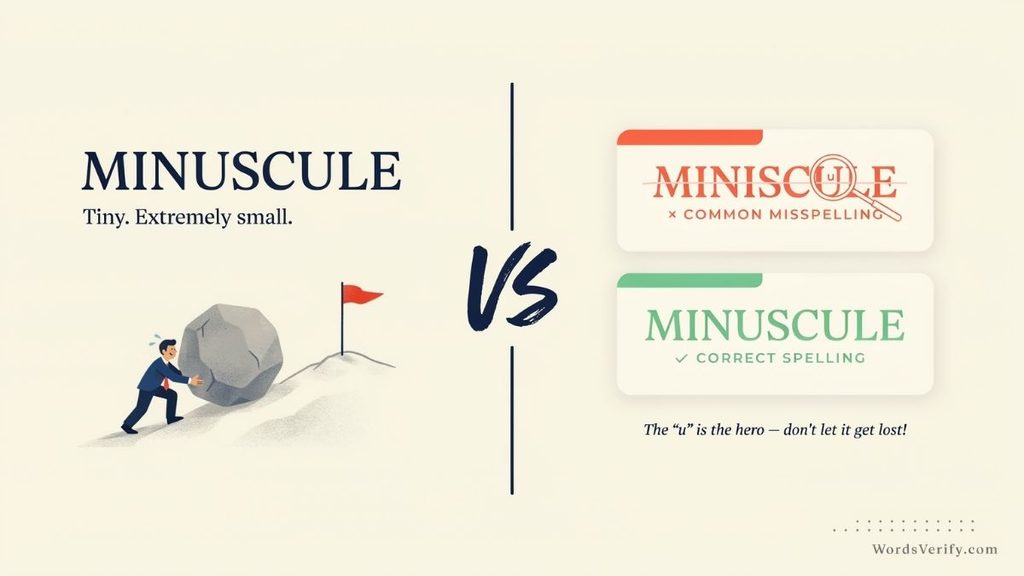
Miniscule generally carries the same meaning as minuscule: extremely small. The difference lies in how dictionaries and editors treat the spelling.
Some dictionaries recognize miniscule as a variant. Others label it incorrect or nonstandard. This distinction matters because dictionaries can record how people use a word without recommending every form for formal writing.
The variant has appeared in published writing for well over a century. Its continued use reflects a natural tendency to spell unfamiliar words according to familiar patterns.
So, is miniscule a word? The answer depends on what you mean by the question. It is a documented spelling variant, not a separate word with an entirely different meaning. However, if you’re asking which spelling to use in polished writing, minuscule is the safer option.
Compare these examples:
- Preferred: The budget allocated a minuscule amount to advertising.
- Variant: The budget allocated a miniscule amount to advertising.
Both sentences communicate the same idea. The first follows the traditional spelling convention that most editors prefer.
Learn the difference between tricky more English words
Breeched vs Breached which one is correct ?
The Difference Between Minuscule vs Miniscule
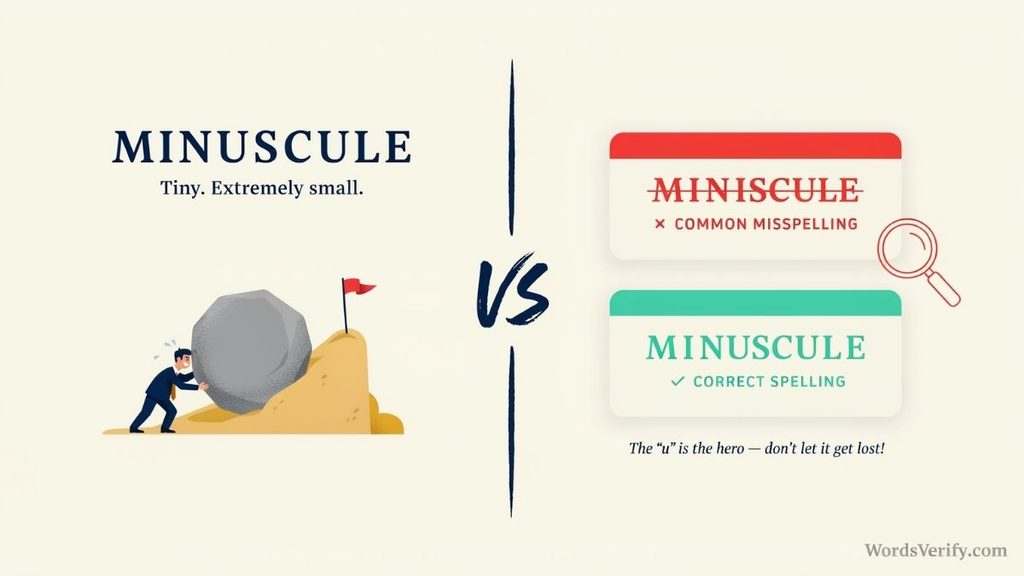
Difference comes down to one letter. Minuscule contains a u in the middle, while miniscule uses an i.
The distinction doesn’t change the intended meaning or grammatical role. Both spellings can appear in sentences such as “The difference was minuscule” and “The difference was miniscule.”
However, standard spelling conventions favor minuscule. If you’re writing for a teacher, employer, editor, or academic audience, it’s best to use the traditional form.
This confusion resembles many other spelling mistakes in English. A word may look as though it should follow a familiar pattern, but its actual spelling can reflect a much older history. That’s why checking a dictionary is often more reliable than spelling a word according to how it sounds.
Why Do People Spell Minuscule vs Miniscule?
The most likely reason is the familiar prefix mini. English speakers regularly encounter words such as miniature, minimum, miniskirt, and miniseries. These words contain the familiar mini sequence associated with small size or a reduced version of something.
When people encounter minuscule, they naturally connect it with that group. The spelling miniscule then looks logical, even though it doesn’t reflect the traditional form.
Pronunciation adds to the confusion. In ordinary speech, vowels in unstressed syllables can sound less distinct. The middle vowel may not provide an obvious clue about whether the word contains a u or an i.
Repeated exposure also plays a role. If you see miniscule in emails, articles, or social media posts, you may begin to assume it’s the standard spelling. Familiarity can influence what looks correct, even when a different form remains the preferred choice.
Why Is Minuscule Spelled With a U?
The spelling makes more sense when you understand the word’s history. Minuscule entered English through French and ultimately traces back to Latin.
The Latin word minusculus means somewhat smaller or rather small. It is related to minus, meaning less. This connection explains why the traditional English spelling contains a u rather than following the familiar mini pattern.
The modern variant miniscule developed partly through its association with words such as miniature and minimum. The similarity in meaning encouraged people to adopt a spelling that looked more familiar.
English spelling doesn’t always follow predictable rules. Some words preserve historical forms even when modern speakers might expect a different arrangement of letters and Minuscule is a good example.
Learn the difference between tricky more English words
Shiney vs Shiny which one is correct?
Minuscule in American and British English
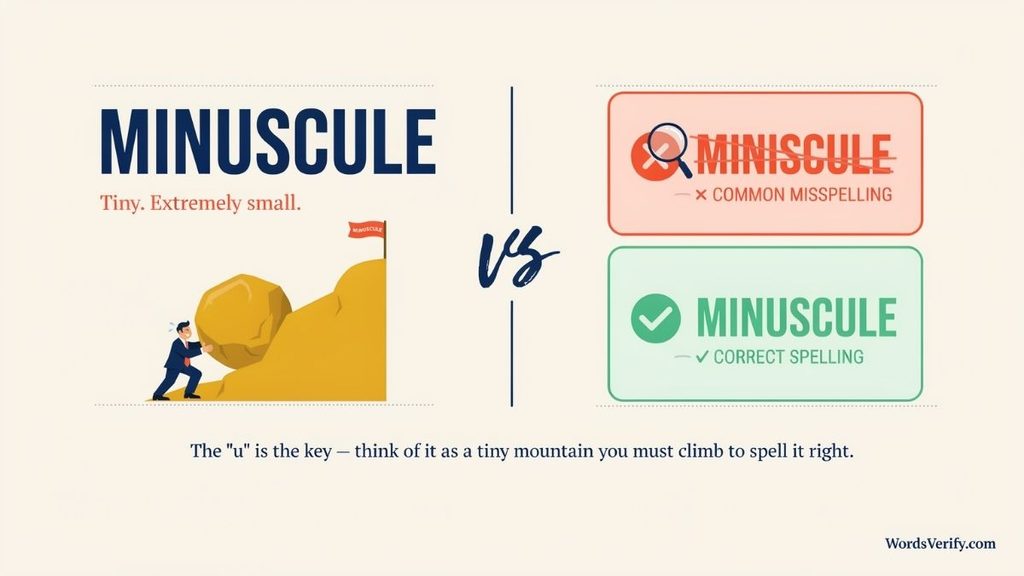
Some English words change spelling depending on where you use them. American English favors color, while British English generally uses colour. Minuscule vs miniscule don’t follow that pattern.
Minuscule is the standard spelling in both American and British English. Miniscule also appears in both varieties as a variant. The difference isn’t a regional convention like color and colour.
Here’s what that means in practice:
| Writing situation | Recommended spelling |
|---|---|
| American school assignment | Minuscule |
| British university essay | Minuscule |
| Professional email | Minuscule |
| Academic paper | Minuscule |
| Newspaper or magazine article | Minuscule, unless the publication specifies otherwise |
| Informal message | Minuscule remains preferred |
If you’re wondering whether miniscule is an accepted spelling, the answer requires some nuance. Certain dictionaries record it as a variant, while others explicitly label it incorrect or nonstandard.
Recognition and recommendation aren’t the same thing. A dictionary may acknowledge a spelling because people use it, but that doesn’t mean an editor will accept it in every context.
For consistent writing, choose minuscule and stick with it.
Learn the difference between tricky more English words
Puting vs Putting Which one Is Correct?
Minuscule Pronunciation and Meaning
Pronunciation can make this spelling problem even more confusing. In standard American English, minuscule is commonly pronounced /ˈmɪn.ə.skjuːl/. The first syllable carries the stress, while the middle vowel is relatively weak.
Because the middle vowel doesn’t always sound distinct in everyday speech, people may spell the word according to the familiar mini pattern rather than its traditional form.
The key is to separate pronunciation from spelling. Even if a variant looks closer to the way you hear a word, that doesn’t automatically make it the preferred written form.
If you’re uncertain about how to pronounce minuscule, consult a dictionary that provides audio. Listening to the word can help you recognize its syllables and stress pattern, although you’ll still need to remember its spelling.
Minuscule in a Sentence Practical Examples
Understanding a word becomes easier when you see how people use it in different situations. The following examples demonstrate minuscule in everyday English, business, science, and academic contexts.
Examples Describing Physical Size
- The watchmaker used a magnifying lens to examine a minuscule screw.
- A minuscule crack appeared along the edge of the phone screen.
- The artist added minuscule details to the miniature painting.
- The label contained minuscule lettering that was almost impossible to read.
- A minuscule seed fell between the floorboards.
In these sentences, minuscule describes physical dimensions. The word emphasizes smallness without providing a specific measurement.
Examples Describing Amounts and Differences
- The company reported a minuscule increase in its operating costs.
- The two laboratory measurements differed by a minuscule amount.
- She made a minuscule contribution to the overall fundraising total.
- The new policy produced a minuscule improvement in response times.
- The price difference was minuscule compared with the cost of shipping.
These examples show how the word works with abstract quantities. It can describe money, measurements, improvements, and other values that are small relative to a comparison.
Examples Describing Chances and Importance
- After losing the first three rounds, the player had a minuscule chance of winning.
- The delay played a minuscule role in the project’s final cost.
- Their disagreement concerned a minuscule detail in the contract.
- The error had a minuscule effect on the final result.
- The team gained a minuscule advantage over its competitors.
Here, minuscule refers to degree or significance rather than physical size. It helps communicate that something exists but has little influence.
Incorrect vs Preferred Spelling
Compare these sentences to see how the preferred spelling works in context.
| Less preferred | Recommended |
|---|---|
| The company earned a miniscule profit. | The company earned a minuscule profit. |
| We noticed a miniscule difference. | We noticed a minuscule difference. |
| The chance of failure was miniscule. | The chance of failure was minuscule. |
| She made a miniscule adjustment. | She made a minuscule adjustment. |
The meaning stays the same in each pair. The correction simply brings the spelling in line with the traditional standard.
Learn the difference between tricky more English words
Panic vs Panick Which one Is Correct?
Common Mistakes to Avoid With Minuscule
The miniscule spelling mistake is easy to make, but the word can also cause confusion when writers choose an imprecise synonym or misunderstand its meaning.
Assuming Miniscule Is the Only Logical Spelling
The familiar prefix mini makes miniscule look reasonable. However, spelling isn’t always a matter of assembling familiar word parts.
The preferred spelling reflects the word’s history rather than a direct combination of mini and another element. If you rely only on how a word looks or sounds, you may repeat common spelling errors.
The better approach is to learn the standard form and check a dictionary when you’re unsure.
Confusing Minuscule With Minute
Minuscule and minute can both describe something very small. However, they aren’t pronounced the same way in that sense, and minute has another common meaning.
| Word | Meaning | Example |
|---|---|---|
| Minuscule | Extremely small | The sample contained a minuscule particle. |
| Minute | Extremely small | The report identified a minute difference. |
| Minute | A period of 60 seconds | Give me a minute to finish. |
When minute means extremely small, it’s usually pronounced my-NOOT. When it means 60 seconds, it’s pronounced MIN-it.
Minuscule is often a useful alternative when you want to emphasize how tiny something is. However, minute may suit a sentence better when you want a more understated description.
Assuming Minuscule Always Means Unimportant
Minuscule can describe something negligible, but context determines whether that meaning makes sense.
For example, “The error had a minuscule effect on the result” means the error barely changed the outcome. It doesn’t necessarily mean the error itself was insignificant in every respect.
A tiny mistake in a medical dosage or safety procedure may have serious consequences. In such a case, describing the error as minuscule could confuse its size with the seriousness of its effects.
Remember that minuscule describes size or degree. It doesn’t automatically mean harmless.
Confusing Minuscule With Miniature
Both words relate to smallness, but they have different uses.
- Minuscule means extremely small in size, amount, or degree.
- Miniature describes a small-scale version or representation of something larger.
- Microscopic describes something so small that it requires magnification to see clearly, or something comparable to objects at that scale.
- Infinitesimal describes an extremely small quantity, often one that is almost negligible.
For example, a miniature house is a small-scale model of a house. A minuscule house is simply an extremely small house.
The distinction may seem subtle, but choosing the right word makes your meaning clearer.
Learn the difference between tricky more English words
Vendor vs Vender which one is correct?
Synonyms and Antonyms of Minuscule
Choosing a suitable synonym can make your writing more precise. Although many words mean small, each one carries a slightly different shade of meaning.
Synonyms of Minuscule
| Synonym | Best use | Example |
|---|---|---|
| Tiny | Everyday descriptions | A tiny insect landed on the table. |
| Minute | Extremely small details or differences | A minute crack appeared in the glass. |
| Microscopic | Very small objects or details | The sample contained microscopic organisms. |
| Infinitesimal | Extremely small quantities | The adjustment made an infinitesimal difference. |
| Diminutive | Small size, often describing people or objects | A diminutive figure stood near the doorway. |
| Negligible | So small that it barely matters | The additional cost was negligible. |
| Insignificant | Little importance or influence | The change had an insignificant effect. |
| Slight | Small in degree | There was a slight improvement. |
| Trivial | Unimportant or of little consequence | They argued over a trivial detail. |
Choose a word that fits the context. Microscopic is particularly useful when discussing scientific scale, while negligible often works better when evaluating costs, risks, or effects.
Antonyms of Minuscule
The opposite of minuscule depends on what you’re describing.
- Huge: Very large in size or amount.
- Enormous: Exceptionally large.
- Massive: Large, heavy, or substantial.
- Immense: Extremely great in size or extent.
- Substantial: Considerable in amount or importance.
- Significant: Important or large enough to matter.
For example, a minuscule increase in spending contrasts with a substantial increase. A minuscule building might contrast with an enormous structure.
Learn the difference between tricky more English words
Worse vs Worst which one is correct?
How to Remember the Correct Spelling of Minuscule
The easiest way to remember the spelling is to focus on its traditional form rather than the familiar prefix mini.
Try these simple techniques for minuscule vs miniscule:
- Remember the U. The preferred spelling is minuscule, not miniscule.
- Think about its Latin origin. The word traces back to minusculus, meaning somewhat smaller.
- Learn the whole word. Don’t try to rebuild the spelling from the prefix mini.
- Use a dictionary. If you’re uncertain, check a trusted reference instead of relying on spellcheck alone.
- Proofread for consistency. Search your document for both spellings and replace the variant if your chosen style requires the standard form.
A useful memory cue is simple: minuscule has a U for the usual spelling. It’s easy to recall when you’re editing quickly.
A Practical Editing Example
Imagine you’re proofreading a business report that contains this sentence:
“The company experienced a miniscule decline in operating expenses.”
Your first task is to check whether the spelling follows the document’s chosen standard. Replacing miniscule with minuscule gives you this corrected sentence:
“The company experienced a minuscule decline in operating expenses.”
Next, check whether minuscule accurately describes the decline. If the decline was very small relative to the company’s total expenses, the word fits. If the decline was substantial, the spelling correction alone won’t fix the sentence.
This example illustrates an important point: good proofreading checks both spelling and meaning. A grammar checker may flag a variant, but you still need to decide whether the word accurately expresses your intended idea.
Learn the difference between tricky more English words
Piqued vs Peaked which one is correct?
practice session Minuscule vs Miniscule
Test your understanding of minuscule vs miniscule with these sentences
Fill in the Blanks
- The difference between the two prices was __________.
- She made a __________ spelling error in her report.
- The company earned only a __________ profit last month.
- A __________ crack appeared on the surface of the glass.
- The scientist detected a __________ change in temperature.
- Even a __________ mistake can affect the meaning of a sentence.
- The artist added a __________ detail to the painting.
- We noticed a __________ difference between the two designs.
- The chance of rain was __________, according to the forecast.
- He spent a __________ amount of time checking the document.
- The insect left a __________ mark on the window.
- The team found a __________ error in the computer program.
- Her contribution made a __________ difference to the final result.
- The witness remembered only a __________ detail about the incident.
- The company reported a __________ increase in sales.
- The typo was so __________ that most readers overlooked it.
- A __________ amount of paint covered the edge of the table.
- The doctor noticed a __________ change in the patient’s condition.
- The difference in their test scores was __________.
- The author corrected a __________ error before publishing the book.
- The machine uses a __________ amount of energy when idle.
- The map showed a __________ variation in the measured distance.
- The manager dismissed the complaint as a __________ issue.
- The designer made a __________ adjustment to the layout.
- In standard English, minuscule is the preferred spelling over __________.
Answers
- minuscule
- minuscule
- minuscule
- minuscule
- minuscule
- minuscule
- minuscule
- minuscule
- minuscule
- minuscule
- minuscule
- minuscule
- minuscule
- minuscule
- minuscule
- minuscule
- minuscule
- minuscule
- minuscule
- minuscule
- minuscule
- minuscule
- minuscule
- minuscule
- miniscule
Here’s a trusted source for clear more words Comparison:
FAQS
Which spelling should you use in formal writing?
Use “minuscule” in formal writing, academic papers, and professional communication. It’s the standard spelling and the safest choice when you want to avoid spelling debates.
Can minuscule describe an amount of money?
Yes. Minuscule can describe a very small amount of money, a tiny profit, or a nearly insignificant expense. For example: “The investment generated a minuscule return.”
Is minuscule suitable for describing a problem?
Yes. You can use minuscule to describe a problem that’s extremely small or insignificant. For example: “The team fixed a minuscule error before launching the website.”
Does minuscule have a formal or informal tone?
Minuscule works in both formal and informal contexts. It sounds slightly more precise than everyday words such as “tiny” or “little,” making it useful in professional writing as well as casual conversation.
Can minuscule describe differences between two things?
Absolutely. Minuscule can describe a difference so small that it barely matters. For example: “There was a minuscule difference between the two test results.”
Is minuscule commonly used in scientific writing?
Yes. Scientific and technical writers may use minuscule to describe extremely small quantities, changes, or variations. However, precise measurements are usually better than vague descriptions when accuracy matters.
What is the difference between minuscule and negligible?
Minuscule means extremely small in size or amount. Negligible means so insignificant that it can be ignored or has little practical effect. A difference can be minuscule without being negligible if it has important consequences.
Can minuscule be used as an adverb?
No. Minuscule is an adjective, not an adverb. Use “minutely” when you need an adverb related to smallness or detail, depending on the intended meaning. For example: “The document was minutely examined” means it was examined in great detail.
Is minuscule related to lowercase letters?
Yes. In typography, minuscule can refer to lowercase letters, as opposed to majuscule letters, which are uppercase. This specialized meaning comes from the word’s historical connection with small letter forms.
How can you avoid confusing minuscule with similar words?
Focus on the context. Use minuscule when describing something extremely small, negligible when emphasizing insignificance, and miniature when referring to a smaller version of something. Remember that “minuscule” is the preferred spelling, so you can leave that extra “i” out of your writing.
Learn the difference between tricky more English words
Inclusivity vs Inclusiveness which one is correct?
conclusion
The spelling difference between minuscule vs miniscule may be small, but it can cause a surprising amount of confusion. Minuscule is the preferred spelling in standard English and the safest choice for professional, academic, and everyday writing. Although miniscule appears frequently and is recognized by some dictionaries as a variant, not every style guide accepts it.
Here’s an easy way to remember the correct spelling of minuscule vs miniscule: minuscule comes from the Latin word minusculus, meaning “rather small.” So, skip the extra “i” and stick with minuscule when you want to play it safe. After all, the word describes something tiny, but that doesn’t mean its spelling deserves less attention!

Lisa AJS is an experienced blogger and language enthusiast at Words Verify, dedicated to making grammar simple, practical, and enjoyable. She writes engaging content on commonly confused words, grammar mistakes, word meanings, and everyday language challenges.