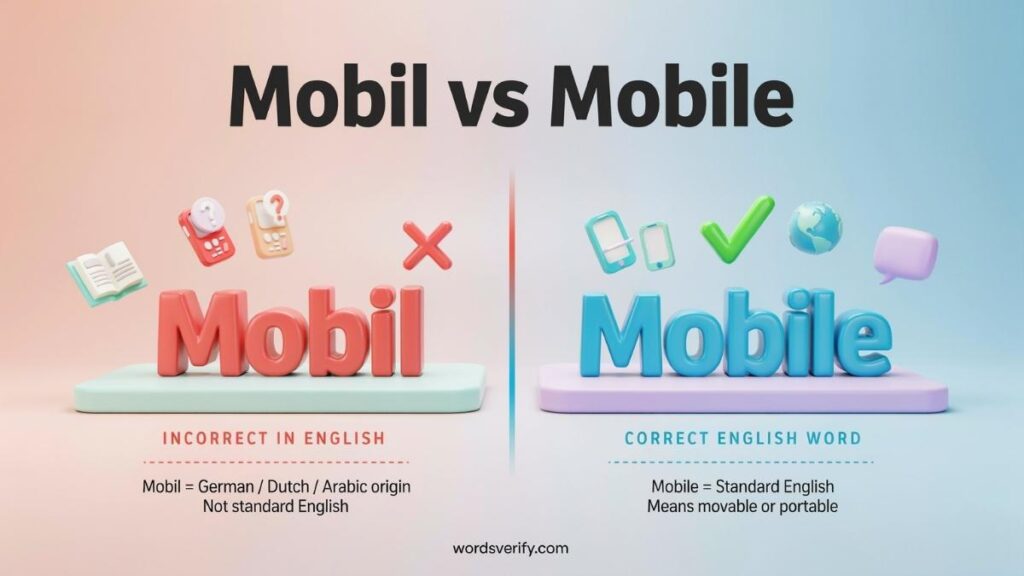
Have you ever confused “Mobil” with “mobile” and wondered whether one little letter could cause so much trouble? It certainly can! The difference between Mobil vs Mobile is small but important. “Mobile” describes something that can move or be easily carried, such as a mobile phone. “Mobil,” on the other hand, is a well-known brand associated with fuel and motor oil. Mix them up, and your message might sound more like a gas station advertisement than everyday conversation. The good news? This spelling mix-up is easy to fix once you understand the difference. Let’s break it down and make this common grammar mistake a thing of the past!
Quick Answer Mobil vs Mobile
The difference between Mobil vs mobile comes down to meaning and usage.
- Mobile: The standard English word for something movable or portable. It also describes phones, devices, and related technology.
- Mobil: A proper name, most notably the fuel and lubricant brand associated with ExxonMobil.
Consider these examples:
- Correct: “She bought a new mobile phone.”
- Correct: “We stopped at a Mobil gas station.”
- Incorrect: “She bought a new mobil phone.”
- Incorrect: “The company operates a mobil clinic.”
The easiest rule to remember is simple: use mobile when describing something portable or capable of movement. Use Mobil when referring to the brand.
| Question | Answer |
|---|---|
| How do you spell the word for a portable phone? | Mobile |
| How do you spell the fuel brand? | Mobil |
| Is mobile spelled with an e? | Yes |
| Is Mobil a real name? | Yes, it’s a brand name |
| Is mobil the standard spelling of the adjective? | No |
| Do American and British English use mobile? | Yes |
Avoid everyday grammar mistakes with simple tips
Gummy vs Gummie Which one Is Correct?
What Does Mobile Mean?
The word mobile describes something that can move, be moved, or operate in different locations. It also appears in technology, communication, healthcare, art, and everyday conversation.
Its meaning depends on the context. A mobile phone is a portable communication device. A mobile clinic travels to serve patients in different locations. A decorative mobile is a hanging arrangement of objects that move gently in the air.
In English grammar, mobile can function as both an adjective and a noun. Understanding these roles makes it easier to use the word correctly.
Mobile as an Adjective
As an adjective, mobile describes a person, object, service, or system that can move or operate in different places.
For example:
- “The hospital launched a mobile clinic for rural residents.”
- “The company has a mobile workforce.”
- “She uses a mobile device to manage her appointments.”
- “The equipment is lightweight and mobile.”
In each sentence, mobile describes the noun that follows or relates to it. The clinic travels, the workforce operates across locations, and the device can be carried around.
The word also appears in expressions such as mobile computing, mobile internet, mobile services, and mobile technology. These terms often describe systems that allow people to access information or complete tasks away from a fixed workstation.
Mobile as a Noun
Although many people recognize mobile as an adjective, it can also function as a noun.
In British English and some other varieties, mobile is a common shortened form of mobile phone. Someone might say, “I left my mobile at home,” meaning they forgot their phone.
The word has another established meaning in art and decoration. A mobile can be a suspended arrangement of lightweight shapes that move in response to air currents or changes in balance.
For example, a colorful baby mobile might hang above a crib, gently moving as air circulates through the room.
These meanings share an association with movement, but context tells you whether mobile refers to a phone or a decorative object.
Mobile Phone and Mobile Technology
In modern English, mobile frequently appears in technology-related terms. A mobile phone provides wireless communication, while a mobile application is software designed for portable devices such as smartphones and tablets.
Common expressions include:
- Mobile phone: A portable telephone that connects through a wireless cellular network.
- Mobile device: A broad term for portable electronics, including smartphones and tablets.
- Mobile application: Software designed for use on mobile devices.
- Mobile internet: Internet access through cellular networks or other wireless connections.
- Mobile computing: Using portable devices to access information and perform tasks while moving between locations.
Although these expressions relate to technology, mobile still conveys the idea of portability. The surrounding noun explains the specific purpose.
For example, mobile banking refers to banking services accessed through a phone or another mobile device. It doesn’t mean the bank building moves from one place to another.
Avoid everyday grammar mistakes with simple tips
Flys vs Flies which one is correct?
Mobile in American and British English
The spelling mobile is standard in both American and British English. The main differences involve everyday vocabulary and pronunciation.
In the United States, people commonly say cell phone or cellphone when referring to a portable telephone. Americans also use mobile phone, particularly in technical, business, and international contexts.
In the United Kingdom, mobile phone is common, and speakers frequently shorten it to mobile.
| Context | American English | British English |
|---|---|---|
| Common phone term | Cell phone | Mobile phone |
| Shortened term | Cell or phone | Mobile |
| Portable application | Mobile app | Mobile app |
| Correct spelling | Mobile | Mobile |
Neither variety normally drops the final e. Whether you’re writing for an American or British audience, mobile remains the correct spelling.
Avoid everyday grammar mistakes with simple tips
Breeched vs Breached which one is correct ?
What Does Mobil Mean?
Unlike mobile, Mobil is best known as a proper name. It identifies a major fuel and lubricant brand associated with ExxonMobil Corporation, an energy company whose businesses include petroleum products and other energy-related operations.
The distinction matters because proper names follow their established spelling. You wouldn’t change a company’s name simply because it resembles an ordinary English word.
Mobil appears in the names of fuel stations and automotive products. By contrast, mobile appears in descriptions of portable devices, movable equipment, and services that operate in different locations.
Mobil as a Fuel and Lubricant Brand
Mobil is a recognized name in the automotive industry. Drivers may see it at fuel stations, while vehicle owners may encounter it on bottles of motor oil and other lubricants.
The brand name appears in several familiar contexts:
- Mobil gas station: A location that sells fuel under the Mobil brand.
- Mobil motor oil: An automotive lubricant sold under the Mobil name.
- Mobil 1: A well-known line of synthetic motor oils.
- Mobil lubricants: Products intended for automotive and other lubrication applications.
For example:
- “We stopped at a Mobil station to fill the tank.”
- “The mechanic recommended Mobil motor oil for the car.”
- “She compared Mobil 1 products before choosing an engine lubricant.”
In these sentences, Mobil identifies a brand. It doesn’t describe an object that can move.
The capital letter helps readers recognize the name, although capitalization alone doesn’t determine meaning in every sentence. Mobile also begins with a capital letter when it starts a sentence or appears in a proper name.
What Is the Difference Between Mobil and Mobil 1?
Although the names are related, Mobil and Mobil 1 don’t refer to exactly the same thing.
Mobil is the broader brand name used for fuel and lubricant products. Mobil 1 identifies a particular line of synthetic motor oils associated with the brand.
Motor oil lubricates an engine’s moving parts, helps reduce friction, and supports engine protection under operating conditions. Different oils have different viscosity grades and performance specifications, so drivers should select products that meet their vehicle manufacturer’s requirements.
For example, a bottle of Mobil 1 might carry a viscosity grade such as SAE 0W-20 or SAE 5W-30. Those numbers identify the oil’s viscosity classification, not a spelling difference between Mobil and mobile.
If you’re discussing engine oil or a fuel station, the established brand spelling is Mobil.
Is Mobil a Real English Word?
The question “Is mobil a word?” needs some context.
Mobil is a real proper name, especially as a brand name. However, mobil isn’t the standard spelling of the ordinary English adjective meaning movable or portable.
A proper name doesn’t have to follow the spelling of a similar common word. Companies often choose names that differ from familiar dictionary words, and their established names retain their own spelling.
Consider these examples:
| Sentence | Correct usage | Why |
|---|---|---|
| “I bought a new mobile phone.” | Mobile | Describes a portable device |
| “I bought Mobil 1 motor oil.” | Mobil | Identifies a product brand |
| “The clinic has a mobile unit.” | Mobile | Describes a unit that can travel |
If someone writes “mobil phone,” the intended meaning will probably be clear. Nevertheless, the spelling is incorrect in standard English.
Avoid everyday grammar mistakes with simple tips
Envision vs Invision which one is correct?
Mobil vs Mobile The Key Differences
The most reliable way to understand the mobile vs. Mobil distinction is to examine meaning, grammar, capitalization, and context together.
The two forms aren’t interchangeable, even when they sound similar.
| Feature | Mobile | Mobil |
|---|---|---|
| Word type | Commonly an adjective; also a noun | Proper name |
| Standard usage | Describes something movable or portable | Identifies a brand or another established name |
| Final letter | Ends in e | Doesn’t end in e |
| Typical context | Phones, devices, clinics, equipment, decorations | Fuel stations, motor oil, automotive products |
| Example | “My mobile phone is charging.” | “The station sells Mobil products.” |
| Capitalization | Usually lowercase in ordinary use | Capitalized when referring to the brand |
| American English | Standard spelling | Brand spelling |
| British English | Standard spelling | Brand spelling |
The Difference Between Mobil and Mobile in Grammar
English grammar distinguishes common words from proper names. Mobile usually acts as an adjective, while Mobil functions as a brand name.
Consider this sentence:
“The mobile mechanic visited the Mobil station.”
The first word describes the mechanic’s service. The mechanic travels to customers instead of requiring them to visit a fixed workshop. The second word identifies a fuel brand.
Both spellings are correct because they serve different purposes.
This example also shows why replacing one form with the other can make a sentence incorrect. Grammar and context work together to determine the right choice.
Mobile vs Movable vs. Portable
Another source of confusion is the relationship between mobile, movable, and portable. These words overlap in meaning, but they aren’t always interchangeable.
- Mobile: Often suggests the ability to move freely or operate in different places.
- Movable: Means capable of being moved from one position to another.
- Portable: Emphasizes that something can be carried or transported relatively easily.
For example, a mobile medical team travels between communities. A movable partition can be shifted to divide a room. A portable charger can be carried in a bag.
These distinctions aren’t absolute. A portable device can also be mobile, and movable equipment can be described as mobile in the right context. However, each word emphasizes a slightly different quality.
None of these meanings calls for the spelling mobil.
Avoid everyday grammar mistakes with simple tips
Bespectacled vs Bespeckled What’s the Difference?
Mobil vs Mobile Examples in Sentences
Definitions help, but real sentences make the difference easier to remember. The following examples show how to use each spelling in everyday, professional, and technical contexts.
Correct Examples Using Mobile
Use mobile when describing movement, portability, phones, or related technology.
- “The business introduced a mobile app for customers.”
- “A mobile clinic visits the village twice a month.”
- “My mobile phone needs a new battery.”
- “The technician brought mobile equipment to the construction site.”
- “The company allows employees to work through a mobile network.”
- “The baby watched the colorful mobile hanging above the crib.”
- “The patient’s condition improved enough for her to become more mobile.”
- “The organization provides mobile services to people who cannot easily travel.”
- “He prefers mobile banking because he can check his account while traveling.”
- “The new device offers better mobile connectivity.”
Notice that mobile doesn’t always refer to electronics. In the seventh example, it describes a person’s ability to move. In the sixth, it names a hanging decoration.
Correct Examples Using Mobil
Use Mobil when referring to the brand.
- “We stopped at a Mobil station during our road trip.”
- “The driver checked the fuel prices at Mobil.”
- “The mechanic recommended Mobil motor oil for the car.”
- “She purchased a bottle of Mobil 1 synthetic oil.”
- “The garage stocks several Mobil lubricant products.”
- “He compared the specifications of different Mobil 1 oils.”
- “The customer asked whether the station carried Mobil products.”
- “The owner checked the vehicle manual before choosing an engine oil.”
These examples use the brand name rather than a general adjective. The final e doesn’t belong in Mobil when you’re writing the established brand name.
Incorrect Examples and Their Corrections
Spelling mistakes often happen when a writer leaves out a letter that seems unimportant. However, even one missing letter can produce the wrong form.
| Incorrect sentence | Correct sentence | Explanation |
|---|---|---|
| I bought a new mobil phone. | I bought a new mobile phone. | The ordinary word requires the final e. |
| The clinic operates a mobil unit. | The clinic operates a mobile unit. | Mobile describes a unit that can travel. |
| She downloaded the mobil app. | She downloaded the mobile app. | Mobile describes the type of application. |
| He purchased mobile 1 oil. | He purchased Mobil 1 oil. | Mobil 1 is a brand and product-line name. |
| We stopped at a Mobile gas station. | We stopped at a Mobil gas station. | Use the brand’s established spelling. |
The final example needs a little context. Mobile can also appear as a proper name in other settings, including Mobile, Alabama. The surrounding words help establish the intended meaning.
A Simple Example One Missing Letter, Two Different Contexts
Imagine that a writer is preparing two short advertisements.
The first promotes a phone repair service:
“Get your mobil phone repaired today.”
The second promotes a fuel station:
“Visit Mobil for your next fuel stop.”
Only the first sentence contains a spelling mistake. The writer should change mobil phone to mobile phone because the sentence describes a portable communication device.
The second sentence is correct because Mobil names the brand.
This comparison illustrates a useful principle: similar-looking words must be judged by meaning and context, not appearance alone.
Avoid everyday grammar mistakes with simple tips
Visible vs Visable Which one Is Correct?
Mobil vs Mobile Pronunciation
Pronunciation can explain why people confuse Mobil and mobile. Although the words differ in spelling and meaning, their sounds can be similar in some accents and speaking styles.
The exact pronunciation depends on the speaker’s accent and whether the word appears in ordinary conversation or as a brand name.
How Do Americans Pronounce Mobile?
In American English, mobile has two common pronunciations:
- MOH-buhl
- MOH-byle
Both pronunciations occur in the United States. Usage can vary by region, individual speaker, and context. Someone might pronounce mobile phone differently from someone who uses the word in the name of Mobile, Alabama.
The important point is that both pronunciations use the same spelling: mobile.
How Do British People Pronounce Mobile?
British English commonly uses a pronunciation similar to MOH-byle. However, pronunciation varies across the United Kingdom, and speakers don’t all follow one uniform pattern.
The spelling remains mobile regardless of pronunciation.
How Do You Pronounce Mobil?
The Mobil brand name is commonly pronounced with the first syllable stressed and a short, unstressed ending. The exact vowel sounds vary by accent.
Because the pronunciations can overlap, hearing a word isn’t always enough to determine which spelling the speaker intends. The surrounding context usually provides the answer.
For instance, a conversation about engine oil points toward Mobil, while a discussion about smartphones points toward mobile.
Avoid everyday grammar mistakes with simple tips
Heros vs Heroes Which one Is Correct?
Why Does Mobile Have an E at the End?
The final e in mobile is part of its established spelling. English spelling reflects word history and convention rather than a single rule that explains every word.
The word comes through French from Latin mobilis, meaning movable or capable of movement. Its historical connection to movement remains clear in modern expressions such as mobile equipment, mobile workforce, and mobile phone.
The brand name Mobil, by contrast, has its own established spelling. It isn’t simply an ordinary adjective with a missing letter.
A Simple Memory Trick for Mobile Spelling
Use this quick reminder:
Mobile moves with an E. Mobil names the brand.
Then ask yourself two questions:
- Am I describing something portable or capable of movement? Write mobile.
- Am I referring to the Mobil fuel or lubricant brand? Write Mobil.
You can also remember the word through familiar expressions such as mobile phone, mobile app, mobile clinic, and mobile device. Every example preserves the final e.
Repeated exposure to correct forms is one of the easiest ways to improve spelling and build confidence in English grammar and vocabulary.
Avoid everyday grammar mistakes with simple tips
Minuscule vs Miniscule which one is correct?
Common Mistakes Involving Mobil vs Mobile
Even experienced writers sometimes make spelling mistakes when two forms look nearly identical. Here are the most common errors and how to avoid them.
Dropping the Final E
Writing mobil phone instead of mobile phone is the most direct mistake.
The solution is simple: remember that the ordinary adjective retains its final e. A spelling checker may catch the error, but it might not identify it in every context because Mobil is also a valid proper name.
Using the Brand Name as an Ordinary Adjective
A sentence such as “The company launched a mobil service” is incorrect if the writer means a service that travels to customers.
The correct version is “The company launched a mobile service.”
Don’t assume that a brand name can replace a similar common word simply because the pronunciation sounds close.
Confusing Capitalization With Spelling
Capitalization helps identify names, but it doesn’t change the underlying spelling.
For example:
- “The mobile service operates throughout the city.”
- “The driver stopped at Mobil.”
- “Mobile technology continues to develop.”
The third sentence begins with a capital letter because it starts a sentence. That doesn’t turn Mobile into the Mobil brand.
Assuming American and British English Use Different Spellings
American and British English differ in many vocabulary choices and some spelling conventions. However, mobile isn’t a case in which Americans normally drop the final e.
Both varieties use mobile. Their differences mainly involve pronunciation and terms such as cell phone and mobile phone.
Avoid everyday grammar mistakes with simple tips
Indure vs Endure Which one Is Correct?
practice session Mobil vs Mobile
Complete each sentence with the correct word: Mobil vs mobile. The answers are provided in a separate section so you can test yourself first.
Fill in the blanks
- I bought a new ______ phone last week.
- ______ is a well-known brand of motor oil and fuel.
- This ______ device is easy to carry while traveling.
- My mechanic recommended ______ 1 for my car.
- Please switch off your ______ phone during the exam.
- The company sells fuel under the ______ brand.
- A ______ clinic provides medical services to remote communities.
- She uses a ______ app to manage her daily tasks.
- The mechanic checked the engine oil before adding ______ 1.
- A laptop is more ______ than a desktop computer.
- The baby watched the colorful ______ hanging above the crib.
- My ______ number has changed recently.
- The driver stopped at a station that sold ______ fuel.
- A ______ library brings books and reading services to different neighborhoods.
- You can make payments using your ______ phone.
- The garage stocks several ______ lubricants.
- A ______ workforce can work from different locations.
- I accidentally spelled “______ phone” when I meant “mobile phone.”
- The company introduced a new product under the ______ name.
- A ______ application lets users access services while on the go.
- The artist created a hanging ______ from wire and colorful shapes.
- My father uses ______ 1 synthetic oil in his vehicle.
- The school launched a ______ learning app for students.
- Always check your ______ phone before leaving home.
- Remember that ______ is a brand name, while mobile is a common English word.
Answers
- mobile
- Mobil
- mobile
- Mobil
- mobile
- Mobil
- mobile
- mobile
- Mobil
- mobile
- mobile
- mobile
- Mobil
- mobile
- mobile
- Mobil
- mobile
- Mobil
- Mobil
- mobile
- mobile
- Mobil
- mobile
- mobile
- Mobil
Here’s a trusted source for clear word meanings:
FAQs
Which is correct, Mobil or mobile?
Both spellings are correct, but they have different uses. “Mobile” is the standard English word for something portable or movable. “Mobil” is a proper name commonly associated with the fuel and motor oil brand.
What does Mobil mean in English?
Mobil is a brand name associated with gasoline, motor oil, and other petroleum products. Unlike “mobile,” it isn’t the standard spelling of the everyday English word for something portable.
Is a car a Mobil or mobile?
A car is a mobile vehicle because it can move from place to place. “Mobil” refers to the brand, not the general category of vehicles.
Is “Mobil” spelled correctly?
Yes. “Mobil” is spelled correctly when you mean the brand. If you’re describing something that can move or be carried easily, the correct spelling is “mobile.”
What are the two meanings of mobile?
“Mobile” has several meanings, but two common ones are:
- Movable or portable: Something that can move or be moved easily, such as a mobile phone.
- A hanging decoration: An arrangement of suspended objects that move freely, often displayed above a baby’s crib.
How do Americans pronounce mobile?
Americans commonly pronounce “mobile” as MOH-buhl, with the first syllable stressed. You may also hear MOH-byle, depending on the region and context.
How do British people pronounce mobile?
British speakers commonly say “mobile” as MOH-byle, particularly when referring to a mobile phone. Pronunciation can vary by region and individual speaker.
How do Canadians pronounce mobile?
Canadian pronunciation varies, but many Canadians use a pronunciation similar to the common American form, MOH-buhl. Others use MOH-byle, especially in certain contexts.
What do British people call a mobile phone?
British people usually call it a “mobile” or “mobile phone.” In everyday conversation, someone might simply ask, “Where’s my mobile?”
Should I say cell phone or mobile phone?
Both terms are correct. “Cell phone” is more common in American English, while “mobile phone” is widely used in British English and many other English-speaking regions.
Why is it called a mobile phone?
It’s called a mobile phone because you can carry it and use it while moving between locations, unlike a traditional landline phone connected to a fixed place.
What does mobile mean in slang?
In informal speech, “mobile” usually refers to a cell phone or mobile phone. Its exact meaning depends on the conversation, and it doesn’t have one universal slang definition.
What is a fancy word for mobile?
Depending on the context, alternatives include “portable,” “movable,” “transportable,” and “versatile.” For a phone or electronic device, “portable” is often the clearest substitute.
How do you say mobile when referring to a baby’s toy?
A baby’s mobile is a hanging decoration with suspended toys or shapes that move above a crib. The word is spelled “mobile,” not “Mobil,” regardless of how you pronounce it.
What does mobile mean in technology?
In technology, “mobile” describes devices and services designed for use while moving or away from a fixed location. Examples include mobile phones, mobile apps, and mobile internet.
Avoid everyday grammar mistakes with simple tips
Scary vs Scarry which one is correct?
Conclusion
The difference between Mobil vs mobile may be just one letter, but that tiny detail can change your meaning completely. “Mobile” refers to something movable or portable, such as a mobile phone, while “Mobil” is a well-known brand associated with fuel and motor oil. Confusing the two won’t necessarily leave you stranded, but it might send your reader down the wrong road!
Fortunately, remembering the distinction is simple. Use “mobile” when discussing portable devices or things that can move. Choose “Mobil” when referring to the brand. With this small spelling trick in mind, you can avoid unnecessary confusion and write with confidence. After all, one missing letter shouldn’t be allowed to drive your grammar off course!

Lisa AJS is an experienced blogger and language enthusiast at Words Verify, dedicated to making grammar simple, practical, and enjoyable. She writes engaging content on commonly confused words, grammar mistakes, word meanings, and everyday language challenges.