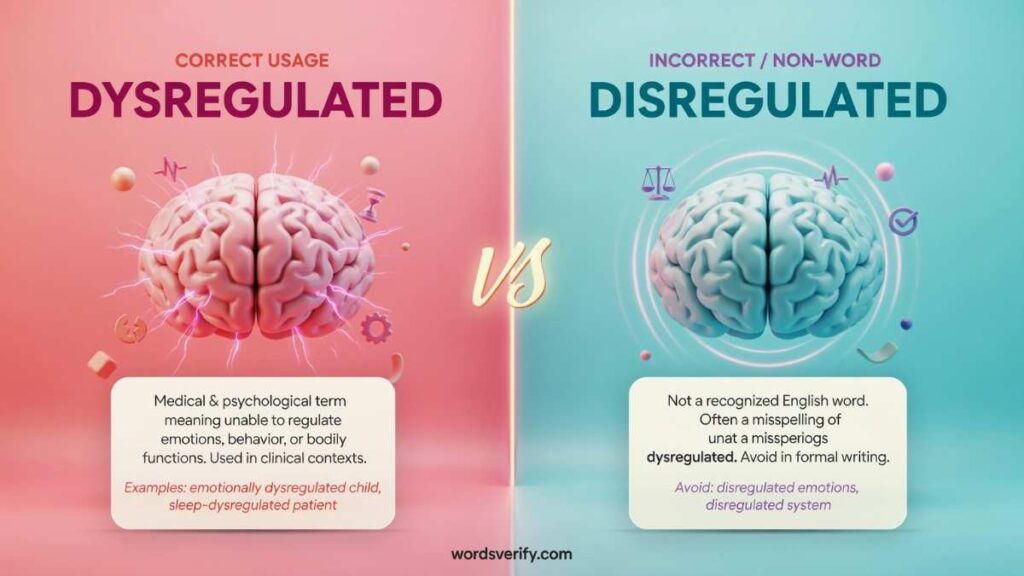
Have you ever questioned a word so much that even the correct spelling starts to look wrong? You’re not alone! The confusion between dysregulated vs disregulated can leave even confident writers second-guessing themselves. Although these words may look similar, they aren’t interchangeable. Choosing the wrong one can make an otherwise polished sentence less accurate. Fortunately, clearing up this spelling mystery is easier than you might think. In this guide, you’ll learn which word is correct, what it means, how to use it in everyday writing, and which common grammar mistakes to avoid. Let’s clear up the confusion once and for all!
quick answer
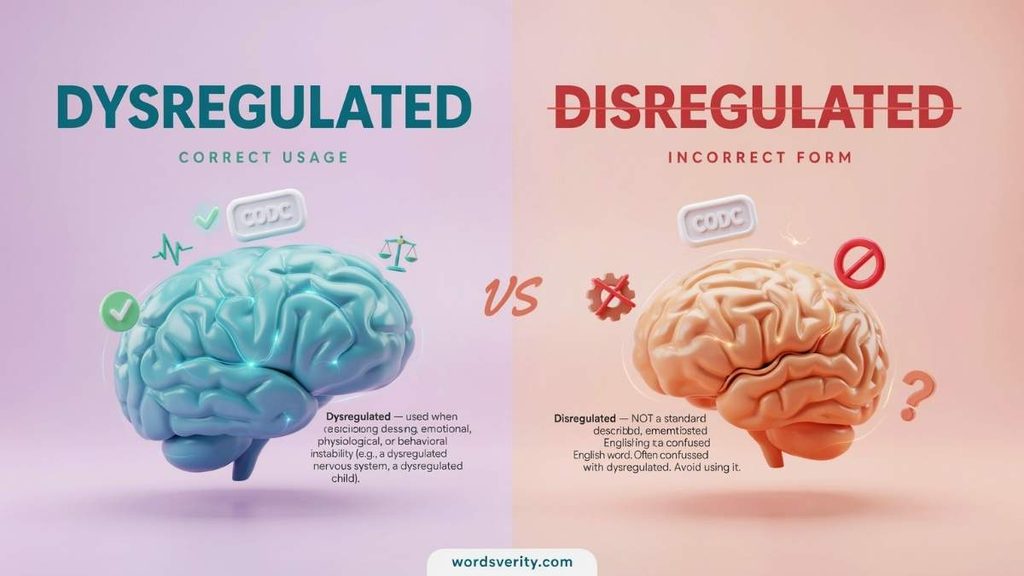
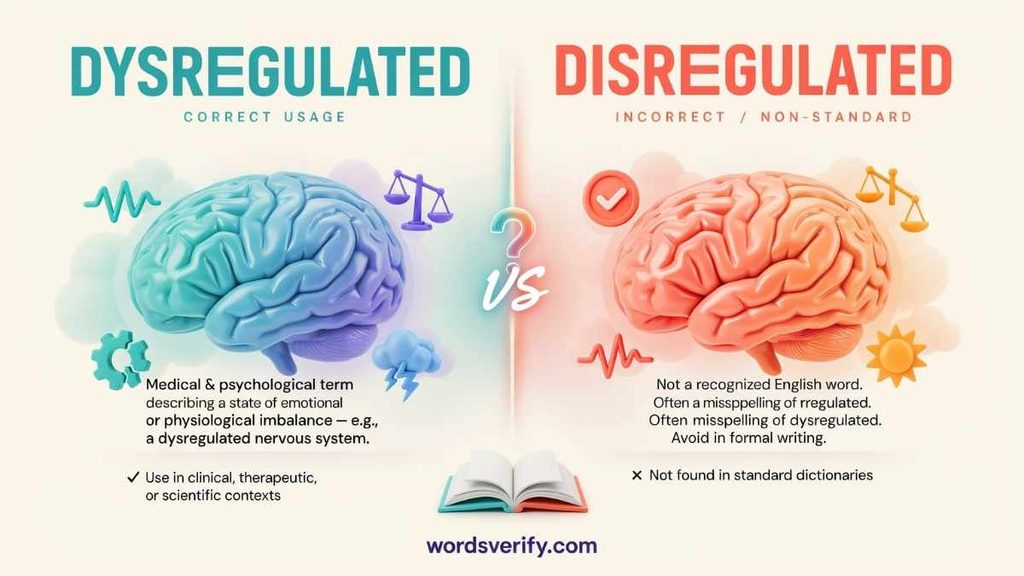
Dysregulated is the correct spelling when you want to describe a process, response, or system whose normal regulation has become impaired. The term appears in psychology, medicine, biology, and everyday discussions about managing emotions.
Disregulated, on the other hand, is usually a spelling mistake when someone intends to describe impaired regulation. Although you may see it in informal writing, it isn’t the standard form used in professional or academic contexts.
Here’s a quick comparison of dysregulated vs disregulated:
| Feature | Dysregulated | Disregulated |
|---|---|---|
| Standard spelling | Yes | No, not for the intended meaning |
| Meaning | Poorly or abnormally regulated | Usually an incorrect spelling of dysregulated |
| Common contexts | Psychology, medicine, biology, and everyday conversation | Informal writing and spelling errors |
| Recommended use | Use this spelling | Replace it with dysregulated when appropriate |
If you’re writing about emotional responses, biological processes, or difficulty maintaining normal regulation, choose dysregulated.
Fix common more word mistakes in English
Mobil vs Mobile which one is correct?
What Does Dysregulated Mean?
Dysregulated describes something that isn’t regulating itself as expected. In simple terms, a process or system may struggle to maintain balance, respond appropriately, or adjust to changing circumstances.
Think of a thermostat that can’t keep a room at a steady temperature. Sometimes the room becomes too hot. At other times, it stays too cold. The thermostat still operates, but its control system isn’t working as it should.
That’s a useful way to understand dysregulation. Regulation hasn’t necessarily stopped altogether. Instead, the process may respond too strongly, too weakly, or at the wrong time.
The word can describe several situations, including:
- Emotional responses that are difficult to manage.
- Biological processes that don’t function within their usual regulatory patterns.
- Glucose regulation that fails to maintain appropriate blood sugar levels.
- Immune responses that aren’t properly controlled.
- Stress responses that remain heightened after a stressful event.
The exact meaning depends on the context. A psychologist discussing emotional regulation and a medical researcher studying immune function may use the same word to describe different processes.
Emotional Dysregulation
Emotional dysregulation refers to difficulty managing emotional responses in ways that fit a situation or support everyday functioning.
For example, imagine receiving an upsetting message from a friend. You might feel hurt or angry, but after taking some time to think, you can respond calmly. Someone experiencing emotional dysregulation might feel overwhelmed by the same situation and struggle to settle down.
Common signs can include:
- Strong emotional reactions that feel difficult to manage.
- Irritability or frustration that takes a long time to settle.
- Rapid changes in mood.
- Difficulty pausing before reacting.
- Trouble recovering after an argument, disappointment, or stressful experience.
These experiences don’t automatically indicate a mental health condition. Everyone has difficult days, and strong emotions are a normal part of life. What matters is the broader pattern, including how often these difficulties occur and how much they affect daily activities.
Emotional regulation also doesn’t mean suppressing feelings. You can feel angry, sad, anxious, or disappointed while still managing how you respond. The goal is to recognize your emotions and handle them in a way that helps you move forward.
Dysregulated in Medical and Biological Contexts
In medicine and biology, dysregulated describes a process whose usual control mechanisms aren’t working as expected.
For example, the body uses hormones such as insulin to help regulate blood glucose. When this process becomes impaired, blood sugar levels may remain too high or fail to respond appropriately to the body’s needs. Researchers may describe aspects of this process as dysregulated.
Immune system dysregulation provides another example. The immune system must respond to threats while controlling the strength and duration of its activity. When that control becomes impaired, the resulting response may contribute to inflammation, tissue damage, or other health problems.
The same general idea applies to hormone regulation, cellular signaling, and other biological processes.
However, the word alone doesn’t identify a disease or explain what’s causing a problem. Researchers use it to describe a particular finding or process, and the surrounding evidence determines its significance.
Fix common more word mistakes in English
Gummy vs Gummie Which one Is Correct?
What Does Disregulated Mean?
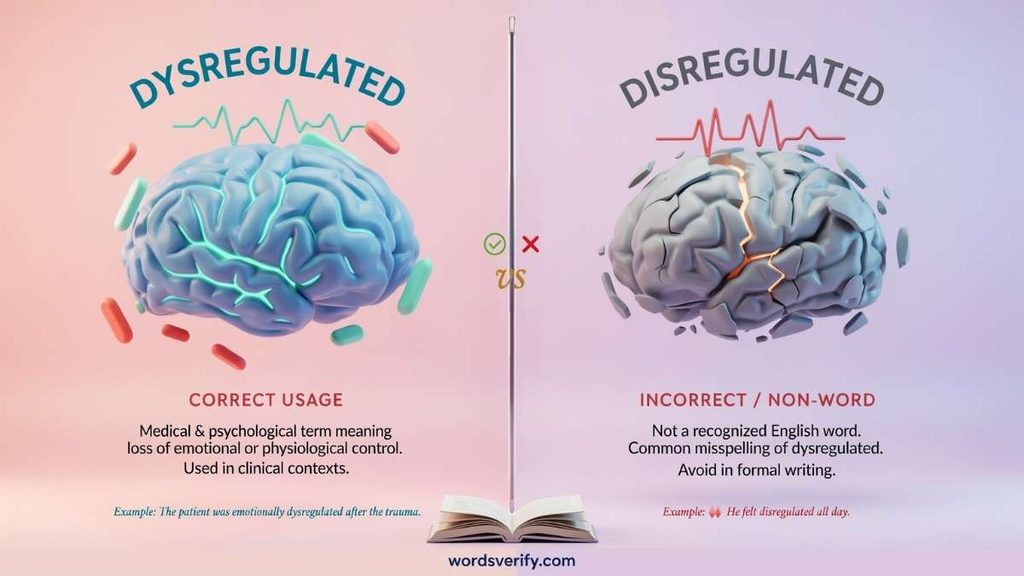
Disregulated is a spelling that people sometimes use when they mean dysregulated. The confusion often comes from familiar English words such as disorganized, disconnected, and disrupted.
Because the prefix dis- appears in many words that describe something going wrong, writers may assume it also belongs in disregulated. However, English spelling doesn’t allow prefixes to be swapped freely just because their meanings seem similar.
When describing impaired emotional, biological, or physiological regulation, use dysregulated.
Is Disregulated Ever Acceptable?
For the intended meaning of impaired regulation, dysregulated is the standard choice.
You should use it in:
- School assignments and essays.
- Academic papers and research reports.
- Workplace documents and professional emails.
- Health and psychology materials.
- Articles about emotions, behavior, or biological processes.
If you’re quoting a source that uses disregulated, you may preserve its original wording when necessary. Otherwise, correct the spelling during editing.
The important point is that seeing a spelling in published material doesn’t automatically make it an accepted standard form.
Fix common more word mistakes in English
Flys vs Flies which one is correct?
Why Do People Confuse Dysregulated vs Disregulated?
The confusion is understandable. Both spellings look alike, and their first syllables sound nearly identical in common American English pronunciation.
When people encounter an unfamiliar word, they often rely on spelling patterns they already know. Since dis- appears in many familiar words, it can seem like the obvious choice.
The difference becomes clearer when you understand how the prefixes work.
Understanding the Prefixes Dys- and Dis-
The prefix dys- often indicates difficulty, impairment, or abnormal functioning. You can see it in established words such as:
- Dysfunction, which refers to impaired or abnormal functioning.
- Dyslexia, which is a learning disorder that affects reading and related language skills.
- Dysregulation, which refers to impaired or abnormal regulation.
The prefix dis- can express separation, reversal, negation, or removal, depending on the word. Examples include disconnect, disagree, and disorganized.
Although the prefixes can appear in words with related meanings, they aren’t interchangeable. Established spelling conventions determine which form is correct.
A helpful way to remember the spelling is to connect dysregulated with dysregulation and dysfunction. All three words use dys-.
Why Pronunciation Doesn’t Settle the Question
In American English, dysregulated is pronounced approximately as dis-REG-yuh-lay-tid, with the main stress on REG.
Because the opening sound resembles dis, you can’t reliably determine the spelling by listening alone. The best approach is to remember the established word form and its related terms.
Fix common more word mistakes in English
Envision vs Invision which one is correct?
Dysregulated vs Deregulated vs Unregulated
unregulated ,Dysregulated and deregulated may look related, but they describe different situations. Choosing the wrong one can change the meaning of your sentence.
| Word | Meaning | Example |
|---|---|---|
| Dysregulated | Regulation is impaired or abnormal | Researchers studied dysregulated immune responses. |
| Unregulated | A particular system of rules or oversight is absent | The activity takes place in an unregulated market. |
| Deregulated | Existing rules or controls have been removed or relaxed | The government deregulated the industry. |
Dysregulated vs Unregulated
Dysregulated describes a process that isn’t regulating itself properly. Unregulated describes an activity or system that lacks a particular form of control or oversight.
For example, a person’s stress response may be dysregulated if it remains unusually intense after a stressful event. An industry may be unregulated if no relevant authority oversees a particular activity.
The distinction is simple: dysregulated concerns impaired regulation, while unregulated concerns the absence of a specified regulatory framework.
Dysregulated vs Deregulated
Deregulated generally describes something from which existing rules or controls have been removed or relaxed. The word often appears in discussions about government policy, economics, and industry.
Consider these examples:
- Dysregulated: Researchers examined abnormal hormone regulation.
- Deregulated: The government deregulated parts of the telecommunications industry.
The first sentence describes a biological process. The second describes a change in the rules governing an industry.
Remember the distinction: dysregulated means regulation isn’t working properly, unregulated means a particular system of controls is absent, and deregulated means existing controls have been removed or relaxed.
Fix common more word mistakes in English
Bespectacled vs Bespeckled What’s the Difference?
Dysregulated Example Sentences
Examples make the spelling easier to remember and show how the word works in different situations.
Everyday Conversation
In everyday English, dysregulated often appears in conversations about emotions, stress, and behavior.
- “I felt emotionally dysregulated after a difficult conversation.”
- “He needed a quiet break because he felt overwhelmed.”
- “The child became dysregulated when the routine changed unexpectedly.”
- “She struggled to settle down after receiving upsetting news.”
- “After several stressful days, he found it harder to manage his emotions.”
Not every sentence about emotional difficulty needs the word dysregulated. Sometimes a simpler phrase, such as feeling overwhelmed or having trouble calming down, communicates the meaning more clearly.
For example, instead of saying, “I’m dysregulated,” you could say, “I’m feeling overwhelmed and need a few minutes to calm down.” Both expressions may describe the same experience, but the second is easier for many readers to understand.
Academic and Professional Writing
In academic writing, dysregulated often describes a specific process or pattern that researchers have observed.
- “The researchers examined emotional dysregulation among adults with ADHD.”
- “The study investigated mechanisms involved in dysregulated immune responses.”
- “The findings suggest that impaired regulation may contribute to the observed changes.”
- “Researchers assessed whether the intervention affected participants’ emotional regulation.”
- “The paper discusses dysregulated signaling pathways in the context of disease.”
When using the word in research, be precise about what is being regulated and what evidence supports the claim. The term shouldn’t imply that every participant experiences the same symptoms or that every abnormal finding represents a clinical disorder.
Parenting and Child Development
Parents, teachers, and child development professionals sometimes use dysregulated to describe a child’s difficulty managing emotions or behavior in a particular situation.
- “The child became dysregulated when playtime ended.”
- “The teacher gave the student time to settle after a frustrating activity.”
- “The parent noticed that loud environments often preceded emotional overwhelm.”
- “The child needed adult support to recover after a disagreement with a friend.”
These examples describe situations rather than defining a child’s character. A child who struggles with transitions isn’t necessarily experiencing a persistent regulation problem. Fatigue, hunger, stress, sensory demands, and changes in routine can all affect behavior.
It’s more helpful to describe what happened, consider possible triggers, and identify the support the child needs than to treat dysregulated as a label that explains everything.
Fix common more word mistakes in English
Visible vs Visable Which one Is Correct?
What Does Dysregulated Mean in ADHD?
In discussions about attention-deficit/hyperactivity disorder (ADHD), dysregulated often appears alongside emotional dysregulation.
Some people with ADHD experience difficulties with frustration tolerance, irritability, emotional intensity, or shifting attention away from upsetting experiences. However, these experiences vary from person to person.
Emotional dysregulation is associated with ADHD, but it isn’t synonymous with the condition. A person can experience difficulty managing emotions without having ADHD, and an emotional reaction alone cannot establish a diagnosis.
An Example of Emotional Dysregulation in ADHD
Imagine an adult with ADHD who receives unexpected criticism during a meeting. The criticism triggers intense frustration. Even after the meeting ends, the person struggles to redirect their attention because the interaction continues to occupy their thoughts.
This example illustrates a possible difficulty with emotional regulation. It doesn’t prove that ADHD caused the response or establish a diagnosis.
Similar experiences can occur in people without ADHD and in people with other conditions. A qualified professional must consider the broader pattern of symptoms, their duration, and their impact on daily life before making a diagnosis.
When discussing ADHD, use dysregulated to describe a specific pattern or process rather than as a substitute for the diagnosis itself.
Fix common more word mistakes in English
Heros vs Heroes Which one Is Correct?
What Does It Mean When a Child Is Dysregulated?
When someone describes a child as dysregulated, they usually mean the child is struggling to manage emotions, behavior, or responses to a particular situation.
One child might become intensely upset when a preferred activity ends. Another might withdraw or struggle to communicate after an overwhelming day at school. These reactions can look different because children vary in temperament, developmental skills, and support needs.
How Adults Can Help a Dysregulated Child
Adults can support children by responding calmly and helping them understand what they’re experiencing.
- Provide predictability. Explain transitions before they happen and keep routines consistent when possible.
- Reduce unnecessary demands. A quieter space or a short break may help when a child feels overwhelmed.
- Name emotions without judgment. Saying “You seem frustrated” can help a child identify a feeling.
- Model self-regulation. Calm breathing, patient communication, and thoughtful responses demonstrate useful coping skills.
- Offer age-appropriate choices. Simple options can help a child regain a sense of control.
- Look for patterns. Notice whether particular situations, sensory demands, or unmet needs tend to precede difficult moments.
The goal isn’t to prevent every strong emotion. It’s to help children understand their feelings and develop healthier ways to respond.
If emotional or behavioral difficulties persist, cause significant distress, or interfere with everyday life, a qualified health or child development professional can help assess the situation.
Fix common more word mistakes in English
Minuscule vs Miniscule which one is correct?
Common Mistakes in dysregulated vs disregulated
Even after learning the correct spelling, writers can confuse related terms or use the word too broadly.
Writing Disregulated Instead of Dysregulated
Incorrect: “The article explores disregulated emotional responses.”
Correct: “The article explores dysregulated emotional responses.”
Remember the related noun dysregulation. Both words share the same prefix.
Confusing Dysregulated With Unregulated
A dysregulated process has impaired regulation. An unregulated activity lacks a particular system of rules or oversight.
An abnormal stress response may be dysregulated, while an activity without relevant regulatory oversight may be unregulated.
Confusing Dysregulated With Deregulated
Deregulated describes a change in rules or controls. It doesn’t ordinarily describe an impaired emotional or biological process.
Use dysregulated when regulation is impaired and deregulated when existing controls have been removed or relaxed.
Treating Emotional Dysregulation as a Diagnosis
Emotional dysregulation describes a difficulty or pattern. It doesn’t automatically identify a specific mental health condition.
Someone can experience emotional overwhelm without having a mental health disorder. A diagnosis depends on a broader assessment of symptoms, duration, context, and impact.
Assuming Every Strong Emotion Is Dysregulation
Anger, sadness, fear, and excitement are normal human emotions. A strong response doesn’t automatically mean someone is dysregulated.
The more useful questions are whether the person can manage the response in context, recover afterward, and continue with daily activities. Even then, one observation doesn’t establish a persistent problem.
Fix common more word mistakes in English
Indure vs Endure Which one Is Correct?
Practice Session Dysregulated vs Disregulated
Test your understanding of the difference between dysregulated vs disregulated, unregulated, and deregulated
Fill in the Blanks
Instructions: Choose the correct word to complete each sentence. Pay attention to the meaning and context of each sentence.
1. After a stressful day at school, the child became emotionally __________ and struggled to calm down.
2. The government decided to __________ the telecommunications industry by removing certain restrictions.
3. The company operates in an __________ market with very few government regulations.
4. People who experience emotional __________ may find it difficult to manage intense feelings.
5. The correct standard spelling for difficulty regulating emotions is __________.
6. The government introduced new regulations to control the previously __________ industry.
7. After the argument, he felt emotionally __________ and needed time to regain his composure.
8. The process of removing government restrictions from an industry is called __________.
9. The word __________ is generally considered nonstandard when used to describe difficulty with emotional regulation.
10. A lack of clear rules and oversight can leave a market largely __________.
11. The therapist helped the patient develop strategies to manage emotional __________.
12. Poor sleep can make it harder for some people to regulate their emotions, leaving them feeling __________.
13. The government voted to __________ the energy sector to encourage competition.
14. The child’s __________ behavior improved after the teacher provided a calm and supportive environment.
15. The term __________ describes a system or process that struggles to regulate itself properly.
16. An __________ industry may operate without sufficient rules or official supervision.
17. The company adapted to the changes after the industry was __________.
18. Emotional __________ can affect how a person responds to stress and frustration.
19. The editor corrected the spelling mistake and replaced “disregulated” with __________.
20. The government reduced restrictions on the industry through a process known as __________.
21. When a person struggles to manage intense emotional reactions, they may be described as emotionally __________.
22. The absence of effective rules can create problems in an __________ market.
Answers
- Dysregulated
- Deregulate
- Unregulated
- Dysregulation
- Dysregulated
- Unregulated
- Dysregulated
- Deregulation
- Disregulated
- Unregulated
- Dysregulation
- Dysregulated
- Deregulate
- Dysregulated
- Dysregulated
- Unregulated
- Deregulated
- Dysregulation
- Dysregulated
- Deregulation
- Dysregulated
- Unregulated
Here’s a trusted source for clear word meanings:
FAQs
Is it spelled dysregulated vs disregulated?
dysregulated vs disregulated ,Dysregulated is the standard spelling when describing difficulty regulating emotions, behavior, or bodily processes. Disregulated is generally considered a nonstandard spelling in this context.
Is it unregulated or disregulated?
Both words differ in meaning. Unregulated means lacking sufficient rules or controls, while disregulated is generally a nonstandard spelling of dysregulated.
Is it dysregulation vs disregulation?
dysregulated vs disregulated Dysregulation is the standard term for disrupted or impaired regulation. Disregulation is generally considered nonstandard when used with the same meaning.
Is ADHD a form of dysregulation?
No. ADHD is a neurodevelopmental disorder that can involve difficulties with attention, impulse control, and emotional regulation. Dysregulation may occur alongside ADHD, but it isn’t the same condition.
When did dysregulated become a word?
Dysregulated developed from the verb regulate and the prefix dys-, which indicates difficulty or impaired functioning. The term became more widely used in medical, psychological, and scientific writing as discussions of emotional and biological regulation expanded.
How do I spell disregulated?
The standard spelling is dysregulated when you mean difficulty regulating emotions, behavior, or bodily processes. Although people sometimes write disregulated, it’s generally considered nonstandard for this meaning.
Are dysregulated and unregulated the same thing?
No. Dysregulated describes something that struggles to regulate itself properly, while unregulated describes something that lacks adequate rules, controls, or oversight.
What does it mean to be disregulated?
People often use disregulated to describe feeling emotionally overwhelmed or unable to manage their reactions. However, dysregulated is the standard spelling for this meaning.
Is it disregulated or deregulated?
Deregulated is correct when referring to the removal or reduction of rules and restrictions. Dysregulated is the standard term for difficulty regulating emotions, behavior, or bodily functions.
Is it emotionally unregulated or dysregulated?
Emotionally dysregulated is generally the more precise term when someone struggles to manage emotional reactions. Emotionally unregulated may be understandable in everyday conversation, but dysregulated is more established in psychological contexts dysregulated vs disregulated.
Do kids grow out of dysregulation?
Some children develop stronger emotional regulation skills as they mature and receive appropriate support. However, persistent or severe difficulties may require additional help from caregivers, educators, or qualified health professionals.
What is a person who cannot control their emotions called?
A person who struggles to manage emotional reactions may be described as emotionally dysregulated or as experiencing emotional dysregulation. These terms describe a difficulty rather than define someone’s entire personality or establish a diagnosis.
What are the signs of dysregulation?
Common signs may include intense emotional reactions, difficulty calming down, irritability, impulsive behavior, feeling overwhelmed, and trouble recovering after stressful situations. These signs can have many causes and don’t automatically indicate a specific condition.
What is the 30% rule in ADHD?
The 30% rule is an informal idea suggesting that some people with ADHD may show certain emotional or self-regulation skills that lag behind their chronological age. It isn’t a scientifically established rule that applies to everyone with ADHD, and individual development varies considerably.
What are the seven triggers that make ADHD worse?
Factors that may intensify ADHD symptoms include insufficient sleep, chronic stress, distracting environments, inconsistent routines, overwhelming tasks, inadequate physical activity, and difficulty managing strong emotions. These factors affect people differently and don’t necessarily worsen symptoms in every person.
At what age is ADHD at its peak?
There isn’t one age when ADHD universally peaks. Symptoms and their impact can change throughout childhood, adolescence, and adulthood. Hyperactivity may become less noticeable for some people over time, while inattention and organizational difficulties can persist.
What makes people with ADHD happy?
People with ADHD may enjoy activities that match their interests, provide appropriate stimulation, encourage creativity, or offer a sense of achievement. Supportive relationships, meaningful goals, movement, and manageable routines may also improve well-being. Individual preferences vary.
What is a deep ADHD shutdown?
An ADHD shutdown is an informal term for a state in which someone feels overwhelmed and has difficulty thinking clearly, communicating, making decisions, or taking action. Stress, sensory overload, frustration, or exhaustion may contribute. It’s not a formal medical diagnosis, and similar experiences can occur for several reasons.
Fix common more word mistakes in English
Scary vs Scarry which one is correct?
Conclusion
The difference between dysregulated vs disregulated may come down to a few letters, but those letters matter. Dysregulated is the correct standard spelling when describing difficulty regulating emotions, behavior, or bodily processes. Disregulated is generally considered nonstandard in this context, so using it in formal writing can create unnecessary confusion. dysregulated vs disregulated Now that you understand the meaning, spelling, and practical uses of these terms, you can avoid common grammar mistakes and write with greater confidence. Remember, even the smallest spelling slip can distract readers from your message. Keep your wording accurate, your meaning clear, and your grammar in check. Your writing deserves better than a prefix mix-up!

Lisa AJS is an experienced blogger and language enthusiast at Words Verify, dedicated to making grammar simple, practical, and enjoyable. She writes engaging content on commonly confused words, grammar mistakes, word meanings, and everyday language challenges.